The End of April and National Poetry Month part 2: the game of boxes by Catherine Barnett

calendarAs I said in “The End of April…part 1,” the month got away from me. What I mean is that all the great ideas I had for celebrating National Poetry Month were just that…great ideas. Just so much smoke. And so to make up for it, I am trying to put up several posts about a variety of poetry collections that I read during the month of April.

Back in the fall, I went to a conference of poets and heard Catherine Barnett read. I also bought her book The Game of Boxes which had just won the 2012 James Laughlin Award of the Academy of American Poets. And like too many of the books that I buy, it joined the stacks of “to read” books that are now towering next to my bed and next to my desk. Then, as if to increase my guilt for not reading it yet, in April, the Academy sent me a copy in the mail. (Fortunately, I was later able to give that away as a birthday gift to another poet.)

Assailed with the guilt of owning two copies and not having cracked the spine yet, I dived in. And was I glad.

the-game-of-boxes Barnett’s collection is divided into three parts: “Endless Forms Most Beautiful,” “Of All Faces,” and “The Modern Period.” The poems in each section are informed by a mature wisdom and wonder and understanding and befuddlement while dealing with those very issues that simply befuddle a younger world. Lust, love, family loyalty, parents and parenting, self, partnership, Barnett touches upon all of these, assuring us that none of us ever really get a grip on everything swirling about us. The middle section, “Of All Faces” is subtitled “Sweet Double Talk-Talk” and delineates the love/lust/comfort/discomfort of a partnership worn smooth over time. This is my favorite part of the collection.

From the outset, there is an immediate comfort in their age and a delight in their familiarity:

It’s a different beauty,
Your torso is stained and creased,
you say your an old man–

the backs of your hands
might be an old man’s hands
but the tips of your fingers —

little shocks of pure mind,
and I like theme there,, yes, ageless
persuasion’s design and rush. (Sweet Double Talk-Talk, i)

There is a weariness in famliarity:

Sometimes he’s everything to me:
yesterday, tomorrow, regret and shame.

And sometimes he’s nothing to me,
an old cushion on an old couch:

a pin-cusion:
something I think I can replace. (Sweet Double Talk-Talk, xvii)

But overall, there is a comforting lust and an accepted love:

I’m afraid you’ll die,
and tonight’s your birthday, it’s no different,
in fact it’s worse,
come drink some wine–

Let’s sit at the bar.
It’s winter,
so I’m in your coat,
I’m in your promises,
your smooth worn promises
sliding in and out of my own
love of death so slick
with want–

Soon, you say, your breath still warm in my ear. (Sweet Double Talk-Talk, xviii)

I cannot say why, but I love this couple. I love their honesty, their quirks, their enduring lusts, their enduring second-guessing. And while this section could almost be considered a narrative, each section is similarly anchored by a wise understanding of time and love and others.
The End of April and National Poetry Month part 1: Shackamaxon

flying calendarI begin each April–designated in the U.S. as National Poetry Month–with all kinds of grand ideas.  I will organize students into a poetry festival, we will stage poetry slams, another teacher and I will do readings together, we will invite celebrated, fascinating (and inexpensive) guests to speak.  And then before I get any of it done, May comes around and I’ve done nothing.

This month the most I did was organize a festival for the following year and set out to go to Philadelphia Stories’ “Party Like a Poet” benefit. I made my way down to the location (a subway and a bus trip away), got there far too early, and talked myself out of it — I returned home before it started.  Not very poetic, I guess.

But what I did do–not very celebratory or communal–was read a lot of poetry.  And I mean a lot.

Some of the titles were by veteran poets such as Mark Doty and Edward Hirsch and others newer names such as David Livewell and Catherine Barnett.  They ran the entire gamut of poetic offerings–free verse and formal verse; confessional poetry and nature poetry; poems about love, loss, sex and death; poems about animals and insects, planets and hardwiring. They were collections that I bought, that were given to me as gifts, and one that was sent to me by the Academy of American Poets.  Mark Doty’s was a National Book Award Winner, Catherine Barnett’s was a James Laughlin Award winner, and David Livewell’s was T.S. Eliott Poetry Prize winner.

And they were each unique and very different from each other.

And so in celebration of April “the cruelest month,” each day I’ll give a quick run down of one of those titles that have come across my path in the past month or so.

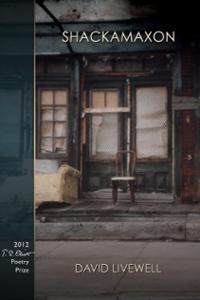
shackamaxon-david-livewell-paperback-cover-artShackamaxon by David Livewell was fun because he is a talented local poet and his work is situated in the places and neighborhoods I am very familiar with. (How fun is that when in a movie you recognize a street, a diner, a department store, a park?!) The title “Shackamaxon” was the Native American settlement where William Penn made his famous treaty with the Leni Lenape tribe and began establishing what is now the city of Philadelphia.

 Livewell’s work is gentle and honest and gritty and searing and, to a large degree, nostalgic, as he captures his blue-collar environs, the families, the struggles, the personal milestones and the larger changes over time.  Looking back at the hardscrabble neighborhoods where he was raised, he elevates his urban experience–both memorable and familiar–into art. My favorite is “Summer Elegy,” a nostalgic piece that reminds me of my own father and his generation–loyal to their perennially awful baseball team–and of the passions they passed on to their children.  Here is a short piece of it:

On the front step my Grandpop strained to hear
Harry and Whitey* call the Phillies game
from a crackling Philco hung on the wrought iron railing.
He’d grind his teeth and move a toothpick left and right
the way that on-dck players swung at air,
a rhthym to Harry’s baritone
and Whitey’s softer quips between the crowd
noises and vendor calls. He seemed to wait
on possibilities that hung like pop flies.
Gramps would tisk at strikeouts, whistle for homers,
and often blurt “About damn time!” or “Bum!”
And all around the neighborhood were men
from other families catching the baseball game…
(from “Summer Elegy”)

* beloved announcer (Harry) and color-man(Whitey) of the Philadelphia Phillies

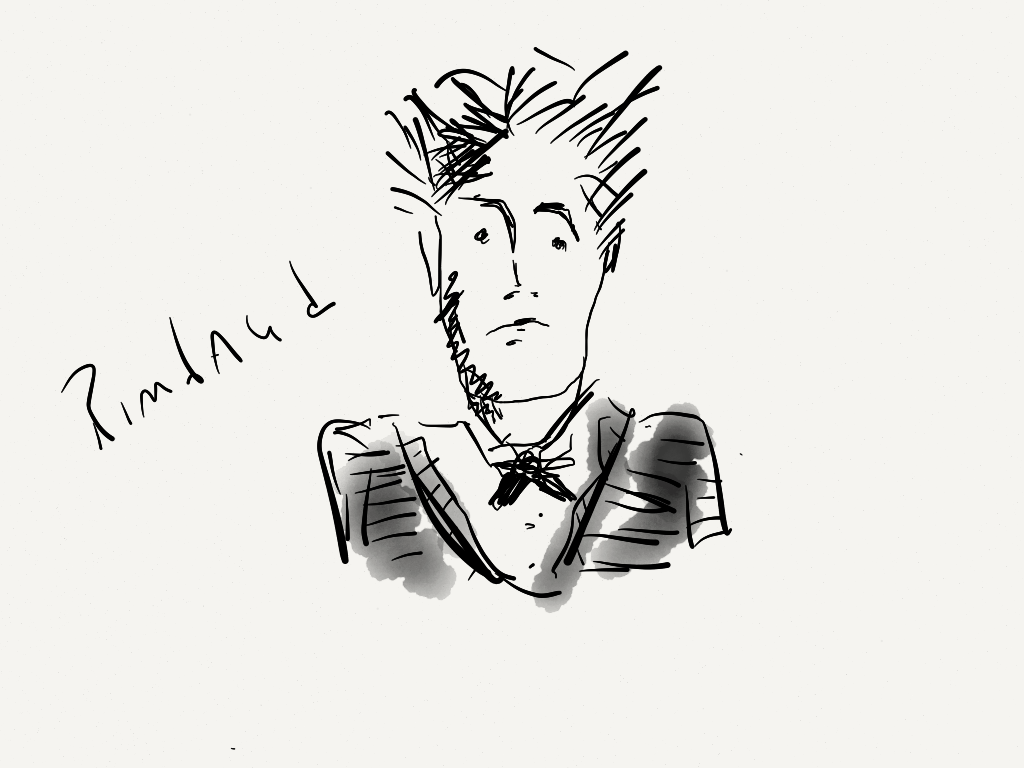
“I is someone else”: Rimbaud–l’enfant terrible

rimbaud drawing

Rimbaud
illustration by jpbohannon © 2013

A colleague came up to me with a problem–a problem with some unruly boys who had been displaying a growing disrespect towards her, coupled with a sophomoric sexism that went beyond their adolescent asininity and a smattering of racism. She then went on to say that to make matters worse, they were also very good writers. I wondered to myself if what she said was not necessarily atypical–that their innate creativity is being strangled by the dysfunctions of the modern educational system and that that is one cause of their intractability.

To make the point, I told her, I wouldn’t want to have taught Rimbaud.

Ah, Rimbaud, the boy-child terror who created haunting, mesmerizing verses until he was 21 and then quit to become a businessman, to dabble in gun-running in Africa, and to even try to join the U.S. Navy. But whatever he did from that point on, he had quit writing and refused to talk about it thereafter. Yet in those five or six years in late adolescence, he cut a swath of creativity and destruction, of love and violence, of intelligence and stupidity–and blazed into the pantheon of world poetry.

In actuality, however, Rimbaud was in fact a fine, model student. While he was in school, he usually walked away with the academic prizes given out at the end of a school year. He wrote poetry in in his native French, as well as in Latin and Greek, mature verse, some of which is still anthologized. Indeed, he was a stellar student. But then he quit school.

When he was still sixteen–and with the encouragement and support of the older Paul Verlaine whom he had enamored with some verses –Rimbaud first ran away to Paris. There he began a meteoric life of debauchery, anarchism, promiscuity, violence, substance abuse–and the most intense poetic creativity.

And like a meteor, Rimbaud burned out quickly. His intense and volatile love affair with Verlaine ended with Verlaine shooting him twice in the arm. Verlaine was arrested and served two years in prison.

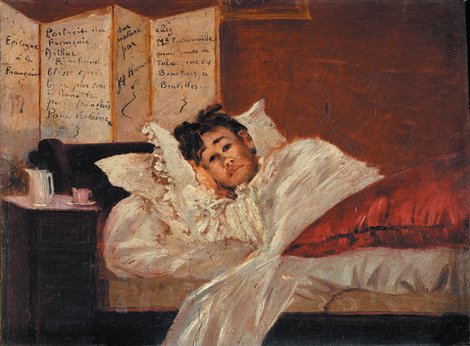
Wounded Rimbaud by Jef Rosman, 1873

Wounded Rimbaud by Jef Rosman, 1873

When Verlaine was released from prison, Rimbaud handed him a sheaf of loose papers which would become Illuminations, his last major work. Rimbaud was but 21 years old. He was already an old poet. Verlaine had published his FIRST book at 21. Rimbaud was finished by then. (A series of prose reflections, Illuminations is akin–in its intent–to the epiphanies that Joyce gathered –at the beginning of his career, however. )

Here are some 4 stanzas from Rimbaud’s 100 line poem The Drunken Boat (Le Bateau Ivre). He was sixteen when he wrote it!

But now I, a boat lost under the hair of coves,
Hurled by the hurricane into the birdless ether,
I, whose wreck, dead-drunk and sodden with water,
neither Monitor nor Hanse ships would have fished up;

Free, smoking, risen from violet fogs,
I who bored through the wall of the reddening sky
Which bears a sweetmeat good poets find delicious,
Lichens of sunlight [mixed] with azure snot,

Who ran, speckled with lunula of electricity,
A crazy plank, with black sea-horses for escort,
When Julys were crushing with cudgel blows
Skies of ultramarine into burning funnels;

I who trembled, to feel at fifty leagues’ distance
The groans of Behemoth’s rutting, and of the dense Maelstroms
Eternal spinner of blue immobilities
I long for Europe with it’s aged old parapets!
(From
Arthur Rimbaud, the Collected Works, translated by Oliver Bernard)

So the question remains “Would I want to have taught Rimbaud?” I am not sure. I am not sure of myself. Rimbaud–the excellent student, remember–was fortunate to have an exceptional school teacher and mentor, George Izambard, who fostered and encouraged the boy’s talent, gave him free access to his personal library and pushed him towards greatness. That is a big responsibility, to see and encourage greatness.

But in a large way, that is the true nature of teaching–whether it is a future Rimbaud or not. For how are we to know?

The Blackest of Comedys: Martin McDonagh’s The Lonesome West and Six Shooters

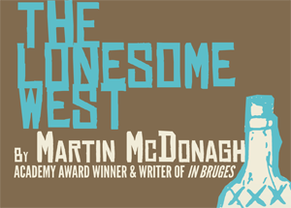
As many of you know, I am teaching a course in modern Irish literature this term to a group of 18-year old American boys.  As an American classroom, it is filled with various ethnicities and races.  And so, I can never assume that they know what I–or the authors they are reading–are talking about.  And so when we began Martin MacDonagh’s Lonesome West, I knew it was going to be a challenge to get them to enjoy it.poster

Because, when all is said and done, that’s really the purpose…to get them to enjoy what they are reading.  And surprisingly, that is a difficult thing for them to do.  Sure they loved saying the word “fek” when we read the play out loud–and which sometimes occurs twenty-five to thirty times on a page.  (One student told me he loved the word so much he started saying it around the house.  I advised him that maybe he should rein it in a bit.)

But surprisingly, they were too uptight to enjoy the humor…or even to get it!  There is a great line where Father Walsh Welsh — even that’s funny: I explained that this character has appeared in three separate plays now and that no one ever gets his name right, so they continually call him both. Stone faces in front of me. … anyway, there’s this great line where Father Walsh Welsh is anguishing about his failure as a priest.  Coleman tries to reassure him:

Ah there be a lot worse priests than you, Father, I’m sure. The only thing with you is you’re a bit weedy and you’re a terror for the drink and you have doubts about Catholicism. Apart from that you’re a fine priest. …

I had to explain that that was funny.  I had to explain that Girleen’s blatant attempts at seduction, her outrageous dirty-mindedness, and her falling in love were funny. (The pathos of her ending was a whole other story!) That Coleman’s constant ribbing of Fr. Walsh Welsh about the priest scandal in Ireland was funny. And that a small village where a father has been murdered by his son, a mother by her daughter, and a wife by her husband is a funny world indeed, especially when the smashing of holy figurines or stealing poteen is considered a more serious crime.

They were fine in talking about themes of redemption and reconciliation, in tracking down and explaining symbols, and analyzing character.  But they stumbled upon the humor.  And when all is said and done, that might be more important than all that the other stuff.

sixshooterAnd so I thought I would relieve their reading by showing them MacDonagh’s Oscar winning short film Six Shooter.  Unlike most of MacDonagh’s work which takes place in the west of Ireland, this takes place in  southeast Ireland, particularly on a train to Dublin.  A man is returning from hospital where his wife has just died that morning. He boards a train to go home and sits next to a young twenty-something who is a bit more than strange and possibly deranged.  The boy’s patter, aggressiveness and nonsequiturs are amusing, uncomfortable, and awkward.  But they are also, at times, bizarre and hilarious.  But maybe not to a group of high-school Americans.  Suffice it to say that by story’s end we have seen a cow explode, a rabbit get shot, a woman throw herself off a train, a character gunned down by police and a man fail at his attempt at suicide.  And that is  the violence that happens just on screen.  (I explained to them that MacDonagh was a combination of Quentin Tarentino, David Mamet, and John Millington Synge.)

Anyway, if a short movie that moves the cartoonish violence of Tarentino into the idyllic countryside of the Irish coast sounds appealing, then here it is below. It did win a 2006 Oscar in movie, though I don’t know if that held any sway with my boys.  Here it is:


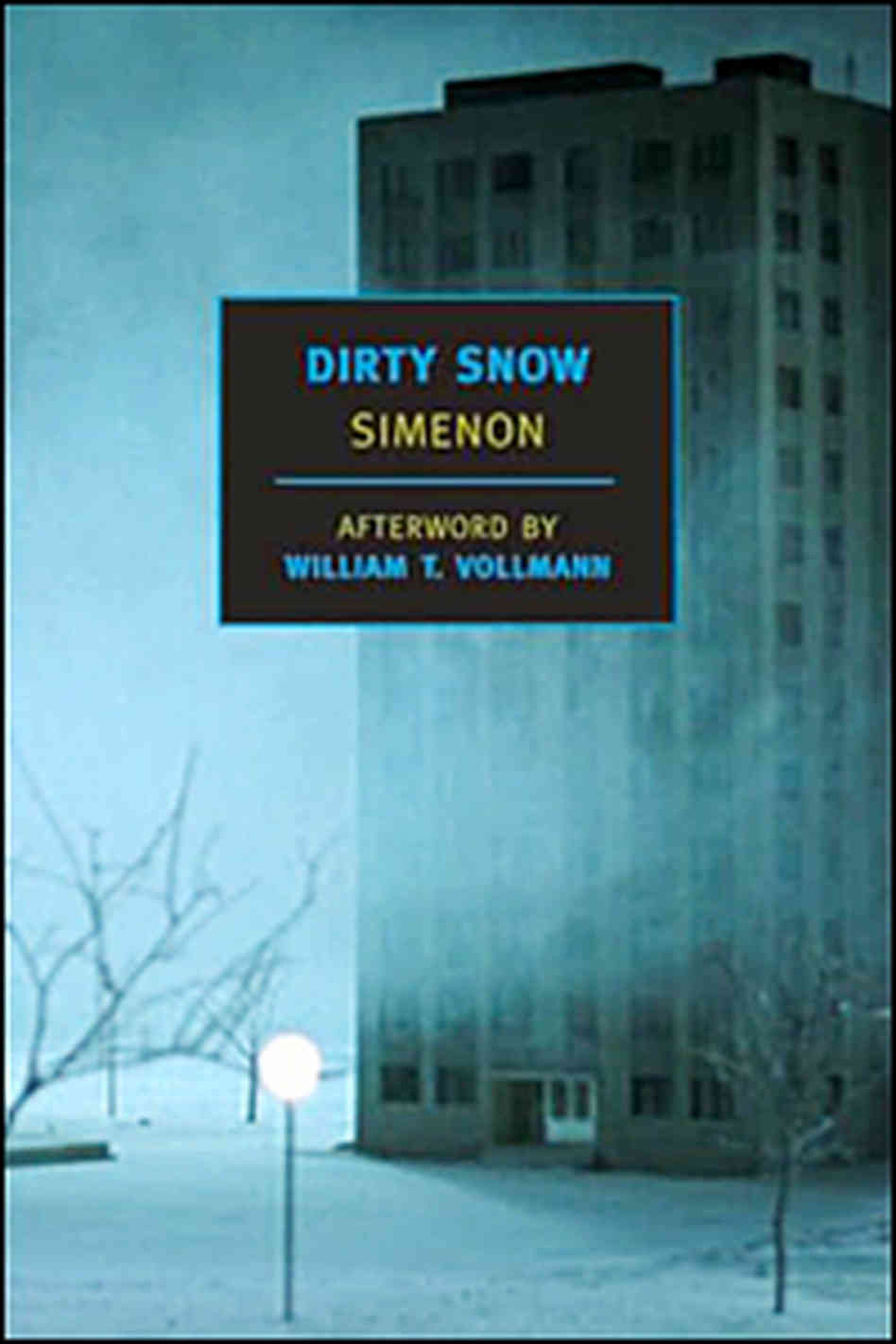
Book Review: Dirty Snow by George Simenon–Dostoyevsky with a touch of Kafka…only bleaker.

dirtysnow

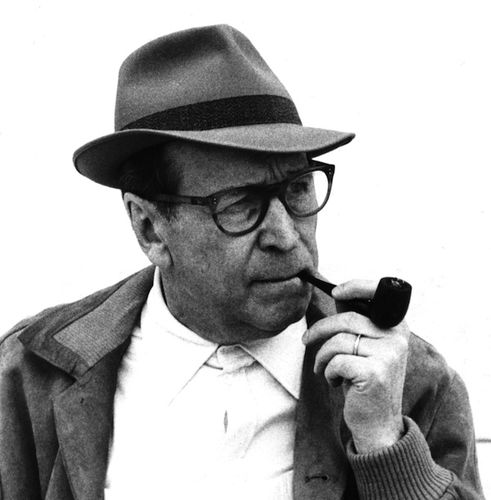
A colleague of mine passed on a book that he liked very much. Dirty Snow by the prolific Belgian writer, George Simenon. I had read several of Simenon’s detective novels, gritty tales that featured the Parisian detective Maigret. The Maigret novels–I believe there are over fifty of them—seemed superior to most in that genre, filled with a certain ennui and jaded acceptance that went beyond the cynical aloofness of his American counterparts or the aloof cynicism of his more modern offspring. And to be honest, they were good reads.

georgesimenon

George Simenon

Although I had read only the Maigret novels, I knew that Simenon wrote other sorts of novels. I had always heard them referred to as “philosophical” novels, though the French label them as “psychological” novels. And the French are closer to the truth, here.

And when my colleague passed on to me Dirty Snow, he did so with the caveat that it was “extremely grim” although oddly humanistic.

Dirty Snow is the story of Frank Friedmaier making his way through his occupied city.  We never know who the occupiers are and where the city is. When he is imprisoned, his captors, his location, and his crime are never identified. All of this, gives the novel a certain Kafkaesque feeling. And although time moves forward throughout the seasons, there seems always to be piles of soiled, stained, and dirtied snow.

And yet it was Crime and Punishment that I thought of immediately. Frank–who may be the most amoral, sociopath I have come across in my reading, and I know Burgess’s Alex and Ellis’s Bateman–begins the novel looking to kill his first person. There is no reason for, no gain from this murder–it is, as he says, like losing his virginity: “Losing his virginity, his actual virginity, hadn’t meant very much to Frank. He had been in the right place. … And for Frank, who was nineteen, to kill his first man was another loss of virginity hardly any more disturbing than the first. And like the first, it wasn’t premeditated.”  Like Raskolnikov in Crime and Punishment, he needs little push to kill his victim. Yet, there the similarity ends.  For Raskolnikov punishes himself, mentally, emotionally, spiritually and psychologically for the crime he committed.  Frank feels nothing. And soon he kills again…an old woman in his childhood village who recognized him in the course of a burglary.

But the murders are not his greatest crime. That is reserved for the sweet and loving Sissy who lives across the hall from the brothel that Frank’s mother runs and where Frank lives.  (Sissy mirrors very closely Raskolnikov’s Sophia in her love and faithfulness to Frank.)  Frank’s relations with women are brutal at best–indeed all the women in the novel seem mistreated one way or another.  He takes full advantage of his mother’s prostitutes, coldly, quickly and unemotionally, and this is the way he treats Sissy as well, deceiving her into a situation where she is nearly raped by his drinking associate.

One might say there is no reason for Frank’s viciousness, but that would be inaccurate. There is no “motive,” no “purpose” for his ferocity. But there is a reason, and Simenon attempts to suggest it subtly. Frank’s mother abandoned him to a wet-nurse so she could “ply her trade” and visited only occasional. He never knew his father, only the brutality of both life and the State.  Two men are offered as father surrogates in the novel: one, a Maigret-like inspector who turns a blind eye to Frank’s mother’s occupation and who very well may be his biological father and Sissy’s father, Holst, who Frank is drawn to from the beginning, who sees Frank in the alleyway on his first kill, and who offers him forgiveness at the end.

But many men have similar upbringings and few turn out as nihilistic, amoral, and unfeeling as Frank.  To his interrogator he says at the end: “I am not a fanatic, an agitator, or a patriot. I am a piece of shit.” There is nothing.  Yet the flip side of that is that there is nothing the State offers either.  They have not arrested him for the murders or the burglary. They have brought him in, they torture him merely for information.  And here, in the claustrophobic room where he is questioned, one remembers a similar room–Room 101 in Orwell’s 1984. But Frank is no Winston Smith either; there is no romantic dream of something better, no fervid belief in the ultimate progress of what is right.  There is only Frank, solipsistic and brutal Frank.

Simenon’s novel is fascinating. His hero is repellent. And I can’t stop thinking about neither it nor him… It’s sort of like wearing wet shoes, soaked through by dirty snow.

Book Review: Ask the Dust–Los Angeles, Obsession, and William Butler Yeats

Ask the dust

Ask the dust 3

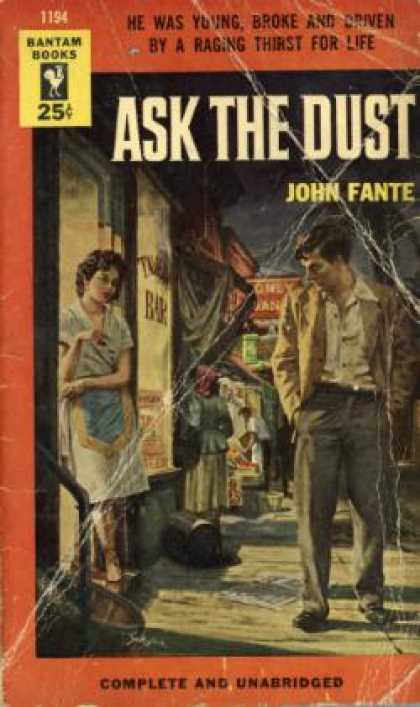
ask the dust 4One of those weird coincidences: I began reading John Fante’s 1938 novel Ask the Dust late this past Tuesday night. I didn’t get far–maybe three chapters–but the story of a young writer who had moved to L.A. from Colorado had grabbed me. Wednesday morning, I wake up early, check my messages and e-mails and a few blogs that I read. One of them–francescannotwrite–has a picture of the Disney Concert Hall at the top and a quote from Fante’s novel: “Los Angeles, come to me as I have come to you.” (Besides the weird coincidence of the novel, I also had, just a few weeks back, put the Disney Concert Hall on my computer as its wallpaper.) The blog-post offered some examples of the novel’s humor, its brief passages of romance, and its overall feeling of gloom. And then it segued into some extraordinary pictures of Vietnam.

Anyway, so I finish the novel and it was a good read, although one that left a few questions unanswered. Episodes where the act of writing were described were particularly memorable, for it is hard to put down on paper the art of ART. Most times, it comes off as stagy and overly dramatic. But the scenes where Fante gives us two or three paragraphs of Arturo Bandini in a “creative” groove are fun to read. For instance, here is Bandini–having sold two short stories for a handsome price–sitting down to begin his novel:

Out of my desperation, it came, an idea, my first sound idea, the first in my entire life, full-bodied and clean and strong, line after line, page after page. … I tried it and it moved easily. But it was not thinking, not cogitation. It simply moved of its own accord, spurted out like blood. This was it. I had it a last. Here I go, leave me be, oh boy do I love it. … big fat words, little fat words, big thin words, whee whee whee.

But primarily, Ask the Dust is about obsession. The hero, Arturo Bandini, self-conscious of his Italian heritage and full of fluctuating self hate, falls madly in love with Camilla Lopez, a Mexican waitress at a cheap coffee shop. The entire novel, his writing, his day to day living, his memories of home become wrapped around her–or around deliberately hating her. For the relationship is a strange sado/masochistic thing that yo-yos between love and hate, between tenderness and violence, but that never vascillates in its obsession. Camilla too has her obsessions and it is the thrust of the novel that they are not the same as Arturo’s.

I have always been attracted to obsession. I remember reading the novel Damage by Josephine Hart in one sitting and being floored by the destructive obsession of its characters. (I can still remember cancelling a lunch appointment because of my emotional exhaustion. The film version, by the way, tries, but does not do it justice.)

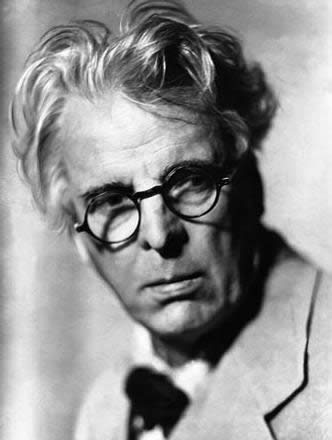
But mainly I think of obsession as a good thing…as a passion that forms and defines you. And in this I turn to Yeats. My favorite Yeats’ poem is “The Song of Wandering Aengus.” The poem tells of discovering a great passion…and of following it throughout one’s life. There is a sadness in it, but one tinged with hope, colored with the concept that chasing the obsession is more important than actually attaining it.yeats3

The Song of Wandering Aengus

by W. B. Yeats

WENT out to the hazel wood,

Because a fire was in my head,
And cut and peeled a hazel wand,
And hooked a berry to a thread;
And when white moths were on the wing,
And moth-like stars were flickering out,
I dropped the berry in a stream
And caught a little silver trout.
When I had laid it on the floor
I went to blow the fire a-flame,
But something rustled on the floor,
And some one called me by my name:
It had become a glimmering girl
With apple blossom in her hair
Who called me by my name and ran
And faded through the brightening air.
Though I am old with wandering
Through hollow lands and hilly lands,
I will find out where she has gone,
And kiss her lips and take her hands;
And walk among long dappled grass,
And pluck till time and times are done
The silver apples of the moon,
The golden apples of the sun.

And this is how, John Fante’s novel Ask the Dust leaves us. His Mexican girl has “faded through the brightening air” and, while he chases her through the foreboding desert, he is left to use her image, her memories, and his pain to create his next novel, to fashion his next work of art.

And so for something different on this snowy March day, here is a clip of the singer Christy Moore doing his version of Yeats’ poem. It never fails to bring a tear to my eye:

A Portrait of the Artist with One Left Foot

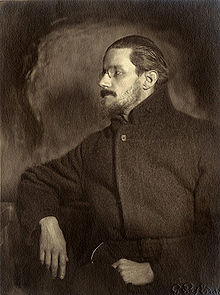
Joyce  ©2013 by J.P. Bohannon

Joyce
illustration by jpbohannon © 2013

I’ve had the nice experience of putting two seemingly different works together and seeing startling comparisons that I hadn’t thought of before. In the class I am teaching on Irish Literature, we had begun the semester with Joyce’s A Portrait of the Artist as a Young Man. From there we moved through some Frank O’Connor stories, some Yeats poems, and three plays by John Millington Synge. And then as a breather, I showed the film My Left Foot, based on the autobiography of the Dublin poet, painter and writer, Christy Brown.

The Artist Joyce as a Young Man

The Artist Joyce as a Young Man

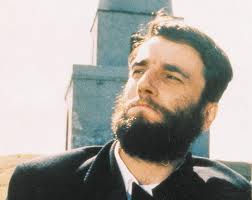
Daniel Day-Lewis as Christy Brown in My Left Foot

Daniel Day-Lewis as Christy Brown in My Left Foot

I have a fond relationship with My Left Foot which began long before the film was released. A friend of mine was living in San Francisco, working as a nurse. She would search the used book shops looking for the odd nugget, and she was always very kind to me. Every so often there would be a T-shirt from some cleverly-named dive bar, an esoteric album that no one knew about it, or a used book she found in her travels. One day, in the mail came a package containing My Left Foot by Christy Brown. I didn’t know the book at the time though it was twenty years old by then, but the worn and ragged dust jacket and the beaming face of Christy Brown on the back announced the joy, the vibrancy, the humor, and the pathos of the story inside.

I remember reading it twice in a short space of time, of lending it to a friend, and then lending it to another, and soon I lost track of it. And, to be truthful, I forgot about it. Until the movie was released and Daniel Day-Lewis’s performance announced to the world that this was someone to watch.

Viewing it this past week, so close to having finished Joyce’s Portrait, however, impressed on me how similar the story of these two Irish artists are. Joyce’s hero–Stephen Dedalus–is a sensitive, young child, bullied a bit at school, helpless without his glasses.

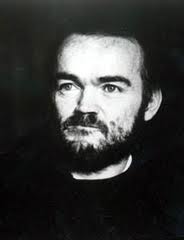
Christy Brown

Christy Brown

That Christy is also helpless, everyone assumes. Born with cerebral palsy and able to move only his left leg, he spends his early years lying under the stairs watching his family interact with each other—for better or worse. Joyce’s novel also begins with the early interactions of the family. From the hairy face of his father and the nicer smell of his mother when he was an infant to the fierce political/religious argument at Christmas Dinner, the Daedalus family is indeed similar to the Brown family. Particularly in the characterization of the fathers and mothers.

Simon Dedalus and Paddy Brown are hard men, perhaps a bit too fond of the drink. And both young boys, Christy and Stephen, see it as their responsibility to save their families from the fathers’ excesses. The mothers are doting: Christy’s mother innately sure that her son was more than just the vegetable that everyone believed him to be and Dedalus’ mother praying for her son’s soul and protecting him from his father’s increasing wrath.

And it wouldn’t be an Irish tale, if religion didn’t play a part. Father Arnall’s sermon on hell affects Stephen to such a large degree that he believes he might have a priestly vocation. And Christy is taught religion by a priest who comes to the house and who is also fond of describing the fires of hell–and causing young Christy no end of terrors.

Relations with the opposite sex are a stumbling block in both works as well. Sensitive Stephen vacillates from madonna to whore to madonna throughout, while Christy–caged within his crippled body–falls in love easily and is rebuked as often.

But the importance of both works is the creation of the Artist. Joyce’s Dedalus ultimately abandons church, nation and family in order to strike out on his own and “forge …the consciousness of [his] race,” while Christy embraces that world–dear dirty old Dublin and his sprawling family–to find the inspiration of his art. The artistic output–however disparate–is not the point here. The point is the development of an artist within similar constraints and backgrounds, a tale of two young men who travel the same narrative arc in order to discover the art that is within them.

♦ ♦ ♦ ♦ ♦ ♦ ♦ ♦

To one and all, Happy St. Patrick’s Day.

Book Review: Sweet Tooth by Ian McEwan

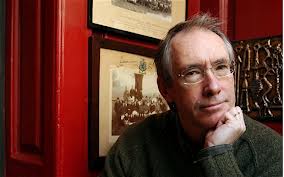
Ian McEwan

A lot of people I know do not like McEwan’s books.  However, I do very much. I find that his novels are both literary and very good reads.

McEwan’s novels are always well plotted, full of wonderful local color and specialized information that I did not know, and often times appeal to a particularly personal aspect of my life.  I remember very well and with great fondness the exact day that the novel Saturday takes place. (In fact I have written a piece about that particular day as well and am now shopping it around to place somewhere.) The novella On Chesil Beach is in many ways a modernization of the poem “Dover Beach” –a poem which also plays a crucial part in the ending of Saturday–and one on which I had based a short story a long while ago.  And despite the time period, Atonement is thoroughly post-modern in its attitude towards time and the historicity of events.

U.K. Cover of McEwan’s Sweet Tooth

McEwan’s new novel Sweet Tooth also plays with post-modernism in its narration. Indeed, the main character Serena Frome–a woman noted for her prolific reading habits–complains about the very type of novel that Sweet Tooth ends up being.

The time is the early 1970s, and Serena Frome is an intelligent young woman who goes off to Cambridge to study maths. It is right before the burgeoning of the women’s rights movement, and in fact, Serena is the only Cambridge female studying mathematics at the time. Yet she does not see herself as a trailblazing feminist, and in fact often  distances herself from many aspects of the movement’s agenda.

Yet feminism is not the crux on which this novel hangs. The Cold War is in full swing, and Frome has been recruited by an elderly Cambridge teacher who is also her lover for a position at MI5. Her task is to help wage battle on the cultural lines between the West and the Soviet Union. The government is worried that it is losing the cultural battle as more and more intellectuals, artists, and writers lean further and further left.  What it proposes is a plan to set up a false foundation that subsidizes writers with the idea that the intellectual community will see the country as supporting the arts and  with the added  hope that the writers’ work will fall more in line with its philosophies.

The mission is dubbed “Sweet Tooth” and Frome is given the job to bring in such a writer. She is to introduce herself as part of a panel that has recommended a young, upcoming writer and to offer him a stipend of two years salary to complete a novel.

Unfortunately, she also falls in love with the man.

Illustration: Satoshi Kambayashi/The Guardian
Taken from Guardian’s excerpt from Sweet Tooth

Like many Cold War tales, particularly when dealing with MI5, there are betrayals and mistrust.  There are thwarted love affairs, rogue agents, and a general sense of looking over one’s shoulder.  And in many ways, Serena is out of her depth.

The story is couched in the gestalt of the 70’s.  The IRA campaign in Northern Ireland is emigrating to England, the hippie movement is petering out while the establishment is growing its sideburns, and opposition to the war in Viet Nam is growing exponentially.  And all of these elements play a small role in Serena’s world.  Even McEwan’s buddy, Martin Amis, shows up to receive an award, along with Serena’s protege.

I was innundated with work (one reason I haven’t posted in three weeks), but had ordered Sweet Tooth from the U.K.  (It doesn’t come out in the U.S. until mid-November). And despite being behind in everything else, I picked up the novel and read it in two days. It is fast moving, intricately plotted, and enjoyable. I was told that the beginning was a little slugish and that one had to be patient before things got good, but I did not find this to be the case at all.

And I loved the ending, which put everything in perspective.

My only complaint is the cover of this edition–it is a bit cheesy and, with the title “Sweet Tooth,”  it  looks like the cover to some sort of  girls’  young-adult series, or worse some tarted up middle-class porn.  Don’t know what the people at Cape were thinking, but I think they blundered on this one.

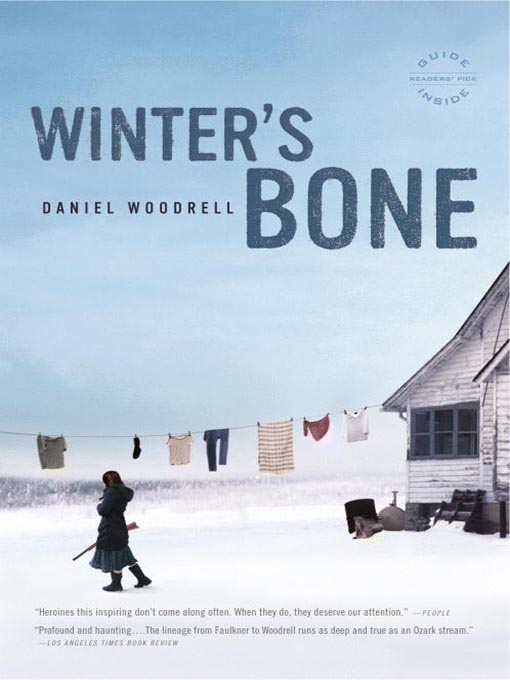
Book Review: Winter’s Bone by Darrell Woodrell–can you find a better heroine in all of literature?

I have a tendency to exaggerate, to think that whatever I have read, heard or seen lately and liked  is the BEST!  I am much more nuanced about things I dislike and usually soften the blows rather than exaggerate them.

But with Daniel Woodrell’s novel Winter’s Bone, I feel confident in stating what a truly fine book it is.

In fact, since I have read it, I have tried to think of a heroine in an American novel who matches Ree Dolly for grit, perseverance, wisdom and sheer moxie. These are the suggestions I have gotten so far:

1. Scarlett O’Hara in Margaret Mitchell’s Gone with the Wind (too spoiled, mercurial and self-centered)
2. Scout Finch in Harper Lee’s To Kill a Mockingbird (not really her story but her father’s–who, by the way, may be the best father in literature.)
3. Hester Prynne in Nathaniel Hawthorne The Scarlet Letter (interesting suggestion, but her props come from accepting her punishment and not revealing who the father of her child was, while letting the simpy Rev. Dimmesdale preach his sermons and fill himself with self-loathing. I don’t see her as a particularly active heroine.)
4. Katniss in Susan Collins The Hunger Games (must say, I don’t know enough about her, except that Jennifer Lawrence played both Katnis in the Hunger Games AND Ree Dolly in Winter’s Bone.)
5. Mattie Ross in Charles Portis’ True Grit (Mattie is a good second to Ree Dolly. Her challenges just don’t seem as daunting as Ree’s.)

Please feel free to add your own selections.

But my point is, I can’t remember any heroine–or any protagonist for that matter–who is so admirable in her refusal to not back down, in her persistence in doing what she must, and in her bravery in standing up to the very nasty forces that surround her.

In case you don’t know, Winter’s Bone is the story of Ree Dolly, a seventeen-year old girl who is raising her two younger siblings and caring for her catatonic, demented mother. Her meth-cooking father has just skipped bail and he had put up their hovel of a home as bond.  If he doesn’t show up for court, Ree and her family are out on the streets–or more realistically out in the fields of this very hardscrabble Missouri Ozarks setting.

Suffice it to say that her father is dead. And people aren’t real happy about Ree poking into their business. This is a community whose main economy and main diversion is crystal meth-amphetamine, and there are a whole lot of very, very nasty people.  No one talks. Talking creates witnesses.

In the course of her journey, Ree gets a truly horrible beating, she allies herself with her rough Uncle Teardrop (named such because of the three tears self-tattooed on his face), and finally proves her father’s death by sawing off his two hands (with a chain-saw from where he is sunken in a murky lake) and bringing the “identification” back to the authorities.

If it sounds gruesome. It is. But it is also one of those books that hooks you immediately and which you wish would go on forever. And it is all because of the character of Ree.  It is Ree that rises above all the violence, the poverty, the bleakness. But while Ree completes her quest at the end, while a few things begin to go right for her and her family, one is left feeling that in another five or ten years Ree will have turned into one of the many harridans that populate this mountain.  I hope not.

♦     ♦     ♦     ♦     ♦

I read the novel for a film class I am teaching.  And so, I also had to show the film. As in all translations, there are various changes–her two brothers for some reason become a brother and a sister–and particular scenes are deleted.  Yet the film very much captures the spirit and the landscape of the novel.

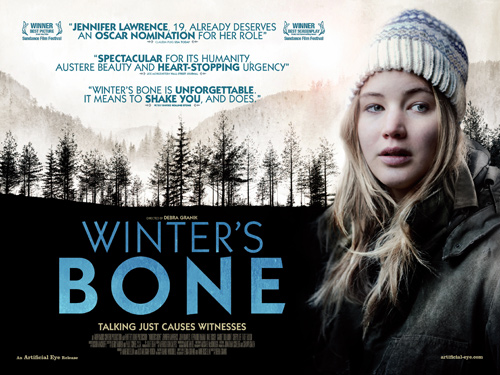
Jennifer Lawrence is, at times, magnificent. There are moments when the camera captures the soft plumpness of her face adding even a greater vulnerability to this girl/woman who has to face such ordeals.  At other times, that softness works against her, straining our credibility that she is who she is supposed to be.

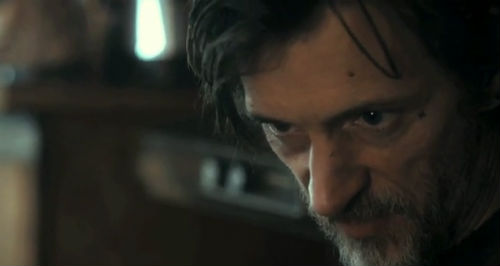
Not so with John Hawkes.  Hawkes, who was the soft-spoken hardware salesman in Deadwood–a similar world of extreme dirtiness and corruption, plays Teardrop perfectly. Hard as Ozark flint, creased and shaky, Hawkes captures the violence, the drug addled paranoia and stupor, and the family loyalty of these inbred mountain folk with studied truthfulness and credibility.  While Winter’s Bone is Lawrence’s movie, you don’t forget Hawkes for too long.

Jennifer Lawrence as Ree Dolly in Winter’s Bone.

John Hawkes as Teardrop in Winter’s Bone

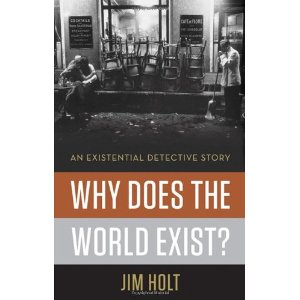
Nothing, nothingness, and the world: a book review of Why Does the World Exist? by Jim Holt

I am reading about nothing.  Literally, about nothing.  I am reading about the concept of nothingness, and it’s a pretty difficult thing to get one’s head around.

Philosophers, theologians, mathematicians, and physicists have been puzzling the concept for a very long time, and it is quite a hot button in philosophical and scientific circles today.

In the West the concept of nothing is relatively new. 

In fact, it wasn’t until the mid-14th century that the idea of “zero” came to the West. And then, it came to us through accounting.  Something had to stand between asset and debit.

The East, however, had long dealt with nothingness not only in their mathematics but in their spirituality as well. For after all, attaining “nirvana” was equal to attaining nothingness, to achieving “emptiness.”

The Hindu word for this nothingness was sunya, which became in Arabic sefir, which came to Europe in the Middle Ages and is the root of our word “zero” and “cipher.”  And when it came to Europe, it came along with the rest of the Arabic numerals that we use today.

And yet what is nothing? There are many who say that no such thing exists.

The philosopher Henri Bergson tried to imagine nothingness. He simply kept subtracting all that he knew existed. However, when he reached the end he felt there was still something–his inner self which was doing all this subtracting. (An enlightened Buddhist would perhaps be able to extinguish that entity, but most of us cannot.) He concluded that imagining absolute nothingness is impossible.

Another philospher, Bede Rendell, saw that the failure in imagining nothingness is that after one had subtracted everything that was in the universe, one still had the space where those things once existed–a universe skin collapsed on itself.

The entire conversation is both intriguing and maddening, puzzling and wondrous.  (Sort of like in Alice in Wonderland when the Red King concludes that since nobody passed the messenger on the road, then nobody should have arrived first.)

I am having this “conversation” with myself because of the book Why Does the World Exist?–An Existential Deterctive Story by Jim Holt.  Holt’s book, which is somewhat addressed to the lay reader (I can only imagine what a technical book on this subject might be like), springs from the question “Why is there Something rather than Nothing?” 

This question, I have learned, is one that has puzzled philosophers for aeons.

And when you get to the question of “something” and “nothing” you are led to the question of what “existed” in the universe before the “Big Bang” created the universe. The theologians have their answer. The scientists are not all that sure.  But they have their theories.

And both try to define or dismiss “nothing.”

All of which makes for fascinating reading.  Even the mathematical equations (which Holt has to explain to me or which I run to my resident philosopher/mathematician) are fascinating. For instance, his mathematical equation for absolute nothingness is

(X) ˜ (x=x)

and now seems to makes some sense to me. But it took a while for me to get to. (The equation means that X [the empty universe] is not where x = x [where something is something.]) He explains it much better and is  much more entertaining.

I am no philosopher or mathematician. My sense of the void, of nothingness–aside from my own existential angst and probings seeemingly hardwired in my soul–comes from Satre, Camus and Beckett.  And Holt brings these into the mix as well. (The cover of the book features a photograph of the Café de Flore, a favorite haunt of Sartre’s.) The book, in many ways,  is almost a primer of thinkers, ancient and new, and a wonderful introduction to the confluence of metaphysics, philosophy, literature and science.

And what  they ask is:  Why is there something rather than nothing?  Why is there a world?  A universe?

These are pretty big questions to roll around with and Holt’s book makes it a entertaining and informative  ride.

But to be truthful, I still don’t know the answer.