Book Review: Deadman’s Pedal by Alan Warner…coming of age in Scotland

Chisolm Tartan 2013 jpbohannon

Chisolm Tartan
illustration © 2013 jpbohannon

Alan Warner belongs to a certain group of writers who came of age in Scotland in the last decades of the 20th century. Those with more recognizable names would included Irvin Welsh who gave us Trainspotting, James Kelman with his unique voice of urban rootlessness, Ian Banks (who died last week) and A.L. Kennedy with their distinctive fictions, and Ian Rankin who gave us Inspector Rebus and his Edinburgh detective novels. Among these, Alan Warner seems the one who has gained less recognition over here in the States. And that is a shame.

Warner’s first novel Morvern Caller was a magnificent tale of a young woman who steals her dead boyfriend’s novel from his computer, changes the name on the manuscript and quickly and decadently burns through the advance that the novel garners, moving from her dilapidated Scottish town through the ravages of the European rave scene. A later novel with the unfortunate title The Sopranos follows a group of high school choir girls from a rural western outpost on its class trip to Edinburgh. Both novels are memorable for their voice, for the seeming accuracy of Warner’s portrayals of 16 and 17-year olds. And both are fun.

Warner returns to the same locale from which Morvern Caller and the girls from The Sopranos escape in his newest novel, The Deadman’s Pedal. And again, he is dealing with characters of a certain age, characters who are between childhood and adulthood, characters who are innocents even as they are losing their innocence.deadman-s
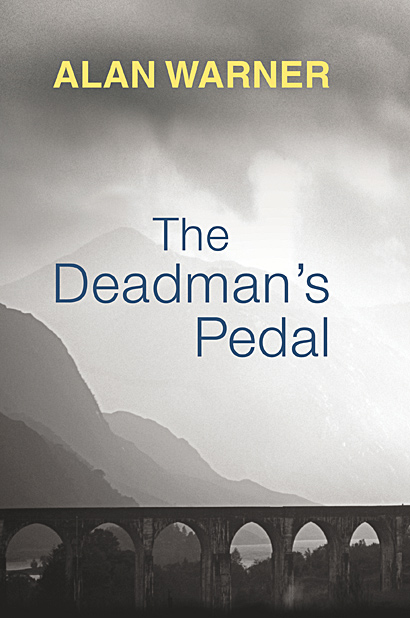
The novel takes place around “the Port,” Warner’s fictionalized treatment of the town of Oban in western Scotland and is held together by the train line that serves the area and which is dwindling in impact. In fact the title “Deadman’s Pedal” refers to a device that on a runaway train is set to brake in the case of an engineer losing consciousness.

Simon Crimmons is turning sixteen and wants to quit school, get a motorbike, and get a job. He is considered well-to-do by his companions because his father owns a trucking company, but wealth is a relative thing, and the Crimmons family is certainly working class in comparison to the lordly Bultitude’s. In fact, Simon, the town and the novel itself are greatly aware of class distinctions. And this is a running theme throughout.

Yet it is in terms of young Simon’s desires that the class distinctions are most evident. For he is torn between the beautiful and always available Nikki Caine from the Estate houses and the enigmatic Varie Bultitude–of the town’s legendary, aristocracy. Managing such affairs is always risky and managing one between such two disparate worlds is like being on a run-away train.

When Simon mistakenly gets a job as a trainee train driver–he thought he was applying for a hospital position–he discovers the extent of these class divisions. He says to Vaire, “I’ve got the whole railway telling me I’m not working class enough and I’ve got you telling me I’m not middle class enough. This country needs to sort out the class question. As far as it applies to me.”

And to make matters more difficult, Simon’s father is caught up in it as well. He sees his son’s work on the trains as a betrayal, as his son’s working for a competitor that could ultimately put him out of business. It’s never easy being sixteen. It seems much harder for Simon Crimmons.

The joy of the novel–apart from the very real depictions of young desire, lust, and confusion–is the language itself. Some may find the dialect off-putting at first, but it quickly becomes second nature, but the narration itself is pure genius: A funeral for a dead train man is told with humor, nostalgia and poignancy; Simon’s first kiss is described as sweet, anxious, innocent and thrilling; the grounds of the Bultitude property are given an almost gothic eeriness and grandeur. (The Bultitudes are said to bury their dead in glass coffins…the aristocracy is always with us!)

Early in the novel, Simon and his friend Galbraith show Nikki the secret hideout they have built out in the wilds. They make her promise not to mention it to the other boys knowing that it is a childish thing and that the others would tease them for it. It is here that Simon and Nikki first have sex– in a short scene that is both innocent and knowing. It is a scene–positioned in his boyhood escape– that captures the very tension of this novel, the tension between innocence and adulthood, between desire and attainment, between the people and their landscape.

Alan Warner Photo: Jayne Wright

Alan Warner
Photo: Jayne Wright

Alan Warner is an extraordinary writer. That his name is little known outside Britain is an injustice, but one that may be set aright by Deadman’s Pedal–a novel that is larger than its Scottish setting, a novel that is universal in its wonders, its desires, and its struggles.


“Likes…and Dislikes”: something to think about

I’ve been reading a lot of Susan Sontag lately: her journals, her book Illness as Metaphor, and a slew of blog posts. One of these excerpted a journal entry in which Sontag not only analyzed why we humans like lists but that produced a list of her own likes and dislikes. Essentially, she was standing up for or against particular aspects of modern life. Most of us “jot down” lists, but this is probably the wrong phrase for this activity, because thinking about what one actually likes and dislikes is a more difficult thing to do than I first imagined, more involved than mere jotting. I know, because I tried.

2013 jpbohannon

© 2013 jpbohannon

At first I worried that making such a list bordered on the narcissistic. Who really cares what a person likes or dislikes? Do we make conscious decisions with any of this knowledge about other people? I doubt it, particularly in our day to day interactions.

But making such a list could be enlightening, for oneself. No one else needs to know. Sit down and think about the world and what you actually enjoy and what you find annoying, painful, sad.

However, if created lightly, without much thought, this list ends up sounding like the profile of some air-headed celebrity: “I like moonlit walks on the beach…, etc.” A far cry from the list Sontag created.

And to put any such a list out there is a bit risky…and again a bit self-involved.

I spent a good bit of time thinking about what I like–which writers and musicians, what art forms and what cities, what quirks of my own and what indulgences, what parts of everyday life and what special dreams. It was harder thinking of those things I didn’t like–the things I find annoying seemed petty when put on paper, seemed like too much kvetching, and was beginning to be forced.

So I put my list together and I worked hard at it and I decided it didn’t need posting, after all. It was good enough for me: “the examined life and all that.” Hah!

A good story … and a story of goodness

Adams Daramy

Adams Daramy
photo © 2013 Malvern Preparatory School

Last summer, an African student at my school asked me to help him with his college application essay.  I was surprised–I had never taught him, had never actually met him before, although I knew who he was.  He was very polite, wide-smiling, and serious about his studies.  When I read his essay, I knew why.

Adams Daramy was born in Sierra Leone during the height of its civil war, the brutal Blood Diamond wars.  By the age of six, he had witnessed mutilation and rape, had seen dead bodies in the street and children trained to kill, and had eluded mass killings and general thuggery. He had seen vultures pick at not-yet-dead bodies and had barely escaped being forced himself into the military.  He told me of the favorite intimidation tactic of the rebels–chopping the limbs off civilians–and how once he was forced to stand in one of two lines and how his line was spared, but the other were not.  And all this by the time he was six years old.

His mother, wisely, got him out of there.

Because of the wars, Sierre Leone had no infrastructure to process Adams’ coming to the United States, so Adams had to live for a year in the Ivory Coast.  He worked that year as a tailor’s apprentice, sending money back to his mother and learning still yet another language–the French spoken in the Ivory Coast. In his college essay, he described how wonderful it was having a morning coffee at a shop down the street before he went off to work.  He was now seven, the age when most of the children we know are taking their first steps off to school.

And yet, in his essay, he did not dwell entirely on the bad. He recalled how kite flying was a favorite activity in the coastal town of Abidjan and because of his tailoring skills, how he was able to make some wonderful and beautiful kites.  He was proud of them and smiled brightly when telling me. But mostly, he wrote about his mother. He wrote about her love, her sacrifices and her courage.

This was all in 2001.

Fast forward now to 2013.  Adams had made it to the United States and lived with an uncle who had also escaped the horror that was Sierre Leone.  He enrolled in a good prep school where he succeeded in academics, athletics, activities and service. For his senior year, his classmates elected him president of the Student Council.  And all this success–the academic challenges, the championships on the track and field,  the rewarding service, the broadening activities and the solidarity with his classmates–all this came about while he was working long hours as an aide in a retirement home, sending the money home to the mother he had not seen in 12 years.

Yesterday, Adams Daramy graduated from high-school.  For the past three months, his classmates have been working very hard fund-raising and pestering a sometimes intractable bureaucracy to enable Adams’ mother to travel to the United States and be present at her son’s graduation.  On June 3, his mother was denied a visa.  The offices of Representative Pat Meehan worked overtime to see if they could have that decision changed, though they offered little hope. On June 4, the decision was reversed and she could come. Now, intricate travel plans had to be quickly expedited.

At midnight, ten hours before Adams Daramy would graduate from a prestigious American prep school, he embraced his mother, Grace Sankoh.

It was the first time in twelve years he had seen the woman he had written about so lovingly in his college application essay.

As with all graduations, there were speeches and homilies, awards and recognitions yesterday.  But nothing spoke so loudly about goodness and hope and friendship and love than the reunion of Adams Daramy and his mother.

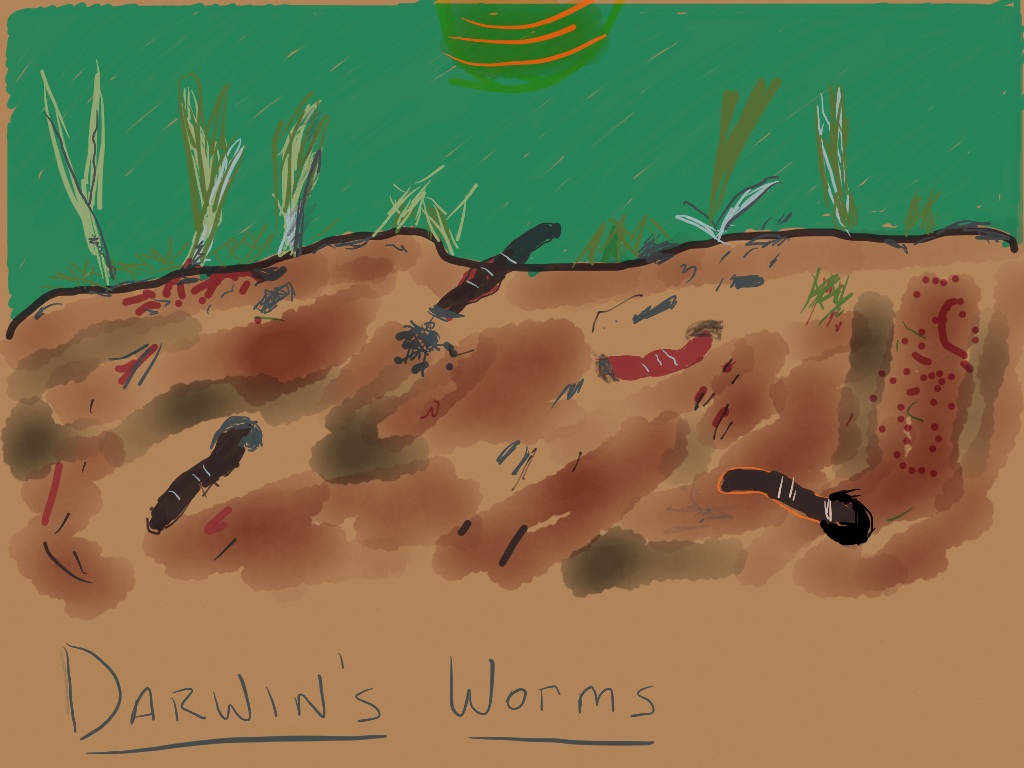
Book Review: Darwin’s Worms: On Life Stories and Death Stories by Adam Phillips

2013 jpbohannon

2013 jpbohannon

Adam Phillips begins his small book Darwin’s Worms with a story about the composer John Cage. Cage had attended a concert by a friend. In the program notes to the concert the friend had written that he hoped in some small way that his music helps to ease some of the suffering in our modern world. When Cage criticized this desire, the friend asked him if he didn’t think there was too much suffering in the world. “No,” replied Cage. “I think there is just the right amount.”

And so, Phillips writes, it is to remind us of and reconcile us to the fact that the amount of suffering in life is just the right amount that we turn to Darwin and Freud.

Darwin was very aware of the suffering in the natural world. Anticipating Freud on one level, he saw all organisms in a war for survival, thrust forward by an instinct to regenerate, adapting continually to a constantly changing environments. While the rest of his society were arguing, debating, proselytizing what it believed were the weightier implications of Darwin’s observations, Darwin studied the lowly earthworm, understanding its importance in the life of nature and, in turn, our own, (which he would argue is part of nature and not separate from). Flipping the usual symbolism on its head, removing the lowly worm from man’s symbolic last meal (“not where he eats, but where he is eaten”) and placing it at the continual meal that is life, Darwin points out that worms function in nature like plows, turning over soil and creating the soft and germinating loam that we take as the earth’s surface. As they struggle to survive (and “struggle” and “survival” are both key words in Darwin and Freud’s lexicon), worms leave behind shards of the past–that which they cannot digest–and form suitable soil for the plants that will provide for their future. Darwin states that:

“…it would be difficult to deny the probability that every particle of earth forming the bed from which the turf in old pasture land springs has passed through the intestines of worms.” That is a very large contribution to life on earth, powered simply by the worm’s instinctual drive to survive.

Later, Freud elaborated this drive, this instinct to survive and coupled it with its antithesis, the death instinct. At first, he termed them simply, the life instinct and the death instinct. Ultimately, he gave it the poetic designation of “Eros and Thanatos.” The life instinct is easy to understand. Man is driven to survive and to propagate. (“To be or not to be” becomes “to survive or not to be.”) The latter, however, the death instinct is a bit more difficult to get one’s head around. Freud believes that in the struggle to survive man also has a desire to cease that struggle–to stop the pain, if you will. However, the desire, says Freud, is also to be in control of that death. To make it part of one’s life story.

Later in the book, Phillips gives us passages from two separate biographies (“life stories”) of Freud. Both describe the same scene, Freud’s death (“death stories”). The scenes themselves are poignant, but what Phillips does with the passages is telling. In it, he shows Freud “controlling his death” the way that he thought all humans desired. In a way, it is a heroic portrait and an affirmation of Freud’s theories.

As Phillips concludes, in their work, both Freud and Darwin “ask us to believe in the permanence only of change and uncertainty… . to describe ourselves from nature’s point of view; but in the full knowledge that nature, by (their) definition, doesn’t have one.” In an work that analyzes mortality, death, and loss, Darwin’s Worms is a surprisingly upbeat and reassuring view of the world.

♦ ♦ ♦ ♦ ♦ ♦

Freud famously said that there are no such things as coincidences. But today as I opened my computer to begin writing this post about Darwin and Freud, the homepage on my computer opened to this New York Times article revealing the discovery of the fossil of a nearly complete skeleton of what is the earliest primate known, changing scientists’ time-line for the appearance of primates on earth by 8 million years, and giving credence to the growing theory that primates emerged first in Asia rather than Africa.

Xijun Ni/Chinese Academy of Sciences An artist's interpretation of a tiny primate that is thought to be the earliest known ancestor of nocturnal primates living today in Southeast Asia. from NYTimes 06/06/2013

Xijun Ni/Chinese Academy of Sciences An artist’s interpretation of a tiny primate that is thought to be the earliest known ancestor of nocturnal primates living today in Southeast Asia. from NYTimes 06/06/2013

How appropriate. Darwin would have been excited, for he saw great value in studying the simplest and earliest of life-forms, plankton, barnacles, and earthworms.

Movie Review: The 400 Blows by Francois Truffaut

400blows

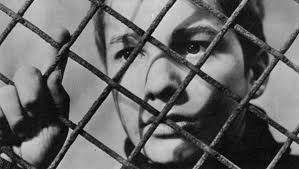
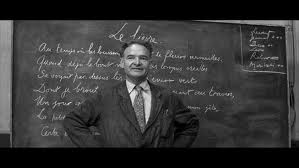
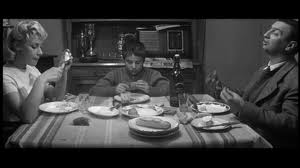
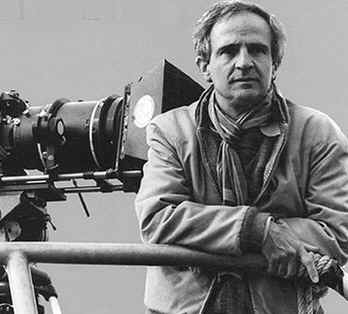
HuluPlus is showing the entire “Criterion Collection” of classic films over the next 101 nights. My understanding is that the films remain available throughout that period, but a new one is added each night. This weekend I watched Francois Truffaut’s extraordinary debut film, The 400 Blows (1959). Shot in black and white with Hitchcockian lighting (Truffaut idolized Alfred Hitchcock and wrote the definitive study of him, Hitchcock), the film follows the plight of a young 12-year old boy as he moves from trouble in school to trouble at home to a juvenile detention center.

teacherfamily

francois_truffaut

Francois Truffaut (1932-1984)

Young Antoine Doinel (Jean-Pierre Léaud) is scapegoated by his domineering teacher, brushed aside by his preoccupied parents, and disregarded by most of the world around him. The teacher has so stereotyped him that he cannot see the sensitive, impressionable boy within; his parents are bothered by his very existence. After several episodes involving both school and home, he runs away. His first night is spent in a vacant printing plant; his meal–a quart of milk that he has stolen. His next nights are spent hiding in a friend’s house where the two enjoy the freedom of the city–playing hooky from school, shooting pea-shooters at passersby from a tall window, smoking cigars, and going to the movies. (Indeed, movies are a big part of Antoine’s life as they were for Truffaut himself, on whose childhood this film is loosely based. Perhaps the happiest moment in the film is when Antoine and his parents go out on the town to see a movie. The boy is visibly entranced.)

After Antoine steals a typewriter from his stepfather’s office, he finds it difficult to hock, and so returns it. It is in returning it that he is caught by the night-watchman. His stepfather hands him off to the police where he is charged with theft and vagrancy. Antoine spends the night in a holding cell with a thief and three prostitutes, is transported with them to a larger jail, and then off to a juvenile “observation center.” While this is going on, we see his parents cede responsibility to the authorities; they have given up on him. (The scene of Antoine in the back of the police coach watching the bright lights of the Parisian night go flitting by is perhaps the most poignant in the film. When the camera closes in on Antoine’s usually stalwart face, there are big tears rolling down his cheeks.)

In the observation center, we learn more about Antoine’s life through his interviews with the center’s psychologist. Finally, during a soccer match, Antoine sneaks under a fence and escapes to the sea. The film ends with him on the beach, between ocean and land, staring enigmatically at the camera. We are left to wonder whether he stands there between childhood and adulthood? Between a life of crime and a life of productivity? Between a world of misery or a bit of joy?

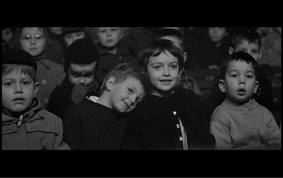
The performance of the 12-year old actor, Jean-Pierre Léaud, is unforgettable. More through his expressive face than his spoken words, he reveals a quiet strength developing around his innocence and fragility–the strength that will propel him forward rather than downward. In fact, Antoine is simply the featured child in a film with countless children’s faces–faces that are trusting and bruised, filled with elation and terror, marked by both wonderment and a premature world-weariness. Children in the classrooms, in movie theaters, in the playground, on city streets. There is a scene where a group of children are watching a puppet show. The camera stays focused for a good while on the varied and wonderful faces of the children watching. In a way, it is a heart-wrenching scene, for one cannot help but wonder, as we watch Antoine grapple with his fate, what will become of them all.childrn

Léaud continued working with Truffaut, making four other films with him and playing the same role, Antoine Doinel, in the progressing stages of his life. But it is in The 400 Blows that the young actor and his director most closely capture movie perfection.

Quote of the Week #6: June 2, 2013

“The sun shone, having no alternative, on the nothing new.”

Samuel Beckett (1906-1989), Murphy

sun

Endings, beginnings, and start-overs

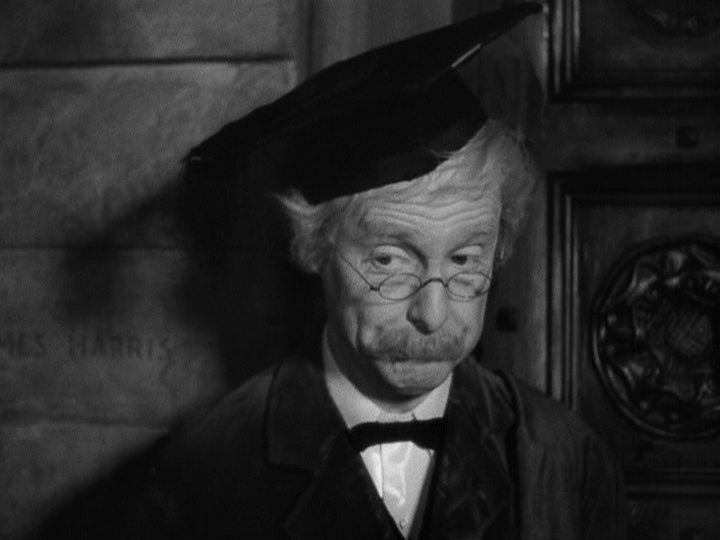
Before I began teaching at the school where I currently teach, I worked in an advertising agency. During the interview process at the school, the headmaster asked me what I thought would be the greatest difference. My answer was “Endings.”

dandraper       mrchips

In the advertising world, it was not unusual for some print ad for which I had written copy  nine, twelve, eighteen months earlier needing to be re-tweaked  later. We are changing our direction, the headline is too “downtown,”  we want to downplay the price, emphasize the sponsor, etc., etc.  Things never were truly complete. They were signed-off on, yes. But they were never done with.

Teaching, however, is one of those professions where there are periodic endings, arbitrary endpoints where the slate is wiped clean, one can review what went right, rue what went wrong, and learn from both.

It is the end of May now, but I know that I and many of my colleagues are already plotting out projects and readings, weighing shifts in focus and shifts in technique, and (always on my part) constructing schemes to stay better organized in the upcoming school year.

And besides a chance to start anew, the end of a quarter, a semester, a school year offers a chance to bury the past and move forward. To begin again.

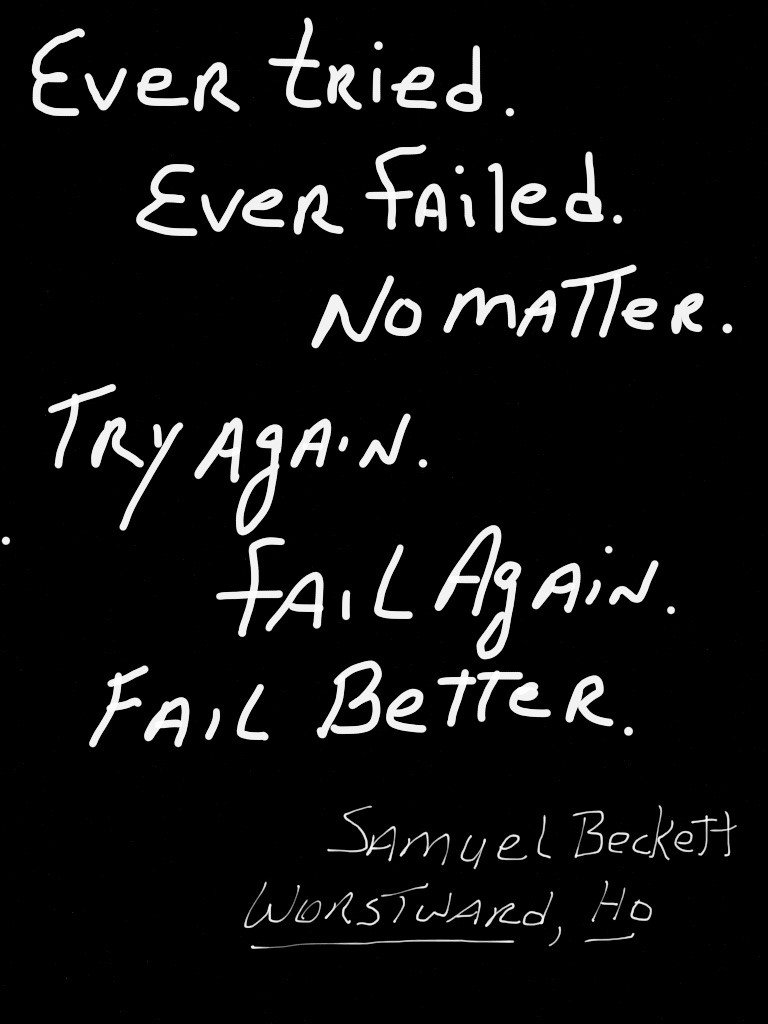
I used to have the Beckettian quote, Try Again, Fail Again, Fail Better, posted on the wall of my office. At the time, it was a personal mantra for me, for my own work. I was not thinking of teaching. This year it has become a buzzword/phrase throughout education.failbetter1

All over in print and on the web there are articles about the value of failing, about the necessity of failing, of the embrace of failing. And we as teachers know that as well as anyone–for ourselves, if not necessarily for our students.  For what is the end of each term but a chance to review our failings and resolve to “fail better” next time.

Now with the end of the school year, there is also the spate of “commencement speeches” that must be heard. Those talks given to graduating seniors in colleges and high-schools around the country that are especially inspiring, especially poignant, especially relevant.

David Foster’s Wallace’s commencement speech at Kenyon University has become legendary. For a long while it was shot all over the internet, and then capitalism took over and someone decided to release it as a book.  It has been abridged and made into a wonderful short film, This is Water. Like all great commencement speeches, this is wise, humorous, and relevant without falling into clichés. It emphasizes compassion and empathy, warns graduates of the sometimes benumbing world of adulthood, and charges them to make their world better by understanding it more tolerantly.

Lately, Neil Gaiman’s 2012 speech at the University of the Arts in Philadelphia has been parsed and tweeted, analyzed and blogged about. It has been highly criticized and highly praised. It is about creativity and about personal freedom. And, of course, at this time of year, it is all over the place and referenced almost every time you log on.

And even Jane Lynch, the wonderful actress who has appeared in so many of the Christopher Guest films and now stars in the television show Glee, even Jane Lynch keeps appearing in my in-box and my twitter feeds and blogs that I follow because of the inspiring speech she gave in 2012 to the women of Smith College.  It too is forthright and wise and commanding.

But it is the nature of graduation speeches to address an audience as they START OUT into something new.  One of the joys/perks of teaching is that one gets to START OVER.  My best and frequent companion these days is a 7-year old boy with whom I play a lot of games.  Often when something goes wrong for him in a game we are playing, he is the first to yell, “Start Over” (though just as often he simply  changes the rules!)  Who knew that the gaming-strategy of a 7-year-old is the same spark that keeps good teachers fresh, engaged and effective?

Book Review: Ancient Light by John Banville

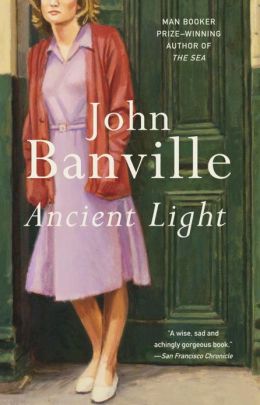
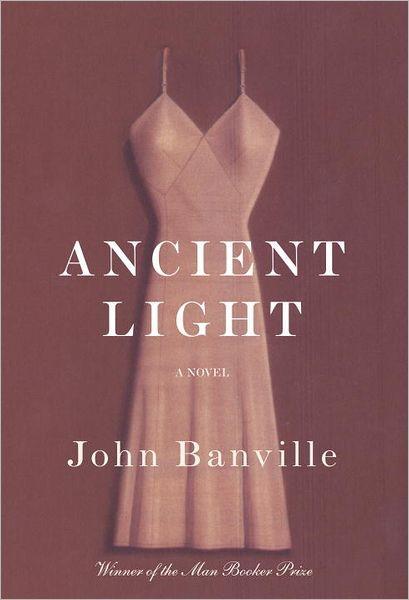
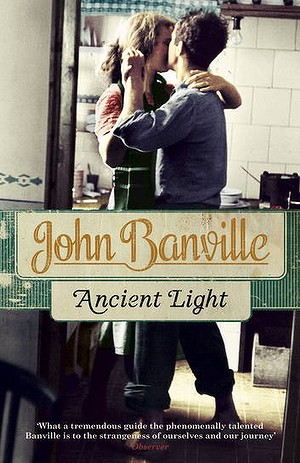
Banville3Banville1Banville2

It seems appropriate that there are three book-covers for John Banville’s Ancient Light. For confusion–or perhaps”uncertainty” –is the appropriate word for the various threads that form the cloth of Banville’s novel. Weaving together three stories (at the very least), Ancient Light details the aging actor Alex Cleave’s misted memories and the challenges of his present life.

Particularly important in his mind are the affair he had when he was 15 with the 35-year old mother of his best friend, his daughter who killed herself in Italy ten years before the novel begins, and the young “movie-star”with whom he–a respected stage actor– is filming his first movie. And hovering in the background, drinking tea in the kitchen while Cleave writes these “memoirs” is his wife, Lydia, who is struggling with their daughter’s death in her own way.

So who are the women represented on the book covers? Is that Mrs. Gray, his first love standing in front of the shop? Or his daughter waiting impatiently for his arrival? Is that the actress Dawn Davenport’s slip? Or Mrs. Gray’s? Or his daughter’s? And who can that be dancing? Mrs. Gray and young Alex seems obvious. But could it also be the characters that Cleave and Davenport are playing in their film? Or his daughter and the mysterious man she was working for (and whose child she was carrying) when she flung herself into the rock-strewn sea?

John Banville photogaph Derek Speirs for The New York Times, 2005

John Banville
photograph © 2005, Derek Speirs for The New York Times

That we can not be sure is part of the joy and wonder–and admiration–one feels in reading Ancient Light. Banville is an exquisite writer–and I do not use that word lightly. Character description, dialogue, setting, interior life–all are rendered with keenly sensitive language and thoughtfulness. At one point, the sky is the color of “wetted jute“; at another, it is described as “a layering of bands of clay-white, peach, pale green, all this reflected as a vaguely mottled mauve wash on the motionless…canal.” Some of the writing is heart-wrenching in its perfection; some is amusing. Here is Cleave describing a “researcher” sent by the movie company to help him with his role:

Billie, however, is obviously a native of these parts, a short pudgy person in, I judge, her middle to late thirties. She really is of remarkable shape, and might have been assembled from a collection of cardboard boxes of varying sizes that were first left out in the rain and then piled soggily any old way one on top of the other. The general effect was not improved by the extremely tight jeans she was wearing, and the black polo-necked jumper that made her large head look like a rubber ball set squarely atop those precariously stacked cartons.

Here is what the aging Alex has to say early about love:

I should like to be in love again, I should like to fall in love again, just once more.

He is aware of both the poignancy of those words and the sadness of the thought in the presence of his wife.

What Ancient Light is most surely about is the past. Cleave–believing he is nearing the end of his career–is enamored by it, by the love affair with Mrs. Gray (he notes the inexactness of this phrase) and by the death of his daughter.

Because I am getting old and the past has begun to seem more vivid than the present, he states, and then later, when he learns of what he mis-remembered, he concludes that often the past seems a puzzle from which the most vital pieces are missing.

When in Italy with Dawn Davenport he meets a mysterious Argentinian, (a ghost? his doppelgänger?) who over a bottle of wine says this too him:

“Even here,” he said, ” at this table, the light that is the image of my eyes takes time…to reach your eyes, and so it is that everywhere we look, everywhere, we are looking into the past.”

But the past is slippery for both Cleave and the memoir he is writing. He notices instances when the progression of time seems to slip, to miss a cog:

There are moments, infrequent though marked, when it seems that by some tiny shift or lapse in time I have become misplaced, have outstripped or lagged behind myself.

Cleave’s stories ultimately come together in subtle and satisfying ways. There are coincidences, but Cleave does not believe in coincidences. There are “apparitions,” though Cleave is reluctant to but wishes to believe in an afterlife. (Twenty years ago, Banville did write a novel Ghosts.) There is doubling and there are doubles. There is a subtle knowledge of and reference to Greek mythology, and a faint feeling that the ancient gods are still at work in the lives of these mortals. And it is all done in a lush, rich style that is the very antithesis of modernity’s spare and sparse writing.

John Banville is an author who writes intelligent and dense books that deserve a much wider readership. His novel The Sea won the Man Booker Prize (much to the dismay of critics who felt it wasn’t commericial enough.) And lately he has also been writing detective novels under the pseudonym Benjamin Black. And I just learned, when I mentioned Ancient Light to a friend that this novel is in fact the third of a loose triology featuring Alex Cleave, his wife Lydia and their daughter Cass.

I will have to hunt them down.