1984Brave New World…and Phillip K. Dick????

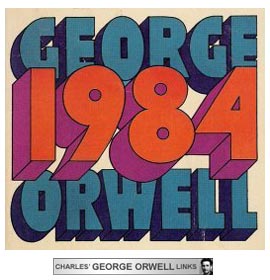
It is perhaps the most iconic novels of the 20th century.  George Orwell’s 1984 is the dystopian novels of all dystopian novels.  We all know the phrases “Big Brother,” “doublethink,” “thought-police”; their ominous overtones and insinuations are recognized even by those who have never read the book. The deadening conformity and mind-control that Orwell writes about are the fears often invoked by those who fear totalitarianism in any form–in governments or corporations.

Apple–now a mighty corporation in itself–famously advertised its new Macintosh computer by pitting itself against the corporate giants of the computer world in a magnificent television commercial that echoed the world of 1984–and Apple’s defiance to its conformity.  (The ad was seen only once on television during the American Superbowl and then subsequently was shown in theaters.)

The novel is bleak and that bleakness is broken only briefly by a wonderful love affair and the main character’s misplaced hope.  Indeed, my favorite image from the book is one that perfectly captures the grime, the incompetency, the substandard level of life, when Winston Smith, the protagonist, goes to unclog a sink in a neighbor’s apartment. As he looks at her, he notices the dust that has gathered in the lines of her face.  I always remember that–a pretty powerful image.
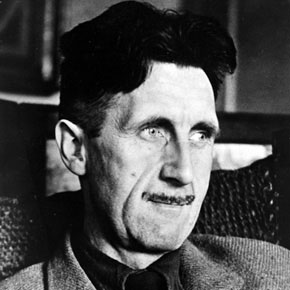
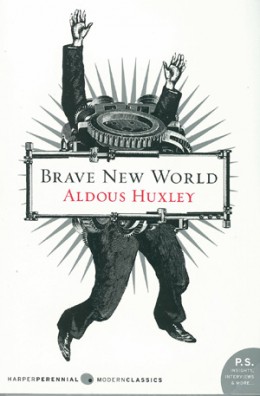
Orwell wrote his novel in 1948 (that’s really the only significance of the novel’s title: it’s the year he wrote it reversed). But nearly a quarter century earlier, another British writer also wrote a powerful dystopic novel: Aldous Huxley’s Brave New World.
And where Orwell’s world is one in which a film of oil lies on the gin and ready-made cigarettes fall apart in your hand and where sex is frowned upon (because one should really only love Big Brother), Huxley’s novel is the opposite.

Huxley saw his dystopia as a world in which people are perfectly happy–indeed where they are conditioned to be happy. There is no disgruntlement–people have been conditioned to accept and love their station in life. (A station that has been pre-decided by the artificial generation process.) Promiscuity is greatly encouraged and sex is varied and plentiful. And if for some reason, one might feel a little blue, there is SOMA, a mood-enhancing drug that is given out in vast quantities to all the classes.

The society works efficiently and happily. Yet Huxley sees the snake in the garden–the lack of freedom to be wrong, to be sad, to disagree. Even to be alone.  It is when a “savage” is brought back from a reservation in the southwestern part of the U.S. is the society and its beliefs challenged–but not for long.

♦     ♦    ♦    ♦    ♦    ♦

By the way, click here for a letter that Huxley wrote to Orwell upon first reading 1984. It is this very discussion of dystopia comprising great suffering or constant happiness:

Huxley to Orwell letter

♦     ♦    ♦    ♦    ♦    ♦
Aldous Huxley

I teach Brave New World as the first book of the new school year.  I will have thirty very bright 18-year-old students enrolled in my class. I know that half of them read 1984 last year with the one teacher they had. The other half did not. (And 1984 is such a great companion piece to any discussion of Brave New World.) So I assigned it as “summer reading.” But only to half of them. I looked for another “dystopian” novel to give the class that had already read Orwell’s novel.
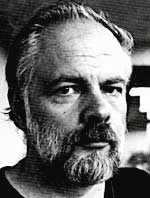
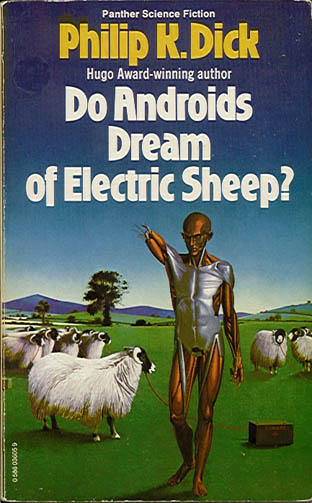
And so I assigned Phillip K. Dick’s Do Androids Dream of Electric Sheep?

Now, I have never been a big fan of science-fiction. I have just never gotten into it. In fact, I have never seen a Star Wars movie!

I’ve read some of the standards–Bradbury, Welles, Asimov, and, if we are stretching, Vonnegut.  But it’s something I just never made a connection with.

And Dick’s novel did nothing to change my mind!? Despite it being anointed a “classic” by so many and being the source for the beloved film, Blade Runner, it left me very flat.
Again we are dealing in a world different than our own–a post-apocalyptic earth where most of the able bodied people have emigrated to Mars.  Nuclear fallout from World War Terminus has made much of Earth inhabitable. The government’s enticement for people to emigrate is a free android that will work as their personal servants.

However, some of these androids have returned to earth and must be killed. And the only way to distinguish between the androids and the humans is the lack of empathy in the androids–a lack that can be tested.
Phillip K. Dick

The plot, entails the main character, Rick Deckhard–an android bounty hunter–attempting to increase his bounty numbers so that he can buy some real animals, instead of the “electric sheep” he now owns. Animals, he feels, encourage empathy in humans.
I am not sure how I will squeeze this into our discussions of Brave New World and 1984.  I am not sure if it can be squeezed into dystopic literature.  Post-apocalpytic maybe–most of my kids have read or seen The Road and I am Legend–but it doesn’t really fit in with totalitarianism and its evils.

And then, maybe it won’t be all that important to the discussion anyway. Or better yet, maybe it’ll throw us all in a different direction completely.

Book Review: Disgrace by J. M. Coetzee

A new acquaintance of mine asked if I had ever read the book Disgrace by J. M. Coetzee.  I hadn’t, though I had read several others by the South African writer.  We talked about many things that morning, and, to be truthful, I had forgotten all about the book until about a week later, when a package arrived in the mail with a gift-wrapped book. Inside was a copy of Disgrace with the note: “I hope you enjoy this half as much as I did.”

And so I began.

Disgrace is the story of David Lurie, a 52 year-old, twice-divorced, white South African professor of Communications and Romantic poetry.  Quite early in the novel he is forced to resign from his university under the disgrace of having sex with one of his students.  As Lurie  rationalizes to himself, the sex itself was not rape, but it certainly wasn’t completely consensual.  He admits guilt but not contrition–which infuriates even those trying to help him.

In disgrace, hounded by reporters, and bereft of his job, Lurie leaves town and drives out into the eastern countryside of the Cape. There his daughter has some land where she raises flowers and kennels dogs.  He is there presumably to write an opera on Byron, Byron’s mistress Teresa, and her husband.  But it is not the most conducive area for such refined creation: it is a hard land and an area still simmering in the afterbirth of the post-apartheid era.

As Lurie settles into the rhythms of country-life, of physical labor and simple pleasures, even volunteering in an animal shelter, his life is once again shattered when he and his daughter are attacked by three men.  All the dogs are slaughtered, Lurie is doused in alcohol and set on fire, and his daughter is gang-raped (and impregnated) by the three men.  The very crime for which Lurie was censured has been visited trebly on his daughter.  The very world he has known–the power he has always arrogantly assumed for himself–has been violently wrenched away.

As both father and daughter try to come to terms with the horrors that have visited them, as they learn more and more about the identity of their attackers and their relations to people they know, and as they struggle with the essential character of each other’s personalities, Lurie comes to better realize the nature of the world around him.  His views on racism, on feminism, even on animal rights, must be examined and re-calibrated.  The world he has known is, simply, no longer.

I knew nothing of the book when I opened it. I thought it was contemporary, not published in 1999–a mere five years after the historic elections in which the African National Congress overwhelmingly won and from which apartheid’s demise can best be dated. The difficulties that Lurie has in understanding the new order, the distrust, fear and violence among the various peoples, even the “modernization” of the University all make better sense. (Lurie’s teaching of Communication is in itself ironic–Communication skills are what this country and its people are badly in need of.  An expert in the British romantic poets–those type of courses are considered fluff in the new university structure–Lurie teaches both Communications 101 and Communications 201. The one Romantic Poets course he teaches is a salve that the administration gives its older professors.) In many ways the novel is a reflection of the birth pangs of the new country: it is violent, bloody, and at times deadly.

Does everything get resolved?  Of course, not.  Is Lurie a better person at the end?  I’m not sure.  I think he is. Early in the novel when a tribunal is questioning Lurie on his womanizing, he states that he believes that every woman he has bedded has “enriched” him in some way.  The question at the end of the novel then must be  “has the violence and catastrophe that he has suffered also enriched him?”  Again, I don’t know. But he is a different man than he was at the beginning of the novel.

J.M. Coetzee

And while the summary of the plot seems rather dark, the novel itself is quick moving and understated.  It is a very subtle but easy read, and it sucks you into its disparate worlds–the urbane world of the university and the stark world of the South African countryside–quite easily.

And so much dovetails together within the novel: the womanizing man of letters writing about that grand literary womanizer Byron; the mirrored rapes; his evolving attitudes towards women underpinning his new understanding of animals; his role as both teacher and father. It all comes together seamlessly and wonderfully, not like a patchwork quilt, but a beautifully woven cloth–like the Ashanti patterned bedspread that Lurie’s daughter presents to the woman living on her land.

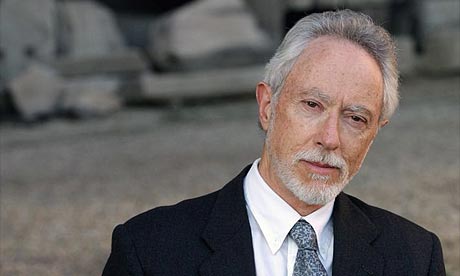
J.M. Coetzee won the Booker Prize for Disgrace in 1999, four years before winning the Nobel Prize for Literature in 2003. His writing is succinct and accessible. In many ways he is a quiet writer, not at all flashy. (Not surprising, considering that his dissertation was on Beckett.)  Intelligent, subtle, and layered, the writing is satisfying and rewarding from the very first, and ages richly with subsequent reading.

Rejection: a writer’s two-way street


Ah rejection! It is the most certain part of the writer’s life. And we all have had our share. Putting something out there, for someone else to judge, to deem suitable for his or her journal/magazine/anthology/contest, is risky. The odds of receiving a “no” are much larger than receiving a “yes.”

At least they are for the less established writers. Which is the majority of us.

Having said that, however, 2012 has been a particularly successful year for me. Even Duotrope–the wonderful submission/market site that I use– congratulated me saying that my “acceptance ratio” is higher than average for users who have submitted to similar markets. And my rate for both fiction and poetry is a measly 21.4%!

But lately, I’ve hit a fallow patch. Stories going out, rejections coming back.  Indeed, one journal (who in fairness won’t be named) e-mailed the same rejection to me three times in one day! Talk about Churchill’s black dog in the afternoon!

So at the moment, I have eleven pieces out there awaiting some editor’s thumbs up or thumbs down. Two have been out there for five months.  If I continue at my current above average pace (hah!) then I can expect two of the eleven pieces to get the okay.

And when that happens all the self-doubt and depression (understandable with a three-pronged rejection) disappears and one once again fantasizes about quitting the day job and really getting it done fill an hour or two of my daydreams.

♦     ♦     ♦

Now, the other side of the coin is that we as writers must do our fair share of rejection, as well, if we are to do the task well.  I believe it was Hemingway who once said that he knew he had had a productive day if in the morning he had three pages of manuscript and by afternoon he had only one. That’s a lot of rejection. That’s a lot of concision. That’s a lot of word choice.

Someone once told me that if I really love a particular phrase or passage, I should probably discard it! Reject it! My love of it is a signal that it is too”special” and doesn’t belong in the work. And he is probably right. Be careful when you are feeling particularly “writerly.”  Not a good portent for good writing.

Another story I heard was that the writer Ray Bradbury would complete a piece, date it, and file it away for a year to the day to begin editing it. He believed that when he first completed a piece, he was too enamored with it to critically re-write, edit, and polish.

But who has that kind of time?

I know one of my many faults is to believe something is finished well before it is. I do not edit well on a computer screen and there is a certain part of me that cringes at printing out drafts.

So my August 1 resolution will be to do better editing, better re-writing. Maybe I’ll even start printing out my work to look over…but certainly on both sides.

♦     ♦     ♦

P.S. Originally I had no  graphics in this post because

I wrote it on my iPad on a cross-country plane with WiFi from Los Angeles to Philadelphia.

How cool is that?

But when I got home my interior clock was a bit askew, so I returned and added some images.

Northern California and Ireland, sea lions and selkies, and a powerful poem

I am not the first to make the comparison between the Pacific Coast Highway in Northern California and Ireland. But that doesn’t make it any less true. It is a magnificent landscape, full of crashing surf and rock-strewn fields, dramatic cliffs and rolling mountains. The hills are more “golden” than green, and the roadways have much fewer sheep and doubledecker tour buses, but yes, it very much reminds me of the west coast of Ireland. Every turn in the corkscrewing highway offers another extraordinary vista.

But it is Goat Beach which is perhaps the most memorable. Goat Beach sits where the Russian River meets the Pacific Ocean. In July the river flow is feeble, but it is then–between March and July–that the area is a breeding ground for sea lions.

By July the sea lions have already pupped and the adult ones seemed quite tired. At first, it is a bit jolting to see twenty to thirty adult sea lions asleep by the rivers edge. It looks as if they have all been slaughtered. But then a fin rises to slap a companion or another waddles to find a more comfortable position. They are just resting–and continue to do so for the rest of the morning.

But the seal pups are another story. Frisky and active, they plunge into the crashing surf of the Pacific or slide into the muddy waters of the Russian River. There is something fascinating about these creatures: their sleekness, their eyes, their movement.

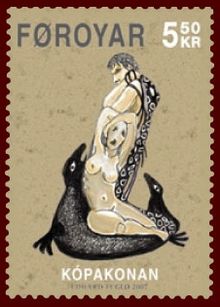
A stamp from the Faroe Islands featuring a selkie emerging from her skin.

Seals and sea lions have long played a part in Norse and Celtic myth.  The legend of the selkie is perhaps one of the most famous and there are a wide variety of stories about them.  These creatures are seals when in the water but humans when they go upon land and emerge from their sealskin. And while there are numerous variants on the stories, there are basically two version of the selkie myth: one female, one male.  The female selkie is often a beautiful woman who is  “captured” by the man who finds her, unable to return to the water because the man has taken possession of her discarded skin.  The male selkie is also renowned  for its beauty and charm when it comes upon land and sheds its skin, and he is often noted for his ability to satisfy the unhappy and dissatisfied women of the area.  Fairly often, these women bear his children, usually children with some sort of “deformity” or oddity about them. These women too are in possession of the creature’s skin.

I can immediately think of two wonderful movies that deal with this myth.  One, is a 2009 film, Ondine, featuring Colin Farrell (and my personal favorite actress Dervla Kirwan from Ballykissangel)  and the other is an older film from 1994 called The Secret of Roan Inish.  Both are well worth finding, however you find your movies these days. And both deal with the female version of the story.

Anyway, so I am reading The Guardian online this winter and I come a cross a video of the Scottish poet Robin Robertson reading his poem “At Roane Head.” It is a powerful poem, and perhaps the most powerful reading I have ever witnessed. In it a woman cares for her four children. Her drunken husband has disowned them–for they have seal-like characteristics as well as human. At the tragic end, the woman returns the seal skin to her lover.

Here is the video.  Give it a view–I find it very powerful.


A small whiskey, the Zoetrope Cafe and Francis Ford Coppola

As one travels towards the end of North Beach in San Francisco, just before entering the financial district, there is a distinctive building on the corner of Columbus and Kearney. Its iron sheathing has been oxidized a gentle green color and, in a way, it resembles an ornate version of the Flat Iron Building in New York.

The building houses the offices of Francis Ford Coppola. Aside from the production duties, the writing, and script doctoring, it is here that Coppola does all his film editing–where all the Godfather movies, Apocalypse Now, Dracula and so many others were edited.

It is also where the literary journal Zoetrope: All Story is produced.  The journal presents some of the finest in contemporary fiction and one-act plays and has featured such established writers as David Mamet, Don DeLillo, Andrew Sean Greer,  Margaret Atwood, Salman Rushdie, Woody Allen,  Neil Jordan, and Haruki Murakami. (Full disclosure: I had submitted once when the magazine first started up, not realizing I was so far out of my depth.)

And on the bottom floor is the Zoetrope Cafe, an Italian bistro, featuring an Old World menu and, not surprisingly, a large selection of Coppola wines.

So last night, we stopped in for a nightcap. 

I noticed what I wanted on the shelf immediately. The whiskey was poured into the most unusual bar glass I’ve ever seen. It was more like a “petri-dish” than a drink glass, about an inch and a half-tall and 4 inches wide.  We asked if the barkeep had ever met Coppola, and she said she did for the first time that day. He told her to call him “Francis” which she said she was still a bit uncomfortable yet to do.

There were copies of Zoetrope in a corner so we brought a couple to the bar and began leafing through them when the bartender came back and with a jerk of her head whispered, “There he is.”  Coppola was chatting with the hostess, looking as if he was going over the wine stock.  About fifteen minutes later, he called to his wife who had been sitting in the corner next to us and they left the cafe, getting into an ordinary SUV.

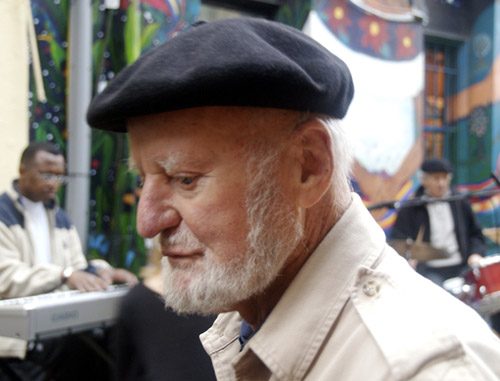
I had seen the poet Lawrence Ferlinghetti the day before and now Francis Ford Coppola this night, and there was so much I would have liked to ask them both.  But their celebrity is mostly in our minds only–their audience.  They, themselves, must go through their days and nights much like you and I, and the intrusion of strangers certainly must be tiresome. At the same time, it is also good to see these literary/cultural lions in their daily routine–to see them simply as working men, no different than the rest of us.

Still, I would have loved to have bought another whiskey, offered each a drink, and listened to what they had to say.

Francis Ford Coppola, July 12,2012, Zoetrope Cafe

City Lights, Vesuvio Bar and sighting Lawrence Ferlinghetti

I had the chance to be across the country and in San Francisco for a few days this week, and I immediately went to City Lights Books in the North Beach section of the city.  If not the most famous bookstore in America, it is certainly one of them.

City Lights was founded by Peter D. Martin and named after the politico/literary magazine he had founded named City Lights in 1953. It was the very first paperback book store in the United States. As he was hanging the sign on the store at 291 Columbus Avenue, Larry Ferlinghetti walked past and asked to be a partner. Both Martin and Ferlinghetti invested $500. Martin sold his share to Ferlinghetti in 1955.

But the financial/founding history isn’t what is important. It is the store’s place in America literary  history that stands out.

In December, 1955, Ferlinghetti and City Lights published Alan Ginsberg’s Howl. Ferlinghetti had seen Ginsberg read at Six Galleries. It was an extraordinary evening. The reading was delayed until Jack Kerouac, who after collecting donations for wine, returned with several gallon jugs. Also performing and/or in attendance were Mike McLure, Kenneth Rexroth, Gary Snyder, Lawrence Ferlinghetti, Phillip Lamantia and Phillip Whalen–all bright lights in the Beat movement. The next morning, Ferlinghetti sent Ginsberg a telegram stating that he would like to publish the poem, the fourth book in City Lights’ Pocket-Rocket Series. Ferlinghetti’s telegram began: “I greet you at the beginning of a great career. When do I get the manuscript?

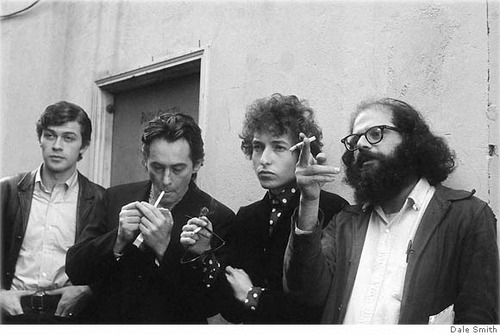
Robbie Robertson, Mike McLure, Bob Dylan, and Alan Ginsberg. City Lights Books, San Francisco 1965.

Four months after publication, the cashier at the store and Ferlinghetti were arrested for selling obscene material–Howl. The case riveted the nation–and made Howl one of the most notorious/famous books of its time. The judge’s decision–that Howl was fully protected by the First Amendment–became an important precedent in the future cases against Lawrence’s Lady Chatterley’s Lover and Miller’s Tropic of Cancer.

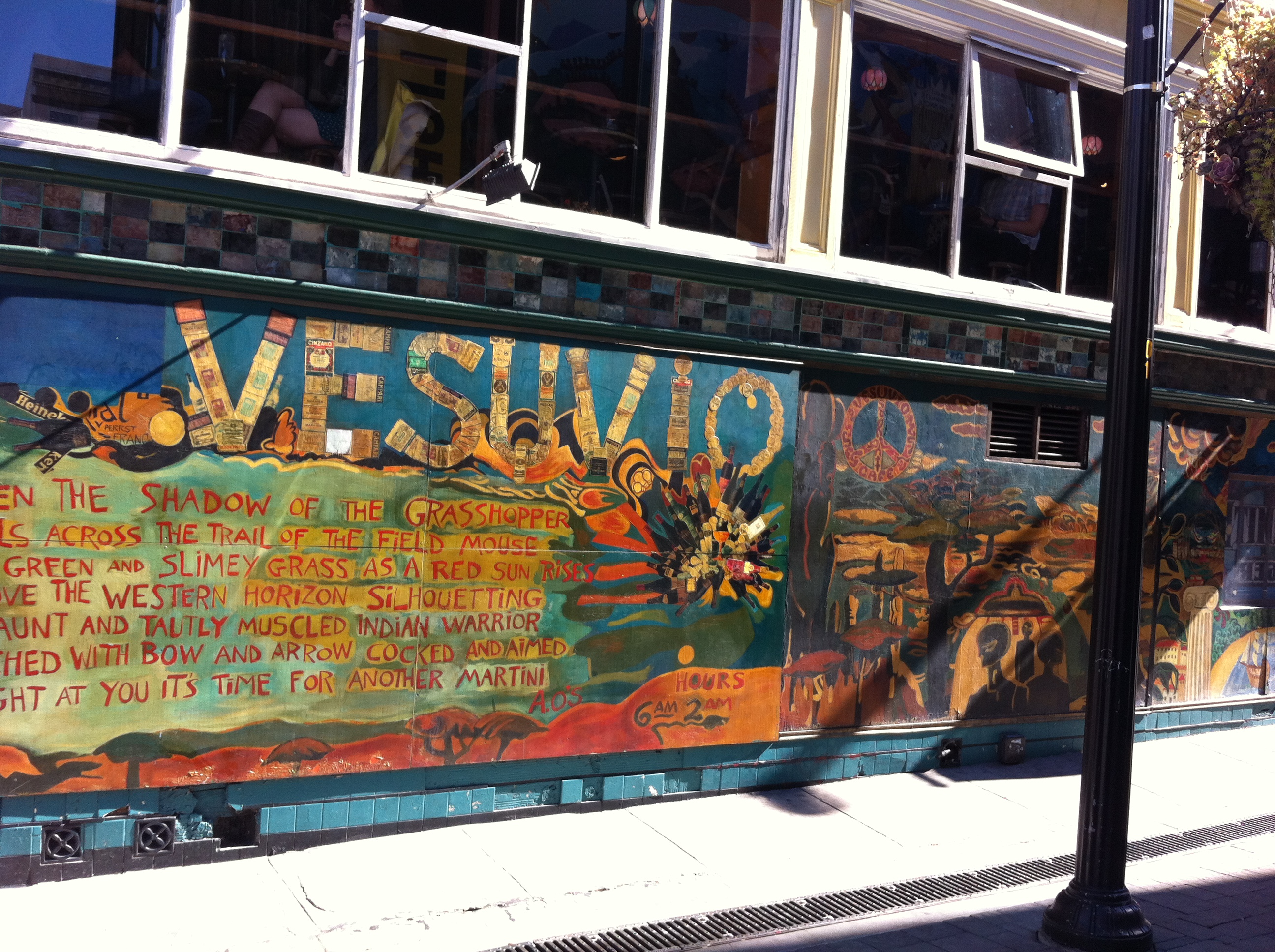
And so…after browsing  the three floors of the book-store, filled with memorabilia, photos, and more than just books, I went across the alley–Jack Kerouac Square–to  the Vesuvio bar. This wonderful bar –mismatched furniture, decals, art work, cheap drinks, two floors, old posters–is a step back into time, or at least in my head. Pictures of Jack London vie with pictures of Jack Kerouac vie with pictures of David Crosby and Grace Slick. A giant portrait of James Joyce hangs next to a photo of Joyce reading the paper in Paris on Bloomsday, June 16th.

Ienjoyed myself. Spent most of the time walking around and reading the walls–the vintage posters advertising readings by a who’s who of San Francisco poets and concerts from the early days, the photos of legendary writers, poets, activists and actors, and original art both bad and worse.

And then it was time to leave.  Outside, we took a few pictures and turned to leave.  And then, as I turned to look back, there coming out of the bar was Ferlinghetti himself.  He stopped, looked around, and placed a cap on his head. My first inclination was to go up to him and shake his hand, thanking him for his long battle against censorship, imperialism, and philistinism, for his support of art, poetry and the avant-garde.  But then I decided against it.  Let a man walk out of a bar, look into the sunshine and set on his way without being bothered by an admirer.

Lawrence Ferlinghetti. photo via Flickr by Steve Rhodes

“Love Poem” by John Frederick Nims…all the toys of the world would break.

Love Poem
(by John Frederick Nims)

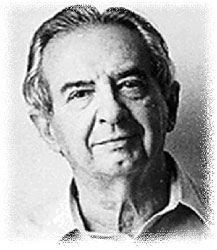
John Frederick Nims (1913-1999)

My clumsiest dear, whose hands shipwreck vases,
At whose quick touch all glasses chip and ring,
Whose palms are bulls in china, burs in linen,
And have no cunning with any soft thing

Except all ill-at-ease fidgeting people:
The refugee uncertain at the door
You make at home; deftly you steady
The drunk clambering on his undulant floor.

Unpredictable dear, the taxi drivers’ terror,
Shrinking from far headlights pale as a dime
Yet leaping before apopleptic streetcars—
Misfit in any space. And never on time.

A wrench in clocks and the solar system. Only
With words and people and love you move at ease;
In traffic of wit expertly maneuver
And keep us, all devotion, at your knees.

Forgetting your coffee spreading on our flannel,
Your lipstick grinning on our coat,
So gaily in love’s unbreakable heaven
Our souls on glory of spilt bourbon float.

Be with me, darling, early and late. Smash glasses—
I will study wry music for your sake.
For should your hands drop white and empty
All the toys of the world would break.

I once read this poem in public to a group of twenty to twenty-five people. Afterwards, a woman came up to me and said that I had brought her to tears.  Although it was a nice compliment, I knew surely that it wasn’t I that did it.  For who could hear those final lines “For should your hands drop white and empty/All the toys of the world would break” and not get a catch in their throat?

I love this poem because it is an anti-ideal love poem.

Shakespeare did the same thing 400 years ago with his Sonnet 130 (“My mistress’ eyes are nothing like the sun.)

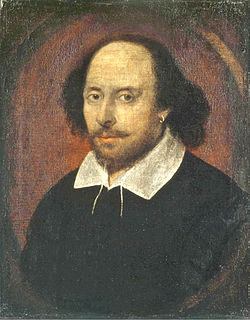
My favorite portrait of Shakespeare

My mistress’ eyes are nothing like the sun;
Coral is far more red than her lips’ red;
If snow be white, why then her breasts are dun;
If hairs be wires, black wires grow on her head.
I have seen roses damasked, red and white,
But no such roses see I in her cheeks;
And in some perfumes is there more delight
Than in the breath that from my mistress reeks.
I love to hear her speak, yet well I know
That music hath a far more pleasing sound;
I grant I never saw a goddess go;
My mistress when she walks treads on the ground.
And yet, by heaven, I think my love as rare
As any she belied with false compare.

Here too, the poet celebrates the flaws and the humanness of his beloved. In embracing her reality–and announcing that he has no need to “belie her with false compare” as so many other poets did–he claims a superior, purer love… “a love as rare” in Shakespeare’s words.

Both men, separated by four centuries, are similarly battling against a constructed “ideal.”  Whether it was the “ideal woman” presented by the Renaissance sonneteers or the “ideal woman” fashioned by Hollywood and Madison Avenue, it was a false image.  And both men knew it.  Their love, they claim, is special because it is grounded in the real world, not in an imaginary, air-brushed, wish-fulfillment world.  Their love exists in the everyday, “everyman/everywoman” world that most of us mortals inhabit.

We know little of Shakespeare’s beloved except for what she looks like: dark hair, pale-lipped and dun-skinned, bad-breathed, clunky-walking and shrilly-voiced. Nims, on the other hand, gives us more information about the object of his love.  She deftly handles those who are ill-at-ease, exiled or drunk; she moves easily with words and people and wit and love. Certainly, she has her frenetic failings–and Nims recounts them with affection– but that is not what makes her unique; that makes her human.  She is much more than that.  She is unique in the welcoming warmth of her love, in her compassion for and embrace of life.

Nims truly appreciates and loves her for what she is. And isn’t that what all of us is looking for?

Sunday Book Review: Hitch-22: A Memoir by Christopher Hitchens

It is a cliché that one should never meet the writer’s that one admires–disappointment is surely to be the outcome.  Well, Christopher Hitchens is the exception to the rule.

I admire him even more having read his memoir.

As one of the most prolific and provocative essayists of the last thirty-odd years, Hitchens seemed to be everywhere–his journalist’s beat the places where injustice, cruelty, and war loomed most horribly.  From Belfast during the heights of the “Troubles,” to Argentina during the period of the “disappeared,” to Poland at the beginnings of the “Solidarity” movement, to Zimbabwe, Mogadishu, Romania, Cyprus, Iraq, and Iran, Hitchens brought his sensible eye and exquisite writing style to reveal to the world the frequent cruelty and inanity of world politics, exposing the greed and stupidity of many of the political leaders who claim to have the “peoples’ interests” at heart.

It is that principled, observant eye and the exquisite sense of writing that defines Hitchens memoir–for his biography is one of two sides: the principled, political advocate and the Oxford educated, man of letters. And the people he encounters come from both of these worlds as well.

On one hand, he is with a young Bill Clinton at Oxford when he infamously “did not inhale.”  (Hitchens says that is probably correct because Clinton was terribly allergic to smoke. However, he adds, he certainly consumed more than his share of the “brownies.”) He meets Margaret Thatcher when she is made head of the Tory party. (He immediately got in a disagreement with her and she smacked his bottom with rolled up program to terminate the discussion.)  He meets the vile General Videla of Argentina; the future first elected president of Iraq,  Jalal Talabani; the Cypriot president, Archbishop Makarios. He debates Western pundits and arranges lectures for some of the world’s most unsung champions of the people.

On the other hand, his closest friends are major lights of the British literary world: the novelists, Martin Amis and Ian McEwan, and the poet James Fenton.  His accounts of their times together rival any of the apocryphal stories of the Algonquin Table.  (My favorite line is the critic’s Clive James’ review of Pumping Iron, the documentary on body-building that introduced Arnold Schwarzneggger to the world.  James said that Schwarzenegger looked like “a brown condom stuffed with walnuts.”)

But what stands out in Hitch-22 is not the list of notables with whom Hitchens associated or fought against. It is the dedication to principle with which he lived his life.  As a young man he was a dedicated member of the International Socialist party and later became a dedicated member of the Labour Party. Both of these he jettisoned when he believed that the party had strayed from its principles–and he continually called them on it.

As he traveled from hot-spot to hot-spot, he began to trust the leaders of all these revolutionary movements less and less. Here’s what he says:

I eventually came to appreciate a feature of the situation that since helped me to understand similar obduracy in Lebanon, Gaza, Cyprus, and several other spots. The local leadership that are generated by the “troubles” in such places do not want there to be a solution. A solution would mean that they were no longer deferred to by visiting UN or American mediators, no longer invited to ritzy high-profile international conferences, no longer treated with deference by the mass media, and no longer able to make a second living by smuggling and protection-racketeering.

A bit cynical to be sure, but this is from a man who has entered the belly of the beast and refuses to swallow the muck he sees there.

Always an iconoclast, Hitchens attacks those he believes deserve it, no matter what their status or reputation. For example, early on, he admits that he felt separated from the rest of the world in November, 1963 for not mourning sufficiently  the assassination of the American president.   The sainted Jack Kennedy he condemns as a “high risk narcissist” for the game of chicken that he played with Russia over the Cuba missile crisis.  (This event  very likely sowed his interest in geopolitics.) He very famously debunked Mother Theresa and was called in by the Vatican to present a case against her when she was up for canonization. (This used to be called “The Devil’s Advocate,”  a position that the Vatican eliminated by the time Hitchens was called in. He jokingly said that he  must then be advocating for the devil, pro bono.)

Like any good thinker, Hitchens is not afraid to change his mind, to reconsider his position, when presented by new facts.

More than anything else, it is this life as a DELIBERATE THINKING HUMAN that impresses me more than anything else in his story. Hitchens considered the world around him with open, unprejudiced eyes, tried to make sense of it, and tried to expose what he saw as nonsense.

Hitchens died 15, December 2011, after a struggle with esophagal cancer.  His writings live on. I have two collections of his essays on hold at our public library.  I can’t wait to tackle them.

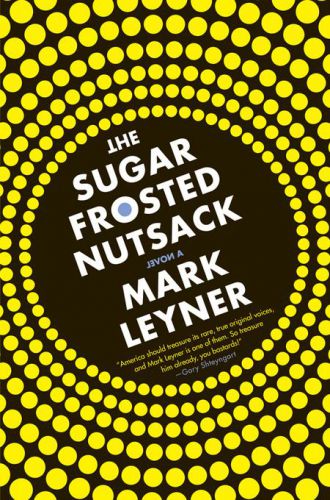
The Sugar Frosted Nutsack by Mark Leyner: When does one stop reading a book?

When is it time to stop reading a novel?  And why do I feel so guilty about it?

I decided today to go no further in Mark Leyner’s The Sugar Frosted Nutsack.  Was it bad?  No, it was quite entertaining?  Was it difficult?  No, not in the way say Joyce’s Finnegans Wake or DFW’s Infinite Jest is difficult.

To be truthful, it is simply a tiring read.

The title refers to poor Ike Karton, the “nutbag” as he is called in his neighborhood in Jersey City, New Jersey.  Here is his introduction (35 pages in):

“What subculture is evinced by Ike‘s clothes and his shtick, by the non-Semitic contours of his nose and his dick, by the feral fatalism of all his looney tics–like the petit-mal fluttering of his long-lashed lids and the Mussolini torticollis of his Schick-nicked neck, and the staring and the glaring and the daring and the hectoring, and the tapping on the table with his aluminum wedding ring, as he hums those tunes from his childhood albums and, after a spasm of Keith Moon air-drums, returns to his lewd mandala of Italian breadcrumbs?

So begins the story of Ike Karton, a story variously called throughout history Ike‘s Agony, T.G.I.F. (Ten Gods I’d Fuck), and The Sugar Frosted Nutsack. This is a story that’s been told, how many times? –over and over and over again, …”

Ike is a believer in a pantheon of Gods who have played havoc with the universe for billions of years.  Earlier we learn that

The Sugar Frosted Nutsack is the story of a man, a mortal, an unemployed butcher, in fact, who lives in Jersey City, New Jersey, in a two-story brick house that is approximately twenty feet tall. This man is the hero IKE KARTON. The epic ends with Ike’s violent death.  If only Ike had used for his defense “silence, exile, and cunning.” But that isn’t Ike. Ike is the Warlord of his Stoop.  Ike is a man who is “singled out.” A man marked by fate. A man of Gods, attuned to the Gods. A man anathematized by his neighbors. A man beloved by La Felina and Fast-Cooking Ali, and a man whose mind is ineradicably inscribed by XOXO. [these are the names of gods we’ve already met]. Ike’s brain is riddled with the tiny, meticulous longhand of the mind-fucking God XOXO, whose very name bespeaks life’s irreconcilable conntradictions, symbolizing both love (hugs and kisses) and war (the diagramming of football plays).

Are you tired yet?  I am…(but I have such a developed sense of guilt that I will probably return to it before the evening’s out.)

The  novel begins with the beginnings of the universe. This gaggle of gods arrive on a school-bus, blaring the Mister Softee jingle, like a bunch of college students “Gone Wild” on spring break.  Like the gods of other mythologies, they are petty and mischievous and promiscuous and quite often harmful to humanity. Now, they are living in the tallest (and most opulent) building in the world (now they are in Dubai, but they have had to move several times as humans keep building taller buildings.) Bored and propelled by their own machinations and relations they have become obsessed with Ike Kantor.

The novel plays with meta-fiction to a large degree. A sentence is repeated. Then the sentence that makes the repetition is repeated again including the original sentence. And again. And again.  It is tiring…and soon loses its cleverness.

But the book is not the theme of this post; it is is the decision to give up on one.  Why do some people (myself to be sure) feel a sense of obligation to finish a book once he or she has begun it?  Is it financial, in that you’ve invested fifteen bucks in a book you might as well get your money’s worth?  I don’t think so.

Is it something that happened to us when we were school children? Are we afraid that the nuns, headmasters, schoolmarms are going to rap our knuckles with a ruler for not completing our assignment?

Or is it respect for the artist?  Do we feel the need to stick with something, to see where it leads to, out of respect and admiration for the writer’s work?

I don’t know.

But I have a day and half free–so I’ll probably end up finishing it anyway.

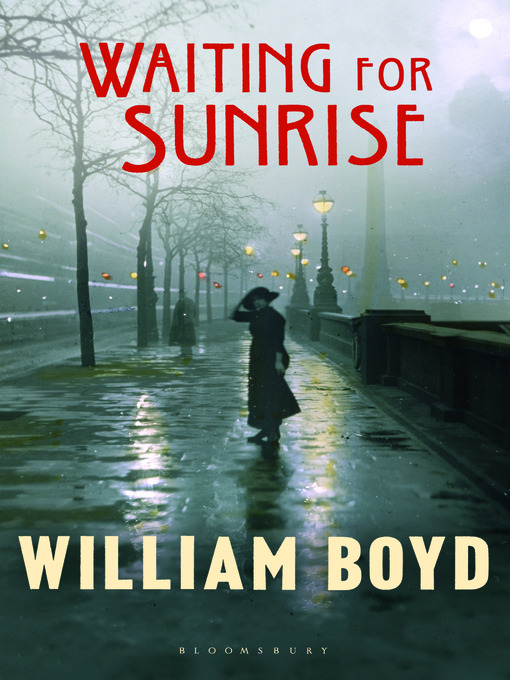
Sunday Book Review: Waiting for Sunrise by William Boyd

For ninety-percent of the novel Waiting for Sunrise by William Boyd, I was enthralled.

Vienna before the first World War, London on the eve of war, the no-man’s land between the trenches, neutral Geneva at the height of hostilities, London during zeppelin bombing raids. The settings are dramatic and richly drawn.

As was the plot: A young actor, following his famous father’s footsteps (if that’s not Oedipal enough for him, his mother catches him at his first experience at masturbation to boot), goes to Vienna to find a cure for a sexual condition–to Vienna, the center of the burgeoning new concept of psychoanalysis. Although he meets Freud himself, it is Freud’s English speaking neighbor who takes Lysander Rief on–and who successfully cures him.  And we know he is cured because his four month affair with the English bohemian Hettie Bull ends in a pregnancy and his arrest for rape by the Viennese authorities.

When two British diplomats arrange for Rief’s escape, they also arrange for his indenture to British intelligence.

Soon after Rief returns to London, his rescuers called in his debt and he is asked to enter Geneva via  the front lines. He is successful at his mission, survives seven bullet wounds, and completes the assignment that he had been ordered to finish.  And then he is given a second mission.

The action–of both the military and intelligence escapades and Rief’s romantic life–is riveting, fast paced and cleverly intertwined. Each character seems to be connected to another and no one is entirely innocent. And Rief’s inner-life is subtly and intelligently revealed. One learns much about military ordinance, psychoanalytic practices, the British class system and the early 20th-century British world of theater. And the information is never pedantic or overwhelming but richly woven into the plot.

Yet the solution of Rief’s intelligence mission and the resolution of his own personal quests seems to be lacking.  As the Novel wraps up and the various strands are pulled together, the story begins to limp rather than gain strength.  By the end, I felt I was reading a Hardy Boys’ Adventure. The solution was pat and somewhat anti-climactic.

I had been look forward to Waiting for Sunrise for several months and to be quite honest I enjoyed reading it very, very much. Until the end that is.  I was disappointed. It seemed that Boyd had simply decided to quit.

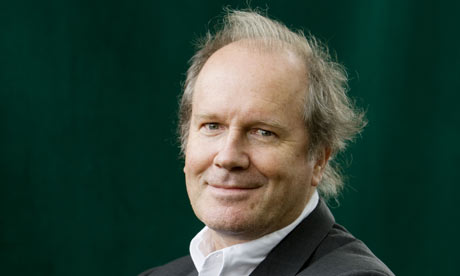
William Boyd

I like William Boyd very much. I feel he is greatly underrated among his contemporaries and is a wonderful stylist with a perfect ear for the nuances of an age.

I had previously read several Boyd novels and do not remember this falling off, this disappointment before. The novels all successfully re-create historic eras, describing its people, its culture, its ethos, its fears, all braced by an intelligent understanding and description of the scientific theories and advancements that are at that moment being born. For instance, Brazzaville Beach deals with mathematical chaos theory and the sociology of chimpanzees.  The New Confessions (modeled on Rousseau’s Confessions) also deals with World War I–as with Waiting for Sunrise–moves through Hollywood and Berlin, treats the horrors of World War II and then ends with the Hollywood Communist  trials, the whole while treating  us to the internal workings of the Hollywood film industry.  The Blue Afternoon (my personal favorite) is centered on the United States invasion of Manilla and its ultimate acquisition of the Philippines through the Treaty of Versaille and travels from Lisbon, Manilla and Los Angeles, from 1902 through the 1930s, while leading the reader through advancements in surgery and trends in architecture.

All of Boyd’s novels are rich with fascinating information, realistic period details, and memorable human stories. And all are vastly enjoyable and worthwhile.  Waiting for Sunrise, however, for me, ends a little too quickly and a little too weakly.