Movie Review: Black, White + Gray: A Portrait of Sam Wagstaff and Robert Mapplethorpe 

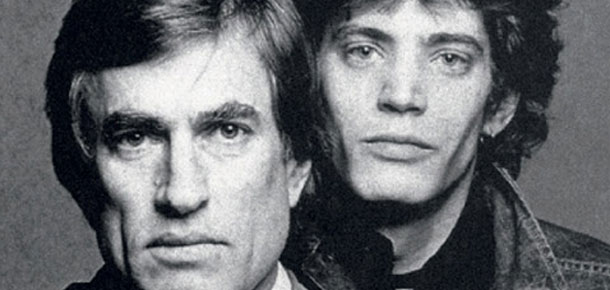
Sam Wagstaff and Robert Maplethorpe

Sam Wagstaff and Robert Maplethorpe

I discovered a documentary the other night called Black, White + Gray by James Crumb (2007). The blurb calls it a study of the relationship between the curator/collector Sam Wagstaff, the artist Robert Mapplethorpe, and the poet/singer Patti Smith. To be honest, however, it is really the story of Wagstaff, that touches greatly on his relationship with Mapplethorpe and to a much smaller degree with Smith, both for whom he was mentor and patron and friend. (In Mapplethorpe’s case lover and companion.) Consequently, it also deals with art, the business of art, the demimonde of gay life in the 1970s and 80s, and, of course, the scourge of AIDS.
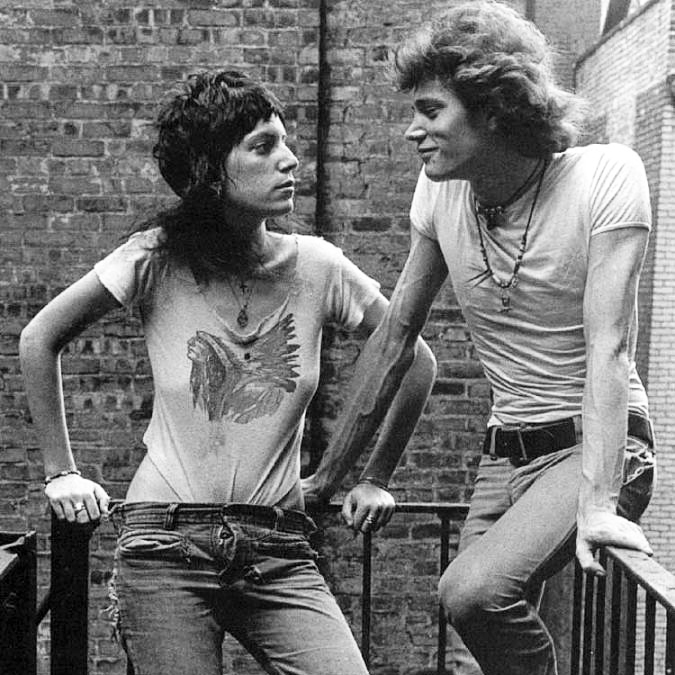
patti smith robert mapplethorpe

patti smith robert mapplethorpe

Moving chronologically through Wagstaff’s life–and anchored by Patti Smith’s intelligent and honest and fond recollections–the film follows Wagstaff from his schooldays through his loathed time spent in advertising to his prominence in the art worlds of New York, Paris and London. Along the way, there are appearances on the Dick Cavett Show, press conferences, interviews with his friends and colleagues, and countless photographs, many taken by him or Mapplethorpe and many part of his historic collection.

Wagstaff was strikingly handsome, aristocratic, and intelligent. (Dominick Dunne called him one of the most handsome men he ever saw.) He was also gay, but closeted himself for much of the oppressive fifties and early part of his life. Not until his meeting with Mapplethorpe did it seem he grew comfortable with his homosexuality. As a curator, he embraced and pushed forward those artists and art forms that were still on the fringe, Minimalism, Earth Works, Conceptual Art, and, most importantly, photography. Wagstaff believed that photography was an ignored art and deserved to be elevated to the pantheon of “Fine Arts.”

Indeed, it is because of Wagstaff that photography holds the status that it does today. His relentless collecting, the exorbitant sums he paid, the continual praise and comments in the press, single-handedly hauled photography onto the main stage.

A few years before he died, Wagstaff sold his private collection of photographs to the Getty Museum in Los Angeles for the then unheard-of price of $5-million. It was testimony to how far he had brought photography to the forefront.

The interviews within the film are honest and intelligent. Many deal with his collecting, with his curating, and with his “vision.” Many deal (some negatively, some positively) with his relationship with Mapplethorpe. Dominick Dunne, particularly, gets much air time, and talks about Wagstaff in two of the worlds that he lived in–the socialite world and the gay world. And all is brought together by the reminiscences of Smith.

“Compartmentalized” is a word that often came up, and it seemed that Wagstaff was very good in ordering his life into separate and distinct components. But in the end, it was the gay world that did him–and so many others–in. It is easy to forget that at one point, AIDS was a scourge that was decimating much of the art world. The film ends with Wagstaff’s death, and then with Mapplethorpe’s, and then with a list of the many artists who have died of AIDS complications since.

It is a sobering ending. But then the credits role and are intersperse with clips from the many interviewees and once again we are reminded of the life, of the visionary man who rose so high in the world of art–and brought others with him .

We know much about Mapplethorpe’s life, and Patti Smith’s, greatly due to her wonderful memoir, Just Kids. James Crumb’s film Black, White + Gray adds greatly to our knowledge of that time and that world and the people who populated it. It’s worth while finding and fascinating viewing.

By the way…

The title of the film, Black, White + Gray not only refers to the B&W Photography that Sam Wagstaff collected, cataloged, and often curated, or the shades of distinctions in the compartmentalized life that he constructed, but also to the momentous exhibited he staged at the Hartford Wadsworth Atheneum entitled “Black, White and Gray.” The exhibit, considered the first minimalist show, featured the work of Stella, Johns, Kelly, and Lichtenstein, among others. It was an extraordinary success, influencing fashion, Hollywood, advertising, and, of course, Truman Capote’s infamous Black and White Ball.
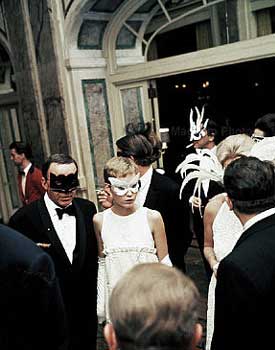
Frank Sinatra and Mia Farrow arriving at Truman Capote's Black and White Ball.

Frank Sinatra and Mia Farrow arriving at Truman Capote’s Black and White Ball.

https://i0.wp.com/media-cache-ak0.pinimg.com/192x/85/cf/f1/85cff11fb5bb99780ab77c77af4861d9.jpg

Andy Warhol at Truman Capote’s Black and White Ball without a mask.
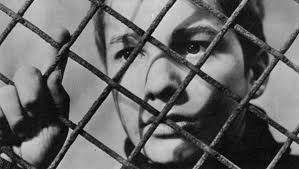
Movie Review: The 400 Blows by Francois Truffaut

400blows

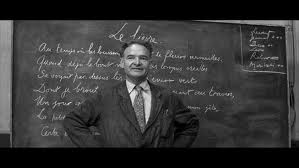
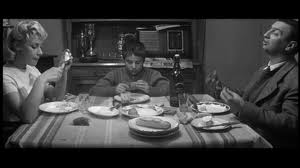
HuluPlus is showing the entire “Criterion Collection” of classic films over the next 101 nights. My understanding is that the films remain available throughout that period, but a new one is added each night. This weekend I watched Francois Truffaut’s extraordinary debut film, The 400 Blows (1959). Shot in black and white with Hitchcockian lighting (Truffaut idolized Alfred Hitchcock and wrote the definitive study of him, Hitchcock), the film follows the plight of a young 12-year old boy as he moves from trouble in school to trouble at home to a juvenile detention center.

teacherfamily

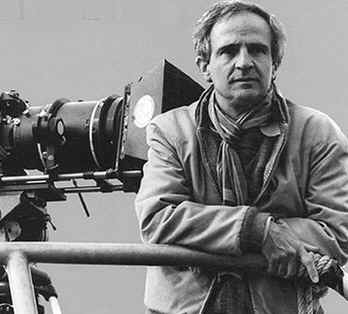
francois_truffaut

Francois Truffaut (1932-1984)

Young Antoine Doinel (Jean-Pierre Léaud) is scapegoated by his domineering teacher, brushed aside by his preoccupied parents, and disregarded by most of the world around him. The teacher has so stereotyped him that he cannot see the sensitive, impressionable boy within; his parents are bothered by his very existence. After several episodes involving both school and home, he runs away. His first night is spent in a vacant printing plant; his meal–a quart of milk that he has stolen. His next nights are spent hiding in a friend’s house where the two enjoy the freedom of the city–playing hooky from school, shooting pea-shooters at passersby from a tall window, smoking cigars, and going to the movies. (Indeed, movies are a big part of Antoine’s life as they were for Truffaut himself, on whose childhood this film is loosely based. Perhaps the happiest moment in the film is when Antoine and his parents go out on the town to see a movie. The boy is visibly entranced.)

After Antoine steals a typewriter from his stepfather’s office, he finds it difficult to hock, and so returns it. It is in returning it that he is caught by the night-watchman. His stepfather hands him off to the police where he is charged with theft and vagrancy. Antoine spends the night in a holding cell with a thief and three prostitutes, is transported with them to a larger jail, and then off to a juvenile “observation center.” While this is going on, we see his parents cede responsibility to the authorities; they have given up on him. (The scene of Antoine in the back of the police coach watching the bright lights of the Parisian night go flitting by is perhaps the most poignant in the film. When the camera closes in on Antoine’s usually stalwart face, there are big tears rolling down his cheeks.)

In the observation center, we learn more about Antoine’s life through his interviews with the center’s psychologist. Finally, during a soccer match, Antoine sneaks under a fence and escapes to the sea. The film ends with him on the beach, between ocean and land, staring enigmatically at the camera. We are left to wonder whether he stands there between childhood and adulthood? Between a life of crime and a life of productivity? Between a world of misery or a bit of joy?

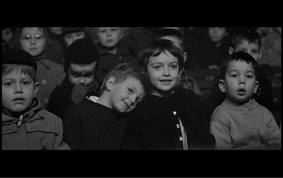
The performance of the 12-year old actor, Jean-Pierre Léaud, is unforgettable. More through his expressive face than his spoken words, he reveals a quiet strength developing around his innocence and fragility–the strength that will propel him forward rather than downward. In fact, Antoine is simply the featured child in a film with countless children’s faces–faces that are trusting and bruised, filled with elation and terror, marked by both wonderment and a premature world-weariness. Children in the classrooms, in movie theaters, in the playground, on city streets. There is a scene where a group of children are watching a puppet show. The camera stays focused for a good while on the varied and wonderful faces of the children watching. In a way, it is a heart-wrenching scene, for one cannot help but wonder, as we watch Antoine grapple with his fate, what will become of them all.childrn

Léaud continued working with Truffaut, making four other films with him and playing the same role, Antoine Doinel, in the progressing stages of his life. But it is in The 400 Blows that the young actor and his director most closely capture movie perfection.

Movie Review: Something in the Air: Born Too Late

The actual title of Olivier Assayas’ new film is Après Mai–a reference to the months following the student and worker demonstrations of May 1968 in France.  And that, in many ways, is the focus of the film: young, sincere characters trying to maintain the commitments of 1968, but somewhat too young still to be a real part and unprepared for the crashing ordinariness of the life to come.

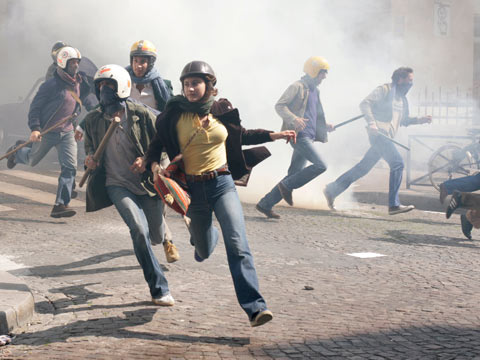
The film begins with high-school students’ listening to their teacher’s monotonous reading of Pascal’s Penseés. Within minutes of screen time, these same students are scrambling away from overzealous police dispelling a student demonstration.  The life of the classroom and their political/social/activist lives are much, much different. The teachers give them Pascal and they are reading Gregory Corso, Chairman Mao and listening to Phil Ochs.

Early riot scene in Something in the Air

Early riot scene in Something in the Air

I had a friend who was a student in Paris at that time in 1968.  When I asked her about it, she sort of shrugged.  “The only difference,” she said,  “was that afterwards we were permitted to call our professors tu rather than vous.

But for Gilles, Alain, Christine, Rachkam la Rouge, they want very much for the  spirit of May 1968 to be carried on, to be carried through.  They believe that May was not the climax but the beginning of the revolution. Stuck in their sleepy village outside of Paris, the students join political parties, pack debating halls, distribute the radical free-press, and organize guerrilla graffiti forays against the local establishment and police.  One of these night raids goes wrong and a guard falls into a coma when hit with a bag of cement mix.  The students decide to scatter.

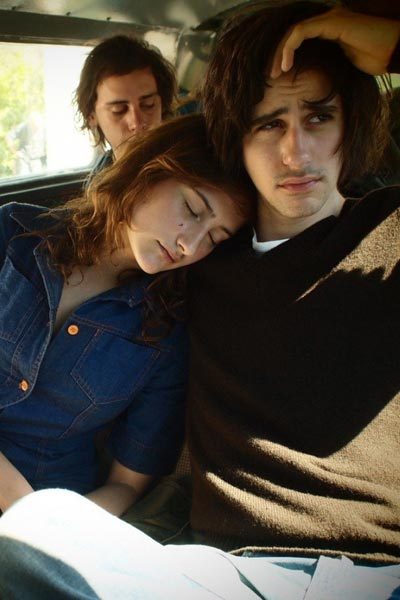
Gilles (Clémont Métayer) and Christine (Lola Créton) hitch up with a radical collaborative on its way Italy where they become lovers and later part as she continues with the collaborative to make a film on Italian workers.

Christine and Giles on the road to Italy

Christine and Giles on the road to Italy

gilleschristine

Gilles (Clémont Métayer) and Christine (Lola Créton)

Gilles is torn in his radicalism–for his passion is art, and he is not convinced that his art must always serve the “cause.”  Alain (Felix Armand)  and Leslie (India Menduez), an American he meets in Rome,  go East to Afghanistan, he an artist and she a dancer looking for spirituality. Disillusioned over time, they all return to France, and ultimately to Paris.

But there is another story running through Gilles life.  Of course, in a story of a teenage-boy there needs to be friction between him and his father, a successful movie director.  While there is never dramatic conflict between the two, as he grows, Gilles is able to tell his father how superficial and wrong-headed he believes his film adaptations are.  (The father makes adaptations of George Simenon’s Maigret novels.)

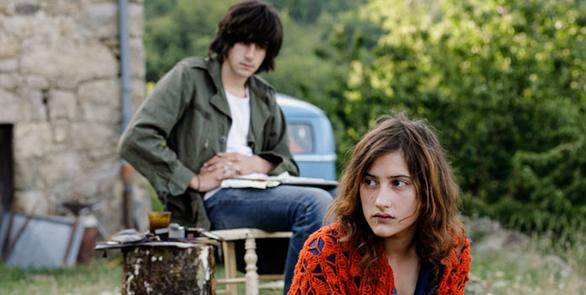
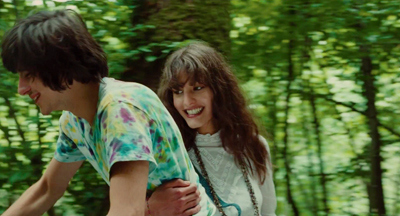
But the more important sub-plot is about Gilles and his true love, Laure (Carole Combes).  When she first appears early in the film, there is a jarring film switch from the smokey riots of their village to an Edenic, woodsy scene. She has come to meet Gilles and is in flowing white and the sun illuminates both her and the shimmering foliage around her.  I felt however that I was in a 1970’s shampoo advertisement and that any minute I would hear Donovan singing “Wear Your Love Like Heaven.”

Gilles and Laure

Gilles and Laure

Laure is a bit more worldly than Gilles and his mates, and her wealthy bohemian parents are taking her to London, as the father is the light-man for a fledgling rock band. She is willowy and bright and airy and full of sunshine.  And she leaves a mark that even Christine knows she cannot undo.  Later, when his father informs him that she has returned, he ventures out to her parents’ chateau for a party.  Throughout the party, I was reminded of when the Stones had moved to the south of France in the early ’70s  and had worked on Exile on Main Street.  There was the same louche, blowsy freedom, the same drug use, the same music, the same comings-and-goings.

The party is important, though I am not positive how it ended.  Gilles leaves. Laure jumps from a burning building and that is it.

And then real life steps in.  Gilles is a “go-fer” for his father’s film company (although a left-wing broadsheet has begun using his drawings), Leslie abandons her “spirituality” and returns with her father to New York and Julliard,  Rackham le Rouge leaves the Trotskyites for inconsequential anarchism, and Christine discovers that the earnest leftism of the man she is living with and the collective they are part of does not carry forward to women.

Olivier Assayas–who wrote and directed–gives us a nostalgic film, a film that even looks from an earlier period. The colors, the lighting, the cutting, the soundtrack all capture a particular moment in time.  And the two leads, Créton and Métayer are likeable and familiar–we do care about them and their decisions.

Frequently in the film, we watch characters watching films–and these films within a film are rendered in wavering, sincere, gaudy, and innocent beauty.  (Perhaps part of that innocence is the knowledge in hindsight that much of it is not going to last.) Indeed, film and film-making is such an integral part of the story that now I am not sure if Apres Mai (Something in the Air) isn’t a dissertation on film of that era disguised behind a story of that era.

In the end, Gilles is working on a science fiction film in London that features giant lizards and Nazis (and Dolores Chaplin, the granddaughter of Charlie and Oona!); Christine’s collective is releasing its first commercial documentary on Italian workers (though free to workers’ unions) and Gille’s dad is still turning out the Maigret mysteries.  However, Apres Mai ends with a haunting, new wave, almost psychedelic clip of a willowy woman walking towards the camera.

We recognize her by the end.

♦     ♦     ♦     ♦     ♦     ♦

And for a treat, here’s the Stones live in 1972 doing “Tumbling Dice” from Exile on Main Street.

The Blackest of Comedys: Martin McDonagh’s The Lonesome West and Six Shooters

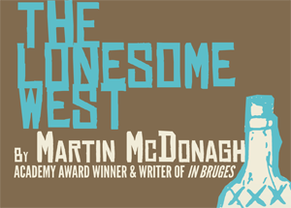
As many of you know, I am teaching a course in modern Irish literature this term to a group of 18-year old American boys.  As an American classroom, it is filled with various ethnicities and races.  And so, I can never assume that they know what I–or the authors they are reading–are talking about.  And so when we began Martin MacDonagh’s Lonesome West, I knew it was going to be a challenge to get them to enjoy it.poster

Because, when all is said and done, that’s really the purpose…to get them to enjoy what they are reading.  And surprisingly, that is a difficult thing for them to do.  Sure they loved saying the word “fek” when we read the play out loud–and which sometimes occurs twenty-five to thirty times on a page.  (One student told me he loved the word so much he started saying it around the house.  I advised him that maybe he should rein it in a bit.)

But surprisingly, they were too uptight to enjoy the humor…or even to get it!  There is a great line where Father Walsh Welsh — even that’s funny: I explained that this character has appeared in three separate plays now and that no one ever gets his name right, so they continually call him both. Stone faces in front of me. … anyway, there’s this great line where Father Walsh Welsh is anguishing about his failure as a priest.  Coleman tries to reassure him:

Ah there be a lot worse priests than you, Father, I’m sure. The only thing with you is you’re a bit weedy and you’re a terror for the drink and you have doubts about Catholicism. Apart from that you’re a fine priest. …

I had to explain that that was funny.  I had to explain that Girleen’s blatant attempts at seduction, her outrageous dirty-mindedness, and her falling in love were funny. (The pathos of her ending was a whole other story!) That Coleman’s constant ribbing of Fr. Walsh Welsh about the priest scandal in Ireland was funny. And that a small village where a father has been murdered by his son, a mother by her daughter, and a wife by her husband is a funny world indeed, especially when the smashing of holy figurines or stealing poteen is considered a more serious crime.

They were fine in talking about themes of redemption and reconciliation, in tracking down and explaining symbols, and analyzing character.  But they stumbled upon the humor.  And when all is said and done, that might be more important than all that the other stuff.

sixshooterAnd so I thought I would relieve their reading by showing them MacDonagh’s Oscar winning short film Six Shooter.  Unlike most of MacDonagh’s work which takes place in the west of Ireland, this takes place in  southeast Ireland, particularly on a train to Dublin.  A man is returning from hospital where his wife has just died that morning. He boards a train to go home and sits next to a young twenty-something who is a bit more than strange and possibly deranged.  The boy’s patter, aggressiveness and nonsequiturs are amusing, uncomfortable, and awkward.  But they are also, at times, bizarre and hilarious.  But maybe not to a group of high-school Americans.  Suffice it to say that by story’s end we have seen a cow explode, a rabbit get shot, a woman throw herself off a train, a character gunned down by police and a man fail at his attempt at suicide.  And that is  the violence that happens just on screen.  (I explained to them that MacDonagh was a combination of Quentin Tarentino, David Mamet, and John Millington Synge.)

Anyway, if a short movie that moves the cartoonish violence of Tarentino into the idyllic countryside of the Irish coast sounds appealing, then here it is below. It did win a 2006 Oscar in movie, though I don’t know if that held any sway with my boys.  Here it is:


Movie Review: Barbara, The Lives of Others, and Paranoia

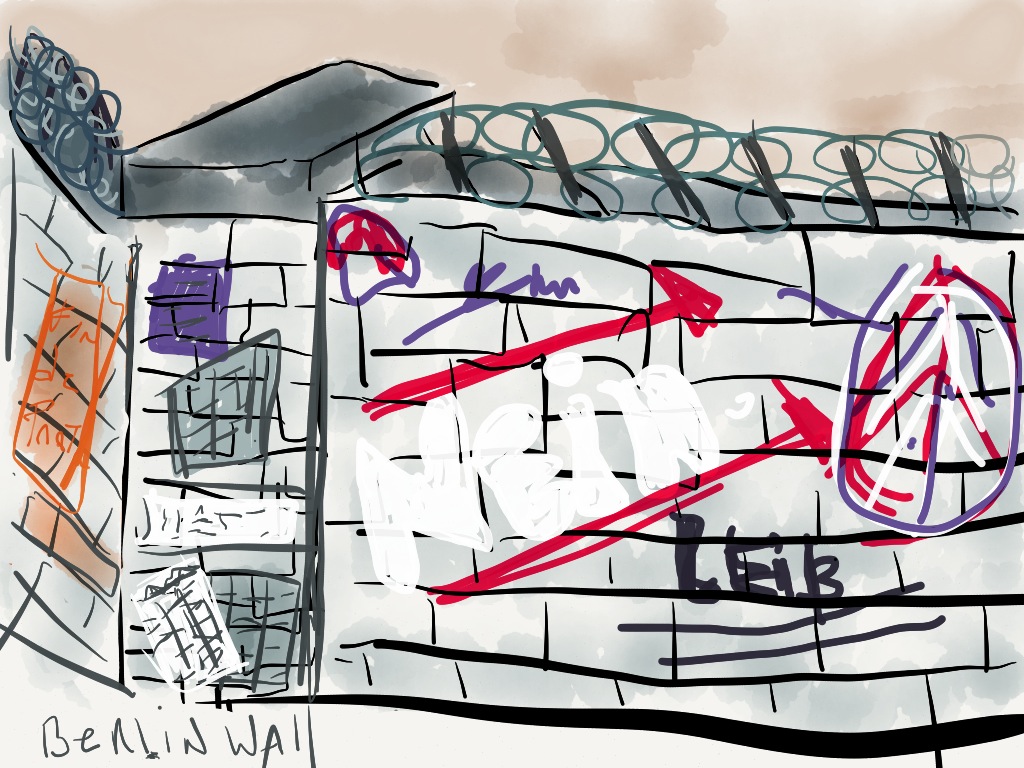
Berlin Wall                     2013 jpbohannon

Berlin Wall
illustration by jpbohannon © 2013

The East German film Barbara begins with a sense of paranoia and never backs off. Colors are muted, weather is stormy and damp, buildings are dilapidated. And Barbara (Nina Hoss) enters the picture wary, distant and observant.

Remember that old Kurt Cobain lyric that states that “just because your paranoid it doesn’t mean they’re not after you.” Well, it has never been truer than with Barbara. The film opens in East Germany in the 1980s with Barbara arriving at her job early. She is alone, aloof, and very aware. As she sits having a final cigarette before going into work, we see two men spying on her from a window and they give us some back-story. They already know her life. Barbara was a prestigious doctor in “the city” and for some misadventure–we are never told what–she has been sent to work in the provinces.

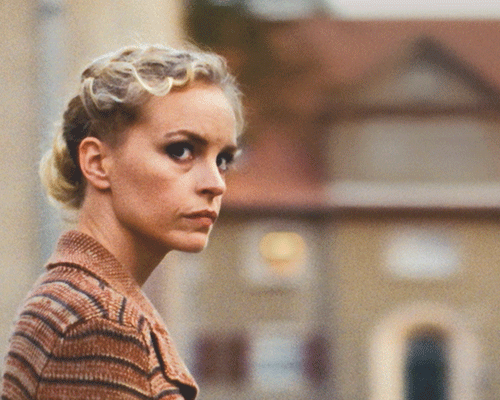
Nina Hoss as Barbara in the film Barbara

Nina Hoss as Barbara in the film Barbara

Andre (Ronald Zehrfeld), the young doctor who is her “handler,” is impressed by her skills but flustered by her attitude. He too has had a past that has sentenced him to this provincial hospital. But she sees him as nothing more than a pawn of the government. When he first offers her a ride home from the bus stop where she waits, he drives her home–without asking where she lives. Barbara is very certain of the eyes that are on her.

This oppressive watching makes Barbara’s secret plotting even more difficult. She is repeatedly meeting a lover who is arranging to have her escape to the West. And while the authorities are not aware of her plans, they are unhappy when she is unaccounted for hours at a time. Twice when she returns home, the Stassi are at her apartment, having rifled through her flat and subjecting her to a full body search. The humiliation and oppressiveness is palpable.

There are also two young patients that Barbara and her handler attend to, one of whom grows very fond of Barbara and begs not to be sent back to the work farm where she is sentenced. The young girl will play an important role later in the film, but it would be too much of a spoiler to say how. The other too is a fulcrum on which the plot balances.

Needless to say, the romantic tension between Barbara and Andre grows, but it is always secondary to the political and personal tension involved in Barbara’s escape.

Without giving too much of the ending away, let me just say that it is satisfying, heartwrenching and thoughtful.

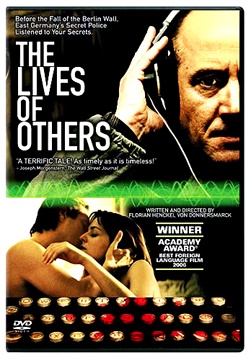
The East German paranoia reminded me of another film The Life of Others directed by Florian Henckel von Donnersmarck. This too took place in East Germany during the 547_The-Lives-of-Others_375931980s, but the film was told from the point of view of a Stassi spy. Spying on a writer and his lover, he becomes increasingly involved in the life he is observing. And while the oppressive paranoia and wariness is as palpable as it is in Barbara, it is, perhaps, less personal. In the former, we are in fairly familiar territory–the spy thriller, albeit with a twist. In director Christian Petzold‘s Barbara, the paranoia, the fear, and the oppression–engulfing the lives of everyday people as it does– seems more suffocating, closer to real.

♦ ♦ ♦ ♦ ♦ ♦ ♦ ♦

I’m not sure what Leonard Cohen has to do with any of this, except he tells us that “next we’ll take Berlin” in this, one of my favorite songs. But the water’s edge where the video begins is eerily reminiscent of the water’s edge where Barbara ends and that is what I thought of. Enjoy:

A Portrait of the Artist with One Left Foot

Joyce  ©2013 by J.P. Bohannon

Joyce
illustration by jpbohannon © 2013

I’ve had the nice experience of putting two seemingly different works together and seeing startling comparisons that I hadn’t thought of before. In the class I am teaching on Irish Literature, we had begun the semester with Joyce’s A Portrait of the Artist as a Young Man. From there we moved through some Frank O’Connor stories, some Yeats poems, and three plays by John Millington Synge. And then as a breather, I showed the film My Left Foot, based on the autobiography of the Dublin poet, painter and writer, Christy Brown.

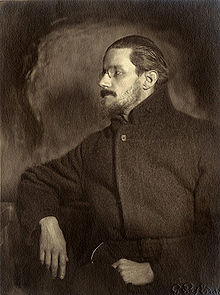
The Artist Joyce as a Young Man

The Artist Joyce as a Young Man

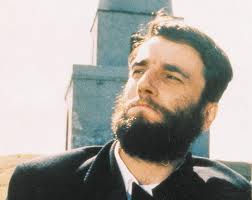
Daniel Day-Lewis as Christy Brown in My Left Foot

Daniel Day-Lewis as Christy Brown in My Left Foot

I have a fond relationship with My Left Foot which began long before the film was released. A friend of mine was living in San Francisco, working as a nurse. She would search the used book shops looking for the odd nugget, and she was always very kind to me. Every so often there would be a T-shirt from some cleverly-named dive bar, an esoteric album that no one knew about it, or a used book she found in her travels. One day, in the mail came a package containing My Left Foot by Christy Brown. I didn’t know the book at the time though it was twenty years old by then, but the worn and ragged dust jacket and the beaming face of Christy Brown on the back announced the joy, the vibrancy, the humor, and the pathos of the story inside.

I remember reading it twice in a short space of time, of lending it to a friend, and then lending it to another, and soon I lost track of it. And, to be truthful, I forgot about it. Until the movie was released and Daniel Day-Lewis’s performance announced to the world that this was someone to watch.

Viewing it this past week, so close to having finished Joyce’s Portrait, however, impressed on me how similar the story of these two Irish artists are. Joyce’s hero–Stephen Dedalus–is a sensitive, young child, bullied a bit at school, helpless without his glasses.

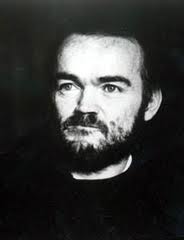
Christy Brown

Christy Brown

That Christy is also helpless, everyone assumes. Born with cerebral palsy and able to move only his left leg, he spends his early years lying under the stairs watching his family interact with each other—for better or worse. Joyce’s novel also begins with the early interactions of the family. From the hairy face of his father and the nicer smell of his mother when he was an infant to the fierce political/religious argument at Christmas Dinner, the Daedalus family is indeed similar to the Brown family. Particularly in the characterization of the fathers and mothers.

Simon Dedalus and Paddy Brown are hard men, perhaps a bit too fond of the drink. And both young boys, Christy and Stephen, see it as their responsibility to save their families from the fathers’ excesses. The mothers are doting: Christy’s mother innately sure that her son was more than just the vegetable that everyone believed him to be and Dedalus’ mother praying for her son’s soul and protecting him from his father’s increasing wrath.

And it wouldn’t be an Irish tale, if religion didn’t play a part. Father Arnall’s sermon on hell affects Stephen to such a large degree that he believes he might have a priestly vocation. And Christy is taught religion by a priest who comes to the house and who is also fond of describing the fires of hell–and causing young Christy no end of terrors.

Relations with the opposite sex are a stumbling block in both works as well. Sensitive Stephen vacillates from madonna to whore to madonna throughout, while Christy–caged within his crippled body–falls in love easily and is rebuked as often.

But the importance of both works is the creation of the Artist. Joyce’s Dedalus ultimately abandons church, nation and family in order to strike out on his own and “forge …the consciousness of [his] race,” while Christy embraces that world–dear dirty old Dublin and his sprawling family–to find the inspiration of his art. The artistic output–however disparate–is not the point here. The point is the development of an artist within similar constraints and backgrounds, a tale of two young men who travel the same narrative arc in order to discover the art that is within them.

♦ ♦ ♦ ♦ ♦ ♦ ♦ ♦

To one and all, Happy St. Patrick’s Day.

Movie Review: Liberal Arts–Light but Enjoyable

David Foster Wallace famously gave a commencement speech at Kenyon College in 2005. The speech –Wallace’s only know public speech–had been printed and reprinted, e-mailed and downloaded time and again, and now is published as the book, This Is Water: Some Thoughts, Delivered on a Significant Occasion, about Living a Compassionate Life.  Wallace, whose magnificent and enormous novel Infinite Jest is perhaps for the millennium generation what Gravity’s Rainbow was for the Viet Nam generation, is known for his intricate plots and subplots, his baroque sentences, his numerous footnotes, and his expansive and enormous intellect.

Well, Kenyon College and Wallace meet up again in the 2012 comedy Liberal Arts.  Actually, Wallace isn’t there physically, but Infinite Jest is, and the novel and its author play a significant part in a poignant subplot about a depressed, genius undergraduate. In fact, towards the end of the film, the hero tells the hospitalized boy to put down Infinite Jest  (he has already read it three times) and pick up one of the Twilight books! 

Kenyon College, on the other hand, is very much visible–and looks torn right out of a college brochure. The leafy campus, the quaint town, the rural surroundings, all make Kenyon look like a movie set for the perfect college.  However, although Kenyon is one of the more illustrious and demanding liberal arts colleges in the U.S., it offers up a pretty “easy-A” with Liberal Arts. Nothing too difficult, too taxing , or too subtle.

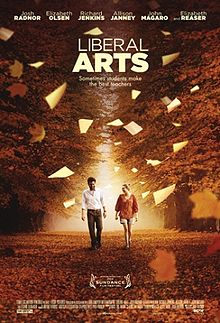
The film tells the story of Jesse (Josh Radnor), a bookish and sensitive admissions officer at a New York City college (read NYU) who is dissatisfied with his job and his life. When he is called back to Kenyon to attend the retirement party of one of his favorite professors (Richard Jenkins), he meets Zibby (Elizabeth Olsen), an undergraduate studying Improv Theater.

Elizabeth Olsen and Josh Radnor in Liberal Arts

The 35-year old Jesse and the 19-year old Zibby hit it off immediately and enjoy each other’s company as they wander around the bucolic campus. When Jesse returns to New York, he begins a “pen-pal” relationship with “Zibby” that is sweet, literate and full of hope.

However, when he returns to visit her, the differences in their age–and life experience–plays very much on his mind. (To me, since the actors do not seem all that greatly separated in age,  the age difference did not really seem all that jarring.)  Her attempt to bed him on this second visit is the moral center of the movie.

There are some wonderful performances–Allison Janney as an ice-hearted professor of the British Romantics is marvelous and Zac Efron as a chorus-like sprite that pops in and out of the story is charming and enigmatic. And the lead characters are very likeable.  The camera work between Ohio and New York is beautiful and perfectly captures the shift in energy that Jesse feels in moving between the two places. And the subplot with the depressive undergraduate is interesting enough, if rather slight. (It might have made a better movie in itself.)

In all, the film is concerned with life and its trajectory, with love and its various shadings, and with contentment and its frequent elusiveness. It is funny and literate at times, but for the most part it is a simple story, simply told.  Liberal Arts could have been a much weightier film–but that’s not the film the director chose to make.

I can’t imagine David Foster Wallace liking it. There isn’t much layering here, not much that he could footnote.  It would  have made a very slim novel.

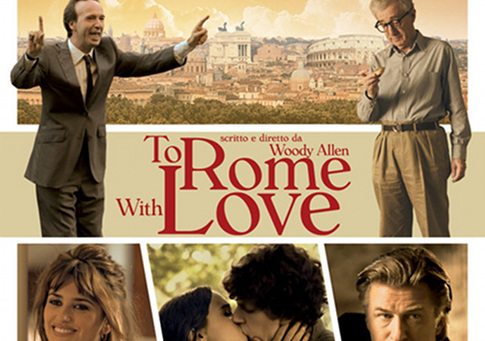
Movie Review: To Rome with Love, written and directed by Woody Allen

With an over-sized brace on my knee, a bottle of Vicodin in my pocket and a set of “just-a-bit-too-tall” crutches, I limped down to the corner, grabbed the 57 Bus on 4th street, and rode it to Walnut where I hobbled over to the theater to see Woody Allen’s latest film, To Rome with Love.

I used the word “hobble” intentionally because that was what Woody Allen seemed to have done with this collection of slight stories set in Rome, the eternal city. He took several disparate tales and hobbled them into some sort of unity– a whimsical investigation of fame and celebrity, set under the bright Roman sun. (It is noteworthy, that very few scenes take place after sunset–there is the finale on the Spanish steps and a cheesy storm-scene in the Roman Baths. The rest is filmed beautifully in the bright Italian sun.)

There are four basic stories:

♦ a young architect with dreams of greatness and confused romanticism is being advised by the pedestrian man he will become.

♦ a funeral director with a magnificent operatic voice can only sing in the shower.

♦ a newly wedded bride is seduced by a celebrated actor, an incompetent hotel thief, and her newly educated husband.

♦ a middle-class man becomes famous for no reason at all.

Each story is successful to varying degrees.  And each has its own charm…to varying degrees.

Alec Baldwin plays the elder architect watching his younger self stumble through a risky affair. Woody Allen himself plays a retired opera impresario trying to get the shy mortician to sing on stage. The Italian actress, Alessandra Mastronardi,  plays the timid newlywed who is bedazzled by her favorite actor. And Roberto Benigni plays the hapless man who becomes–for no reason at all–the most famous man in Rome.  The stories are not connected but move from one to another easily.

Allen has proven before that no one makes a location look as attractive as he can, and here again, he does for Rome what he has previously done for Paris, Barcelona, London, and–most readily–New York.  He also proves that he has the ability to get wonderful performances from his actors.  Alec Baldwin is all self-effacing and snarky wisdom; Penelope Cruz seems to be channeling those  mid-century Italian film stars–Sophia Loren and Gina Lollabrigida; Benigni is permitted to clown with little restraint; and even the young actors–Jesse Eisenberg, Greta Gerwig, and Ellen Page–are given room to breathe into their roles.  On screen, Allen, reprises the role he has played forever–the neurotic, death-fearing, nebbish.  But perhaps the most extraordinary performance is that by the great, internationally-acclaimed tenor, Fabio Armilato, who plays a man who can only sing in the shower and who gamely lets Allen place him in several showers throughout the film.

Allen has long proclaimed his love of European movies–he famously dabbled in Bergman-esque type films in the late 1970s–and earlier this summer he listed four Italian movies that he felt influenced him profoundly. Two were by the director Vittorio de Sica (The Bicycle Thief and Shoeshine), one by Michelangelo Antonini (Blow-up) and one by Federico Fellini (Armacord). He stated that these films changed the way stories could be told, a narrative arc very similar to that which he would use in many of his own films.

He quipped about his love of European film: “I wanted nothing more than to be a foreign film director, but, of course, I was from Brooklyn which is not a foreign country.”

And yet, while To Rome with Love is an entertaining two hours, it is much less substantial than the four films he had referenced. Even as a comedy, it lacks a certain gravitas.

No, by no means is To Rome with Love a hearty, four-course Italian meal–and maybe it is not meant to be.

Simply, it is a lovely four-scoop of gelato. And sometimes that’s all you need to get you through a Saturday afternoon.

If you haven’t seen the trailer, here it is:

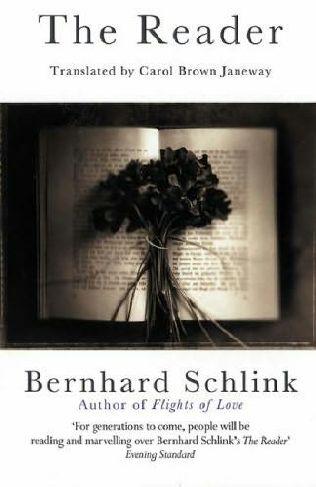
Book Review: The Reader by Bernhard Schlink

Cover of Bernhard Schlink’s book.

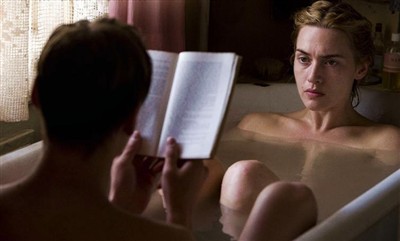
A scene from Stephen Daldry’s film, The Reader

The old question of the book and the movie: Can a film ever do a novel justice?  Or should we look at them as entirely separate works of art and not make the comparison at all?  Just the parameters of a roughly  two hour viewing experience seriously limits what a film maker can do with his source, a source that usually comprises a multi-hour/multi-day experience for a reader.

Certainly there are films that are more successful than others in capturing the essence of a novel. And just as certain there are real travesties. But the successes are such because they capture the spirit of the novel rather than getting lost in trying to relate every detail.  I am thinking of Mike Nichols Catch-22 based on the Joseph Heller novel.  The film works because it perfectly captures the inanity of bureaucracy, the numbness of war, and the black humor of Heller.  It is a large novel, non-linear in its arc, and Nichols captures its essence without getting bogged down in trying to capture every character and sub-plot.

I saw the film The Reader when it was released in 2008 and only got to reading the book in 2012. (I had two friends who refused to see the film because they had loved the novel so much.)  Regardless, it was a compelling film with a maddening and dramatic twist.  A young school boy (Michael) has an affair with a older woman who insists that he reads to her every time before they have sex.  He reads her all the classics–The Odyssey, War and Peace, etc. But she seems oddly aloof, and at the end we realize why. The boy, on the other hand, grows into an unfeeling man, and his coldness and inaction when needed is what is infuriating.

The novel–by its very nature–is quite different. First, it is much more internal, narrated by the boy who often questions and analyzes his own thoughts and his own actions. There are ruminations on the ethical choices made by ordinary citizens during the Holocaust, on the responses of the following generations on the actions of their own mothers and fathers. (These scenes take place in 1966, two decades after the war.) And yet while the narrator weighs, dissects, conjectures about these ethics, his own actions–many years after the war–must also be examined.  His coldness, his lack of human kindness, his decision not to act is all quite similar to that which he condemns in the female guards who are on trial in the second half of the novel.

When Hannah (the older woman) confesses to a crime she did not commit rather than reveal a secret she is much more ashamed of, she is given life imprisonment. Michael has information that could acquit her that he does not reveal.

To me, the ending is insignificant, despite the attempt to redeem Michael. Yes, he does reach out to Hannah, he does realize his own hardness, and he does try to do right.  But it is all too late. I had grown to dislike him so much by then that his redemption was all but impossible for me.

Most of the details of the plot remained the same from  book to  film but the internal voice was missing–or at least adulterated. The novel also starts out quite erotic which simply cannot be captured adequately on film with the same impact–words seem always more intimate and immediate than soft-lit actors and actresses.

The old question of book and movie?  In the case of The Reader, both.  They are two different things, two very good experiences, two separate ways of engaging a reader/viewer.

A small whiskey, the Zoetrope Cafe and Francis Ford Coppola

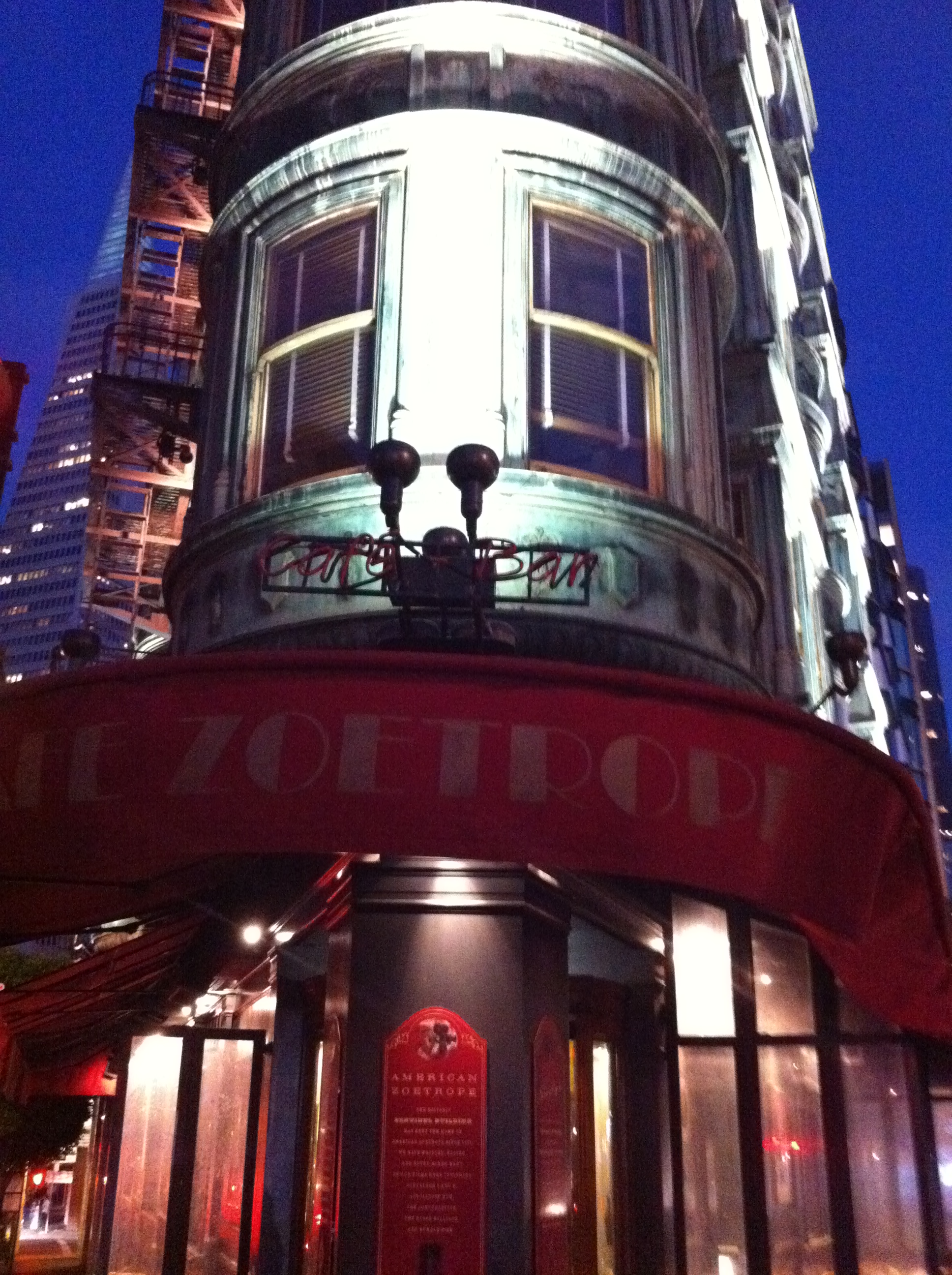
As one travels towards the end of North Beach in San Francisco, just before entering the financial district, there is a distinctive building on the corner of Columbus and Kearney. Its iron sheathing has been oxidized a gentle green color and, in a way, it resembles an ornate version of the Flat Iron Building in New York.

The building houses the offices of Francis Ford Coppola. Aside from the production duties, the writing, and script doctoring, it is here that Coppola does all his film editing–where all the Godfather movies, Apocalypse Now, Dracula and so many others were edited.

It is also where the literary journal Zoetrope: All Story is produced.  The journal presents some of the finest in contemporary fiction and one-act plays and has featured such established writers as David Mamet, Don DeLillo, Andrew Sean Greer,  Margaret Atwood, Salman Rushdie, Woody Allen,  Neil Jordan, and Haruki Murakami. (Full disclosure: I had submitted once when the magazine first started up, not realizing I was so far out of my depth.)

And on the bottom floor is the Zoetrope Cafe, an Italian bistro, featuring an Old World menu and, not surprisingly, a large selection of Coppola wines.

So last night, we stopped in for a nightcap. 

I noticed what I wanted on the shelf immediately. The whiskey was poured into the most unusual bar glass I’ve ever seen. It was more like a “petri-dish” than a drink glass, about an inch and a half-tall and 4 inches wide.  We asked if the barkeep had ever met Coppola, and she said she did for the first time that day. He told her to call him “Francis” which she said she was still a bit uncomfortable yet to do.

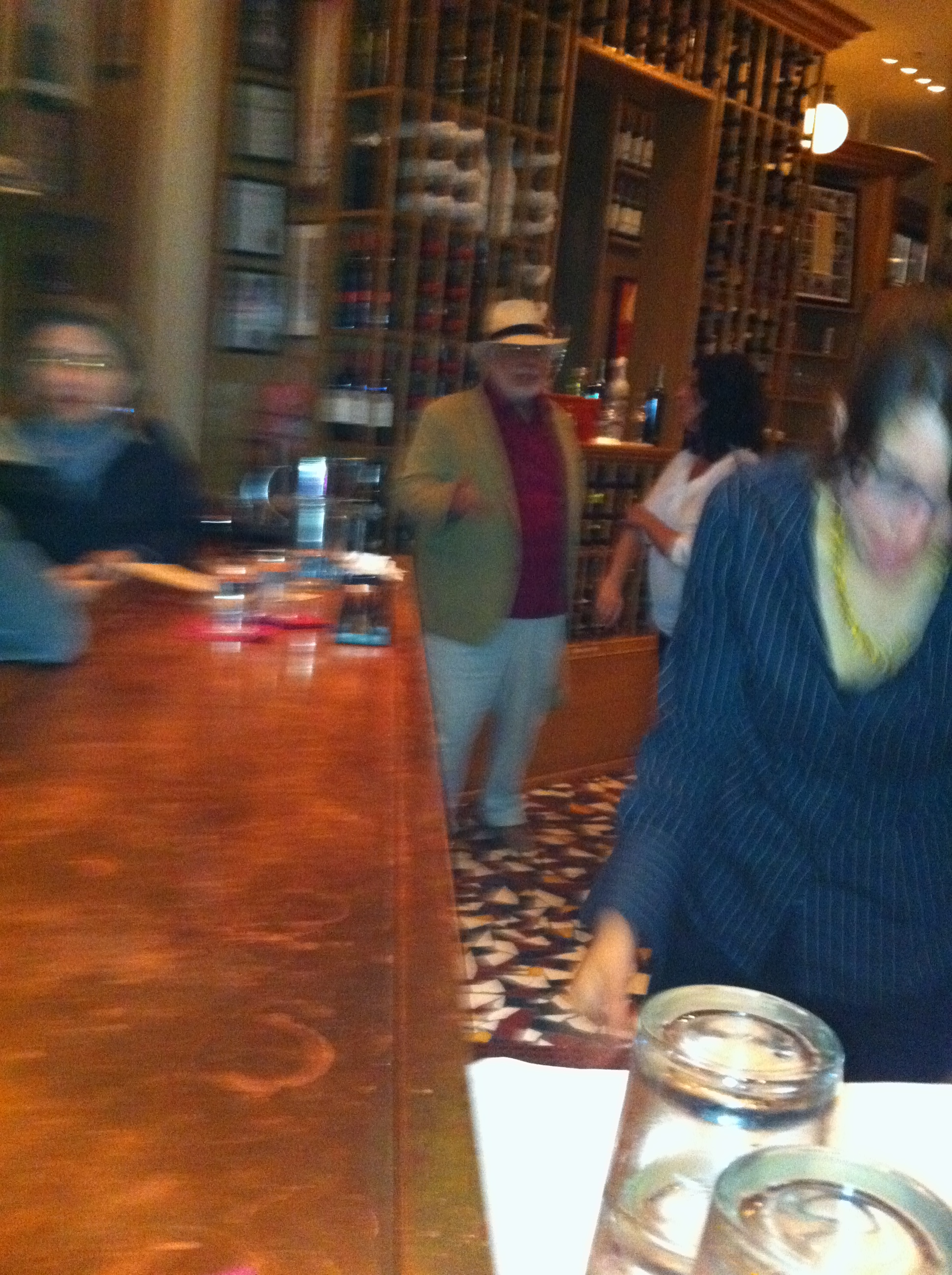
There were copies of Zoetrope in a corner so we brought a couple to the bar and began leafing through them when the bartender came back and with a jerk of her head whispered, “There he is.”  Coppola was chatting with the hostess, looking as if he was going over the wine stock.  About fifteen minutes later, he called to his wife who had been sitting in the corner next to us and they left the cafe, getting into an ordinary SUV.

I had seen the poet Lawrence Ferlinghetti the day before and now Francis Ford Coppola this night, and there was so much I would have liked to ask them both.  But their celebrity is mostly in our minds only–their audience.  They, themselves, must go through their days and nights much like you and I, and the intrusion of strangers certainly must be tiresome. At the same time, it is also good to see these literary/cultural lions in their daily routine–to see them simply as working men, no different than the rest of us.

Still, I would have loved to have bought another whiskey, offered each a drink, and listened to what they had to say.

Francis Ford Coppola, July 12,2012, Zoetrope Cafe