Book Review: TransAtlantic by Colum McCann–the world continues spinning.

National Book Award Winner, Colum McCann

National Book Award Winner, Colum McCann

Around this time last year, a friend of mine lent me a paperback copy of Colum McCann’s Let the Great World Spin. It was nothing short of masterful, an eloquent novel filled with beauty, wit, humor, and wisdom–and a helluva story as well. A variety of personal histories are threaded around the dazzling 1974 tight-rope walk of Philippe Petite between the World Trade Towers and set against the more resonant chapter in the Towers’ history, with the tragedy of 9/11 looming in the background. The writing was dizzily beautiful, every page an extraordinary read.let the great world spin
When I returned to work at the beginning of the school year, I learned that many of my colleagues were also reading McCann’s novel. And each of them held the same high opinion.
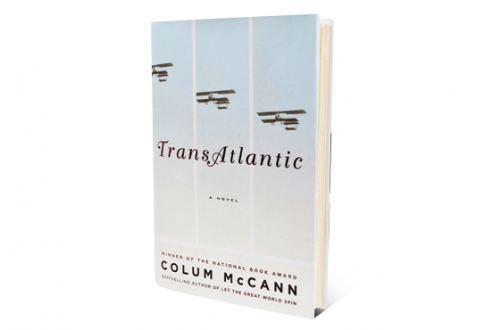
Now, this summer I was excited for the release of McCann’s latest novel, Trans Atlantic. And my anticipation was well worth it.
Like the previous work, McCann’ new novel is steeped in history, although this work stretches from 1847 to 1998 and concerns three separate stories of historic figures who have traveled across the Atlantic.
The novel begins in 1919 with two pilots, Alcock and Brown, both veteran RAF flyers, about to embark on the first transatlantic flight. The two leave from Newfoundland for Ireland, with a thermos of tea, a few wax-papered sandwiches, a load of mail, and a lot of gumption. At one point, close to their end point then get caught in an enormous cloud. They lose their perspective, not knowing what’s up or down, what’s left or right, The only way to survive is to go into a spin–a dangerous thing in itself. But the ultimate fly out and land in a bog field in Galway. The soft earth swallows the nose of their plane.
books.transatlantic_1
In fact, “spinning” is a theme that plays greatly in this book–seemingly carrying on a theme outlined in the last novel.
The second story comes seventy years earlier, and Frederick Douglas, the escaped slave, has traveled to Ireland to promote his book. (Although he had tried to book first class passage, he had been threatened and made to sleep in steerage.) In Ireland, however, he is feted and adored by the Anglo-Irish; he gives speeches to large audiences, garners great donations to send home to the abolitionist movement and his book sells well. But he too feels he is spinning. At one point, he even refers to himself as a tightrope walker (he says “funambulist”–I had to look it up.) Again we are echoing the tropes of the last novel.
Douglas is “spinning” because while he is being celebrated for his passion for equality and the end of slavery in America, he witnesses the utter horror of the starving Irish, starving while rivers of food, livestock and goods are exported to the rest of the British Empire. (Ireland led the British Empire in beef exports during the years of the potato famine!) It is the beginning of the potato blight, and Douglas is greatly affected by what he sees–the men whose faces are brown from eating bark, the woman whose arms are like ropes asking them to take care of her dead infant–affected by the disparity between the Anglo overlords and the downtrodden Irish.
On stage, he meets and joins the great liberator, Daniel O’Connell, but when he later expounds O’Connell’s beliefs at table, his host pulls him aside and tells him not to “bite the hand that feeds him.” Douglas’ tightrope-walk is to embrace justice and freedom for his people, while keeping silent about the horrors of Ireland in the 1840s. The one will bring funds and awareness to the abolitionist movement back home; the other would dry those funds up. It is a dizzying conundrum.
The third story takes place in 1998 and follows George Mitchell as he jets back and forth across the Atlantic negotiating what would become the Good Friday Peace Accord. Mitchell has been picked by President Clinton to lead this historic conference, and, aside from the constant jetting back and forth, he feels his head spinning from the various participants in the process: the separate governments, the various paramilitary organizations, the political parties, the loyalists, the nationalists, the Gaels, the Unionists, etc.
Here is the world that Mitchell is trying to straighten out, trying to stop from spinning further out of control:
The Battle of the Boyne. Eniskillen. Bloody Sunday. There was a clue in every detail. Gary was a Prod. Seamus was a Taig. Liz lived on the Shankill Road. Bobby on the Falls. Sean went to St. Columba’s. Jeremy to Campbell. Bushmill’s was a Protestant whiskey. Jamesons for Catholics. Nobody drove a green car. Your tie was never orange. You went for holidays in Bundoran or you went to Portrush. Fly you flag. Pick your poison. Choose your hangman.
Added to this, the ex-senator, is an old father. At sixty-four, his son is only five months old. Talk about your head spinning. In the five months of his son’s life, Mitchell has been home less than twenty days–his transatlantic treks becoming more and more urgent. (Mitchell did this for two years and received zero salary, just expenses.)
All three stories–like the stories in Let the Great World Spin–are threaded together in a marvelous tapestry of history and generation, of perspective and connection. Four generations of women–from the scullery maid who met Douglass in 1846 and emigrated on a coffin ship to America to her great, granddaughter shaken but unbowed by the Troubles that George Mitchell is striving to repair–weave their story through the historic narrative.
And the language is exquisite. The streets of New York, the light on the town of Cove, the sky above the Atlantic, the horrors of a Civil War field hospital, the ice fields of Minnesota, all are described with details that are both lyrical and true. The inner and outer lives of both the historic personages and the fictional characters are drawn with verisimilitude and generosity. And the story itself is affirmative and moving, profoundly moving.
In an NPR interview after Let the Great World Spin won the National Book Award, McCann implied that he now thinks of himself as a New York writer. That may be so. But the transatlantic tug is a strong one, and his Irish way with words is very much still serving him well.
Find the book and read it. It is that good.


Movie Review: Pedro Almodovar’s I’m So Excited! (Los Amantes Pasajeros )

Pedro Almadovar famously said in 2012 that Pablo Berger’s Blancanieves was the best film made in Spain that year.

Pedro Almodovar at London premiere of I'm So Excited

Pedro Almodovar at London premiere of I’m So Excited!

Whether it was false modesty or not on Almodovar’s part, he could have said that his own Los Amantes Pasajeros was Spain’s funniest movie of the year.

Almadovar’s film–which was given the English title of I’m So Excited!--gives us all the things one wants in an Almodovar film: Brightness, intelligence, silliness, kinkiness, a large dose of drugs combined with a bit of social commentary, modern instability and fractured and teetering relationships . Working within a particular genre–a group of unusual characters are trapped within a small confine, Almodovar uses the trope to have fun, plain and simple.

The plot of the film is that a plane bound for Mexico from Madrid encounters immediate mechanical problems and must begin circling until an empty airport can be found so it can make an emergency landing. The crew, in order to keep things calm give the entire “economy class” and its attendants muscle relaxers, and they are asleep they entire film (except for one who is later sexually awakened!) Leave it to yourself to figure out what Almodovar is saying about the sleeping “economy class.”

Meanwhile business class has seven passengers: a washed-up actor, the most famous dominatrix in Spain, a shy hit-man, a crooked businessman, a honeymooning couple and a virginal psychic who has sneaked in from economy. And we soon learn their quirks, their secrets, and their passions. We are right to think we have been here before with Agatha Christie and that bunch. But we’d be wrong.

Listening to Norma's (Cecelia Ruth) secrets.

Listening to Norma’s (Cecilia Roth) secrets.

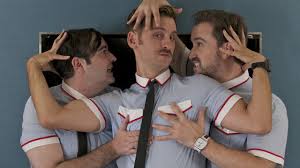
For we have never been here with the likes of Almodovar’s flight crew. They are introduced swigging shots of tequila as they prepare meals (their way to deal with the mechanical emergency after drugging the economy class). One has a pop-up Hindu temple that he prays to; the other is having an affair with the closeted and married pilot; and the third has his eyes on the “determinedly” heterosexual co-pilot. And as the danger becomes more eminent and potentially catastrophic, they entertain the business-class travelers with a song and dance routine (the Pointer Sisters’ “I’m So Excited!”)

The Airline Stewards performing "I'm So Excited"

The airline stewards performing “I’m So Excited”

This isn’t Ship of Fools, nor was it meant to be. It is silly, outrageous fun. And when the “Valencia Cocktails” are served, spiked with an overdose of mescaline, the fun really begins! As the one steward tells us, the mescaline will make people more open, more honest and horny. And was he ever right!

Almodavar has been soundly criticized for this, his nineteenth film, for its being too light, too campy, too slapstick. (One reviewer said to “never trust a movie title with an exclamation point”!) But the hell with them. Sometimes, light, campy and slapstick are what we need. I know I almost moved my seat because of the guffawing elderly lady near by. She laughed (loudly) non-stop. And there was good reason to.

Almodovar is sure of his craft and his precedents. The nods to Hitchcock’s Vertigo are almost immediately obvious–we quickly find ourselves staring into the twirling mechanics of a jet engine. While the awareness of his own personal filmography and progression is demonstrated by his opening the film with his original stars Antonio Banderas and Penelope Cruz–actors who never again appear in the film– anchoring it with Cecelia Roth who has played so many great Almodovar roles, and featuring a whole new stable of actors who are certain to show up in future Almodovar films. (Paz Vega is another actor who has played in Almodovar films before but who has a minor part and less than two minutes of screen time.)

Almodovar has his own bag of tricks and devices and storylines; that he uses them time and again is not necessarily a negative for me. We have neurotic women, shady men, flamboyant revelers, and unknowingly ingested drugs–as we have had often before in Almodovar films. But because the colors are bright and mod, the homosexuality over the top and flamboyant, the villains somewhat stereotyped and the story too sweetly resolved—because we know what to expect in an Almodovar film, it has been regularly panned by critics.

But for me, it was a cool, tasty, silly romp that was perfect for a muggy day at the end of July.

Disney’s Folly, Snow White and Disneyland

The Carthay Theater

The Carthay Circle Theater where Snow White and the Seven Dwarfs premiered on December 21, 1937

I’ve been in Southern California for the past two weeks, and yesterday I spent 14 1/2 hours in Disneyland. With a very energetic seven-year old. And I’m completely exhausted.

But I am sure of this: no matter what people say about the Disneyfication of things, one has to admit that everything they do is efficient and entertaining. And often awe-inspiring.

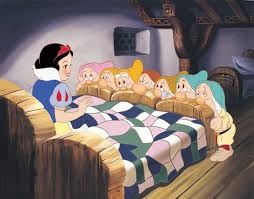
When Walt Disney came to California, he focused on making short animated films, primarily the Mickey Mouse and the Silly Symphonies cartoons. But in 1934, he decided to produce the first feature-length animated feature…much to the dismay of his brother and business partner, Roy Disney, and the delight of the Hollywood critics who called Disney’s project “Disney’s Folly.”

For what sensible person, it was thought, would sit through a 90 minute cartoon?

Disney mortgaged his house, brought artists in to train his animators, emphasized a European look for the artwork ensign design, and spent close to $1.5 million in 1937 dollars to get his feature,  Snow White and the Seven Dwarfs, completed.

If Snow White and the Seven Dwarfs hadn’t succeeded, most of us probably would never have heard of Walt Disney–except maybe for a few film students who might have studied his early cartoons.  Instead the film’s success, both among the public and the industry, allowed Disney to capitalize on success after success until the Disney brand became what would have been unfathomable to Disney itself.

The story of the making of Snow White and The Seven Dwarfs is well documented: the switch from a rollicking tale about the dwarfs to the romantic love story it became,  the metamorphosis of the Wicked Stepmother from a hare-brained slovenly witch to the sensuous, shapely queen that all boys of a certain age remember, the downplaying of the prince’s role in the plot–this is all a matter of history.

The wicked queen, witch, stepmother

The wicked queen, witch, stepmother

But no one would have cared about that history, if the film flopped.

On December 21, 1937, the film premiered at the Carthay Circle Theater. The premier, which was attended by all the Hollywood royalty—Judy Garland, Charlie Chaplin, Marlene Dietrich, Cary Grant, George Burns and many more were present—was an extraordinary success.  Outside the Carthay Circle Theater, 30,000 fans who couldn’t get tickets waited.  The NY Times led with the line, “Thank You, Mr. Disney” and Walt Disney and his Seven Dwarfs were on the cover of Time a week later. (Disney always saw the dwarfs as the centerpiece of his film.)

A shot the Walt Disney wanted badly in the film

A shot that Walt Disney wanted badly in the film

And the film made money. The numbers are staggering–within 15 months it had become the all time money making film ever–but more importantly Snow White and the Seven Dwarfs provided the seed money for what was to become the Disney Empire.

And so, as I trudged around Disneyland–visiting Radiator Springs and Ariel’s Undersea Adventure, as I watch Henson’s Muppets and a Broadway caliber Aladdin,  as I witness technological and creative boundaries pushed and optimized–I realize what an awful lot has blossomed from Disney’s hunch that people, yes, would sit through ninety minutes of animation.

By the way…

Did you know that Snow White and the Seven Dwarfs was the first film to release a “soundtrack” album as a separate entity?

Movie Review: Frances Ha (dir. by Noah Baumbach) —-running in place and getting nowhere

Frances running through the streets of Brooklyn

Frances running through the streets of Brooklyn

Frances runs a lot during the course of Frances Ha.  She leaves a restaurant and runs to the ATM, she runs to work, she runs to her parents in Sacramento, she runs back to New York, she runs to Paris, she runs from New York, she runs back to her old college, and she returns again to New York.  And until the end, she doesn’t get anywhere. She’s just running in place. She is hapless and feckless and lonely and dangerously stuck in the past.  And she is endearingly quirky.

Frances is played by Greta Gerwig who also co-wrote the screenplay with director Noah Baumbach. (There is a follow-up collaboration already in post-production, tentatively titled Untitled Public School Project). She–like countless others–have come to New York, because it’s the world’s biggest stage and she is a dancer. However, we are to infer, not a very good one.

So we follow her trajectory as she breaks up with her boyfriend, as her roommate leaves to move in with her mate, as she “crashes” in various friends’ apartments, and as she is “fired” from her job.  What is a poor girl to do?  Certainly, she makes some bad decisions–an impulsive trip to Paris on her credit card and a friendship shattering tantrum at a restaurant–but ultimately we know she is decent and hard-working, and we hope that things will pan out for her.

I had seen the trailer for Frances Ha a few months back, but hadn’t put it on my “must see” list. Then I saw an article in one of the free newspapers that ran with this headline:

“Woody Allen Call Your Lawyers…Someone has Stolen your Style.”

Greta Gerwig as Frances in Frances Ha

Greta Gerwig as Frances in Frances Ha

So of course that sent me to the theaters.  (I didn’t even read the article, just the headline.) The “stolen style” is the cinematography. It is filmed in black-and-white, and there are scenes that very much have a “Woody Allen” feel: New York street scenes, a shot going down into the subway, a scene around a table in an up-scale apartment, a family Christmas dinner.  These all very much LOOK like a Woody Allen film.

However, the similarity stops with the dialog.  What, I assume, is meant to be witty and quirky and insightful is not.  It simply does not come off.

Instead, we follow Frances (and her friend Sophie, played by Mickie Sumner) as she stumbles forward, sometimes awkwardly and sometimes ineptly.  And we want to root for her except that we often lose interest in her.  No doubt that her travails are all true to life, but more often than not it is simply that–true to life.  And life is often not all that interesting to watch.

I realize that Gerwig and Baumbach both have solid credentials in films about life’s wry moments. Baumbach has successfully co-written with Wes Anderson and has written and directed such films as Margot and the Wedding and The Squid and the Whale; while Gerwig has been working–non-stop it seems–with directors as varied as Daryl Wein and, yes, Woody Allen (Midnight in Paris), while increasingly taking part in the screenwriting, as well.  But Frances Ha left me wanting something more.

I want to like Gerwig and Baumbach’s work. I want to very much. I am excited about what they are trying. But so far, I am lukewarm with the results. I feel as if I know what they are trying to say, to do, but it is not coming across.

I feel as if they are running in place.

Quote of the Week #13: July 21, 2013

illustration 2012 jpbohannon

illustration 2012 jpbohannon

“If my books had been any worse, I should not have been invited to Hollywood, and if they had been any better, I should not have come.”

Raymond Chandler

The Getty Museum, Los Angeles– “a work of art with a museum inside”

20130716-223355.jpgWhen I think of art museums, I think of urban spaces. In my experience, most large cities ensconce their major museums within the city landscape itself.  And often times, the buildings themselves are as impressive as the art they house: the majesty of the Louvre, the edgy hipness of the MOMA, the serenity of the capital’s Hirschhorn, the classical grandeur of Philadelphia’s Museum of Art, the modernity of the Tate. Yet, again, each is an urban creation, set upon city streets.

The Getty Center of Los Angeles, however, is something wonderfully different. To get there one must drive–as one always must in Los Angeles–along some congested stretch of highway ( the 405) and pull into a car park. From there you take a tram car 900 feet up a mountain and when you disembark at the mountaintop, you feel you have arrived on Olympus itself.

A sculpture "running" next to the tram car

A sculpture “running” next to the tram car

The museum is open-aired. As you move from wing to wing, from gallery to gallery, you walk into the California sunlight–the San Bernadino and San Gabriel Mountains stretching out to the east, the Pacific Ocean to the west, the blue sky all around you. The buildings are constructed in beautiful white block with striated stone quarried in Israel and Italy that mutates in color from brown to gold to sandstone in the changing light. Large panels of glass and open-air passageways further blur the distinction between outside and in. As one museum docent said, “People come here with the idea that they’re going to a museum with works of art on the inside, but they’re really visiting a work of art with a museum inside.”

image

“Air” by Aristide Maillol

Sculptures both modern and contemporary are scattered throughout the grounds, so as you move from a special exhibition on Renaissance gardens to the Getty’s renowned permanent photography collection you must walk past Giocometti and Magritte and Henry Moore as well as Barbara Hepworth, Aristide Maillol and Charles Day.

Boy with a Frog, by Alexander Day

“Boy with a Frog” by Charles Day

Torso of a woman by Rene Magritte

“Delusions of Grandeur” by Rene Magritte

The holdings –and the special exhibits–that the Getty museum houses are world-class and extraordinary. From Van Gogh’s Irises to Mapplethorpe’s photos, from Titian to Rembrandt to Monet, the Getty is a magnificent collection.

But I could spend the entire day there and never walk inside.

by the way…

In case I didn’t say, there is also extraordinary art inside:

image

“Specimen (after Durer)” by John Baldessari

image

Book Review: Tenth of December by George Saunders

To be truthful, I was put off by all the hype that surrounded Tenth of December when it was released back in January. Articles about the short stories and their author, George Saunders, were everywhere. All the major papers, magazines and blogs were praising, lavishly, both the collection and Saunders himself. All of sudden I was seeing articles about or by Saunders from years past, all floating to the front, all becoming part of this giant group-hug! He was compared to Twain and Flannery O’Connor, to Vonnegut and Pynchon, to Bartheleme and Welty. Even the late David Foster Wallace was corralled in for a blurb on the inner covers.

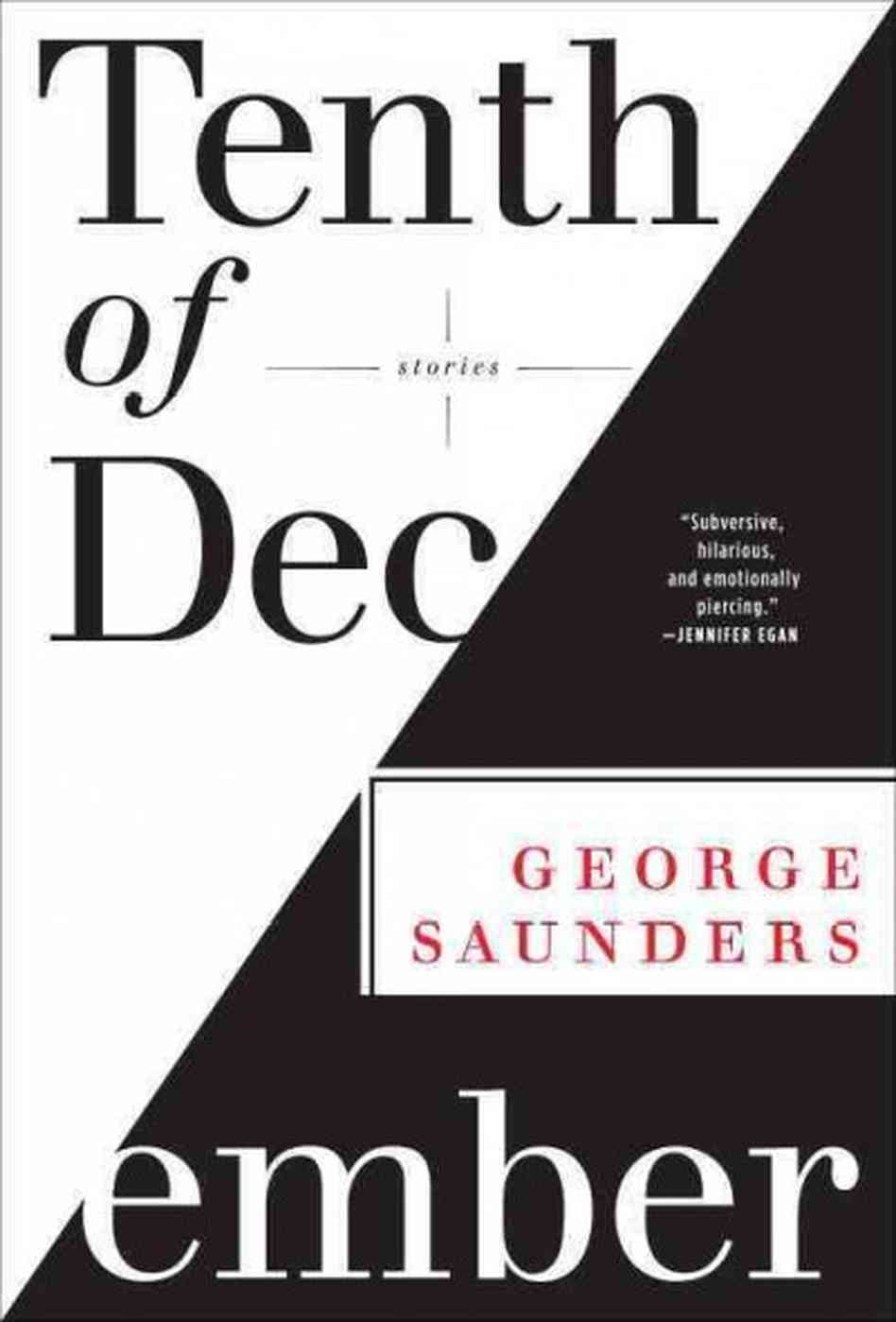
And now, I can say, all the hype was legitimate and deserved.  Tenth Of December is something special. 10thdecemberbookcover

The longest story in the book “The Semplica Girl Diaries” begins with a father, in the near future, starting a diary. As he begins, he recounts his fears and worries for his children, fears that they are growing up with so much less, materially, than their classmates. He also reveals his own anxieties about his failure as a provider of these consumer necessities. During the course of his journaling, the family is teased with a windfall and then pushed towards ruin. Oddly enough, strung throughout the story, literally, are third-world women who sell themselves in America as lawn ornaments, putting his own focus on material success in a very skewed light.

Other fathers–or father figures– appear throughout the stories. In the first story, “Victory Lap,” a young boy saves a girl who is being abducted. But he second guesses all of his heroic actions in terms of what his father would say about his getting involved and not completing his chores. At the same time, the perpetrator keeps worrying about his own father–and while carrying out his violent abductions–worries whether his father would be proud of the way he is doing things.

In a very short piece, “Sticks,” an aloof, mean-spirited and inaccessible father dresses a crucifix-like contraption for every holiday: Santa for Christmas, a groundhog for February 2nd, a soldier for Veterans Day, etc. When his wife dies, he dressed the pole as Death and makes a memorial to her. His own–and the sticks’–ending is seemingly inconsequential, but full of pathos nevertheless.

George Saunders

George Saunders

On the whole, Saunders’ stories are full of dysfunctioning families trying to succeed in a world of plastic values and overwrought commercialism. It is filled with simple people having difficulty coping in an increasingly complicated world. This world he describes is a bit off-kilter, but it all seems unnervingly familiar.  And his telling of these tales is enjoyable and unforgettable.

Life and death, hope and despair, pride and self-loathing: these are the topics that Saunders addresses but in a way that is funny as often as it is heart wrenching, a way that is wryly observed, emotional and thought provoking.

All that hype was well deserved after all.

Music Review: Tom Jones’ Spirit in the Room: “There’s a Lot New, Pussycat!”

tomjonesI can’t believe I’m doing this. But I am.  I am reviewing the latest Tom Jones album.  Mainly because it’s extraordinary.

Remember when Johnny Cash did that Nine Inch Nails cover produced by Rick Rubin and accompanied by that powerful video, and how every hipster coffee shop around now has a Johnny Cash tune playing on its sound system about once every 20 minutes?  If you don’t remember, here it is:

Well, Tom Jones is doing the same thing. He has left behind the Las Vegas glitz and the sex-god personna of his past (he parodied himself in Mars Attacks, for god’s sake!) And he is choosing songs that give resonance to his powerful voice.  Like a old bottle of Laphroaig that announces itself with a blast of peat smoke against your throat, Tom Jones voice is aged to perfection. And the lyrics he’s delivering add to that agedness, to the gravitas.Spirit+in+the+Room

Produced by Ethan Johns and covering songs by Leonard Cohen, Tom Waits, Bob Dylan, Richard Thompson, Odetta, Paul Simon and McCartney, among others, Spirit in the Room presents Jones stripped down and honest. Just as likely to be accompanied  by a single acoustic guitar or a tinkling piano as a full-tilt-boogie band, Jones dives into the blues, gospel, and roots music.

And again, he has the voice to do it: this time, however, one hears more of the Welsh ditch-digger than the nightclub lounge singer.  And in my opinion, that’s a vast improvement. He is authentic, he is wise, he is ruminative.

Jones’ cover of Cohen’s “Tower of Song” is every bit as good as Cohen has ever done it. One hears the pain of age, the pain of wisdom.

Richard Thompson’s “Dimming of the Day” is one of my top ten favorite songs ever (I own recordings by Thompson, Bonnie Raitt, the Corrs, Emmylou Harris, and a wonderful version by the short-lived band, Danko, Fjeld and Anderson) and I was excited to see that Jones included it here and that he does it well.

His voice smooths out Waits’ growl, roughs out Simon’s baritone and turns Dylan’s “When the Deal Goes Down” into a rueful waltz that reminds me of Jagger’s version of “The Long Black Veil” with the Chieftains. And his version of Blind Willie Johnson’s “Soul of Man” is almost threatening and is as jagged as the guitar that centers it.

I have always felt that Tom Jones was a bit schmaltzy but, to be fair, I never gave him much of a listen. He has always had a powerful voice, but his delivery was always a little more polished than I preferred, every end note seemed elongated, every word seemed to carry the same weight.  He always seemed to be overdoing what I saw was essentially an outdated vibrato.

But I was wrong or he has changed or I have changed.  Because Spirit in the Room is quite an achievement.

Now, I’ll  probably start hearing him every fifteen minutes in the coffee shops I hide in!

♦     ♦    ♦    ♦    ♦    ♦    ♦

Here is Tom Jones covering Leonard Cohen’s “Tower of Song,” the first track on the album:

Quote of the week # 12: July 14, 2013

illustration 2013 jpbohannon

illustration 2013 jpbohannon

“After so many years, I’ve learned that being creative is a full-time job with its own daily patterns. That’s why writers, for example, like to establish routines for themselves. The most productive ones get started early in the morning, when the world is quiet, the phones aren’t ringing, and their minds are rested, alert, and not yet polluted by other people’s words. They might set a goal for themselves — write fifteen hundred words, or stay at their desk until noon — but the real secret is that they do this every day. In other words, they are disciplined. Over time, as the daily routines become second nature, discipline morphs into habit.

“It’s the same for any creative individual, whether it’s a painter finding his way each morning to the easel, or a medical researcher returning daily to the laboratory. The routine is as much a part of the creative process as the lightning bolt of inspiration, maybe more. And this routine is available to everyone.

“Creativity is a habit, and the best creativity is a result of good work habits.”

Twyla Tharp, The Creative Habit