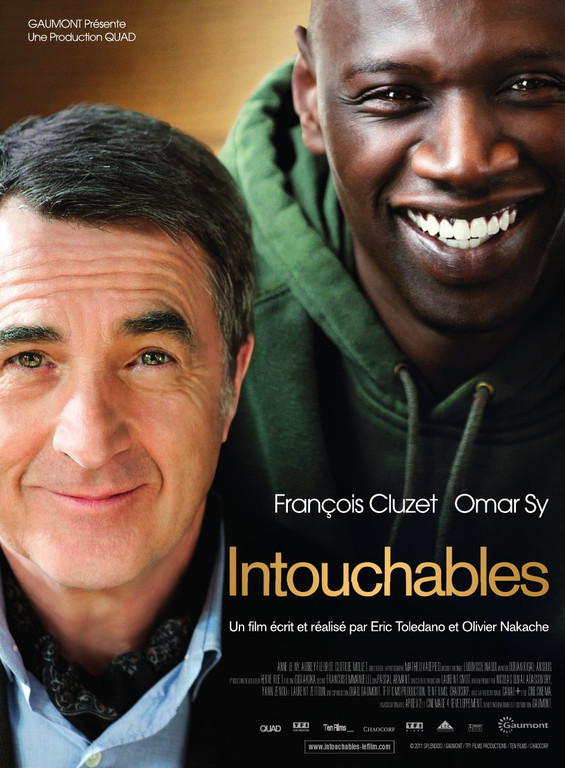
Monday Movie Review: The Intouchables

This is, without a doubt, the most enjoyable movie I’ve seen in a long time.

Two men, from vastly different backgrounds, form a relationship that is simply a delight to watch.

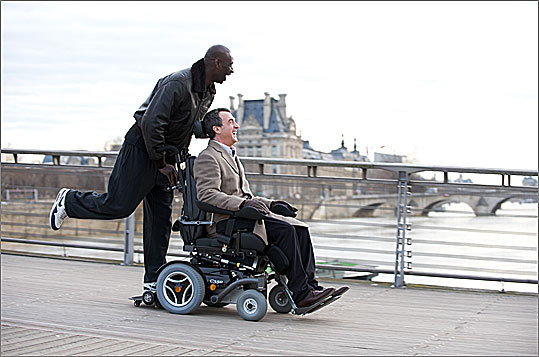
François Cluzet plays Philippe, a very wealthy business magnate who is now a quadriplegic after a para-gliding accident.  Omar Sy plays Driss, a Senegalese thug who lives in the Parisian projects and who becomes Cluzet’s live-in nurse.

The story line is predictable. Driss gets the job, bristles initially at some of its requirements, is overwhelmed by the luxuries of his new world, and rubs up against the expectations of his new boss. Phillipe, on the other hand, admires his new nurse’s honesty and his love of life. By movie’s end, they are very close and very good for each other.

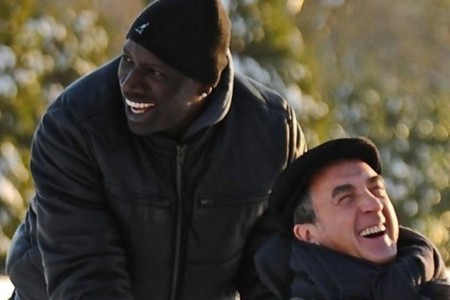
So if the plot is predictable, what is it about the movie that has made the second most popular movie in the history of France film-making? It is the perfect combination of Omar Sy’s over-the-top acting and Cluzet’s subtlety.  Cluzet, because of the physical handicaps of his character, must do all his acting through his face–and his enjoyment of Sy’s infectious joie de vivre is more than obvious.

Sy, on the other hand, dances, mugs, flirts, mimics, and roars laughing–in the rarefied environs of salon receptions, opera boxes, and art galleries.

Driss “pimps” Philippe’s motorized wheel chair so it can go 12 km/hr; he joyfully shares with Cluze the joints he is always carrying around; and in the end, he makes him face his greatest fear.

The chemistry between the two actors (and the two characters) is more than charming, and Sy’s relationships with the people around him–Philippe’s  household staff, Philippe’s daughter and her boyfriend, his own extended family in the projects–are both comical and touching, as well.

Based on a true story, Intouchables shows two men, from worlds as different as possible, becoming better human beings because of the presence of each other.

In writing about the film, it is all too tempting to give in to cliché:  It is a buddy movie like no other, a “feel-good” comedy, a lovely entertainment.  But the clichés should not take away from the truth.  Intouchables is in fact a very good film and thoroughly enjoyable from the beginning to the end

As I walked out of the theater I immediately texted a friend to tell him to be sure to get down to see it before it leaves the theaters. I can’t remember when I last enjoyed a movie as much.

Sunday Book Review: Hitch-22: A Memoir by Christopher Hitchens

It is a cliché that one should never meet the writer’s that one admires–disappointment is surely to be the outcome.  Well, Christopher Hitchens is the exception to the rule.

I admire him even more having read his memoir.

As one of the most prolific and provocative essayists of the last thirty-odd years, Hitchens seemed to be everywhere–his journalist’s beat the places where injustice, cruelty, and war loomed most horribly.  From Belfast during the heights of the “Troubles,” to Argentina during the period of the “disappeared,” to Poland at the beginnings of the “Solidarity” movement, to Zimbabwe, Mogadishu, Romania, Cyprus, Iraq, and Iran, Hitchens brought his sensible eye and exquisite writing style to reveal to the world the frequent cruelty and inanity of world politics, exposing the greed and stupidity of many of the political leaders who claim to have the “peoples’ interests” at heart.

It is that principled, observant eye and the exquisite sense of writing that defines Hitchens memoir–for his biography is one of two sides: the principled, political advocate and the Oxford educated, man of letters. And the people he encounters come from both of these worlds as well.

On one hand, he is with a young Bill Clinton at Oxford when he infamously “did not inhale.”  (Hitchens says that is probably correct because Clinton was terribly allergic to smoke. However, he adds, he certainly consumed more than his share of the “brownies.”) He meets Margaret Thatcher when she is made head of the Tory party. (He immediately got in a disagreement with her and she smacked his bottom with rolled up program to terminate the discussion.)  He meets the vile General Videla of Argentina; the future first elected president of Iraq,  Jalal Talabani; the Cypriot president, Archbishop Makarios. He debates Western pundits and arranges lectures for some of the world’s most unsung champions of the people.

On the other hand, his closest friends are major lights of the British literary world: the novelists, Martin Amis and Ian McEwan, and the poet James Fenton.  His accounts of their times together rival any of the apocryphal stories of the Algonquin Table.  (My favorite line is the critic’s Clive James’ review of Pumping Iron, the documentary on body-building that introduced Arnold Schwarzneggger to the world.  James said that Schwarzenegger looked like “a brown condom stuffed with walnuts.”)

But what stands out in Hitch-22 is not the list of notables with whom Hitchens associated or fought against. It is the dedication to principle with which he lived his life.  As a young man he was a dedicated member of the International Socialist party and later became a dedicated member of the Labour Party. Both of these he jettisoned when he believed that the party had strayed from its principles–and he continually called them on it.

As he traveled from hot-spot to hot-spot, he began to trust the leaders of all these revolutionary movements less and less. Here’s what he says:

I eventually came to appreciate a feature of the situation that since helped me to understand similar obduracy in Lebanon, Gaza, Cyprus, and several other spots. The local leadership that are generated by the “troubles” in such places do not want there to be a solution. A solution would mean that they were no longer deferred to by visiting UN or American mediators, no longer invited to ritzy high-profile international conferences, no longer treated with deference by the mass media, and no longer able to make a second living by smuggling and protection-racketeering.

A bit cynical to be sure, but this is from a man who has entered the belly of the beast and refuses to swallow the muck he sees there.

Always an iconoclast, Hitchens attacks those he believes deserve it, no matter what their status or reputation. For example, early on, he admits that he felt separated from the rest of the world in November, 1963 for not mourning sufficiently  the assassination of the American president.   The sainted Jack Kennedy he condemns as a “high risk narcissist” for the game of chicken that he played with Russia over the Cuba missile crisis.  (This event  very likely sowed his interest in geopolitics.) He very famously debunked Mother Theresa and was called in by the Vatican to present a case against her when she was up for canonization. (This used to be called “The Devil’s Advocate,”  a position that the Vatican eliminated by the time Hitchens was called in. He jokingly said that he  must then be advocating for the devil, pro bono.)

Like any good thinker, Hitchens is not afraid to change his mind, to reconsider his position, when presented by new facts.

More than anything else, it is this life as a DELIBERATE THINKING HUMAN that impresses me more than anything else in his story. Hitchens considered the world around him with open, unprejudiced eyes, tried to make sense of it, and tried to expose what he saw as nonsense.

Hitchens died 15, December 2011, after a struggle with esophagal cancer.  His writings live on. I have two collections of his essays on hold at our public library.  I can’t wait to tackle them.

Movie Review: Lola versus…boredom and apathy

I just don’t care.

That was my dominant emotion while watching Lola versus.  As this young 29-year old battles an aborted romance, the tightrope of clubbing, parental micro-managing, and the demands and restraints of friendship, I never once was on her side.  I  wasn’t against her, mind you. I just didn’t care.

Lola’s story begins with a dream sequence. (Usually not a good sign!)  She is doing yoga on the beach when wave after wave of trash washes up. Her conclusion-on her 29th birthday–is that she must learn to make her way through all the shit that life throws at her.

And then she is awakened by her boyfriend bringing her a cake and blowing a birthday horn in her ear.

Very quickly, the boy proposes, wedding plans get over-complicate, a “quirky” female friend and a “platonic” male friend celebrate, and the fiancé calls over the engagement. I guess this is the crap that life is throwing at her.

The rest of the film deals with her coping…and moping.

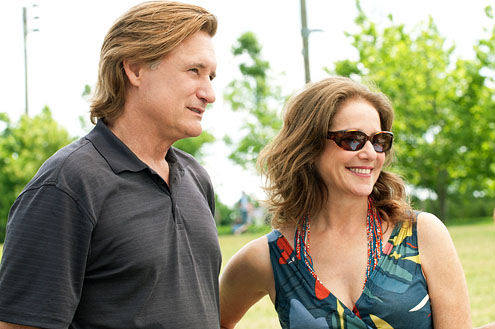
In fact, the only times when there seems to be any energy in the film is when Lola’s parents are in screen.  They are played by veterans Bill Pullman and Debra Winger, and I often wondered what they where doing in this movie, or why they signed on in the first place.

  Lola herself is played by Greta Gerwig and Luke, the man who dumped her, by Joel Kinnaman.  Kinnaman will be vaguely familiar as the lead detective in the U.S. television series The Killing, while Gerwig is a bright, intelligent actress who still has not found a decent movie for her to star in. (Perhaps, Woody Allen will be able to tap in best to her talents in To Rome with Love, in which she stars.)

The film was co-written by Zoe Lister Jones, who also plays the quirky girl-friend Alice who acts as a foil to Lola’s moodiness.  Lister seems infatuated with the script she wrote and seems to find her lines clever and hilarious when in fact they are less than sophomoric and sadly trite.

Even New York seems tired.  There is no depth–of New York excitement or of urban alienation–to any of the location sites and the interiors are often a confused jumble of …interiors. One is never quite sure if one is in Lola’s, Alice’s, Henry’s or Luke’s place.

Lola is working on her PH.D. dissertation which concerns silence in 19th-century French literature. (And of course there are the shots of an anguished Lola in front of a laptop, unable to move forward because of the devastation in her love life.) When the subject of her dissertation is introduced there are some clever moments of silence–in a restaurant, in a college meeting, on the street. But, one finishes the film wishing there was more…silence that is.

Music: Rhythm and Rest: Glen Hansard moves beyond Once

Glen Hansard’s new album, Rhythm and Repose

Glen Hansard is trying to separate himself from the massive success of Once. The former front man for the Frames (one person once said that “U2 gets all the fame but the Frames have all the soul”), Hansard found extraordinary success with the indie movie, Once, for which he and his partner, Marketa Irglova, garnered an Academy Award for Best Song.

But this was not his first foray into film. As a much younger man, Hansard was chosen by Alan Parker to play the guitarist in The Commitments–a former busker who ended up almost making it with Jimmy Rabbit’s Dublin Soul band. He was one of the more likeable lads in the band and as things worked out in the film his character ended up back on the Dublin streets busking.

Hansard as Outspan Foster in The Commitments

Fast forward 15 years and Hansard is again playing a busker in the Dublin streets, and this time he strikes gold. The on-screen (and purported off-screen) chemistry between him and Marketa Irglova found a wide audience around the world.  The music (much of it from the Frames’ repertoire) was memorable, the story was charming, and the ending was so far from a typical Hollywood ending that it was a refreshing success. And if people doubted Hansard and Irglova’s sincerity, their acceptance speech at the Oscars was one of the finest moments in what is usually an orgy of narcissism and self-aggrandizement.

When the music played to whisk Hansard off the stage, the emcee-Jon Stewart–stepped in and made the audience listen to what Irglova had to say.  Here is both of their “thank you speeches”–a tribute to independent artists and dreamers everywhere:

So Hansard and Irglova took advantage of the momentum and began a whirlwind concert tour bringing the music of Once to audiences live and then teamed up in a new band called The Swell Season, releasing a double album.

Marketa Irglova and Glen Hansard

Yet Once was not going to let go.  In 2011, the film was turned into a Broadway musical and in 2012 it won the Tony Award for Best Musical.

By then, Hansard and Irglova’s partnership had severed and Hansard moved to New York to work on a solo gig.

And on June 19th, his new album Rhythm and Rest hit the stores.  If you liked the music from Once and you like the music of the Frames, you will very much like this.

On Rhythm and Rest, Hansard does what he does best.  He writes personal,  soulful songs, often begins them with a single, simple instrument and then builds to a painful wail or a embracing chorus.  The song “High Hope” is typical–Hansard’s voice accompanied by his acoustic guitar and piano begins the tune and then builds with a rousing choral section on the choruses. The choral accompaniment is very similar to the styling of some of Van Morrison’s productions. “The Song of Good Hope” (do you detect a theme here?) starts the same way–if even more stark at the beginning being fortified not by choral voices but by strings.  It is the last song of the album and like all of Hansard’s songs it is bittersweet.

The song “Philander” (and the video) straddles loneliness and the determination to persevere, while “Love Don’t Leave Me Waiting,” reveals more resilience in human relations.  At times in “Philander,” Hansard’s voice–which I find expressive AND beautiful–veers towards the articulation of Tom Waits. It is amusing to find this Dublin street performer, unwittingly channeling the American blues, saloon singer.  While I very much like the song “Maybe Not Tonight” which begins with a simple guitar arpeggio, it reminds me an awful lot of the old Crazy Horse tune, “I Don’t Want to Think About It.”  It’s now all I hear when I listen.

My personal favorites are “The Storm is Coming” and “You will Become.” The first song on the album, “You Will Become” has a simple Leonard Cohen-like guitar, a haunting cello and a faint penny-whistle, before crescendo-ing with tinkling piano.  And the music perfectly complements the heart-breaking lyrics. “The Storm is Coming” features a single piano and Hansard’s voice in all its pain, its anticipation of the future, and its acceptance.

Hansard’s lyrics are very personal and his voice is perfectly suited for this. As he bemoans romantic fates, upcoming storms, lost chances, his voice soulfully captures the very essence of his words. Here is the video for “Philander”:

A footnote on The Sugar Frosted Nutsack by Mark Leyner

Despite my misgivings, I plowed ahead and finished The Sugar Frosted Nutsack by Mark Leyner.  My original appraisal was unchanged. I felt it was infantile, too enamored with its own cleverness, and pointless. It wasn’t a pleasant read–the effort in no way equaled the payoff.

However, I did notice something that I hadn’t before.  I was proofreading what I had written last week about the novel on a different platform. The tablet had shrunk the margins so that the text ran narrow like a newspaper column.  I had originally quoted this text:

“What subculture is evinced by Ike‘s clothes and his shtick, by the non-Semitic contours of his nose and his dick, by the feral fatalism of all his looney tics–like the petit-mal fluttering of his long-lashed lids and the Mussolini torticollis of his Schick-nicked neck, and the staring and the glaring and the daring and the hectoring, and the tapping on the table with his aluminum wedding ring, as he hums those tunes from his childhood albums and, after a spasm of Keith Moon air-drums, returns to his lewd mandala of Italian breadcrumbs?

But in the “newspaper column” format the passage ran quite poetically like this:

“What subculture is evinced by Ike‘s clothes and his shtick,
by the non-Semitic contours of his nose and his dick,
by the feral fatalism of all his looney tics–
like the petit-mal fluttering of his long-lashed lids
and the Mussolini torticollis of his Schick-nicked neck,
and the staring and the glaring and the daring
and the hectoring, and the tapping on the table
with his aluminum wedding ring, as he hums
those tunes from his childhood albums
and, after a spasm of Keith Moon air-drums,
returns to his lewd mandala of Italian breadcrumbs?

There is a rhyme scheme to the passage, a rhythm that I had missed when reading the prose. I went through the novel for similar riffs and they are a few but they are there for no intrinsic reason–they seem to occur only when Leyner is in a rhythm himself, apart from the needs or function of the novel.

It was fun to discover but it didn’t change my opinion.


printed books, personal libraries, cleaning out and French bookstores

by roboartemis. Found on deviontart.com

It seems I have always loved books, and in my lifetime have amassed quite a library. I find some sort of comfort in being surrounded by books, books on shelves, in piles on tables and floors.

In the past few years, though, I have had to thoroughly cull my shelves, for a variety of reasons.

Last year, I inherited about a thousand books from an uncle–he had promised me them ever since I was about nine years old–but after he died I simply couldn’t house them. I  already owned more than that myself and his simply were not going to fit. The two of us had had similar tastes and many of the same titles, so the duplicates  were easy to get rid of.  Others I gave to friends, even to non-readers. And the majority I gave to two used book sellers.

In 2004 I had ghostwritten a history of Ireland and part of my contract was that the publisher paid for any books I purchased while doing my research–I bought a lot. So I was able to make more room by donating about seventy-five of these titles to the Irish Center in Philadelphia.  They were hard to part with but I consoled myself in thinking that they are being read rather than simply sitting on my shelf. (I had ghostwritten a biography of Darwin as well but for some reason the publishers didn’t offer to pay for that research. I had far less books on Darwin than on Ireland.)

Now for any new reading, I turn more and more often to the public library, and I have begun buying some e-books, though only a handful.  I make an exception and still buy poetry regularly (kidding myself by rationalizing that these usually take up less space), and I have bought some non-fiction titles that I knew that I wanted to own, and would go back to time and time again. But novels generally come from the library now.  And that’s just as well.

We have all read the dire warnings about the demise of printed books. Such articles crop up almost weekly: The death of bookstores, the death of the author, the death of the novel (granted that one has been going around since long before the internet), etc. A friend of mine in Brooklyn passed along this article to me about how in France book sales are actually rising rather than being smother by digital devices. It makes for some interesting reading. Click on the picture below to read the piece:

Shoppers in La Hune, in Paris, which receives government help.Alice Dison for The New York Times 

So by the end, I went through an enormous amount of books and gave many, many away. (For 6 months I had to rent a storage shed to house my “inheritance” while I figured out what was going and what was not.) I didn’t like doing it, but I knew I had to.

And of course, that book that I hadn’t looked at in fifteen years, that had sat dusty on my shelves for so long.  As soon as I gave it away, I needed it for something or other!  Isn’t that how it always goes?

Saturday Potpourri: The young pups are taking over…and a story of G.A.S.

I went to a party Friday night to celebrate Zeke McLaughlin’s 60th birthday. It was a very good party–good conversation, great food, bottomless drink, and good music (the very definition of great craic).

As a gift, the man’s brother hired two twelve year old musicians: one played fiddle, the other uillean pipes and whistle. The music was nice–the boys had even brought Zeke a whistle of his own as a gift (he is an Irish flute player as well as whistler.) It was good to see the young pups bringing in the music.  Here they are:

I only found out later that these two young men are quite serious about their music.  They have their own website The Ladeens and their own touring schedule.  And two more polite and charming young men you’ll never meet.

♦     ♦     ♦    ♦     ♦     ♦     ♦

After the party, I went to a pub to see some friends play where I ran into a friend I hadn’t seen in many, many years.  He introduced me to the woman he had brought with him and riskily I asked her if he had told her about his G.A.S.  She knew right away that I was talking about Guitar Acquisition Syndrome.

A Small Case of G.A.S.

I met Richard while working in an advertising agency.  He was in the cubicle next to me. I knew he had had some success as a musician. He had opened for some pretty famous bands and had worked as a studio musician in Nashville.  And I also knew that he hadn’t touched a guitar in about ten years. I don’t know the whys or wheres, but he had just put that part of himself away and was now a talented graphic designer.

One afternoon, I took an extended lunch and bought a $300 dollar guitar that was on sale for $150. The day was sweltering and I didn’t want to leave it in a car so I brought it into my cubicle. Richard soon moseyed over and began noodling around. (It was immediately obvious that he was a very good player.)

Well a few days later, Richard asked me to go with him to a music store.  We wandered around a bit, and Richard left with a very good guitar. (Much better, more expensive than the low-end Ibanez that I had bought.)

A month later, he told me he had bought another.  I had re-awakened a monster.  He was teetering very close to the edge of G.A.S. Soon there was another…then another…then a humidifier or dehumidifier for the basement where he kept them. He was no longer teetering. He had a full-blast syndrome.

Since then, Richard has stopped buying guitars in music shops. Instead, he is having them made for him. In our conversation last night, he mention that he has a “luthier” who he works with.  I think he is down to eight, but they are sometimes different–he trades them or sells them in order to get another.

He plays very well, but refuses to play out anymore. (He had joined a band a few years back but his reluctance to play out was an obstacle to the band’s going anywhere.)

Anyway, it was good to see a long gone friend. And fun to talk music with him. Maybe, before too long we can sit down and play a few tunes together again.

Richard’s Olsen guitar

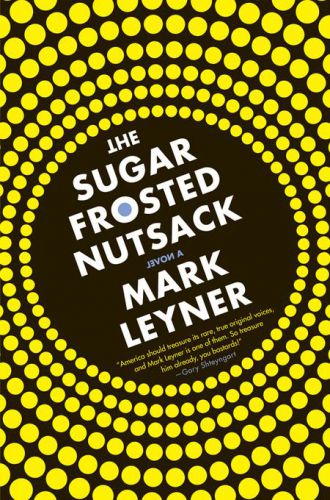
The Sugar Frosted Nutsack by Mark Leyner: When does one stop reading a book?

When is it time to stop reading a novel?  And why do I feel so guilty about it?

I decided today to go no further in Mark Leyner’s The Sugar Frosted Nutsack.  Was it bad?  No, it was quite entertaining?  Was it difficult?  No, not in the way say Joyce’s Finnegans Wake or DFW’s Infinite Jest is difficult.

To be truthful, it is simply a tiring read.

The title refers to poor Ike Karton, the “nutbag” as he is called in his neighborhood in Jersey City, New Jersey.  Here is his introduction (35 pages in):

“What subculture is evinced by Ike‘s clothes and his shtick, by the non-Semitic contours of his nose and his dick, by the feral fatalism of all his looney tics–like the petit-mal fluttering of his long-lashed lids and the Mussolini torticollis of his Schick-nicked neck, and the staring and the glaring and the daring and the hectoring, and the tapping on the table with his aluminum wedding ring, as he hums those tunes from his childhood albums and, after a spasm of Keith Moon air-drums, returns to his lewd mandala of Italian breadcrumbs?

So begins the story of Ike Karton, a story variously called throughout history Ike‘s Agony, T.G.I.F. (Ten Gods I’d Fuck), and The Sugar Frosted Nutsack. This is a story that’s been told, how many times? –over and over and over again, …”

Ike is a believer in a pantheon of Gods who have played havoc with the universe for billions of years.  Earlier we learn that

The Sugar Frosted Nutsack is the story of a man, a mortal, an unemployed butcher, in fact, who lives in Jersey City, New Jersey, in a two-story brick house that is approximately twenty feet tall. This man is the hero IKE KARTON. The epic ends with Ike’s violent death.  If only Ike had used for his defense “silence, exile, and cunning.” But that isn’t Ike. Ike is the Warlord of his Stoop.  Ike is a man who is “singled out.” A man marked by fate. A man of Gods, attuned to the Gods. A man anathematized by his neighbors. A man beloved by La Felina and Fast-Cooking Ali, and a man whose mind is ineradicably inscribed by XOXO. [these are the names of gods we’ve already met]. Ike’s brain is riddled with the tiny, meticulous longhand of the mind-fucking God XOXO, whose very name bespeaks life’s irreconcilable conntradictions, symbolizing both love (hugs and kisses) and war (the diagramming of football plays).

Are you tired yet?  I am…(but I have such a developed sense of guilt that I will probably return to it before the evening’s out.)

The  novel begins with the beginnings of the universe. This gaggle of gods arrive on a school-bus, blaring the Mister Softee jingle, like a bunch of college students “Gone Wild” on spring break.  Like the gods of other mythologies, they are petty and mischievous and promiscuous and quite often harmful to humanity. Now, they are living in the tallest (and most opulent) building in the world (now they are in Dubai, but they have had to move several times as humans keep building taller buildings.) Bored and propelled by their own machinations and relations they have become obsessed with Ike Kantor.

The novel plays with meta-fiction to a large degree. A sentence is repeated. Then the sentence that makes the repetition is repeated again including the original sentence. And again. And again.  It is tiring…and soon loses its cleverness.

But the book is not the theme of this post; it is is the decision to give up on one.  Why do some people (myself to be sure) feel a sense of obligation to finish a book once he or she has begun it?  Is it financial, in that you’ve invested fifteen bucks in a book you might as well get your money’s worth?  I don’t think so.

Is it something that happened to us when we were school children? Are we afraid that the nuns, headmasters, schoolmarms are going to rap our knuckles with a ruler for not completing our assignment?

Or is it respect for the artist?  Do we feel the need to stick with something, to see where it leads to, out of respect and admiration for the writer’s work?

I don’t know.

But I have a day and half free–so I’ll probably end up finishing it anyway.

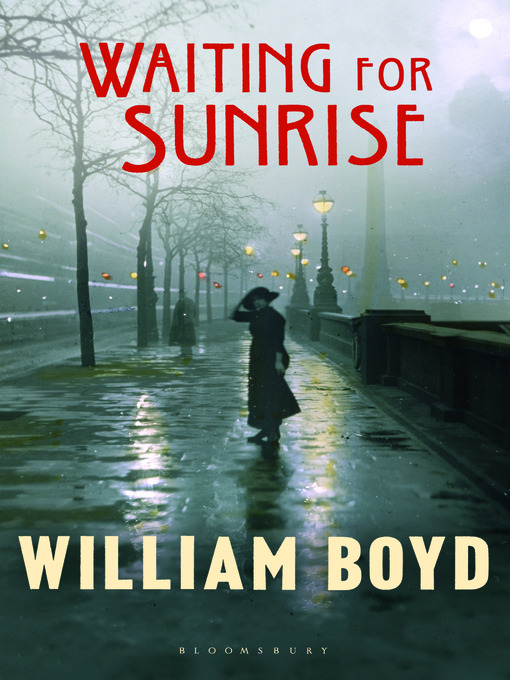
Sunday Book Review: Waiting for Sunrise by William Boyd

For ninety-percent of the novel Waiting for Sunrise by William Boyd, I was enthralled.

Vienna before the first World War, London on the eve of war, the no-man’s land between the trenches, neutral Geneva at the height of hostilities, London during zeppelin bombing raids. The settings are dramatic and richly drawn.

As was the plot: A young actor, following his famous father’s footsteps (if that’s not Oedipal enough for him, his mother catches him at his first experience at masturbation to boot), goes to Vienna to find a cure for a sexual condition–to Vienna, the center of the burgeoning new concept of psychoanalysis. Although he meets Freud himself, it is Freud’s English speaking neighbor who takes Lysander Rief on–and who successfully cures him.  And we know he is cured because his four month affair with the English bohemian Hettie Bull ends in a pregnancy and his arrest for rape by the Viennese authorities.

When two British diplomats arrange for Rief’s escape, they also arrange for his indenture to British intelligence.

Soon after Rief returns to London, his rescuers called in his debt and he is asked to enter Geneva via  the front lines. He is successful at his mission, survives seven bullet wounds, and completes the assignment that he had been ordered to finish.  And then he is given a second mission.

The action–of both the military and intelligence escapades and Rief’s romantic life–is riveting, fast paced and cleverly intertwined. Each character seems to be connected to another and no one is entirely innocent. And Rief’s inner-life is subtly and intelligently revealed. One learns much about military ordinance, psychoanalytic practices, the British class system and the early 20th-century British world of theater. And the information is never pedantic or overwhelming but richly woven into the plot.

Yet the solution of Rief’s intelligence mission and the resolution of his own personal quests seems to be lacking.  As the Novel wraps up and the various strands are pulled together, the story begins to limp rather than gain strength.  By the end, I felt I was reading a Hardy Boys’ Adventure. The solution was pat and somewhat anti-climactic.

I had been look forward to Waiting for Sunrise for several months and to be quite honest I enjoyed reading it very, very much. Until the end that is.  I was disappointed. It seemed that Boyd had simply decided to quit.

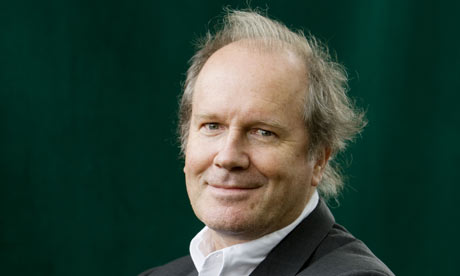
William Boyd

I like William Boyd very much. I feel he is greatly underrated among his contemporaries and is a wonderful stylist with a perfect ear for the nuances of an age.

I had previously read several Boyd novels and do not remember this falling off, this disappointment before. The novels all successfully re-create historic eras, describing its people, its culture, its ethos, its fears, all braced by an intelligent understanding and description of the scientific theories and advancements that are at that moment being born. For instance, Brazzaville Beach deals with mathematical chaos theory and the sociology of chimpanzees.  The New Confessions (modeled on Rousseau’s Confessions) also deals with World War I–as with Waiting for Sunrise–moves through Hollywood and Berlin, treats the horrors of World War II and then ends with the Hollywood Communist  trials, the whole while treating  us to the internal workings of the Hollywood film industry.  The Blue Afternoon (my personal favorite) is centered on the United States invasion of Manilla and its ultimate acquisition of the Philippines through the Treaty of Versaille and travels from Lisbon, Manilla and Los Angeles, from 1902 through the 1930s, while leading the reader through advancements in surgery and trends in architecture.

All of Boyd’s novels are rich with fascinating information, realistic period details, and memorable human stories. And all are vastly enjoyable and worthwhile.  Waiting for Sunrise, however, for me, ends a little too quickly and a little too weakly.

Movie Review: Moonrise Kingdom

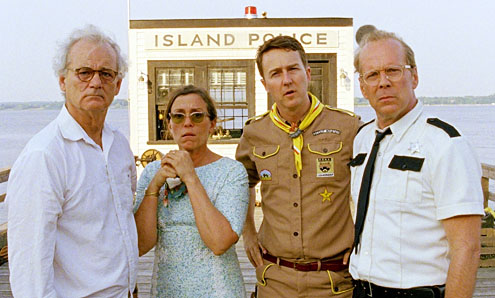
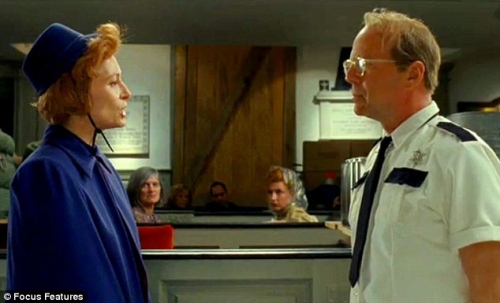
There are some real heavy weights here:  Bill Murray (can there be a Wes Anderson movie without him?), Frances McDormand, Tilda Swinton, Bruce Willis, Ed Norton, Bob Balabay, Jason Schwartzman, Harvey Keitel.  And yet Wes Anderson’s delightful, quirky, warm-hearted movie is completely stolen by the two young stars who play 12-year-old runaways.

Jared Gilman plays Sam, an iconoclastic, orphaned Khaki Scout who is not liked by any of the other scouts. Kara Hayward plays Suzie, the disturbed and angry daughter of Bill Murray and Frances McDormand.  For over a year, after Sam saw Suzie playing a raven in a local production of Benjamen Britten’s children’s opera Noye’s Fludde, the two have been planning to escape their unhappy lives.

When Sam escapes his Scout camp, the authorities are alerted.  When Suzie is discovered missing, everything goes into overdrive.

As the two twelve-year-olds make their way through rugged country–Sam is an extraordinary Scout–we get to witness one of the most beautiful, innocent, and real love stories.  Maybe the most intense love is that one that is first felt when you are twelve years old?  It certainly is for them.

Yet the real world, in the guise of hurricanes, adulterous unhappy parents, foster parents, social services, man-scouts, and a lonely policeman, comes crashing in on them.

This is a comedy, so everything ends well. But the journey towards that ending is filled with all the anguish and hope of being in love at 12 years old; it is defined by  that feeling of being too small against the world while believing that one’s unique love will protect you from everything.  In many ways, it is perfect. (One reviewer said that it was made by the 12-year old Wes Anderson, so perfect is the point of view.)

The two young stars are extraordinary. They are playing children who are precious, treading in the murk of real life, battered by injustices and misunderstandings that are too big for them to withstand, and roiled by all the passions of first love.  And they play it perfectly.

And aside from the two kids, and the A-list group of adults, the set designers, graphic artists, and cinematographers are also front and center in the film.

From the quirky credits and the Bishop’s  loopy house to the book covers on the adventure stories that Suzie reads and the watercolors that Sam paints, everything pops with an fresh palate of color and tone and liveliness.  You are aware of the filming–not in an obtrusive way but in a way that stuns and delights you. This is not cinema verite; it is very aware of its artfulness and it succeeds at it.

The natural setting is gorgeous–our two runaways have found Eden–and the sets are filled with color and eccentricity.  While the island New Penzance is based on Fishers’s Island, NY, I am not sure where it was actually filmed. But it is romantic–in the original sense of the word–and sublime.

I have enjoyed all of Wes Anderson’s films, but am often left with a sense of emptiness, with a sense that surfaces were barely scratched and characters hardly born. Moonrise Kingdom is different.  While not a character study, by any definition, it is a beautiful study of original love, love that is pure and scary and wonderful and all of that.