1984Brave New World…and Phillip K. Dick????

It is perhaps the most iconic novels of the 20th century.  George Orwell’s 1984 is the dystopian novels of all dystopian novels.  We all know the phrases “Big Brother,” “doublethink,” “thought-police”; their ominous overtones and insinuations are recognized even by those who have never read the book. The deadening conformity and mind-control that Orwell writes about are the fears often invoked by those who fear totalitarianism in any form–in governments or corporations.

Apple–now a mighty corporation in itself–famously advertised its new Macintosh computer by pitting itself against the corporate giants of the computer world in a magnificent television commercial that echoed the world of 1984–and Apple’s defiance to its conformity.  (The ad was seen only once on television during the American Superbowl and then subsequently was shown in theaters.)

The novel is bleak and that bleakness is broken only briefly by a wonderful love affair and the main character’s misplaced hope.  Indeed, my favorite image from the book is one that perfectly captures the grime, the incompetency, the substandard level of life, when Winston Smith, the protagonist, goes to unclog a sink in a neighbor’s apartment. As he looks at her, he notices the dust that has gathered in the lines of her face.  I always remember that–a pretty powerful image.
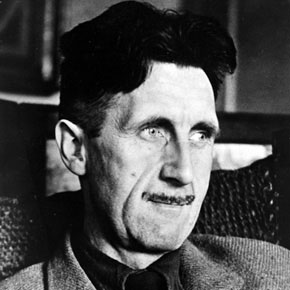
Orwell wrote his novel in 1948 (that’s really the only significance of the novel’s title: it’s the year he wrote it reversed). But nearly a quarter century earlier, another British writer also wrote a powerful dystopic novel: Aldous Huxley’s Brave New World.
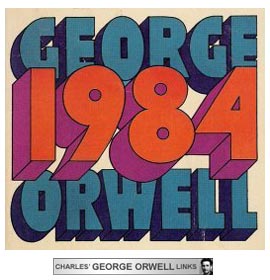
And where Orwell’s world is one in which a film of oil lies on the gin and ready-made cigarettes fall apart in your hand and where sex is frowned upon (because one should really only love Big Brother), Huxley’s novel is the opposite.

Huxley saw his dystopia as a world in which people are perfectly happy–indeed where they are conditioned to be happy. There is no disgruntlement–people have been conditioned to accept and love their station in life. (A station that has been pre-decided by the artificial generation process.) Promiscuity is greatly encouraged and sex is varied and plentiful. And if for some reason, one might feel a little blue, there is SOMA, a mood-enhancing drug that is given out in vast quantities to all the classes.

The society works efficiently and happily. Yet Huxley sees the snake in the garden–the lack of freedom to be wrong, to be sad, to disagree. Even to be alone.  It is when a “savage” is brought back from a reservation in the southwestern part of the U.S. is the society and its beliefs challenged–but not for long.

♦     ♦    ♦    ♦    ♦    ♦

By the way, click here for a letter that Huxley wrote to Orwell upon first reading 1984. It is this very discussion of dystopia comprising great suffering or constant happiness:

Huxley to Orwell letter

♦     ♦    ♦    ♦    ♦    ♦
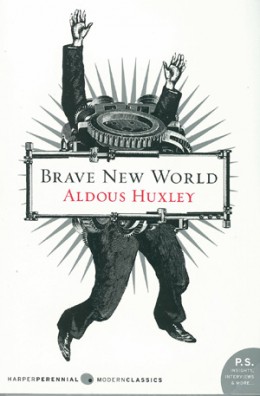
Aldous Huxley

I teach Brave New World as the first book of the new school year.  I will have thirty very bright 18-year-old students enrolled in my class. I know that half of them read 1984 last year with the one teacher they had. The other half did not. (And 1984 is such a great companion piece to any discussion of Brave New World.) So I assigned it as “summer reading.” But only to half of them. I looked for another “dystopian” novel to give the class that had already read Orwell’s novel.
And so I assigned Phillip K. Dick’s Do Androids Dream of Electric Sheep?

Now, I have never been a big fan of science-fiction. I have just never gotten into it. In fact, I have never seen a Star Wars movie!

I’ve read some of the standards–Bradbury, Welles, Asimov, and, if we are stretching, Vonnegut.  But it’s something I just never made a connection with.

And Dick’s novel did nothing to change my mind!? Despite it being anointed a “classic” by so many and being the source for the beloved film, Blade Runner, it left me very flat.
Again we are dealing in a world different than our own–a post-apocalyptic earth where most of the able bodied people have emigrated to Mars.  Nuclear fallout from World War Terminus has made much of Earth inhabitable. The government’s enticement for people to emigrate is a free android that will work as their personal servants.

However, some of these androids have returned to earth and must be killed. And the only way to distinguish between the androids and the humans is the lack of empathy in the androids–a lack that can be tested.
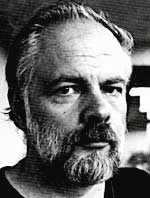
Phillip K. Dick

The plot, entails the main character, Rick Deckhard–an android bounty hunter–attempting to increase his bounty numbers so that he can buy some real animals, instead of the “electric sheep” he now owns. Animals, he feels, encourage empathy in humans.
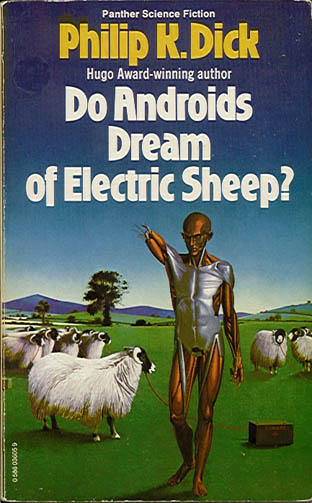
I am not sure how I will squeeze this into our discussions of Brave New World and 1984.  I am not sure if it can be squeezed into dystopic literature.  Post-apocalpytic maybe–most of my kids have read or seen The Road and I am Legend–but it doesn’t really fit in with totalitarianism and its evils.

And then, maybe it won’t be all that important to the discussion anyway. Or better yet, maybe it’ll throw us all in a different direction completely.
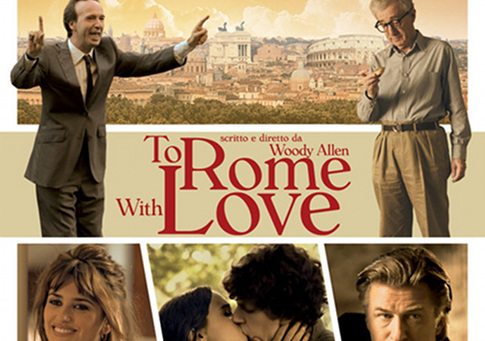
Movie Review: To Rome with Love, written and directed by Woody Allen

With an over-sized brace on my knee, a bottle of Vicodin in my pocket and a set of “just-a-bit-too-tall” crutches, I limped down to the corner, grabbed the 57 Bus on 4th street, and rode it to Walnut where I hobbled over to the theater to see Woody Allen’s latest film, To Rome with Love.

I used the word “hobble” intentionally because that was what Woody Allen seemed to have done with this collection of slight stories set in Rome, the eternal city. He took several disparate tales and hobbled them into some sort of unity– a whimsical investigation of fame and celebrity, set under the bright Roman sun. (It is noteworthy, that very few scenes take place after sunset–there is the finale on the Spanish steps and a cheesy storm-scene in the Roman Baths. The rest is filmed beautifully in the bright Italian sun.)

There are four basic stories:

♦ a young architect with dreams of greatness and confused romanticism is being advised by the pedestrian man he will become.

♦ a funeral director with a magnificent operatic voice can only sing in the shower.

♦ a newly wedded bride is seduced by a celebrated actor, an incompetent hotel thief, and her newly educated husband.

♦ a middle-class man becomes famous for no reason at all.

Each story is successful to varying degrees.  And each has its own charm…to varying degrees.

Alec Baldwin plays the elder architect watching his younger self stumble through a risky affair. Woody Allen himself plays a retired opera impresario trying to get the shy mortician to sing on stage. The Italian actress, Alessandra Mastronardi,  plays the timid newlywed who is bedazzled by her favorite actor. And Roberto Benigni plays the hapless man who becomes–for no reason at all–the most famous man in Rome.  The stories are not connected but move from one to another easily.

Allen has proven before that no one makes a location look as attractive as he can, and here again, he does for Rome what he has previously done for Paris, Barcelona, London, and–most readily–New York.  He also proves that he has the ability to get wonderful performances from his actors.  Alec Baldwin is all self-effacing and snarky wisdom; Penelope Cruz seems to be channeling those  mid-century Italian film stars–Sophia Loren and Gina Lollabrigida; Benigni is permitted to clown with little restraint; and even the young actors–Jesse Eisenberg, Greta Gerwig, and Ellen Page–are given room to breathe into their roles.  On screen, Allen, reprises the role he has played forever–the neurotic, death-fearing, nebbish.  But perhaps the most extraordinary performance is that by the great, internationally-acclaimed tenor, Fabio Armilato, who plays a man who can only sing in the shower and who gamely lets Allen place him in several showers throughout the film.

Allen has long proclaimed his love of European movies–he famously dabbled in Bergman-esque type films in the late 1970s–and earlier this summer he listed four Italian movies that he felt influenced him profoundly. Two were by the director Vittorio de Sica (The Bicycle Thief and Shoeshine), one by Michelangelo Antonini (Blow-up) and one by Federico Fellini (Armacord). He stated that these films changed the way stories could be told, a narrative arc very similar to that which he would use in many of his own films.

He quipped about his love of European film: “I wanted nothing more than to be a foreign film director, but, of course, I was from Brooklyn which is not a foreign country.”

And yet, while To Rome with Love is an entertaining two hours, it is much less substantial than the four films he had referenced. Even as a comedy, it lacks a certain gravitas.

No, by no means is To Rome with Love a hearty, four-course Italian meal–and maybe it is not meant to be.

Simply, it is a lovely four-scoop of gelato. And sometimes that’s all you need to get you through a Saturday afternoon.

If you haven’t seen the trailer, here it is:

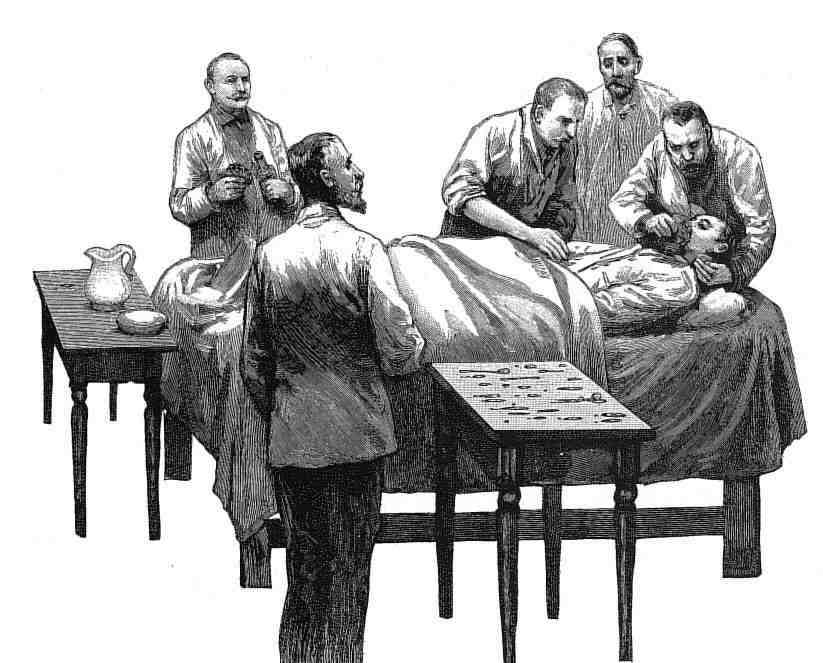
Anesthesia–the perfect vacation

I had to get some work done on my knee this week and in order to do it, the doctors had to give me general anesthesia.

God I love it.  It is the perfect vacation.

To start with, an anesthesiologist gave me a light anesthetic and then wheeled me into the operating room where I would be administered a more powerful anesthetic.  I remember her wheeling me towards the operating room, I remember her saying to someone else that the bed had to be turned around because I had to go into the room head first.

And I remember nothing else.  I awoke a little more than an hour later in the recovery room.  How great is that!

For that short interim, I had no worries about bills, no stresses about work, no fretting about family, no anguish, no responsibilities, no obligations, nothing.  I desired nothing, feared nothing, was attached to nothing.  It is the very definition of Nirvana.  And I experienced it without hours of meditation!

The word “nirvana” has been misrepresented by Westerners as a simple synonym for “paradise,” for an existence of pure pleasure and perfection. Nothing can be further from the truth. In Eastern thought, “nirvana” is the final stage of enlightenment, a state where there is NO pleasure and NO pain. One has NO desires nor regrets.  There is no suffering, no joy, no self.  One is completely separated from the pulls, the demands, the pains, joys, wants, and urges of modern existence.

Wow, that certainly sounds like  the perfect vacation to me. Or a lethe-like morning of general anesthesia.

(Or at least until the painkillers wear off. Hah!)

A simple and wonderful book for westerners to read as an introduction to the Buddha,

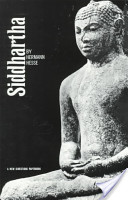
Siddhartha by Herman Hesse

to nirvana and the path towards it is Herman Hesse’s Siddhartha. It is a short, beautiful,
inspiring novel of Gotama Buddha, written by German author for the western mind.
One cannot finish the book without feeling some sense of peace. I used to give it out
quite often as a gift.

If you have never read it, try to find it. You can read it in one sitting.
If you have already read it, pick it up again. Those same good feelings will return.

Book Review: Disgrace by J. M. Coetzee

A new acquaintance of mine asked if I had ever read the book Disgrace by J. M. Coetzee.  I hadn’t, though I had read several others by the South African writer.  We talked about many things that morning, and, to be truthful, I had forgotten all about the book until about a week later, when a package arrived in the mail with a gift-wrapped book. Inside was a copy of Disgrace with the note: “I hope you enjoy this half as much as I did.”

And so I began.

Disgrace is the story of David Lurie, a 52 year-old, twice-divorced, white South African professor of Communications and Romantic poetry.  Quite early in the novel he is forced to resign from his university under the disgrace of having sex with one of his students.  As Lurie  rationalizes to himself, the sex itself was not rape, but it certainly wasn’t completely consensual.  He admits guilt but not contrition–which infuriates even those trying to help him.

In disgrace, hounded by reporters, and bereft of his job, Lurie leaves town and drives out into the eastern countryside of the Cape. There his daughter has some land where she raises flowers and kennels dogs.  He is there presumably to write an opera on Byron, Byron’s mistress Teresa, and her husband.  But it is not the most conducive area for such refined creation: it is a hard land and an area still simmering in the afterbirth of the post-apartheid era.

As Lurie settles into the rhythms of country-life, of physical labor and simple pleasures, even volunteering in an animal shelter, his life is once again shattered when he and his daughter are attacked by three men.  All the dogs are slaughtered, Lurie is doused in alcohol and set on fire, and his daughter is gang-raped (and impregnated) by the three men.  The very crime for which Lurie was censured has been visited trebly on his daughter.  The very world he has known–the power he has always arrogantly assumed for himself–has been violently wrenched away.

As both father and daughter try to come to terms with the horrors that have visited them, as they learn more and more about the identity of their attackers and their relations to people they know, and as they struggle with the essential character of each other’s personalities, Lurie comes to better realize the nature of the world around him.  His views on racism, on feminism, even on animal rights, must be examined and re-calibrated.  The world he has known is, simply, no longer.

I knew nothing of the book when I opened it. I thought it was contemporary, not published in 1999–a mere five years after the historic elections in which the African National Congress overwhelmingly won and from which apartheid’s demise can best be dated. The difficulties that Lurie has in understanding the new order, the distrust, fear and violence among the various peoples, even the “modernization” of the University all make better sense. (Lurie’s teaching of Communication is in itself ironic–Communication skills are what this country and its people are badly in need of.  An expert in the British romantic poets–those type of courses are considered fluff in the new university structure–Lurie teaches both Communications 101 and Communications 201. The one Romantic Poets course he teaches is a salve that the administration gives its older professors.) In many ways the novel is a reflection of the birth pangs of the new country: it is violent, bloody, and at times deadly.

Does everything get resolved?  Of course, not.  Is Lurie a better person at the end?  I’m not sure.  I think he is. Early in the novel when a tribunal is questioning Lurie on his womanizing, he states that he believes that every woman he has bedded has “enriched” him in some way.  The question at the end of the novel then must be  “has the violence and catastrophe that he has suffered also enriched him?”  Again, I don’t know. But he is a different man than he was at the beginning of the novel.

J.M. Coetzee

And while the summary of the plot seems rather dark, the novel itself is quick moving and understated.  It is a very subtle but easy read, and it sucks you into its disparate worlds–the urbane world of the university and the stark world of the South African countryside–quite easily.

And so much dovetails together within the novel: the womanizing man of letters writing about that grand literary womanizer Byron; the mirrored rapes; his evolving attitudes towards women underpinning his new understanding of animals; his role as both teacher and father. It all comes together seamlessly and wonderfully, not like a patchwork quilt, but a beautifully woven cloth–like the Ashanti patterned bedspread that Lurie’s daughter presents to the woman living on her land.

J.M. Coetzee won the Booker Prize for Disgrace in 1999, four years before winning the Nobel Prize for Literature in 2003. His writing is succinct and accessible. In many ways he is a quiet writer, not at all flashy. (Not surprising, considering that his dissertation was on Beckett.)  Intelligent, subtle, and layered, the writing is satisfying and rewarding from the very first, and ages richly with subsequent reading.

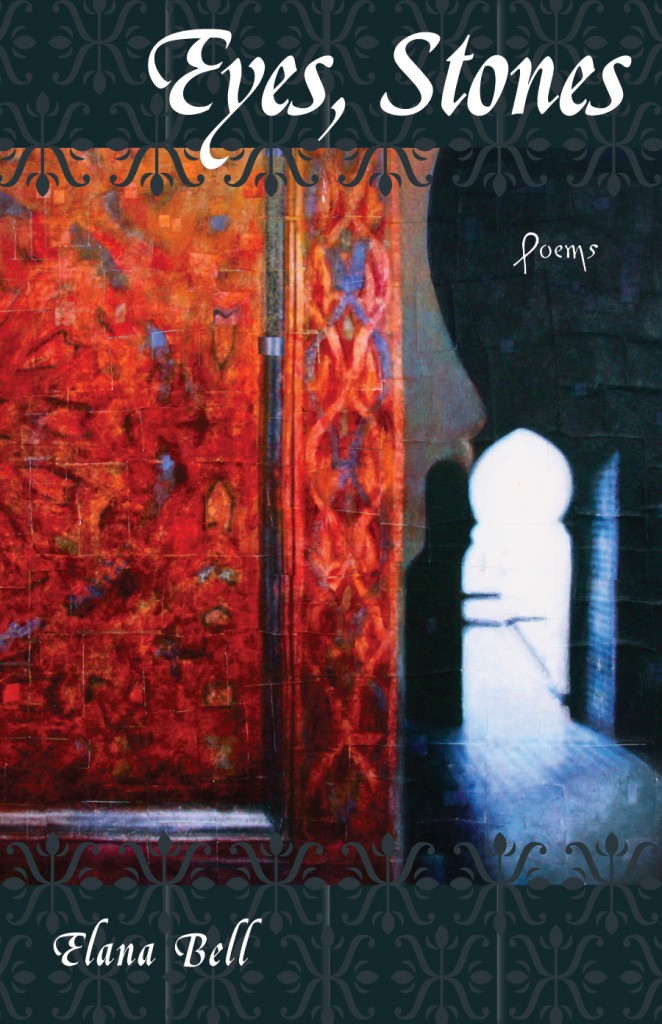
Book Review: Eyes, Stones by Elana Bell

Eyes, Stones–Elana Bell’s first collection of poetry and the winner of the 2011 Walt Whitman Award–is an extraordinary feat of poetry and clear-mindedness.  Each of these 40 small poems are dense explosions of beauty and clarity, encased in language that is both modern and antique, beautiful and brutal–much like the countries that she writes about.

In her poetry, Bell attempts to look and understand the worlds that are Palestine and Israel. She moves from biblical stories to modern events and much in between. Her topics range from the ancient relationship of Abraham and God, Sarah and Hagar, Ishmael and Hagar to the modern Holocaust, the Zionist movement, the 1968 Egypt-Israeli War, and the most recent Intifada.

But what is remarkable about these poems is that they don’t stink of politics, of nationalism, of self-righteousness.  They are simple poems that lay bare the simplicity of man’s pain, the artlessness of his troubles, the wonder of his existence. Often, in these poems one is unsure which side of the Israeli-Palestinian conflict Bell sits, her treatment is so even-handed.

Take for instance her poem “Naming the Day,” which is a composite both of those Jewish villages in Eastern Europe destroyed or made “Jew free” AND those Palestinian villages destroyed or evacuated during the 1948 Arab-Israeli war.

In “On a Hilltop at the Nassar Farm,” the speaker admires the Palestinian woman Amal:

Amal laughs with all her teeth and her feet
tickle the soil when she walks. She moves
through her land like an animal. She knows it
in the dark. She feeds stalks to the newborn
colt and collects its droppings like coins
to fertilize the field. Amal loves this land
and when I say land I mean this
exact dirt and the fruit of it.

Amal’s rough existence she compares with her own existence in the settlement that surrounds Amal’s land:

All around her land the settlements sprout like weeds.
They block out the sun and suck precious water
through taps and pipes while Amal digs wells
to collect the rain. I am writing this poem
though I have never drunk rain
collected from a well dug by my own hands,
never pulled a colt through
the narrow opening covered in birth fluid
and watched its mother lick it clean,
or eaten a meal made entirely of things
I got down on my knees to plant.

Yet Bell’s work does not rise from the guilt of the occupier.  It comes from a genuine love of the people–both Arab and Israeli–and a horror of the world that has evolved around them.  A particularly poignant poem, “In Another Country It Could Have Been Love,”  laments what could be between the two:


The next time I saw her, a rifle
strapped her shoulder. The tip
of it fingered my ribs, my hips
the inside of my thighs.
Cold metal instead of her hands,
her eyes.

Elana Bell herself is the granddaughter of Holocaust survivors, and as such, her examination of Jewish and Arab relationships is strikingly honest. She maintains an embracing love of the land through its many incarnations: biblical landscape and Zionist dream, modern nation and occupied territory.

In the end of the collection, she returns to Brooklyn where she lives. There she will “watch the Super Bowl…eat organic greens and make love on Saturday afternoon…[She will] listen to jazz in tight-packed clubs…and sleep on clean cotton sheets.” It is during this sleep, however, that the Mid-East comes to haunt her, to remove her from her comfort, and to tie her to the lands of her heritage.

Eyes, Stones won the 2011 Walt Whitman Award of the Academy of American Poets.  Five of her poems (along with her bio) are published on the Academy’s website. Check it out. She is a remarkable woman and a fine poet.

Rejection: a writer’s two-way street


Ah rejection! It is the most certain part of the writer’s life. And we all have had our share. Putting something out there, for someone else to judge, to deem suitable for his or her journal/magazine/anthology/contest, is risky. The odds of receiving a “no” are much larger than receiving a “yes.”

At least they are for the less established writers. Which is the majority of us.

Having said that, however, 2012 has been a particularly successful year for me. Even Duotrope–the wonderful submission/market site that I use– congratulated me saying that my “acceptance ratio” is higher than average for users who have submitted to similar markets. And my rate for both fiction and poetry is a measly 21.4%!

But lately, I’ve hit a fallow patch. Stories going out, rejections coming back.  Indeed, one journal (who in fairness won’t be named) e-mailed the same rejection to me three times in one day! Talk about Churchill’s black dog in the afternoon!

So at the moment, I have eleven pieces out there awaiting some editor’s thumbs up or thumbs down. Two have been out there for five months.  If I continue at my current above average pace (hah!) then I can expect two of the eleven pieces to get the okay.

And when that happens all the self-doubt and depression (understandable with a three-pronged rejection) disappears and one once again fantasizes about quitting the day job and really getting it done fill an hour or two of my daydreams.

♦     ♦     ♦

Now, the other side of the coin is that we as writers must do our fair share of rejection, as well, if we are to do the task well.  I believe it was Hemingway who once said that he knew he had had a productive day if in the morning he had three pages of manuscript and by afternoon he had only one. That’s a lot of rejection. That’s a lot of concision. That’s a lot of word choice.

Someone once told me that if I really love a particular phrase or passage, I should probably discard it! Reject it! My love of it is a signal that it is too”special” and doesn’t belong in the work. And he is probably right. Be careful when you are feeling particularly “writerly.”  Not a good portent for good writing.

Another story I heard was that the writer Ray Bradbury would complete a piece, date it, and file it away for a year to the day to begin editing it. He believed that when he first completed a piece, he was too enamored with it to critically re-write, edit, and polish.

But who has that kind of time?

I know one of my many faults is to believe something is finished well before it is. I do not edit well on a computer screen and there is a certain part of me that cringes at printing out drafts.

So my August 1 resolution will be to do better editing, better re-writing. Maybe I’ll even start printing out my work to look over…but certainly on both sides.

♦     ♦     ♦

P.S. Originally I had no  graphics in this post because

I wrote it on my iPad on a cross-country plane with WiFi from Los Angeles to Philadelphia.

How cool is that?

But when I got home my interior clock was a bit askew, so I returned and added some images.

I had read about this and seen the satellite maps of Greenland earlier in the week. I thought it was important to reblog. It is scary.

James Wight's avatarPrecarious Climate

Recent findings suggest climate change in Greenland may be approaching a tipping point, beyond which amplifying feedbacks could lead (probably over centuries) to complete melting of the ice sheet, raising sea level by about 7 meters.

In June, a team of glaciologists led by Jason Box predicted that we would see melting across 100% of the ice sheet’s surface area in summer within a decade. They drew that conclusion from data on the Greenland ice sheet’s surface reflectivity, or “albedo”, showing the surface has gotten darker over the last 12 years. A darker surface absorbs more heat, leading to more melting, causing albedo to decrease further, and so on in a vicious circle.

The ice naturally gets less reflective in summer because the shape of the snowflakes changes, but in 2012 Greenland has become much darker than in previous summers. This is occurring particularly at high elevations, which were…

View original post 402 more words

Book Review: The Reader by Bernhard Schlink

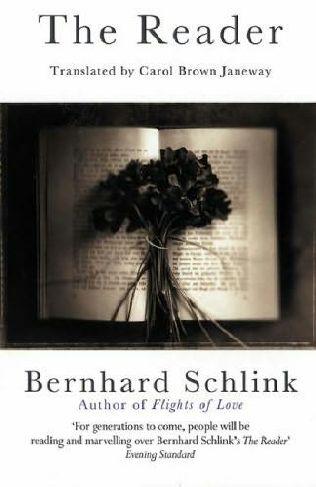
Cover of Bernhard Schlink’s book.

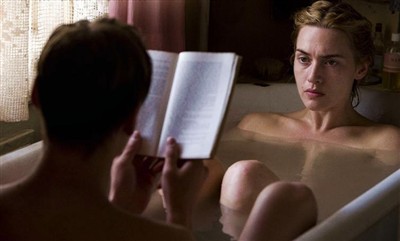
A scene from Stephen Daldry’s film, The Reader

The old question of the book and the movie: Can a film ever do a novel justice?  Or should we look at them as entirely separate works of art and not make the comparison at all?  Just the parameters of a roughly  two hour viewing experience seriously limits what a film maker can do with his source, a source that usually comprises a multi-hour/multi-day experience for a reader.

Certainly there are films that are more successful than others in capturing the essence of a novel. And just as certain there are real travesties. But the successes are such because they capture the spirit of the novel rather than getting lost in trying to relate every detail.  I am thinking of Mike Nichols Catch-22 based on the Joseph Heller novel.  The film works because it perfectly captures the inanity of bureaucracy, the numbness of war, and the black humor of Heller.  It is a large novel, non-linear in its arc, and Nichols captures its essence without getting bogged down in trying to capture every character and sub-plot.

I saw the film The Reader when it was released in 2008 and only got to reading the book in 2012. (I had two friends who refused to see the film because they had loved the novel so much.)  Regardless, it was a compelling film with a maddening and dramatic twist.  A young school boy (Michael) has an affair with a older woman who insists that he reads to her every time before they have sex.  He reads her all the classics–The Odyssey, War and Peace, etc. But she seems oddly aloof, and at the end we realize why. The boy, on the other hand, grows into an unfeeling man, and his coldness and inaction when needed is what is infuriating.

The novel–by its very nature–is quite different. First, it is much more internal, narrated by the boy who often questions and analyzes his own thoughts and his own actions. There are ruminations on the ethical choices made by ordinary citizens during the Holocaust, on the responses of the following generations on the actions of their own mothers and fathers. (These scenes take place in 1966, two decades after the war.) And yet while the narrator weighs, dissects, conjectures about these ethics, his own actions–many years after the war–must also be examined.  His coldness, his lack of human kindness, his decision not to act is all quite similar to that which he condemns in the female guards who are on trial in the second half of the novel.

When Hannah (the older woman) confesses to a crime she did not commit rather than reveal a secret she is much more ashamed of, she is given life imprisonment. Michael has information that could acquit her that he does not reveal.

To me, the ending is insignificant, despite the attempt to redeem Michael. Yes, he does reach out to Hannah, he does realize his own hardness, and he does try to do right.  But it is all too late. I had grown to dislike him so much by then that his redemption was all but impossible for me.

Most of the details of the plot remained the same from  book to  film but the internal voice was missing–or at least adulterated. The novel also starts out quite erotic which simply cannot be captured adequately on film with the same impact–words seem always more intimate and immediate than soft-lit actors and actresses.

The old question of book and movie?  In the case of The Reader, both.  They are two different things, two very good experiences, two separate ways of engaging a reader/viewer.

Music Review: Ray Davies and the Kinks

Girl, you really got me goin’
You got me so I don’t know what I’m doin’

(Go up an octave)

Yeah, you really got me now
You got me so I can’t sleep at night

You’ve really got me, you’ve really got me.

For me the beginning of the Kinks’ song “You’ve Really Got Me” and to a similar degree the opening of their “All Day and All of the Night” represent the early days of British rock more than anything else.  Yes, more than the opening of the Stones’ “Satisfaction,” more than the the iconic opening chord of the Beatles’ “Help” or even the early intros to “I Want to Hold Your Hand”  or “Twist and Shout.”  It just seems more primal, less produced, more rock-and-roll.

Someone once told me that Rock-and-Roll was basically about wanting to “do it,” that jazz was about “doing it” and that country music was about “doing it with the waitress because your wife wrecked your truck and ran off with your dog and your best friend.”  I always liked that definition–encapsulates things very nicely, I think.

Anyway, by those parameters, the Kinks first two hits were pure Rock-and Roll.

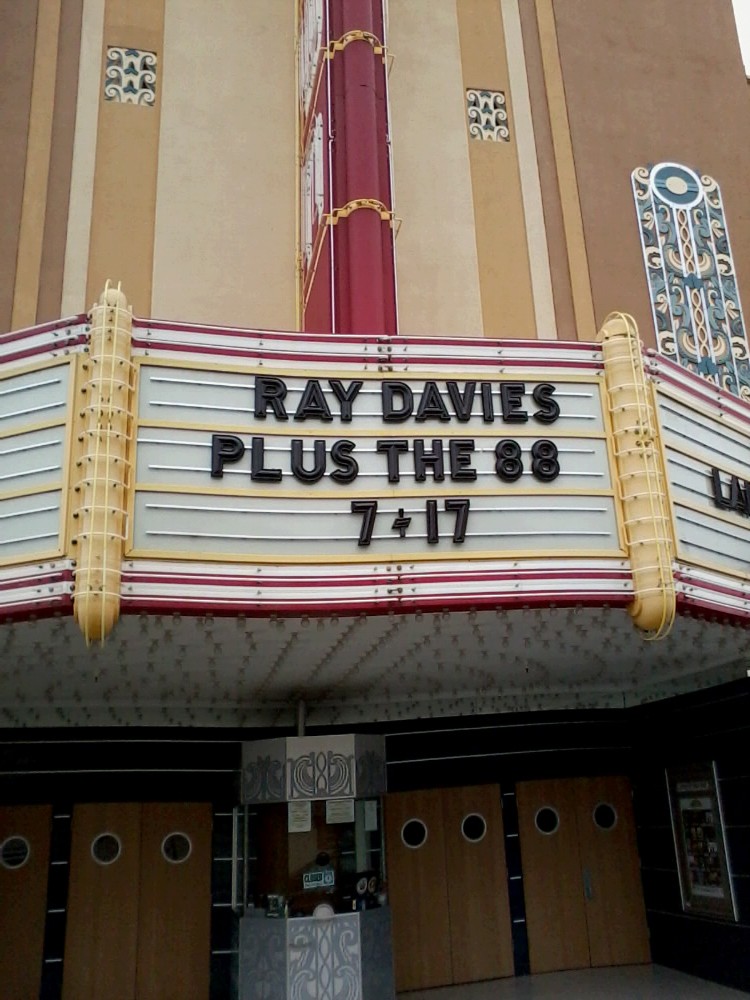
Ray Davies and The 88 at the Uptown Theater in Napa.

I drove into Napa last Friday night from San Francisco and just fifty yards away from where I was staying was the Uptown theater with Ray Davies advertised for Tuesday the 17th.  Didn’t know if I’d make it–had a lot of wine yet to drink and a lot of wineries yet to visit–but go I did.  And I was glad. The opening band The 88 were very good–the front man reminded me a lot of Larry Kirwan from Black 47–and later they acted as Ray Davies back-up band for the second half of Davies’ set.

And then Davies came on.  Nearly 50 years have passed since he and his brother Dave began the Kinks, and the years have taken their toll on his body–he looked thin and haggard and old. (Having experienced a terrible mugging in New Orleans a few years back also took its toll.) In fact often during the show he reminded me of the Bill Nighy character in the film Love Actually. (So much so, that I wonder if the director of the film had Ray Davies in mind when he cast and directed Nighy in the role.)
But his voice and his showmanship were still the same.  If you closed your eyes, no time had passed.  Accompanied by the Irish guitarist, Bill Shanley, and then by The 88, Davies put on a hell of a show with energy that belied his age.
It must be difficult for an artist whose major work is behind him.  Davies is still recording solo, still writing good music, but he is well aware that the majority of his audience wants to hear what he used to do…especially what he used to do with his old band.  He generously mixed many of his old Kinks tunes with newer things from later solo albums–but the majority of the set list  seemed to be the Kinks’ tunes. He introduced his new stuff by asking the audience “to just indulge me for a few minutes.”His new material is good, fine songwriting, fine melodies, but most of the audience wanted the past.
I didn’t write them down, but from the Kinks’ repertoire I know he did at least these titles:
•  Waterloo Sunset
•  Victoria
•  Celluloid Heroes
•  Low Budget
•  Apeman
•  Dedicated Follower of Fashion
•  Twentieth-Century Man
•  Dead-End Street
•  A Sunny Afternoon
•  All Day and All of the Night
•  You Really Got Me
So it was a great night of rock-and-roll, re-creating the sound of one of the seminal bands of the “first British invasion.”  I have always thought the Kinks were grossly underrated–and still do.  After their initial success with rocking tunes, they went on to create beautiful songs that often poked the stereotypical view of the “idyllic English life” in the eye.  They were clever, witty, and fun.  And Ray Davies is still capturing that on stage.
As a treat, here is a video of Ray Davies and the Kinks from a long, long time ago, but a treat nevertheless:

Northern California and Ireland, sea lions and selkies, and a powerful poem

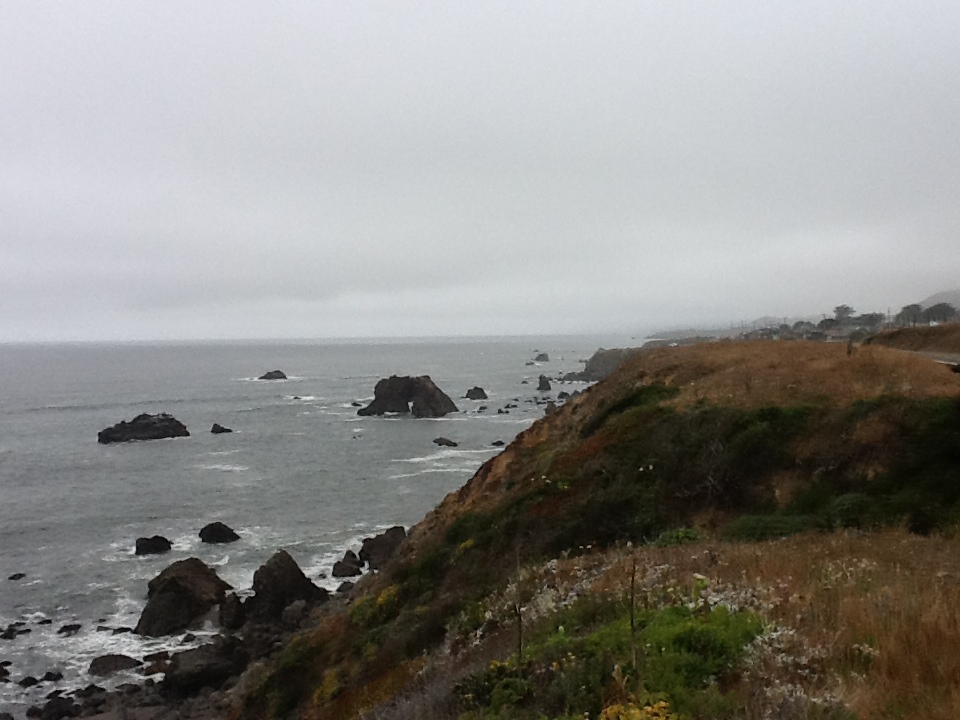
I am not the first to make the comparison between the Pacific Coast Highway in Northern California and Ireland. But that doesn’t make it any less true. It is a magnificent landscape, full of crashing surf and rock-strewn fields, dramatic cliffs and rolling mountains. The hills are more “golden” than green, and the roadways have much fewer sheep and doubledecker tour buses, but yes, it very much reminds me of the west coast of Ireland. Every turn in the corkscrewing highway offers another extraordinary vista.

But it is Goat Beach which is perhaps the most memorable. Goat Beach sits where the Russian River meets the Pacific Ocean. In July the river flow is feeble, but it is then–between March and July–that the area is a breeding ground for sea lions.

By July the sea lions have already pupped and the adult ones seemed quite tired. At first, it is a bit jolting to see twenty to thirty adult sea lions asleep by the rivers edge. It looks as if they have all been slaughtered. But then a fin rises to slap a companion or another waddles to find a more comfortable position. They are just resting–and continue to do so for the rest of the morning.

But the seal pups are another story. Frisky and active, they plunge into the crashing surf of the Pacific or slide into the muddy waters of the Russian River. There is something fascinating about these creatures: their sleekness, their eyes, their movement.

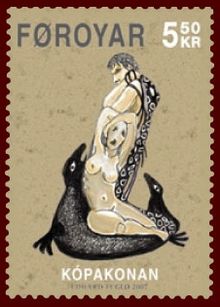
A stamp from the Faroe Islands featuring a selkie emerging from her skin.

Seals and sea lions have long played a part in Norse and Celtic myth.  The legend of the selkie is perhaps one of the most famous and there are a wide variety of stories about them.  These creatures are seals when in the water but humans when they go upon land and emerge from their sealskin. And while there are numerous variants on the stories, there are basically two version of the selkie myth: one female, one male.  The female selkie is often a beautiful woman who is  “captured” by the man who finds her, unable to return to the water because the man has taken possession of her discarded skin.  The male selkie is also renowned  for its beauty and charm when it comes upon land and sheds its skin, and he is often noted for his ability to satisfy the unhappy and dissatisfied women of the area.  Fairly often, these women bear his children, usually children with some sort of “deformity” or oddity about them. These women too are in possession of the creature’s skin.

I can immediately think of two wonderful movies that deal with this myth.  One, is a 2009 film, Ondine, featuring Colin Farrell (and my personal favorite actress Dervla Kirwan from Ballykissangel)  and the other is an older film from 1994 called The Secret of Roan Inish.  Both are well worth finding, however you find your movies these days. And both deal with the female version of the story.

Anyway, so I am reading The Guardian online this winter and I come a cross a video of the Scottish poet Robin Robertson reading his poem “At Roane Head.” It is a powerful poem, and perhaps the most powerful reading I have ever witnessed. In it a woman cares for her four children. Her drunken husband has disowned them–for they have seal-like characteristics as well as human. At the tragic end, the woman returns the seal skin to her lover.

Here is the video.  Give it a view–I find it very powerful.