The Blackest of Comedys: Martin McDonagh’s The Lonesome West and Six Shooters

As many of you know, I am teaching a course in modern Irish literature this term to a group of 18-year old American boys.  As an American classroom, it is filled with various ethnicities and races.  And so, I can never assume that they know what I–or the authors they are reading–are talking about.  And so when we began Martin MacDonagh’s Lonesome West, I knew it was going to be a challenge to get them to enjoy it.poster
Because, when all is said and done, that’s really the purpose…to get them to enjoy what they are reading.  And surprisingly, that is a difficult thing for them to do.  Sure they loved saying the word “fek” when we read the play out loud–and which sometimes occurs twenty-five to thirty times on a page.  (One student told me he loved the word so much he started saying it around the house.  I advised him that maybe he should rein it in a bit.)

But surprisingly, they were too uptight to enjoy the humor…or even to get it!  There is a great line where Father Walsh Welsh — even that’s funny: I explained that this character has appeared in three separate plays now and that no one ever gets his name right, so they continually call him both. Stone faces in front of me. … anyway, there’s this great line where Father Walsh Welsh is anguishing about his failure as a priest.  Coleman tries to reassure him:

Ah there be a lot worse priests than you, Father, I’m sure. The only thing with you is you’re a bit weedy and you’re a terror for the drink and you have doubts about Catholicism. Apart from that you’re a fine priest. …

I had to explain that that was funny.  I had to explain that Girleen’s blatant attempts at seduction, her outrageous dirty-mindedness, and her falling in love were funny. (The pathos of her ending was a whole other story!) That Coleman’s constant ribbing of Fr. Walsh Welsh about the priest scandal in Ireland was funny. And that a small village where a father has been murdered by his son, a mother by her daughter, and a wife by her husband is a funny world indeed, especially when the smashing of holy figurines or stealing poteen is considered a more serious crime.

They were fine in talking about themes of redemption and reconciliation, in tracking down and explaining symbols, and analyzing character.  But they stumbled upon the humor.  And when all is said and done, that might be more important than all that the other stuff.

sixshooterAnd so I thought I would relieve their reading by showing them MacDonagh’s Oscar winning short film Six Shooter.  Unlike most of MacDonagh’s work which takes place in the west of Ireland, this takes place in  southeast Ireland, particularly on a train to Dublin.  A man is returning from hospital where his wife has just died that morning. He boards a train to go home and sits next to a young twenty-something who is a bit more than strange and possibly deranged.  The boy’s patter, aggressiveness and nonsequiturs are amusing, uncomfortable, and awkward.  But they are also, at times, bizarre and hilarious.  But maybe not to a group of high-school Americans.  Suffice it to say that by story’s end we have seen a cow explode, a rabbit get shot, a woman throw herself off a train, a character gunned down by police and a man fail at his attempt at suicide.  And that is  the violence that happens just on screen.  (I explained to them that MacDonagh was a combination of Quentin Tarentino, David Mamet, and John Millington Synge.)

Anyway, if a short movie that moves the cartoonish violence of Tarentino into the idyllic countryside of the Irish coast sounds appealing, then here it is below. It did win a 2006 Oscar in movie, though I don’t know if that held any sway with my boys.  Here it is:
 

Book Review: Dirty Snow by George Simenon–Dostoyevsky with a touch of Kafka…only bleaker.

dirtysnow

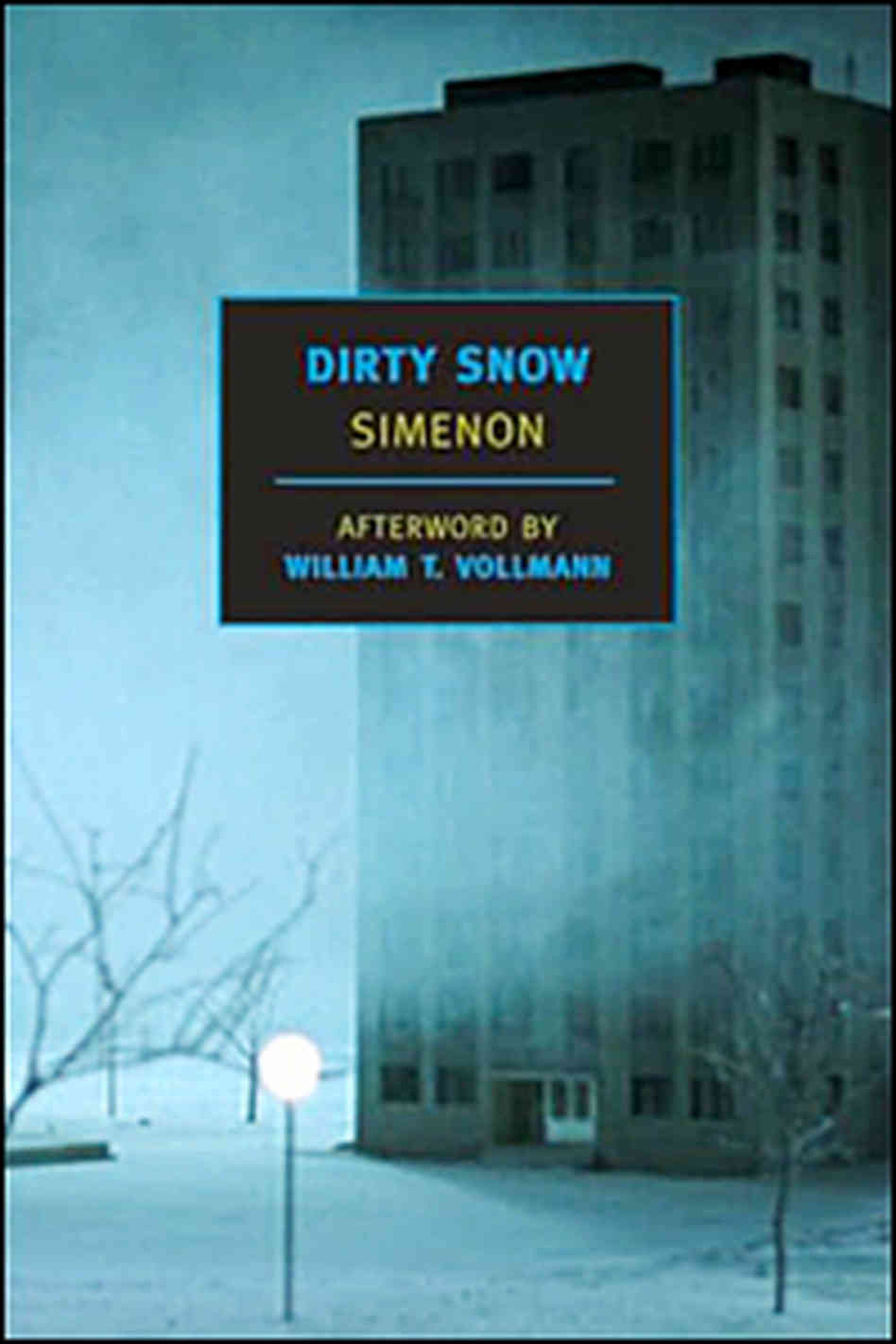
A colleague of mine passed on a book that he liked very much. Dirty Snow by the prolific Belgian writer, George Simenon. I had read several of Simenon’s detective novels, gritty tales that featured the Parisian detective Maigret. The Maigret novels–I believe there are over fifty of them—seemed superior to most in that genre, filled with a certain ennui and jaded acceptance that went beyond the cynical aloofness of his American counterparts or the aloof cynicism of his more modern offspring. And to be honest, they were good reads.

georgesimenon

George Simenon

Although I had read only the Maigret novels, I knew that Simenon wrote other sorts of novels. I had always heard them referred to as “philosophical” novels, though the French label them as “psychological” novels. And the French are closer to the truth, here.

And when my colleague passed on to me Dirty Snow, he did so with the caveat that it was “extremely grim” although oddly humanistic.

Dirty Snow is the story of Frank Friedmaier making his way through his occupied city.  We never know who the occupiers are and where the city is. When he is imprisoned, his captors, his location, and his crime are never identified. All of this, gives the novel a certain Kafkaesque feeling. And although time moves forward throughout the seasons, there seems always to be piles of soiled, stained, and dirtied snow.

And yet it was Crime and Punishment that I thought of immediately. Frank–who may be the most amoral, sociopath I have come across in my reading, and I know Burgess’s Alex and Ellis’s Bateman–begins the novel looking to kill his first person. There is no reason for, no gain from this murder–it is, as he says, like losing his virginity: “Losing his virginity, his actual virginity, hadn’t meant very much to Frank. He had been in the right place. … And for Frank, who was nineteen, to kill his first man was another loss of virginity hardly any more disturbing than the first. And like the first, it wasn’t premeditated.”  Like Raskolnikov in Crime and Punishment, he needs little push to kill his victim. Yet, there the similarity ends.  For Raskolnikov punishes himself, mentally, emotionally, spiritually and psychologically for the crime he committed.  Frank feels nothing. And soon he kills again…an old woman in his childhood village who recognized him in the course of a burglary.

But the murders are not his greatest crime. That is reserved for the sweet and loving Sissy who lives across the hall from the brothel that Frank’s mother runs and where Frank lives.  (Sissy mirrors very closely Raskolnikov’s Sophia in her love and faithfulness to Frank.)  Frank’s relations with women are brutal at best–indeed all the women in the novel seem mistreated one way or another.  He takes full advantage of his mother’s prostitutes, coldly, quickly and unemotionally, and this is the way he treats Sissy as well, deceiving her into a situation where she is nearly raped by his drinking associate.

One might say there is no reason for Frank’s viciousness, but that would be inaccurate. There is no “motive,” no “purpose” for his ferocity. But there is a reason, and Simenon attempts to suggest it subtly. Frank’s mother abandoned him to a wet-nurse so she could “ply her trade” and visited only occasional. He never knew his father, only the brutality of both life and the State.  Two men are offered as father surrogates in the novel: one, a Maigret-like inspector who turns a blind eye to Frank’s mother’s occupation and who very well may be his biological father and Sissy’s father, Holst, who Frank is drawn to from the beginning, who sees Frank in the alleyway on his first kill, and who offers him forgiveness at the end.

But many men have similar upbringings and few turn out as nihilistic, amoral, and unfeeling as Frank.  To his interrogator he says at the end: “I am not a fanatic, an agitator, or a patriot. I am a piece of shit.” There is nothing.  Yet the flip side of that is that there is nothing the State offers either.  They have not arrested him for the murders or the burglary. They have brought him in, they torture him merely for information.  And here, in the claustrophobic room where he is questioned, one remembers a similar room–Room 101 in Orwell’s 1984. But Frank is no Winston Smith either; there is no romantic dream of something better, no fervid belief in the ultimate progress of what is right.  There is only Frank, solipsistic and brutal Frank.

Simenon’s novel is fascinating. His hero is repellent. And I can’t stop thinking about neither it nor him… It’s sort of like wearing wet shoes, soaked through by dirty snow.

Movie Review: Barbara, The Lives of Others, and Paranoia

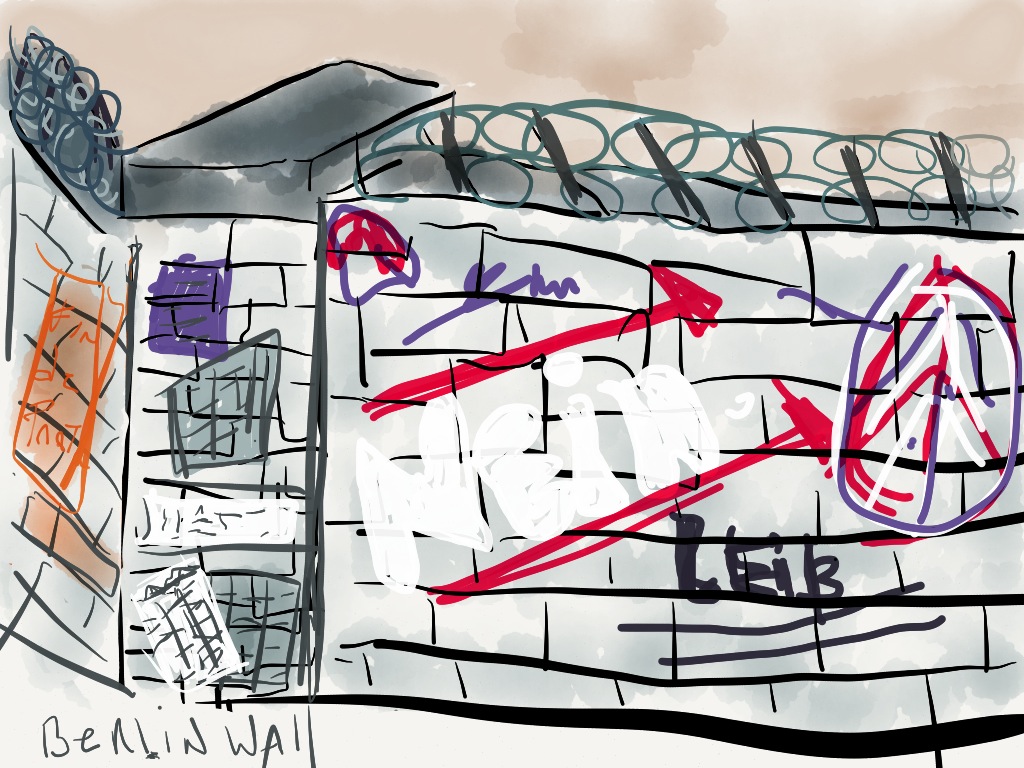
Berlin Wall                     2013 jpbohannon

Berlin Wall
illustration by jpbohannon © 2013

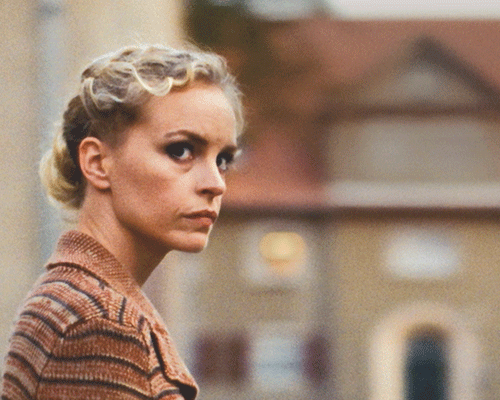
The East German film Barbara begins with a sense of paranoia and never backs off. Colors are muted, weather is stormy and damp, buildings are dilapidated. And Barbara (Nina Hoss) enters the picture wary, distant and observant.

Remember that old Kurt Cobain lyric that states that “just because your paranoid it doesn’t mean they’re not after you.” Well, it has never been truer than with Barbara. The film opens in East Germany in the 1980s with Barbara arriving at her job early. She is alone, aloof, and very aware. As she sits having a final cigarette before going into work, we see two men spying on her from a window and they give us some back-story. They already know her life. Barbara was a prestigious doctor in “the city” and for some misadventure–we are never told what–she has been sent to work in the provinces.

Nina Hoss as Barbara in the film Barbara

Nina Hoss as Barbara in the film Barbara

Andre (Ronald Zehrfeld), the young doctor who is her “handler,” is impressed by her skills but flustered by her attitude. He too has had a past that has sentenced him to this provincial hospital. But she sees him as nothing more than a pawn of the government. When he first offers her a ride home from the bus stop where she waits, he drives her home–without asking where she lives. Barbara is very certain of the eyes that are on her.

This oppressive watching makes Barbara’s secret plotting even more difficult. She is repeatedly meeting a lover who is arranging to have her escape to the West. And while the authorities are not aware of her plans, they are unhappy when she is unaccounted for hours at a time. Twice when she returns home, the Stassi are at her apartment, having rifled through her flat and subjecting her to a full body search. The humiliation and oppressiveness is palpable.

There are also two young patients that Barbara and her handler attend to, one of whom grows very fond of Barbara and begs not to be sent back to the work farm where she is sentenced. The young girl will play an important role later in the film, but it would be too much of a spoiler to say how. The other too is a fulcrum on which the plot balances.

Needless to say, the romantic tension between Barbara and Andre grows, but it is always secondary to the political and personal tension involved in Barbara’s escape.

Without giving too much of the ending away, let me just say that it is satisfying, heartwrenching and thoughtful.

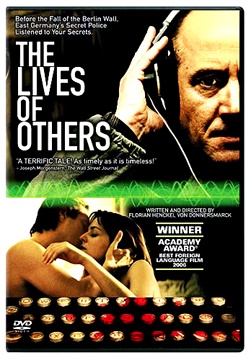
The East German paranoia reminded me of another film The Life of Others directed by Florian Henckel von Donnersmarck. This too took place in East Germany during the 547_The-Lives-of-Others_375931980s, but the film was told from the point of view of a Stassi spy. Spying on a writer and his lover, he becomes increasingly involved in the life he is observing. And while the oppressive paranoia and wariness is as palpable as it is in Barbara, it is, perhaps, less personal. In the former, we are in fairly familiar territory–the spy thriller, albeit with a twist. In director Christian Petzold‘s Barbara, the paranoia, the fear, and the oppression–engulfing the lives of everyday people as it does– seems more suffocating, closer to real.

♦ ♦ ♦ ♦ ♦ ♦ ♦ ♦

I’m not sure what Leonard Cohen has to do with any of this, except he tells us that “next we’ll take Berlin” in this, one of my favorite songs. But the water’s edge where the video begins is eerily reminiscent of the water’s edge where Barbara ends and that is what I thought of. Enjoy:

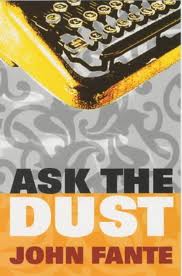
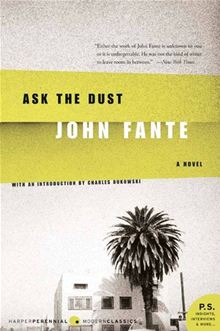
Book Review: Ask the Dust–Los Angeles, Obsession, and William Butler Yeats

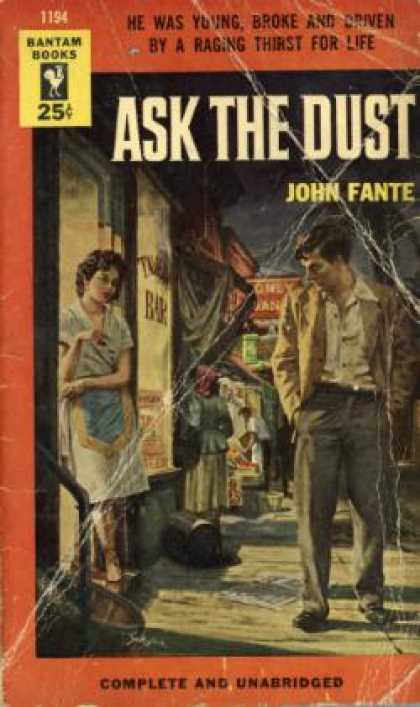
Ask the dust

Ask the dust 3

ask the dust 4One of those weird coincidences: I began reading John Fante’s 1938 novel Ask the Dust late this past Tuesday night. I didn’t get far–maybe three chapters–but the story of a young writer who had moved to L.A. from Colorado had grabbed me. Wednesday morning, I wake up early, check my messages and e-mails and a few blogs that I read. One of them–francescannotwrite–has a picture of the Disney Concert Hall at the top and a quote from Fante’s novel: “Los Angeles, come to me as I have come to you.” (Besides the weird coincidence of the novel, I also had, just a few weeks back, put the Disney Concert Hall on my computer as its wallpaper.) The blog-post offered some examples of the novel’s humor, its brief passages of romance, and its overall feeling of gloom. And then it segued into some extraordinary pictures of Vietnam.

Anyway, so I finish the novel and it was a good read, although one that left a few questions unanswered. Episodes where the act of writing were described were particularly memorable, for it is hard to put down on paper the art of ART. Most times, it comes off as stagy and overly dramatic. But the scenes where Fante gives us two or three paragraphs of Arturo Bandini in a “creative” groove are fun to read. For instance, here is Bandini–having sold two short stories for a handsome price–sitting down to begin his novel:

Out of my desperation, it came, an idea, my first sound idea, the first in my entire life, full-bodied and clean and strong, line after line, page after page. … I tried it and it moved easily. But it was not thinking, not cogitation. It simply moved of its own accord, spurted out like blood. This was it. I had it a last. Here I go, leave me be, oh boy do I love it. … big fat words, little fat words, big thin words, whee whee whee.

But primarily, Ask the Dust is about obsession. The hero, Arturo Bandini, self-conscious of his Italian heritage and full of fluctuating self hate, falls madly in love with Camilla Lopez, a Mexican waitress at a cheap coffee shop. The entire novel, his writing, his day to day living, his memories of home become wrapped around her–or around deliberately hating her. For the relationship is a strange sado/masochistic thing that yo-yos between love and hate, between tenderness and violence, but that never vascillates in its obsession. Camilla too has her obsessions and it is the thrust of the novel that they are not the same as Arturo’s.

I have always been attracted to obsession. I remember reading the novel Damage by Josephine Hart in one sitting and being floored by the destructive obsession of its characters. (I can still remember cancelling a lunch appointment because of my emotional exhaustion. The film version, by the way, tries, but does not do it justice.)

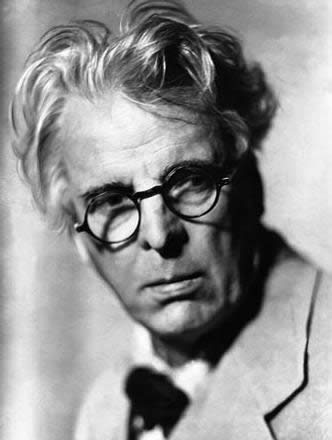
But mainly I think of obsession as a good thing…as a passion that forms and defines you. And in this I turn to Yeats. My favorite Yeats’ poem is “The Song of Wandering Aengus.” The poem tells of discovering a great passion…and of following it throughout one’s life. There is a sadness in it, but one tinged with hope, colored with the concept that chasing the obsession is more important than actually attaining it.yeats3

The Song of Wandering Aengus

by W. B. Yeats

WENT out to the hazel wood,
Because a fire was in my head,
And cut and peeled a hazel wand,
And hooked a berry to a thread;
And when white moths were on the wing,
And moth-like stars were flickering out,
I dropped the berry in a stream
And caught a little silver trout.
When I had laid it on the floor
I went to blow the fire a-flame,
But something rustled on the floor,
And some one called me by my name:
It had become a glimmering girl
With apple blossom in her hair
Who called me by my name and ran
And faded through the brightening air.
Though I am old with wandering
Through hollow lands and hilly lands,
I will find out where she has gone,
And kiss her lips and take her hands;
And walk among long dappled grass,
And pluck till time and times are done
The silver apples of the moon,
The golden apples of the sun.

And this is how, John Fante’s novel Ask the Dust leaves us. His Mexican girl has “faded through the brightening air” and, while he chases her through the foreboding desert, he is left to use her image, her memories, and his pain to create his next novel, to fashion his next work of art.

And so for something different on this snowy March day, here is a clip of the singer Christy Moore doing his version of Yeats’ poem. It never fails to bring a tear to my eye:

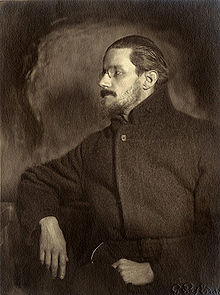
A Portrait of the Artist with One Left Foot

Joyce  ©2013 by J.P. Bohannon

Joyce
illustration by jpbohannon © 2013

I’ve had the nice experience of putting two seemingly different works together and seeing startling comparisons that I hadn’t thought of before. In the class I am teaching on Irish Literature, we had begun the semester with Joyce’s A Portrait of the Artist as a Young Man. From there we moved through some Frank O’Connor stories, some Yeats poems, and three plays by John Millington Synge. And then as a breather, I showed the film My Left Foot, based on the autobiography of the Dublin poet, painter and writer, Christy Brown.

The Artist Joyce as a Young Man

The Artist Joyce as a Young Man

Daniel Day-Lewis as Christy Brown in My Left Foot

Daniel Day-Lewis as Christy Brown in My Left Foot

I have a fond relationship with My Left Foot which began long before the film was released. A friend of mine was living in San Francisco, working as a nurse. She would search the used book shops looking for the odd nugget, and she was always very kind to me. Every so often there would be a T-shirt from some cleverly-named dive bar, an esoteric album that no one knew about it, or a used book she found in her travels. One day, in the mail came a package containing My Left Foot by Christy Brown. I didn’t know the book at the time though it was twenty years old by then, but the worn and ragged dust jacket and the beaming face of Christy Brown on the back announced the joy, the vibrancy, the humor, and the pathos of the story inside.

I remember reading it twice in a short space of time, of lending it to a friend, and then lending it to another, and soon I lost track of it. And, to be truthful, I forgot about it. Until the movie was released and Daniel Day-Lewis’s performance announced to the world that this was someone to watch.

Viewing it this past week, so close to having finished Joyce’s Portrait, however, impressed on me how similar the story of these two Irish artists are. Joyce’s hero–Stephen Dedalus–is a sensitive, young child, bullied a bit at school, helpless without his glasses.

Christy Brown

Christy Brown

That Christy is also helpless, everyone assumes. Born with cerebral palsy and able to move only his left leg, he spends his early years lying under the stairs watching his family interact with each other—for better or worse. Joyce’s novel also begins with the early interactions of the family. From the hairy face of his father and the nicer smell of his mother when he was an infant to the fierce political/religious argument at Christmas Dinner, the Daedalus family is indeed similar to the Brown family. Particularly in the characterization of the fathers and mothers.

Simon Dedalus and Paddy Brown are hard men, perhaps a bit too fond of the drink. And both young boys, Christy and Stephen, see it as their responsibility to save their families from the fathers’ excesses. The mothers are doting: Christy’s mother innately sure that her son was more than just the vegetable that everyone believed him to be and Dedalus’ mother praying for her son’s soul and protecting him from his father’s increasing wrath.

And it wouldn’t be an Irish tale, if religion didn’t play a part. Father Arnall’s sermon on hell affects Stephen to such a large degree that he believes he might have a priestly vocation. And Christy is taught religion by a priest who comes to the house and who is also fond of describing the fires of hell–and causing young Christy no end of terrors.

Relations with the opposite sex are a stumbling block in both works as well. Sensitive Stephen vacillates from madonna to whore to madonna throughout, while Christy–caged within his crippled body–falls in love easily and is rebuked as often.

But the importance of both works is the creation of the Artist. Joyce’s Dedalus ultimately abandons church, nation and family in order to strike out on his own and “forge …the consciousness of [his] race,” while Christy embraces that world–dear dirty old Dublin and his sprawling family–to find the inspiration of his art. The artistic output–however disparate–is not the point here. The point is the development of an artist within similar constraints and backgrounds, a tale of two young men who travel the same narrative arc in order to discover the art that is within them.

♦ ♦ ♦ ♦ ♦ ♦ ♦ ♦

To one and all, Happy St. Patrick’s Day.

Central Station…more about a boy

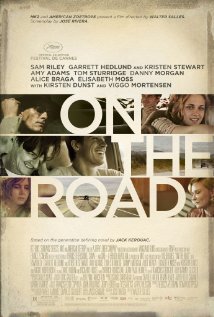
MV5BMTc1MzU5MDgzMF5BMl5BanBnXkFtZTcwMDQ4ODY2OA@@._V1_SX214_In the late November, I made a deal with my students. If they read Kerouac’s On the Road by Christmas, we could go see the film together as a class trip. (It was opening December 21.) However, for whatever reason, the film came, left, and went straight to video, before the first weekend was through. Needless to say, we did not go on our trip, (although one student claimed he could pirate it the day it came out and offered to show it in class.)

Later I told my boss this story. He hadn’t been aware of the On the Road film, but said that the director Walter Sayles was one of his favorites and that Sayles’ film Central Station was extraordinary and something I should see. And as he does often, he presented me with the DVD of it a week later.

Well, I finally got to watch last week. (I need to announce a spoiler here, but the ending is not the point. We all know how Romeo and Juliet ends but we watch it for what it gives us and makes us feel!)

Central Station (original title Central do Brasil) begins in Rio de Janiero’s enormous and busy train station, where Isadora (Fernanda Montenegra) makes her living writing letters for the illiterate. She scams most of them, never posting the letters she writes. One day a boy, Josué (Vinícius de Oliveira) and his mother arrive at her table. The mother wants to contact the boy’s father; she says that the boy has been asking about his father whom he has never seen. She dictates a letter that is both angry and accusatory.

The two appear again to Isadora’s table the next day to revise the letter, the mother wanting to erase much of the bile that was in the first. Astutely, the young boy is suspicious that Isadora still has the first letter right there and is able to retrieve it so quickly.

Central Station

Central Station illustration by jpbohannon © 2013

Afterwards, as the mother and the young boy leave the station, the mother is run over by a bus and killed, and by the end of the day Josué falls into the care of Isadora.

Central Station could have easily followed the film cliché where the rigid adult is paired with a rambunctious child and all sorts of mahem ensues–but it does not. It is not that kind of movie. Isadora does not want the boy; she has long been dealing with her own issues of parental abandonment. In fact, her first action is to sell him to an adoption agency. But that wracks her with guilt and she goes and retrieves him–keeping the money for herself which places her in some danger. Despite her bitter disposition, her jaded cynicism, and her own personal issues, she is responsible enough to want to get the child to his father. (And after all, she still has the address from the letter she never sent.) And so the two start the long trek by bus, kitted out with the money that she had originally sold Josué for.

Of course, the journey is difficult and there are a number of setbacks. Several times Isadora attempts to abandon Josué, but she fails–not because of pangs of conscience, but because of circumstances beyond her control. She dreams of running away with the kind truck driver who helped them out, but even Jopsué knew that that wasn’t going to work. She attempts to leave him while he is sleeping (his backpack secretly supplied with the money), but that doesn’t work and, in fact, goes horribly wrong.

And then finally they arrive, but the father is not where he last address indicated. Finding him is more difficult than they originally thought. In fact, they never do find the father–but they do find that Josué has two older brothers, who take him in.

In the history of film, there are certain moments that break your heart in both their beauty and their poignancy. The final scene where Isadora rides in a bus back home to Rio is one such scene. She has snuck away once again, in the middle of the night and leaving Josué with his brothers. As she attempts to write him a note, her anguish is palpable.

[caption id="attachment_2082" align="alignright" width="364"]fernanda_1 Brazilian actress, Fernanda Montenegra

The film is really a showcase for Fernanda Montenegra, one of Brazil’s greatest actresses. To be honest, her character Isadora is very unlikable –someone who cheats the poor and illiterate and sees a suddenly orphaned child as a get rich quick opportunity. Yet it is Montenegra’s talent that draws us into her, that makes us want her to do the right thing, and that breaks our hearts in the closing scenes. And the young Oliveira, who plays Josué, plays against her as if her were a veteran actor. Indeed, Josué’s uncanny and mature sense of what Isadora is up to is one of the delights of the film.

What Central Station is not is a showcase for Rio de Janeiro Except for Rio’s bustling train station and a street fair in a small outpost beyond the city, the film doesn’t dwell on location or even local color. Sayles, a Rio de Janiero native, sees nothing exotic about his home city…but perhaps that is to deliberately underscore the universality of this lovely and moving film.

Blogging, Beckett and a Seven-Year Old Boy

It was one year ago last week that I started blogging.  But I  quit before that anniversary came around.

Yes, I quit blogging in late November, because I could no longer do it.  I loved doing it. I had met some extraordinary people–Romanians in London, Americans in Ecuador, an art colony in Italy.  I enjoyed thinking about the books I read, the music I heard, the films I watched.  And I enjoyed trying to get those thoughts “down on paper.”

photo

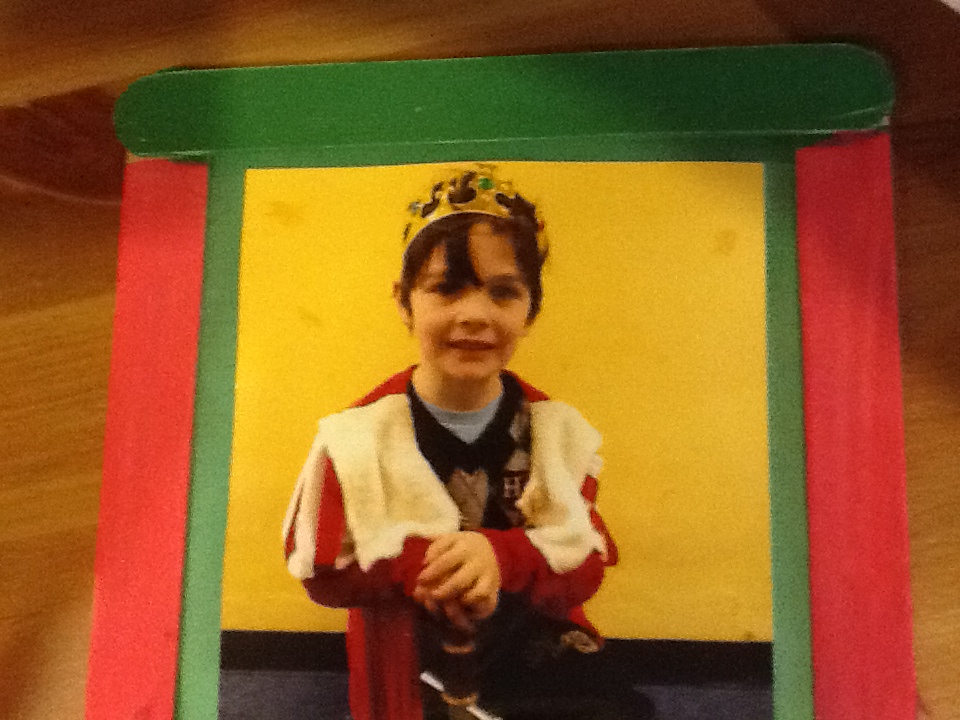
Henry dressed as the “Holy Roman Emperor Saint Henry” for Halloween last October.

But then my life changed drastically and blogging found itself way down on my list of priorities.

I became responsible for a seven-year old boy.

Henry is a delightful young boy. He is creative, bright, and personable.  And it is my job, to a degree, to nurture and protect him. I shower him with love and I make sure that he knows he is loved. I try to pay attention to what he does and what he says and what he feels.

We play silly word games. We read together: I to him on the sofa; he to me on the steps, (where the game is that I must go up or down a step every time he turns a page.)  He is seven years old, but will still hold my hand when we walk places, at least for now.  We often take “adventures” together, and these are usually simple jaunts across the city on public transportation. We take a trolley and then a subway and then a train and then we reverse ourselves, adding in a bus on the return trip. He points out train yards and sidings, trolley tracks and subway couplers. We stay and wave to the drivers after we get off and they drive away. (He does LOVE his transportation!)

Sure, there are time when I must get him to do things that he doesn’t want to: to try foods he does not like (that comprises everything that isn’t pizza) or to stop talking and listen when others are speaking or to slow down with his homework, with his handwriting. I try to teach him, and I try to do so with patience, with gentleness and with love.

For the most part, when I am not at work, I am with him, or I am asleep. And when I am at work, I am thinking about him and worrying about him.

photo22

Henry and I on the R5

Having a seven-year old in your 30s is one thing; having a seven-year old in your late 50s is something else altogether.  I haven’t read a book in I can’t say how long. My film-going is greatly constricted.  And my television viewing is completely limited to Phineas and Ferb (don’t ask!) and America’s Funniest Home Videos.  And yet his enjoyment of both of these shows is genuine and sweet. He laughs with purity and with delight. And that, I wouldn’t trade  for anything.

♦     ♦     ♦     ♦     ♦     ♦     ♦     ♦     ♦     ♦

I went out last Thursday night with my wife and some friends to see a play: Endgame by Samuel Beckett.  I had read it many times, but had never seen it performed, and so we made definite plans to get there.

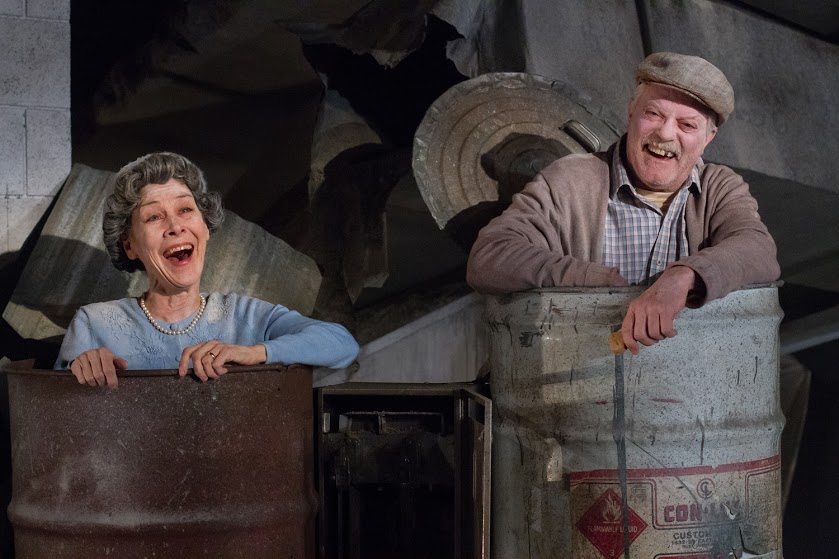
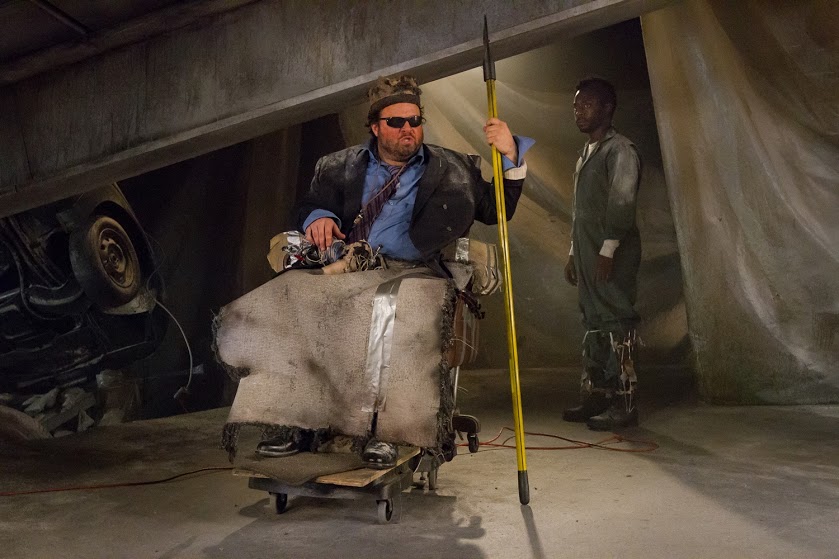
Endgame is the second of the four major plays that Beckett wrote following World War II. (Waiting For Godot, Endgame, Krapps Last Tape and HappyDay.) Situated firmly in the Theater of the Absurd, Endgame presents Hamm, a blind, crippled man who sits in a make-shift wheel-chair in a single, disheveled room. He is tended to by Clov, who, conversely, is unable to sit.  In the room are also two trash bins.  In the one is Hamm’s legless father, Nagg, and in the other, his legless mother, Nell. Hamm pontificates on the bleakness of  life, on the attraction of story-telling, on the uncertainty of a future.  It is one of my favorite plays.

In one piece of dialogue that I particularly love, Hamm asks Clov to open the trash bin to see what his father is doing:

          HAMM (letting go his toque)
                What’s he doing?
               (Clov raises lid of Nagg’s bin, stoops, look into it. Pause.)

            CLOV
               
He’s crying.
                  (He closes lid, striaghtens up.)

          HAMM
                Then he’s living.

I love this. How simple, how poignant, how piercing. It perfectly captures Beckett’s–and to a large degree, my own–world view.  For better or worse, my personal philosophy has long been greatly informed by Beckett’s.  Or else, I had already formed it and because of that I found Beckett. But, for one reason or another, I am drawn to his bleakness and  emptiness–and to the black humor that attends it.

Endgame_2_high

Nancy Boykin and Dan Kern as Nell and Nagg in Arden Theater’s production of Endgame. Philadelphia, February 28, 2013.
© Photos by Mark Garvin

Endgame_8_high

Scott Greer and James iJames as Hamm and Clov in the Arden Theater’s production of Endgame. Philadelphia, February 28, 2013.
© Photos by Mark Garvin

As I said, I have long enjoyed and embraced Beckett’s dire existentialism.  But now, I can no longer afford it, can no longer afford to wallow in such bleakness, to delight in such barren absurdity.  I have to try to tamp it down. For I have Henry now to take care of, and that is very much the purpose of my life.

The End

Thank you to all who have been such gracious readers

and who have left such wonderful comments

and taken part in such thoughtful conversations.

It has been fun and I’ve met an extraordinary amount of wonderful people.

But it is time to stop…at least for a while.

Thank you, again.

Book Review: Mo Said She Was Quirky by James Kelman

James Kelman

I first started reading James Kelman back in 1994 when his novel How Late It Was, How Late had just won the Man Booker Award. The novel was entrancing. Driven by a rough Glaswegian dialect that was musical, whimsical and earthy, the novel followed the Kafkaesque troubles of an ex-con who has been beaten, blinded and abandoned.  I remember the plot only faintly, but the language itself will stay with me forever. It was as if Samuel Beckett had plopped down into Glasgow, went on a long bender, and lived to tell the tale.

After that introduction, I read his short story collection, Busted Scotch. Again, while I enjoyed the stories, it was the language that remained. Lively, working-class language, filled with imaginative slang and time-born wisdom.

I remember being excited when I learned of his next novel, You Have to Be Careful In the Land of the Free when it came out in 2005. How wonderful, I thought, to hear that raspy, magical, glittering voice unleashed in the vastness of the Americas. But I was greatly disappointed.  Storyline was never his strong point, but here even the voice had faded. I was off Kelman for a while.

And I guess to my detriment, because Kelman’s next work was widely praised.  Kieron Smith, Boy was a story of an urban and lonely childhood and it was called both “magnificent and important.”  But I missed it and now it’s at the bottom of a long list of must reads.

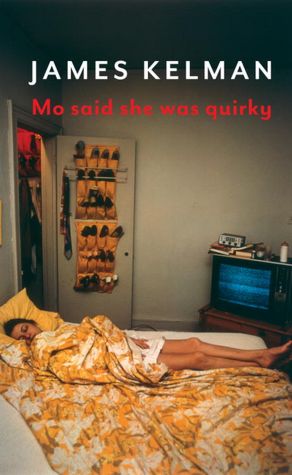
But I did pick up Kelman’s latest novel, Mo Said She Was Quirky–mainly because of the intriguing title. And once again, the language is at the forefront. Once again we are in a Beckettian world of isolation and words. Yet, unlike anything he did before, in Mo Said She Was Quirky, Kelman’s lyrical speaker is a woman, Helen. The novel is told primarily in the first person, much an extended interior monologue. Other characters appear, but we see and hear them only through Helen’s eyes.

Helen works the night shift at a London casino, where she and her daughter have moved to get away from her no-account husband in Glasgow and where they now share a small, one-bedroom flat with her Pakistani lover, Mo.

In a cab on the way home one night, Helen stares at two homeless men stagger across the intersection in front of the taxi. One of the me stares intently into the cab and Helen recognizes him as her brother. This recognition begins her long night of self-examination, self-incrimination, and self-rationalization. Why is she here? Why is he there? How dysfunctional was her and her brother’s growing up or is this the state of all humanity? Helen is generous in her compassion and stingy with her self-pity. Many have it worse than she, she deliberates, and then realizes that misery, sorrow, and pain are  very relative and the fact that she has a hot shower and another person does not does not make her pain any easier or lighter to bear.

Completely knackered and unused to the night-shift, Helen, nevertheless, cannot sleep. Her mind races with memories of her brother, her damaged parents, her child, her ex, and the kind man she lives with, Mo. She waits until Mo and her daughter waken, watches them go off to school, and yet, still, she cannot sleep.  She thinks greatly about the differences between men and women, the posturing and bullying of those she has known, the favorites that her parents very obviously played. She thinks about racism and worries about Mo. She thinks of the urban jungle and worries about her daughter.

As night turns into day, as Mo takes her child to work, she grabs a few hours of rest but her mind is increasingly racing. And as it does we learn more why this simple-hearted woman is so fraught with worry about the future, so done-in by her present, and so haunted by her past.

I give Kelman a lot of credit for trying what he does so well in a woman’s voice. At times, Helen’s monologue seems to drag but at others it is riveting, revealling bits and bits of a single life and illuminating the mind of a  woman who lives in constant worry about the world around her–and the past that formed her.

I’m not really sure yet how I feel about Mo Said She Was Quirky. I do know that Kelman’s voice in it has me returning to reread How Late It Was, How Late. That’s the novel of his that I loved the most, and the others have yet to measure up.

Aventuras de Avril, Reader Appreciation Award, and some blogs to check out

For a long while, the country that was third or fourth in readership of my blog was Ecuador.  That was mainly because of a woman named April who writes a wonderful blog herself and whose comments on my own postings were always amusing, thoughtful  and enjoyable.

April is a remarkable woman.  About a year ago, she decided to change her life. Not something superficial like a new hair-style, a new tattoo (I don’t know if she has even one!) or a change in diet. April picked up and moved to Ecuador.  As she said “I filled up a backpack, bought a ticket to Ecuador and left, without speaking any Spanish, with no job lined up, and just a starting point and a general goal.”

She has been living there for nine months now and she has been recording her adventures in a delightful blog called AVENTURAS de AVRIL.  You should check it out. Her enthusiasm for her new world, her new language and the many new people that are in her life is uplifting, and her writing and photography are special.  I had read two pieces this week–one in the NYTimes and one in the preface to the Best American Short Stories of 2011–which advised one to pick up his or her things, move to a place where the language is unknown, and discover something special about one’s self.  April has successfully taken that to heart.  So be sure to check out her blog by clicking on the link above.

So why am I writing about April?  To THANK HER. She has recommended me for a Reader Appreciation Award–a recognition that she herself just won.  In the large scale of things, this is a very unassuming award, meaningful and known to only a few. But it is a simple recognition from someone out there who’s reading. And that is very, very much appreciated.  So THANK YOU very much April!  Keep writing and keep wringing everything you can out of life.

♦     ♦     ♦     ♦      ♦

The Rules:


1. Provide a link and thank the blogger who nominated you for this award.
2. Answer 10 questions.
3. Choose 10-12 blogs that you find a joy to read.
4. Provide links to these blogs and kindly let the recipients know that they have been chosen.
5. Include the award logo within your blog post.

The Questions:

Your favorite color?     I like grey in all its many shades. (This is not a literary reference. Hah!)
Your favorite animal?      Otters
Your favorite non-alcoholic drink?     Chocolate Milk
Facebook® or Twitter®?     Neither.
Your favorite pattern?   Very small checks.
Getting or giving presents?   I very much dislike receiving gifts. I love giving gifts when I am truly excited about what I am giving.
Your favorite number? 18
Your favorite day of the week?    Every day.  I see no differences in them.
Your favorite flower? Bird of Paradise.
What is your passion? To learn to write well.

The Blogs I Appreciate:


Two of these are the blogs of a personal friend and a niece. The rest are by people that I have connected with since I began writing my blog at the beginning of March and are part of a very neat community.  Some I read for advice, others I read for inspiration, and still others I read for the shear joy of it.  So, here they are in no particular order:

Sue Healy – An Irish born writer whose short stories and dramas have won numerous awards. Her blog addresses the day-ins and day-outs of the writing craft.

Diane Bones – The very humorous opinions of a very funny writer. Diane opines on everything from SPAM to National Elections, from Award Shows to urban violence.  A great and wonderful read.

me myself and ela –a Romanian woman living in London, her blog is filled with magnificent photographs, music videos, and her own musings.

O Lumi in Imagini –another Romanian blog, this one focusing on art and film. A bit avant garde but fun to look at.

Courtney Gillette— a young Brooklyn writer who is literate, interesting, funny and saavy.

The Coevas–I am not sure what this is or how I got here.  It’s from a middle-European writing/creative collective that is putting together a novel and the film to go with it all at once on the site. Pretty dramatic images and a beautiful site.

francescannotwrite–“so let these writers impress you instead” states the header of this blog. I think she’s being modest. Francess Antoinette is well travelled and posts her amazing photos and amusing thoughts on her blog.  It’s a very nice read.

Pretty Feet, Pop Toe–post after post, this is one of the funnier blogs I read. A snarky complaint about all the things that drive all of us mad, written well and with a unique sense of humor.

apk: an art diary–I have probably forwarded posts from this blog site more than any other. It is like a digital art gallery that posts extraordinary art work from artists (all unknown to me) from around the world. Truly wonderful.

The Saturday Morning Post–as the title says, it is a blog that delivers a post each and every Saturday. It discusses the writing life in all its aspects, from successes to rejection, from inspiration to business.  Well written, serious, and informative.

♦     ♦     ♦     ♦      ♦

So THANKS to all of you for reading my  blog.  I was seriously considering putting my blog to sleep–but I’ve developed a strange relationship with it. So maybe we’ll go on for a bit longer. Go check out some of the blogs listed above. I’m sure you’ll find them interesting.

And thank you to April for sending me this Reader Appreciation Award. Please be sure to check out her blog. She’s a fascinating person.