Movie Review: Bonjour Tristesse (dir. by Otto Preminger)–Jean Seberg and the weight of sadness

"Bonjour Tristesse" illustration 2013 by jpbohannon based on image from film credits.

“Bonjour Tristesse”
illustration 2013 by jpbohannon
based on image from film credits.

Bonjour Tristesse (1958) was Jean Seberg’s second movie and her second one with the director Otto Preminger. The first, St. Joan, was a commercial flop and roundly criticized, as was Seberg’s performance in it. But it wasn’t really her fault: Preminger had let the nineteen year old naif vulnerably out on her own and she was unprepared. In fact, she had “won” the major role when, unknown to her, a neighbor had entered her name in a raffle that Preminger had famously set up to pick his St. Joan. The young girl from Iowa was in no way prepared to carry the load of Preminger’s version of George Bernard Shaw’ play.

As a gesture of faith (and apology), Preminger cast Seberg in his next film, Bonjour Tristesse, based on the novel by Francois Sagan. Set in Paris and on the French Riviera, Seberg plays Cecile, the daughter of widowed playboy, Raymond (David Niven). Present day scenes are set in Paris and shot in black-and-white. As she flits from bohemian jazz club to high-society, pre-opera dinners,  Seberg’s voice narrates a voice-over explaining her present ennui. Her memories, on the other hand–the events that have caused this sadness–take place on the French Riviera and are filmed in brilliant, sun-soaked color.

While on the Riviera, Raymond abandons his young, scatter-brained girlfriend for an old friend, the more sophisticated, more mature and more serious Anne Larson (Deborah Kerr). The two quickly get engaged and the new fiance is serious about curbing the young Cecile’s carefree life.  It doesn’t end nicely.

bonjourtristessecast

Jean Seberg, Deborah Kerr, and David Niven in Bonjour Tristesse

The film is a bit dated now, but Seberg’s charm is still infectious and her waif-like beauty fetching. But again, the film was pilloried by the critics. She was a younger, spunkier Audrey Hepburn (whom Preminger had considered), but she simply did not have the acting experience…yet.

Her next film, The Mouse that Roared with Peter Sellers was much more warmly received, but by then Seberg had already decided on a life in France. (She had by then married François Moreuil, a French man she had met while filming Bonjour Tristesse.)  Her career in France skyrocketed, and she soon became the female face of the French New-Wave–most notably starring in Jean-Luc Godard’s Breathless–and an international sensation.

Jean Seberg in Bonjour Tristesse

Jean Seberg in Bonjour Tristesse

But around then, her personal life was already under scrutiny by the FBI. Her financial support and vocal support of civil rights organizations and Native American organizations brought her to the attention of J. Edgar Hoover and the  U.S. government, and she quickly became one of the more celebrated objects of the FBI’s COINTELPRO program. Its surveillance of her, its rumor-mongering, and its harassment were unceasing. And damaging.

In the end, it was too much, and Jean Seberg killed herself at the age of 40 in 1979. (Although even this is questionable, and the circumstances of her death are more than suspicious.)

In, Bonjour Tristesse, Seberg played a young woman stumbling under the weight of immense sadness (the sadness works much better in the novel.) Her career from that point on would likewise embrace much sadness but also much happiness. Celebrated in Europe, blacklisted (probably) in Hollywood, and hounded by the U.S. government, the young gamine-like beauty became a film icon…and a large footnote in the annals of FBI malfeasance.
Movie Review: Girl Most Likely –a different kind of Jersey girl

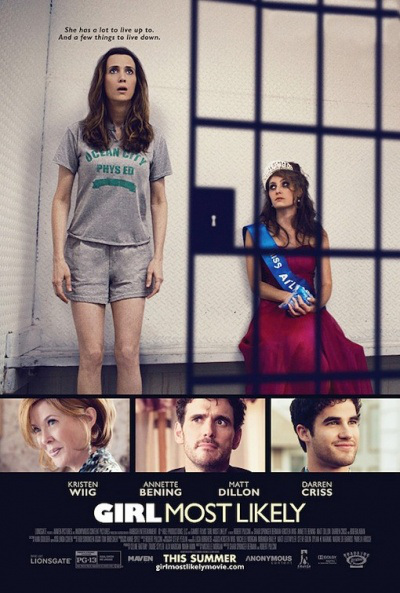
poster2Ocean City, New Jersey cannot be happy that they allowed Girl Most Likely to use it as location, for the directors, Shari Springer Berman and Robert Pulcini, paint this quaint, South Jersey town in a trashy, rusty, tone that is so opposite to the quaint, well-kept, South Jersey resort that it is.  It is as if they wanted a “Jersey Shore” vibe and settled on the first town they found named on a map. Except they chose one of the most conservative, upper-middle-class, dry towns, and they didn’t know it.

A hint that they truly didn’t know the locale happens early when Lee, Darren Criss’s character, is filling his car with gas as he prepares to drive to New York.  I saw the film in Philadelphia, and everyone in the theater noticed the gaffe: New Jersey does not let drivers pump their own gas! (It must be done by an attendant and it’s a good 20 to 50 cents cheaper than Philly’s stations.)

But aside from their missing the mark with the location–which only a small proportion of the audience will recognize–Girl Most Likely is a likeable film that doesn’t seem to know what it wants to be: is it a “small film” or a large entertainment? It can’t be both.

Imogene (Kristen Wiig) is an aspiring playwright in New York. She had won some recognition as a young woman, but ten years later she has produced nothing. Through her boyfriend, she travels in the rarefied world of women who chair charities, wear simple black dresses, and sharpen their talons on their preposterously large diamonds. Although they tolerate Imogene’s company (because of her boyfriend), they look down their noses at her because she is, after all, (gasp), from Jersey.

annettebenning2

Annette Benning as Zelda, Imogene’s eccentric mother.

When her boyfriend leaves her, she fakes a suicide attempt in the hope that he will save her and come back to her. Her plan backfires, and, instead, she is given in custody to her mother  and driven to New Jersey. Her mother–the wonderful Annette Bening–is a casino habitue, an ex-go-go dancer, living with a shady CIA agent (Matt Dillon) who has told her children that their father died twenty years ago rather than saying that he simply left her.

When Imogene comes home, she learns that her mother has rented out her room to a handsome casino performer (Chriss), her brother’s social anxiety is getting worse, and her father isn’t really dead as she has believed for all these years.

The arc of the plot is familiar. Angry about being in New Jersey and not in “glamorous” New York, appalled by her mother and her life-style, and shattered by the news of her idolized father’s existence, Imogene grows to learn how wrong she is in so many ways.  After lurching from one disappointment to another, from one shredded dream to the next, Imogene finally realizes her talent, embraces her family, and “lives happily ever after.”

While the film is inconsistent at times, it is propped up by some memorable performances:

Christopher Fitzgerald plays Imogene’s brother Ralph, who bordering on the autistic, is more comfortable with crustaceans than with people and has constructed a bullet-proof, wearable, snail shell into which he can retreat when he needs protection from the real world.  But he is wiser than his sister and more tolerant of the quirky household that their mother has assembled.

Matt Dillon plays a CIA agent (“Is he or isn’t he?” we wonder throughout most of the film.) with the name of George Bousche.  We have seen Dillon play this character before, over-the top, mildly threatening and unbalanced, and oddly mysterious.

Annette Bening looks like she is having fun playing trashy, but when her character has to show depth and anxiety she demonstrates why she is one of America’s finest actors.

Kristen Wiig is loveable and confused and vulnerable and frustrating. She seems, however, ten years too old for the character. We are used to seeing late twenty-somethings struggling with identity, purpose, and life; it is a bit off-putting to see that same struggle played the same way ten years later.

Light summer fare, Girl Most Likely, is too frothy to deal with the subject it seems to want to address: class distinctions and presumptions.  Imogene’s father is a pompous prig, her New York girlfriends are two-dimensional caricatures and her condescending attitude towards Lee, Chriss’s casino performer, is brutal and unfair. But the film simply does not have enough weight to go there.

Like a night of summer fireworks, Girl Most Likely is enjoyable but easily forgotten.

Movie Review: Pedro Almodovar’s I’m So Excited! (Los Amantes Pasajeros )

Pedro Almadovar famously said in 2012 that Pablo Berger’s Blancanieves was the best film made in Spain that year.

Pedro Almodovar at London premiere of I'm So Excited

Pedro Almodovar at London premiere of I’m So Excited!

Whether it was false modesty or not on Almodovar’s part, he could have said that his own Los Amantes Pasajeros was Spain’s funniest movie of the year.

Almadovar’s film–which was given the English title of I’m So Excited!--gives us all the things one wants in an Almodovar film: Brightness, intelligence, silliness, kinkiness, a large dose of drugs combined with a bit of social commentary, modern instability and fractured and teetering relationships . Working within a particular genre–a group of unusual characters are trapped within a small confine, Almodovar uses the trope to have fun, plain and simple.

The plot of the film is that a plane bound for Mexico from Madrid encounters immediate mechanical problems and must begin circling until an empty airport can be found so it can make an emergency landing. The crew, in order to keep things calm give the entire “economy class” and its attendants muscle relaxers, and they are asleep they entire film (except for one who is later sexually awakened!) Leave it to yourself to figure out what Almodovar is saying about the sleeping “economy class.”

Meanwhile business class has seven passengers: a washed-up actor, the most famous dominatrix in Spain, a shy hit-man, a crooked businessman, a honeymooning couple and a virginal psychic who has sneaked in from economy. And we soon learn their quirks, their secrets, and their passions. We are right to think we have been here before with Agatha Christie and that bunch. But we’d be wrong.

Listening to Norma's (Cecelia Ruth) secrets.

Listening to Norma’s (Cecilia Roth) secrets.

For we have never been here with the likes of Almodovar’s flight crew. They are introduced swigging shots of tequila as they prepare meals (their way to deal with the mechanical emergency after drugging the economy class). One has a pop-up Hindu temple that he prays to; the other is having an affair with the closeted and married pilot; and the third has his eyes on the “determinedly” heterosexual co-pilot. And as the danger becomes more eminent and potentially catastrophic, they entertain the business-class travelers with a song and dance routine (the Pointer Sisters’ “I’m So Excited!”)

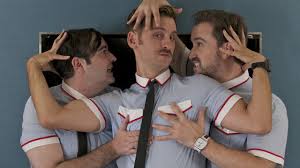
The Airline Stewards performing "I'm So Excited"

The airline stewards performing “I’m So Excited”

This isn’t Ship of Fools, nor was it meant to be. It is silly, outrageous fun. And when the “Valencia Cocktails” are served, spiked with an overdose of mescaline, the fun really begins! As the one steward tells us, the mescaline will make people more open, more honest and horny. And was he ever right!

Almodavar has been soundly criticized for this, his nineteenth film, for its being too light, too campy, too slapstick. (One reviewer said to “never trust a movie title with an exclamation point”!) But the hell with them. Sometimes, light, campy and slapstick are what we need. I know I almost moved my seat because of the guffawing elderly lady near by. She laughed (loudly) non-stop. And there was good reason to.

Almodovar is sure of his craft and his precedents. The nods to Hitchcock’s Vertigo are almost immediately obvious–we quickly find ourselves staring into the twirling mechanics of a jet engine. While the awareness of his own personal filmography and progression is demonstrated by his opening the film with his original stars Antonio Banderas and Penelope Cruz–actors who never again appear in the film– anchoring it with Cecelia Roth who has played so many great Almodovar roles, and featuring a whole new stable of actors who are certain to show up in future Almodovar films. (Paz Vega is another actor who has played in Almodovar films before but who has a minor part and less than two minutes of screen time.)

Almodovar has his own bag of tricks and devices and storylines; that he uses them time and again is not necessarily a negative for me. We have neurotic women, shady men, flamboyant revelers, and unknowingly ingested drugs–as we have had often before in Almodovar films. But because the colors are bright and mod, the homosexuality over the top and flamboyant, the villains somewhat stereotyped and the story too sweetly resolved—because we know what to expect in an Almodovar film, it has been regularly panned by critics.

But for me, it was a cool, tasty, silly romp that was perfect for a muggy day at the end of July.

Disney’s Folly, Snow White and Disneyland

The Carthay Theater

The Carthay Circle Theater where Snow White and the Seven Dwarfs premiered on December 21, 1937

I’ve been in Southern California for the past two weeks, and yesterday I spent 14 1/2 hours in Disneyland. With a very energetic seven-year old. And I’m completely exhausted.

But I am sure of this: no matter what people say about the Disneyfication of things, one has to admit that everything they do is efficient and entertaining. And often awe-inspiring.

When Walt Disney came to California, he focused on making short animated films, primarily the Mickey Mouse and the Silly Symphonies cartoons. But in 1934, he decided to produce the first feature-length animated feature…much to the dismay of his brother and business partner, Roy Disney, and the delight of the Hollywood critics who called Disney’s project “Disney’s Folly.”

For what sensible person, it was thought, would sit through a 90 minute cartoon?

Disney mortgaged his house, brought artists in to train his animators, emphasized a European look for the artwork ensign design, and spent close to $1.5 million in 1937 dollars to get his feature,  Snow White and the Seven Dwarfs, completed.

If Snow White and the Seven Dwarfs hadn’t succeeded, most of us probably would never have heard of Walt Disney–except maybe for a few film students who might have studied his early cartoons.  Instead the film’s success, both among the public and the industry, allowed Disney to capitalize on success after success until the Disney brand became what would have been unfathomable to Disney itself.

The story of the making of Snow White and The Seven Dwarfs is well documented: the switch from a rollicking tale about the dwarfs to the romantic love story it became,  the metamorphosis of the Wicked Stepmother from a hare-brained slovenly witch to the sensuous, shapely queen that all boys of a certain age remember, the downplaying of the prince’s role in the plot–this is all a matter of history.

The wicked queen, witch, stepmother

The wicked queen, witch, stepmother

But no one would have cared about that history, if the film flopped.

On December 21, 1937, the film premiered at the Carthay Circle Theater. The premier, which was attended by all the Hollywood royalty—Judy Garland, Charlie Chaplin, Marlene Dietrich, Cary Grant, George Burns and many more were present—was an extraordinary success.  Outside the Carthay Circle Theater, 30,000 fans who couldn’t get tickets waited.  The NY Times led with the line, “Thank You, Mr. Disney” and Walt Disney and his Seven Dwarfs were on the cover of Time a week later. (Disney always saw the dwarfs as the centerpiece of his film.)

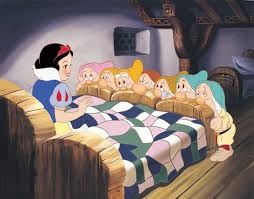
A shot the Walt Disney wanted badly in the film

A shot that Walt Disney wanted badly in the film

And the film made money. The numbers are staggering–within 15 months it had become the all time money making film ever–but more importantly Snow White and the Seven Dwarfs provided the seed money for what was to become the Disney Empire.

And so, as I trudged around Disneyland–visiting Radiator Springs and Ariel’s Undersea Adventure, as I watch Henson’s Muppets and a Broadway caliber Aladdin,  as I witness technological and creative boundaries pushed and optimized–I realize what an awful lot has blossomed from Disney’s hunch that people, yes, would sit through ninety minutes of animation.

By the way…

Did you know that Snow White and the Seven Dwarfs was the first film to release a “soundtrack” album as a separate entity?

Movie Review: Frances Ha (dir. by Noah Baumbach) —-running in place and getting nowhere

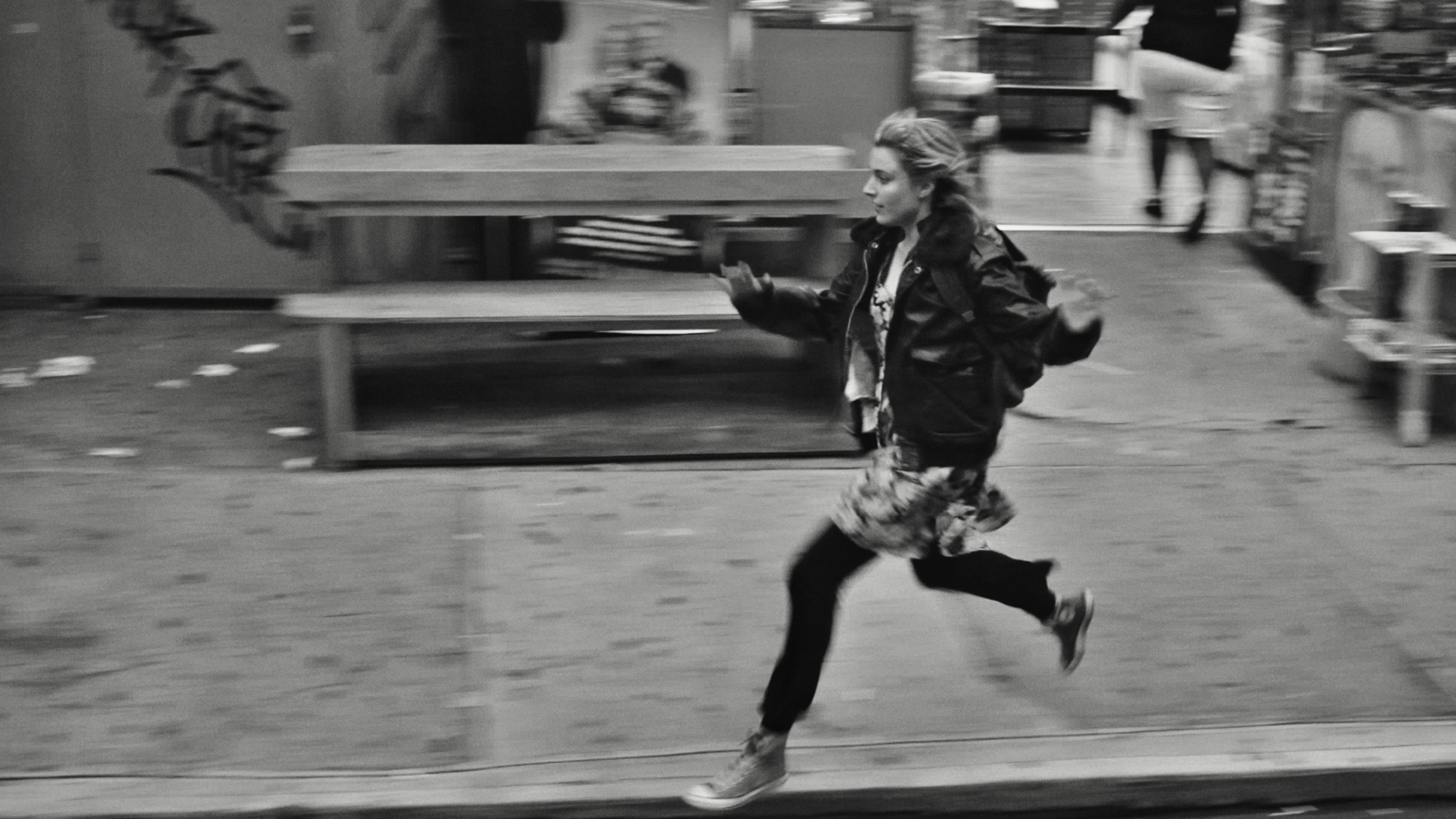
Frances running through the streets of Brooklyn

Frances running through the streets of Brooklyn

Frances runs a lot during the course of Frances Ha.  She leaves a restaurant and runs to the ATM, she runs to work, she runs to her parents in Sacramento, she runs back to New York, she runs to Paris, she runs from New York, she runs back to her old college, and she returns again to New York.  And until the end, she doesn’t get anywhere. She’s just running in place. She is hapless and feckless and lonely and dangerously stuck in the past.  And she is endearingly quirky.

Frances is played by Greta Gerwig who also co-wrote the screenplay with director Noah Baumbach. (There is a follow-up collaboration already in post-production, tentatively titled Untitled Public School Project). She–like countless others–have come to New York, because it’s the world’s biggest stage and she is a dancer. However, we are to infer, not a very good one.

So we follow her trajectory as she breaks up with her boyfriend, as her roommate leaves to move in with her mate, as she “crashes” in various friends’ apartments, and as she is “fired” from her job.  What is a poor girl to do?  Certainly, she makes some bad decisions–an impulsive trip to Paris on her credit card and a friendship shattering tantrum at a restaurant–but ultimately we know she is decent and hard-working, and we hope that things will pan out for her.

I had seen the trailer for Frances Ha a few months back, but hadn’t put it on my “must see” list. Then I saw an article in one of the free newspapers that ran with this headline:

“Woody Allen Call Your Lawyers…Someone has Stolen your Style.”

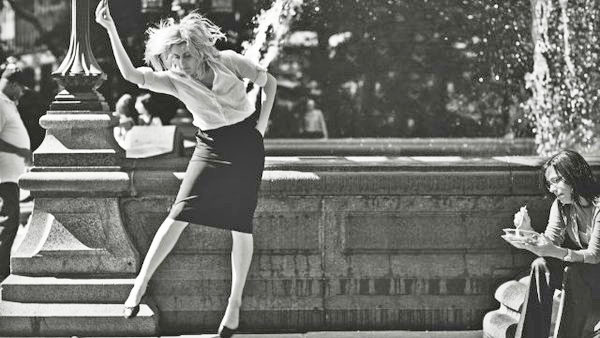
Greta Gerwig as Frances in Frances Ha

Greta Gerwig as Frances in Frances Ha

So of course that sent me to the theaters.  (I didn’t even read the article, just the headline.) The “stolen style” is the cinematography. It is filmed in black-and-white, and there are scenes that very much have a “Woody Allen” feel: New York street scenes, a shot going down into the subway, a scene around a table in an up-scale apartment, a family Christmas dinner.  These all very much LOOK like a Woody Allen film.

However, the similarity stops with the dialog.  What, I assume, is meant to be witty and quirky and insightful is not.  It simply does not come off.

Instead, we follow Frances (and her friend Sophie, played by Mickie Sumner) as she stumbles forward, sometimes awkwardly and sometimes ineptly.  And we want to root for her except that we often lose interest in her.  No doubt that her travails are all true to life, but more often than not it is simply that–true to life.  And life is often not all that interesting to watch.

I realize that Gerwig and Baumbach both have solid credentials in films about life’s wry moments. Baumbach has successfully co-written with Wes Anderson and has written and directed such films as Margot and the Wedding and The Squid and the Whale; while Gerwig has been working–non-stop it seems–with directors as varied as Daryl Wein and, yes, Woody Allen (Midnight in Paris), while increasingly taking part in the screenwriting, as well.  But Frances Ha left me wanting something more.

I want to like Gerwig and Baumbach’s work. I want to very much. I am excited about what they are trying. But so far, I am lukewarm with the results. I feel as if I know what they are trying to say, to do, but it is not coming across.

I feel as if they are running in place.

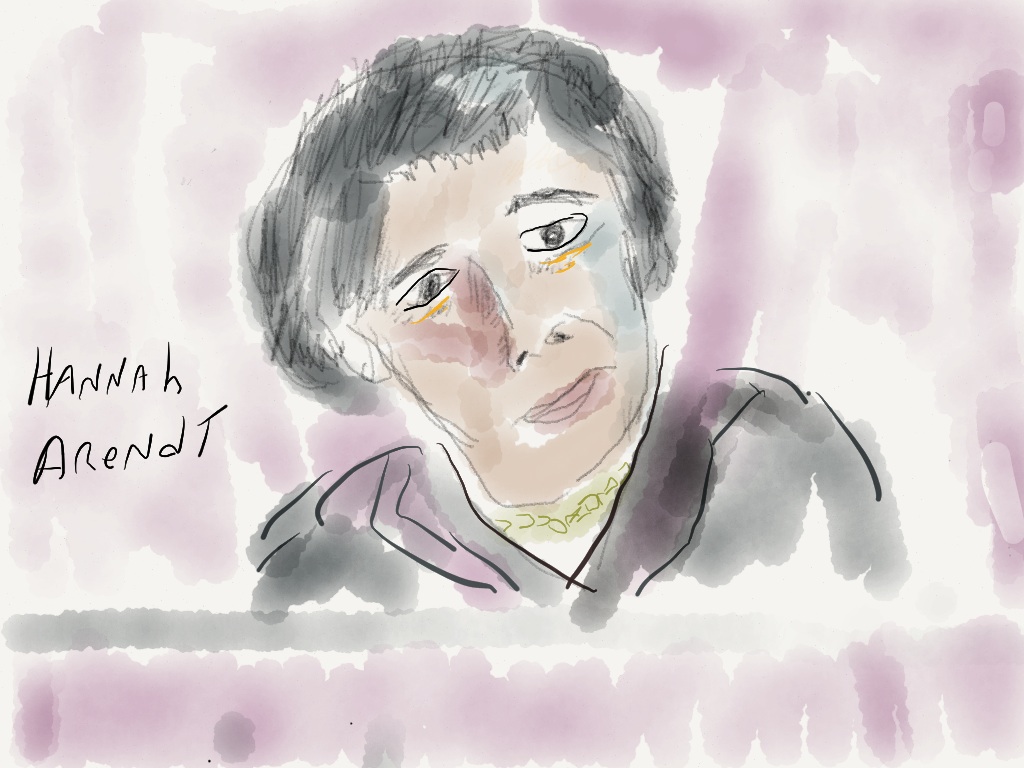
Movie Review: Hannah Arendt dir. by Margarethe von Trotta

illustration 2013 jpbohannon

illustration 2013 jpbohannon

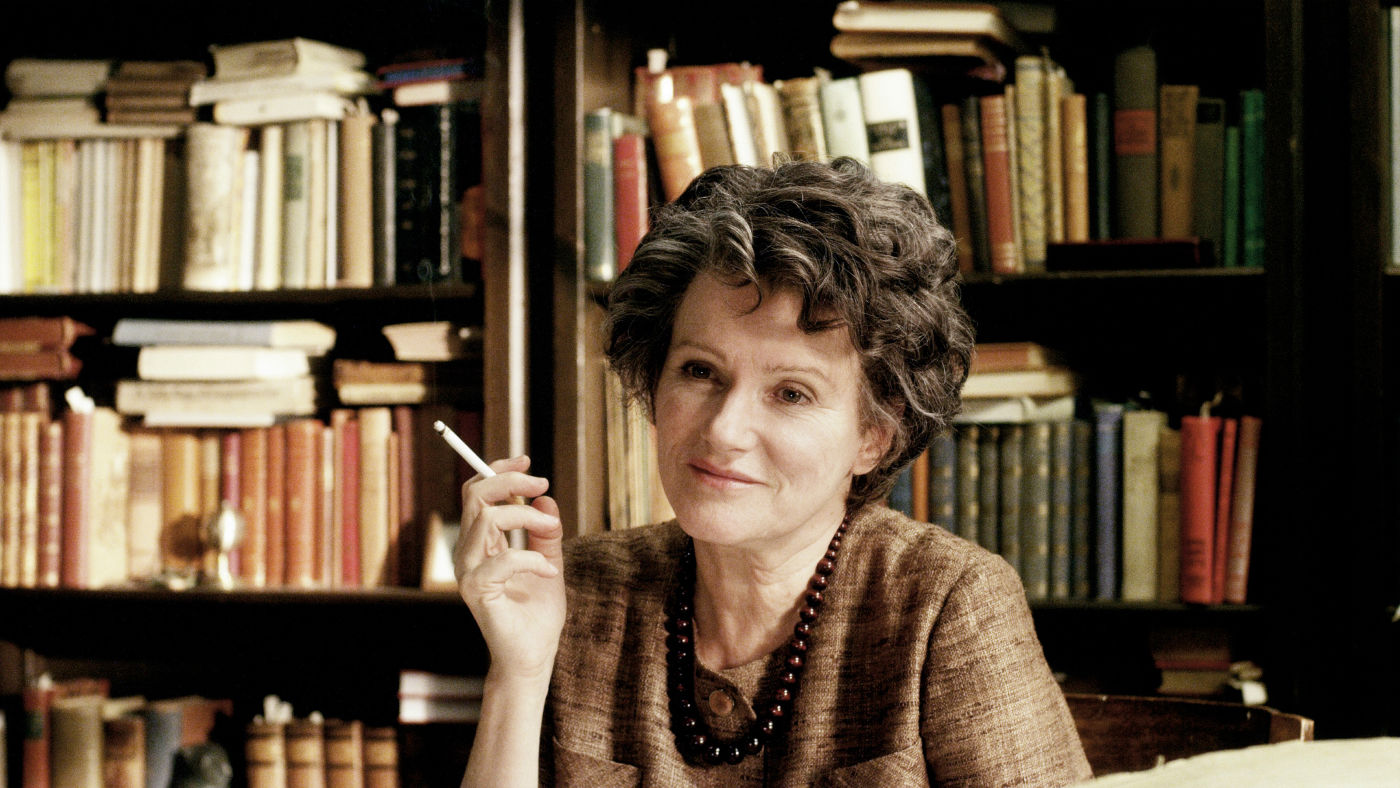
The philosopher, political theorist and writer, Hannah Arendt has received a thoughtful and deserving biopic from director Margarethe von Trotta, in her eponymous film, Hannah Arendt. The film’s intelligence reflects the life of the mind that Arendt lived–and an honest and hard intelligence at that.  Concentrating on the period when Arendt covered the Adolph Eichmann trials for New Yorker magazine–and the fury that it unleashed– it shows Arendt resolute in her thinking, uncolored by prejudice or sympathies.

Her coverage of the Eichmann trial ended with these words, this pronouncement:

Just as you [Eichmann] supported and carried out a policy of not wanting to share the earth with the Jewish people and the people of a number of other nations—as though you and your superiors had any right to determine who should and who should not inhabit the world—we find that no one, that is, no member of the human race, can be expected to want to share the earth with you. This is the reason, and the only reason, you must hang.

♦       ♦      ♦      ♦      ♦      ♦      ♦      ♦

Arendt’s biography is well know.  Born into a secular Jewish family, she studied under Martin Heidegger with whom she reportedly had a long affair.  Her dissertation was on Love and Saint Augustine, but after its completion she was forbidden to teach in German universities because of being Jewish. She left Germany for France, but while there she was sent to the Grus detention camp, from which she escaped after only a few weeks. In 1941, Arendt, her husband Heinrich Blücher, and her mother escaped to the United States.

From there she embarked on an academic career that saw her teaching at many of the U.S.’s most prestigious universities (she was the first female lecturer at Princeton University) and publishing some of the most influential works on political theory of the time.

♦       ♦      ♦      ♦      ♦      ♦      ♦      ♦

Hannah-ArendtBut the film, concerns a small time period in her life–but one for which many people still hold a grudge.  The film begins darkly with the Mosada snatching Eichmann off a dark road in Argentina. Back in New York City, Arendt (Barbara Sukowa) and the American novelist, Mary McCarthy (Janet McTeer) are sipping wine and gossipping about the infidelities of McCarthy’s suitors.  Even genius can be mundane–perhaps a subtle reference to Arendt’s conclusions from the trial.  When news of Eichmann’s arrest–and trial in Israel–is announced, Arendt writes to William Shawn (Nicholas Woodeson) at the New Yorker, asking if she might cover the trial for the magazine. Shawn is excited; his assistant, Francis Wells (Megan Gay,) less so.

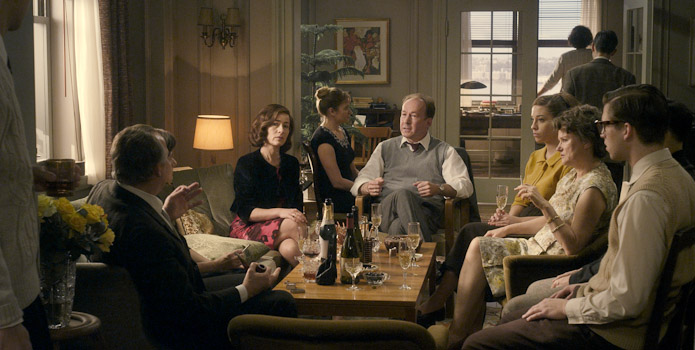
Of course, the trial–and Arendt’s commission to follow it–is fascinating and controversial and we listen in on Arendt and her husband and their circle of friends as they debate and argue and opine. Aside from Mary McCarthy and the head of the German department at the New School where Arendt is teaching, the guests at Arendt’s apartment are all friends from Europe, German-Jews who have escaped the Shoah/Holocaust. Listening to their different conversations is fascinating and electrifying.  This is a movie about “thinking.”

Conversing in Arendt's apartment.

Conversing in Arendt’s apartment.

In Israel, Arendt meets with old friends, friends who remember her argumentative spirit, and stays with the Zionist, Kurt Blumenfeld. From the outset, one sees that Arendt is not thinking along the same lines as the masses following the trial.

“Under conditions of tyranny it is much easier to act than to think.”

Hannah Arendt

At the trial, there is a telling moment, when Arendt watches Eichmann in his glass cage sniffling, rubbing his nose and dealing with a cold. It is then, a least in the film, that she comes to understand that this monster is not a MONSTER. She sees him as simply a mediocre human being who did not think. It is from here that she coins the idea of the “banality of evil.”

Upon returning home–with files and files of the trial’s transcripts–her article for the New Yorker is slow in coming. Her husband has a stroke, and the enormity of what she has to say needs to be perfect.

When it is finally published, the angry reaction is more than great. The critic Irving Howe called it a “civil war” among New York intellectuals. (Just last week, the word “shitstorm” was added to the German dictionary, the Duden, partly due to Chancellor Angela Merkel’s use of the word to describe the public outcry she faced over the Eurozone’s finacial crisis. It is an apt term for what occurred upon publication of Arendt’s coverage.)

It is this extraordinary anger towards Arendt–and her staunch defense–that makes up the final moments of the film. In the closing moments, Arendt speaks to a packed auditorium of students (and a few administrators). She has just been asked to resign, which she refuses to do.  These are her closing words:

“This inability to think created the possibility for many ordinary men to commit evil deeds on a gigantic scale, the like of which had never been seen before. The manifestation of the wind of thought is not knowledge but the ability to tell right from wrong, beautiful from ugly. And I hope that thinking gives people the strength to prevent catastrophes in these rare moments when the chips are down.”

This is, more than anything else, a film about thinking.

♦       ♦      ♦      ♦      ♦      ♦      ♦      ♦

The extraordinary anger shown in the film is still felt by many today and, in fact, seems to have colored some of the reviews that I have read and heard. Some of these reviewers seem to be reviewing the life and work of Arendt and not the film of Margarethe von Trotta, for von Trotta’s film is a unique, masterpiece. It is more than a biography of a controversial thinker…it is a portrait of thought itself.  Arendt attempts to define “evil”–certainly an apt exercise at the time. She defines it–to her friends, to her classes, to her colleagues, and to herself–and finds that it is not “radical” as she once had posited. It is merely ordinary.  Goodness, she sees, is what has grandeur.

The film, Hannah Arendt, is well worth seeking out. It is thoughtful, provoking, controversial, and, at times, even funny.  You can’t ask for much more for the price of a movie ticket.  As always, here’s a trailer:

Movie Review: Much Ado About Nothing dir. Joss Whedon…another inevitable comparison

Claudio in Joss Whedon's Much Ado About Nothing

Fran Kranz as Claudio in Joss Whedon’s Much Ado About Nothing

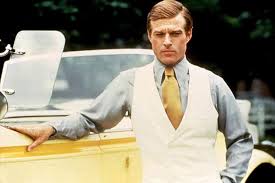
The summer of 2013 began with the release of Baz Luhrman’s The Great Gatsby, and everyone was in a race to compare it with the Robert Redford version from the 1970s. To be truthful, I never cared for Redford as Gatsby, but thought the rest of the cast was spot on. The opposite goes with Baz Luhrman’s film, in which I prefer DiCaprio’s Gatsby to the rest of the cast.

Robert Redford as Jay Gatsby (1974)

Robert Redford as Jay Gatsby (1974)

Leonardo DiCaprio as Jay Gatsby 2013

Leonardo DiCaprio as Jay Gatsby (2013)

But we forgot about all that–and rather quickly– before the summer actually began, and now we have a new version of another “classic” work of literature: Much Ado About Nothing, directed by Joss Whedon, which must undoubtedly be compared with the Kenneth Branagh version of 1993.

The story behind Whedon’s project is fun. It was something that he had long wanted to do, and finally his wife suggested that instead of going away on vacation for their 20th-anniversary, they make the film. And they did…entirely in their gorgeous home. Whedon gathered many of the actors who had played in his previous productions, and the first that Hollywood knew about the film was when they announced that photography had been completed. They had wrapped things up in 12 days.

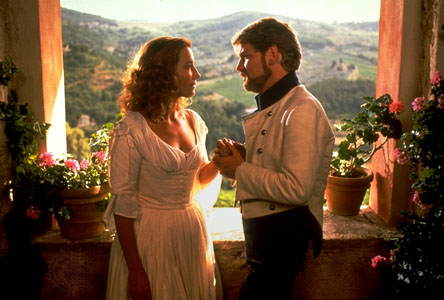
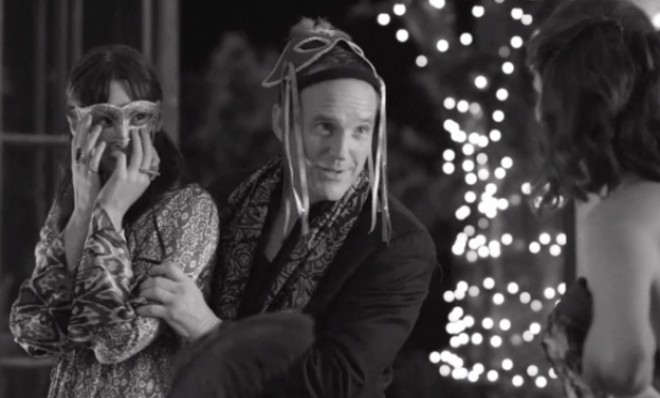
Whedon chose to film in black-and-white which gives the film a stylish patina. And yet, I found it drained some of the emotion from the story. Benedick (Alexis Denisof) and Beatrice (Amy Acker) are likeable enough, and quite funny at times, but they shine mostly when they are apart…there are few sparks when they are together. Invariably, one has to compare them to Kenneth Brannagh and Emma Thompson–whose fire (both on film and personally) was palpable. And the golden sunlight of Tuscany, the shimmering palette of the entire film, gives Brannagh’s version a much richer patina.

Amy Acker as Beatrice and Alexis Denisof as Benedck

Amy Acker as Beatrice and Alexis Denisof as Benedck

Emma Thompson as Beatrice and Kenneth Brannagh as Benedick (1993).

Emma Thompson as Beatrice and Kenneth Brannagh as Benedick (1993).

Whedon’s actors all handle the dialog well and naturally, and after a few minutes you might even forget you are listening to Shakespearean English.

In both films, the constabulary are very good–verbal slapstick and mental banana skins. Nathan Fillon’s doltish Dogberry in Whedon’s film is every bit as memorable–and laugh-inducing– as Michael Keaton’s dimwitted portrayal in the 1993 version.

And the performance of Clark Gregg, as Leonato, Hero’s father is likeable and believeable. Much of the audience will quickly forget that he is Agent Phil Coulson of the Avenger’s franchise (also by Joss Whedon).

Clark Gregg as Leonato and Jillian Morgese as Hero

Clark Gregg as Leonato and Jillian Morgese as Hero

However, there are a few choices that Whedon made that I am not so sure about. The character of Conrade, for example, which was played by Richard Clifford in the Brannagh version has now been changed to a female role, played by Riki Lindhome. This in itself is usually not a problem. For instance, in Michael Almareyda’s Hamlet (starring Ethan Hawke), Marcello was changed to Marcella and played by Paula Malcomson. But nothing is changed, the part is minor, and her lines are few. In Whedon’s Much Ado…, the Conrade character is quite sexy and there is even a bit of titillating bed-play between her and Don John (Sean Maher), although the words of the play would not lead us to think so.

There is also a scene that is not in the play–during the opening credits–where Benedick sneaks out of Beatrice’s bed in the early morn. Beatrice lies there feigning sleep, but slyly opening her eyes as he dresses and leaves. We are left with the vision of her wide awake in bed, with eyes that speak of her aloneness. If this scene is supposed to prepare us for the friction between the two when the play proper begins, it fails.

Whedon shares writing credits with William Shakespeare, and, to be honest, he does a very admirable job. He has cut judiciously, and the only time he has changed the language was in Act 2 where he excised an anti-Semitic remark and changed it to a statement about love’s foolishness. The new line flows seamlessly into the original.

In all, I prefer the Brannagh version, but that is not to dismiss Whedon’s, which also I like very much. Whedon’s Much Ado About Nothing is inventive and imaginative and aimed at a whole new audience. The filming is crisp, fresh, and confidant–and quite stylish. Whedon has successfully taken Shakespeare out of the classroom and made it very hip, without destroying the story at all. It is certainly worth viewing…and more than once. If this was his gift for his 20th anniversary, I hope he tackles another Shakespeare title before his 40th anniversary comes around.

Here is the very elegant and engaging trailer:

Movie Review: The Discreet Charm of the Bourgeoisie by Luis Buñuel

bunueld

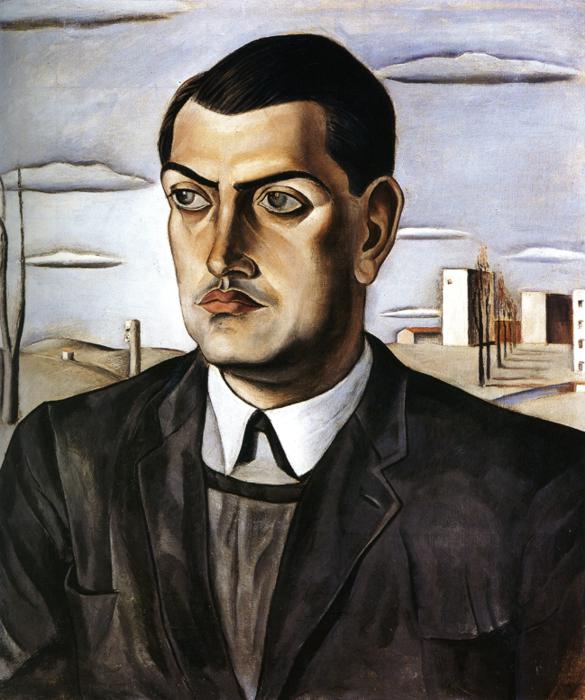
painting of Luis Bunuel
(artist unknown)

Towards the end of Midnight in Paris, the main character Gil (Owen Wilson) suggests a movie idea to a young man accompanying Salvador Dali. The man (played by Adrien de Van) was Luis Buñuel, the Spanish filmmaker and poet who caused a outrage with his first two films, Un Chien Andalou (1928)  and L’Age d’Or (1930), both collaborations with the surrealist painter, Salvador Dali. The latter film was banned for nearly 50 years before it had its premier in the U.S. in 1979.

(By the way, the movie that the Owen Wilson character was suggesting was Buñuel’s The Exterminating Angel.)

Buñuel and his compatriot Dali were at the forefront of surrealism and, while their artistic vision was not embraced by everyone, both men practiced their art well into old age.  And while the difficulty of surrealism coupled with Buñuel’s savage attacks on the bourgeoisie and on religion might have distanced himself from much of the mainstream audience, he was quickly seen as a seminal figure in film and one of its greatest directors. His films won or were nominated for major awards throughout the world.

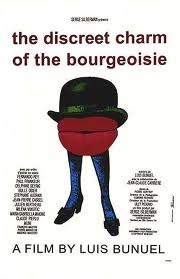
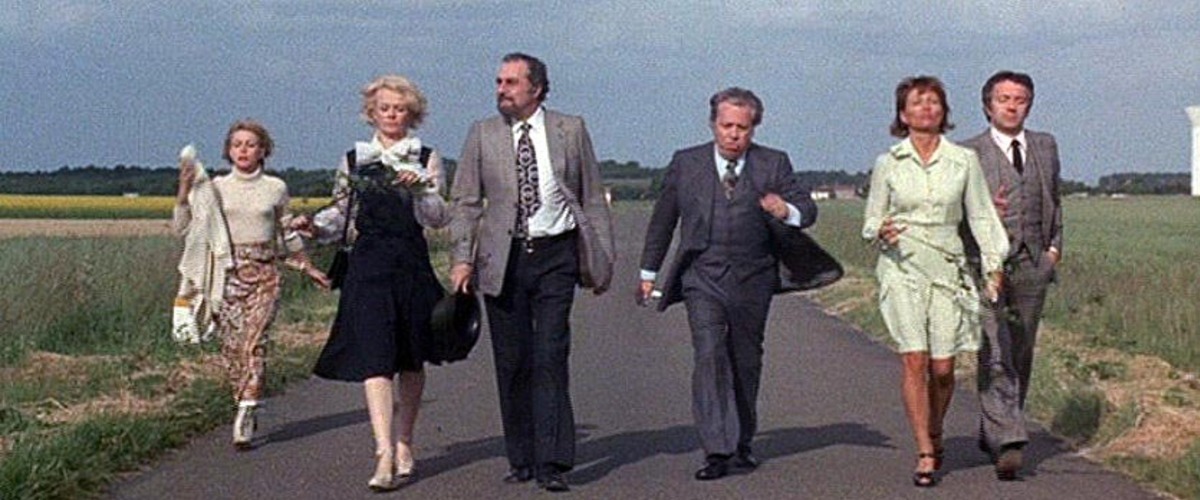
Both his anti-religion and the anti-bourgeoisie attitudes are in full display in Buñuel’s 1972 film The Discreet Charm of the Bourgeoisie. And of course, the entire film is surreal.poster..and quiet funny.

While plot has never been the most stringent part of Buñuel’s films, The Discreet Charm of the Bourgeoisie focuses on three couples and a series of quirky events and odder dreams that continually prevent them from dining together. There is also a Catholic bishop who asks to moonlight as one couple’s gardener. (It is typical of Buñuel that the bishop performs the most brutal action in the film.)

There are gentle stabs at the military, the police, and the upper-middle-classes, but overall the film is relatively light–at times even farcical. Etiquette is important to the three couples–and propriety–despite the fact that the men are drug smugglers and their life style is founded on drug money. They talk about the proper way to drink a martini and bemoan the fact that the lower classes do not know how–this they see as evidence of the downfall of society. (They use their chauffeur as a test case.)

Throughout the film, dreams occur within dreams within dreams…and at times we forget that some of the situations the characters find themselves in dissolve upon waking. And the dreams themselves get increasingly brutal. There are various ghosts and visits to the underworld and dreamlike violence.

And all these well-to-do people want to do is eat a meal together–and they can’t…a rare event for people who are used to getting everything they want. Life–as surreal as it can be–gets in the way.

The six discreet bourgeoisie

The six discreet bourgeoisie

By the way…

The original title for the movie was Down with Lenin, or The Virgin in the Manger (A bas Lénine, ou la Vierge à l’écurie) and was changed to The Charm of the Bourgeoisie.  Adding the word Discreet was an afterthought.

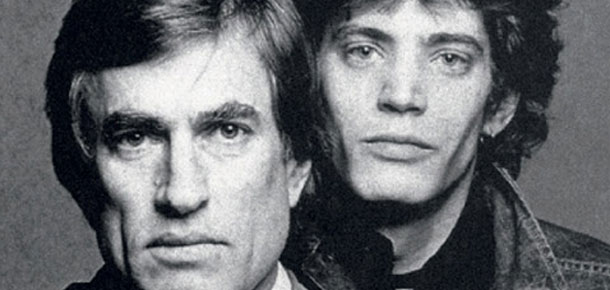
Movie Review: Black, White + Gray: A Portrait of Sam Wagstaff and Robert Mapplethorpe 

Sam Wagstaff and Robert Maplethorpe

Sam Wagstaff and Robert Maplethorpe

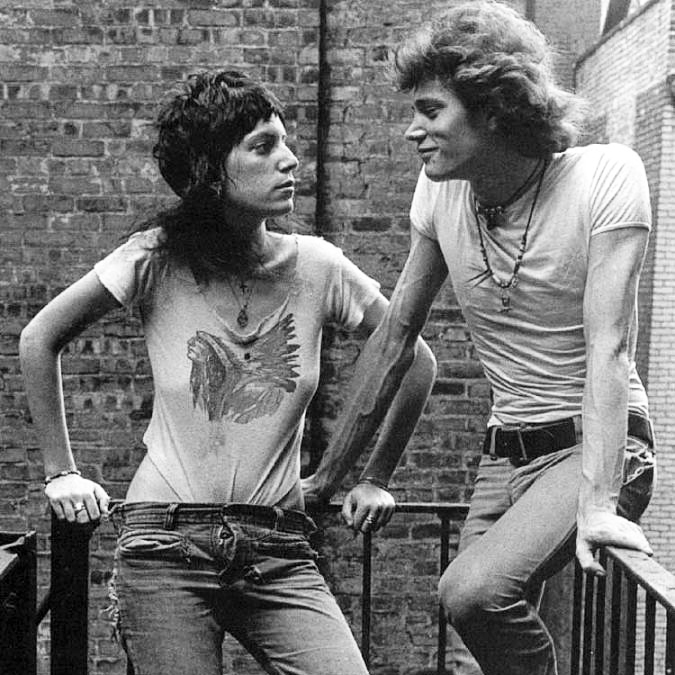
I discovered a documentary the other night called Black, White + Gray by James Crumb (2007). The blurb calls it a study of the relationship between the curator/collector Sam Wagstaff, the artist Robert Mapplethorpe, and the poet/singer Patti Smith. To be honest, however, it is really the story of Wagstaff, that touches greatly on his relationship with Mapplethorpe and to a much smaller degree with Smith, both for whom he was mentor and patron and friend. (In Mapplethorpe’s case lover and companion.) Consequently, it also deals with art, the business of art, the demimonde of gay life in the 1970s and 80s, and, of course, the scourge of AIDS.

patti smith robert mapplethorpe

patti smith robert mapplethorpe

Moving chronologically through Wagstaff’s life–and anchored by Patti Smith’s intelligent and honest and fond recollections–the film follows Wagstaff from his schooldays through his loathed time spent in advertising to his prominence in the art worlds of New York, Paris and London. Along the way, there are appearances on the Dick Cavett Show, press conferences, interviews with his friends and colleagues, and countless photographs, many taken by him or Mapplethorpe and many part of his historic collection.

Wagstaff was strikingly handsome, aristocratic, and intelligent. (Dominick Dunne called him one of the most handsome men he ever saw.) He was also gay, but closeted himself for much of the oppressive fifties and early part of his life. Not until his meeting with Mapplethorpe did it seem he grew comfortable with his homosexuality. As a curator, he embraced and pushed forward those artists and art forms that were still on the fringe, Minimalism, Earth Works, Conceptual Art, and, most importantly, photography. Wagstaff believed that photography was an ignored art and deserved to be elevated to the pantheon of “Fine Arts.”

Indeed, it is because of Wagstaff that photography holds the status that it does today. His relentless collecting, the exorbitant sums he paid, the continual praise and comments in the press, single-handedly hauled photography onto the main stage.

A few years before he died, Wagstaff sold his private collection of photographs to the Getty Museum in Los Angeles for the then unheard-of price of $5-million. It was testimony to how far he had brought photography to the forefront.

The interviews within the film are honest and intelligent. Many deal with his collecting, with his curating, and with his “vision.” Many deal (some negatively, some positively) with his relationship with Mapplethorpe. Dominick Dunne, particularly, gets much air time, and talks about Wagstaff in two of the worlds that he lived in–the socialite world and the gay world. And all is brought together by the reminiscences of Smith.

“Compartmentalized” is a word that often came up, and it seemed that Wagstaff was very good in ordering his life into separate and distinct components. But in the end, it was the gay world that did him–and so many others–in. It is easy to forget that at one point, AIDS was a scourge that was decimating much of the art world. The film ends with Wagstaff’s death, and then with Mapplethorpe’s, and then with a list of the many artists who have died of AIDS complications since.

It is a sobering ending. But then the credits role and are intersperse with clips from the many interviewees and once again we are reminded of the life, of the visionary man who rose so high in the world of art–and brought others with him .

We know much about Mapplethorpe’s life, and Patti Smith’s, greatly due to her wonderful memoir, Just Kids. James Crumb’s film Black, White + Gray adds greatly to our knowledge of that time and that world and the people who populated it. It’s worth while finding and fascinating viewing.

By the way…

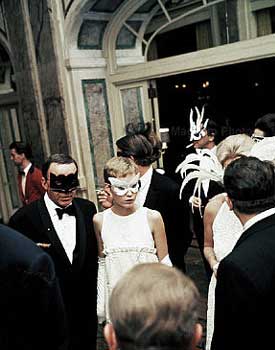
The title of the film, Black, White + Gray not only refers to the B&W Photography that Sam Wagstaff collected, cataloged, and often curated, or the shades of distinctions in the compartmentalized life that he constructed, but also to the momentous exhibited he staged at the Hartford Wadsworth Atheneum entitled “Black, White and Gray.” The exhibit, considered the first minimalist show, featured the work of Stella, Johns, Kelly, and Lichtenstein, among others. It was an extraordinary success, influencing fashion, Hollywood, advertising, and, of course, Truman Capote’s infamous Black and White Ball.

Frank Sinatra and Mia Farrow arriving at Truman Capote's Black and White Ball.

Frank Sinatra and Mia Farrow arriving at Truman Capote’s Black and White Ball.

https://i0.wp.com/media-cache-ak0.pinimg.com/192x/85/cf/f1/85cff11fb5bb99780ab77c77af4861d9.jpg

Andy Warhol at Truman Capote’s Black and White Ball without a mask.

Movie Review: The 400 Blows by Francois Truffaut

400blows

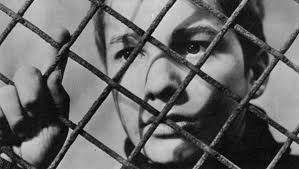
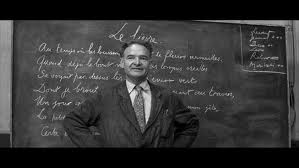
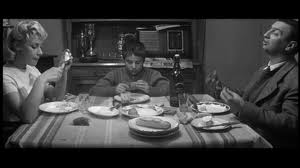
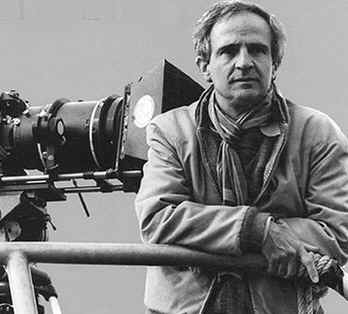
HuluPlus is showing the entire “Criterion Collection” of classic films over the next 101 nights. My understanding is that the films remain available throughout that period, but a new one is added each night. This weekend I watched Francois Truffaut’s extraordinary debut film, The 400 Blows (1959). Shot in black and white with Hitchcockian lighting (Truffaut idolized Alfred Hitchcock and wrote the definitive study of him, Hitchcock), the film follows the plight of a young 12-year old boy as he moves from trouble in school to trouble at home to a juvenile detention center.

teacherfamily

francois_truffaut

Francois Truffaut (1932-1984)

Young Antoine Doinel (Jean-Pierre Léaud) is scapegoated by his domineering teacher, brushed aside by his preoccupied parents, and disregarded by most of the world around him. The teacher has so stereotyped him that he cannot see the sensitive, impressionable boy within; his parents are bothered by his very existence. After several episodes involving both school and home, he runs away. His first night is spent in a vacant printing plant; his meal–a quart of milk that he has stolen. His next nights are spent hiding in a friend’s house where the two enjoy the freedom of the city–playing hooky from school, shooting pea-shooters at passersby from a tall window, smoking cigars, and going to the movies. (Indeed, movies are a big part of Antoine’s life as they were for Truffaut himself, on whose childhood this film is loosely based. Perhaps the happiest moment in the film is when Antoine and his parents go out on the town to see a movie. The boy is visibly entranced.)

After Antoine steals a typewriter from his stepfather’s office, he finds it difficult to hock, and so returns it. It is in returning it that he is caught by the night-watchman. His stepfather hands him off to the police where he is charged with theft and vagrancy. Antoine spends the night in a holding cell with a thief and three prostitutes, is transported with them to a larger jail, and then off to a juvenile “observation center.” While this is going on, we see his parents cede responsibility to the authorities; they have given up on him. (The scene of Antoine in the back of the police coach watching the bright lights of the Parisian night go flitting by is perhaps the most poignant in the film. When the camera closes in on Antoine’s usually stalwart face, there are big tears rolling down his cheeks.)

In the observation center, we learn more about Antoine’s life through his interviews with the center’s psychologist. Finally, during a soccer match, Antoine sneaks under a fence and escapes to the sea. The film ends with him on the beach, between ocean and land, staring enigmatically at the camera. We are left to wonder whether he stands there between childhood and adulthood? Between a life of crime and a life of productivity? Between a world of misery or a bit of joy?

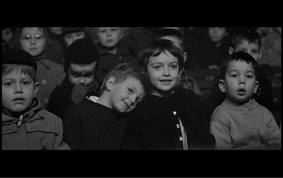
The performance of the 12-year old actor, Jean-Pierre Léaud, is unforgettable. More through his expressive face than his spoken words, he reveals a quiet strength developing around his innocence and fragility–the strength that will propel him forward rather than downward. In fact, Antoine is simply the featured child in a film with countless children’s faces–faces that are trusting and bruised, filled with elation and terror, marked by both wonderment and a premature world-weariness. Children in the classrooms, in movie theaters, in the playground, on city streets. There is a scene where a group of children are watching a puppet show. The camera stays focused for a good while on the varied and wonderful faces of the children watching. In a way, it is a heart-wrenching scene, for one cannot help but wonder, as we watch Antoine grapple with his fate, what will become of them all.childrn

Léaud continued working with Truffaut, making four other films with him and playing the same role, Antoine Doinel, in the progressing stages of his life. But it is in The 400 Blows that the young actor and his director most closely capture movie perfection.