
Women Writers and New York City–or all writers and everywhere.

Top row: Dorothy Parker, Zora Neale Hurston, Shirley Jackson, Gael Greene.
Bottom row: Patti Smith, Susan Sontag, Tama Janowitz, Kate Christensen.

I have a niece who is struggling in New York City to make it as a writer…and she is doing pretty well (see my blogroll and click on “Courtney Gillette.”) Nevertheless, it is a struggle. I have a friend whose son Brendan is carving his way as a comic/comedy writer–not the easiest of niches to crack into–and he is making headway. They are just two of thousands who go to NYC with dreams of making it big and –more power to them–they have the drive and determination to do so.  But it is not just New York, it is cities around the world where people intent on making something new, struggle to survive and to get their work out…and hopefully recognized.  So I thought of both of them–Courtney and Brendan–when I read this article this morning.  The article itself is from mid-April, but it is a fun piece highlighting some of my favorite people and writers.

Anyway, here is the article from a site called AWL. It tracks what particular writers arrived New York with before they “made it” and adjusts the value of their belongings and purchases for inflation.  It is a fun piece that ranges from Dorothy Parker and Zora Neale Huston to Patti Smith and Tama Janowitz:

What it Cost Eight Women Writers…

And speaking of Patti Smith, I have been on a Patti Smith kick for over a year now.  One day in December 2010, I actually received three separate copies of her memoir, Just Kids and of course read it in a night and then began giving out copies to everyone. Then I began to reacquaint myself with her music. (Her video singing “Helpless” with Neil Young is powerful.)

Just last week a friend sent me this new Patti Smith video/song. It’s about April and poetry and fools.  Enjoy.

Hugh MacDiarmid, Robert Burns and My Father

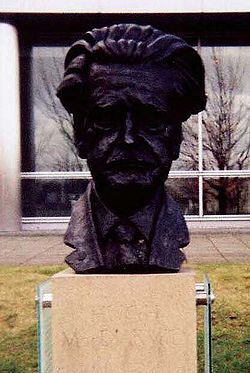
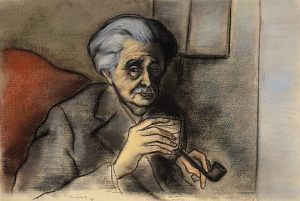
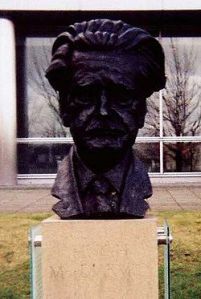
Hugh MacDiarmid

Hugh MacDiarmid times 4
No’ wan in fifty kens a wurd Burns wrote
But misapplied is a’body’s property
And gin there was his like alive the day
They’d be the last a kennin’ haund to gi’e–

Croose London Scotties wi’ their braw shirt fronts
And a’ their fancy freen’s, rejoicin’
That Simlah gatherings in Timbuctoo,
Bagdad — and Hell, nae doot–are voicin’

Burns’ sentiments o’ universal love,
In pidgin English or in wild-fowl Scots,
And toastin’ ane wha’s nocht to them but an
Excuse for faitherin’ Genius wi’ their thochts.

A’ they’ve to say was aften said afore
A lad was born in Kyle to blaw aboot.
What unco fate mak’s him the dumpin’-grun’
For a’ the sloppy rubbish they jaw oot?

Mair nonsense has been uttered in his name
Than in ony’s barrin’ liberty and Christ.
If this keeps spreedin’ as the drink declines,
Syne turns to tea, wae’s me for the Zeitgeist!

Rabbie, wad’st thou wert here–the warld hath need,
And Scotland mair sae, o’ the like o’ thee!
The whisky that aince moved your lyre’s become
A laxative for a loquacity.

from “A Drunk Man Looks at the Thistle” (lines 41-64)
Hugh MacDiarmid (1892-1978)

I got involved with this poem yesterday–a poem that I had long forgotten and had once loved dearly.  A student of a friend of mine got in a bit of trouble with it and an art project he was doing. Just a few bad decisions.

Anyway, he was also out of his depth. The poem is nearly a hundred pages long, close to 3000 lines long, and written in the Scots dialect. In it MacDiarmid is bemoaning the present state of the world ( (“Rabbie, wad’st thou wert here–the warld hath need”) and calling for a certain national identity through a link to the past. And of course, as a early-twentieth century Scots poet, for Hugh MacDiarmid that link is Robert Burns.

I have always had an affinity for Burns.  We share the same birthday and hit some of life’s milestones at the same time. But my introduction to him was from my father. My father was not a academic man; he had finished high-school and then out to work. But he had always been a wide-ranging and voracious reader.  And he had a extraordinary memory for the poems he had read in school. Even in old age, he could recite poems that he had learned as a youth.  The one I remember most was Robert Burns’ “To A Louse.”  I remember it because it was his way of teaching humility, of teaching his children not to become too full of themselves.  As a child, I loved the poem because it dealt with the humorous situation of spying a louse crawling in the wig of the elegant lady in front of him at church.  Her social airs and superciliousness are punctured by the creature burrowing through her hair, unknown to her but visible to those in the pew behind.

But making fun of the rich lady was not the point.  The lesson my father was offering was directed to us.  Burns ends the poem with a prayer:

O wad some Power the giftie gie us
To see oursels as ithers see us!

How perfect.  How humbling. What an antidote to hubris!

I grew older, life went by, and I began reading seriously on my own. Suddenly, many of the pieces that my dad had recited came back into my life.  And I took to Burns. (Even, his most anthologized–”To A Mouse, on Turning up her Nest with a Plough”–is a plea for empathy and understanding among all creatures, not only between humans, although that too certainly is implied. And it was there that I first recognized my father’s oft recited quote about the frequent ruinations of the “best laid plans.”)

In the section of Hugh MacDiarmid’s poem above, the speaker laments the caricature that has been made of Robert Burns over the years. The Burns’ suppers held around the world, the saccharine versions of “Auld Lang Syne” that punctuate each passing year (and that omit most poignant verses), the iconic being that he has been puffed up as, emptied of all the genius, vitality, politics and love that made him what he was.

Instead, MacDiarmid yearns for that great lover of liberty,  the lover of life, the lover of Scotland. For instance, here is Burns simply singing the praises of his love–and stating that even death would not sever its bond:

Fair and lovely as thou art,
Thou hast stown my very heart;
I can die–but canna part,
My bonie dearie.
(“Ca’ the Yowes,”  lines 20-24)

Here in 1792–70 years before the American Emancipation Proclamation–Burns writes about the anguish of a Senegalese leaving his home on a slave ship for the shores of Virginia.  It is not the politics that are most important here (although they are important) it is the humanizing of a black man in 1792, the compassion and empathy for the slave’s lot. One can feel the slave’s weariness. One can feel his “bitter tear.”

The Slave’s Lament

It was in sweet Senegal that my foes did me enthral,
For the lands of Virginia,-ginia, O:
Torn from that lovely shore, and must never see it more;
And alas! I am weary, weary O:
Torn from that lovely shore, and must never see it more;
And alas! I am weary, weary O.

All on that charming coast is no bitter snow and frost,
Like the lands of Virginia,-ginia, O:
There streams for ever flow, and there flowers for ever blow,
And alas! I am weary, weary O:
There streams for ever flow, and there flowers for ever blow,
And alas! I am weary, weary O:

The burden I must bear, while the cruel scourge I fear,
In the lands of Virginia,-ginia, O;
And I think on friends most dear, with the bitter, bitter tear,
And alas! I am weary, weary O:
And I think on friends most dear, with the bitter, bitter tear,
And alas! I am weary, weary O:

But for me, it is the love poems that stand out. While some here in the 21st century might bash his promiscuity,  I see it as his inordinate zeal and love of life. I believe the truth of his love poems–they are not simply lines to bed a willing lass–and I see them as some of the tenderest poems ever written. Here is one in which he has been played false…and his heart is breaking:

Ye banks and braes o’ bonnie Doon

Ye banks and braes o’ bonnie Doon,
How can ye bloom sae fair!
How can ye chant, ye little birds,
And I sae fu’ o’ care!

Thou’ll break my heart, thou bonnie bird
That sings upon the bough;
Thou minds me o’ the happy days
When my fause Luve was true.

Thou’ll break my heart, thou bonnie bird
That sings beside thy mate;
For sae I sat, and sae I sang,
And wist na o’ my fate.

Aft hae I roved by bonnie Doon
To see the woodbine twine,
And ilka bird sang o’ its love;
And sae did I o’ mine.

Wi’ lightsome heart I pu’d a rose
Frae aff its thorny tree;
And my fause luver staw the rose,
But left the thorn wi’ me.

From a boy in trouble in a friend’s school, to a poem by Hugh MacDiarmid, to Robert Burns, to my dad.  The mind shifts easily from one thing to another. This is not a scholarly piece–my dad would find no worth in that–but a post about things I love and loved.
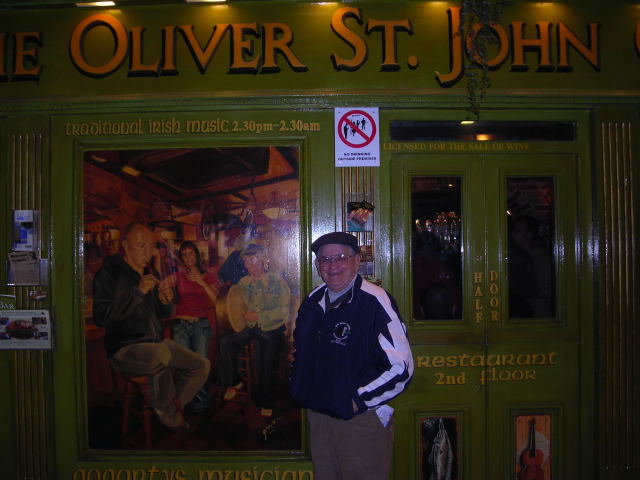
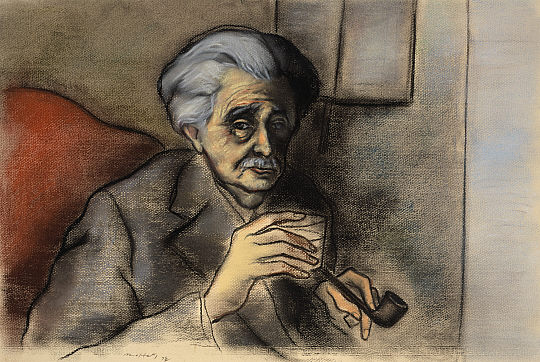
My father outside a pub in Dublin

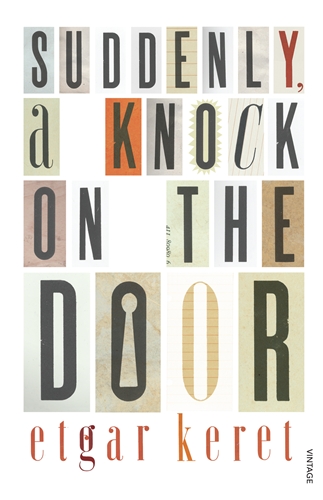
Book Review: Suddenly, A Knock on the Door by Etgar Keret

There is a weird zeitgeist about my reading these days.  I will pick up a book that I am unfamiliar with, because of a friend’s recommendation or a short review in the Sunday papers, and then all of a sudden I am seeing it everywhere.  I began reading Etgar Keret’s collection of short stories, Suddenly a Knock on the Door, after seeing it reviewed in the Sunday NYTimes two weeks ago (15 April). While I was half way through it, I was tidying up the house when a magazine from back in February fell open to a review of the book announcing its upcoming publication. I had read the review back then, but had forgotten completely about it. And then again on Wednesday in the Metro–the free paper given to commuters each day and hardly a go-to read for  literary suggestions–the book was advertised on the front page and reviewed inside. On Friday, a co-worker told me the library had called to tell him the book he had on hold had arrived: Suddenly a Knock on the Door.

What is with all the buzz?  Keret’s publicists must be very good.

And to a large degree it is worth it.  Keret’s thirty-seven stories (translated by three people) are short, zippy, and fun.  They straddle the world between stark realism (suicide bombers and bratty children) and magic (talking fish, pissed-off angels). The subject matter often seems to be fiction itself–the fictions of the literary mind and the fictions of liars.

The collection is bookended by two stories in which they author is forced to write a story in front of us.  In the final story, he is being filmed by German Television and they want to film him writing, want to record the actual creative process. In the first, he is being forced by three men–a terrorist, a poll taker, and pizza delivery man–who have invaded his home and demand a story. Violence is threatened if he doesn’t come through with a story they approve of.  When the narrator begins telling a story about what is actually happening at the time–the most current form of realism–the pizza delivery man demands something more magical: “Things are tough,” he says. “Unemployment, suicide bombings, Iranians. People are hungry for something else.”

And something else is what Keret gives us.

In one story, “Lieland,” a man is pulled into a world where all his past lies have come alive. The fabrications he has made up throughout his life in order to deceive his mother, his employers, his girlfriends all confront him in a world that is harrowing and freeing.  In “Unzipping,” a woman, tired of her current lover, finds a zipper in the man’s mouth, and unzips it to reveal a new person inside, who is indeed a different sort of lover. In still another, a woman has only slept with men named Ari–twenty-eight of them previously and now her current boyfriend and the landlord.

Yet all is not silliness.

The number of suicides and suicide bombings in the stories are many. One beautiful story, “Not Completely Alone” begins “Three of the guys she dated tried to commit suicide. …One of them even succeeded.”  The last paragraph begins “Four of the guys she dated tried to commit suicide. Two of them succeeded.”  It’s only after going back to read the first sentence that we realize the narrator is the fourth guy–and the second success. In another, a man’s life is completely changed after emerging from a extended coma that was caused by a  jumper landing on his head after falling eleven stories to his death.  In another story “Joseph,” a smarmy producer in a cafe boasts about his talent for reading people but is not clever enough to spot the sweating man with the bomb strapped to him.  After a discussion of final words by those who die a violent death, we learn of one bombing victim whose last words are the bathetic “Without cheese” as he orders a kosher “cheeseburger” in the story “Cheesus Christ.”

In “Pick a Color,” a black man is beaten badly when he moves into a white neighborhood. In the hospital, he falls in love with the white nurse who tends to him, and, whom, confined to a wheelchair, he marries  in a ceremony presided by a Yellow priest whose family also had been beaten because of their color. When the white nurse is murdered by brown men, the man turns to the Yellow priest for explanation, explanation of “the God who loves you and wishes you all the best.” When that God shows up, in a wheel chair like the black man, the explanation that God gives is not what any of us probably expected.

In relating these stories here , they seem much darker than they are upon first reading. The stories do zip by, some of them only a page and a half long.  There is much “smoke-and-mirror” playing with reality, turns with truth and illusion.  There is banality, as there is always in life, and there is beauty. A young son gives animal names to the prostitutes who visit the old man on the floor above…a dying man gets his dying wish for peace on earth…a mourning widow comes to some closure through cooking in her diner.

Nathan Englander, in the title story of his collection What We Talk About When We Talk About Anne Frank, has a character say that the difference between Israel and Miami is “the space” –that there is none in Israel.  In Etgar Keret’s collection (in which Englander translated seven of the stories), space is also the focus. Ketger looks closely at the spaces between lies and truth, between life and illusion, between hope and reality.  The stories are clever, witty, and fun. There are enough “wow” moments, enough times when you breathe out in relief or exasperation, and plenty of times when you simply smile knowingly to yourself.

In the blurbs on the paperback edition, there are statements by Salmon Rushdie, Amos Oz, Yann Martel.  But my favorite is by Gary Shteyngart, author of Super Sad True Love Story. Talking about Keret’s novel The Nimrod Flipout, Shteyngart calls it “the best work of literature to come out of Israel in the last five thousand years… .” That’s quite a claim.  Maybe I’ll see if it’s in our library.

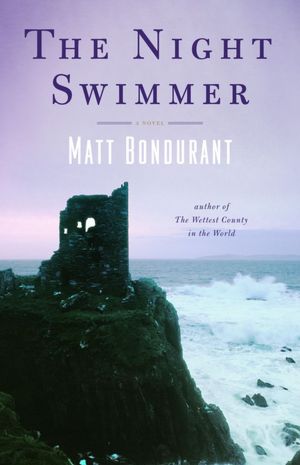
Book Review: The Night Swimmer by Matt Bondurant

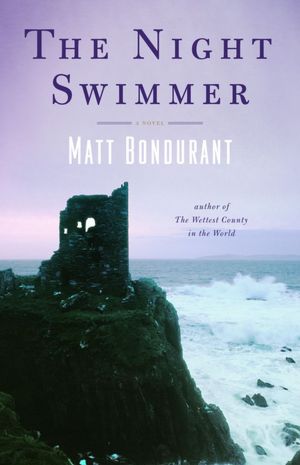
A goat that walks on its hind legs…a woman who swims in the dangerously cold North Atlantic…hallucinogenics…two Irish pubs…a violent underworld…a blind goatherd…a dubious fiddler…9/11…an ancient tragedy.  These all are elements that come together in the magnificent novel The Night Swimmer by Matt Bondurant.

I wrote about this novel in an earlier blog; I had only been a few chapters in at the time and was focusing on the urge to live somewhere else. Indeed, the examination of this urge is part of the narrator’s train of thought. But I had no idea where this story was going and how vividly it would be told.

The novel is about an American couple who move to Ireland, when the husband wins a pub in the town of Baltimore in southwestern County Cork. The husband has aspirations of writing and feels that the pub will give him ample time and material to do something great. He certainly has both–but is unable to fashion anything with it.

The woman–the narrator–has an rare skin condition, a subcutaneous level of fat, that allows her to withstand extremely low water temperatures. She is an open sea swimmer and the move to Ireland allows her to revel in this activity, in water that is frigid and dangerous. She spends much of her time on Clear Island, where she swims and begins to attract the attention of the islanders as well as of a little goat that walks upright. The islanders are very suspicious of strangers–blow-ins they call them–and they are particularly concerned about this young woman who swims in their harbor. They are also going through some large shifts that threaten to change their centuries-old way of life.

As Elly, the narrator, spends more and more time on the island, she begins to feel, to a small degree, a part of the island–but she knows that this is a false feeling. She befriends a blind goat-herder and  learns of his heartbreaking personal tragedy, and then discovers a much larger tragedy that once wiped out an entire generation of islanders–except for two. She also begins to see that her marriage is not strong enough to withstand the battering that the move across the ocean occasions. She watches it erode and sadly understands why this is occurring.

The novel is many things–it is a domestic novel about marriage infused with a magical realism built on folk lore and village life.  It is a novel about enterprise and failure. About love and its withdraw. About the fear of strangers and the resistance to change. Elly attempts twice to swim to Fastnet Island–something no one has actually ever done–and in describing this momentous feat, Bondurant elevates his already lofty writing into something sublime.  Neither attempt is successful, but both are certainly memorable. In a whirling world of deep open-sea, hallucinogenic visions, and towering inspirations, Elly’s swimming anchors this already magnificent read.

Because of the epigraphs taken from the journals of John Cheever and the various allusions to him and his stories throughout The Night Swimmer, there have been the expected comparisons between the two. I find this a little wrong. For while the epigraphs from Cheever’s journals are appropriate and thoughtful,  and the thematic focus on dualities similar to that in Cheever’s own stories, the writing of The Night Swimmer seems so much fuller, fatter, more exuberant.  Cheever’s writing, for me, reflects the dessicated suburbias that he depicts, and reflects it in a much leaner style of writing.

In many ways I wish that the novel ended one chapter before it did. There is an epilogue of sorts, a tying-up of things, that I found unsatisfying. I would have rather left Elly on Clear Island, with both her and the reader trying to figure out the impact of what just happened, of where the future lies.

Ethical versus Moral

I had a conversation the other day with a woman who is teaching Marjane Satrapi’s  graphic-novel Persepolis. Our discussion revolved around the differences between ethics and morality. Neither of us are professional philosophers, but I like to think that we are thoughtful, intelligent people. And so, we must answer the questions: What is ethical? What is moral?

From the dictionaries I learned that morals are “a person’s standards of behavior or belief’s concerning what is and is not acceptable for them to do” and that ethics are “moral principles that govern person’s or group’s behavior.”

Yet that seems backwards to the way that I have always viewed it. I had viewed morals as being proscribed by a particular group and ethics as being a more personal, individual code of living.  Perhaps my association of “groups” with morals  is coming from the preponderance of fundamentalists–in all religions–who attempt to press their moral code on all. Ethics to me, on the other hand, is the system of right and wrong, just and unjust, developed individually.

Is this a case where I am just wrong, outright?

So, I went to a man who teaches philosophy. His distinction was this: ethics is a system of right and wrong behavior derived from rationality. Morals is a system derived from religious belief.  Yes, many times they overlap. But sometimes they do not.

Yup, that seemed to clear some things up.  And I didn’t seem completely off in my understanding.

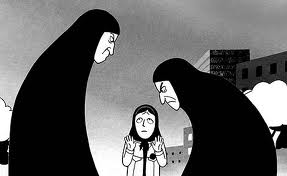
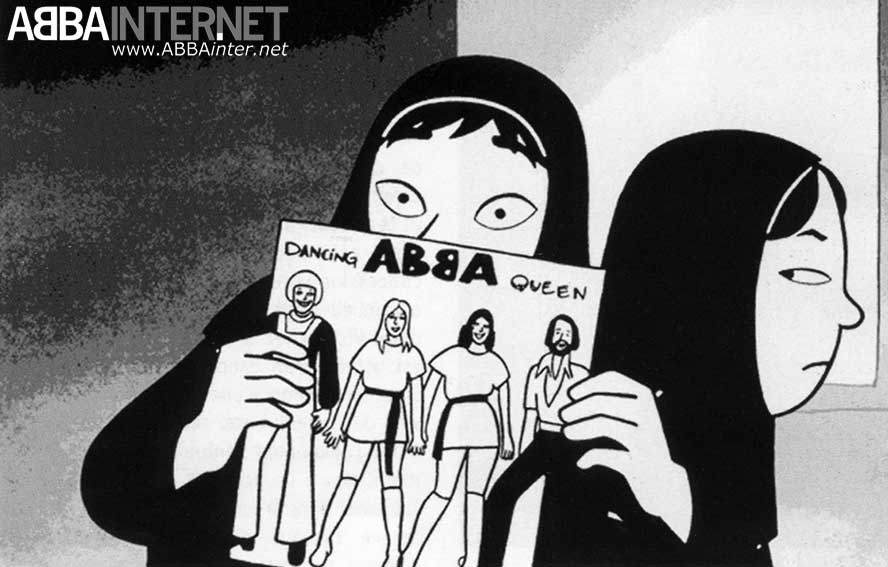
For instance, according to the religious belief group in charge in the picture above, it is IMMORAL to listen to ABBA. (We are talking ethics and morals here, not musical discernment.) Yet it is hardly UNETHICAL to do so.

So think of the things that are proscribed by particular groups and weigh them in light of ethical or moral. For some, it is marrying outside one’s group (unethical or immoral?); for others, it is believing in evolution (unethical or immoral?); and still for others, it is having men and women sit on the same side of a room (unethical or immoral?).

In the States, we are going through an election season (doesn’t it always seem like an election season) and, in the political debate, social issues always seem to force their way to the top–or at least garner the most attention. Issues of sexuality, women’s reproductive rights, marriage get a lot of discussion.  Are these ethical issues or moral issues?  In a system that supposedly separates church from state, are the morals of a particular belief system muddying the ethics of a rational system?  In other words, I might not want to listen to ABBA but should you tell me I can’t?

I listened to a man speak two weekends ago who suggested that members of the U.S. Congress should read more poetry. He noted that the poet Adrienne Rich once called poetry, in all its ambiguity,  the “perfect antidote to moral certainty.” I keep thinking about that and worrying about governmental moral certainty.  Other governments have tried it–and it ain’t pretty.

It’s been a while since I read Persepolis or Persepolis 2, and I have never seen the film version. I remember both books as being quick reads, but I have lasting memories of them. Maybe, I’ll go through them again this weekend.

Movie Review: The Footnote: fathers and sons, parents and children

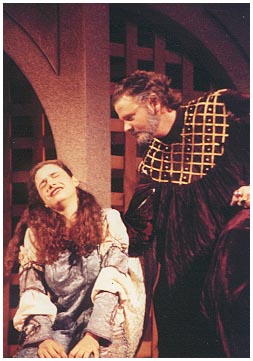
Juliet being bullied by her father

I have always been fascinated by the importance of parent/child relationships in Shakespeare. As school children, one of the first plays we read is Romeo and Juliet and aside from the love story, the second major story is Juliet’s relationship with her parents. The mother is cold and aloof and the father, while seemingly sensible in the beginning, shows himself an insensitive brute. Then there is Hamlet–a psychiatrist’s field-guide to dysfunctional parenting. In the histories, there is Henry IV, parts 1 and 2; the tragedies also give us King Lear–a tragedy of parenting if ever there were one; the romances give us The Tempest with the sorcerer Prospero manipulating his daughter’s–and everyone else’s–life. Throughout the canon, there are lovers blocked by parents, young nobles obeying the edicts of  fathers, and even a childless woman declaring what violence she would wreak on her children if she had them.

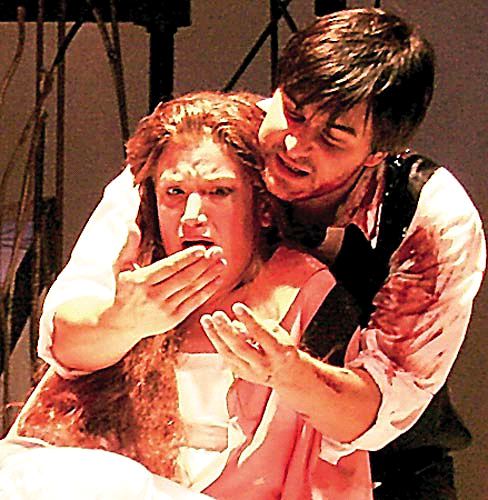
Hamlet berating his mother

And then I thought how much all of literature is tied in with this theme. From the earliest fairy-tales like Snow White, Cinderella, and Rumpelstiltskin to the Greek plays–where does one begin with Oedipus?–the dynamic between parent and child is in the foreground. As for the great epics: The Odyssey is really a tale of a son trying to find his father, as is its modern counterpoint, Ulysses,where “fatherless” Stephen is cared for by Bloom who mourns the death of his own infant son; and what is Paradise Lost but a father punishing his errant children?  In Great Expectations Pip is orphaned and raised by a beastly sister and her kind and understanding husband. In Huck Finn, Huck is trying to survive in spite of the obstacles that the disreputable Pap has put in his way. And even a modern potboiler like the Girl with the Dragon Tattoo trilogy is founded on several perverse father/child relationships.

Lisbeth Salander and her father from The Girl With the Dragon Tattoo

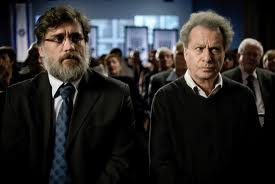
So I thought of all of this as I left the theater Sunday after watching The Footnote. An Israeli film, The Footnote follows a father and son, both Talmudic scholars through their strained relationship. The father’s career–rightly or wrongly–stalled early in its course. The son, on the other hand, is immensely successful. The film opens with an award ceremony where the son is being inducted into the Academy of Sciences. In his thank-you speech, the son focuses on what an inspiration and model his father was, but the father is so filled with envy, anger, and bile that he walks out of the theater.

Son and father from The Footnote

Later, the father receives a telephone call informing him that he has won the prestigious Israeli Prize, an award given by the President of Israel to an important scholar. The call is actually a mistake and was intended for the son who naturally has the same last name.  The son is informed of the mistake and told that he must be the one to tell his father. What ensues is riveting, heartwrenching, and sad.

The soured relationship between the two is echoed with the son’s strained relationship with his own adolescent child. At times, it seems the women are holding things in place, but I am not completely sure. There is a lot of dishonesty, a terrible lack of communication, and an underlying egoism that is poisoning the family dynamic.

The film is very good.  It is one of those films that you talk about long after, and think about much longer than that.

Midnight on Revolutionary Road in Paris, County Cork

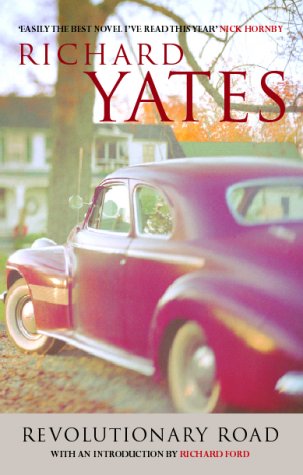
I am reading a book, The Night Swimmer by Matt Bondurant, where early in the novel, a young, successful couple have these yearnings to chuck it all and to move to Ireland.  They are intelligent and aware of the commonness of this trope–they intentionally nickname their street “Revolutionary Road” after the Richard Yates’ novel.  Earlier, before the dream of starting afresh in Ireland, the couple had wished to live in the time period when the novel Revolutionary Road takes place–a Cheever-esque world where pitchers of martinis and pyramids of cigarettes punctuated each evening. That glamorous “Mad-Men” world had not work out for them, but the dream of emigrating does: the husband wins a pub in County Cork, Ireland.  Needless to say, the paradise/excitement/vigor of the new life they imagined in this other world does not pan out they way it had in their dreams.  And like in Richard Yates’ novel, the marriage suffers more than greatly.

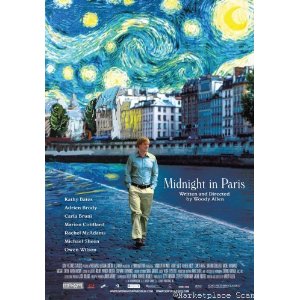
What is it about us that makes us often wish we were in some other place, some other time?  In Midnight in Paris,  Woody Allen wrestles with this question. The protagonist wishes he lived in 1920s Paris, but the 1920s woman he meets wishes she lived in the Paris of the 1890s?  And in fact, the life he is already experiencing in 2011 turns out to be full of promise. Why is this nostalgia for a world other than our own,  for an imagined place and an imagined time, so strong?  Is it  general among everyone?  Or only with a certain type of person?

I walked out to get a coffee today and on my walk home I cut down an alley.  Looking around me, I realized that I could have been walking in any foreign city with any foreign adventure around the corner.  I could have been in Paris, in Cork, but I was merely a short stroll from my own house. I took a picture with my phone.  The concept of a more exotic, romantic other place is just a whiff of smoke–it is always around us if we keep our eyes open.

Now it is often said that one doesn’t appreciated one’s home until one is separated from it. Joyce gave us a loving, photographic picture of Dublin, but only when he was writing in Switzerland and Paris.  Beckett too gives us an unnamed but undoubtedly Irish landscape in his novels and several of his plays and he too was across the sea.  But that is different than romanticizing a place one wishes for, a place that does not exist.  What Joyce and Beckett do is understand what they had left, see it without the distortion of being so close within. This is not the same as dream-manufacturing, as imagining a better world through the kaleidoscope of nostalgia and generalities.

Nevertheless, there are still many days when I wish I was somewhere else, when I don’t appreciate the vitality of the world around me. But in these daydreams, it seems that I am never working, that there is no concern about putting food on the table or where the next dollar is coming from–who wouldn’t find that attractive. And that’s what makes it all somewhat of a sham.

Central Park in Spring…Poetry in April

Went up to NYC for two days. The weather was glorious. Bright sunny skies and comfortable 70-degree weather. Central Park was bustling–workers extending their lunches, children climbing rocks, skateboarders, bikers, and roller-bladers whizzing around. There were even some early sun-bathers stripped down to the bare essentials. Good energy all around–New York at its finest.

The reason I went up to New York was to attend the 10th annual “Poetry and Creative Mind” gala held at the Alice Tulley Hall at Lincoln Center on Thursday night.  Sponsored by the Academy of American Poets, the gala celebrates National Poetry month by presenting various writers, directors, and personalities to read two or three poems of their choosing.  Simply, the night was fun. The presenters were relaxed and entertaining, and the audience was appreciative and receptive.

The readers were Meryl Streep, Brook Shields, Diana Reeves, Colum McCann, Chip Kidd, Bill Keller, Terrence Howard, John Wesley Harding, Claire Danes and Tom Brokow.

Chip Kidd (Master of Ceremonies) dressed in an extraordinary red-and-white striped suit jacket, Kidd was humorous and quick. He handled a small mishap very well when he introduced out-going Academy president Tree Svenson who reached the podium and had to leave stage to retrieve the speech she had forgotten.  He also performed a skit based on his assertion that all Emily Dickinson poems can be sung to the tune of the “Yellow Road of Texas,” “Gilligan’s Island,” and the 1970 theme song for Pepsi.

Colum McCann. McCann’s National Book Award winning novel, Let the Great World Spin was a dramatic, emotional,  exciting portrait of New York City in 1974.  (see and hear McCann talk about the novel here: http://www.amazon.com/Let-Great-World-Spin-Novel/dp/0812973992/ref=sr_1_1?s=books&ie=UTF8&qid=1333815282&sr=1-1).

McCann recited “The Road Not Taken.” He said that instead of gifts for Christmas, he asks his children to memorize a poem and gave us one that he had asked them to memorize. It was “A Meeting” by Wendell Berry and dedicated to Frank McCourt. His poems all tended to celebrate “the road not taken.” They included Rukeyser’s “Then I saw What the Calling Was” and Amy Clampitt’s “Blueberrying in August.” He ended with the very powerful poem by Nikky Finney called “I Have Been Somewhere.”

Claire Danes, the actress, recited e.e. cummings’ “if up’s the word.”  The poem had been read at her wedding.  She then read  Frank O’Hara’s “Having a Coke with you.”  It was new to me–although I inherited O’Hara’s completed poems from my uncle–and it was such a wonderful love poem. Here it is:

“Having a Coke with You” by Frank O’Hara

Having a Coke with you
is even more fun than going to San Sebastian, Irún, Hendaye, Biarritz, Bayonne
or being sick to my stomach on the Travesera de Gracia in Barcelona
partly because in your orange shirt you look like a better happier St. Sebastian
partly because of my love for you, partly because of your love for yoghurt
partly because of the fluorescent orange tulips around the birches
partly because of the secrecy our smiles take on before people and statuary
it is hard to believe when I’m with you that there can be anything as still
as solemn as unpleasantly definitive as statuary when right in front of it
in the warm New York 4 o’clock light we are drifting back and forth
between each other like a tree breathing through its spectacles

and the portrait show seems to have no faces in it at all, just paint
you suddenly wonder why in the world anyone ever did them

I look
at you and I would rather look at you than all the portraits in the world
except possibly for the Polish Rider occasionally and anyway it’s in the Frick
which thank heavens you haven’t gone to yet so we can go together the first time
and the fact that you move so beautifully more or less takes care of Futurism
just as at home I never think of the Nude Descending a Staircase or
at a rehearsal a single drawing of Leonardo or Michelangelo that used to wow me
and what good does all the research of the Impressionists do them
when they never got the right person to stand near the tree when the sun sank
or for that matter Marino Marini when he didn’t pick the rider as carefully
as the horse

it seems they were all cheated of some marvelous experience
which is not going to go wasted on me which is why I am telling you about it.

John Wesley Harding –John Wesley Harding is the stage, folk-singing name of the writer, Wesley Stace. As Wesley Stace he read Thomas Wyatt’s  “They Flee from Me”  which he calls the greatest poem ever written. (I’m not sure I agree). For his second poem, he brought out his guitar and sang the poem, “The Examiners”–which is on his latest album.   He had seen it in a contest in the Times Literary Supplement and was immediately struck by it.  As he noted, the poem may have come in 3rd in the contest, but “numbers 1 and 2 weren’t being played on the stage at Lincoln Center.” Here he is singing “The Examiners”:

Terence Howard, the stage and screen actor, seemed the less comfortable of them all. He haltingly read Stanley Kunitz’s “The Layers,”  but then hit his mark with Rod McKuen’s “Gifts from the Sea.”  It was moving and lovely.  And to me a surprise.

Brooke Shields gave perhaps the best performance of all.  She first read “The Spoilsport”  by Robert Graves, then the very funny “Nostalgia” by Billy Collins and then Howard Nemerov’s “To David, About His Education.” Her delivery was relaxed and humorous and each of the poems themselves were both light and thoughtful.

Bill Keller said that the only reason he had been invited to read was that he had written a NYTimes article in which he said that Congress would be a much better governing organization if they read more poetry. (He said that maybe that would be better than the “Congressional prayer breakfasts” that so many like to boast about.) He cited the late Adrian Rich who once said that “poetry was the perfect antidote to moral certainty” and felt that that was something sorely need in present day Washington. He read three love poems, one each by Brad Leithauser, Kay Ryan, and Frederick Seidel. He ended with Stephen Dunn’s “Our Parents.”

Dianne Reeves. The great jazz singer showed that she can also sing the blues. In the middle of  the Gwendolyn Brooks “Queen of the Blues,” she sang the middle verses in  throaty, bluesy voice that wound back into the poem gently into the poem. It was the high point of the evening. She also read a humorous one about a woman’s hips and another about language and grammar by Kenneth Koch in which the elements of a sentence vowed their love ”until the destruction of language”

Tom Brokaw. Affable and charming, surprisingly his remarks fell flat and his poetry selections were not that memorable. He joked about having been placed between Reeves and Streep. Affable enough, but not that great a performance.

Meryl Streep is always regal, even when she is casual and comfortable. She read W.H. Auden “As I walked out one evening” and then Bishop’s “At the Fishhouses”–she flubbed her lines at the end, but the performance was still spell-bounding.  To atone for her slip-up, she then recited a Chinese poem, first in English and then in Chinese.  It seems that she can do anything.

There was a large reception at the end–one could see in through the glass walls and it looked fine and sumptuous–but it was for the performers and the higher-priced ticket holders only.  Instead I walked across the street and had a whisky and replayed the night in my head.

Letter-writing, letters, Beckett and love

About five years ago, I traveled to Durban, South Africa.  I flew direct from Washington, D.C. to Johannesburg and then a short flight from Johannesburg to Durban. It is a grueling flight–19 hours in the air and plenty more in airports.  But during the flight, I read volume one of The Letters of Samuel Beckett, 1929-1940.  I must admit I was enthralled–and may be the only person to have read the nearly 900-page collection in one sitting. Nevertheless, three years later I am now reading volume two ( The Letters of Samuel Beckett, 1941-1956).  Certainly there is a touch of the voyeur in reading another’s letters, and, for me, not a little hero-worship in reading the letters of Beckett as he casually mentions Jack Yeats, Sartre, de Beauvoir, Nora Joyce, etc.  (The first letter in this collection is a postcard that he had sent to Joyce, a pre-printed, government regulated correspondence limited to family news because of the war.  Beckett sent the postcard from Paris to the Joyces in Switzerland, saying that he and Suzanne were all right.  He wrote it on January 12, 1941 and it arrived in Switzerland on the 17th. Joyce never received it, however, having died on the 13th, the day after Beckett wrote it. )

Anyway besides the snoopiness and the adolescent-like hero worship, the letters have me thinking of correspondence in general.  Except for writing thank-you notes –a good habit I learned from my father and my uncle–most of my correspondence now is through e-mail. Even the majority of my manuscript submissions are done electronically with the cover letter included in the submission.  Yet there is something about letter writing I miss.

A love letter, or any kind of letter for that matter, is so much more intriguing to receive–and more fulfilling to write–than a text or an e-mail. During a 10-day trip to Paris, I once wrote fourteen letters back home to the love of my life. I can still see the thin hotel stationery, the blue, white and red airmail envelopes, the soft lobby light in the ragged hotel under which I poured out my soul. Today, those letters probably mean more to me than to the person that received them. They capture a unique moment in my life, an amber-encased slice of who I once was.

In that sense,  I take pleasure  in reading  letters that I have written or received in the past–they transport me to where and who I was at the time they were written.

(Perhaps  the most beautiful love story I have ever read is by an Irish novelist named Niall Williams entitled Four Letters of Love.  It is a wonderful novel that revolves around letter writing–as well as around painting, fishing, the Aran Islands, death, heartbreak and redemptive love.)

What about you? Have you  given up on snail-mail completely? I worry about the impermanence of all our correspondence, of the ephemeral nature of e-mail and texting. True, they say that every stroke of your keyboard can ultimately be retrieved and that nothing in cyberspace really disappears, but are the biographers and historians of the future going to have access to these? Is the estate of a future Samuel Beckett going to allow some academic to sift through the computer files –deleted and saved–of the person whose name is entrusted to them?  I cannot say. But I do know the thrill of opening an envelope, of slipping out a hard-stock card, sheets of creamy stationery, or ripped pages of loose-leaf.  Am I simply missing some golden-hazed memory or have we truly lost something special?

E-mail me what you think.  Hah!

Book Review: What We Talk About When We Talk About Anne Frank by Nathan Englander

  I was prepared not to like this book.  The hype was too much.  I had read a “life-style” piece in the NYTimes Metropolitan section about Englander, an interview with him in The Guardian,  a front page review in the NYTimes Sunday Book Review, another in the London Review of Books, and a handful of smaller reviews. The title and the author seemed to be everywhere.  And yet, I was wrong.  The hype was deserved–the eight stories in the collection are gem-like in their perfection. Solid, thoughtful, inventive, poignant and droll.

The title of the collection famously alludes to Raymond Carver’s story and collection, What We Talk About When We Talk About Love.  In Englander’s title story two couples sit around in a sunny kitchen drinking hard–just as they did in Carver’s story. The difference is that we are not in Carver’s Mid-West; we are in Florida, and Englander’s two couples are a secular Jewish couple who live there and a Hasidic couple from Israel, visiting after many years.  The conversation is tense, the husband uneasy with these Hasidic guests that he has just met, and the ending surprising and sad. (Go here to read Carver’s original story: “What we Talk About… and here to read it as it finally appeared with editor Gordon Lish’s revisions, “What We Talk About…”)

Several of the reviews I read mentioned how Englander’s stories seem to channel Kafka through Woody Allen, and the example they site is the story “Peep Show.” In fact, this Kafka/Woody Allen connection is what drew me to the collection.  In this particular story, a secular Jewish man walks into a peep show, advertising “live girls” and gets 5 tokens. Inserting the first token, he encounters several women, one of whom particularly arouses him. After the partition closes, he deposits another token, but this time, when the barrier opens, it reveals three rabbis from his past who begin to scold him; subsequent tokens reveal his scolding mother, his pregnant wife, and himself.

There are other stories that touch have a similar absurdity and wryness–particularly one about a gang of Long Island Jewish boys dismally failing to wreak revenge on an anti-Semitic bully and another about a summer camp for senior citizens–but overall this is not the tone of the collection. The final story “Free Fruit for Young Widows” and the second story “Sister Hills”  are memorable and distinct vignettes of life in Jerusalem.  Both have a historical sweep and a personal sadness. Both are extraordinary.

“The Reader” and “Everything I Know About My Family on My Mother’s Side” seem the most personal of the collection, and they too are brilliant. The language in these–as in all the stories–is clean and efficient, but beautiful and evocative.

As I said, I was a little put off by all the hype. But it was well deserved.  These are stories that will stay with me for a while and which I will return to often.