“The sun shone, having no alternative, on the nothing new.”
Samuel Beckett (1906-1989), Murphy

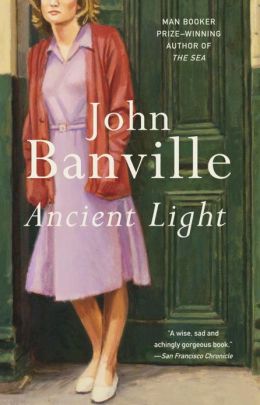
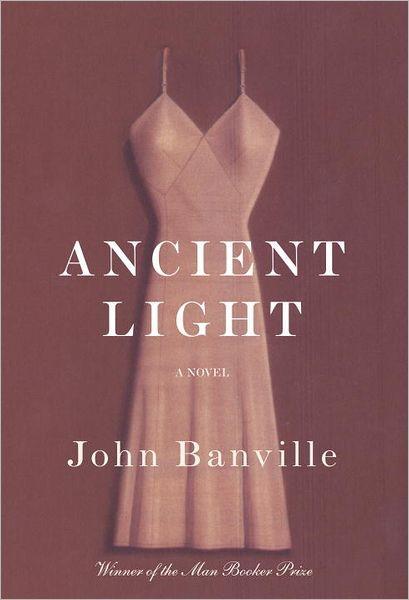
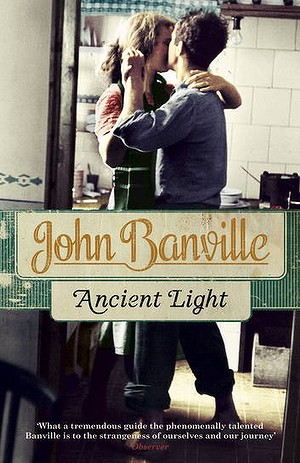
It seems appropriate that there are three book-covers for John Banville’s Ancient Light. For confusion–or perhaps”uncertainty” –is the appropriate word for the various threads that form the cloth of Banville’s novel. Weaving together three stories (at the very least), Ancient Light details the aging actor Alex Cleave’s misted memories and the challenges of his present life.
Particularly important in his mind are the affair he had when he was 15 with the 35-year old mother of his best friend, his daughter who killed herself in Italy ten years before the novel begins, and the young “movie-star”with whom he–a respected stage actor– is filming his first movie. And hovering in the background, drinking tea in the kitchen while Cleave writes these “memoirs” is his wife, Lydia, who is struggling with their daughter’s death in her own way.
So who are the women represented on the book covers? Is that Mrs. Gray, his first love standing in front of the shop? Or his daughter waiting impatiently for his arrival? Is that the actress Dawn Davenport’s slip? Or Mrs. Gray’s? Or his daughter’s? And who can that be dancing? Mrs. Gray and young Alex seems obvious. But could it also be the characters that Cleave and Davenport are playing in their film? Or his daughter and the mysterious man she was working for (and whose child she was carrying) when she flung herself into the rock-strewn sea?

John Banville
photograph © 2005, Derek Speirs for The New York Times
That we can not be sure is part of the joy and wonder–and admiration–one feels in reading Ancient Light. Banville is an exquisite writer–and I do not use that word lightly. Character description, dialogue, setting, interior life–all are rendered with keenly sensitive language and thoughtfulness. At one point, the sky is the color of “wetted jute“; at another, it is described as “a layering of bands of clay-white, peach, pale green, all this reflected as a vaguely mottled mauve wash on the motionless…canal.” Some of the writing is heart-wrenching in its perfection; some is amusing. Here is Cleave describing a “researcher” sent by the movie company to help him with his role:
Billie, however, is obviously a native of these parts, a short pudgy person in, I judge, her middle to late thirties. She really is of remarkable shape, and might have been assembled from a collection of cardboard boxes of varying sizes that were first left out in the rain and then piled soggily any old way one on top of the other. The general effect was not improved by the extremely tight jeans she was wearing, and the black polo-necked jumper that made her large head look like a rubber ball set squarely atop those precariously stacked cartons.
Here is what the aging Alex has to say early about love:
I should like to be in love again, I should like to fall in love again, just once more.
He is aware of both the poignancy of those words and the sadness of the thought in the presence of his wife.
What Ancient Light is most surely about is the past. Cleave–believing he is nearing the end of his career–is enamored by it, by the love affair with Mrs. Gray (he notes the inexactness of this phrase) and by the death of his daughter.
Because I am getting old and the past has begun to seem more vivid than the present, he states, and then later, when he learns of what he mis-remembered, he concludes that often the past seems a puzzle from which the most vital pieces are missing.
When in Italy with Dawn Davenport he meets a mysterious Argentinian, (a ghost? his doppelgänger?) who over a bottle of wine says this too him:
“Even here,” he said, ” at this table, the light that is the image of my eyes takes time…to reach your eyes, and so it is that everywhere we look, everywhere, we are looking into the past.”
But the past is slippery for both Cleave and the memoir he is writing. He notices instances when the progression of time seems to slip, to miss a cog:
There are moments, infrequent though marked, when it seems that by some tiny shift or lapse in time I have become misplaced, have outstripped or lagged behind myself.
Cleave’s stories ultimately come together in subtle and satisfying ways. There are coincidences, but Cleave does not believe in coincidences. There are “apparitions,” though Cleave is reluctant to but wishes to believe in an afterlife. (Twenty years ago, Banville did write a novel Ghosts.) There is doubling and there are doubles. There is a subtle knowledge of and reference to Greek mythology, and a faint feeling that the ancient gods are still at work in the lives of these mortals. And it is all done in a lush, rich style that is the very antithesis of modernity’s spare and sparse writing.
John Banville is an author who writes intelligent and dense books that deserve a much wider readership. His novel The Sea won the Man Booker Prize (much to the dismay of critics who felt it wasn’t commericial enough.) And lately he has also been writing detective novels under the pseudonym Benjamin Black. And I just learned, when I mentioned Ancient Light to a friend that this novel is in fact the third of a loose triology featuring Alex Cleave, his wife Lydia and their daughter Cass.
I will have to hunt them down.
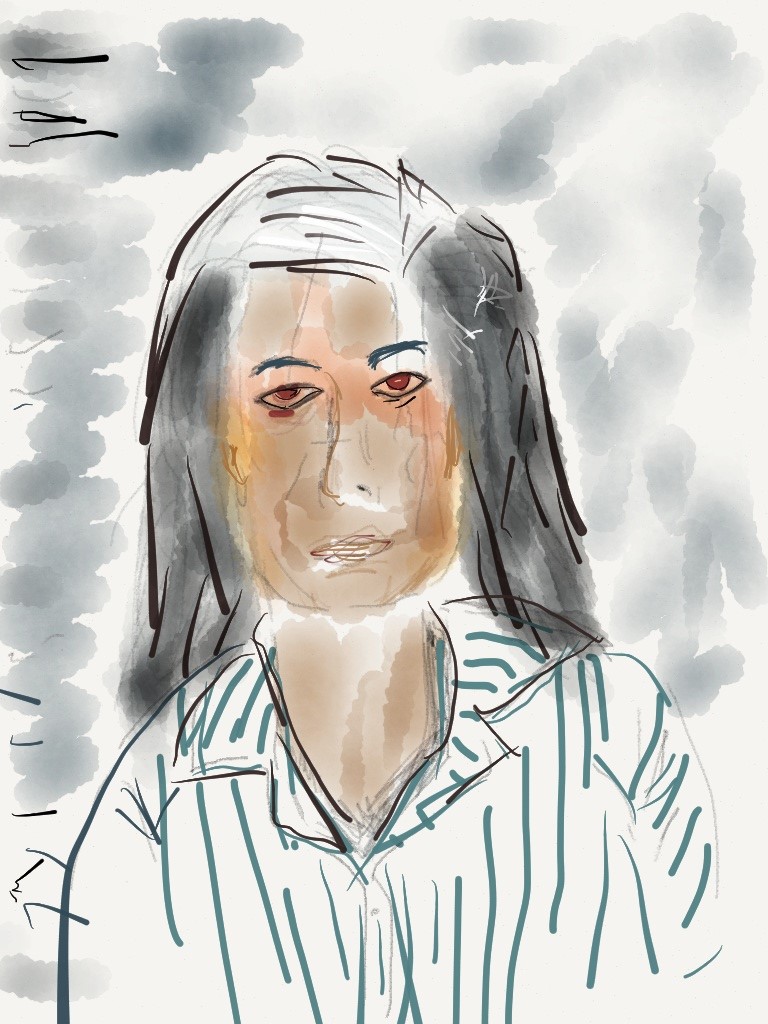
Susan Sontag (1933-2004)
illustration by jpbohannon 2013 (based on painting by Juan Bastos)
There is a danger in reading memoirs, diaries, journals. Certainly, there are times when our angels are shown to have feet of clay. Or other instances, when we weigh the turmoils and angst of a particular life with the end product that impelled you to read the memoir in the first place.
But with Sontag it is quite, quite different.
Next to even her young self, I feel so inadequate, so shallow, so wasteful of time.
Here is a young woman–14 years of age when the journals begin–embarking on a intellectual career that would put most of us to shame. Her reading lists, her “to-do” lists, her debates with herself, her analysis of events, readings, concerts and people she meets, her experiences, all are more fervent, more intelligent, more thoughtful in the years between her 14th birthday and her 30th, than mine have been for most of my life.
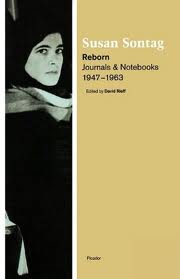
I teach a group of extremely bright 18-year old boys. They have great intelligence, and some are quite creative. But every so often they need to be reminded that their superior intelligence is frequently measured within the very small pond of our school. Here’s what I read them from Sontag’s journal:
…Yet we do exist, + affirm that. We affirm the life of lust. Yet there is more. One flees not from one’s real nature which is animal, id, to a self-torturing externally imposed conscience, super-ego, as Freud would have it–but the reverse, as Kierkegaard says. Our ethical sensitivity is what is natural to man + we flee from it to the beast…
I ask them to describe the person who would write this in his or her personal journal. And they are always far off…in both gender and age. Sontag wrote this (a snippet of a much larger journal entry) two weeks after she had turned 17! Already her depth of reading and understanding and active thoughtfulness is evident.
Immediately in this first volume of the journals, one meets a brilliant, thoughtful intelligence. She attended Berkeley at the age of 16, transfered to University of Chicago, married Phillip Reiff–a sociology professor–at 17, taught at the University of Connecticut when she was 19, and attended graduate school at Harvard, where she got her degree in philosophy and theology. And throughout these years, she recorded her thoughts and criticisms and interpretations, as well as her fears, her doubts and her insecurities. As her marriage began to falter, she received a fellowship to Oxford and then moved to Paris. When she moved back to New York in 1959 (26 years old), her marriage was dissolved and she had gained custody of her son. Established in New York, she began teaching at various colleges, completed her first novel, The Benefactor, and witnessed her reputation as part of New York’s intelligentsia begin to grow.
These are the years covered in the volume. Aside from the inquisitiveness, interpretation, and analysis of what she reads, sees and watches (she was a rabid film-goer), there is the struggle of understanding who she was. The marriage was unsatisfying, the lovers often hurtful, and in reading the journals we see a young woman trying to discover herself and come to terms with her own individuality, her own bi-sexuality, her own identity. There are times when one feels she is too hard on herself…when one wants to warn her, NO, this is going to end bad, but then again, one can’t.
Beginning when she was 14 and ending when she was 30, the journals are remarkable for their honesty and the peek into her rigorous mind. But at the end, one is moved by the ever-going struggle between her sexuality and her intelligence, by the vulnerabilities and insecurities she reveals in her two major love affairs with Harriet Sohmers Zwerling and Irene Fornés. For her extraordinary mind struggled continually to understand the extraordinary pull of the flesh.
Her last two entries for 1963 read:
The intellectual ecstasy I have had access to since early
childhood. But ecstasy is ecstasy.
Intellectual “wanting” like sexual wanting.
♦ ♦ ♦ ♦ ♦ ♦
Reborn is the first of a proposed three volumes of journals. The next volume–As Consciousness Is Harnessed to Flesh– covers the years 1963 to 1964, when Sontag develops her reputation, her political activism, and her writing. It is now on my “to-read” list.
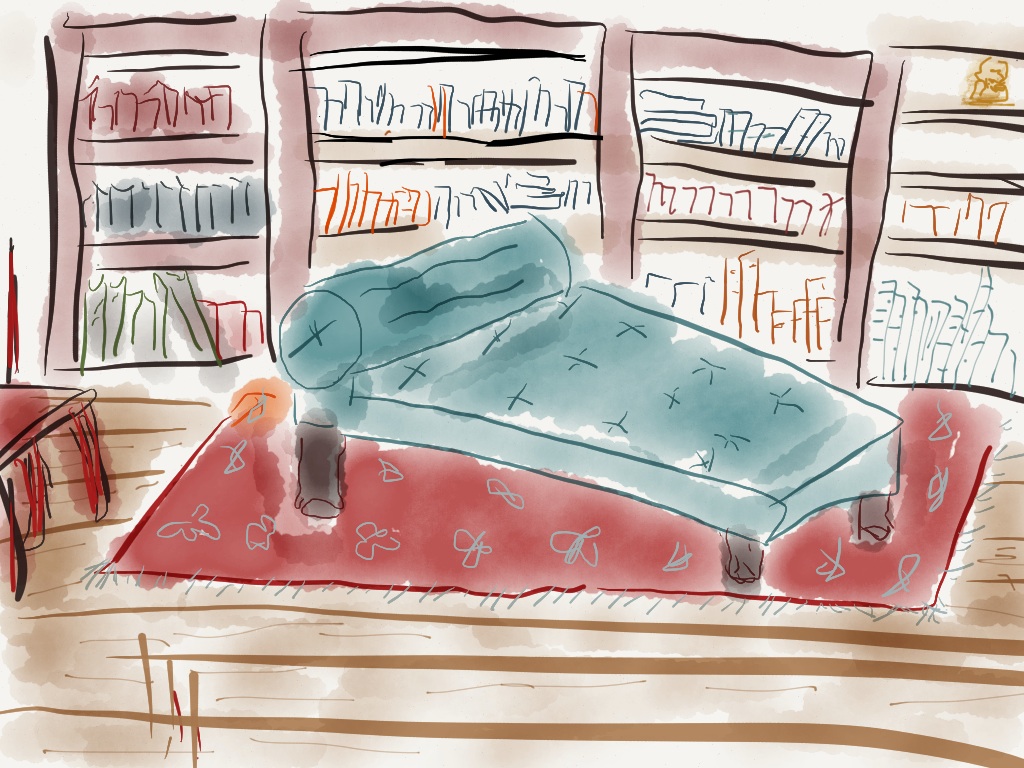
illustration by jpbohannon, 2013
In the office of a colleague a while back I noticed a towering pile of books on the desk, as if he were re-arranging his book shelves or carting out old titles to a different location. But no, it was his “to read” pile, and it was impressive and imposing.
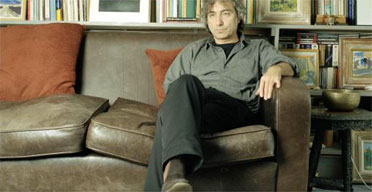
Adam Phillips
photo: Andy Hall
And so I decided to dive in.
Philips, “Poetry and Psychoanalysis”
The crux of Phillips’ essays is the mutual relationship between literature and psychoanalysis…and psychoanalysts’ established reverence for creative writers. Literature, according to Freud, gave birth to psychoanalysis and psychoanalysis often gives resonance to literature.
And so go his essays.
He begins with the essay “Poetry and Psychoanalysis” and brings in the young poet Keats–a former medical student–who famously stated that science ruined poetry when Newton reduced the rainbow to a prism. Not so, Phillips says, for poetry (and you can read “creative writing” where Phillips says “poetry”) can do what the sciences cannot. Indeed, much of his argument is that the science of psychoanalysis is bringing understanding to the vision of poetry. Freud said, Phillips tells us, that the poets had long before discovered the unconscious, and that he only had devised a way to study it.
Phillips graciously gives way to “poetry” saying that the short history of psychoanalysis has been an attempt to study the unconscious that poetry reveals. And since both poetry and psychoanalysis–the “talking cure”–depend on language, and often, coded language, the two are intrinsically welded together.
And so he is off.
There are marvelous literary essays on Hamlet, Hart Crane, Martin Amis, A.E. Housman and Frederick Seidel, all informed by an accessible shading of psychoanalytic theory, as well as masterful psychoanalytic pieces on Narcissism, Jokes, Anorexia and Clutter, informed by a broad knowledge of literature/poetry. It is Phillips’ contention–his modus operandi, if you will–that the two disciplines can or should depend on each other for clarity.
 The collection ends with the title piece, “Promises, Promises.” In it, Phillips examines the “promise” that both literature and psychoanalysis offer. He writes:
“If we talk about promises now, as I think we should when we talk about psychoanalysis and literature, then we are talking about hopes and wishes, about what we are wanting from our relationship with these two objects in the cultural field.”
What does reading literature promise us? What does analysis promise us? Phillips contends that both promise us, to a degree, “the experience of a relationship in silence, the unusual experience of a relationship in which no one speaks.” Of course, ultimately, the analyst must speak. But it is in that silence that often we become “true to ourselves.”
Reading psychoanalytic theory can often be dry and dusty, but Phillips’ writing never is. Bringing in an encyclopedic knowledge of both creative literature and psychoanalytic literature (and, at times, arguing that there might not be a difference), Phillips imaginatively and wittily plumbs past and current trends, canonical and esoteric literatures, clinical practice and private correspondence to bring to light his vision of psychoanalysis and literature’s potential and promise.

Maya Angelou
illustration by jpbohannon © 2013
“…The arts are not a way to make a living. They are a very human way of making life more bearable. Practicing an art, no matter how well or badly, is a way to make your soul grow, for heaven’s sake. Sing in the shower. Dance to the radio. Tell stories. Write a poem to a friend, even a lousy poem. Do it as well as you possibly can. You will get an enormous reward. You will have created something.” — Kurt Vonnegut, Jr. A Man Without a Country, 2005
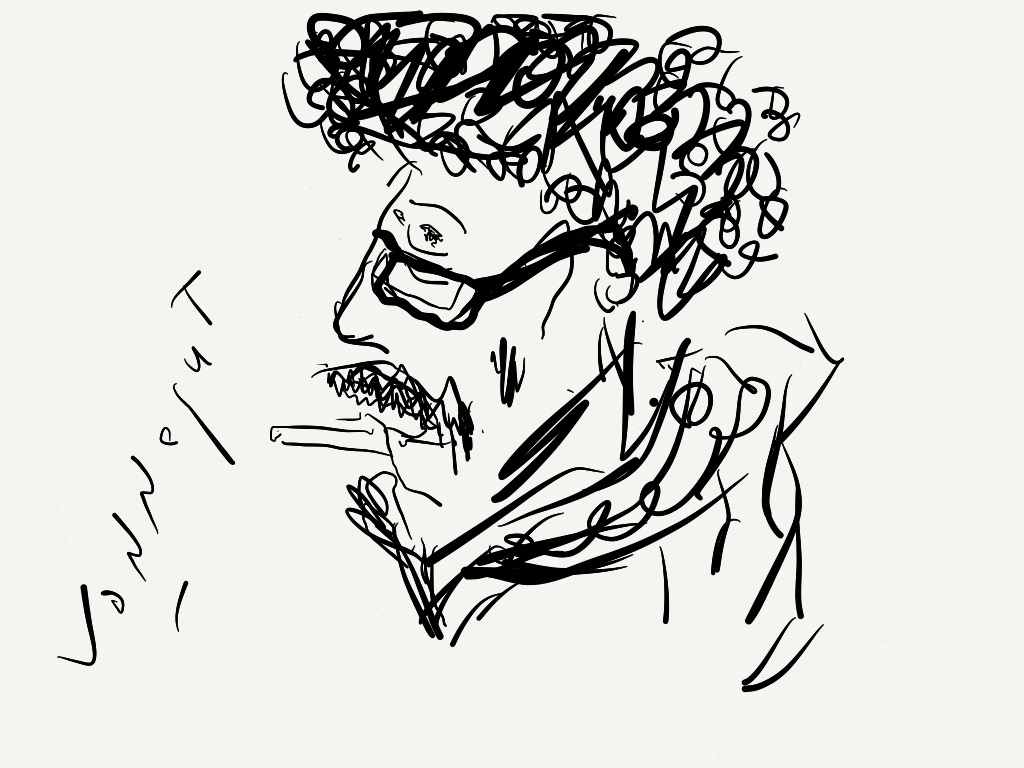
Kurt Vonnegut, Jr., 1922-2007
illustration by jpbohannon © 2013
A while back, I had posted about a performance of Samuel Beckett’s Endgame that I ‘d seen at the Arden Theater in Philadelphia. In it, I quoted my favorite lines from the play:
HAMM: (letting go his toque) What’s he doing?
(Clov raises lid of Nagg’s bin, stoops, look into it. Pause.)
CLOV: He’s crying. (He closes lid, straightens up.)
HAMM: Then he’s living.
The character Hamm has made the immediate inference that if his father is crying, then he is alive. And we, by extension, apply it to the human condition. I remembered this line–and the act of crying– this week when teaching Waiting for Godot. (Actually, the crying seemed more appropriate than ever for someone trying to teach Godot to 18-year old boys during their last week of school when the temperatures are in the mid-70s and the sun is bright! Hah!)
Early in the play, Estragon and Vladimir point out the tree where they are supposed to wait for Godot. (It is the only piece of scenery. The scene description reads simply: A country road. A tree. )

Mark Bedard (Vladimir) and Mark Anderson Phillips (Estragon) in Samuel Beckett s ‘Waiting for Godot,’ at Marin Theatre Company. photo 2013 by Kevin Berne
Estragon: [desparingly] Ah! [pause] You’re sure it was here?
Vladimir: What?
Estragon: That we were to wait.
Vladimir: He said by the tree. [They look at the tree.] Do you see any others?
Estragon: What is it?
Vladimir: I don’t know. A willow.
Estragon: Where are the leaves?
Vladimir: It must be dead.
Estragon: No more weeping.
This is the exact inverse of the lines from Endgame. In Endgame, the syllogism is that if you are crying then you are alive. In Waiting for Godot, the syllogism is that if you are dead, then there is no more crying. More or less the same thing.
Later on, as Vladimir and Estragon rebuke Pozzo for his treatment of his slave/servant, Lucky, there is more conversation about crying:
[Lucky weeps]
Estragon: He’s crying!
Pozzo: Old dogs have more dignity! [He proffers his handkerchief to Estragon.] Comfort him, since you pity him. [Estragon hesitates.] Come on. [Estragon takes the handkerchief.] Wipe away his tears, he’ll feel less forsaken.
[Estragon hesitates]
Vladimir: Here give it to me, I’ll do it.
[Estragon refuses to give the handkerchief. Childish gestures.]
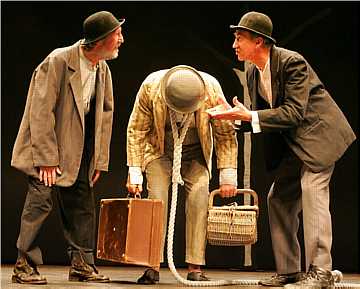
Estragon and Vladimir with Lucky from samuel-beckett.net
Pozzo: Make haste before he stops. [Estragon approaches Lucky and makes to wipe his eyes. Lucky kicks him violently in the shin. Estragon drops the handkerchief, recoils, staggers about the stage, howling with pain.] Hanky!
[Lucky puts down bag and basket, picks up handkerchief and gives it to Pozzo, goes back to his place, picks up bag and basket.]
♦ ♦ ♦ ♦ ♦ ♦
What are we to make of that? What is the significance of Lucky’s crying? Of Estragon and Vladimir’s desire to comfort him? Of Lucky’s lashing out at his comforter? And of his immediate subservience to his persecutor.
There is, of course, much more going on here, but the small emphasis on tears should be noted. Earlier Beckett had equated crying with living. Are we simply to be reminded that Lucky is a living, human being, and leave it at that? (We knew that anyway.)
Or perhaps we are to examine the difficult symbiosis between the comforter and the comforted? The helper and the helped? The cry of pain and those who hear and those who refuse to hear?
What is our responsibility to those who are “crying”? To those who are inconsolable? Good questions, all. And ones that we should take the time to think about every so often.
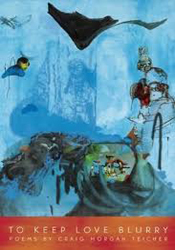 I must say that I did not enjoy Craig Morgan Teicher’s third collection of poems. That is not to say that they are not technically brilliant, that they are not impressively raw and honest, nor that there are not many moments that just knock you open. I admire it greatly; however, I do not like it. Even Teicher understands the sadness and dysfunction and sourness inherent in his verses. Here is his dedication:
To Cal and Simone–you should know that it’s a lot more fun than these poems suggest–
and
for Brenda, who knows…
Brenda is Teicher’s wife, who makes many appearances in the collection (actually throughout his work– his first collection was entitled Brenda is in the Room and other poems.)
To Keep Love Blurry is tied together by two major themes. One his mother and father, particularly after his mother’s death. And two, his marriage to Brenda, their (apparently) special-needs son, and Teicher’s sullen acceptance of love. Indeed, for Teicher love–both familial and marital– is more of an anchor than a source of flight. Here is he about motherhood:
My wife is not my mom. My mom is not
my mom. My father is not my mom. My boss
is not my mom. She is a tooth with rot,
a flower pressed between the pages of a lost
book. My son is not my mom. She is a mare
crushing my skull beneath her hoof. She is forever
starved. I ride to the edge of the earth clutching her hair.
Get it over with. It’s never OK, not ever.
Fuck it, whatever. If Robert Frost is my mom,
then so is Robert Lowell. She taught me to talk.
She is where I’m headed, a bomb
crater. She forgives me like a hunting hawk.
Maybe she’s my boss’s boss, my wife’s other other lover,
my son’s midnight cough. She loves me like a brother.
(“My Mom, d. 1994”)
The perfection of form–a modern Shakespearean sonnet with A-B-A-B…rhyme scheme, a regular rhythm, an unusual octet, quatrain, couplet construction–is made inconspicuous by the language, the odd identifications of motherhood, with unusually negative words: “tooth with rot,” “a mare crushing my skull,” ” a bomb crater,” “my wife’s other other lover.” What exactly are his feelings? “Loves me like a brother” does not cut it for me. Perhaps the secret lies in the allusion to Robert Frost and Robert Lowell. Teicher quotes a Lowell poem as an epigraph to his collection:
“Those blessed structures, plot and rhyme–
why are they no help to me now…”
Perhaps Teicher is saying that the “blessed structures” of poetry–with which he is extraordiaryily adept–are no longer to sufficient to buoy one in the sourness of modern life. Here he is similarly on friendship, marriage and love:
In just the couple years since two by two
we all began to partner off,
already we’ve practically retired, passing though
apartment doors shut tighter than a cough.
There used to be long, wasted hours of talk,
nothing secret between us, not even skin;
at the conclusion of a wandering walk,
the flirtatious dark would set in.
Is marriage lonely by design,
in hopes that obeying an age-old law
of I am only hers, she is only mine
forms a brittle scab over the always-raw
wound of too much intimacy between friends
in favor of a duller aching that never ends.
(“Friendship”)
Again, the “plot and structure” to which Lowell refers are exquisite: a Shakespearean sonnet, intricately wrought and patterned. But for the speaker, the poetry is subsumed by the “duller aching” and “brittle scab.”
Mixed among the villanelles and sonnets, the rhyming couplets and the longer verse, there is a series of prose ruminations on the death of his mother and the subsequent loneliness of his father. These too are notable for their raw honesty, their unflinching introspection.
Well-wrought and linguistically daring, To Keep Love Blurry is evidence of Teicher’s impressive talent. However, I found it sullen and pouty and self-indulgent. Nevertheless, such is Teicher’s poetic cleverness and adroitness that I will surely keep my eye out for his future work.
As many of you know, I am teaching a course in modern Irish literature this term to a group of 18-year old American boys. As an American classroom, it is filled with various ethnicities and races. And so, I can never assume that they know what I–or the authors they are reading–are talking about. And so when we began Martin MacDonagh’s Lonesome West, I knew it was going to be a challenge to get them to enjoy it.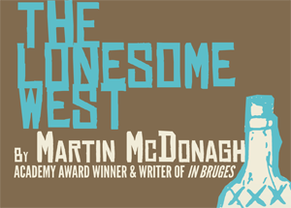
Because, when all is said and done, that’s really the purpose…to get them to enjoy what they are reading. And surprisingly, that is a difficult thing for them to do. Sure they loved saying the word “fek” when we read the play out loud–and which sometimes occurs twenty-five to thirty times on a page. (One student told me he loved the word so much he started saying it around the house. I advised him that maybe he should rein it in a bit.)
But surprisingly, they were too uptight to enjoy the humor…or even to get it! There is a great line where Father Walsh Welsh — even that’s funny: I explained that this character has appeared in three separate plays now and that no one ever gets his name right, so they continually call him both. Stone faces in front of me. … anyway, there’s this great line where Father Walsh Welsh is anguishing about his failure as a priest. Coleman tries to reassure him:
Ah there be a lot worse priests than you, Father, I’m sure. The only thing with you is you’re a bit weedy and you’re a terror for the drink and you have doubts about Catholicism. Apart from that you’re a fine priest. …
I had to explain that that was funny. I had to explain that Girleen’s blatant attempts at seduction, her outrageous dirty-mindedness, and her falling in love were funny. (The pathos of her ending was a whole other story!) That Coleman’s constant ribbing of Fr. Walsh Welsh about the priest scandal in Ireland was funny. And that a small village where a father has been murdered by his son, a mother by her daughter, and a wife by her husband is a funny world indeed, especially when the smashing of holy figurines or stealing poteen is considered a more serious crime.
They were fine in talking about themes of redemption and reconciliation, in tracking down and explaining symbols, and analyzing character. But they stumbled upon the humor. And when all is said and done, that might be more important than all that the other stuff.
 And so I thought I would relieve their reading by showing them MacDonagh’s Oscar winning short film Six Shooter. Unlike most of MacDonagh’s work which takes place in the west of Ireland, this takes place in southeast Ireland, particularly on a train to Dublin. A man is returning from hospital where his wife has just died that morning. He boards a train to go home and sits next to a young twenty-something who is a bit more than strange and possibly deranged. The boy’s patter, aggressiveness and nonsequiturs are amusing, uncomfortable, and awkward. But they are also, at times, bizarre and hilarious. But maybe not to a group of high-school Americans. Suffice it to say that by story’s end we have seen a cow explode, a rabbit get shot, a woman throw herself off a train, a character gunned down by police and a man fail at his attempt at suicide. And that is the violence that happens just on screen. (I explained to them that MacDonagh was a combination of Quentin Tarentino, David Mamet, and John Millington Synge.)
Anyway, if a short movie that moves the cartoonish violence of Tarentino into the idyllic countryside of the Irish coast sounds appealing, then here it is below. It did win a 2006 Oscar in movie, though I don’t know if that held any sway with my boys. Here it is:
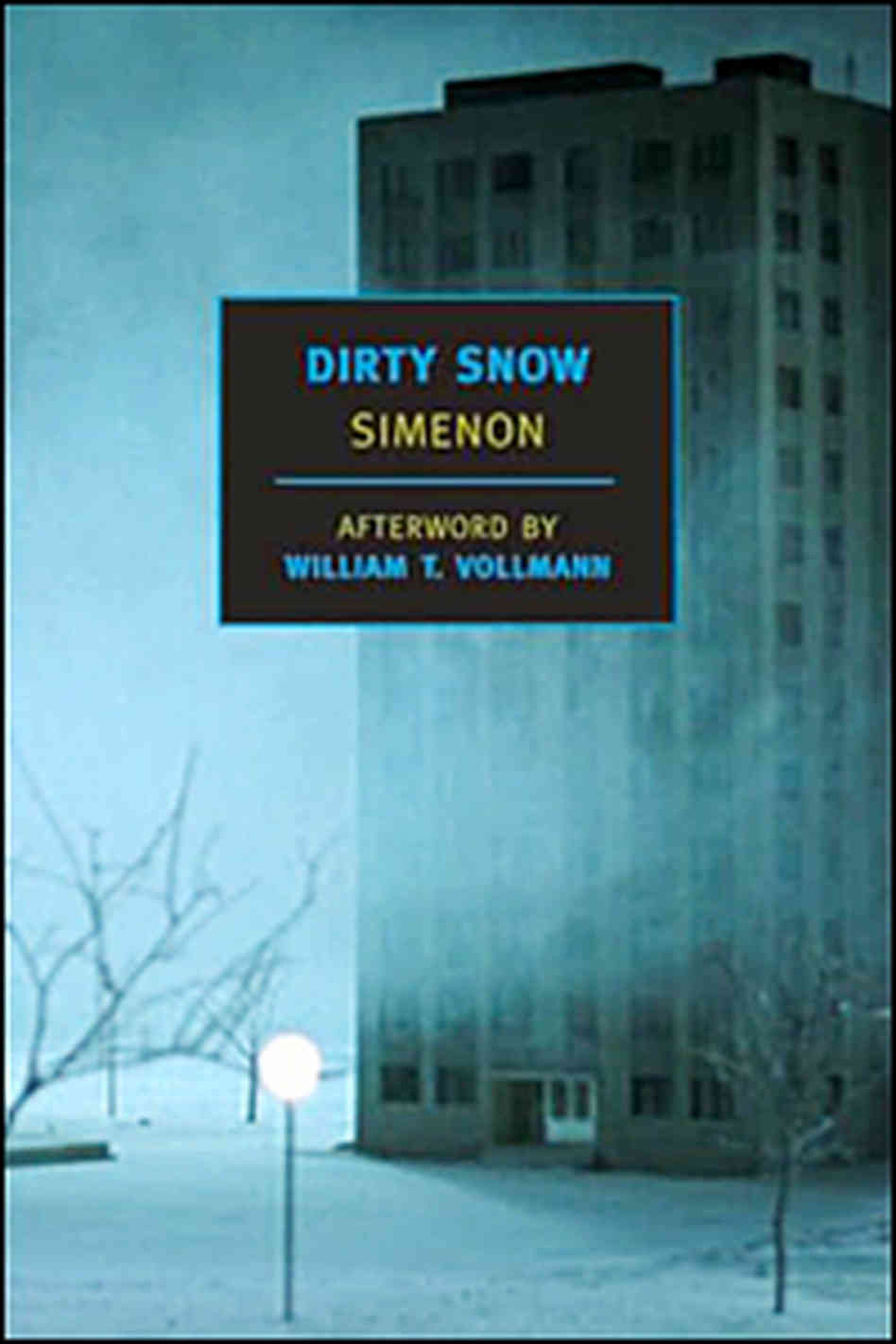
A colleague of mine passed on a book that he liked very much. Dirty Snow by the prolific Belgian writer, George Simenon. I had read several of Simenon’s detective novels, gritty tales that featured the Parisian detective Maigret. The Maigret novels–I believe there are over fifty of them—seemed superior to most in that genre, filled with a certain ennui and jaded acceptance that went beyond the cynical aloofness of his American counterparts or the aloof cynicism of his more modern offspring. And to be honest, they were good reads.
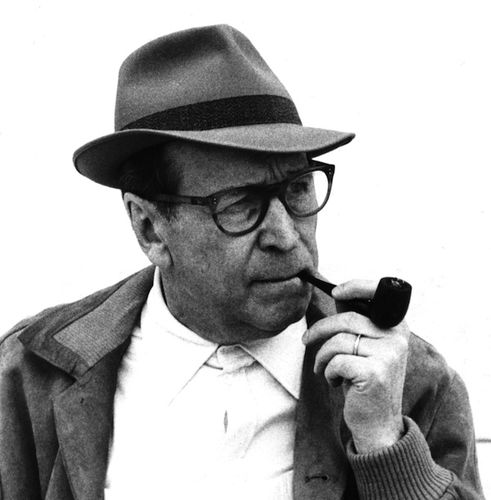
George Simenon
Although I had read only the Maigret novels, I knew that Simenon wrote other sorts of novels. I had always heard them referred to as “philosophical” novels, though the French label them as “psychological” novels. And the French are closer to the truth, here.
And when my colleague passed on to me Dirty Snow, he did so with the caveat that it was “extremely grim” although oddly humanistic.
Dirty Snow is the story of Frank Friedmaier making his way through his occupied city. We never know who the occupiers are and where the city is. When he is imprisoned, his captors, his location, and his crime are never identified. All of this, gives the novel a certain Kafkaesque feeling. And although time moves forward throughout the seasons, there seems always to be piles of soiled, stained, and dirtied snow.
And yet it was Crime and Punishment that I thought of immediately. Frank–who may be the most amoral, sociopath I have come across in my reading, and I know Burgess’s Alex and Ellis’s Bateman–begins the novel looking to kill his first person. There is no reason for, no gain from this murder–it is, as he says, like losing his virginity: “Losing his virginity, his actual virginity, hadn’t meant very much to Frank. He had been in the right place. … And for Frank, who was nineteen, to kill his first man was another loss of virginity hardly any more disturbing than the first. And like the first, it wasn’t premeditated.” Like Raskolnikov in Crime and Punishment, he needs little push to kill his victim. Yet, there the similarity ends. For Raskolnikov punishes himself, mentally, emotionally, spiritually and psychologically for the crime he committed. Frank feels nothing. And soon he kills again…an old woman in his childhood village who recognized him in the course of a burglary.
But the murders are not his greatest crime. That is reserved for the sweet and loving Sissy who lives across the hall from the brothel that Frank’s mother runs and where Frank lives. (Sissy mirrors very closely Raskolnikov’s Sophia in her love and faithfulness to Frank.) Frank’s relations with women are brutal at best–indeed all the women in the novel seem mistreated one way or another. He takes full advantage of his mother’s prostitutes, coldly, quickly and unemotionally, and this is the way he treats Sissy as well, deceiving her into a situation where she is nearly raped by his drinking associate.
One might say there is no reason for Frank’s viciousness, but that would be inaccurate. There is no “motive,” no “purpose” for his ferocity. But there is a reason, and Simenon attempts to suggest it subtly. Frank’s mother abandoned him to a wet-nurse so she could “ply her trade” and visited only occasional. He never knew his father, only the brutality of both life and the State. Two men are offered as father surrogates in the novel: one, a Maigret-like inspector who turns a blind eye to Frank’s mother’s occupation and who very well may be his biological father and Sissy’s father, Holst, who Frank is drawn to from the beginning, who sees Frank in the alleyway on his first kill, and who offers him forgiveness at the end.
But many men have similar upbringings and few turn out as nihilistic, amoral, and unfeeling as Frank. To his interrogator he says at the end: “I am not a fanatic, an agitator, or a patriot. I am a piece of shit.” There is nothing. Yet the flip side of that is that there is nothing the State offers either. They have not arrested him for the murders or the burglary. They have brought him in, they torture him merely for information. And here, in the claustrophobic room where he is questioned, one remembers a similar room–Room 101 in Orwell’s 1984. But Frank is no Winston Smith either; there is no romantic dream of something better, no fervid belief in the ultimate progress of what is right. There is only Frank, solipsistic and brutal Frank.
Simenon’s novel is fascinating. His hero is repellent. And I can’t stop thinking about neither it nor him… It’s sort of like wearing wet shoes, soaked through by dirty snow.
The Official Web Site of LeAnn Skeen
Grumpy younger old man casts jaded eye on whipper snappers
"Here is my secret. It is very simple: It is only with the heart that one can see rightly; what is essential is invisible to the eye.."- Antoine de Saint Exupéry
Of writing and reading
Photography from Northern Ontario
Musings on poetry, language, perception, numbers, food, and anything else that slips through the cracks.
philo poétique de G à L I B E R
Hand-stitched collage from conked-out stuff.
"Be yourself - everyone else is already taken."
Celebrate Silent Film
Indulge- Travel, Adventure, & New Experiences
Haiku, Poems, Book Reviews & Film Reviews
The blog for Year 13 English students at Cromwell College.
John Self's Shelves
writer, editor
In which a teacher and family guy is still learning ... and writing about it
A Community of Writers
visionary author
3d | fine art | design | life inspiration
Craft tips for writers
 j. p. bohannon