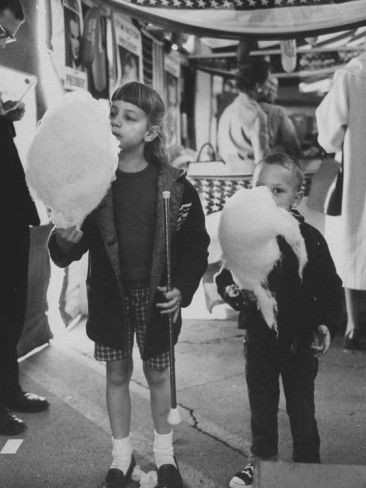
We probably all can imagine that little boy or girl at a fair, a carnival, or an amusement park, who seeing an enormous pompadour of pink or blue cotton candy (spun sugar to some of you) insists on getting the largest size. We can see further the sticky stains upon their faces, the crazed shock of sugar in their eyes. And we can empathize with them and their queasy stomachs that a night filled with cotton candy is certain to produce.
That’s how I feel about Renoir and his nudes.
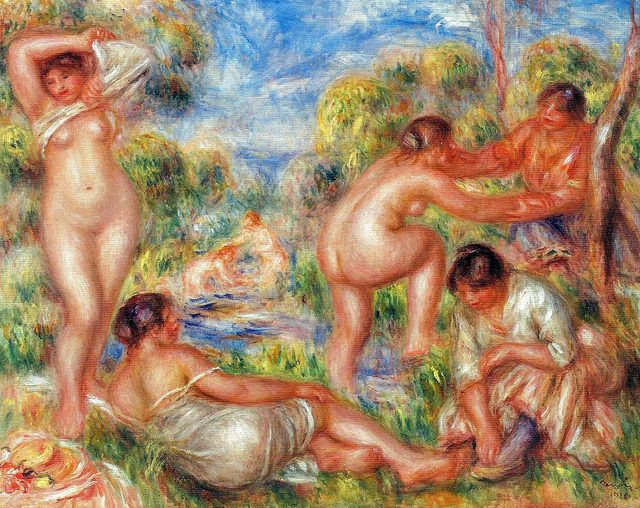
Pierre Renoir “The Bathing Group (1916)” Barnes Foundation
I spent more than three hours at the Barnes Foundation last Friday night. And as always, it is a mind-boggling collection of early modern art, African sculpture, and American furniture, decorative and industrial arts. I could spend a lifetime looking at the Modglianis and Mattisses. I am fascinated by Chaim Soutaine and George Seurat. And Henri Rousseau I find thoroughly relaxing and amusing.
But it is the Renoirs that I find cloying.
Barnes owns 181 Renoirs that encompass the span of the artist’s career. Now, there is much that I like about Renoir: his early works, the group portraits and the early nudes. But the more famous nudes, those cotton candy swirls of creams, oranges, pinks and yellows, I find difficult to look at.
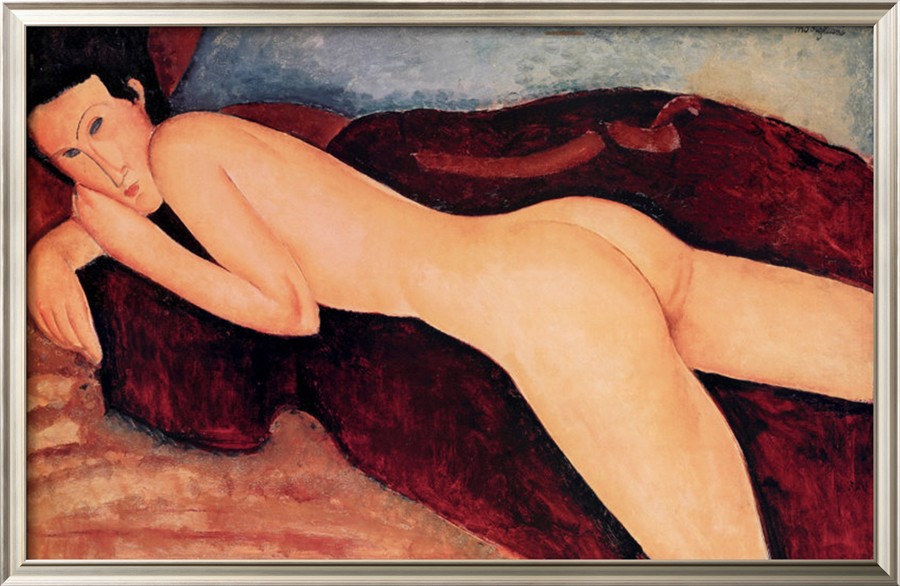
By contrast, one of my favorite paintings in the collection is also a nude: Amadeo Modgliani’s Reclining Nude from Back. Is it lifelike? No. But it is sensuous and intriguing and narrative and appealing and pleasing. And what more could a person want from a work of art?
Reclining Nude from the Back by Amadeo Modgliani
Modgliani’s attenuated figures with their mask-like visages, I find fascinating. I find a story in each of their stony faces. Likewise, I delight in the classical innocence of Picasso’s Girl with a Goat or the bold outlines and patterns of Mattisse’s Reclining Nude with Blue Eyes. Each is so distinct in itself, so original in its view of the human body.
Renoir’s nudes, on the other hand, I find distracting in their busyness. I find them tiring and I tend to pass over them quickly.
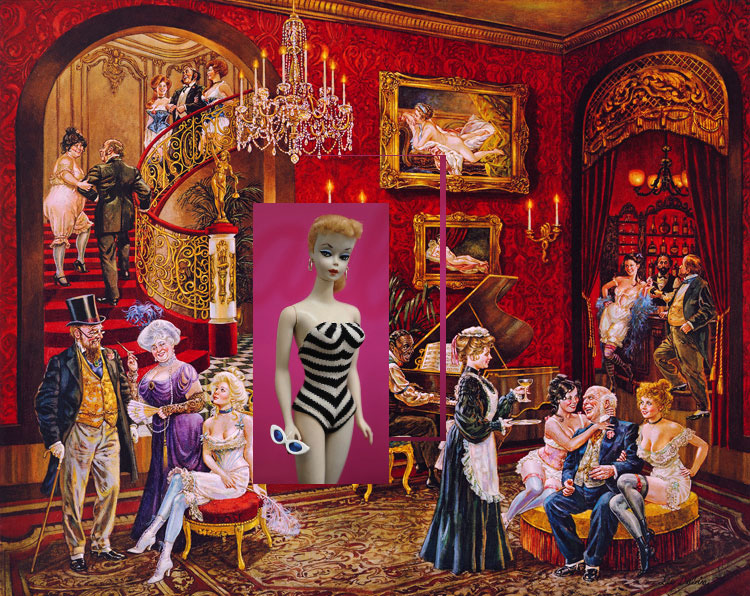
To me, they look like how Barbie would decorate a bordello if she ever became a Madam.
Last week a friend and colleague of mine e-mailed me with an odd request. He was making a film on an Institute he had attended this summer and wanted me to do the voice-over. I was honored and a little nervous. After I agreed, he sent over the script–a mere twenty lines–and I began practicing.
We wrapped it up the next day.
I’m not sure I want to see/hear the finished project.
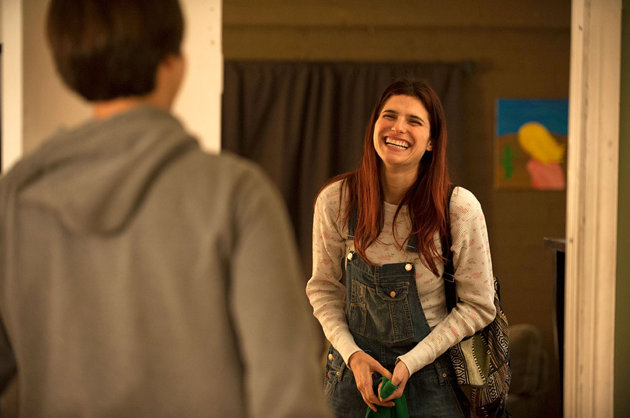
Anyway, in this world of coincidences I went to the movies and saw In a World…, Lake Bell’s delightful film about a young woman in the voice-over business.
Lake Bell–who also wrote and directed the film–plays Carol Solomon, the thirty-something daughter of the “King of Voice-Overs,” Sam Sota, played by Fred Melamed, Sam is a bit full of himself; He has published his own kiss-and-tell autobiography and quickly in the movie kicks Carol out of their apartment because his 30-year old girlfriend is moving in. (That the 30-year old girlfriend ultimately acts as his moral conscience shows the shallowness of the man.)
Carol is trying to crack into the male-dominated world of voice-overs. (Easily a microcosm for the difficulty of women finding jobs in the entire film business). And rather than help his daughter in the business, Sam places every roadblock in her way. He truly believes that women have no place in the voice-over business–even if it is his daughter–and so he mentors the rising new “voice-over” superstar, a man perhaps sleazier than Sota himself.
Suddenly without a home, Carol crashes at her sister and brother-in-laws’s house where there is an undercurrent of marital tension and ekes out a living as a voice coach. That is until a few breaks come her way and she makes the most of them.
The arc of the plot is familiar, but the film is no less enjoyable because of that. Bell is a delight to watch. She is quirky without being annoying, serious without being sober, and she is intelligent–in front of and behind the camera. Her relationship with her sister is satisfying, and the romance she has with the sound man, Louis–played by the always enjoyable Demitri Martin–is one that you find yourself rooting for.
Louis and Carol (Dimitri Martin and Lake Bell)
I came out of the film smiling. Not because of any silliness or humor, but because In a World… is a small film that gives off a good feeling. In a quiet way, good appears to win in a pretty cutt-hroat town, and that is always an unexpected pleasure.
Rebecca Solnit begins her book with this quotation from Thoreau:
“I have traveled widely in Concord.”
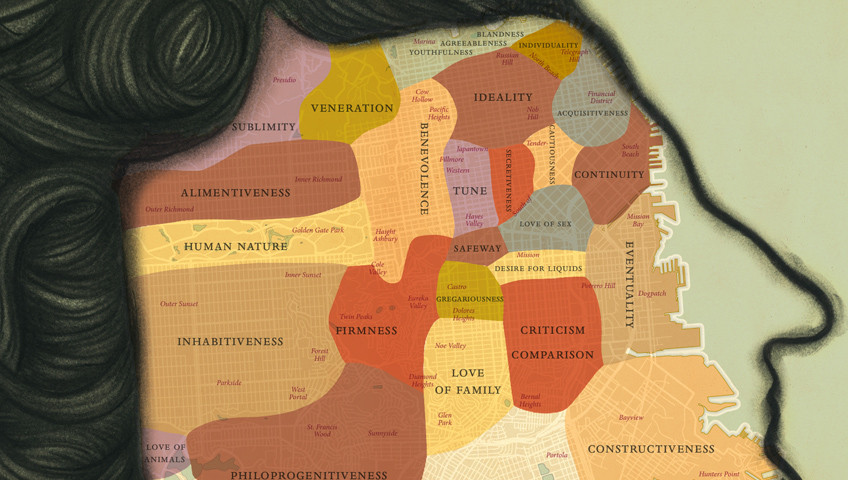
Concord really isn’t that big a place to “travel widely” in, but that is the argument of Solnit’s Infinite City: every place contains an infinite number of “maps” with which we travel, and within her book Solnit creates a unique, intriguing, and entertaining series of maps of her city, San Francisco.
Now, you know you are in heady territory when in the first three paragraphs Solnit makes multiple references to Borges and Calvino, both fantastic cartographers and creators of worlds that have never existed. Yet, Solnit is every bit as imaginative and perceptive. She reveals a given place (San Francisco) in ways that had never been categorized before and introduces new perspectives on the city that have never before been imagined.
In her introduction, Solnit explains her method thus:
Every place is if not infinite then practically inexhaustible, and no quantity of maps will allow the distance to be completely traversed. Any single map can depict only an arbitrary selection of the facts on its two-dimensional surface… . For Infinite City, this selection has been a pleasure, an invitation to map death and beauty, butterflies and queer histories, together, with the intention not of comprehensively describing the city but rather of suggesting through these pairings the countless further ways it could be described. (I also chose pairs in order to use the space more effectively to play up this arbitrariness, and because this city is, as all good cities are, a compilation of coexisting differences, of the Baptist church next to the Dim Sum dispensary, the homeless outside the Opera House.)
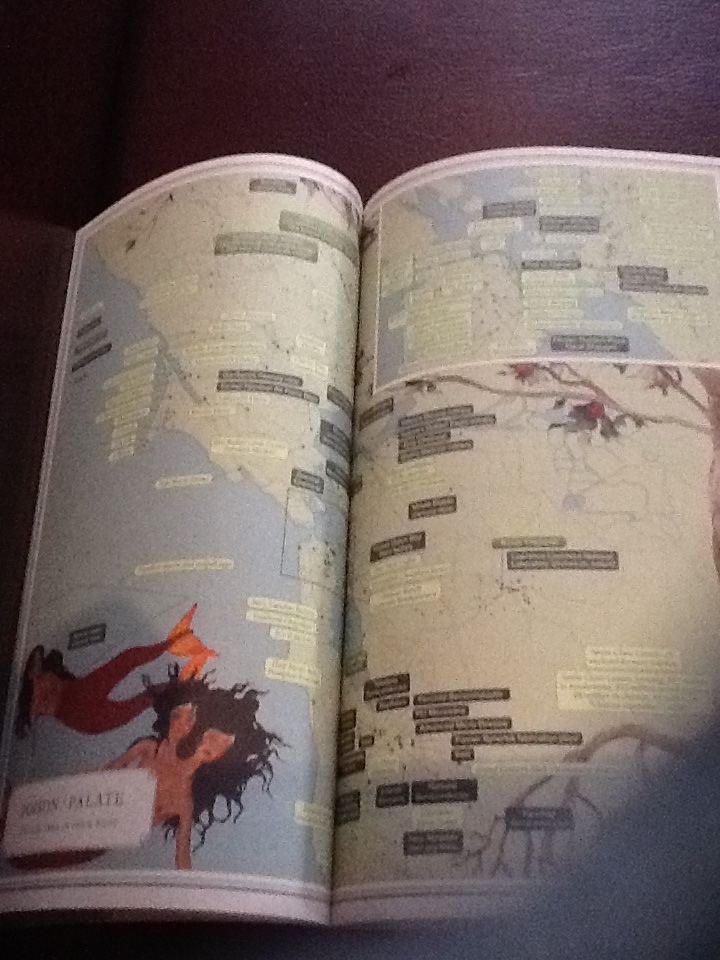
And this is how the book works. The “arbitrary selection of facts” are surprising and unconventional. There are maps of industries and bee migrations and “tribal neighborhoods” and gang-lands and right-wing bastions and bygone areas of entertainment and carousal. And the pairings are both startling and sensible. For instance, the map entitled “Poison/Palate: The Bay Area in your Body” is accompanied by Solnit’s essay “What Doesn’t Kill You Makes You Gourmet.” In both, the reader is given a map of the major dumpers of toxins into the environment (often food and wine growers) and the sites of delicious, food providers. (Often the two overlap.) The key to the map gives symbols for EPA SUPERFUNDS, Poison Sites, Palate Sites, Poison/Palate Sites and Wineries.
Poson/Palate: The Bay Area in your Body
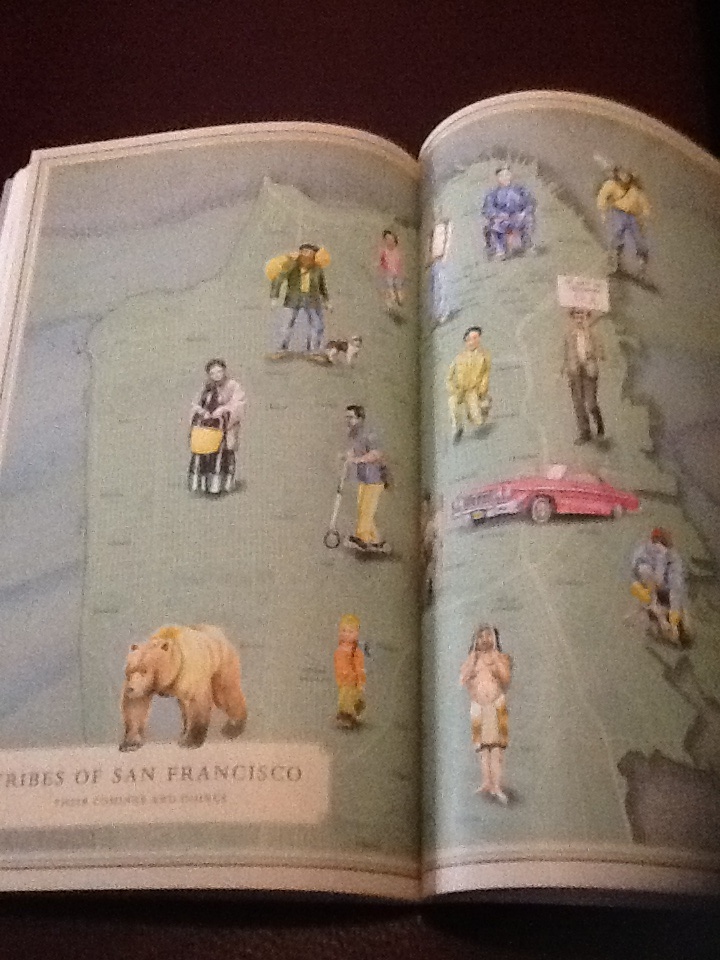
The population map–the current population not the map of those who have left and those who are arriving–is set up as a “tribal” map. The expected ethnicities are cited–the Chinese, the Irish, the Korean, the Mexican–but they are accompanied by neighborhoods where the “tribes” include skateboarders, people with ties, transgender people, etc. Again, this is accompanied by a moving essay by Solnit about the ever changing population shifts of her city.
Tribes of San Francisco
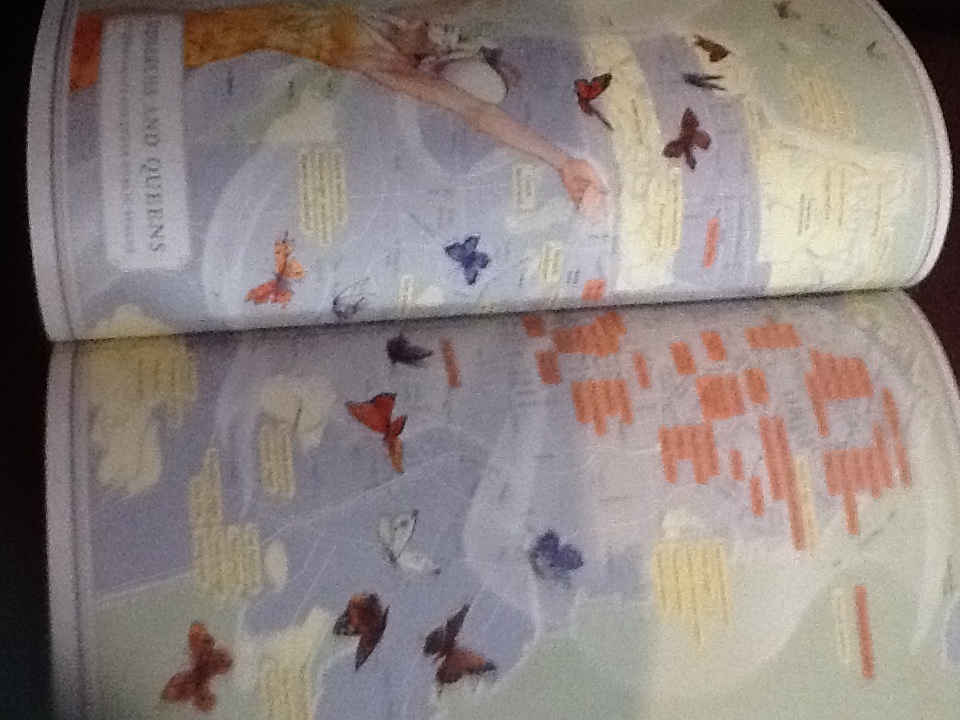
But it is the pairings that are the most intriguing. One map, entitled Death and Beauty, tracks the murders in the city during the year 2008 and the locations of Monterey cyprus trees throughout the city; another entitled Dharma Wheels and Fish Ladders lists salmon streams, hatcheries and viewing sites along with the location of Zen monasteries, schools, and core sites; and still another, entitled Monarchs and Queens, reveals the locations of various butterfly locations and queer public spaces.
Monarchs and Queens
Each of the twenty-two maps are jewels of color, design, and information. They are beautiful, as are all of the illustrations throughout.
While Solnit did not write all of the essays that accompany the maps, she did write the majority and her fellow essayists are similar in spirit, similar in the way they look at their ever-changing city. In a recent piece for the London Review of Books entitled “Google Invades” (February 2013), Solnit bemoaned the changes that have occurred in her city with the influx of Silicon Valley money. She felt that the variety in the city’s fabric–in its economics, its life styles, its ethnicities, its politics, and its arts– was being leveled and watered-down with the influx of cyber-millionaires. The city–not just a neighborhood– was being gentrified.
Solnit sees her city, San Francisco, in many, various ways, in multiple perspectives that have accrued layer after layer through the years that she has lived there. These views are both nostalgic and forward-looking, while still very much ensconced in the present, no matter how ethereal that might be. And while some of these layers may now have physically vanished, they remain in her memory, in her view of the city.
And they remain in this amazing, attractive, and addictive book.
“If you want to live your life in a creative way, as an artist, you have to not look back too much. You have to be willing to take whatever you’ve done and whoever you were and throw them away.”
I rarely drive, so I rarely listen to the radio. That might not make sense for many, but I know that some will understand. The radio is simply not part of my home life.
But anyway,there were reasons for my being behind the wheel this past Thursday and I was listening to RadioTimes on Public Radio (Marty Moss-Coane on WHYY in Philadelphia.) The guest was MK Asante, a hip-hop singer, filmmaker, writer and creative-writing/film teacher at Morgan State University.
I was blown away.
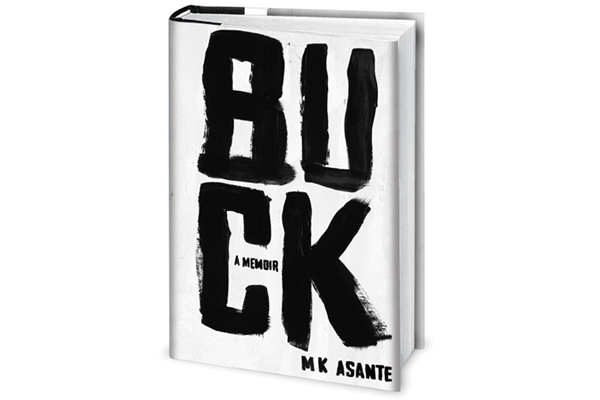
Asante was plugging his new book, Buck: A Memoir about his life in “Killadelphia” during the 1990s. At the same time it is the story of his family’s breaking apart and then coming back together.
Asante was born in Zimbabwe and raised in Philadelphia. His parents’ marriage disintegrated, his idolized brother had a series of run-ins with the law and was imprisoned, his mother suffered from clinical depression, and he grew up in the “hood” full of anger, confusion, and energy.
This coming-of-age story is probably more familiar than it ever should be, but, oh, the language itself is extraordinary. Like nothing you ever heard.
Here is the first paragraph of the book: (Asante reads it in the interview attached below):
The Fall
The fall in Killadelphia. Outside is the color of corn bread and blood. Change hangs in air like sneaks on the live wires behind my crib. Me and my big brother, Uzi, in the kitchen. He’s rolling a blunt on top of the Source, the one with Tyson on the cover rocking a kufi, ice-grilling through the gloss. Uzi can roll a blunt with his eyes closed.
Cracks, splits, bits.
The rawest crews in Philly are all three letters,“ he tells me. I read the cover through the tobacco guts and weed flakes: “The Rebirth of Mike Tyson: ‘I’m Not Good. I’m Not Bad. I’m Just Trying to Survive in this World.’”
Awakening crews in a rude fashion
On they ass like Mike Tyson at a beauty pageant•
I do this–spit lyrics to songs under my breath–all day, every day. The bars just jump out of me no matter where I am or what I’m doing. It’s like hip-hop Tourette’s.
Dumps, spreads, evens.
“JBM–Junior Black Mafia. Of course us, UPK–Uptown Killaz. PHD–Play Hero and Die.”
Tears, licks, wraps.
“HRM–Hit Run Mob. EAM–Erie Ave. Mobsters. ABC–Another Bad Creation.”
Folds, rolls, tucks. Another perfect blunt, jawn looks like a paintbrush.
Jawn can mean anything–person, place, or thing. Sometimes if we’re telling a story and don’t want people to know what we’re talking about, we’ll plug in jawn in for everything. The other day I was at the jawn around the corner with the young jawn from down the street. We get to the jawn, right, and the ngh at the door is all on his jawn, not nowing I had that jawn on me. Man, it was about to be on in that jawn.
“ Wreck Your Ears (Can Do),” The B.U.M.S. (Brothers Under Madness), 1965
This is language at its most alive, its most energetic. (To hear him read it is even more electrifying.)
Asante mentions in the interview that the first book that turned him on was Jack Kerouac’s On the Road. Besides the plot of the novel–drugs, sex, wildness–which he was surprised to learn could be the focus of serious literature, it was the style of the writing that attracted him, the energy, the speed, the exuberance. As he said, from it he learned he didn’t have to worry about commas.
photo of MK Asante from the L.A. Times
MK Asante’s journey from the hood to plugging his books on national radio is one story. But it is a minor story. The true story is the language of this memoir. It is hypnotizing, energetic, alive and present. It puts me to shame.
In two more weeks I begin teaching a class in creative writing. My students are quite a distance from the world that MK Asante grew up in. Nevertheless, I am opening class with readings from the book. It is a lesson in being true to oneself, in being true to one’s voice, in being able to plumb one’s life for the story we all need to tell.
Here is the interview in its entirety: (this is Radio Times web site and will feature the day’s current show. Scroll down to the middle of the page to hear MK Asante on yesterday’s show. As time passes, the 8/22/2013 show will be placed in the easily accessed archives. And check out MK Asante’s web page, above, to see trailers, past works, etc.)
A friend of mine, who had read my post on worrying about too much fiction in my reading diet, met me for coffee the other day with a bag full of books. Some he gave to me. Others he lent. I started the first one yesterday around 5:00 and finished it before finally turning the lights out on the day.
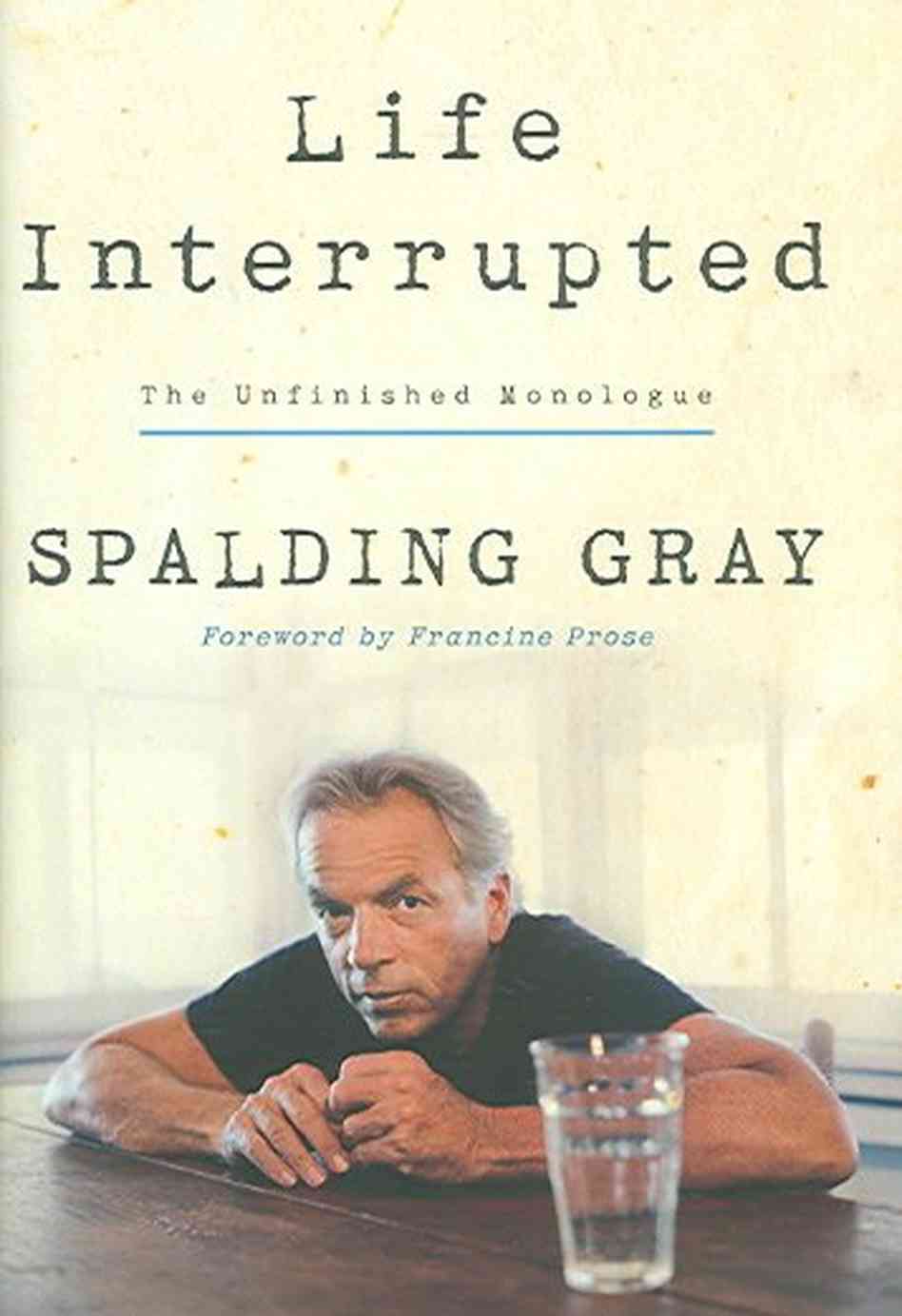
Cover of Life Interrupted/i>
(By the way, my worries were groundless: Out of the last seventeen books I read, 7 were fiction, 6 were non-fiction, 3 were collections of poetry and 1 was a play.)
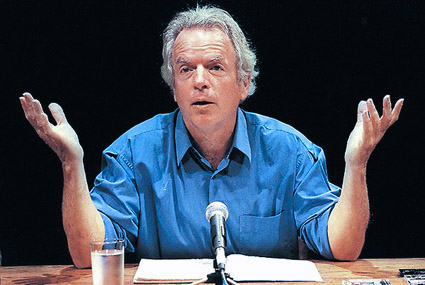
Anyway, Life Interrupted is a wonderful collection that includes the title monologue plus two small companion pieces by Spalding Gray. These were the last pieces Gray was working on, still writing and ironing out, before ending his life in 2004. Filling out the volume is a series of remembrances given at two separate memorials to Gray, remembrances by fellow actors and writers, agents, producers, friends, and family. These are sincere, warm, and humorous reflections on a man who himself was sincere, warm and humorous.
The centerpiece, “Life Interrupted” recounts the horrible car accident and subsequent hospital stay that Gray experienced in Ireland in the summer of 2001. His account of the events before the accident seem to presage (at least to him) that death was everywhere: they were in the town of Mort in County Offaly, next to a monastery where gravediggers were stopping for a cigarette break, in the home of a host who himself had died two weeks earlier and from which, on his walk that morning through the surrounding countryside, Gray had encountered a dying calf.
He had tempted fate, he felt, because he told people he was content–happily married and enjoying fatherhood. His work had always revolved around anxieties, fears, conflicts, disasters. Now, he told someone that morning, he’d have nothing to write about. He was simply too happy.
Boy was he wrong about having nothing to write about.
His stay in the hospital, his transference to another, and then to another is close to slapstick. His detailed observations of his Irish fellow-patients, of his care-givers (a large transvestite with emerald green fingernails comes through the wards offering tea and toast), of the facilities themselves is wickedly funny, especially if you are not yourself experiencing it.
But the injuries were quite debilitating. A smashed hip caused him transference to one hospital. A large dent in his head sent him to another. There it was discovered he had a shattered orbital bone which was allowing open passage to his brain. A plate needed to be inserted and the bone fragments removed from his brain. He chose to fly back to New York for that procedure.
If all this sounds morbid, it is not. Like Gray’s more famous monologues, Swimming to Cambodia, Gray’s Anatomy, The Terrors of Pleasure, it is trenchant in its observation of life and life’s quirks. And extraordinarily funny.
The other two pieces, “The Anniversary” and ” DearNew York City” are much shorter. The first typical of his rambling, tangential style. The second a sweet paean to New York City in the aftermath of the attacks on the twin towers.
Spalding Gray and his entire stage setting
But by then, Spalding was in intractable pain–psychically and emotionally. He had returned from the accident in Ireland a changed man, and the demons he once tempered through his art were getting the better of him. On January 10, 2004 he was reported missing. In March, his body was found in the East River.
But again, this is never a morbid book. Gray’s pieces are funny and clever, and every reader will find him or herself nodding in agreement at the outrageous details that Gray observes.
And even the memorial speeches that finish the book are more upbeat than not. They recount Gray’s generosity, his curiosity, his love of fatherhood, and his kindness. Each speaker genuinely feels that he or she has been blessed to be considered Spalding Gray’s friend, to have spent time with this gregarious and wonderful man.
In a way, reading the book, one gets to experience the same.
In 2010, six years after Spalding Gray’s death, the director Steven Soderbergh put together a documentary on Gray and his art entitled And Everything is Going Fine. It is a wonderful introduction to the man who was a consummate storyteller, an entertaining man to spend an evening with. Here is the trailer:
“Verisimilitude” is a word I know from movie criticism and from literary criticism. I define it as a strict faithfulness to the truth of reality. And it is a concept that the movie director, Richard Linklater, has striven for in his triology, Before Sunrise, Before Sunset, and Before Midnight. In many ways he has succeeded.
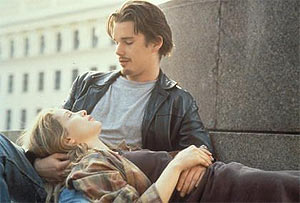
For those who don’t know, in 1995, Linklater cast his stars Julie Delpy and Ethan Hawke in the first movie, Before Sunrise, as young twenty-somethings who meet on a train from Budapest to Vienna, who spend a day and night together and go their separate ways. (That the day is June 16th, the day that James Joyce met his life partner Nora Barnacle and the day that his novel Ulysses takes place is one of the many Joycean allusions in the triology.)
Celine (Julie Delpy) and Jesse (Ethan Hawke) in Before Sunrise (1995)
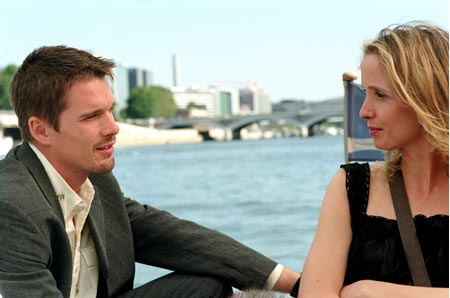
To be truthful to his quest for truthfulness, Linklater nine years later, cast the same two actors to play the same characters who happen to meet again nine years later. This time Hawke’s Jesse is on a book tour in Paris when Delpy’s Celine meets him. His book–which fictionalizes the day they had spent together a decade ago–is a success. They spend this second time together walking through Paris before he must fly back to America. (Because the film takes place in mid-afternoon, Linklater only shot at that time to get the light exactly right. This is verisimilitide. )
Jesse and Celine (Ethan Hawke and Julie Delpy) in Before Sunset 2004
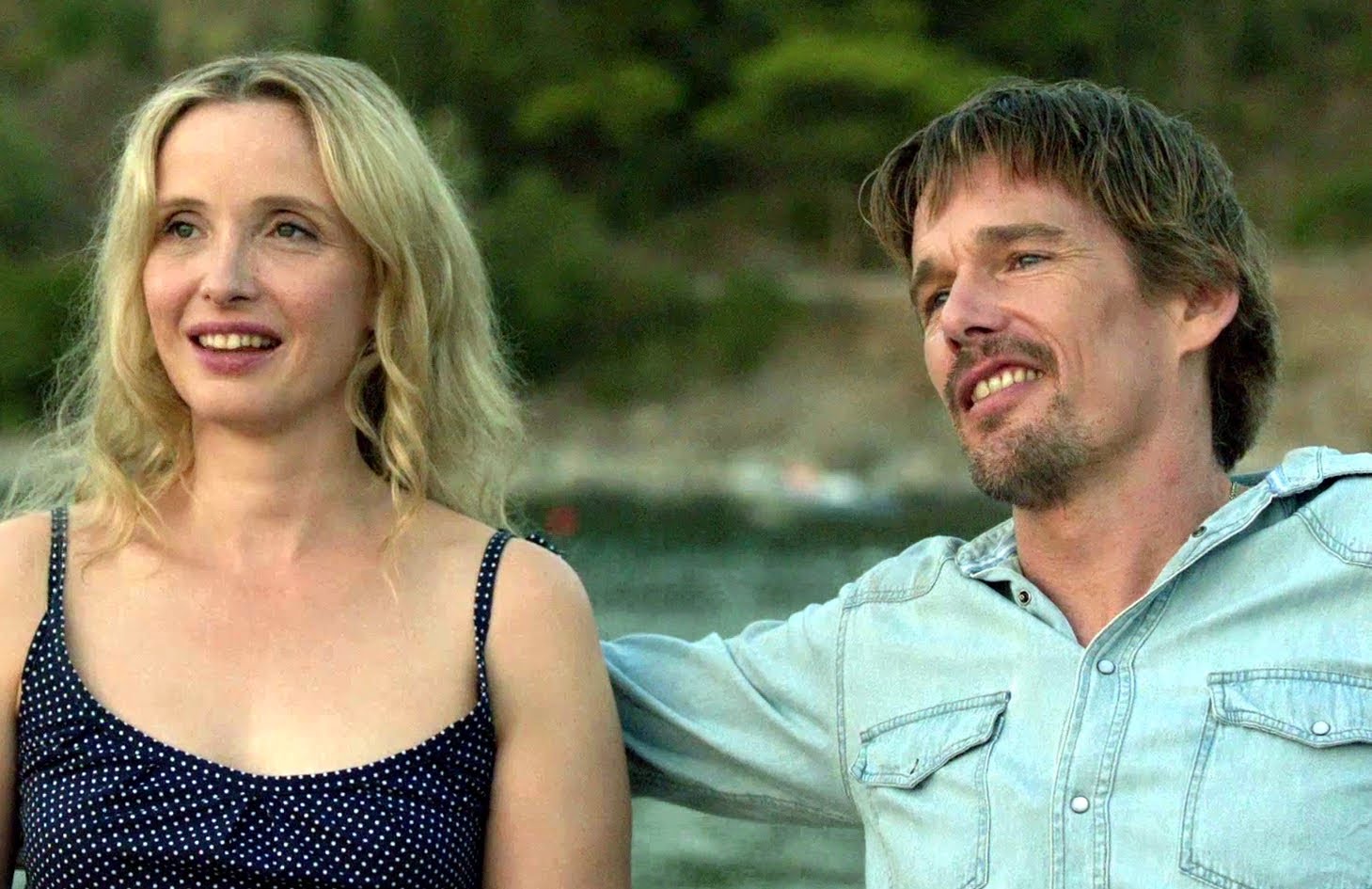
Now in the summer of 2013, we catch up once more with Jesse and Celine. As it is with the actors, it is with the characters–nine more years have passed for both. Now, in Before Midnight, Celine and Jesse have been together for nearly a decade. They have twin girls, and Jesse’s son with his ex-wife, now a young boy going into high-school, has spent the summer with his father and his new family in Greece.
In fact, as the film begins, Jesse is dropping his son off at the airport for the return flight home. Jesse is now a very successful novelist, having written two critically and commercially acclaimed novels (both based on the events that we saw in the previous two movies.) However, he is unhappy about his distance from his son and is toying with the idea of moving his European family to Chicago to be closer to the boy.
The film is divided into three basic scenes: the trip to the airport, a dinner at the villa they are sharing, and a night at hotel together without their daughters (a gift from their friends at the villa.) In the first scene, we see Jesse struggling with saying farewell to his son, Celine announcing that she has the opportunity to change jobs, and the two bantering amicably in the car, both daughters asleep in the back seat. However, Celine does not like the idea of a move to America or the prospect of refusing the career opportunity that has just now cropped up.
Celine and Jesse (Julie Delpy and Ethan Hawke) in Before Midnight (2013)
The second scene is at their villa where the males sit outside discussing literature while Celine and the women prepare the dinner. It is light, gregarious, and beautiful–but you feel the emotion lying low within Celine. The dinner itself is wonderful. At turns, amusing, intelligent, and poignant, the conversation is witty and enjoyable. There is a tad of acid in some of Celine’s comments, but for the most part, it is a dinner which I very much would have liked to have joined.
As a gift, their friends have bought them a child-free night in a hotel in the local town. After dinner, the two walk into town, talk, reminisce, and plan for the future. In the lobby, Jesse is recognized and asked to sign a book. Celine is also asked, as the reader assumes (correctly) that she is the woman whom Jesse writes about. She reluctantly agrees.
The night however does not go exactly the way they had planned.
Like its predecessors, Before Midnight is wonderful because it seems real. (There’s that “verisimiltude” again.) People talk, plan, argue, hurt, and enjoy. There are no cataclysmic disasters pushing them into conflict, no terrorists to fight, no snarky humor to overcome. It is simply two people at a patch in their relationship that is proving a little rough. In their forties now (both the actors and the characters), they are looking at life differently and with more cognizance of its quick passing. If I have problem, it is that Celine’s outburst–while we anticipate its coming–still seems to come out of nowhere. But it is wonderfully honest and wonderfully real.
But, maybe that’s the truth of life–and the truth of relationships–we know little of the turmoil going on in a partner’s soul. Maybe that’s the truth of the movie.
And while Hawke and Delpy have comfortably grown into their parts for the past two decades and while the small supporting cast is more than excellent (Walter Lassally as the aging writer with whom they are staying, Xenia Kalogeropoulou as his widowed friend, and Yiannis Papadopoulos and Athina Rachel Tsangari as the couple who present them with the child-free night), it is the setting that struck me most. Filmed on the southern Peloponnesian coast, it is filled with gorgeous coastline, quaint villages, memorable sunsets, and illuminating sunlight. When I got home from the film, I spent the next two days searching real-estate in the area.
I spent two weeks there once. I wouldn’t mind spending more.
“Build a good name. Keep your name clean. Don’t make compromises, don’t worry about making a bunch of money or being successful — be concerned with doing good work and make the right choices and protect your work. And if you build a good name, eventually, that name will be its own currency.”
Patti Smith (remembering advice she got from William S. Burroughs)
I was up and about the other night, unable to sleep, not ready to start a new book, and mindlessly checking out things on-line. I checked my e-mails, paged through my Zite selections, spun through scores of Twitter and Tumblr postings. And I came upon this very intriguing headline:
Romanian investigators have found the remains of paint, canvas and nails in the oven of a woman whose son is charged with stealing masterpieces from a Dutch gallery in October last year.
(click headline to read original article)
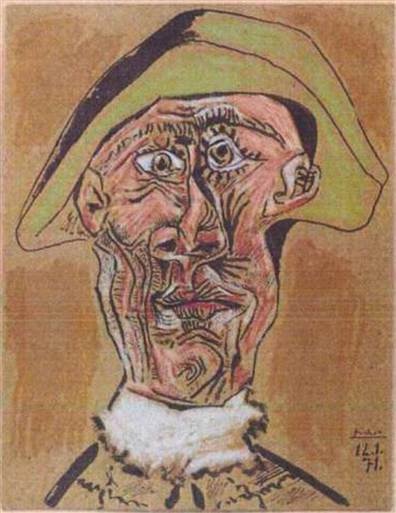
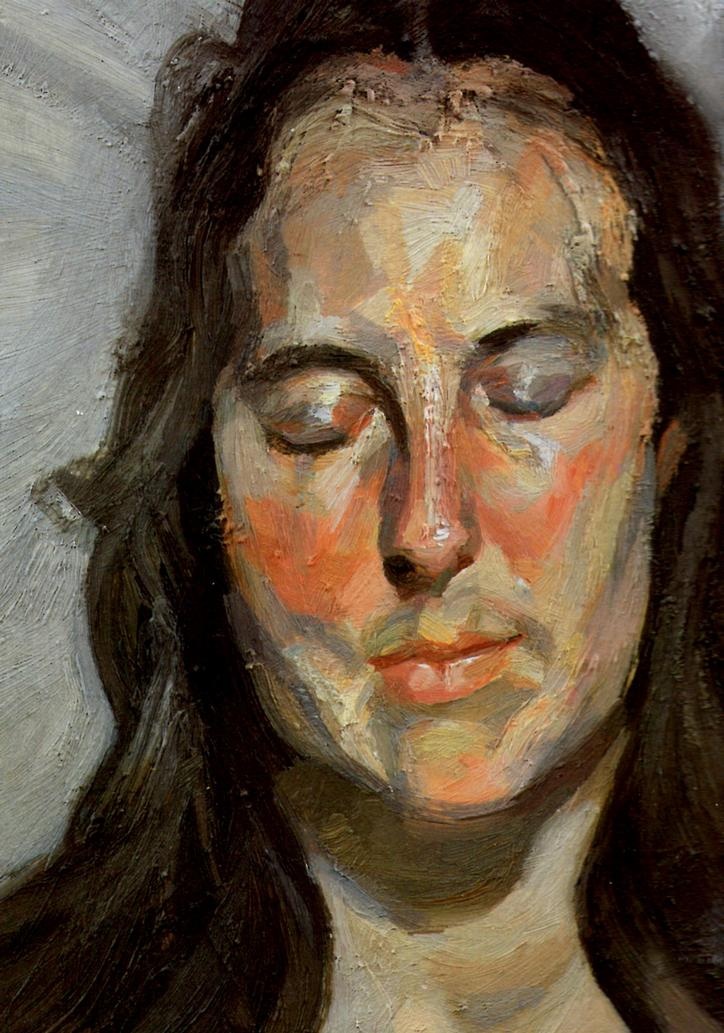
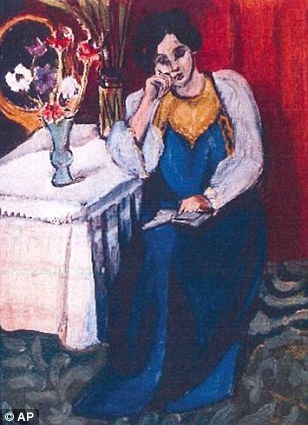
Authorities believe that these are the remains of a cache of paintings that were stolen from a Dutch museum in October 2012 and which included Picasso’s Harlequin Head, Monet’s Waterloo Bridge, Mattise’s Reading Girl in White and Yellow, and Lucien Freud’s Woman with Eyes Closed.
The burnt remains–pigments, bits of wood, nails–were found in the home of a Romanian woman whose son had been arrested in connection with the heist.The woman, Olga Dogaru, told authorities that she had burned the paintings to destroy any evidence that linked her son to the theft. The paintings, which are valued between $130 and $250 million, have not yet been officially identified with the remains in Mrs. Dogaru’s oven, but the likelihood is great.
And so I began thinking and wondering.
In a small house in Romania, we have fragments of painting primer, paint, wood, canvass and nails. In a way, these famous paintings have been “deconstructed” to their most basic elements. What element is missing? Genius? Kind of nebulous. Inspiration? Maybe even more so. Certainly execution and vision.
But what was once one thing is now something else. (In many ways, isn’t that a way of defining art itself.)
One of the officials working on the case stated that if these oven remains are indeed the paintings they are looking for then Olga Dogaru’s actions are a “crime against humanity.”
Come on, now. After the horrors of the Holocaust, the crimes of Pol Pot, various tribal genocides, corporate environmental rape, the atrocities of the twentieth century and the new horrors of the young twenty-first, I think calling this a “crime against humanity” is a bit overstated and a bit overdramatic.
Don’t get me wrong. I am no philistine. I love art. It is a very important and crucial part of my life, day in and day out. I love amateurish, clunky student art and exquisite paintings by the Old Masters. I love rough draft architectural models and elegant Brancusi Birds in Space. I love the avant garde and the mainstream.
And yet, my life is not appreciably diminished by the loss of these individual paintings. There are paintings that I love, that I am lucky to be able to visit often. But if they were gone, life would go on. For me, as well as most of the other 7 billion people on earth.
Undoubtedly, it is a shame that these paintings are gone forever. (A bit amusing that they were destroyed by a mother trying to protect her ne’er-do-well son and probably unaware of the magnitude of her actions.) The monetary loss is arbitrary…and irrelevant. And the fact they they will never be seen in the original is regrettable.
But the entire story has me thinking hard about Art. What is it? What is it for? What is its relationship with society? What are the tiers? And what and who determines them?
To be honest, I don’t know the answers. But they are important questions to ask.
My knowledge of Japanese literature is very limited. I know a few poets–mainly ancient masters of the haiku–and I knew two novelists: Yukio Mishma, who many of my generation would know as the author of The Sailor Who Fell From Grace with the Sea, and the contemporary novelist Haruki Murakami, whose critically acclaimed novels such as Kafka on the Shore, Norwegian Wood, and The Wind-up Bird Chronicles have been international best sellers as well.
Well this summer, I was introduced to a new one–Kenzaburo Oe. (It is evidence of my ignorance that Kenzaburo Oe won the 1994 Nobel Prize for Literature, but nevertheless unknown to me.) I was introduced to him by a wonderful writer, reader, traveler and photographer who writes the erroneously named blog “francescannotwrite“ and who spoke about picking up the novel in Geneva last year, having known nothing about it or the author either. Her comments on it stressed the intelligence of Oe and her fascination with the plot. And it sent me searching for it.
She was right on both accounts.
The Changeling tells the story of an aging writer Kogito whose boy-hood friend is now his brother-in-law and a giant in the Japanese film industry. The brother-in-law, Goro, had once sent Kogito a tape-deck with a collections of tapes that he had made. These first tapes were of overheard (and recorded) conversations, eavesdropped moments, unsettling sounds that Goro collected to help Kogito put out of mind the vindictive journalist who has been hounding him. Fifteen years later, Goro sent him a new collection of tapes, tapes that were, in his voice, lectures, rants, philosophical queries, friendly advice and mentoring, and most importantly–the announcement of his suicide.
Book cover for The Changeling
In fact, it is on an early tape that Kogito learns of his friend’s death:
“So anyway, that’s it for today–I’m going to head over to the Other Side now,” Goro said casually. …”But don’t worry,” Goro went on, “I’m not going to stop communicating with you.”
And the rest of the tapes are Goro’s communication–from the Other Side. Each night Kogito listens, pauses the tapes, responds, pushes play again, responds again. In fact, each night after Goro’s death, Kogito has full-out conversations with his dead friend. Conversations that are filled with intelligence, logic, debate and argument and that are seeped in a great deal of memory.
After a while, Kogito’s wife–and Goro’s sister–asks him to stop. His loud conversations are upsetting both her and their disabled son.
Kogito does stop and accepts a guest teaching spot in Berlin. But Goro speaks to him in other ways there as well. There is a mysterious woman who claims to have known him, claims to know the real reason for Goro’s suicide. (The Japanese tabloids have been running with a scandalous story.) But most importantly there are Kogito’s memories, which, alone in Berlin, he can recount, examine and analyze with much greater attention to detail. Memories of Goro’s life, of his own, and of the two’s together.
We learn that Goro had been attacked and badly beaten by the henchman of Japanese organized crime (he had made an unflattering film about them), but then we learn that the left-leaning Kogito had years earlier been attacked several times by right-wing groups. Goro’s attack made international news and he is fighting the thugs in court; Kogito never reported his assaults.
We also learn a disturbing secret of the two men’s shared childhood. A secret that–when faced–shines much light on Kogito’s memories and the inward journey that Goro’s suicide precipitated.
Frances, of “francescannotwrite” mentions the intelligence with which the novel is imbued. And she is right. The conversations between Goro and Kogito, one dead and one alive, are heady and range from art and politics to society and life, from French literature and Japanese gangsterism to the War and their childhoods. In his tapes, Goro seems–from “the Other Side”–to be pushing his friend to a clarity that his life requires.
And it is a wonderful read. Like the art of Hokusai, where there are minimal lines but great power, Oe’s story is rich and dense and intelligent but it never feels that those things are in the foreground. The power is there in the conversations, the allusions, the references, but In the foreground is the fascinating history of Kogito and his dead friend.
It is a memorable story and a memorable novel. So now, I need to find some others.
"Here is my secret. It is very simple: It is only with the heart that one can see rightly; what is essential is invisible to the eye.."- Antoine de Saint Exupéry






 j. p. bohannon