Waiting for Godot: Crying in Beckett

A while back, I had posted about a performance of Samuel Beckett’s Endgame that I ‘d seen at the Arden Theater in Philadelphia. In it, I quoted my favorite lines from the play:

HAMM: (letting go his toque) What’s he doing?

(Clov raises lid of Nagg’s bin, stoops, look into it. Pause.)
CLOV: He’s crying. (He closes lid, straightens up.)
HAMM: Then he’s living.

The character Hamm has made the immediate inference that if his father is crying, then he is alive. And we, by extension, apply it to the human condition. I remembered this line–and the act of crying– this week when teaching Waiting for Godot. (Actually, the crying seemed more appropriate than ever for someone trying to teach Godot to 18-year old boys during their last week of school when the temperatures are in the mid-70s and the sun is bright! Hah!)

Early in the play, Estragon and Vladimir point out the tree where they are supposed to wait for Godot. (It is the only piece of scenery. The scene description reads simply: A country road. A tree. )

godot tree

Mark Bedard (Vladimir) and Mark Anderson Phillips (Estragon) in Samuel Beckett s ‘Waiting for Godot,’ at Marin Theatre Company. photo 2013 by Kevin Berne

Estragon: [desparingly] Ah! [pause] You’re sure it was here?

Vladimir: What?

Estragon: That we were to wait.

Vladimir: He said by the tree. [They look at the tree.] Do you see any others?

Estragon: What is it?

Vladimir: I don’t know. A willow.

Estragon: Where are the leaves?

Vladimir: It must be dead.

Estragon: No more weeping.

This is the exact inverse of the lines from Endgame. In Endgame, the syllogism is that if you are crying then you are alive. In Waiting for Godot, the syllogism is that if you are dead, then there is no more crying. More or less the same thing.

Later on, as Vladimir and Estragon rebuke Pozzo for his treatment of his slave/servant, Lucky, there is more conversation about crying:

[Lucky weeps]

Estragon: He’s crying!

Pozzo: Old dogs have more dignity! [He proffers his handkerchief to Estragon.] Comfort him, since you pity him. [Estragon hesitates.] Come on. [Estragon takes the handkerchief.] Wipe away his tears, he’ll feel less forsaken.

[Estragon hesitates]

Vladimir: Here give it to me, I’ll do it.
[Estragon refuses to give the handkerchief. Childish gestures.]
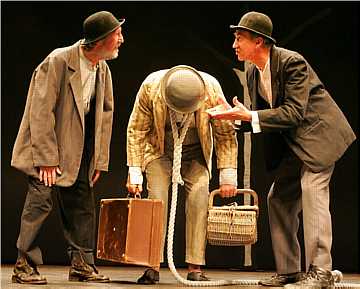
Estragon and Vladimir with Lucky

Estragon and Vladimir with Lucky from samuel-beckett.net

Pozzo: Make haste before he stops. [Estragon approaches Lucky and makes to wipe his eyes. Lucky kicks him violently in the shin. Estragon drops the handkerchief, recoils, staggers about the stage, howling with pain.] Hanky!
[Lucky puts down bag and basket, picks up handkerchief and gives it to Pozzo, goes back to his place, picks up bag and basket.]

♦ ♦ ♦ ♦ ♦ ♦

What are we to make of that? What is the significance of Lucky’s crying? Of Estragon and Vladimir’s desire to comfort him? Of Lucky’s lashing out at his comforter? And of his immediate subservience to his persecutor.

There is, of course, much more going on here, but the small emphasis on tears should be noted. Earlier Beckett had equated crying with living. Are we simply to be reminded that Lucky is a living, human being, and leave it at that? (We knew that anyway.)

Or perhaps we are to examine the difficult symbiosis between the comforter and the comforted? The helper and the helped? The cry of pain and those who hear and those who refuse to hear?

What is our responsibility to those who are “crying”? To those who are inconsolable? Good questions, all. And ones that we should take the time to think about every so often.
The End of April and National Poetry Month, part 3: To Keep Love Blurry by Craig Morgan Teicher

To-Keep-Love-BlurryI must say that I did not enjoy Craig Morgan Teicher’s third collection of poems.  That is not to say that they are not technically brilliant, that they are not impressively raw and honest, nor that there are not many moments that just knock you open. I admire it greatly; however, I do not like it.  Even Teicher understands the sadness and dysfunction and sourness inherent in his verses.  Here is his dedication:

To Cal and Simone–you should know that it’s a lot more fun than these poems suggest–
and

for Brenda, who knows…

Brenda is Teicher’s wife, who makes many appearances in the collection (actually throughout his work– his first collection was entitled Brenda is in the Room and other poems.)

To Keep Love Blurry is tied together by two major themes. One his mother and father, particularly after his mother’s death. And two, his marriage to Brenda, their (apparently) special-needs son, and Teicher’s sullen acceptance of love.  Indeed, for Teicher love–both familial and marital– is more of an anchor than a source of flight. Here is he about motherhood:

My wife is not my mom. My mom is not
my mom. My father is not my mom. My boss
is not my mom. She is a tooth with rot,
a flower pressed between the pages of a lost
book. My son is not my mom. She is a mare
crushing my skull beneath her hoof. She is forever
starved. I ride to the edge of the earth clutching her hair.
Get it over with. It’s never OK, not ever.
Fuck it, whatever.  If Robert Frost is my mom,
then so is Robert Lowell. She taught me to talk.
She is where I’m headed, a bomb
crater. She forgives me like a hunting hawk.
Maybe she’s my boss’s boss, my wife’s other other lover,
my son’s midnight cough. She loves me like a brother.

(“My Mom, d. 1994”)

The perfection of form–a modern Shakespearean sonnet with A-B-A-B…rhyme scheme, a regular rhythm, an unusual octet, quatrain, couplet construction–is made inconspicuous by the language, the odd identifications of motherhood, with unusually negative words: “tooth with rot,” “a mare crushing my skull,” ” a bomb crater,” “my wife’s other other lover.”  What exactly are his feelings?  “Loves me like a brother” does not cut it for me.  Perhaps the secret lies in the allusion to Robert Frost and Robert Lowell.  Teicher quotes a Lowell poem as an epigraph to his collection:

“Those blessed structures, plot and rhyme–
why are they no help to me now…”

Perhaps Teicher is saying that the “blessed structures” of poetry–with which he is extraordiaryily adept–are no longer to sufficient to buoy one in the sourness of modern life.  Here he is similarly on friendship, marriage and love:

In just the couple years since two by two
we all began to partner off,
already we’ve practically retired, passing though
apartment doors shut tighter than a cough.
There used to be long, wasted hours of talk,
nothing secret between us, not even skin;
at the conclusion of a wandering walk,
the flirtatious dark would set in.
Is marriage lonely by design,
in hopes that obeying an age-old law

of I am only hers, she is only mine
forms a brittle scab over the always-raw
wound of too much intimacy between friends
in favor of a duller aching that never ends.

(“Friendship”)

Again, the “plot and structure” to which Lowell refers are exquisite: a Shakespearean sonnet, intricately wrought and patterned. But for the speaker, the poetry is subsumed by the “duller aching” and “brittle scab.”

Mixed among the villanelles and sonnets, the rhyming couplets and the longer verse, there is a series of prose ruminations on the death of his mother and the subsequent loneliness of his father. These too are notable for their raw honesty, their unflinching introspection.

Well-wrought and linguistically daring, To Keep Love Blurry is evidence of Teicher’s impressive talent. However, I found it sullen and pouty and self-indulgent. Nevertheless, such is Teicher’s poetic cleverness and adroitness that I will surely keep my eye out for his future work.

The End of April and National Poetry Month part 2: the game of boxes by Catherine Barnett

calendarAs I said in “The End of April…part 1,” the month got away from me. What I mean is that all the great ideas I had for celebrating National Poetry Month were just that…great ideas. Just so much smoke. And so to make up for it, I am trying to put up several posts about a variety of poetry collections that I read during the month of April.

Back in the fall, I went to a conference of poets and heard Catherine Barnett read. I also bought her book The Game of Boxes which had just won the 2012 James Laughlin Award of the Academy of American Poets. And like too many of the books that I buy, it joined the stacks of “to read” books that are now towering next to my bed and next to my desk. Then, as if to increase my guilt for not reading it yet, in April, the Academy sent me a copy in the mail. (Fortunately, I was later able to give that away as a birthday gift to another poet.)

Assailed with the guilt of owning two copies and not having cracked the spine yet, I dived in. And was I glad.

the-game-of-boxes Barnett’s collection is divided into three parts: “Endless Forms Most Beautiful,” “Of All Faces,” and “The Modern Period.” The poems in each section are informed by a mature wisdom and wonder and understanding and befuddlement while dealing with those very issues that simply befuddle a younger world. Lust, love, family loyalty, parents and parenting, self, partnership, Barnett touches upon all of these, assuring us that none of us ever really get a grip on everything swirling about us. The middle section, “Of All Faces” is subtitled “Sweet Double Talk-Talk” and delineates the love/lust/comfort/discomfort of a partnership worn smooth over time. This is my favorite part of the collection.

From the outset, there is an immediate comfort in their age and a delight in their familiarity:

It’s a different beauty,
Your torso is stained and creased,
you say your an old man–

the backs of your hands
might be an old man’s hands
but the tips of your fingers —

little shocks of pure mind,
and I like theme there,, yes, ageless
persuasion’s design and rush. (Sweet Double Talk-Talk, i)

There is a weariness in famliarity:

Sometimes he’s everything to me:
yesterday, tomorrow, regret and shame.

And sometimes he’s nothing to me,
an old cushion on an old couch:

a pin-cusion:
something I think I can replace. (Sweet Double Talk-Talk, xvii)

But overall, there is a comforting lust and an accepted love:

I’m afraid you’ll die,
and tonight’s your birthday, it’s no different,
in fact it’s worse,
come drink some wine–

Let’s sit at the bar.
It’s winter,
so I’m in your coat,
I’m in your promises,
your smooth worn promises
sliding in and out of my own
love of death so slick
with want–

Soon, you say, your breath still warm in my ear. (Sweet Double Talk-Talk, xviii)

I cannot say why, but I love this couple. I love their honesty, their quirks, their enduring lusts, their enduring second-guessing. And while this section could almost be considered a narrative, each section is similarly anchored by a wise understanding of time and love and others.

The End of April and National Poetry Month part 1: Shackamaxon

flying calendarI begin each April–designated in the U.S. as National Poetry Month–with all kinds of grand ideas.  I will organize students into a poetry festival, we will stage poetry slams, another teacher and I will do readings together, we will invite celebrated, fascinating (and inexpensive) guests to speak.  And then before I get any of it done, May comes around and I’ve done nothing.

This month the most I did was organize a festival for the following year and set out to go to Philadelphia Stories’ “Party Like a Poet” benefit. I made my way down to the location (a subway and a bus trip away), got there far too early, and talked myself out of it — I returned home before it started.  Not very poetic, I guess.

But what I did do–not very celebratory or communal–was read a lot of poetry.  And I mean a lot.

Some of the titles were by veteran poets such as Mark Doty and Edward Hirsch and others newer names such as David Livewell and Catherine Barnett.  They ran the entire gamut of poetic offerings–free verse and formal verse; confessional poetry and nature poetry; poems about love, loss, sex and death; poems about animals and insects, planets and hardwiring. They were collections that I bought, that were given to me as gifts, and one that was sent to me by the Academy of American Poets.  Mark Doty’s was a National Book Award Winner, Catherine Barnett’s was a James Laughlin Award winner, and David Livewell’s was T.S. Eliott Poetry Prize winner.

And they were each unique and very different from each other.

And so in celebration of April “the cruelest month,” each day I’ll give a quick run down of one of those titles that have come across my path in the past month or so.

shackamaxon-david-livewell-paperback-cover-artShackamaxon by David Livewell was fun because he is a talented local poet and his work is situated in the places and neighborhoods I am very familiar with. (How fun is that when in a movie you recognize a street, a diner, a department store, a park?!) The title “Shackamaxon” was the Native American settlement where William Penn made his famous treaty with the Leni Lenape tribe and began establishing what is now the city of Philadelphia.

 Livewell’s work is gentle and honest and gritty and searing and, to a large degree, nostalgic, as he captures his blue-collar environs, the families, the struggles, the personal milestones and the larger changes over time.  Looking back at the hardscrabble neighborhoods where he was raised, he elevates his urban experience–both memorable and familiar–into art. My favorite is “Summer Elegy,” a nostalgic piece that reminds me of my own father and his generation–loyal to their perennially awful baseball team–and of the passions they passed on to their children.  Here is a short piece of it:

On the front step my Grandpop strained to hear
Harry and Whitey* call the Phillies game
from a crackling Philco hung on the wrought iron railing.
He’d grind his teeth and move a toothpick left and right
the way that on-dck players swung at air,
a rhthym to Harry’s baritone
and Whitey’s softer quips between the crowd
noises and vendor calls. He seemed to wait
on possibilities that hung like pop flies.
Gramps would tisk at strikeouts, whistle for homers,
and often blurt “About damn time!” or “Bum!”
And all around the neighborhood were men
from other families catching the baseball game…
(from “Summer Elegy”)

* beloved announcer (Harry) and color-man(Whitey) of the Philadelphia Phillies