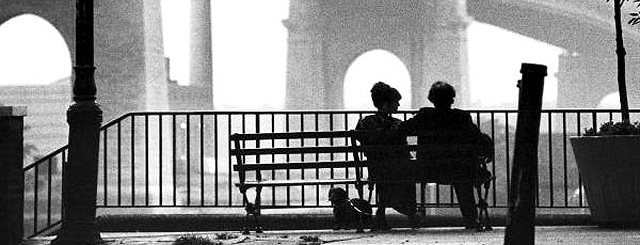
My sister is flying to Edinburgh today and I happened to be searching for a particular clip from the movie Manhattan.
You know the opening of Manhattan where Woody Allen is doing a voice over, purportedly writing a book about his love for the city? The gorgeous photography–Woody had the legendary cinematographer Gordon Willis as his cameraman–the pulsating Gershwin music, the edgy decision to film in black and white, all work to make this perhaps Allen’s most beautiful film and certainly his greatest paean to the energy, diversity, pulse of New York City.
If you don’t know what I am referring to, check out the opening clip here:
The simplicity is its beauty. There are no screen credits, no rolling text, just this gorgeous black-and-white montage of Manhattan. The title of the movie itself appears as a vertical, flashing neon sign, one that you might not notice because it is so incorporated within the segment.
Quickly, the plot of the story is this: Isaac (Woody Allen), a writer whose ex-wife is publishing a tell-all memoir of their marriage, is dating a high-school girl (Mariel Hemingway). Granted that in hind-sight this relationship feels a bit uncomfortable, but Isaac is in fact the moral center of the film (and his high-school girl-friend perhaps the most mature and un-jaded of all the characters). His dating the young girl pales as an issue when juxtaposed against the shallownesss, the deceit and the disloyalty of the other main characters. Isaac’s friend, Yale, is having an affair with Mary, played by Diane Keaton, in what seems to be a reprise of her Annie Hall role–all intellectual charm and goofiness. (Manhattan came out two years after Annie Hall.) She is endearing here as well, but it is basically the same character. Anyway, Isaac is attracted to Mary and Mary to him, but he will not act on it because she is having an affair/relationship with his best friend. The fact that his best friend is cheating on his wife who is also Isaac’s friend is also troubling to him. Not until the affair between Yale and Mary ends, does Isaac allow himself to act on his feelings towards her.
I won’t spoil it, but there is more treachery and disloyalty to come, and towards the end of the film, Isaac bursts into the classroom where Yale is teaching and makes an impassioned speech for morality. It is one of those movie moments when the action, the story, the jokes stop and someone makes an intelligent plea for humanity and for decency.
But the story, in many ways, is secondary for me with the film. It is simply beautiful. The black-and-white photography mixed with George Gershwin’s exhilarating music is majestic, perfect. It might not be far off to say that no one can make a city look better than Woody Allen. Consider his recent efforts outside New York: Paris in Midnight in Paris, Barcelona in Vicki Christina Barcelona, and London in Match Point. In each film, the particular city seems a character in itself–a beautiful, energetic, lively character. A city’s tourist bureau would love to have Woody Allen film their promotional releases. He has a certain means of capturing the magic, the gestalt of a place. (Rome is next in his upcoming film, To Rome with Love.)
I used to pop Manhattan in the VCR/DVD whenever I was feeling particularly blue, for watching it somehow made me feel better. I don’t know why–it really is rather depressing on the whole–but Isaac’s last speech to Yale is something special. Or perhaps the energy of Manhattan itself is what affects me, and my personal malaise at the time proves to be no match for that vigor and life pulse.
Anyway, as I said, my sister is flying to Edinburgh today and I stumbled upon this wonderful video by accident. Someone has taken the opening scene of Manhattan, and substituted black and white photos of Edinburgh. Woody Allen’s voice over–where he praises Manhattan–is taken up verbatim except instead of Woody’s unmistakeable New York accent it is a strong Scottish voice and the word “New York” is replaced with the word “Edinburgh.” Here it is below. Enjoy it.
 j. p. bohannon