Friday Film Review: Into the West

Old Lady:  “You can’t take that horse onto the lift.”

Little Boy:  “I have to. The stairs would fucking kill him.”

                                                                                Into the West (1992).

The drunken revelers started up last weekend, college kids in goofy hats, increasingly offensive t-shirts, and green New Orleans love beads, lining up at Finnegans Wake on Spring Garden, weaving down Spruce, and jamming any bar that has an apostrophe in its title.  But since tomorrow is St. Patrick’s Day, I thought I add to the festivities by taking a look at a wonderful–and somewhat underrated–Irish film, Into the West.

The film is the story of two boys, their widowed father, and their bleak existence in the tower flats of North Dublin. When the boys’ grandfather (the inimitable and late David Kelly) arrives suddenly with a majestic white horse, the young boys’ lives are transformed.  There are conflicts with the police (hard to hide a horse in your 7th floor flat), with undesirable racing buffs, and with the upper-class “gentry,” as well as a sweet nod to Irish myth and the legend of tir na Nog.

Written by Jim Sheridan (and two others) and starring Gabriel Byrne and Ellen Barkin–who were married to each other at the time–the film traces these two young boys and their dreams of going into the West.  Except for them the West is the American West of cowboys and Indians, of gunslingers and tumbleweeds. It is a far cry from the fields and rocks of Galway and Mayo.  Yet sure enough when the authorities come after them–they retake their horse from a high-stakes horserace–the boys gallop into the West.  It is here that Irish myth comes into play and the ending of the film is certain to raise a lump in your throat at the very least.  Yet, to me, it is wonderful.

I saw Into the West on the last day that it was playing in the theaters in Philly.  I wanted everyone to see it, so when my young daughters begged off because they had too much homework, I famously told them that they “would have homework the rest of their lives, but they would get to go see this only once.”  To this day, I am glad I forced them to go.  And I think they are as well.
Deluded Knights in Philadelphia

About two and a half blocks from where I live there is a small patch of grass at the triangle where three streets cross–Girard Avenue, American Avenue  and 2nd Street. There, Girard is a busy, double-wide street with an active trolley line, restaurants, tattoo parlors, bodegas, beauty salons and banks.  2nd Street is a bit smaller but filled with restaurants, bars, boutiques, and galleries and American is but a desolate patch with a beer distributor and the abandoned stables where the horses and carriages that circle the historic area used to be housed. On the north side of Girard, American is just beginning to blossom, anchored by the beautiful Crane Building which houses both the Indigo Art Galleries and the Pig Iron Theater Company.

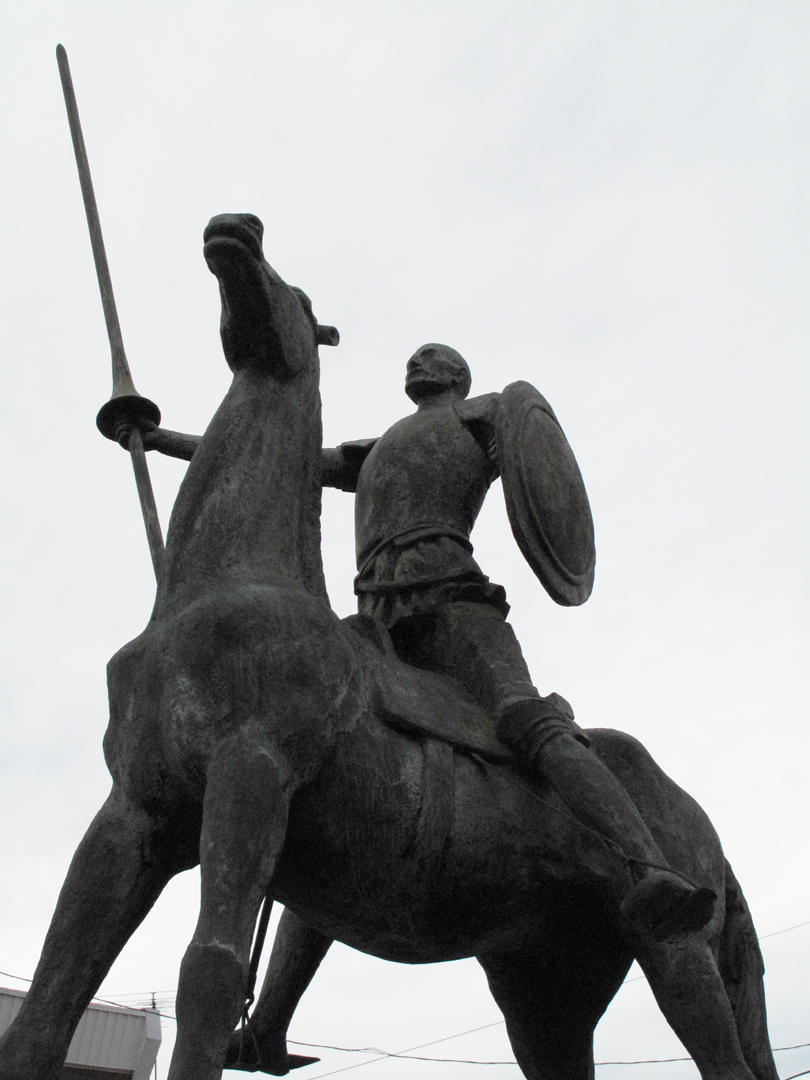
Sitting in the triangular patch made by these three streets  is a large statue of Don Quioxote astride his horse Rocinante. Why Don Quioxte?  I am not sure.  The plaque on the statue says that it was a gift from a “sister city” in Spain, Ciudad Real, and it is an exact replica of an original sculpture by Joaquin Garcia Donaire.  But again, why Quixote?

Quioxte was in many ways a mad man…an idealistic, well-meaning mad man, but mad nevertheless.  His quests and adventures, while couched in the greatest of intentions and wrapped in the mantle of chivalry and honor, were actually farcical and embarrassing.  Quioxte’s famous battle against the windmill, which he had perceived as a dragon, has given us the idiom “Tilting at Windmills,”  a phrase for fighting against the wrong thing, about declaring war on something that is un-winnable and un-fightable, or for dreaming a victory against something that is not at all what one was fighting for or against.  So why is he in Philadelphia?

Philadelphia prides itself on its place in the history of the United States.  It was from here that the colonists argued, debated and hammered out a Declaration of Independence and then a Constitution, both of which are revered around the world.  Throughout the year, one would be amazed at the hordes of international tourists who pose for pictures in front of the revolutionary landmarks, in front of Independence Hall or the Liberty Bell.  In a world where independence and liberty are not a given, it is humbling to see so many people come to honor it here in Philadelphia.  And so, why Don Quioxte that deluded knight?  Is the fight for civil liberties and religious tolerance–two concepts that were the lynchpins of the city–a quioxtic dream?  Is working towards harmony and liberty really just a pipe-dream of some writers from the 18th-century Enlightenment.

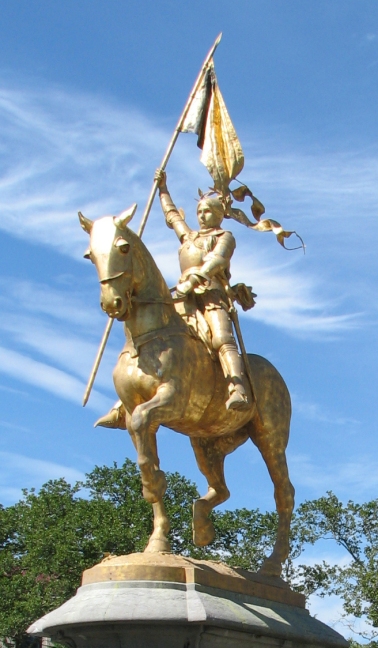
But this thing with knights gets odder still.  Just twenty-three  blocks due west of Don Quioxte is a blazingly gilded statue of Joan of Arc.  Now, I have always loved the story of Joan of Arc.  (I may be one of the few people who have read Mark Twain’s novelization of her life other than for academic credit. And I have read several serious biographies of her as well.)  I have always loved her spunk, her feistiness, her belief in her cause. But one has to admit, as a representative of knighthood, she is a bit suspect. This was a woman who heard voices, voices that encouraged her to leave her simple peasant life, shift to a more masculine nature, don armor and lead a country into battle.  Which she then went and did!  This statue–which is a copy of the one that sits in the Place des Pyramides in Paris and was sculpted by Emmanuel Fremiet–looks across at the neo-classical beauty of the Philadelphia Art Museum and is the starting point for the famous Kelly Drive. It is blindingly gilt and quite handsome.

But then again why, in this city that put an end to medieval monarchies and aspired to a new form of human government, has a heroine of the monarchistic tradition been placed in such a prominent public position?

It probably means nothing, but I think of them often.  They are basically on the same street, less than 2.5 miles apart in a straight line.  They are undoubtedly–along with Shakespeare’s Falstaff –the most suspect knights in all of history.  And yet they are here, in the city that shook off a king and aspired to freedoms never before imagined.

(A kind of interesting irony: just as Joan of Arc died in the flames in 1431, the model for the Joan of Arc statue, 15-year-old Valerie Laneau, burned to death in a house fire when she was 77.)

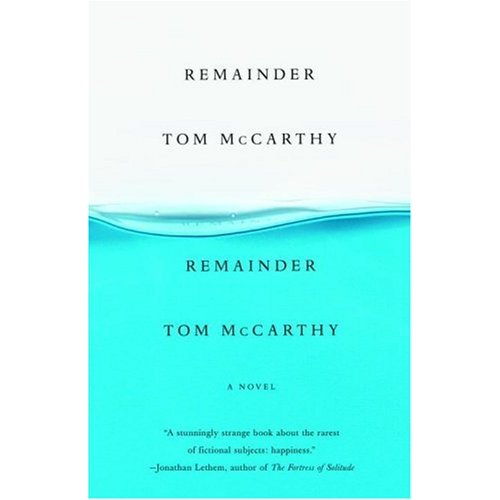
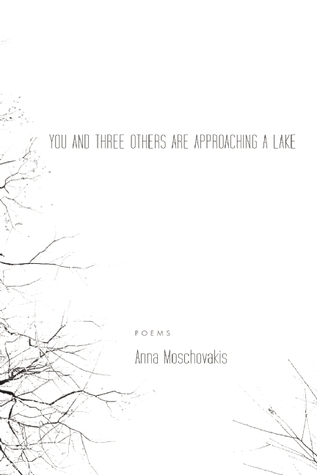
Book Review: Remainder by Tom McCarthy and You and Three Others are Approaching a Lake by Anna Moschovakis

My intention was to talk about one book a week, and originally I wanted that to happen on a Friday. But then, I realized that a large bulk of my outside reading–my non-class reading–is finished up over the weekend, so a posting on Monday makes much better sense. And since, this is the first venture out with a post about books, I figured I would start out with two.  Remainder by Tom McCarthy and You and Three Others are Approaching a Lake by Anna Moschovakis.

Tom McCarthy’s novel about a post-coma, post-trauma survivor who receives a “settlement” for eight-and-half million pounds is at times aggravating and at other times marvelous. The narrator has lost much of his memory after being hit by an untold object that placed him hospital and in a coma for an extended period. When he returns to “normal” life, he is given an enormous payout by the responsible parties. His only vivid memory, however, is one that involves an apartment house with a crack in the bathroom wall, a woman cooking liver in the flat below him, another tenant  playing piano in the room above, and a man working on his motorcycle in the courtyard. With an almost unlimited amount of money, he arranges to “re-enact” the entire memory, buying several buildings, re-doing them to the specifications that he remembers, and hiring actors around the clock to play the tenants that haunt his memory. From here, he begins to re-create other more recent occurrences.  McCarthy’s–and the narrator’s–attention to detail is precise and minute, a true feat of writing and observation, but Nicholas Baker did it much better in his earlier works.  The payoff for me, however, comes at the end of the novel. Early on, when the narrator first learns of his windfall, he is set in a circuitous route between a telephone booth and his home. He travels the distance back and forth three or four times within a short period, stymied by his forgetfulness and his demand for exactitude.  I enjoyed this scene; it verged on the slapstick; and I even related it to other people. At the end of the novel, the same type of scene is played out, though this time with more dire and impending consequences.  It brought the novel together. Remainder certainly contained moments of brilliance yet they were couched in much larger moments of cloudiness and frustration.

Anna Moschovakis’, award-winning book of poetry, You and Three Others are Approaching a Lake, is another work that has me of two minds.  The topics, the observations, the connections, all are intriguing, mind-jarring, fresh. Yet the poetry itself leaves me wanting. The book contains four long poems, plus a prologue and an epilogue.  They touch upon the contemporary and allude to the past. They are geographical and internal. They play with typography and they play with presumptions. They deal with our technological world and the examine our anthropological past.  Indeed, having read the collection at one sitting, my first reaction was to read it again, to try to wrap my head around the numerous ideas and permutations.

In the poem “The Human Machine” there is an extended conversation between “annabot” and “the human machine” which questions what we know about and how we love, questions the substance of spirit, dissects the more mechanical part of our being. In a letter to the Human Machine, Annabot writes:

Dear Human Machine,

Resolve, reason, ration, rational, rationale, rationalize

ratiocination, rationing, ratify, rather, rate,

ratios, ratio, rat

According to Peter Singer, a rat who is loved by a person

is more worthy of being pulled from a fire

than a person who is unloved by persons

This is taking into account Singer’s technical definition

of “person”

As I said, this is truly a marvelous book for thinking, for exploring, for discovering new ways of seeing the world.  It is a book that I have–and will again–return to.  However, I am not sure of the poetry of the pieces. I found them wanting.

Sunday Music–Black 47

For the next two weeks, Philadelphia is awash with “Irish” bands.  Most of them are home-grown and are playing at bars that are on the maps of organized pub crawls for the next two weekends. (Why do so many “Irish” pubs have initials. P.J. O’Toole’s, J.D. McGullicuddy’s, J.P. Monaghan’s?  Wasn’t any Irish kid called by his full name? Or was calling him by his initials a way to ensure that  he becomes a bar-owner?)  Anyway, there is a lot of live Irish music around right now–some of it great, some of it less so.  It is also the time when a slew of national/international Irish-music acts come through the area.  The Chieftains played here Friday night; the SawDoctors are in town Tuesday night; and Lunasa is here on Wednesday night.

Black 47 was at the World Cafe on Friday night, the 9th.  They were brilliant. It had been 10 years since I saw them last, and they are still musically tight, politically raucous, and extraordinary fun. The front man, Larry Kirwan is a dynamo of energy, the brass section is still stellar, and the newer additions (for me, that is) have added to the fun and musicianship. Black 47’s music is raucous and tender,  a mix of Springsteen and the Clash, heavily infused with Celtic melodies and themes.  The songs are filled with stories about life in NYC,  paeans to Irish heroes, recollected broken hearts and broken bones, and clarions for political action.

Larry Kirwan, as I said, is prolific. I once saw a play of his on Governor’s Island at the Guinness Fleadh in 1997–now collected in his book of plays, Mad Angels: The Plays of Larry Kirwan.  At the moment he is doing publicity for his latest novel, Rocking the Bronx; he has his own radio-show Celtic Crush on Sirrus/XM radio, has put together a Celtic Kid’s album and book, and is working on a musical with Thomas Kenneally (author of Schindler’s List).

But put that aside for the time.  Two nights ago I saw Larry Kirwan and Black 47 do what they do so well–deliver a raucous, fun rock show.  Below is an old video from perhaps their most famous song–anyone who was in NYC during the 90s heard in every joint that had a jukebox.  So here it is: Black 47’s “Funky Ceili” (The video ends abruptly before the classic line, “Does he have red hair and glasses” and showing an infant with Larry’s horn-rims, hah!):

Friday Film Review: A Dangerous Method


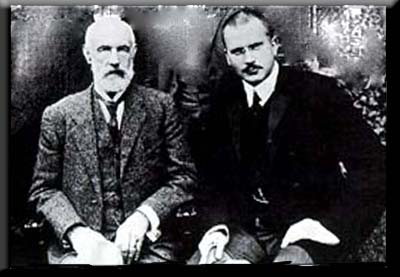
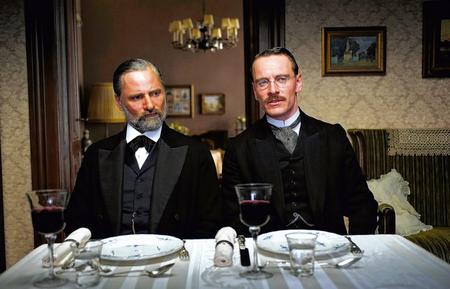
After many missteps and thwarted plans, I finally got to see A Dangerous Method. I don’t know how accurate it was–though it seemed so– but to watch Freud and Jung working together, fencing with each other’s ideas and techniques, is intriguing. History usually sets them in direct opposition to each other–and they saw themselves that way as well after their infamous break–but I see them as simply taking and following two different paths. Jung deals with humanity at large, with myths and archetypes; Freud with the individual, with the conscious and the sub-conscious.

The film is marvelous, hinting at what Jung is about to discover, what he begins to question about Freud; marvelous with Sabina Spielrien talking about anima and animus to Jung, arguing eros and thanatos with Freud; and ominous with the small undertones of the fomenting friction between Jewishness and Aryanism: Wagner’s Siegfried and Spielrien’s Judaism, Jung’s dream of an apocalypse coming from the north and washing Europe with blood, Freud’s concern that his work will be disparaged as the perversity of Jewish doctors.

Jung, it seems, had to break with Freud, just as the son has to break with the father. In fact, Jung’s father complex with Freud seemed quite evident. Although we are dealing with a film and the demands of drama and a story-arc, Jung seems much more fragile than I had imagined. The film ends with his seeming quite shattered–which historically he was–but it was still surprising to see such a towering figure so broken.

All in all, I loved it…and it is sending me to find the book it was based on by John Kerr, plus anything at all on Sabina Spielrien–a relatively forgotten figure in the beginnings of psychoanalysis.

“Modern Love”

The word “modern” is such a subjective term.  The 19th century poet, George Meredith, wrote a poetic sequence of 50 poems and entitled it Modern Love. The poems, each having 16 lines in 4 rhymed quatrains,  describe the relationship between a man and his wife.  It is “modern” for him because it is describing his current life in the 1860s.  Yet, it is extraordinarily modern to us, in that it is timeless.  It doesn’t seem filtered by the past, but emotionally contemporary. The distant couple, the repressed emotions, the sleepless night, these all seem to be taken from the late-20th-century, early -21st. I swear I have seen countless movies where a modern woman and modern man lie on their backs, thinking, wishing, wondering–the very emotions that Meredith attaches to his “modern lovers.”  All it needs is a plaintive soundtrack by  Bonnie “Prince” Billy.

Here is the first poem in the sequence.  Notice the dread, the sadness, the angst; it seems all so very real, very contemporary.

By this he knew she wept with waking eyes:
That, at his hand’s light quiver by her head,
The strange low sobs that shook their common bed                                             
Were called into her with a sharp surprise,
And strangely mute, like little gasping snakes,
Dreadfully venomous to him. She lay
Stone-still, and the long darkness flowed away
With muffled pulses. Then, as midnight makes
Her giant heart of Memory and Tears
Drink the pale drug of silence, and so beat
Sleep’s heavy measure, they from head to feet
Were moveless, looking through their dead black years,
By vain regret scrawled over the blank wall.
Like sculptured effigies they might be seen
Upon their marriage-tomb, the sword between;
Each wishing for the sword that severs all.
——-
(For those who like the “biographical” strategy, check out George Meredith’s life. It makes the poem all the more poignant.)

Voice

I am fairly new to this blogging thing, but I am not new to writing.  However, I am finding it very difficult to find my “Voice” here on these pages. Reading other journals and blogs, I find that the writers seem so confidant, so knowledgeable, so sure of what is important. And I am not. My writing–particularly my fiction–is informed by uncertainty. In the simple “boy meets girl” scenario, for instance, my characters are left hanging. That’s about it…”boy meets girl.”  Rarely does he get her, and if he never gets her, then he certainly can’t lose her.  It is perhaps my version of a Beckettian void (and probably more suitable to a shrink than to a blog.) So where does this void fit in with a regular blog?

Are bloggers just pretending that they know? Or do most of them feel that they are expert in some one thing or another? Is the internet a means for validation of their opinions, of the worth of their personal world view?  I don’t know.  It is difficult for me. For example,  I loved the movie The Beginners, but I know as many people who found it too slow and pointless. Why should I then write about its worth? To prove to myself that my judgement is correct? To initiate a conversation? I don’t know.  I need help here.

I guess, ultimately, my question is “What is the purpose of an individual’s blog?”–mine in particular. I have found that it is good for my thinking, for my productivity, for my thoughtfulness (not the same as “my thinking”). But wouldn’t a private journal do the same? The difference, I have found, between the two–the blog and the journal–is that I am more careful with the blog.  Knowing it is going “out there,” I am more careful with what I write, more careful in its correctness, more conscious of the language.  And I guess that is a good thing.  At least for my writing.   But again, why do it?

Can anyone help?  Are there people out there who can tell me?  Would love to hear your response to my questions.

Sunday Music–“Immigraniada”

Sunday is a chance to listen to–and to think about– music. I don’t get to listen much during the week. So on Sundays, when the afternoons are slow, I listen.

I found GOGOL BORDELLO by accident in the fall of 2011 in, of all places, a special fashion/style supplement of the New York Times. There was a pictorial of various “edgy” bands and only Florence and the Machine was familiar to me.  So I YouTubed the first one–and it was forgettable. Can’t even remember the band’s name. The next one was Gogol Bordello and a performance on the Letterman show.  I was hooked.  Theater, music, message, and what looked like frenetic fun.  (I apparently was late to the game since the Letterman clip was from 2007, but they are still playing and touring and creating great music.)

Anyway, I moved from song to song, downloading from iTunes and checking out videos.  I was floored by songs with allusions to Foucault, to Kafka, to Diogenes–these are not the usual touchstones for modern music.  The band has a Russian fiddler, an Israeli accordionist, a Ukranian guitarist/vocalist, a Chinese vocalist, an Ecuadorian, an Italian, an Ethiopian, a Trinidadian and many more that seem to float in and out of the lineup. And the music is infectious. (They were in NYC on New Year’s Eve this year, but my hopeful plans never amounted to anything.)

This particular song–and the accompanying video– “Immigraniada” is powerful. At first, I watched it over and over;  I gave it to a friend who teaches a course in social justice, hoping his students might understand; I wanted everyone to see it.  So now here it is.  If you like it, share it with someone.  If you really like it, if it somehow connects with you, go to aclu.org/immigrants-rights.

Darwin’s Barnacles

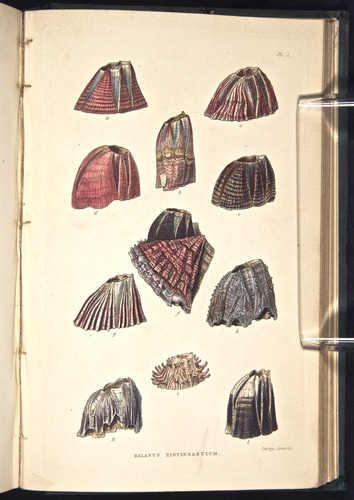
This is a page from Darwin’s journals on which he illustrated some of the barnacles he was working on. Before coming out with his Origin of the Species, Darwin had spent the previous eight years studying barnacles, publishing two monographs on the subject in that period.

In the actual drawings, the colors pop with much more brilliance and clarity, each barnacle delicately and exquisitely drawn.  The petticoat-like, pastel-colored illustrations are so different from the connotations that the word “barnacle” brought to my mind.  I had always associated the word, “barnacle” with roughness, coarseness, ugliness, but apparently I was mistaken, for these drawings are nothing but beautiful.  I saw them at an exhibit on Darwin at the American Philosophical Society Museum in Philadelphia.  The exhibit  was entitled “Dialogs with Darwin” and it included many of Darwin’s journals, scientific specimens, artifacts, personal effects and taxidermy.  Around the ceiling of the room was stenciled the words of a letter he wrote that began “There is a grandeur in this view of life … .”

The museum requested poetry to accompany the show, poetry inspired by one or more items in the show, poems that started a “dialog” with the items displayed and what they evoked.  I was drawn to the barnacles, to his life, to the death of his daughter, and to his discovery of emotion in animals.  The poem appears below:

There is grandeur in this view of life

There is grandeur in this view of life
where Victorian petticoats parachute along an ivory sheet,
barnacles floating on a women’s fashion page,
with precious pleats and twinkling color.

There is grandeur in this view of life
where elephants weep and moan and scream,
for the death of daughters, the loss of certainty,
where joy stretches true across a small chimp’s face.

There is grandeur in this view of life
where a captain’s gentleman unpacks
his crated books, his amateur’s tools
and sails to the bottom of a burgeoning world
beneath those stars from where these tracks begin.

Reading–or juggling–multiple books

As a teacher and a writer, my reading schedule gets a little jammed at times. I certainly have enough to read for my classes (at the moment, Ellison’s Invisible Man and Bradbury’s Fahrenheit 451), but I have my other reading as well. For instance, at home I have three separate books that I am dealing with.  Borges’  Collected Fictions next to my bed,  Tom McCarthy’s Remainders traveling back and forth with me on the train, and The Art of Fielding by Chad Harbach in the living room.

The nice thing about Borges is that so many of the fictions are short–which is why they sit next to my bed. Because, although they are short, they are dense, and I usually get through one or two at the most before my eyelids start falling.

As I said, the train ride to and from work is when I am reading the McCarthy book, and reading certainly makes the commute go quickly. If the book is good enough, there is a real danger of missing one’s stop. And so far, Remainders is very good. I have an hour commute each way, so these “commuter” books usually are finished within a few days.

And finally, the book that is sitting in the living room, The Art of Fielding.  It is there for after dinner, before bed, before or after grading essays, marking tests, preparing classes.  It is this book–the living room book–that usually takes the longest to complete.  But I’ve learned it’s not a race, and more often than not the quickness of a read is not necessarily an indicator of the quality of the read.

Anyway, my question to you writers out there.  When you are writing, do you deliberately stay away from reading?  Do you read only for “research,” whatever that might entail?  Or do you find that you can continue your usual reading patterns without any interruptions to your writing?