A goddess’s eyes, a museum’s treasures, and the fall of civilizations

The old man laughed indulgently, holding in check a deeper, more explosive delight. “Rome was destroyed, Greece was destroyed, Persia was destroyed, Spain was destroyed. All great countries are destroyed.  Why not yours. How much longer do you think your own country will last? Forever? Keep in mind that the earth itself is destined to be destroyed by the sun in twenty-five million years or so.”  Catch-22, Joseph Heller
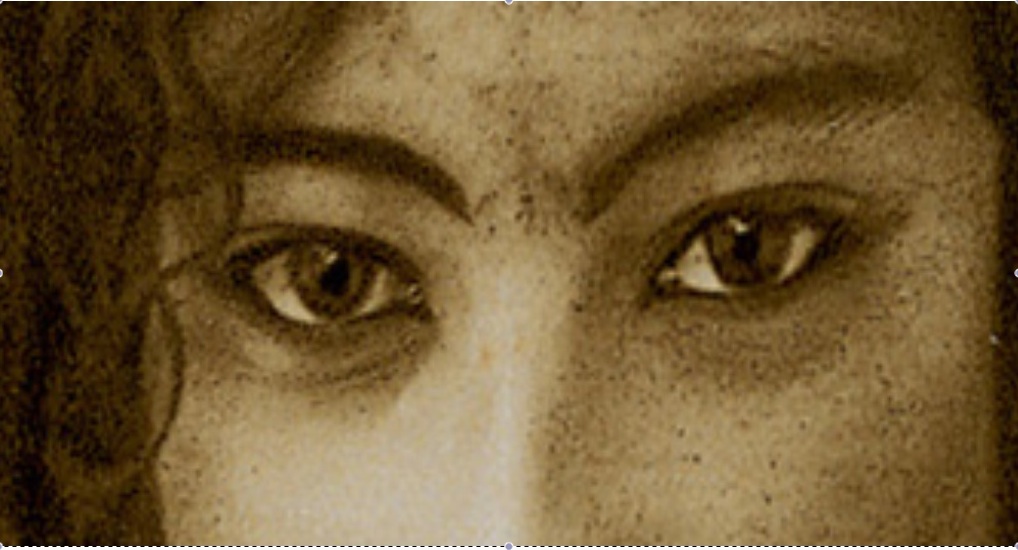

I spent the day yesterday in The University of Pennsylvania Museum of Archaeology and Anthropology.  Part of a photographic-mural, the woman above looks over you as you enter the Mid-Eastern galleries; her almond eyes seem those of a goddess, knowing, far-seeing, beautiful.  And then one wonders, what might she have actually seen in her life. What is her life like?  Is she still alive? Still in her native land?

Afterwards, when I was thinking about the various galleries in the museum that  I had lingered in, I was struck by this: I had visited Persia, Greece, Rome, Mexico, Egypt–high-points of human civilization and, in 2012,  flashpoints of suffering and discontent, violence, confusion and uncertainty.

The poets are helpful here–though not necessarily hopeful–and the photos I took seemed to have their own poetic soundtrack in my mind.  Here is Yeats:

THE SECOND COMING                                                                                              

Turning and turning in the widening gyre
The falcon cannot hear the falconer;
Things fall apart; the centre cannot hold;
Mere anarchy is loosed upon the world,
The blood-dimmed tide is loosed, and everywhere                         
The ceremony of innocence is drowned;
The best lack all conviction, while the worst
Are full of passionate intensity.

Surely some revelation is at hand;
Surely the Second Coming is at hand.
The Second Coming! Hardly are those words out
When a vast image out of Spiritus Mundi
Troubles my sight: a waste of desert sand;
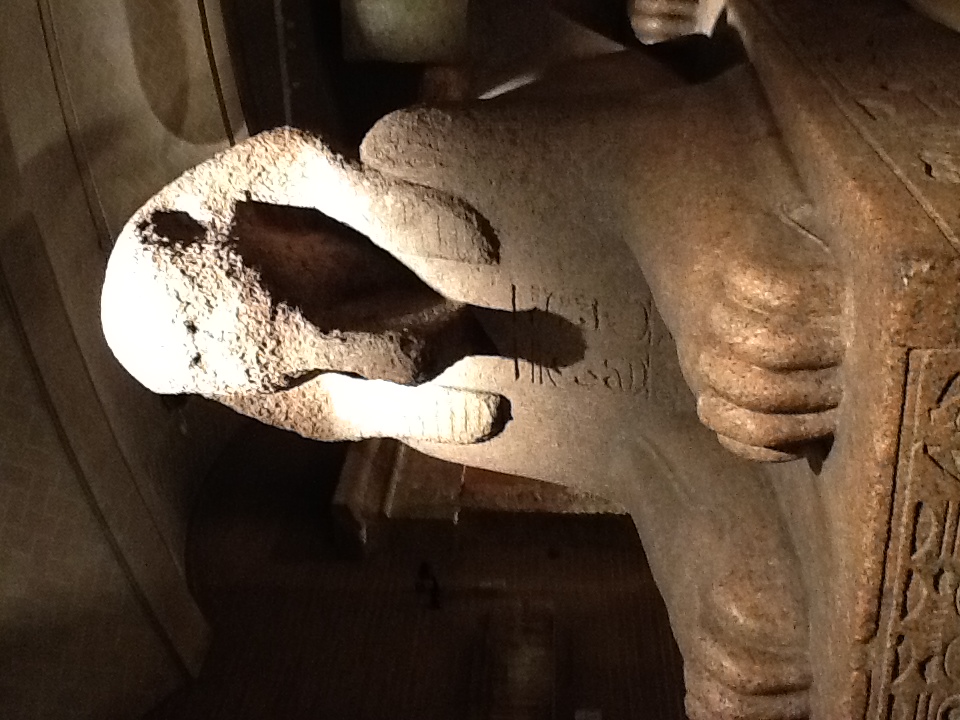
A shape with lion body and the head of a man,
A gaze blank and pitiless as the sun,
Is moving its slow thighs, while all about it
Wind shadows of the indignant desert birds.

The darkness drops again but now I know
That twenty centuries of stony sleep
Were vexed to nightmare by a rocking cradle,
And what rough beast, its hour come round at last,
Slouches towards Bethlehem to be born?

And then here’s Shelley on the same tack although not as apocalyptic:

Ozymandias

I met a traveller from an antique land
Who said: “Two vast and trunkless legs of stone
Stand in the desert. Near them on the sand,
Half sunk, a shattered visage lies, whose frown
And wrinkled lip and sneer of cold command
Tell that its sculptor well those passions read
Which yet survive, stamped on these lifeless things,
The hand that mocked them and the heart that fed.
And on the pedestal these words appear:
`My name is Ozymandias, King of Kings:
Look on my works, ye mighty, and despair!’
Nothing beside remains. Round the decay
Of that colossal wreck, boundless and bare,
The lone and level sands stretch far away”.
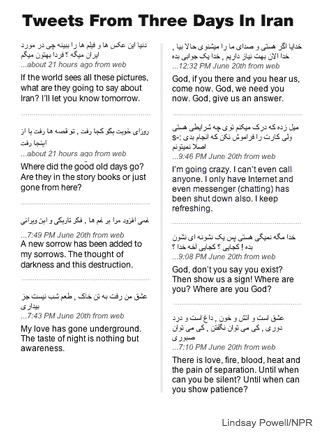
“If the world sees all these pictures, what are they going to say about Iran? I’ll let you know tomorrow.”

“Where did the good old days go? Are they in the story books or just gone from here.”

“A new sorrow has been added to my sorrow. The thought of darkness and this destruction.”

“My love has gone underground. The taste of night is nothing but awareness.”

“God, if you’re there and you hear us, come now. God, we need you now. God, give us an answer.”

The Persians have long been known for their poetry. Lush, emotional, spiritual and clear. The poems to the left were tweets sent during the contested elections in Iran in June 2009.  It is evidence of my theory that poetry–in fact all written expression– is an innate desire, beaten out of children by well-meaning but misinformed teachers. While the immediate world seems to be spinning out of control (see Yeats’ spiral above), these young Iranians find the need to put their thoughts on paper–or onto some kind of device in 140 characters or less.

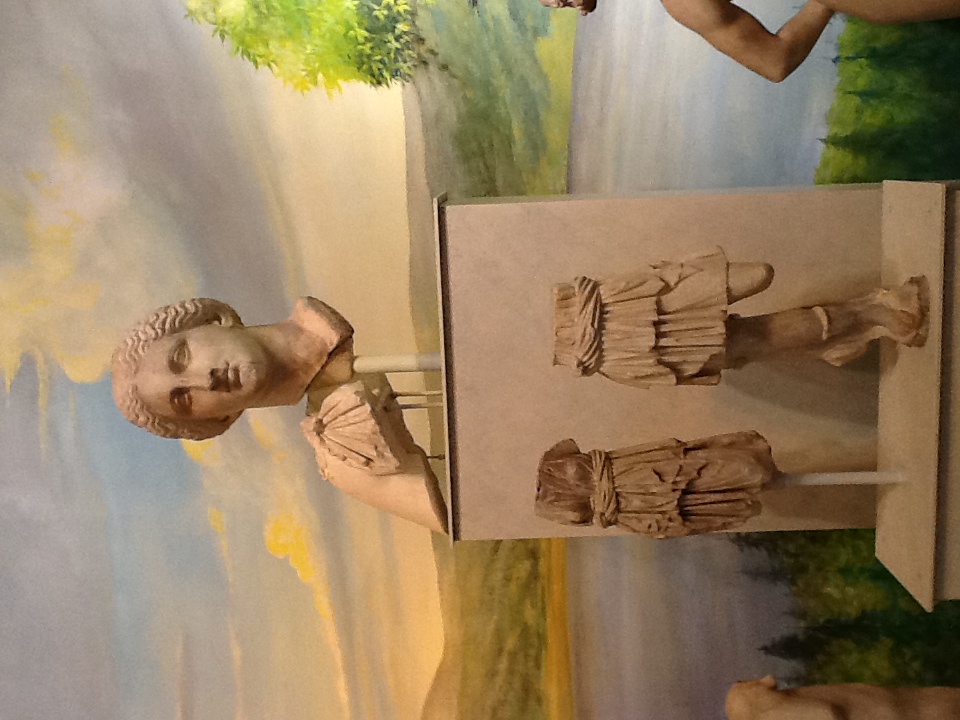
GREECE — Poor Greece, so beautiful, so lovely, and so fragile to economic decisions that seem far removed from the people themselves.

Headless Statue by  Kyriakos Haralambdis
(translated by Kimon Friar). Hellenic Quarterly, Summer, 2000.

I have heard that your head
has been sent as a sacred skull to Constantinople.
Byzantine emperors manfully
placed you in red and gold.
The star of God’s Holy Wisdom
studies you and covers you.
And you, a woman, in a late hour
open your closed eyelashes.
You look fruitlessly, for we have gone away on a journey,
and you call out to us “come to my guest room.”
But we, artful head, seek your whole body,
in a city that resembles you. If we succeed,
we shall call this bone our own.

Poor city, ten years in bed,
without the lamp stead at our head,
as headless and cold as lead.

I don’t want to be distressed by seeing you, my bird.
I know you are absent, all has been heard.
Your skill in a huge box
embellished with small serpents and small stars
all made of paper, seed of manliness
travelled around the world to be placed
in houses of ill repute and cabarets
in the sky of the city where it reigned.

You who hear me, do not misunderstand me.
Such things serve the natural remembrance of mortals,
others the cleansing of memory.

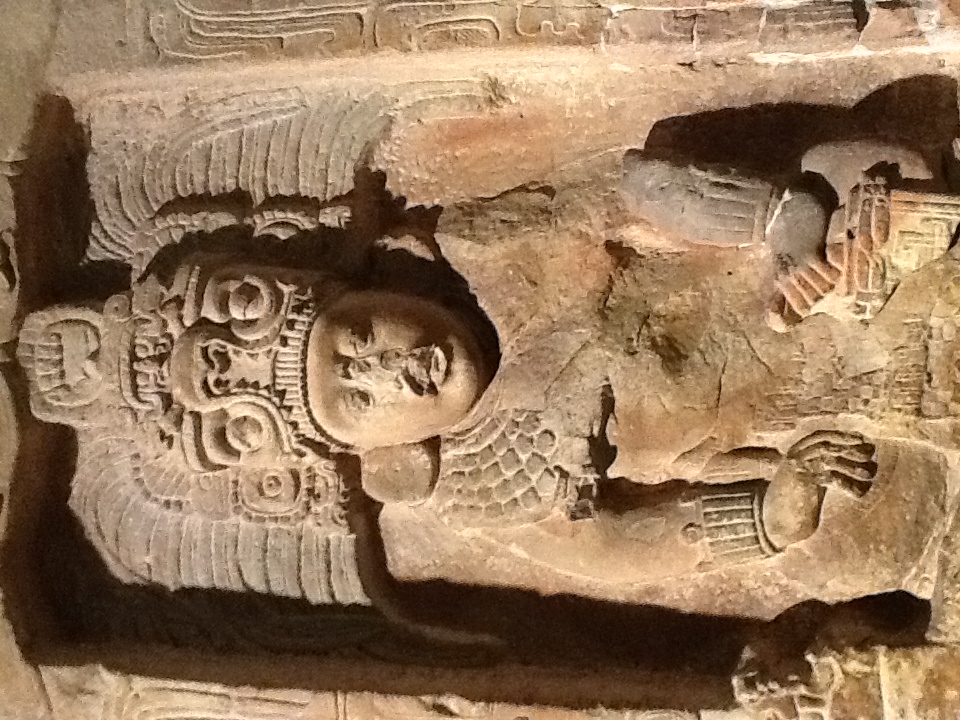
MEXICO— one murder is always too many. Poor Mexico is  far beyond too many, far beyond human understanding, far beyond humanity.

“And every time they opened, it was night and the moon, while they climbed the great terraced steps, his head hanging down backward now, and up at the top were the bonfires, red columns of perfumed smoke, and suddenly he saw the red stone, shiny with the blood dripping off it, and the spinning arcs cut by the feet of the victim whom they pulled off to throw him rolling down the north steps. With a last hope he shut his lids tightly, moaning to wake up. For a second he thought he had gotten there, because once more he was immobile in the bed, except that his head was hanging down off it, swinging. But he smelled death, and when he opened his eyes he saw the blood-soaked fig­ure of the executioner-priest coming toward him with the stone knife in his hand. He managed to close his eyelids again, although he knew now he was not going to wake up, that he was awake, that the marvelous dream had been the other, absurd as all dreams are-a dream in which he was going through the strange avenues of an astonishing city, with green and red lights that burned without fire or smoke, on an enormous metal insect that whirred away between his legs. In the infinite he of the dream, they had also picked him up off the ground, some­one had approached him also with a knife in his hand, approached him who was lying face up, face up with his eyes closed between the bonfires on the steps.”  from “The Night Face-Up” by Julio Cortazar
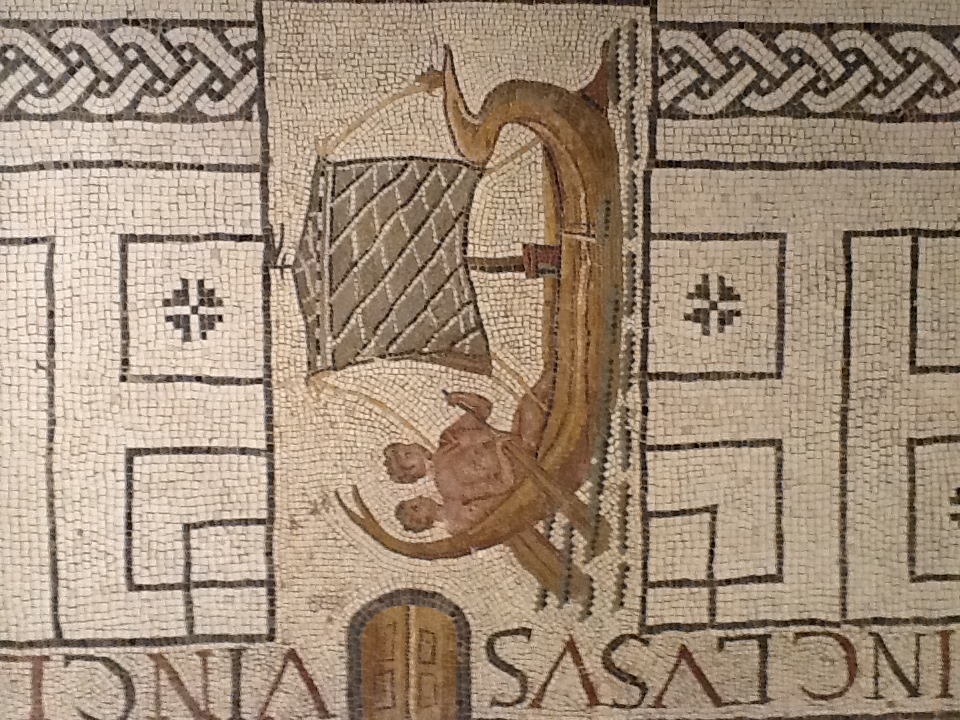
ROME–And on a happier note, this from Catallus:

–5–

Let’s you and me live it up, my Lesbia,

and make some love, and let old cranks

go cheap talk their fool heads off.
Maybe suns can set and come back up again,

but once the brief light goes out on us

the night’s one long sleep forever.

First give me a kiss, a thousand kisses,

then a hundred, and then a thousand more,

then another hundred, and another thousand,

and keep kissing and kissing me so many times

we get all mixed up and can’t count anymore,

that way nobody can give us the evil eye

trying to figure how many kisses we’ve got.

I spent the majority of my visit in the Greco-Roman-Estruscan galleries, though I took a guided tour through the Meso-American gallery and the Southwest American gallery.  These dealt with the ancient peoples of the Yucatan peninsula and the southwest corner of what is now the United States.  Current theories claim that these wide reaching people actually traded and influenced one another over the centuries: the Incans, the Mayans, the Hopi, the Pueblo.  Yet they too–the Mayan cities seem so much more advanced than the Athens, Roman, Cairo counterparts–all were subsumed by human violence and  human greed.

It is an impressive museum, The University of Pennsylvania Museum of Archaeology and Anthropology.  But it left me feeling a bit desperate…a little hopeless…a little sad.  Sad, except for the women in the photographic mural whose eyes are so beguiling. Perhaps the poets are right all along, and it is beauty and love that will carry us through.
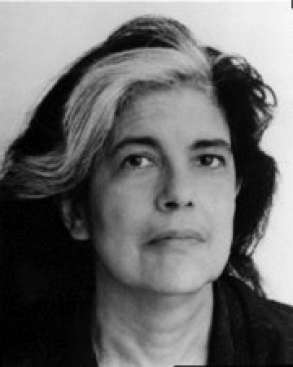
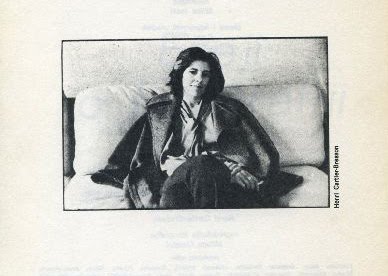
Susan Sontag

I have always been fascinated by Susan Sontag. I envied her seeming crystal-sharp intelligence, her confidence in her opinions, her strength in writing, her omnivorous reading.  While I certainly have not read everything of hers, I have read quite a lot.  Once as a reader for The Franklin Library’s First Editions, I read the galleys of The Volcano Lover, her historical novel about the triangle between Sir William Hamilton, his wife Emma and Lord Nelson. It was the first piece of fiction of hers I had read. Like all of her writing it was intelligent, sharp and incisive.  And it had a truth that can only be found in fiction. Her following novel, In America, was not as satisfying for me–it seemed undone.  Or perhaps overdone, might be a better word, for the brilliant characters and storyline are over-examined and over analyzed as if Henry James were writing the screenplays for MadMan.  The novel is crushed by the intelligence.

However, I have read much of her non-fiction: Against Interpretation and Other Essays (1966),  On Photography (1977),  Illness as Metaphor and AIDS and Its Metaphors (1978 and 1988) and Regarding the Pain of Others (2003). (The Illness as Metaphor book was revamped in 1988 in order to address the scourge that was AIDS in the 1980’s.)  It is this non-fiction, her essays that make her an major figure of the late 20th-century.  It is in these essays that the true brilliance shines. Hers is a hard intelligence, but a very clear intelligence.  Her Against Interpretation gave readers an argument “against what something means” and for “what something is.” It includes insightful–and new–readings of  Sartre, of Beckett, of Bresson, among others.  Illness as Metaphor moves us from the tuberculosis and consumption that affected so many of the 19th century’s literary characters and creators to the cancer that became the overriding metaphor of the twentieth.  On Photography discusses the relatively new art of photography–only since the mid-19th century– in a way that will change how even the most amateur viewer–myself– views photographs again.  And at the beginning of the second Iraq war, I once gave a section of Regarding the Pain of Others to a class of 18-year olds, and it surprised me how well it worked with theml.

A few years ago, I went to the Brooklyn Art Museum to see a photographic exhibit on Sontag by Annie Liebovitz, perhaps America’s most famous and celebrated portraitist at the time. Liebovitz–who had had a decades long romantic relationship with Sontag–captured Sontag’s final years, among family and friends. Many of them were during her final days, during her final battle with cancer. To this day I don’t know if I am more affected by the words Sontag wrote or the images of her that I saw that day.  Both, suggest an admirable toughness and wit.

What I also don’t know is why today, the NYTimes decided to publish a sampler of Sontag’s work in the Week in Review section of the Sunday paper. There is no anniversary that I know of. It just appeared.  But good, it made for a good read on a Sunday morning, and a good afternoon going through some old books. The excerpts are just that–excerpts–but they show the range, the depth and the honesty of her writing and her mind.  The article is below: enjoy it.

Sontag by Henri Cartier-Bresson

Opinion

A Sontag Sampler

By SUSAN SONTAG
Published: March 31, 2012

Art Is Boring

Schopenhauer ranks boredom with “pain” as one of the twin evils of life. (Pain for have-nots, boredom for haves — it’s a question of affluence.)

People say “it’s boring” — as if that were a final standard of appeal, and no work of art had the right to bore us. But most of the interesting art of our time is boring.

Jasper Johns is boring. Beckett is boring, Robbe-Grillet is boring. Etc. Etc.

Maybe art has to be boring, now. (This doesn’t mean that boring art is necessarily good — obviously.) We should not expect art to entertain or divert anymore. At least, not high art. Boredom is a function of attention. We are learning new modes of attention — say, favoring the ear more than the eye — but so long as we work within the old attention-frame we find X boring … e.g. listening for sense rather than sound (being too message-oriented).

If we become bored, we should ask if we are operating in the right frame of attention. Or — maybe we are operating in one right frame, where we should be operating in two simultaneously, thus halving the load on each (as sense and sound).

On Intelligence

I don’t care about someone being intelligent; any situation between people, when they are really human with each other, produces “intelligence.”

Why I Write

There is no one right way to experience what I’ve written.

I write — and talk — in order to find out what I think.

But that doesn’t mean “I” “really” “think” that. It only means that is my-thought-when-writing (or when- talking). If I’d written another day, or in another conversation, “I” might have “thought” differently.

This is what I meant when I said Thursday evening to that offensive twerp who came up after that panel at MoMA to complain about my attack on [the American playwright Edward] Albee: “I don’t claim my opinions are right,” or “just because I have opinions doesn’t mean I’m right.”

Love and Disease

Being in love (l’amour fou) a pathological variant of loving. Being in love = addiction, obsession, exclusion of others, insatiable demand for presence, paralysis of other interests and activities. A disease of love, a fever (therefore exalting). One “falls” in love. But this is one disease which, if one must have it, is better to have often rather than infrequently. It’s less mad to fall in love often (less inaccurate for there are many wonderful people in the world) than only two or three times in one’s life. Or maybe it’s better always to be in love with several people at any given time.

On Licorice, Bach, Jews and Penknives

Things I like: fires, Venice, tequila, sunsets, babies, silent films, heights, coarse salt, top hats, large long- haired dogs, ship models, cinnamon, goose down quilts, pocket watches, the smell of newly mown grass, linen, Bach, Louis XIII furniture, sushi, microscopes, large rooms, boots, drinking water, maple sugar candy.

Things I dislike: sleeping in an apartment alone, cold weather, couples, football games, swimming, anchovies, mustaches, cats, umbrellas, being photographed, the taste of licorice, washing my hair (or having it washed), wearing a wristwatch, giving a lecture, cigars, writing letters, taking showers, Robert Frost, German food.

Things I like: ivory, sweaters, architectural drawings, urinating, pizza (the Roman bread), staying in hotels, paper clips, the color blue, leather belts, making lists, wagon-lits, paying bills, caves, watching ice-skating, asking questions, taking taxis, Benin art, green apples, office furniture, Jews, eucalyptus trees, penknives, aphorisms, hands.

Things I dislike: television, baked beans, hirsute men, paperback books, standing, card games, dirty or disorderly apartments, flat pillows, being in the sun, Ezra Pound, freckles, violence in movies, having drops put in my eyes, meatloaf, painted nails, suicide, licking envelopes, ketchup, traversins [“bolsters”], nose drops, Coca-Cola, alcoholics, taking photographs.

This material is excerpted and adapted from the forthcoming book “As Consciousness Is Harnessed to Flesh: Journals and Notebooks, 1964-1980,” by Susan Sontag, edited by David Rieff.  A version of this was originally published in the NEW YORK TIMES, April 1, 2012.

Canadian Pennies, the Nation of Texas and a poem

April is National Poetry Month.  All sorts of organizations, schools, and institutions have all sorts of things planned to bring poetry into American life. But I heard a pretty cool one on March 30, a few days before it begins.

All Things Considered on NPR had done a story on the demise of the Canadian penny. (Canada is one of ten countries to jettison its lower denomination coins because they are just too expensive to make. The cost to make a U.S. penny is 2.41 cents–a losing proposition, but the U.S. has no immediate for its elimination, despite yearly pleas to do so. There must be a very strong “penny lobby.” ) All Things Considered had also done a faux “what-if” story on Texas seceding from the union and forming its own nation.  There were all kinds of speakers–serious and not–who took part in the piece.  My favorite was Kinky Friedman, the novelist, humorist, rockabilly guitarist who ran for governor a few years back. As foreign minister, Friedman felt that Texas should send a delegation to third world countries to teach the women how to have “big hair”!

So what has this to do with poetry?

Well, aside from its normal news day, All Things Considered also has taken on a poet in residence who follows the news team through a given day and then at the end must make up a poem on some aspect of that particular news day.

Yesterday there was Kevin Young  as the “news poet.” His task was to write a poem about anything he had witnessed, heard, learned throughout the day, and he chose the Texas story and the Canadian penny story. Here is the result, his poem “Anthem”:

ANTHEM

Kevin Young, NPR's Poet in Residence

Life is a near
death experience.

You can go
to hell, I’m goin

to Texas. It costs
more than a penny

to make a penny.
A dollar for your

thoughts, and a dream.
People have to breathe

where they live.
A town big

as her hair.
Aren’t there more

worlds than three?
Texas is finally

free, but not its lunch.
Cleave
can mean

to sunder
or to meet. The threat

must be imminent.
Look and see—

the daffodils, the rain sage
upright, the high

desert, fire warnings,
the scorched trees. Cloven,

clove, clave, cleavage,
cleft. Every day’s
a lottery. Hoods,
blood. The death

of the Canadian penny
means we all may need

to round up. Leaves,
left. Bereave,

bereft.

To understand many of the references you would have to have had heard the “TEXAS-AS-NATION” original story. (Click on link above). I was fortunate; I heard both the Texas story and then the poem.  (It seems he threw in a line about the Mega-Millions lottery madness that was happening that day, as well.) What a great way to end the week and to end the month.  To hear Kevin Young read the poem, click here. It’s pretty good for a poem that was made to order.

Friday Film Review–Manhattan

My sister is flying to Edinburgh today and I happened to be searching for a particular clip from the movie Manhattan.

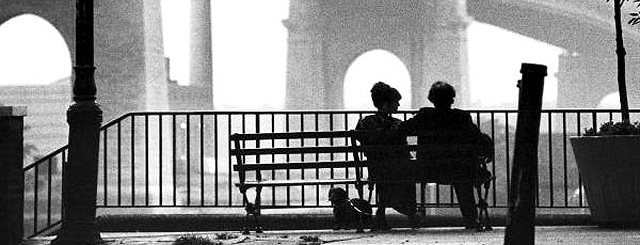
You know the opening of Manhattan where Woody Allen is doing a voice over, purportedly writing a book about his love for the city? The gorgeous photography–Woody had the legendary cinematographer Gordon Willis as his cameraman–the pulsating Gershwin music, the edgy decision to film in black and white, all work to make this perhaps Allen’s most beautiful film and certainly his greatest paean to the energy, diversity, pulse of New York City.

If you don’t know what I am referring to, check out the opening clip here:

The simplicity is its beauty.  There are no screen credits, no rolling text, just this gorgeous black-and-white montage of Manhattan.  The title of the movie itself appears as a vertical, flashing neon sign, one that you might not notice because it is so incorporated within the segment.

Quickly, the plot of the story is this: Isaac (Woody Allen), a writer whose ex-wife is publishing a tell-all memoir of their marriage, is dating a high-school girl (Mariel Hemingway).  Granted that in hind-sight this relationship feels a bit uncomfortable, but Isaac is in fact the moral center of the film (and his high-school girl-friend perhaps the most mature and un-jaded of all the characters). His dating the young girl pales as an issue when juxtaposed against the shallownesss, the deceit and the disloyalty of the other main characters.  Isaac’s friend, Yale, is having an affair with Mary, played by Diane Keaton, in what seems to be a reprise of her Annie Hall role–all intellectual charm and goofiness. (Manhattan came out two years after Annie Hall.)  She is endearing here as well, but it is basically the same character. Anyway, Isaac is attracted to Mary and Mary to him, but he will not act on it because she is having an affair/relationship with his best friend. The fact that his best friend is cheating on his wife who is also Isaac’s friend is also troubling to him.  Not until the affair between Yale and Mary ends, does Isaac allow himself to act on his feelings towards her.

I won’t spoil it, but there is more  treachery and disloyalty to come, and towards the end of the film, Isaac bursts into the classroom where Yale is teaching and makes an impassioned speech for morality. It is one of those movie moments when the action, the story, the jokes stop and someone makes an intelligent plea for humanity and for decency.

But the story, in many ways, is secondary for me with the film.  It is simply beautiful. The black-and-white photography mixed with George Gershwin’s exhilarating music is majestic, perfect.  It might not be far off to say that no one can make a city look better than Woody Allen.  Consider his recent efforts outside New York:  Paris in Midnight in Paris, Barcelona in Vicki Christina Barcelona, and London in Match Point.  In each film, the particular city seems a character in itself–a beautiful, energetic, lively character. A city’s tourist bureau would love to have Woody Allen film their promotional releases. He has a certain means of capturing the magic, the gestalt of a place. (Rome is next in his upcoming film, To Rome with Love.)

I used to pop Manhattan in the VCR/DVD whenever I was feeling particularly blue, for watching it somehow made me feel better.  I don’t know why–it really is rather depressing on the whole–but Isaac’s last speech to Yale is something special. Or perhaps the energy of Manhattan itself is what affects me, and my personal malaise at the time proves to be no match for that vigor and life pulse.

Anyway, as I said, my sister is flying to Edinburgh today and I stumbled upon this wonderful video by accident. Someone has taken the opening scene of Manhattan, and substituted black and white photos of Edinburgh.  Woody Allen’s voice over–where he praises Manhattan–is taken up verbatim except instead of Woody’s unmistakeable New York accent it is a strong Scottish voice and the word “New York” is replaced with the word “Edinburgh.”  Here it is below. Enjoy it.


“It is always a matter, my darling, of life and death…”

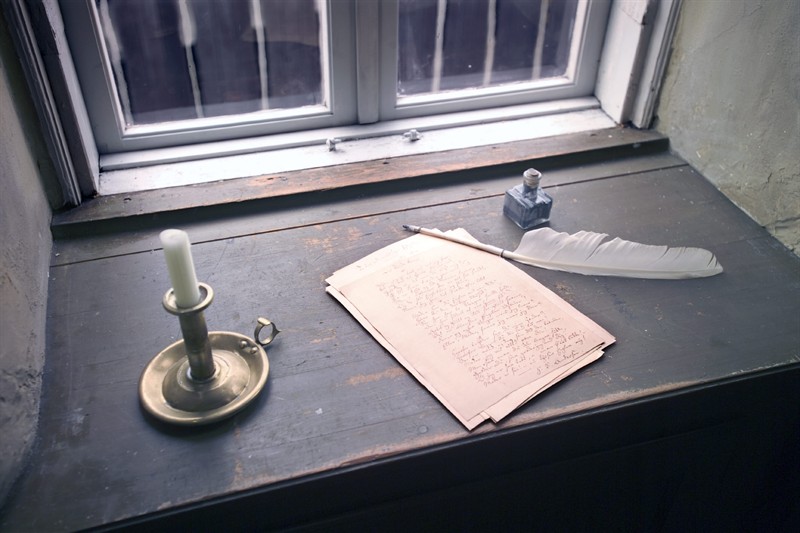
Hans Christian Andersen's Window-sill Desk

“It is always a matter, my darling,
Of life or death, as I had forgotten.  I wish
What I wished you before, but harder.”

I teach eighteen year old boys. They are very bright, quite talented, and well-situated so as to take advantage of the most amazing opportunities.  And yet they are still eighteen years old–filled with false bravado and insecurities, dreams and fears, uncertainties and confusion.

And this is the week!

In the States, April 1 is the arbitrary deadline that most colleges and universities set for informing applicants whether they have been accepted or rejected. The three or four days beforehand is a time period when these students believe that their lives sit in a balance.  I try to tell them–not flippantly–that it is not the end of the world, that perhaps rejection from one school and acceptance to a lesser-desired one might be the best thing to happen to them.  Who can tell?

But I have to remember as the poet says, at that age “it is always a matter of life and death.”

I don’t envy them their angst.  And I don’t downplay it. It is very real–and almost palpable in the school hallways. Instead I give them this poem, which I think is good for them to know.

The Writer by Richard Wilbur

In her room at the prow of the house
Where light breaks, and the windows are tossed with linden,
My daughter is writing a story.

I pause in the stairwell, hearing
From her shut door a commotion of typewriter-keys
Like a chain hauled over a gunwale.

Young as she is, the stuff
Of her life is a great cargo, and some of it heavy:
I wish her a lucky passage.

But now it is she who pauses,
As if to reject my thought and its easy figure.
A stillness greatens, in which

The whole house seems to be thinking,
And then she is at it again with a bunched clamor
Of strokes, and again is silent.

I remember the dazed starling
Which was trapped in that very room, two years ago;
How we stole in, lifted a sash

And retreated, not to affright it;
And how for a helpless hour, through the crack of the door,
We watched the sleek, wild, dark

And iridescent creature
Batter against the brilliance, drop like a glove
To the hard floor, or the desk-top,

And wait then, humped and bloody,
For the wits to try it again; and how our spirits
Rose when, suddenly sure,

It lifted off from a chair-back,
Beating a smooth course for the right window
And clearing the sill of the world.

It is always a matter, my darling,
Of life or death, as I had forgotten.  I wish
What I wished you before, but harder.

There are two important pieces in that last verse.  One, I realize that for them everything–a university rejection, a break-up with a girlfriend, a strike-out when a game is on the line–everything is “a matter of life or death.”  The second is that wish that the speaker “wished you before, but harder.”  Undoubtedly, they will be battered and smacked up against hard obstacles. Even the most fortunate among them–and they are mostly fortunate–will have moments where things seem hopeless.  And so, like the poet, I wish them well, I wish them smooth sailing, and I wish it even harder.

The difficulty of thinking…the ease of not.

Bertrand Russell once said that people would do almost anything to avoid having to think. And we do. Consider how we go through most of our days.  Rise, commute, work, commute, dine, sleep. Certainly there are vacillating degrees of how purposefully we interact with our own lives, but mostly, I would say, we do things by rote.  For the most part, the majority of us do not “live our lives deliberately” as Thoreau advised us to–we would make ourselves mad if we did–but what are we sacrificing?

Samuel Beckett wrote that the routine, the habit, the treadmill of our lives is a way of deadening the pain of existence (how wonderfully Beckettian!); breaking out of the routine, the habit, the treadmill is exciting and might mask the pain, but it is temporary and not without risks.  To think deliberately is indeed difficult. But it is what makes us who we are. Our thinking is what separates us from others, what individualizes us.  There is a second kind of truth in the Cartesian “I think therefore I am.”  It is not simply a statement of existence, but one of uniqueness as well, an emphasis on the “I.”  And if we choose not to think, are we waiving our individuality to become simply a part of the herd?

In politics, for example, do we think or do we react? Do we consider the world around us or do we merely accept what we have been trained to accept? Are we so entrenched in our “camps” that we allow their ideas to immediately become ours without the trouble of thinking? Do we even have a personal philosophy?  How many of us could state what it is?  What do we believe in?  When have we last THOUGHT about what we believe?

The avoidance of thinking is hardly a 21st-century phenomenon–it just seems easier to do these days.  The opportunities for distraction, the ease in which we can fill our lives with noise, makes it all too easy to avoid stopping to think.  And like most habits, once we have learned to “not think,” it becomes a very hard habit to break.

But again, what are we sacrificing?

I’m not sure, but I’ll think about it.

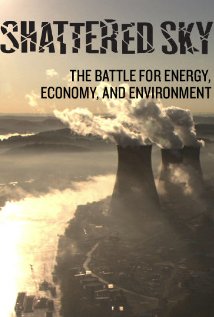
Shattered Sky–An Important and Hopeful Documentary by Steve Dorst and Dan Evans

Tonight I was lucky enough to attend a premier of the film Shattered Sky in Washington D.C. as part of the closing night of the Environmental Film Festival.  (Full disclosure: I was invited because I am friends with one of the filmmakers, Dan Evans.)  Held in the majestic Carnegie Institution for Science at 16th and P streets with a following reception at the Bar at the Hotel Rouge, the film seemed like a good way to spend a Sunday night and catch up with some friends I haven’t seen in a while.

I am so glad I went.

The film–which will be shown on PBS stations in the fall–deals with two distinct environmental situations, separated by four decades. In the 1970s, when the hole in the ozone layer was first detected, the science showed that CFCs were the main culprit, and America and Americans led the way to curtail the use of these photo-carbons around the globe. Fighting against an indifferent world, many of whom had financial interests in the status quo, the EPA–under the Reagan administration–pressed its case hard. The climax of this fight occurs in a marathon session in Montreal when America held sway and the rest of the world finally signed on to greatly limit the use of these ozone-depleting agents. The film  celebrates this moment in American leadership, touting the efforts of Johnson, Nixon, Carter and Reagan admnistrations. It is this battle–and the victory–that is the crux of the film.

Now fast forward, thirty years.  Climate-change is today presenting even more dire predictions. But the topic has become a political tug-of-war.  With the “ozone” problem, there seemed to be immediate repercussions for the public–such as skin cancer and cataracts–and the public made its voice  heard through the marketplace, refusing to buy aerosol products, for instance, and forcing industry’s hand to come up with alternatives. The effects of climate-change, however,  are not so immediate–and the possibilities of market pressures from the public are unlikely given our modern way of life. Plus, while we are enjoying this balmy spring, it is hard to imagine immediate  down-side.  But the down-side is there, and it is drastic. The film deliberately tries to skirt partisan politics; instead, it asks for America to take on the kind of leadership that it showed in the “ozone” battle many years ago.  And it asks, because the situation is urgent.

Unlike many environmental documentaries, however, Shattered Sky does not leave one feeling helpless and doomed, but instead is full of hope. For if America was once able to forget its political differences and  fight together to counter an environmental disaster such as the depletion of the ozone layer, it can certainly rise to the occasion once more.

The science is there.  Those who oppose it, who try to find holes in the facts, do so for other reasons than truth, reasons that often deal with economy, industry, and self-interest. The film is riveting, rational and cautiously hopeful, even as it recognizes the possibility and the consequences of no action at all. Check out the film’s web site for more information.  Check out its Facebook page. And more importantly try to check out the film.

The Shattered Sky web site is here: http://www.shatteredsky.com/

The IMDB review is here: http://www.imdb.com/title/tt1795650/

Letter-writing, letters, Beckett and love

About five years ago, I traveled to Durban, South Africa.  I flew direct from Washington, D.C. to Johannesburg and then a short flight from Johannesburg to Durban. It is a grueling flight–19 hours in the air and plenty more in airports.  But during the flight, I read volume one of The Letters of Samuel Beckett, 1929-1940.  I must admit I was enthralled–and may be the only person to have read the nearly 900-page collection in one sitting. Nevertheless, three years later I am now reading volume two ( The Letters of Samuel Beckett, 1941-1956).  Certainly there is a touch of the voyeur in reading another’s letters, and, for me, not a little hero-worship in reading the letters of Beckett as he casually mentions Jack Yeats, Sartre, de Beauvoir, Nora Joyce, etc.  (The first letter in this collection is a postcard that he had sent to Joyce, a pre-printed, government regulated correspondence limited to family news because of the war.  Beckett sent the postcard from Paris to the Joyces in Switzerland, saying that he and Suzanne were all right.  He wrote it on January 12, 1941 and it arrived in Switzerland on the 17th. Joyce never received it, however, having died on the 13th, the day after Beckett wrote it. )

Anyway besides the snoopiness and the adolescent-like hero worship, the letters have me thinking of correspondence in general.  Except for writing thank-you notes –a good habit I learned from my father and my uncle–most of my correspondence now is through e-mail. Even the majority of my manuscript submissions are done electronically with the cover letter included in the submission.  Yet there is something about letter writing I miss.

A love letter, or any kind of letter for that matter, is so much more intriguing to receive–and more fulfilling to write–than a text or an e-mail. During a 10-day trip to Paris, I once wrote fourteen letters back home to the love of my life. I can still see the thin hotel stationery, the blue, white and red airmail envelopes, the soft lobby light in the ragged hotel under which I poured out my soul. Today, those letters probably mean more to me than to the person that received them. They capture a unique moment in my life, an amber-encased slice of who I once was.

In that sense,  I take pleasure  in reading  letters that I have written or received in the past–they transport me to where and who I was at the time they were written.

(Perhaps  the most beautiful love story I have ever read is by an Irish novelist named Niall Williams entitled Four Letters of Love.  It is a wonderful novel that revolves around letter writing–as well as around painting, fishing, the Aran Islands, death, heartbreak and redemptive love.)

What about you? Have you  given up on snail-mail completely? I worry about the impermanence of all our correspondence, of the ephemeral nature of e-mail and texting. True, they say that every stroke of your keyboard can ultimately be retrieved and that nothing in cyberspace really disappears, but are the biographers and historians of the future going to have access to these? Is the estate of a future Samuel Beckett going to allow some academic to sift through the computer files –deleted and saved–of the person whose name is entrusted to them?  I cannot say. But I do know the thrill of opening an envelope, of slipping out a hard-stock card, sheets of creamy stationery, or ripped pages of loose-leaf.  Am I simply missing some golden-hazed memory or have we truly lost something special?

E-mail me what you think.  Hah!

Book Review: What We Talk About When We Talk About Anne Frank by Nathan Englander

  I was prepared not to like this book.  The hype was too much.  I had read a “life-style” piece in the NYTimes Metropolitan section about Englander, an interview with him in The Guardian,  a front page review in the NYTimes Sunday Book Review, another in the London Review of Books, and a handful of smaller reviews. The title and the author seemed to be everywhere.  And yet, I was wrong.  The hype was deserved–the eight stories in the collection are gem-like in their perfection. Solid, thoughtful, inventive, poignant and droll.

The title of the collection famously alludes to Raymond Carver’s story and collection, What We Talk About When We Talk About Love.  In Englander’s title story two couples sit around in a sunny kitchen drinking hard–just as they did in Carver’s story. The difference is that we are not in Carver’s Mid-West; we are in Florida, and Englander’s two couples are a secular Jewish couple who live there and a Hasidic couple from Israel, visiting after many years.  The conversation is tense, the husband uneasy with these Hasidic guests that he has just met, and the ending surprising and sad. (Go here to read Carver’s original story: “What we Talk About… and here to read it as it finally appeared with editor Gordon Lish’s revisions, “What We Talk About…”)

Several of the reviews I read mentioned how Englander’s stories seem to channel Kafka through Woody Allen, and the example they site is the story “Peep Show.” In fact, this Kafka/Woody Allen connection is what drew me to the collection.  In this particular story, a secular Jewish man walks into a peep show, advertising “live girls” and gets 5 tokens. Inserting the first token, he encounters several women, one of whom particularly arouses him. After the partition closes, he deposits another token, but this time, when the barrier opens, it reveals three rabbis from his past who begin to scold him; subsequent tokens reveal his scolding mother, his pregnant wife, and himself.

There are other stories that touch have a similar absurdity and wryness–particularly one about a gang of Long Island Jewish boys dismally failing to wreak revenge on an anti-Semitic bully and another about a summer camp for senior citizens–but overall this is not the tone of the collection. The final story “Free Fruit for Young Widows” and the second story “Sister Hills”  are memorable and distinct vignettes of life in Jerusalem.  Both have a historical sweep and a personal sadness. Both are extraordinary.

“The Reader” and “Everything I Know About My Family on My Mother’s Side” seem the most personal of the collection, and they too are brilliant. The language in these–as in all the stories–is clean and efficient, but beautiful and evocative.

As I said, I was a little put off by all the hype. But it was well deserved.  These are stories that will stay with me for a while and which I will return to often.

20 Greatest Irish Movies from the past 25 years

Happy St. Patrick’s Day to one and all.  It is glorious here–70 degrees and sunny when we usually have grey skies and sleet.

Here’s something to get you talking.

Twenty Greatest Irish Movies from the past 25 years:

20. Cal (1984) –young IRA man falls in love with older woman (Helen Mirren) whose husband , a Protestant cop, had been killed by IRA.   Good movie. Better novel.

19. Once (2006) — sweet story, sweet players, sweet music. And the ending is perfect.

18. The Secret of Roan Inish (1994)–Beautiful story and a hauntingly beautiful Eileen Colgan

17. The General (1998)–Brendan Gleeson as Dublin crime boss

16. The Guard (2011)–Brendan Gleeson/Don Cheadle

15. Hunger (2008) — Michael Fassbender as Bobby Sands

14. The Snapper (1993)–Colm Meany in the 2nd of the Barrytown Trilogy by Roddy Doyle

13. The Boxer (1997)–Daniel Day-Lewis

12. The Butcher Boy (1997)–Good film of a great novel.  And Sinead O’Connor as the Virgin Mary!

11. The Dead (1987) — Angelica Huston’s greatest moment.

10. Breakfast on Pluto (2005) — Cillian Murphy’s breakout role…as a transvestite in war-torn Belfast and London.

9. The Van (1996) –Colm Meany and the Irish World Cup victory. Last of the Barrytown Trilogy.

8. The Field (1990) — Richard Harris.  Powerful and tragic.

7.   Some Mother’s Son (1996)–Helen Mirren in a story of the hunger strikers

6. Waking Ned Devine (1998)–Ian Bannen/David Kelly

5. Into the West (1992) — Two boys and a horse.  Gabriel Byrne, David Kelly

4. In the Name of the Father–Daniel Day Lewis/Peter Postlethwaite

3. Michael Collins (1996) –Liam Neeson/Alan Rickman

2. The Commitments (1991)–Hardest Working Band in the World! 1st of the Barrytown Trilogy.  Great music, fun story.

1. My Left Foot (1989) –Daniel Day-Lewis. Simply wonderful. Beautiful, funny, inspiring..