 Whiskey cracking on ice
illustration 2016 by jpbohannon
“The light music of whiskey falling into a glass—an agreeable interlude.”
James Joyce (1882-1941)
Whiskey cracking on ice
“The light music of whiskey falling into a glass—an agreeable interlude.”
James Joyce (1882-1941)
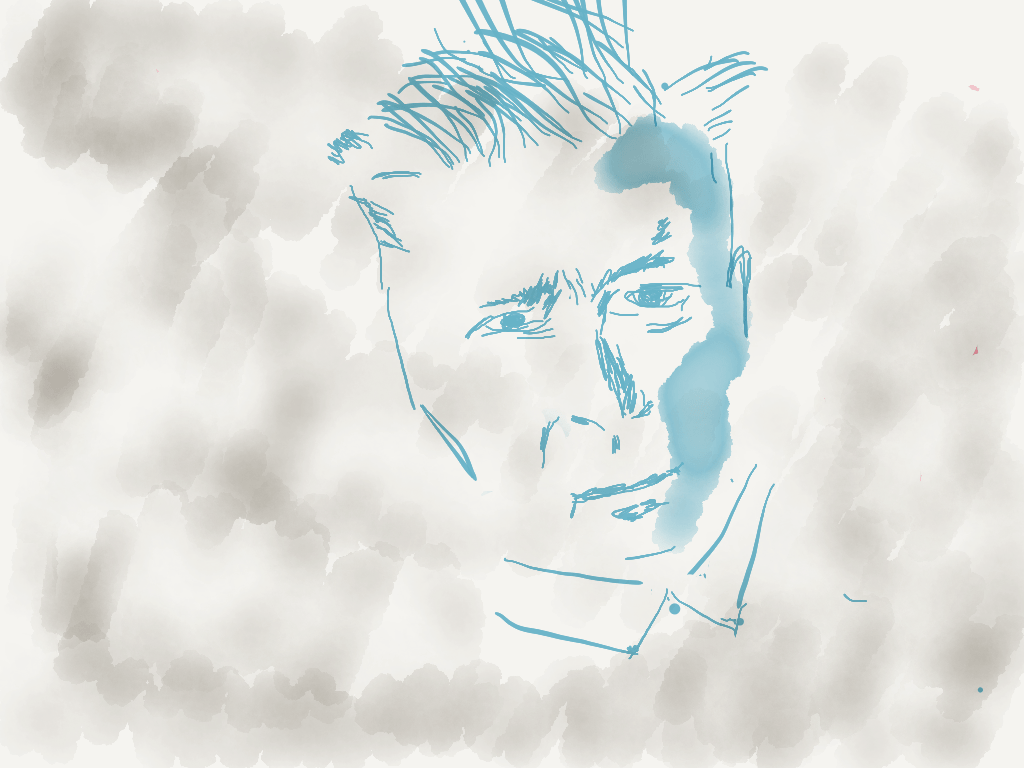
“David Lynch” illustration 2016 by jpbohannon
“A good 65% of the people in metropolitan bus terminals between the hours of midnight and 6:00 A.M. tend to qualify as [David] Lynchian figures–flamboyantly unattractive, enfeebled, grotesque, freighted with a woe out of all proportion to evident circumstances.”
David Foster Wallace defining “Lynchian”as quoted in
David Lynch: The Man from Another Place by David Lim
Ca’ the yowes to the knowes,
Ca’ them wha the heather grows
Ca’ them wha the burnie rows,
My bonie dearie.
Hark! the mavis’ evening sang
Sounding Cluden’s woods amang,
Then a-fauldin let us gang,
My bonie dearie.
We’ll gae down by Cluden side,
Thro’ the hazels spreading wide,
O’er the waves that sweetly glide
To the moon sae clearly.
Yonder Cluden’s silent towers,
Where at moonshine midnight hours,
O’er the dewy-bending flowers,
Fairies dance sae cheery.
Ghaist nor bogle shalt thou fear;
Thou ‘rt to love and Heaven sae dear,
Nocht of ill may come thee near,
My bonie dearie.
Fair and lovely as thou art,
Thou hast stown my very heart;
I can die—but canna part,
My bonie dearie.
I first became interested in Robert Burns’ poetry as a young man. My father—who was not a particularly “learned” man but who was an
inveterate reader—would often recite snippets of his poems when I was a child, particularly “To a Louse” and “To a Mouse,” two of Burns’ more famous poems besides “Auld Lang Syne.”
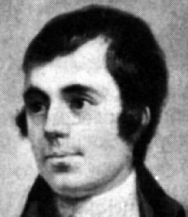
Robert Burns
I often have taken to heart my father’s repeated phrase “O would some power the giftie gie us to see ourselves as others see us.” And, of course, he loved to reassure us that “The best-laid plans o’ mice an’ men gang aft agley.”
My next encounter with Burns was at university, in a wonderful seminar on 18th-century British poetry. It was then that I discovered his full range, his politics and his romanticism, his life and his career, his Scots poems and his English poems.
And then he kept cropping up in a different facet of my life. Playing in a “Celtic folk band” for several decades, I kept encountering Burns’ poems set to music and recorded by some wonderful performers such as The Corries, Dougie MacLean, and Mary Black. (When I would perform a Burns’ song–usually “Green Grow the Rashes-o” or “Auld Lang Syne,” I often would introduce it by stating the many parallels that existed between my life and his, although mine was not quite as “rollicking.”)
I try to teach him in my Advanced Placement course, but I don’t think my enthusiasm is as contagious. Oh well. Maybe they’ll discover him when they are ready.
And so here is my third Video Poem. The first came from a published poem of mine, the second from a poem I have not even sent out yet, and now this by a canonical poet from the 18th century. Enjoy
I saw a friend of mine whom I rarely see anymore. We used to work closely together and were in each others’ company continually throughout the workday. I had an office next to hers, a class across the hall from her, and, at one time, a homeroom within her clay studio.
But times change, careers take different paths, and schedules get more and more hectic. And so, I rarely see her at all, maybe three or four times a quarter.
But I saw her a few weeks ago and she told me that she had spent that Sunday–a lovely, rainy fall day– making mushroom soup while the television in front of her ran the Katharine Hepburn-Spencer Tracy film, Desk Set.
The combination of the two intrigued me. And so I came up with the title “To a Woman Watching Desk Set while Making Mushroom Soup.” I loved it. I had nothing else but the title, but I loved the contrast of a fog of steam from a soup pot and the clarity of Hepburn and Tracy (in their first color film together.)
I played with the title for a while and then with the idea. I combined soup recipes with snippets from the film and with my own take on that legendary Hollywood couple.
I had my poem where I thought I wanted, and so I decided to make a film.
So here it is, enjoy. It is a work in progress in a technique that I am completely new at. (But I am enjoying it madly.)

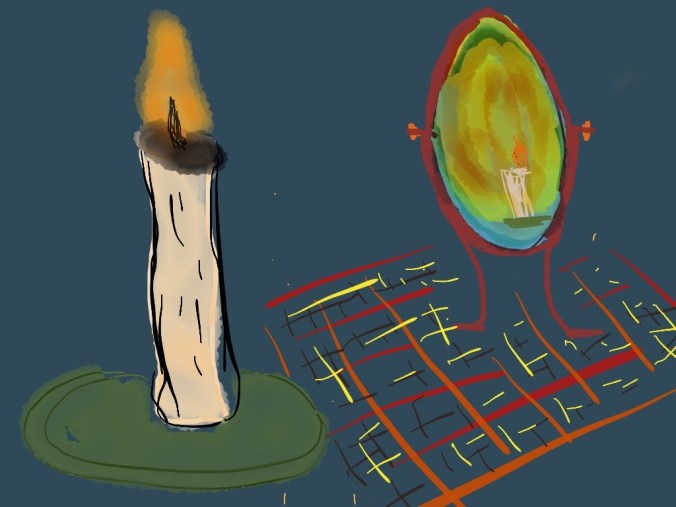
The Candle and the Mirror illustration 2015 by jpbohannon
“There are two ways of spreading light: to be the candle or the mirror that reflects it.”
Edith Wharton
Several years ago, I published a poem called “Tomak Stuffing” in an anthology called A Magical Summer. The beginnings of the poem had come from a quirky misreading. It was around Thanksgiving and someone had left me a text saying that she  was going “tomak stuffing.” She had texted hurriedly and meant to say that she was going “to make stuffing.”
I didn’t immediately pick up the mistake and asked her what indeed was actually involved in “tomak stuffing.”
Later, I decided to run with it, to make an entire world where “tomak stuffing” was an actual and important ritual, filled with wives’ tales and traditional lore
The poem was published in 2012.
I’d been thinking of the poem recently, so this week I put together a short four-minute video with various photos/paintings, with Enya’s version of “Na Laetha Geal M’óige” in the background and with me reading the poem itself.
I think of it as a Thanksgiving poem, but it really isn’t.
So here it is Tomak Stuffing: the video for your enjoyment:
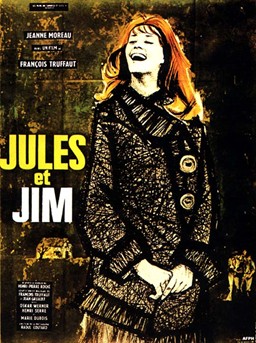
Poster for Jules et Jim
I have always envied that: going to a theater and watching a classic on the big screen. It doesn’t happen much where I am from.
Until recently, that is. One of the city’s major theaters began showing the newly mastered version of Carol Reed’s 1939 thriller The Third Man, and another theater was screening Truffaut’s Jules et Jim. I saw The Third Man earlier in the summer (which, by the way, is the first film I ever recorded on VHS, a long time ago when the local PBS was airing classic films at midnight.)
This past weekend, I saw Jules et Jim for the first time.
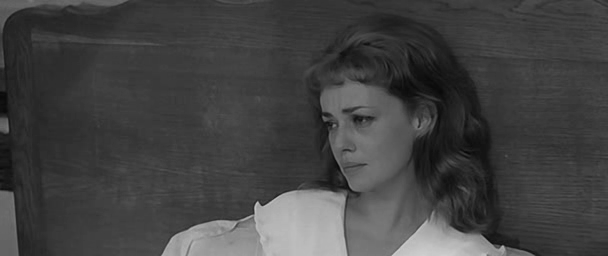
Jeanne Moreau as “Catherine” in Jules et Jim
And, as much as technical innovations defined the moment, so did the narratives. The films focused on youth, on iconoclastic characters outside the mainstream, and on ambiguity. One is never sure what to think at the end–and that is intentional.
Jules et Jim is basically the story of a love triangle. The film opens with a frenetic piece showing the carefree life of two friends, the French Jim and the Austrian, Jim. Jules is overly shy. Jim is a comfortable and adept womanizer.

Jim, Catherine, and Jules
(Serre, Moreau, and Werner)

Catherine and Jim
(Jeanne Moreau and Henri Serre)
in Jules et Jim
One day, another friend Albert introduces them to Catherine, a woman with a captivating smile and quirky personality.
When the normally shy Jules sees Catherine, he famously says to his playboy friend “Pas celle-là, Jim” (“Not this one, Jim”), asking that Jim does not use his charm to sweep this one away.

Jules and Catherine
(Oscar Werner and Jeanne Moreau)
in Jules et Jim.
Soon after, Jules and Catherine marry, but then World War I breaks out. Jules and Jim find themselves in opposing armies and pray that they don’t kill each other.
But Truffaut focuses on more personal conflicts than the global cataclysm of World War I. After the war, Catherine is quite unhappy in her marriage and in her motherhood. She has several affairs, one of which is with Albert who originally introduced her to Jules and Jim and who now is recuperating in the village below. (There is a hint that her child is actually his and not Jules’)
When Jim comes to visit them, she seduces him (he is an easy seduction since he too is in love with her) and ultimately they plan to marry and have children. Jules is okay with this–he loves both Jim and Catherine– and the three live together in an odd but comfortable arrangement.
That the arrangement and the plans fail is the descending path of Truffaut’s narrative arc. How they fail–spectacularly–is the thrill of the movie (and which I won’t reveal here.) Nevertheless, I can say that Jeanne Moreau as Catherine is wonderful and is the anchor of the film. Oddly, a young Oscar Werner resembles a young William F. Buckley, though his shyness and awkwardness is painful to watch. And Henri Serre makes a charming partner–both for Jules and for Catherine.
* * * * *

Francois Truffaut
It is only fitting then that when discussing the classics of twentieth century cinema, the phrase “a Truffaut film” is a necessary component of the conversation.
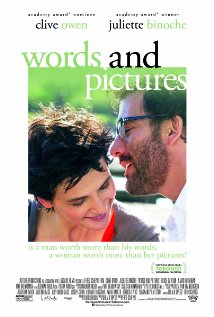
Poster for Words and Pictures
It wasn’t what I was expecting, so I should not hold that against it, but I found Words and Pictures just a tad disappointing. It is a very nice movie, not a great movie, but nice, and its heart is in the right place.

Clive Owen as Jack Marcus in Words and Pictures
The film deals with an English teacher Jack Marcus (Clive Owen) who teaches at a very privileged prep school in Maine. Marcus–who once had a promising start as a writer– is brilliant, witty, energetic, and charming. The students love him; his colleagues tolerate him; his bosses are beginning to tire of him. We immediately see him chastised for being late–an occurrence that is more and more frequent because at night he is drinking more and more. (I found this part a bit unbelievable because after his nightly excesses there is no way he could perform so elegantly in the classroom each day. Add to that the thermos full of vodka he drinks with his lunch each day and his engaging classroom demeanor seems unreal.)
Because of cuts at another school, the school is able to hire a new art teacher, Dina Delsanto (Juliette Binoche). A successful gallery artist, Delsanto has left New York City due to crippling rheumatoid arthritis which forces her to walk with a cane, strap brushes to her wrists, and suffer intense pain, and she has come to rural Maine where she gets the necessary help from her sister.
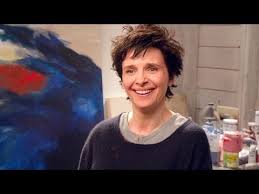
Juliette Binoche as Dina Delsanto in Words and Pictures
She immediately clashes with Marcus, but not without hidden a smile of pleasure.
And this is where I got it wrong. As Hollywood usually goes, the film begins as a typical romantic comedy. Two strong-willed, feisty characters are thrown together–ala Tracy and Hepburn– battle and show their disdain for each other, and finally fall in love. Yet, Words and Pictures takes another tack.
In her first class of Honors Art, Delsanto tells her class that “Words are lies, traps.” Since Marcus teaches the same students, her comments get back to him, and he initiates a war. Words vs picture: What is more powerful? What is more true? What is more dangerous?
And while the battle began between the two adults, the students get very much involved, and actually experience a truly great learning experience. (Educators now call this kind of thing “Project Based Learning.”) The “words” that the students use and the artwork they create as different sides in this battle of philosophies are impressive at the least.
As the battle goes on, Marcus learns that the school board is considering his dismissal, his relationship with his son is becoming more and more estranged, and his muse has completely dried up. And, he begins drinking even more heavily.
Delsanto’s condition worsens–she cannot undress herself or hold a brush without help–but her artistic output is becoming more and more robust.
Ultimately, these two flawed adults get together, but their lovely day together is sabotaged by Marcus’ destructive, drunken night.
It takes the final school assembly, where the contest between “words and pictures” is judged to bring some resolution to the film. Here, Marcus gives a speech stating that there is no greater approach–that together words and pictures are often more powerful than apart. (I’m not sure I agree.) Afterwards, we are left hanging–does Delsanto merely forgive Marcus or does she let him back into her life.
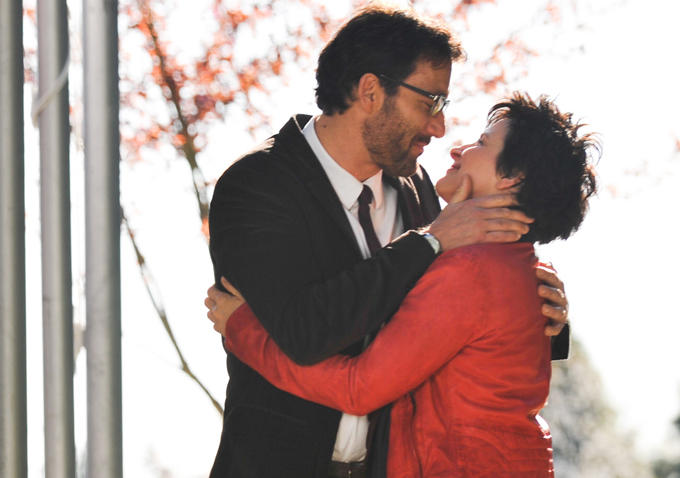
Clive Owen and Juliette Binoche in Words and Pictures
To see a romantic film about two adults, seriously flawed in their own ways, is a rarity in film these days (at least in American movies). And to have this romance played out by the like of such actors as Juliette Binoche and Clive Owen is special. And this is where Words and Pictures promised a delight.
But somewhere along the line, the relationship between Marcus and Delsanto gets hijacked. The philosophical arguments of “words vs. pictures” take center stage, and–by the very nature of film– can only be superficial at best, and ultimately unfulfilling. And we are further distracted by the subplots of Marcus and his son’s disintegrating relationship and an annoying story of a predatory student who continually harasses a shy student in his class. (Granted both of these subplots can be tied into the overall argument of “words vs. pictures,” but again, it is weak.) And so, the “romance”–even the relationship–between Marcus and Delsanto too often gets pushed aside and loses its cinematic momentum,
In the end, I enjoyed Words and Pictures, but I wanted to like the film more than I did. It had the makings of a sweet romance, but the un-fleshed-out philosophical argument got in the way.
What I found most interesting was that all of Dina Delsanto’s artwork was painted by Binoche herself. That bit of info, coming late in the credits, is amazing, for the paintings are powerful expressionist and abstract works that to my untutored eye were dazzling. Binoche has always been one of my favorite actresses…now even more so.
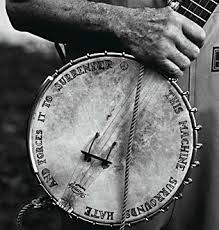
“This machine surrounds hate and forces it to surrender.”
…words inscribed on Pete Seeger’s banjo
Pete Seeger
(1919-2014)
The Official Web Site of LeAnn Skeen
Grumpy younger old man casts jaded eye on whipper snappers
"Here is my secret. It is very simple: It is only with the heart that one can see rightly; what is essential is invisible to the eye.."- Antoine de Saint Exupéry
Of writing and reading
Photography from Northern Ontario
Musings on poetry, language, perception, numbers, food, and anything else that slips through the cracks.
philo poétique de G à L I B E R
Hand-stitched collage from conked-out stuff.
"Be yourself - everyone else is already taken."
Celebrate Silent Film
Indulge- Travel, Adventure, & New Experiences
Haiku, Poems, Book Reviews & Film Reviews
The blog for Year 13 English students at Cromwell College.
John Self's Shelves
writer, editor
In which a teacher and family guy is still learning ... and writing about it
A Community of Writers
visionary author
3d | fine art | design | life inspiration
Craft tips for writers
 j. p. bohannon