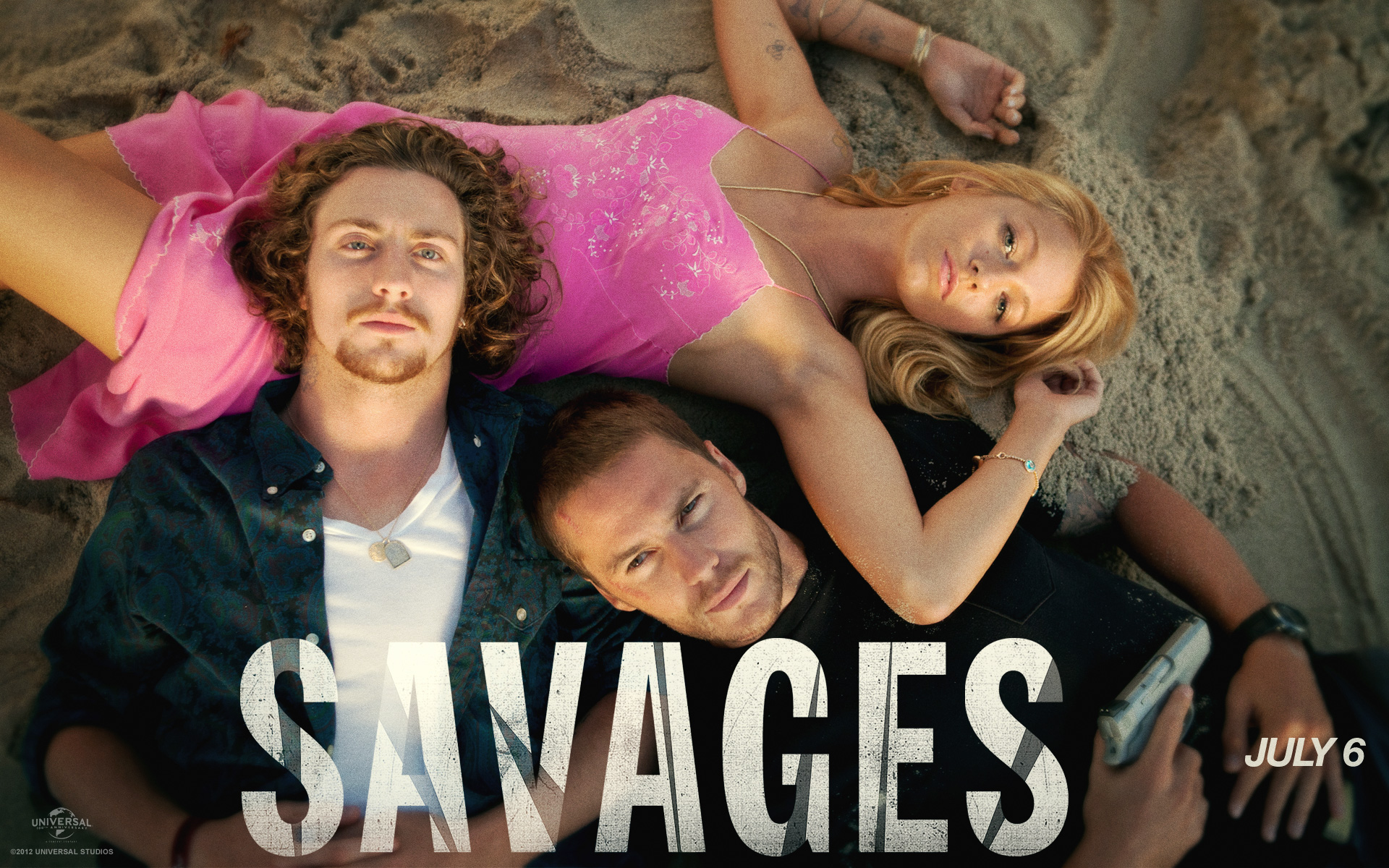
Movie Review: Savages directed by Oliver Stone

There are three important times when someone refers to someone else as “savages” in Oliver Stone’s film of the same name. The movie begins with a computer/video of a Mexican drug cartel beheading six men. The video has been sent as a warning to a young veteran of the Iraq and Afghanistan wars who with his partner has built an extraordinarily successful pot growing business in Southern California. After he sees the video, he mutters “savages.”

When his idealistic partner returns from global activisim, they have two very different responses to the cartel’s offer. The vet wants to go in hard; the idealistic partner wants to give them everything and get out of the dope industry–they have enough money to last several lifetimes.

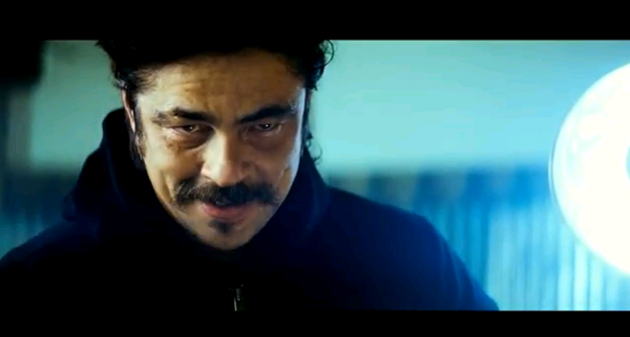
They also share the love and favors of one girl, O (for Ophelia). As the cartel stalks the trio, the cruelest of the Mexican cartel (Benicio Del Toro) notices the sexual arrangement of the three and calls them “savages.”

And finally, while walking on a beach in Indonesia, O notes that they have returned to nature, that they have become “savages.”

So the movie offers three definitions of the word “savage”:

1. utter cruelty
2. perceived perversion
3. stripped of civilization’s “refinements”
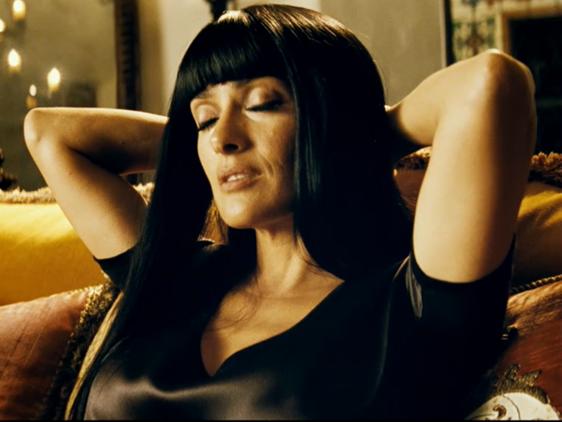
One knows what one is getting with an Oliver Stone film. Edgy cutting, great story, conspiracy, violence, magnificent cinematography and award winning performances. From JFK to Platoon to Born on the Fourth of July, his films have also had a political bent, examining modern society–sometimes controversially–with all its warts exposed and its naked emperors revealed.

The story, based on the novel by Don Winslow, pits the two independent pot growers Ben and Chon against a powerful Mexican cartel led by Selma Hayek. There are betrayals, murders, kidnappings, and thefts–and there are conversations about love and parenting and trust. There is corrupt law enforcement (what would an Oliver Stone film be without it), horrible violence, and magnificent scenery.

In the end, what we have is an enjoyable film where the loveable “bad guys” have to outwit both the despicable “bad guys” and the corrupted “good guys.” We have seen this before but that doesn’t detract from the film at all. It is a plot that always seems to work for me. In fact, after seeing the film one might make a favorable reference to Butch Cassidy and the Sundance Kid–a film about two other loveable outlaws. Except the comparison is ruined because Ophelia herself makes the analogy early in the film. That is my only complaint–Oliver Stone should be more subtle than that.
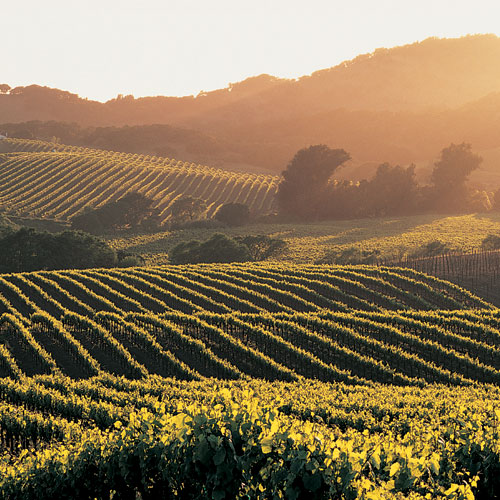
A river of wine…and a clueless wine drinker

So we move up from San Francisco to Napa for a series of private parties. The drive into the Napa valley is impressive, acres and acres of vineyards, rigidly straight rows of vines that climb up mountainsides and spread out for as far as one can see.

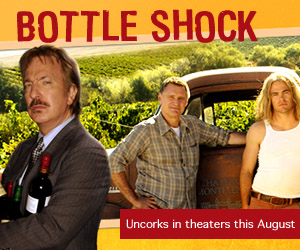
We got there Friday afternoon, in time to go to party number one.  The reception was held in The Backroom, a wine store in the town of Napa proper. It was hosted by Chateau Montelena. If you don’t know Chateau Montelena–and I certainly didn’t until someone pointed it out to me–it is the winery that famously won the blind-taste test against French wines, the “Judgement of Paris,” the first time a Napa wine ever won on the international scale and certainly the first time such a wine had beaten out the French wines. The story is the basis of the movie Bottle Shock, starring a delightfully snooty Alan Rickman.

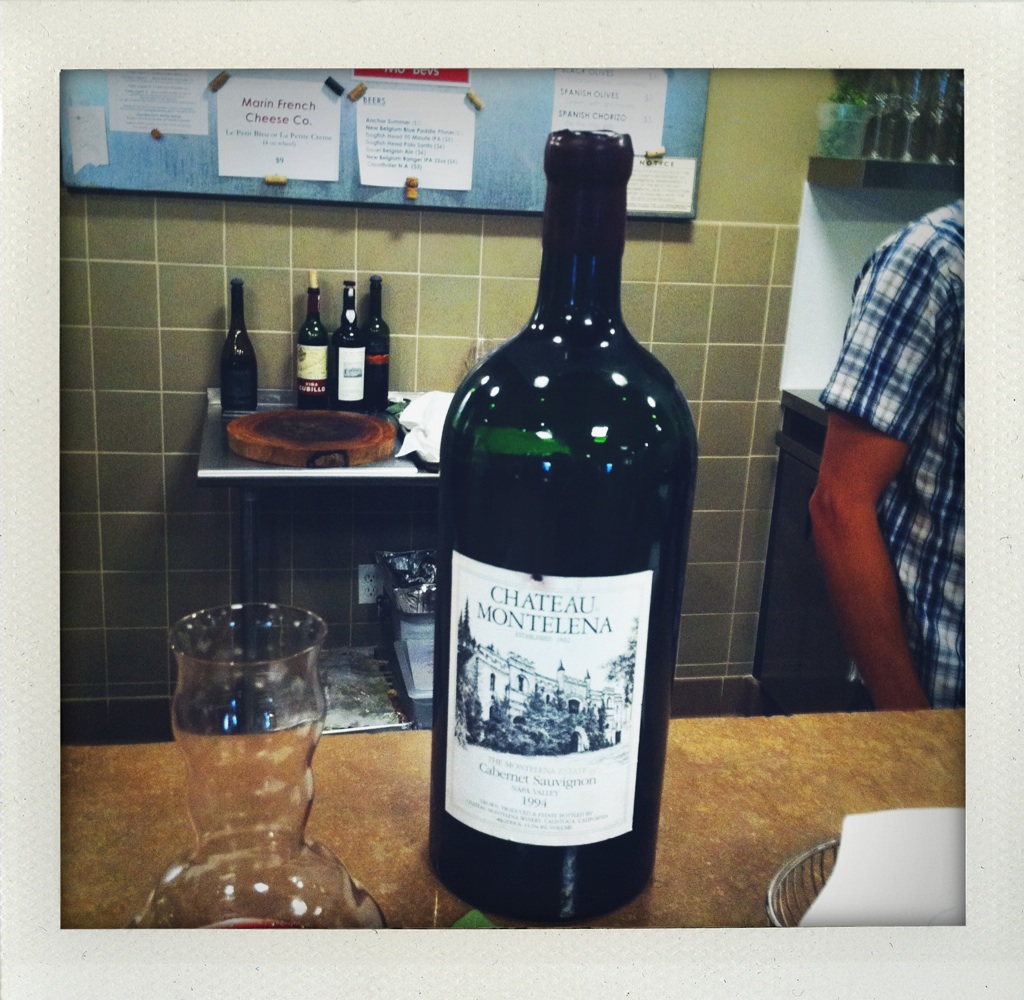
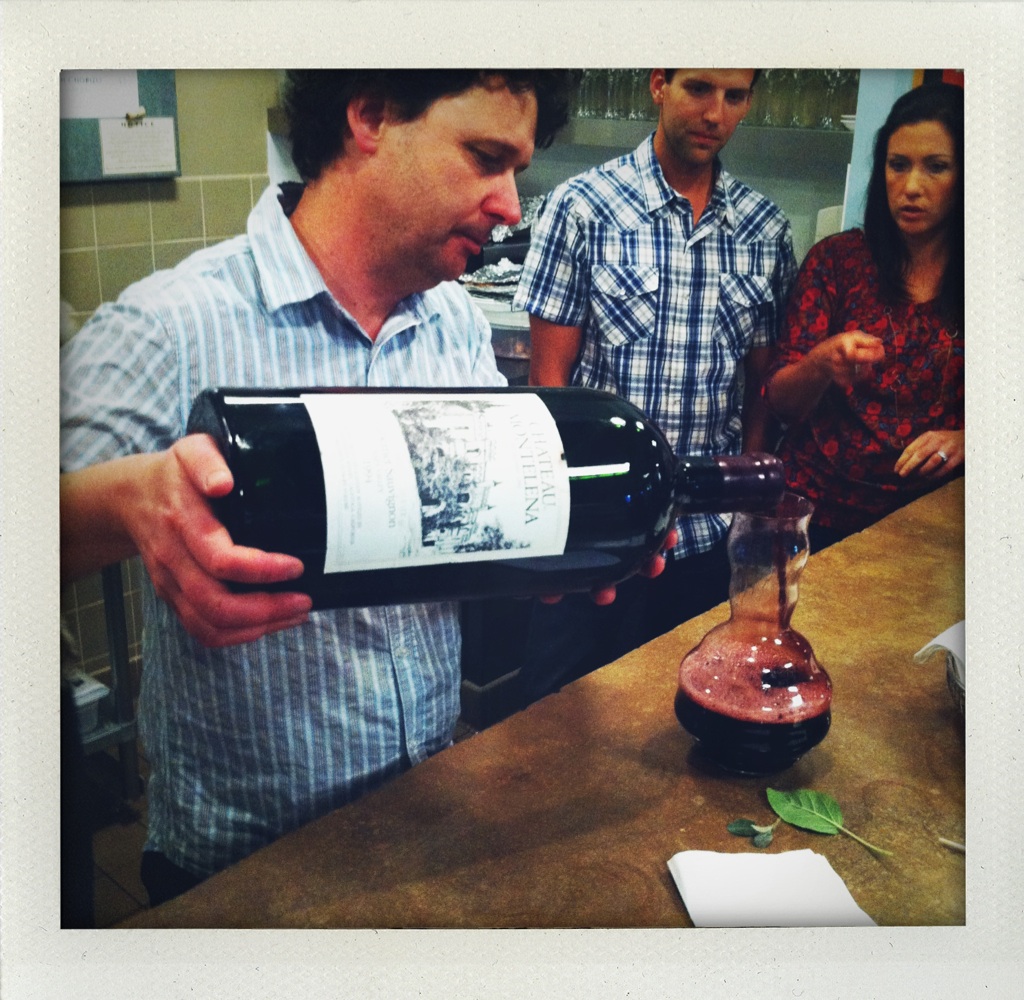
Anyway, a “variety of wines and heavy hors d’ouevres” was what was listed on our invitation, and it ran true to what it said. When we walked in, we were brought to a table and offered a glass of Cabernet Sauvignon which was to be paired with a skewer of mozzarella, basil, and cherry tomatoes. There were seven other tables with rows of various bottles and different foods–steaks, chicken, vegetables, polenta, cheeses, chocolate truffles–and we were to go from one to another for the next four hours. We tasted them all–many of them over and over again.  The night was capped when a jeroboam of the Montelena Reserve was uncorked.

The Jeroboam of Montelena

Giving a jeroboam some visual perspective

The next morning seemed to come very quickly, but we had to get moving, for we were to go to the Detert Family Vineyards–to “Grandma’s house” for a reception.  The Detert vineyards butt up against the Mondavi vineyards, and they provide the Mondavi winery with 75% of their Cabernet Franc crop–retaining the remaining crop for their own estate wines.

We drove up an old dirt road, parked between some olive trees, and then walked behind “Grandma’s House.”  The stone courtyard was set up with white-clothed tables and white umbrellas.  Small pots of lemon trees, pendulous with fruit, ran around the perimeter.  About thirty yards away, a swimming pool looked out over the ascending vineyards. And in the corner of the courtyard, in gleaming array were rows and rows of glasses of sparkling white wine. We grabbed a glass or two, mingled for a while and then walked out into the vineyards with the Detert brothers.  They  explained the nature of the soil, the cultivation of the grapes, and the business side of the winery, in terms simple enough for even the most ignorant of the group (me). But for me  the visuals were the most compelling. About twenty of us were standing between rows of shoulder-high vines, the sun glistening off the white wine in our glasses, and the real world seeming very far away.

When we returned to the courtyard, the table of sparkling white had been replaced with Cabernet Sauvignon and Cabernet Franc (the wine that the Deters are most proud of). Two long tables of food–roast beef, chicken, grilled vegetables, cheeses, breads, fruit–ran along two sides of the courtyard.  I was sure I would never eat and drink again after the night before, but I lied.  Conversation, laughter, food and wine–it is an irresistible combination.

Three hours later we were heading back to our apartment–we had to hurry though, there was another reception in less than an hour.

The reason we are in California at all is that our neighbors in Philadelphia, Rick and Laura, were celebrating their 20th-wedding anniversary and they wanted to share their love of Napa–and wine–with their friends.  Rick is very much a wine connoisseur, and apparently, is fairly well known around the wineries here.  There were several winemakers in attendance–as well as the largesse provided by the wineries at last night and this afternoon’s events. Well this later reception was hosted by them and featured wines from their own stock.  Again a beautiful setting, magnificent hors d’ouvres (to be followed by dinner), and a bottomless supply of wine.

On a table were ten double-magnums of Cabernet, one for each year from 2000 to 2009. The idea was that you were to taste them all–in order–and compare. You could repeat any particular year–many got stuck on the 2003 and 2005 vintages–or you could stay on the one you liked the best, but they encouraged you to try them all. Later in the evening, they brought out a double-magnum of Syrrah and a  double-magnum of a Gold Label Reserve Cabernet that a local winemaker had brought as a gift.

I am too ignorant about wines to distinguish greatly between any of them. I do know that they were all much, much better than what I usually buy at the grocery store.

And so, for a period of twenty-four hours, I have attended three private receptions in the Napa Valley.  I have eaten more than I eat in a week.  And I have drunk a river of wine.

And now, I am headed off to the final planned event of this Napa weekend–a Sunday champagne brunch!

A small whiskey, the Zoetrope Cafe and Francis Ford Coppola

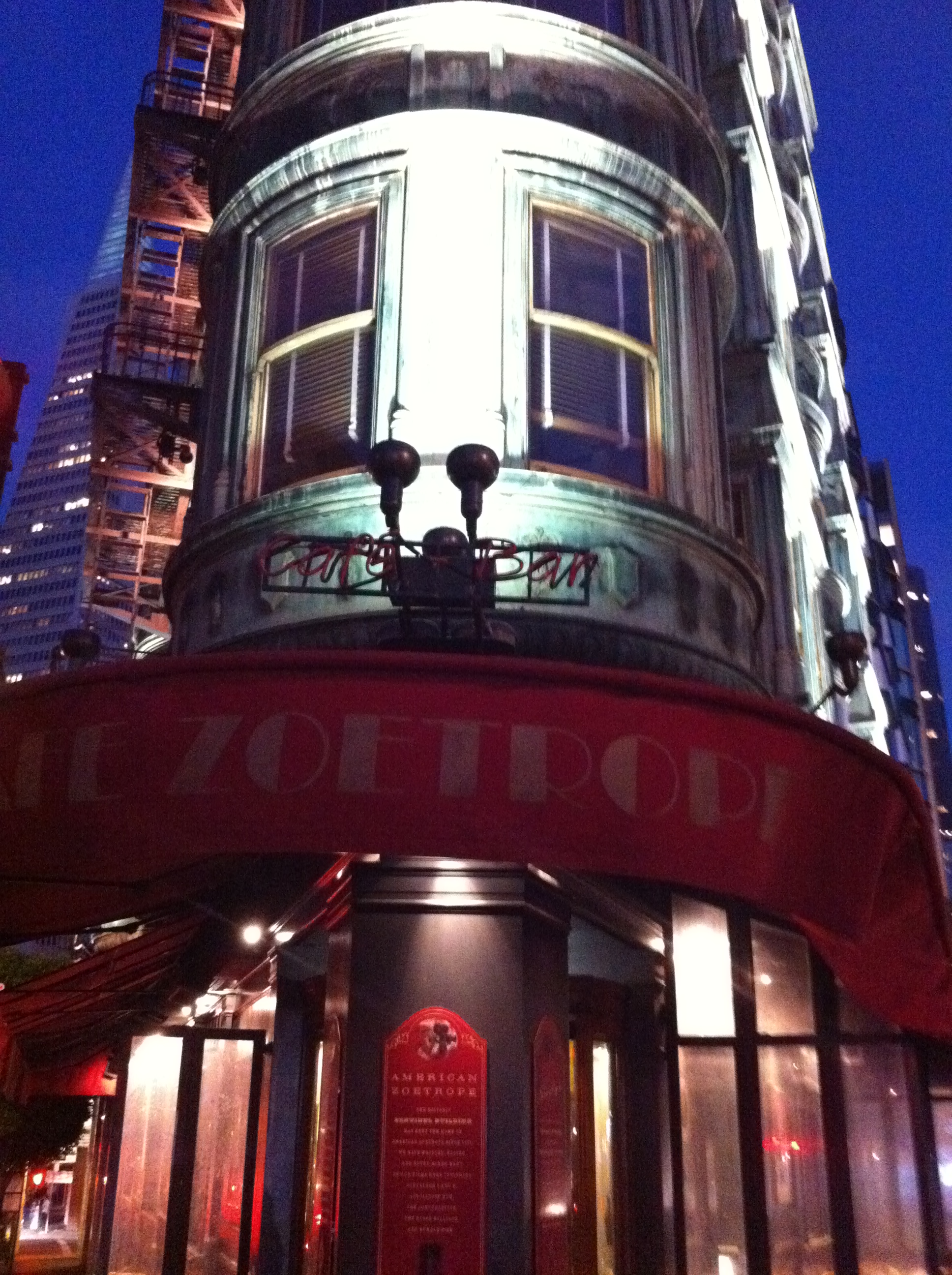
As one travels towards the end of North Beach in San Francisco, just before entering the financial district, there is a distinctive building on the corner of Columbus and Kearney. Its iron sheathing has been oxidized a gentle green color and, in a way, it resembles an ornate version of the Flat Iron Building in New York.

The building houses the offices of Francis Ford Coppola. Aside from the production duties, the writing, and script doctoring, it is here that Coppola does all his film editing–where all the Godfather movies, Apocalypse Now, Dracula and so many others were edited.

It is also where the literary journal Zoetrope: All Story is produced.  The journal presents some of the finest in contemporary fiction and one-act plays and has featured such established writers as David Mamet, Don DeLillo, Andrew Sean Greer,  Margaret Atwood, Salman Rushdie, Woody Allen,  Neil Jordan, and Haruki Murakami. (Full disclosure: I had submitted once when the magazine first started up, not realizing I was so far out of my depth.)

And on the bottom floor is the Zoetrope Cafe, an Italian bistro, featuring an Old World menu and, not surprisingly, a large selection of Coppola wines.

So last night, we stopped in for a nightcap. 

I noticed what I wanted on the shelf immediately. The whiskey was poured into the most unusual bar glass I’ve ever seen. It was more like a “petri-dish” than a drink glass, about an inch and a half-tall and 4 inches wide.  We asked if the barkeep had ever met Coppola, and she said she did for the first time that day. He told her to call him “Francis” which she said she was still a bit uncomfortable yet to do.

There were copies of Zoetrope in a corner so we brought a couple to the bar and began leafing through them when the bartender came back and with a jerk of her head whispered, “There he is.”  Coppola was chatting with the hostess, looking as if he was going over the wine stock.  About fifteen minutes later, he called to his wife who had been sitting in the corner next to us and they left the cafe, getting into an ordinary SUV.

I had seen the poet Lawrence Ferlinghetti the day before and now Francis Ford Coppola this night, and there was so much I would have liked to ask them both.  But their celebrity is mostly in our minds only–their audience.  They, themselves, must go through their days and nights much like you and I, and the intrusion of strangers certainly must be tiresome. At the same time, it is also good to see these literary/cultural lions in their daily routine–to see them simply as working men, no different than the rest of us.

Still, I would have loved to have bought another whiskey, offered each a drink, and listened to what they had to say.

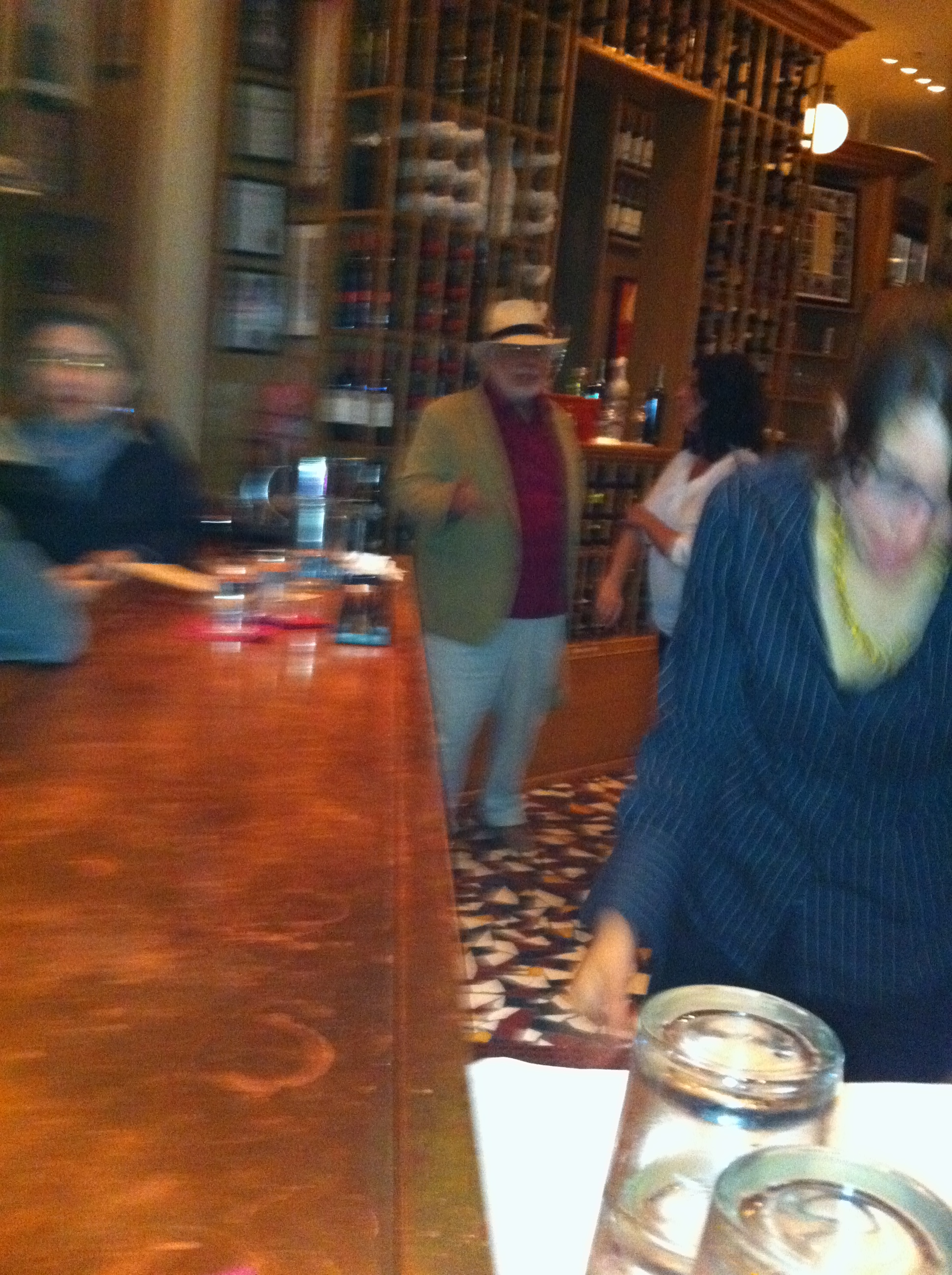
Francis Ford Coppola, July 12,2012, Zoetrope Cafe

City Lights, Vesuvio Bar and sighting Lawrence Ferlinghetti

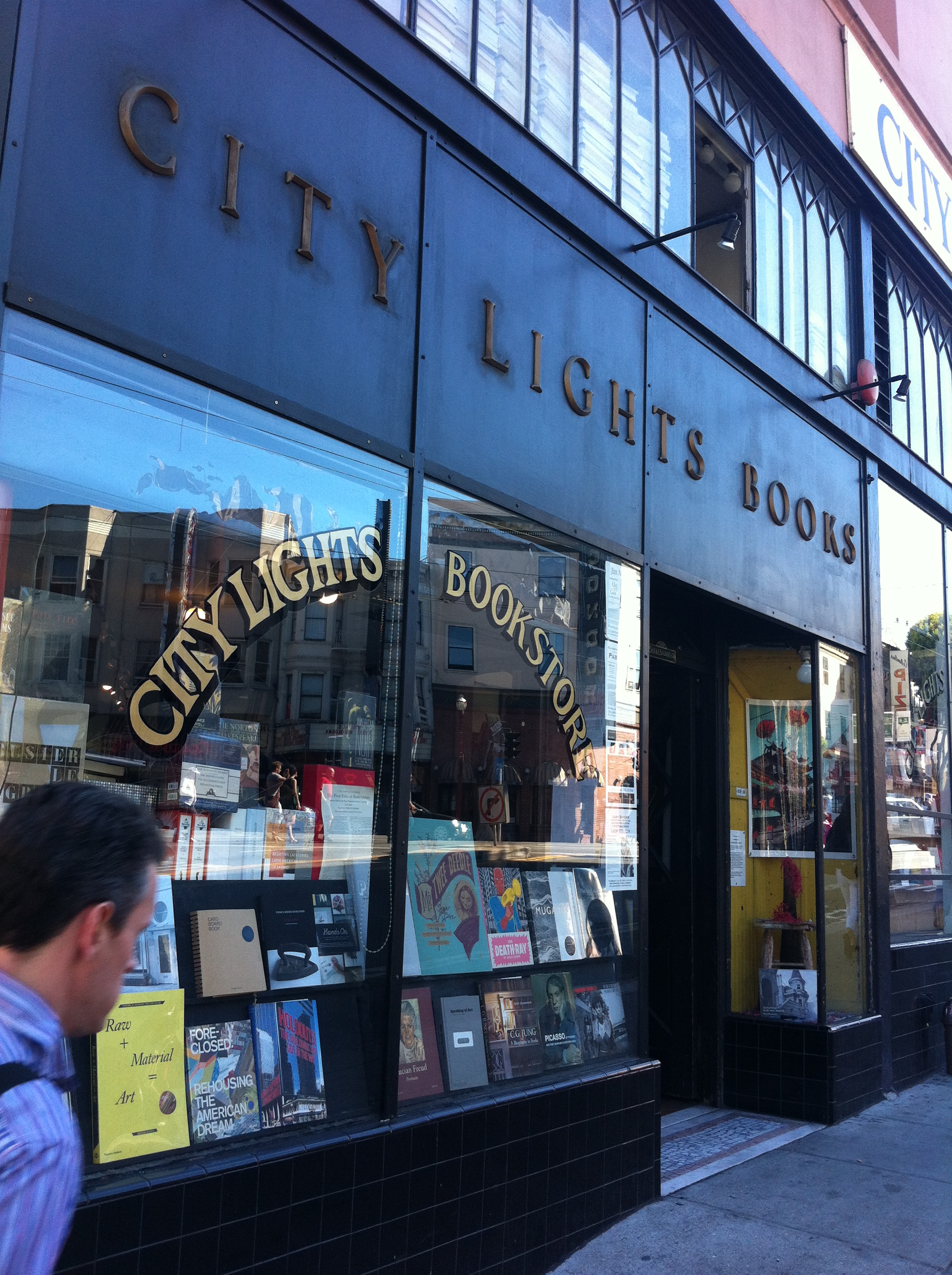
I had the chance to be across the country and in San Francisco for a few days this week, and I immediately went to City Lights Books in the North Beach section of the city.  If not the most famous bookstore in America, it is certainly one of them.

City Lights was founded by Peter D. Martin and named after the politico/literary magazine he had founded named City Lights in 1953. It was the very first paperback book store in the United States. As he was hanging the sign on the store at 291 Columbus Avenue, Larry Ferlinghetti walked past and asked to be a partner. Both Martin and Ferlinghetti invested $500. Martin sold his share to Ferlinghetti in 1955.

But the financial/founding history isn’t what is important. It is the store’s place in America literary  history that stands out.

In December, 1955, Ferlinghetti and City Lights published Alan Ginsberg’s Howl. Ferlinghetti had seen Ginsberg read at Six Galleries. It was an extraordinary evening. The reading was delayed until Jack Kerouac, who after collecting donations for wine, returned with several gallon jugs. Also performing and/or in attendance were Mike McLure, Kenneth Rexroth, Gary Snyder, Lawrence Ferlinghetti, Phillip Lamantia and Phillip Whalen–all bright lights in the Beat movement. The next morning, Ferlinghetti sent Ginsberg a telegram stating that he would like to publish the poem, the fourth book in City Lights’ Pocket-Rocket Series. Ferlinghetti’s telegram began: “I greet you at the beginning of a great career. When do I get the manuscript?

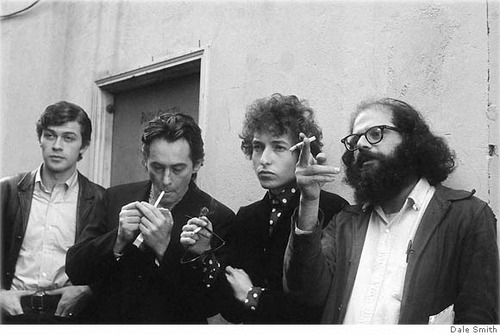
Robbie Robertson, Mike McLure, Bob Dylan, and Alan Ginsberg. City Lights Books, San Francisco 1965.

Four months after publication, the cashier at the store and Ferlinghetti were arrested for selling obscene material–Howl. The case riveted the nation–and made Howl one of the most notorious/famous books of its time. The judge’s decision–that Howl was fully protected by the First Amendment–became an important precedent in the future cases against Lawrence’s Lady Chatterley’s Lover and Miller’s Tropic of Cancer.

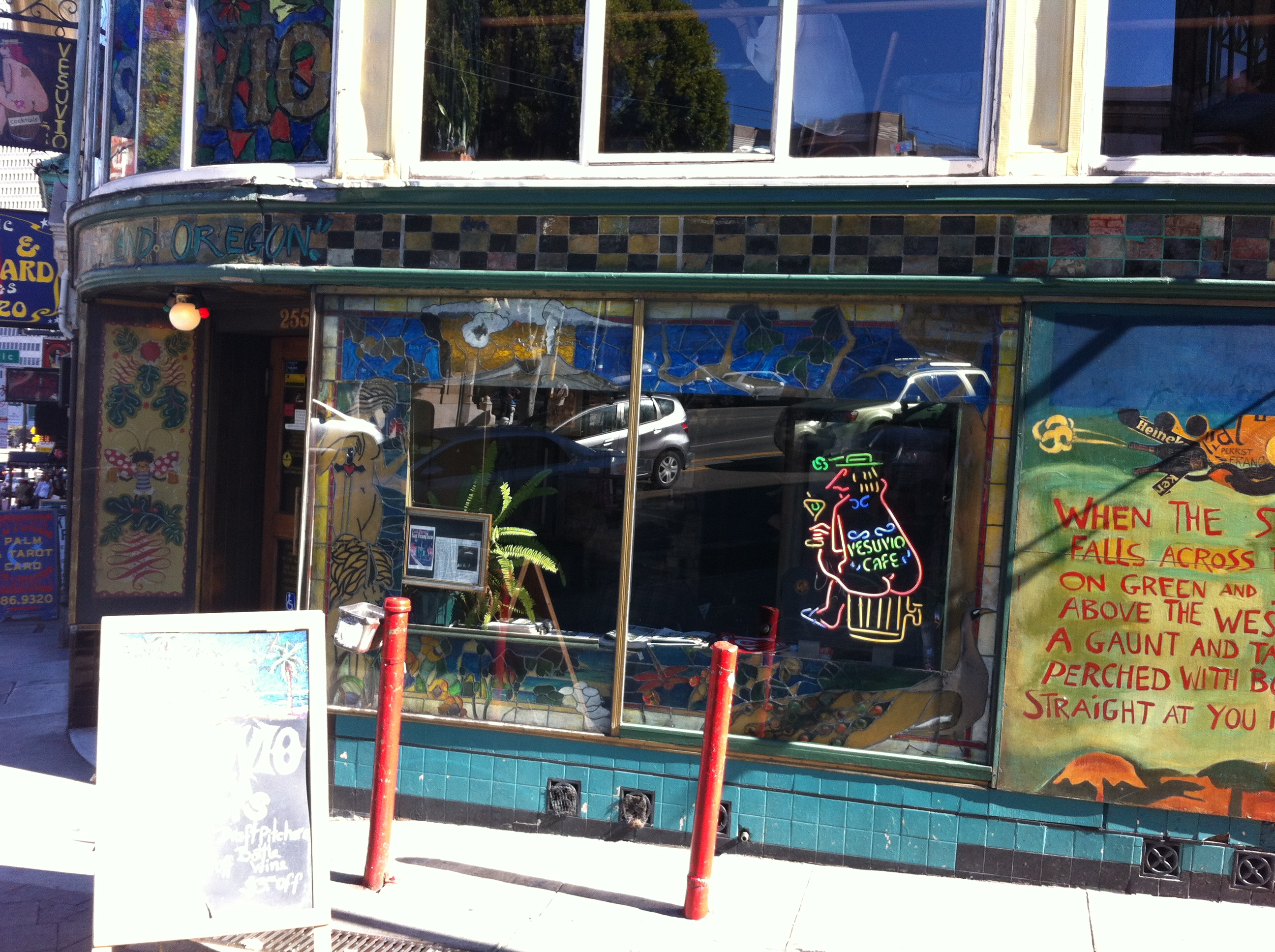
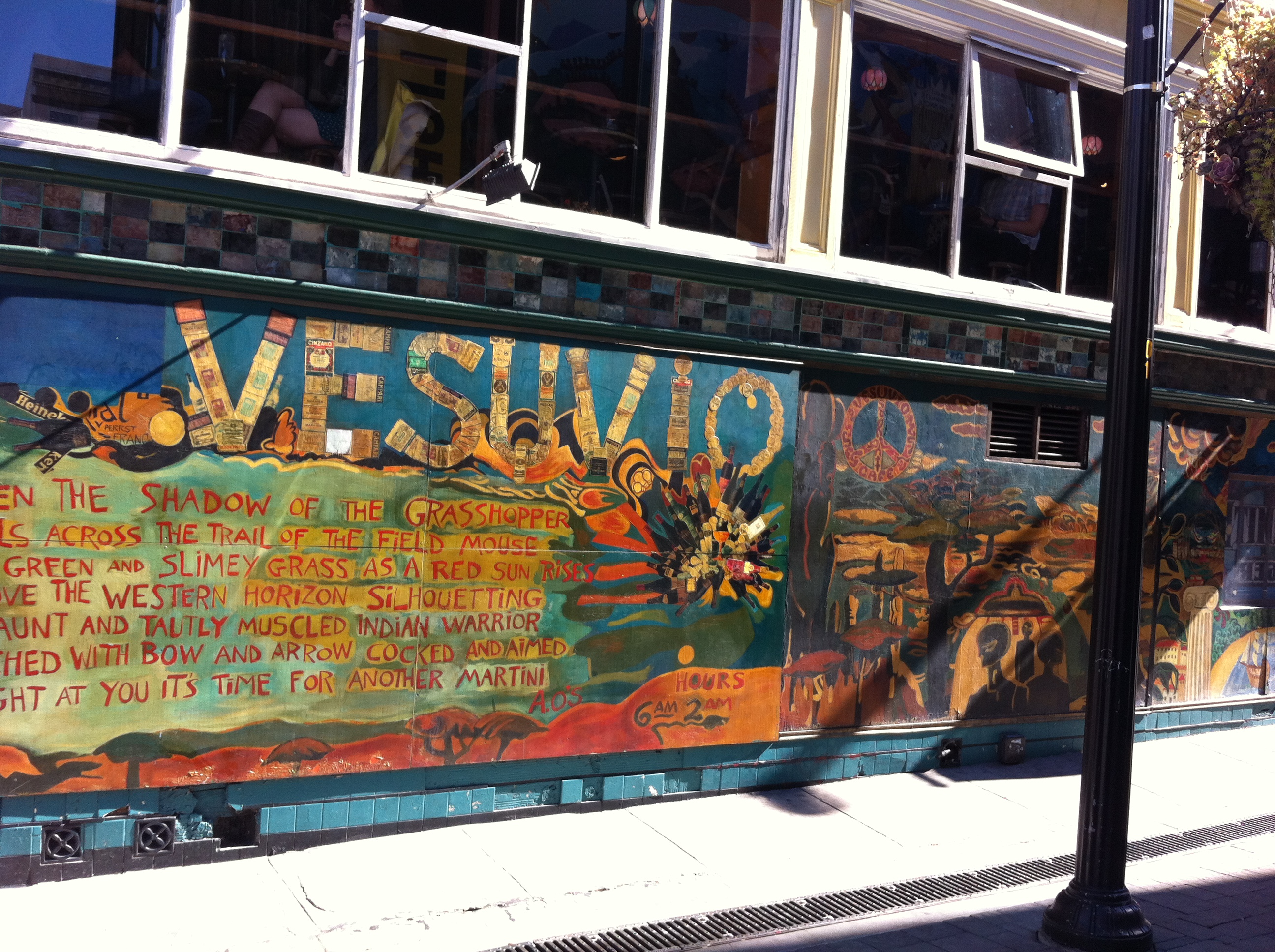
And so…after browsing  the three floors of the book-store, filled with memorabilia, photos, and more than just books, I went across the alley–Jack Kerouac Square–to  the Vesuvio bar. This wonderful bar –mismatched furniture, decals, art work, cheap drinks, two floors, old posters–is a step back into time, or at least in my head. Pictures of Jack London vie with pictures of Jack Kerouac vie with pictures of David Crosby and Grace Slick. A giant portrait of James Joyce hangs next to a photo of Joyce reading the paper in Paris on Bloomsday, June 16th.

Ienjoyed myself. Spent most of the time walking around and reading the walls–the vintage posters advertising readings by a who’s who of San Francisco poets and concerts from the early days, the photos of legendary writers, poets, activists and actors, and original art both bad and worse.

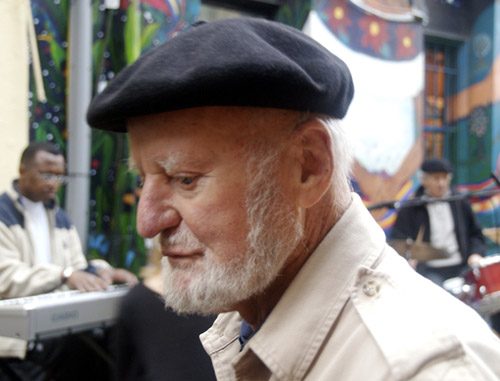
And then it was time to leave.  Outside, we took a few pictures and turned to leave.  And then, as I turned to look back, there coming out of the bar was Ferlinghetti himself.  He stopped, looked around, and placed a cap on his head. My first inclination was to go up to him and shake his hand, thanking him for his long battle against censorship, imperialism, and philistinism, for his support of art, poetry and the avant-garde.  But then I decided against it.  Let a man walk out of a bar, look into the sunshine and set on his way without being bothered by an admirer.

Lawrence Ferlinghetti. photo via Flickr by Steve Rhodes

“Love Poem” by John Frederick Nims…all the toys of the world would break.

Love Poem
(by John Frederick Nims)

John Frederick Nims (1913-1999)

My clumsiest dear, whose hands shipwreck vases,
At whose quick touch all glasses chip and ring,
Whose palms are bulls in china, burs in linen,
And have no cunning with any soft thing

Except all ill-at-ease fidgeting people:
The refugee uncertain at the door
You make at home; deftly you steady
The drunk clambering on his undulant floor.

Unpredictable dear, the taxi drivers’ terror,
Shrinking from far headlights pale as a dime
Yet leaping before apopleptic streetcars—
Misfit in any space. And never on time.

A wrench in clocks and the solar system. Only
With words and people and love you move at ease;
In traffic of wit expertly maneuver
And keep us, all devotion, at your knees.

Forgetting your coffee spreading on our flannel,
Your lipstick grinning on our coat,
So gaily in love’s unbreakable heaven
Our souls on glory of spilt bourbon float.

Be with me, darling, early and late. Smash glasses—
I will study wry music for your sake.
For should your hands drop white and empty
All the toys of the world would break.

I once read this poem in public to a group of twenty to twenty-five people. Afterwards, a woman came up to me and said that I had brought her to tears.  Although it was a nice compliment, I knew surely that it wasn’t I that did it.  For who could hear those final lines “For should your hands drop white and empty/All the toys of the world would break” and not get a catch in their throat?

I love this poem because it is an anti-ideal love poem.

Shakespeare did the same thing 400 years ago with his Sonnet 130 (“My mistress’ eyes are nothing like the sun.)

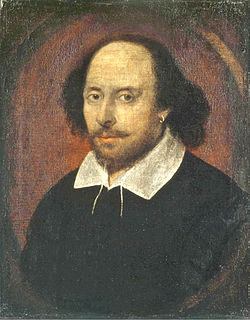
My favorite portrait of Shakespeare

My mistress’ eyes are nothing like the sun;
Coral is far more red than her lips’ red;
If snow be white, why then her breasts are dun;
If hairs be wires, black wires grow on her head.
I have seen roses damasked, red and white,
But no such roses see I in her cheeks;
And in some perfumes is there more delight
Than in the breath that from my mistress reeks.
I love to hear her speak, yet well I know
That music hath a far more pleasing sound;
I grant I never saw a goddess go;
My mistress when she walks treads on the ground.
And yet, by heaven, I think my love as rare
As any she belied with false compare.

Here too, the poet celebrates the flaws and the humanness of his beloved. In embracing her reality–and announcing that he has no need to “belie her with false compare” as so many other poets did–he claims a superior, purer love… “a love as rare” in Shakespeare’s words.

Both men, separated by four centuries, are similarly battling against a constructed “ideal.”  Whether it was the “ideal woman” presented by the Renaissance sonneteers or the “ideal woman” fashioned by Hollywood and Madison Avenue, it was a false image.  And both men knew it.  Their love, they claim, is special because it is grounded in the real world, not in an imaginary, air-brushed, wish-fulfillment world.  Their love exists in the everyday, “everyman/everywoman” world that most of us mortals inhabit.

We know little of Shakespeare’s beloved except for what she looks like: dark hair, pale-lipped and dun-skinned, bad-breathed, clunky-walking and shrilly-voiced. Nims, on the other hand, gives us more information about the object of his love.  She deftly handles those who are ill-at-ease, exiled or drunk; she moves easily with words and people and wit and love. Certainly, she has her frenetic failings–and Nims recounts them with affection– but that is not what makes her unique; that makes her human.  She is much more than that.  She is unique in the welcoming warmth of her love, in her compassion for and embrace of life.

Nims truly appreciates and loves her for what she is. And isn’t that what all of us is looking for?

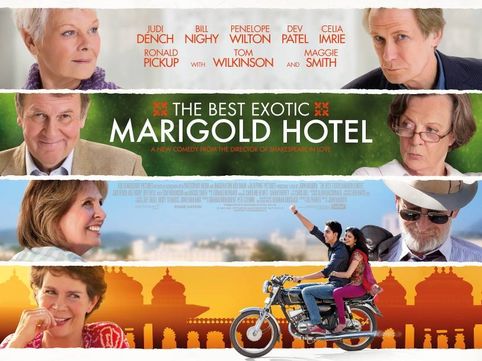
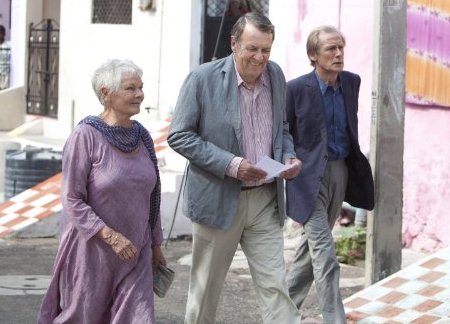
Movie Review: The Best Exotic Marigold Hotel…meh

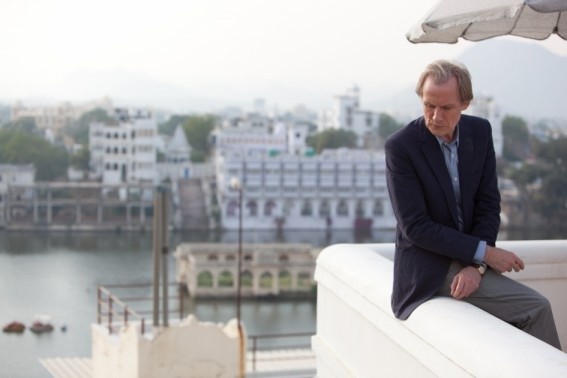
A handful of retirees move to India because elder-care is cheaper there and recent events have altered their vision of what their lives would be like back home in England.  And so separately they move to the Best Exotic Marigold Hotel, advertised for the beautiful and the elderly… a hotel which is still in the early stages of reconstruction.

I wanted to like this film very much.

Afterall, there were magnificent actors:

 Judi Dench
Bill Nighy
Maggie Smith
Tom Wilkerson
Dev Patel
Celie Imrie
Penelope Wilton
Ronald Pickup

There were touching and interesting stories:

• A gay man returning to find an ex-love he believed he had ruined
• A widowed woman trying to be responsible for herself for the first time in forty years
• Young lovers being thwarted by a mother’s demand on arranged marriage
• A decent husband battered by an over-demanding, narrow-minded wife
• A woman wanting one last try at romance
• A man wanting one last try at romance
• Another woman wanting one last try at romance
• A bigoted woman going to India for a hip replacement because she can’t wait for the NHS
• A couple who lost everything in bad investments

And there was extraordinary photography and marvelous settings.

And yet, it all seemed too much…it all seemed to run together.  The film couldn’t seem to decide whether it wanted to be a mad-cap comedy, a fish-out-of-water study, a sentimental love story, a heart-breaking love story, a droll study of old imperialists visiting a once held colony, a humorous clash of cultures. It seem to need a tighter focus.

There is a point made in the film that India is a barrage on the senses; sounds, smells, tastes, sights, textures all come crashing upon the visitor in a way that is often overwhelming.  This seems to describe The Best Exotic Marigold Hotel as well. There was just much too much.

Did I enjoy it?  Yes, it was enjoyable.

Will I forget it? Yes, it is forgettable.

Music: Rhythm and Rest: Glen Hansard moves beyond Once

Glen Hansard’s new album, Rhythm and Repose

Glen Hansard is trying to separate himself from the massive success of Once. The former front man for the Frames (one person once said that “U2 gets all the fame but the Frames have all the soul”), Hansard found extraordinary success with the indie movie, Once, for which he and his partner, Marketa Irglova, garnered an Academy Award for Best Song.

But this was not his first foray into film. As a much younger man, Hansard was chosen by Alan Parker to play the guitarist in The Commitments–a former busker who ended up almost making it with Jimmy Rabbit’s Dublin Soul band. He was one of the more likeable lads in the band and as things worked out in the film his character ended up back on the Dublin streets busking.

Hansard as Outspan Foster in The Commitments

Fast forward 15 years and Hansard is again playing a busker in the Dublin streets, and this time he strikes gold. The on-screen (and purported off-screen) chemistry between him and Marketa Irglova found a wide audience around the world.  The music (much of it from the Frames’ repertoire) was memorable, the story was charming, and the ending was so far from a typical Hollywood ending that it was a refreshing success. And if people doubted Hansard and Irglova’s sincerity, their acceptance speech at the Oscars was one of the finest moments in what is usually an orgy of narcissism and self-aggrandizement.

When the music played to whisk Hansard off the stage, the emcee-Jon Stewart–stepped in and made the audience listen to what Irglova had to say.  Here is both of their “thank you speeches”–a tribute to independent artists and dreamers everywhere:

So Hansard and Irglova took advantage of the momentum and began a whirlwind concert tour bringing the music of Once to audiences live and then teamed up in a new band called The Swell Season, releasing a double album.

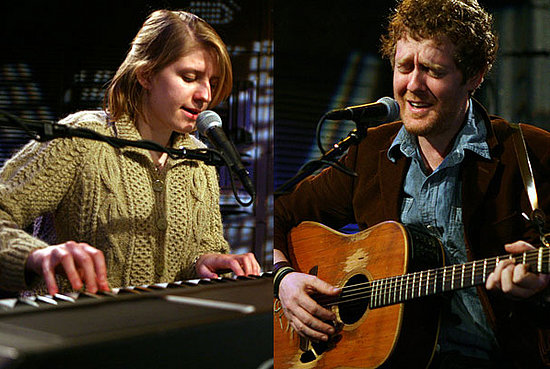
Marketa Irglova and Glen Hansard

Yet Once was not going to let go.  In 2011, the film was turned into a Broadway musical and in 2012 it won the Tony Award for Best Musical.

By then, Hansard and Irglova’s partnership had severed and Hansard moved to New York to work on a solo gig.

And on June 19th, his new album Rhythm and Rest hit the stores.  If you liked the music from Once and you like the music of the Frames, you will very much like this.

On Rhythm and Rest, Hansard does what he does best.  He writes personal,  soulful songs, often begins them with a single, simple instrument and then builds to a painful wail or a embracing chorus.  The song “High Hope” is typical–Hansard’s voice accompanied by his acoustic guitar and piano begins the tune and then builds with a rousing choral section on the choruses. The choral accompaniment is very similar to the styling of some of Van Morrison’s productions. “The Song of Good Hope” (do you detect a theme here?) starts the same way–if even more stark at the beginning being fortified not by choral voices but by strings.  It is the last song of the album and like all of Hansard’s songs it is bittersweet.

The song “Philander” (and the video) straddles loneliness and the determination to persevere, while “Love Don’t Leave Me Waiting,” reveals more resilience in human relations.  At times in “Philander,” Hansard’s voice–which I find expressive AND beautiful–veers towards the articulation of Tom Waits. It is amusing to find this Dublin street performer, unwittingly channeling the American blues, saloon singer.  While I very much like the song “Maybe Not Tonight” which begins with a simple guitar arpeggio, it reminds me an awful lot of the old Crazy Horse tune, “I Don’t Want to Think About It.”  It’s now all I hear when I listen.

My personal favorites are “The Storm is Coming” and “You will Become.” The first song on the album, “You Will Become” has a simple Leonard Cohen-like guitar, a haunting cello and a faint penny-whistle, before crescendo-ing with tinkling piano.  And the music perfectly complements the heart-breaking lyrics. “The Storm is Coming” features a single piano and Hansard’s voice in all its pain, its anticipation of the future, and its acceptance.

Hansard’s lyrics are very personal and his voice is perfectly suited for this. As he bemoans romantic fates, upcoming storms, lost chances, his voice soulfully captures the very essence of his words. Here is the video for “Philander”:

printed books, personal libraries, cleaning out and French bookstores

by roboartemis. Found on deviontart.com

It seems I have always loved books, and in my lifetime have amassed quite a library. I find some sort of comfort in being surrounded by books, books on shelves, in piles on tables and floors.

In the past few years, though, I have had to thoroughly cull my shelves, for a variety of reasons.

Last year, I inherited about a thousand books from an uncle–he had promised me them ever since I was about nine years old–but after he died I simply couldn’t house them. I  already owned more than that myself and his simply were not going to fit. The two of us had had similar tastes and many of the same titles, so the duplicates  were easy to get rid of.  Others I gave to friends, even to non-readers. And the majority I gave to two used book sellers.

In 2004 I had ghostwritten a history of Ireland and part of my contract was that the publisher paid for any books I purchased while doing my research–I bought a lot. So I was able to make more room by donating about seventy-five of these titles to the Irish Center in Philadelphia.  They were hard to part with but I consoled myself in thinking that they are being read rather than simply sitting on my shelf. (I had ghostwritten a biography of Darwin as well but for some reason the publishers didn’t offer to pay for that research. I had far less books on Darwin than on Ireland.)

Now for any new reading, I turn more and more often to the public library, and I have begun buying some e-books, though only a handful.  I make an exception and still buy poetry regularly (kidding myself by rationalizing that these usually take up less space), and I have bought some non-fiction titles that I knew that I wanted to own, and would go back to time and time again. But novels generally come from the library now.  And that’s just as well.

We have all read the dire warnings about the demise of printed books. Such articles crop up almost weekly: The death of bookstores, the death of the author, the death of the novel (granted that one has been going around since long before the internet), etc. A friend of mine in Brooklyn passed along this article to me about how in France book sales are actually rising rather than being smother by digital devices. It makes for some interesting reading. Click on the picture below to read the piece:

Shoppers in La Hune, in Paris, which receives government help.Alice Dison for The New York Times 

So by the end, I went through an enormous amount of books and gave many, many away. (For 6 months I had to rent a storage shed to house my “inheritance” while I figured out what was going and what was not.) I didn’t like doing it, but I knew I had to.

And of course, that book that I hadn’t looked at in fifteen years, that had sat dusty on my shelves for so long.  As soon as I gave it away, I needed it for something or other!  Isn’t that how it always goes?

Saturday Potpourri: The young pups are taking over…and a story of G.A.S.

I went to a party Friday night to celebrate Zeke McLaughlin’s 60th birthday. It was a very good party–good conversation, great food, bottomless drink, and good music (the very definition of great craic).

As a gift, the man’s brother hired two twelve year old musicians: one played fiddle, the other uillean pipes and whistle. The music was nice–the boys had even brought Zeke a whistle of his own as a gift (he is an Irish flute player as well as whistler.) It was good to see the young pups bringing in the music.  Here they are:

I only found out later that these two young men are quite serious about their music.  They have their own website The Ladeens and their own touring schedule.  And two more polite and charming young men you’ll never meet.

♦     ♦     ♦    ♦     ♦     ♦     ♦

After the party, I went to a pub to see some friends play where I ran into a friend I hadn’t seen in many, many years.  He introduced me to the woman he had brought with him and riskily I asked her if he had told her about his G.A.S.  She knew right away that I was talking about Guitar Acquisition Syndrome.

A Small Case of G.A.S.

I met Richard while working in an advertising agency.  He was in the cubicle next to me. I knew he had had some success as a musician. He had opened for some pretty famous bands and had worked as a studio musician in Nashville.  And I also knew that he hadn’t touched a guitar in about ten years. I don’t know the whys or wheres, but he had just put that part of himself away and was now a talented graphic designer.

One afternoon, I took an extended lunch and bought a $300 dollar guitar that was on sale for $150. The day was sweltering and I didn’t want to leave it in a car so I brought it into my cubicle. Richard soon moseyed over and began noodling around. (It was immediately obvious that he was a very good player.)

Well a few days later, Richard asked me to go with him to a music store.  We wandered around a bit, and Richard left with a very good guitar. (Much better, more expensive than the low-end Ibanez that I had bought.)

A month later, he told me he had bought another.  I had re-awakened a monster.  He was teetering very close to the edge of G.A.S. Soon there was another…then another…then a humidifier or dehumidifier for the basement where he kept them. He was no longer teetering. He had a full-blast syndrome.

Since then, Richard has stopped buying guitars in music shops. Instead, he is having them made for him. In our conversation last night, he mention that he has a “luthier” who he works with.  I think he is down to eight, but they are sometimes different–he trades them or sells them in order to get another.

He plays very well, but refuses to play out anymore. (He had joined a band a few years back but his reluctance to play out was an obstacle to the band’s going anywhere.)

Anyway, it was good to see a long gone friend. And fun to talk music with him. Maybe, before too long we can sit down and play a few tunes together again.

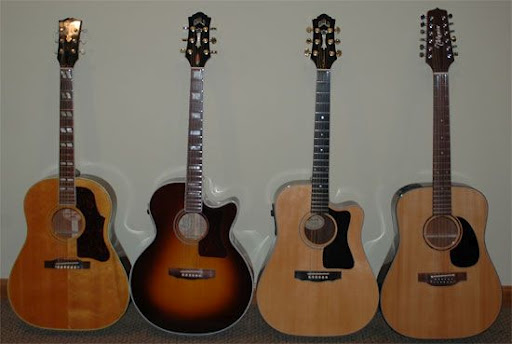
Richard’s Olsen guitar

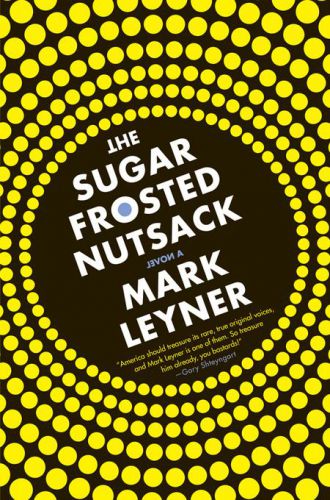
The Sugar Frosted Nutsack by Mark Leyner: When does one stop reading a book?

When is it time to stop reading a novel?  And why do I feel so guilty about it?

I decided today to go no further in Mark Leyner’s The Sugar Frosted Nutsack.  Was it bad?  No, it was quite entertaining?  Was it difficult?  No, not in the way say Joyce’s Finnegans Wake or DFW’s Infinite Jest is difficult.

To be truthful, it is simply a tiring read.

The title refers to poor Ike Karton, the “nutbag” as he is called in his neighborhood in Jersey City, New Jersey.  Here is his introduction (35 pages in):

“What subculture is evinced by Ike‘s clothes and his shtick, by the non-Semitic contours of his nose and his dick, by the feral fatalism of all his looney tics–like the petit-mal fluttering of his long-lashed lids and the Mussolini torticollis of his Schick-nicked neck, and the staring and the glaring and the daring and the hectoring, and the tapping on the table with his aluminum wedding ring, as he hums those tunes from his childhood albums and, after a spasm of Keith Moon air-drums, returns to his lewd mandala of Italian breadcrumbs?

So begins the story of Ike Karton, a story variously called throughout history Ike‘s Agony, T.G.I.F. (Ten Gods I’d Fuck), and The Sugar Frosted Nutsack. This is a story that’s been told, how many times? –over and over and over again, …”

Ike is a believer in a pantheon of Gods who have played havoc with the universe for billions of years.  Earlier we learn that

The Sugar Frosted Nutsack is the story of a man, a mortal, an unemployed butcher, in fact, who lives in Jersey City, New Jersey, in a two-story brick house that is approximately twenty feet tall. This man is the hero IKE KARTON. The epic ends with Ike’s violent death.  If only Ike had used for his defense “silence, exile, and cunning.” But that isn’t Ike. Ike is the Warlord of his Stoop.  Ike is a man who is “singled out.” A man marked by fate. A man of Gods, attuned to the Gods. A man anathematized by his neighbors. A man beloved by La Felina and Fast-Cooking Ali, and a man whose mind is ineradicably inscribed by XOXO. [these are the names of gods we’ve already met]. Ike’s brain is riddled with the tiny, meticulous longhand of the mind-fucking God XOXO, whose very name bespeaks life’s irreconcilable conntradictions, symbolizing both love (hugs and kisses) and war (the diagramming of football plays).

Are you tired yet?  I am…(but I have such a developed sense of guilt that I will probably return to it before the evening’s out.)

The  novel begins with the beginnings of the universe. This gaggle of gods arrive on a school-bus, blaring the Mister Softee jingle, like a bunch of college students “Gone Wild” on spring break.  Like the gods of other mythologies, they are petty and mischievous and promiscuous and quite often harmful to humanity. Now, they are living in the tallest (and most opulent) building in the world (now they are in Dubai, but they have had to move several times as humans keep building taller buildings.) Bored and propelled by their own machinations and relations they have become obsessed with Ike Kantor.

The novel plays with meta-fiction to a large degree. A sentence is repeated. Then the sentence that makes the repetition is repeated again including the original sentence. And again. And again.  It is tiring…and soon loses its cleverness.

But the book is not the theme of this post; it is is the decision to give up on one.  Why do some people (myself to be sure) feel a sense of obligation to finish a book once he or she has begun it?  Is it financial, in that you’ve invested fifteen bucks in a book you might as well get your money’s worth?  I don’t think so.

Is it something that happened to us when we were school children? Are we afraid that the nuns, headmasters, schoolmarms are going to rap our knuckles with a ruler for not completing our assignment?

Or is it respect for the artist?  Do we feel the need to stick with something, to see where it leads to, out of respect and admiration for the writer’s work?

I don’t know.

But I have a day and half free–so I’ll probably end up finishing it anyway.