Do What You Love: The Philadelphia Museum of Art Craft Show

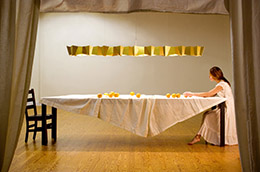
David D’Imperio’s sculptured lighting

On Friday past, I went to the Philadelphia Art Museum’s annual Craft Show.  Now this isn’t your usual craft show with knitted tea cozies, outré Christmas decorations, and cute tchotchkes for the home. This is major art.  The exhibitors were potters and metal workers, fabric artists and glass blowers, painters, fashion designers and jewelers, woodworkers and stone carvers. This was some major stuff–and more often than not far above my price range.

Yet it was all beautiful.  At one point, I called over one of the women I was with to see these magnificent glass platters. The artist corrected me: what I thought was glass was actually wood. All his pieces were wood.  Yet they were so translucent and brilliant and delicate that one would never first believe that they were wood.

Mark Schuler’s wooden bowl.

Two fashion designers–at opposite ends of the “elegance” scale–were both kicky and inventive. Their dresses and capes and skirts and pants were flowing with ruched materials or angular draping. One woman painted gorgeous canvasses, part abstract/part folk art, and treated them so they could be use as floor coverings. Runners for hallways, area mats for large rooms. They were exquisite. 

There was exquisite furniture and graceful pots, jewelry both elegant and extreme. There was a perpetual motion glass wine aerator and eyeglasses made of wood. There were graceful ceramics and fun metal sculptures. There was simply aisle after aisle in the cavernous Convention Center filled with magnificent works of human artistry. 

And that was the true beauty of this collection. Hundreds of people from around the world were simply doing what they loved–creating things of beauty.  How lucky one must be to be able to do what he or she loves as not their job but as their vocation, to be able to start the day with nothing and end up with something. For the artist does not go to work, he is always at work. He eats and sleeps and breathes his work.  And while not all of these crafts were to my taste–though many, many were–all were to my liking. For something inside me loves the idea that human beings are a species that does create, and often creates piece not for their utility but for their simple and utter beauty.

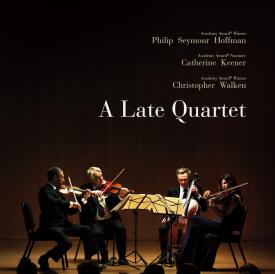
Movie Review: A Late Quartet–Harmony within the Dissonance

I received an e-mail last Monday that read like this:
Ciao Gianni,
Ho visto un film ieri sera si chiamo “A Last Quartet”. Ho pensato molto a Biggs perche un uomo ha Parkinson’s. Interesante  Buon giorno!!

“Biggs” was a friend of ours who struggled with Parkinson’s until the end of her life and Parkinsons plays a major role in the plot of Yaron Zilberman’s film A Late Quartet.  I had read about the film in those end-of-summer write-ups of films that would be arriving in the coming months, but had forgotten completely about it. And now, here it was in town.

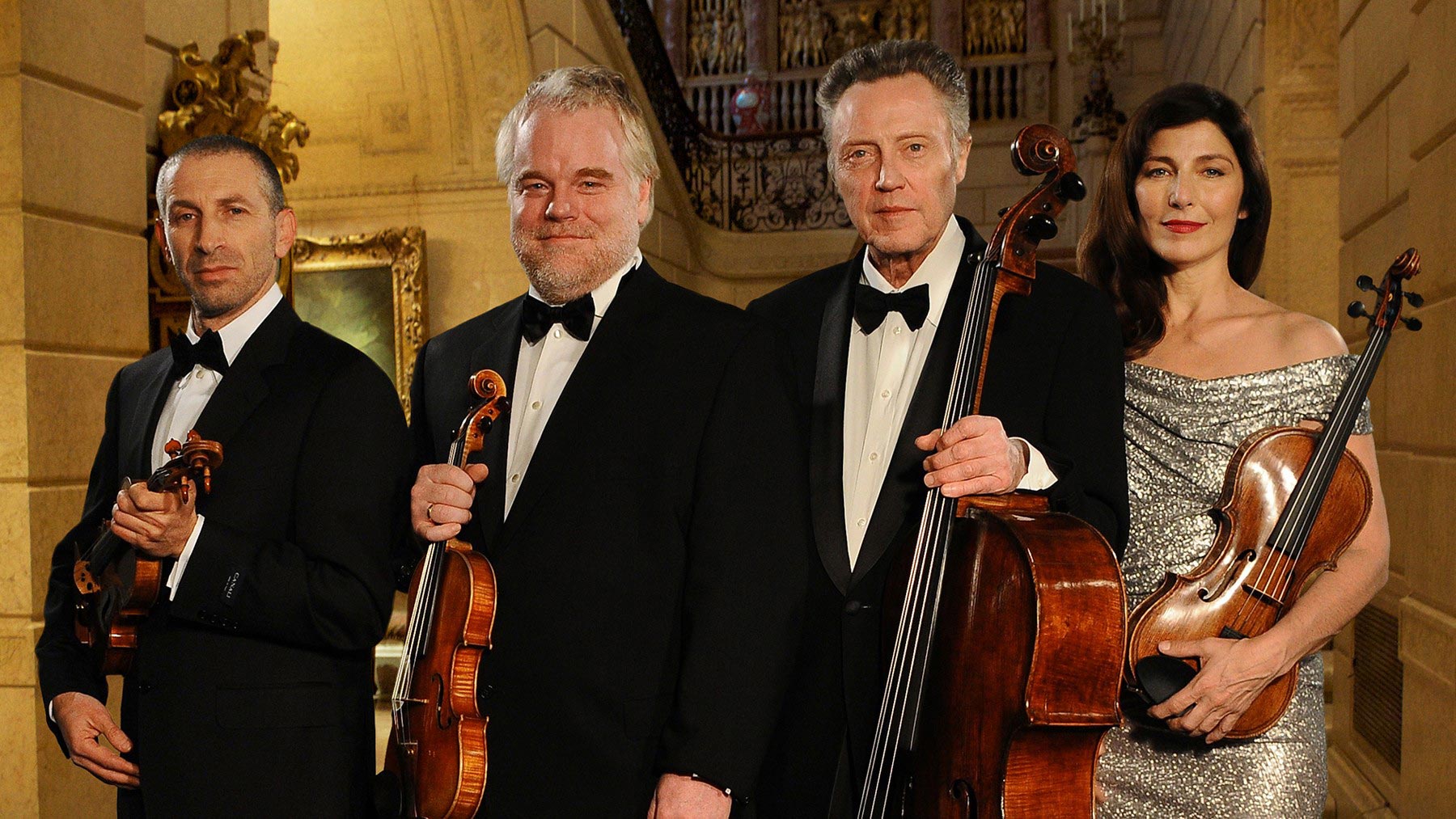
And while a diagnosis of Parkinson’s comes early in the movie, it is not the only malfunction in the story.  The film is about the tensions, dysfunctions, rivalries, and bickerings that take place within a famous string quartet, “The Fugue String Quartet.”  Celebrating its 25th anniversary together, the quartet reveals a shattering disharmony in an ensemble devoted to creating celestial harmony.

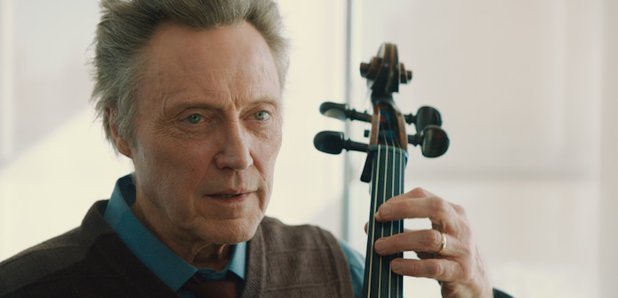
The film begins as the ensemble gathers for its first rehearsal after a short period apart. The cello player, Peter (Christopher Walken) cuts the practice short as he finds he is losing control and strength in his hand. After some visits to the doctor, he learns he has the onset of Parkinson’s disease, and he calls the group together to tell them and to announce that the first concert of the new season will be his final performance.
Yet Peter’s debilitating disease plays underneath the rest of the melodrama–much like his cello plays under the melodies of the quartet. Robert (Philip Seymour Hoffman) and Juliette (Catherine Keener) have been married through most of the quartet’s existence, and the strains within the marriage seem to be becoming more and more taut.  There is a silent dissatisfaction and regret running through the both of them. And finally, the first violinist Daniel (Mark Ivanir) is an exacting, domineering, egoist whose suppressed passion erupts in an affair that may fracture the quartet. (No, gentle readers. Although Juliette and he were once lovers before she married, she is not the focus of his attentions.)

A Late Quartet would be considered no more than just a middling film if it weren’t for the performances of Hoffman, Keener, Ivanir and Walken.  Walken, who lately seemed to be a mere parody of himself (more cowbell, anyone?) is superb. I can’t remember ever seeing him this intense, this openly vulnerable. In the class he teaches, he reads his young prodigies T.S. Eliot on Beethoven and reminisces about his and Pablo Casal’s conversations. He is dying, he is missing his dead wife, and he is suffering as he watches his beloved quartet rip apart. It is a simple, understated performance that echoes the role that his cello brings to the music.

On the other hand, while his character plays second violin in the quartet, Philip Seymour Hoffman is certainly the first violin in this ensemble. It is his quiet emotional rollercoaster, his final refusal to be everyone’s “doormat,” his true declaration of love for the wife whom he has just betrayed that is the masterstroke in this film. The film builds on Hoffman.  He and Cathrine Keener have worked in several films together (most notably Capote and Synecdoche, New York) and their comfort with each other is evident. The character she plays is perhaps the least discoverable–she is strong and yet damaged, wise and yet blindered, loving and yet cold.  Mark Ivanir (who people will recognize from countless television series as well as three Spielberg films and a couple of DeNiro projects) plays the role of the obsessive Daniel. Focused on passionless precision, he is the counterweight to Hoffman–who inwardly covets Daniel’s role as first violinist.

As well as the ensemble works off each other, the music is perhaps the most memorable.  The quartet is preparing Beethoven’s Opus 131 String Quartet (in C-sharp minor), a piece that Beethoven wrote during his last days and which taxes the strength and stamina of the performers as well as the integrity of the instruments.  We learn that it is what Schubert asked to be played to him as he was dying. In the film, the music is actually played by the Brentano Quartet, and it is stirringly emotional.  If you wish, you can hear it here:

Schubert once said after having heard Opus 131, “After this, what is left for us to write?”  The film A Late Quartet falls far short of those heights, yet when I think of Parkinson’s Disease and the people who I knew who have suffered from it, I wonder if the “what is left…?” is the haunting motif. I wonder if the Christoper Walken character–who so much wants the quartet to continue after him–has considered the same.

Zero words, four days drinking and not getting near a mustache!!

In the States, November is the month for all sorts of things.  I don’t know why, but it is.  In 2000, National Novel Writing Month was begun when Chris Bayley launched an interactive web-site that encouraged writers to produce 50,000 words or more of a novel. (Here is the site, but it’s too late to join this year: www.nanowrimo.org/).  The year earlier, Bayley had started the novel writing month in July, but moved it to  November the following year to take advantage of the more miserable weather.

Anyway, there was a lot of press in the weeks leading up to November 1, and I had toyed with the idea of doing it on my own without “registering” on the official website.  I had already 1700 words of something I had been working on, so I figure I’d cheat a little and have a head start when November came around. Well now it is November 4 and I still have the original 1700 hundred words.  November has produced ZERO!

I also figured I would try to cut back a little on the drink and use November as a dry month–sort of like what some people do during Lent.  I thought maybe it would get me feeling a bit more energized, a little more clear headed, repair some brain cells, and get a little further along on my “works in progress” (see paragraph above!)

Well it’s now November 4th.  I didn’t succeed on the 1st–a few beers with pizza.  On the 2nd, I stopped for dinner at my local and had several pints of Guinness and then a couple of glasses of wine when I returned home. Yesterday, the 3rd,  I was at a dinner party where the wine was flowing voluminously, and today I am invited again somewhere for dinner.  I plan to drink water at the dinner tonight and start my dry month from there.  We shall see.

But to be truthful, I haven’t been too successful for the first three days.

And then the oddest of all the November month “challenges,” this month is the November Mustache Growing Month for Prostate Health.  Entitled MOVEMBER, the event has been around for nine years now and is instituted to heighten awareness of all men’s health issues. There are celebrities involved, a Mobile App that allows you to time-lapse record the results of your growing and share with other participants, and professionally produced videos celebrating hairy upper lips.  I am sure it is a very good cause (my father died of prostate cancer) but Mustache Growing is very scary territory.  What happened to the good old 5k run?

Anyway, scarred by too many images of bad mustaches, this is one event I am not getting close to, not by a whisker.

.

Book Review: Sweet Tooth by Ian McEwan

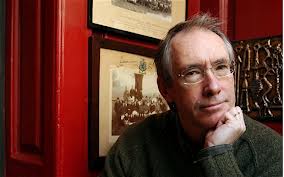
Ian McEwan

A lot of people I know do not like McEwan’s books.  However, I do very much. I find that his novels are both literary and very good reads.

McEwan’s novels are always well plotted, full of wonderful local color and specialized information that I did not know, and often times appeal to a particularly personal aspect of my life.  I remember very well and with great fondness the exact day that the novel Saturday takes place. (In fact I have written a piece about that particular day as well and am now shopping it around to place somewhere.) The novella On Chesil Beach is in many ways a modernization of the poem “Dover Beach” –a poem which also plays a crucial part in the ending of Saturday–and one on which I had based a short story a long while ago.  And despite the time period, Atonement is thoroughly post-modern in its attitude towards time and the historicity of events.

U.K. Cover of McEwan’s Sweet Tooth

McEwan’s new novel Sweet Tooth also plays with post-modernism in its narration. Indeed, the main character Serena Frome–a woman noted for her prolific reading habits–complains about the very type of novel that Sweet Tooth ends up being.

The time is the early 1970s, and Serena Frome is an intelligent young woman who goes off to Cambridge to study maths. It is right before the burgeoning of the women’s rights movement, and in fact, Serena is the only Cambridge female studying mathematics at the time. Yet she does not see herself as a trailblazing feminist, and in fact often  distances herself from many aspects of the movement’s agenda.

Yet feminism is not the crux on which this novel hangs. The Cold War is in full swing, and Frome has been recruited by an elderly Cambridge teacher who is also her lover for a position at MI5. Her task is to help wage battle on the cultural lines between the West and the Soviet Union. The government is worried that it is losing the cultural battle as more and more intellectuals, artists, and writers lean further and further left.  What it proposes is a plan to set up a false foundation that subsidizes writers with the idea that the intellectual community will see the country as supporting the arts and  with the added  hope that the writers’ work will fall more in line with its philosophies.

The mission is dubbed “Sweet Tooth” and Frome is given the job to bring in such a writer. She is to introduce herself as part of a panel that has recommended a young, upcoming writer and to offer him a stipend of two years salary to complete a novel.

Unfortunately, she also falls in love with the man.

Illustration: Satoshi Kambayashi/The Guardian
Taken from Guardian’s excerpt from Sweet Tooth

Like many Cold War tales, particularly when dealing with MI5, there are betrayals and mistrust.  There are thwarted love affairs, rogue agents, and a general sense of looking over one’s shoulder.  And in many ways, Serena is out of her depth.

The story is couched in the gestalt of the 70’s.  The IRA campaign in Northern Ireland is emigrating to England, the hippie movement is petering out while the establishment is growing its sideburns, and opposition to the war in Viet Nam is growing exponentially.  And all of these elements play a small role in Serena’s world.  Even McEwan’s buddy, Martin Amis, shows up to receive an award, along with Serena’s protege.

I was innundated with work (one reason I haven’t posted in three weeks), but had ordered Sweet Tooth from the U.K.  (It doesn’t come out in the U.S. until mid-November). And despite being behind in everything else, I picked up the novel and read it in two days. It is fast moving, intricately plotted, and enjoyable. I was told that the beginning was a little slugish and that one had to be patient before things got good, but I did not find this to be the case at all.

And I loved the ending, which put everything in perspective.

My only complaint is the cover of this edition–it is a bit cheesy and, with the title “Sweet Tooth,”  it  looks like the cover to some sort of  girls’  young-adult series, or worse some tarted up middle-class porn.  Don’t know what the people at Cape were thinking, but I think they blundered on this one.

Watching the wheels go round and round

photo from “Gorillas don’t Blog,” November 3, 2011

I woke today in one of those states.  I didn’t know who I was or where I was or what I was supposed to be doing. And as I seeped into clearer consciousness, I felt in a rut…already in a rut at 4:45 a.m. Geeesh!

The day begins: the 57 bus, the Market-Frankford El, the R5 train and then a brisk walk, hoping for a co-worker to come driving by. I will do the reverse in the evening. And then again tomorrow and tomorrow and tomorrow.

But the commute is not what was getting me. I enjoy it. I get plenty of reading done–and not a little dozing as well.  But something wasn’t sitting well.

Simply, I am not sure what I am doing. 

For work, I am teaching Atwood’s The Handmaid’s Tale, Woodrell’s Winter’s Bone, and Jim Shepherd’s Like You’d Understand Anyway. But I ask myself, “What am I teaching?” Sure they are great reads. They are more than that: they are thoughtful, engaging, and well-suited for introspection, reflection, and–hopefully–understanding.  But, as for today…meh.

I know that it is a passing feeling, the not uncommon question of  “Is that all there is?”

And I know I will get pumped by the next great book I encounter, by the old song that I hear from someone else’s radio, by a magnificent movie that comes in under the radar, by good craíc shared with friends. 

But today the feeling is real. It is simply something you work through.

I was listening today to John Lennon’s “Watching the Wheels Go Round.”  I was thinking beforehand that it reflected my own feelings today.  But it was just the opposite.

Lennon is watching “the wheels go round” because he had gotten off the merry-go-round, had walked out of the maze, was no longer “playing the game.”  He was enjoying the real things–his wife, his child, his new life.

But at the moment, for me (as for most of us),  I need to stay on the merry-go-round as it continues to spin, mindlessly, pointlessly and without destination. 

Nevertheless, today I am listening to what John says and that always seems hopeful.

Hackles, Philly Fringe Festival and a personal ghost

Photo courtesy of Groundswell Players

The Philly Fringe Festival and the Live Arts Festival have been running concurrently in Philadelphia for the past few weeks.  This usually means that there is an abundance of cutting edge theater, dance, performance, readings going on throughout the city, and this year it seems even more so.

For the past three years we have had a friend, Pia Agarwal, who worked for the festivals and always gave us a heads-up on what to see.  And she was never wrong.

But she’s moved to Austin, so we were on our own.

Fortunately, I know Nick Gillette, who is finding some success in the local theater scene.  This year, for the Fringe Festival,  he directed one play, Myths and Monsters,  at the Adrienne Mainstage and performed in another Hackles at the Crane Arts Old School White Space.

On Saturday night I went and saw Hackles. I have been in this venue twice before and each time have been wowed and impressed. This night was no different.

Groundswell Players in rehearsal for Hackles
(photo: Emma Lee/for NewsWorks)

“Devised” by the Groundswell Players–students at the Pig Iron School for Advance Performance Training–the play features four actors who take on a variety of roles. The main roles however are a blind old man, his daughter, his cockatoo, and Death itself. Scott Shepherd, who played the cockatoo–incredibly well by the way–also played the daughter’s hesitant boyfriend. The other additional roles–teacher, fellow students, policeman–were negligible and merely stock figures to keep the plot moving.

When  the cockatoo dies, the daughter–played by Martha Stuckey–believes she sees Death come and take the bird’s soul. Later, she witnesses an accident (off-stage) and sees this female incarnation of Death (played by Alice Yorke) more clearly and more definitely.

She tells her blind father (Nick Gillette), who is fascinated by what she relates and who believes that the dead continue to contact us through the holes in the static of his off-station transistor radio.

There is still more death, in the past and yet to come, but there is also great hope: the play ends with the awkward daughter and her boyfriend figuring out how to slow dance while Al Green’s version of  “How Can You Mend a Broken Heart” plays on the father’s no-longer-static radio.

The set was very cool–pure white walls with clear plastic opened umbrellas suspended from the ceiling. There was minimum furniture–the father’s table and chairs and a cabinet-like piece that was spun around–and great lighting.  There were two or three scenes with a scooter and roller-blades which could have been discarded, but as for the rest, it was perfect.

The play combined physical performance, comedy, metaphysics and domestic drama in a piece that was entrancing, engaging and thoughtful.

But the play was not what raised the “hackles” on my neck!

After the play, a number of us met in the parking lot, going over what we were doing and where we were going next.  Someone had an iPhone and asked someone else to take a picture of us all gathered.

No one, however, invited the ghost, who appears behind my head.

I have now studied this picture backwards and forwards, have enlarged it as much as I could and still see clearly, and it doesn’t make sense. Granted, the play dealt with death and the afterlife and the conviction that spirits communicate with us regularly, but I didn’t expect them to come out to an abandoned grammar-school parking lot. She seems to be in period costume–and our play was in modern dress; In fact, Death was dressed in a sexy black cocktail dress.  So she’s not from the play and she isn’t from the audience; her proportions seem larger than those walking out of the building; and she wasn’t with us.

So where do we go with this?

Job’s question, the Death of a Child and Ben Jonson’s poetry

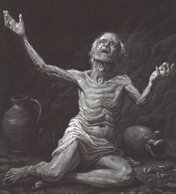
Job asking “Why?” Asking “How much more?”

Last year, a friend of my sister had a 4-year old child drown in a neighborhood swimming pool.  One would think that was enough for any parent to bear.

Last week, the very same woman’s 4-month old baby died in her crib—a case of SIDS.

This is a Job-like battering.   How much more can two people take?  How much more? They can’t be looking to sense, or reason, or “God’s plan.”  None of that can help, certainly not at the moment.

Lately, I have had a number of friends and relatives  who have lost aging parents. Sad as that is, it is reasonable and acceptable—part of the pattern of life.  But the death of a child?  No.

And there are thousands of children all over the world who die every day of disease, mal-nourishment, war, violence, and mere accident.

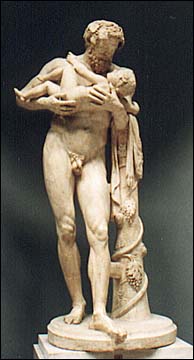
Statue of Father and Son
Vatican Museums. ©1999 A. Jokinen.

I used to teach a poem by Ben Jonson. If Shakespeare had not come along the era would have probably been known as “the Age of Jonson.”  He was much more successful, much more popular than Shakespeare was during his life.  And yet, he is not really part of the common culture today.  Shakespeare has pushed him aside.  But he is good and he is important. Here is the poem in which Jonson tries to deal with the death of his son: 

On My First Son
by Ben Jonson

Farewell, thou child of my right hand, and joy ;
    My sin was too much hope of thee, lov’d boy.
Seven years thou wert lent to me, and I thee pay,
    Exacted by thy fate, on the just day.
Oh, could I lose all father now ! For why
    Will man lament the state he should envy?
To have so soon ‘scaped world’s and flesh’s rage,
    And if no other misery, yet age !
Rest in soft peace, and, asked, say, Here doth lie
    Ben Jonson his best piece of poetry.
For whose sake henceforth all his vows be such
    As what he loves may never like too much.

Jonson’s first son—also named Benjamin, which in Hebrew means “Son of My Right Hand”—died when he was seven years old. Jonson, renowned and celebrated for his poetry and drama, puts it all in perspective and rates this dead son as the best thing he has ever created.  One can feel the father’s pain in the final two lines–the fear of “liking too much” that which one loves.

Movie Review: City Lights by Charlie Chaplin

I began showing City Lights to my students last week. It is for my “Literature and Film” class and while I don’t necessarily have a “literature” to couple with,  I think it is a film that everyone should see.

In fact, I believe it is one of the finest movies ever.

(The AFI ranks it as number 76 of the 100 best American movies of all time. Chaplain’s  The Gold Rush is ranked two slots before it at 74 and his Modern Times several below it at 81. Chaplin leads all directors with having three in the top 100.)

Yet art is not a contest. And City Lights is pure art.

Most of my students have never seen a movie in black-and-white! And they immediately say (and moan)  that they have never seen a silent movie. Yet, City Lights is not a silent movie. Chaplin made the movie well past the advent of the “talkies.” He chose silence for his “Little Tramp” because giving him a voice–and a language–would impair his universally beloved appeal. In speaking no language, the Little Tramp belonged to all languages. And so Chaplain dubbed City Lights a romantic pantomine.

But it is false to state that it is a silent movie.  There is a omnipresent score (written by Chaplin) as well as several moments of sound. In the boxing ring, the bell signalling the end of a round clangs time and time again–the rope pulling the bell is tied around the Little Tramp’s neck and every time he hits the floor the bell sounds. An opera singer’s performance at a high society party is disrupted by the piercing whistle that the Little Tramp has inadvertently swallowed. And perhaps the best of all is the nonsensical sounds that emit from the braying politician and socialite at the film’s beginning.  Chaplin did not suffer fools easily and pompous power brokers are a large and easy target. (There is a series of holiday Charlie Brown television specials here in the States and in them all the adults speak no language; they simply bray these “wah, wah, wah” sounds.  I have to wonder if they picked it up from Chaplin’s City Lights.)

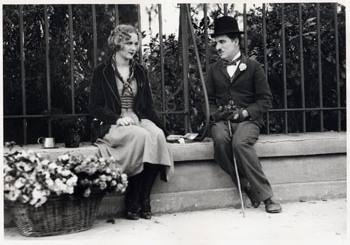
Charlie first meets the blind flower girl

But aside from the superb technicalities, the dramatic lighting, and the slapstick choreography, what anchors the film and raises it above mere madcap film-making is the story itself.

The Little Tramp has fallen in love with a blind flower girl, and she with him, but she mistakenly believes he is a millionaire. (When we–and Charlie–first meet her, a fleet of fancy cars had just pulled up to where she sells her wares. She believes that Charlie belongs with them. Several other coincidences add more credence to her misunderstanding.) As the story moves forward,  Charlie goes to great lengths to get her money not only to avoid eviction but to take part in a experimental cure for blindness, and his efforts finally land him in jail.

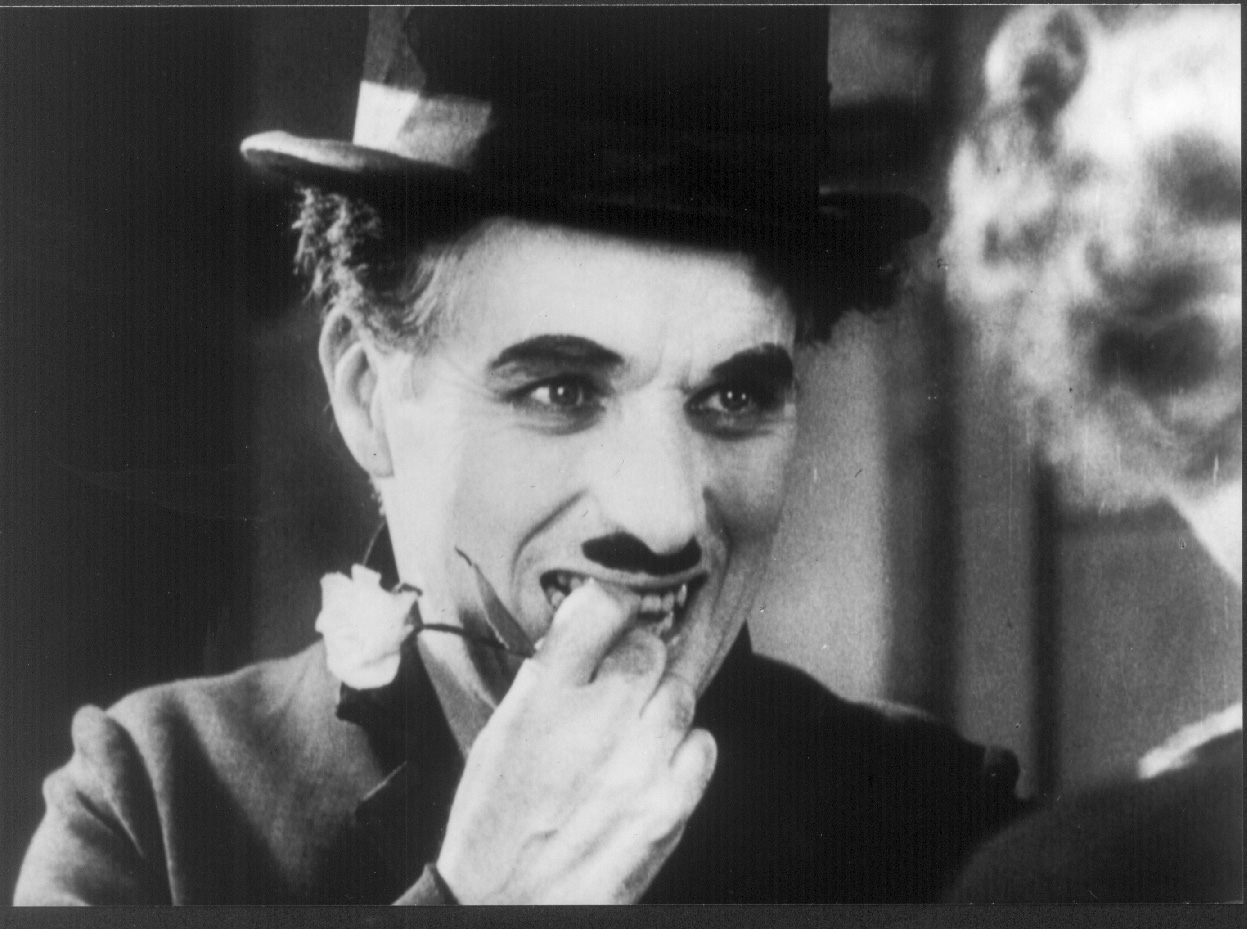
By the time  he is released from prison, she is cured. She can see.  And yet the rich prince she had imagined as her benefactor is a far cry from the Little Tramp she notices at the end. The scene where this is discovered has been called one of the high points of movie making.  The acting is all in the face. It is subtle, internal and real. (see the picture at the top of the post, look at Chaplain’s eyes, imagine what he is thinking.) And it is very hard not to beome a little teary when viewing it. It is not cloyingly sentimental–and it very well could have been. It is perfect.

The Little Tramp was a masterful creation. Always gentle, polite, and kind, he often acted as a foil to the crassness and cold-heartedness of modern life. From his position at the bottom of the social ladder, the Little Tramp sweetly pointed out the foibles of those above him.

Here is a delightful clip from the movie Chaplin in which Chaplin (played by Robert Downey, Jr.) creates the character of “the Little Tramp.”  Enjoy.

Reading, writing, and laughing with Anne Lamott

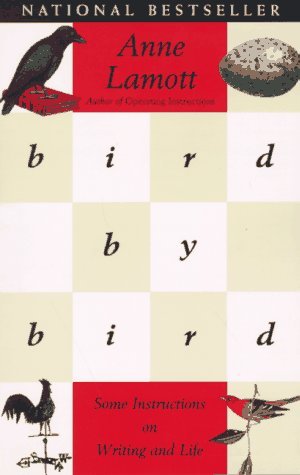
A woman I work with is teaching a course in Creative Writing that I will be teaching in January. She has assigned a book for her students to read: bird by bird: Some Instructions on Writing and Life by Anne Lamott.

And in a marvelous feat of procrastination, I decided to begin reading it as well–instead of the three other books that I need to be reading right now for the classes I am currently teaching.

And it was a good decision.  I have not yet completed it–but I have laughed through much of it.  Lamott has a voice–a way with words– that seems nurturing, real, wise and funny.

For instance: “We are a species that needs and wants to understand who we are. Sheep lice do not seem to share this longing, which is one reason why they write so very little.”
Where in the world did those “sheep lice” come from? But better yet, look at the next to the last word–“very.”  How perfect is “very” in this instance.

She gives us a bit of her own background, her bookish parents, her father the writer, her feelings of insecurity and isolation–the gist of many a writer’s baggage. And she gives us episodes from the writing courses she teaches.  Many of her students, it seems, don’t want to write, they want to be published. They want the fame, the riches, the sense of satisfaction that they believe they will attain when they are published.  And they are so wrong.  And yet, time and again in her courses questions about agents, editors and publishers  maddeningly outnumber questions about writing.  She tells them to try to get a refund on their tuition!

There are no special formulas, secret tricks, magic keys that will get you published, she tells them. And to illustrate that she tells this story:

My son, Sam, at three and a half, had these keys to a set of plastic handcuffs, and one morning he intentionally locked himself out of the house. I was sitting on the couch reading the newspaper when I heard him stick his plastic keys into the doorknob and try to open the door. Then I heard him say, “Oh, shit.” My whole face widened, like the guy in Edvard Munch’s Scream. After a moment I got up and opened the front door.

“Honey,” I said, “what’d you just say?”

I said, ‘Oh, shit,” he said.

“But, honey, that’s a naughty word. Both of us have absolutely got to stop using it. Okay?”

He hung his head for a moment, nodded, and said, “Okay, Mom.” Then he leaned forward and said confidentially, “But i’ll tell you why I said ‘shit.’ I said Okay, and he said, “Because of the fucking keys!”

There are no “fucking keys” that will get you in, she tells her students–and some get it and some don’t.

The best advice she says she ever received about writing–and which she passes on to her students–came from  the writer Natalie Goldberg.  When asked for the best possible writing advice, Goldberg picked up a pad of paper and mimicked the act of writing, page after page after page. The best advice?  Write and write and write and write.

So I am enjoying this book immensely but not necessarily for its writerly advice. I am enjoying Lamott’s voice, the natural flow of her words, the wise humor of her thought.

In describing, a person she does not like, whom she believes even God dislikes, she repeats this observation that a priest friend of hers passed on: “…you can safely assume you’ve created God in your own image when it turns out that God hates all the same people you do.”

How perfect.

Brueghel, Auden, and the death of my mother

My mother died yesterday.

She was a simple, quiet, sweet woman whose last few months were horrible. And while it might sound cold-hearted, I can honestly say she is better off today than she was the past few weeks. For better or worse, at least she is now at peace.

And while I have a good number of siblings and a large network of friends and relatives with whom to share the loss, privately I turn to Art with a capital “A.”

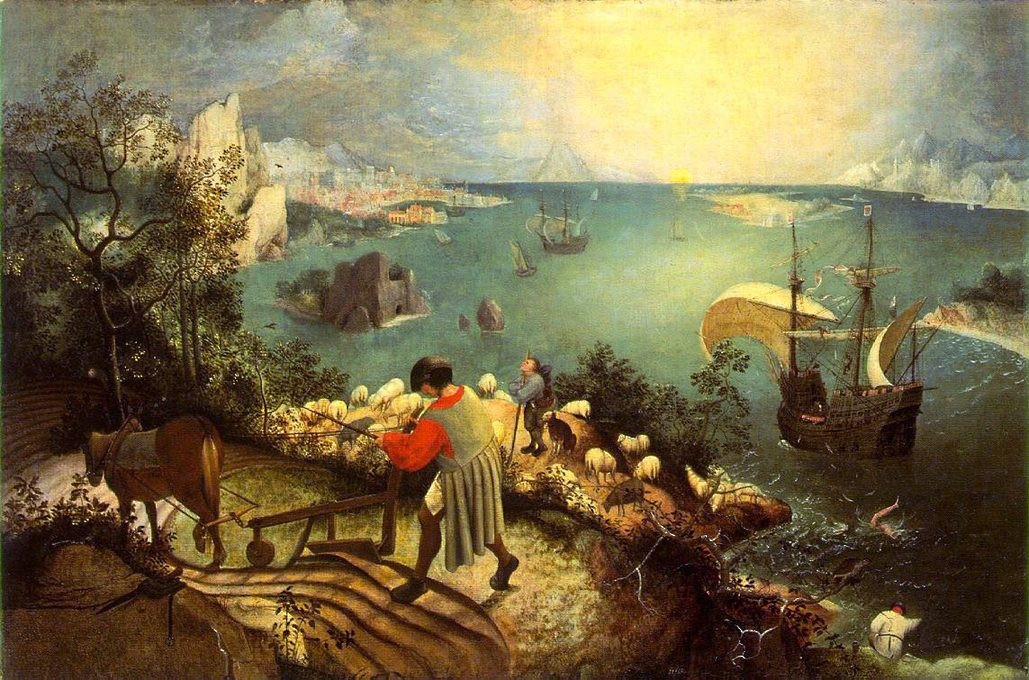
The picture above is of a painting by Pieter Brueghel. Entitled Landscape with the Fall of Icarus, it depicts the legendary fall of Icarus, who (in one story) famously disobeyed his inventive father and flew too close to the sun. The sun melted the wax holding together the wings that his father had fashioned, and he crashed into the sea.  Through the ages, Icarus has become a two-sided symbol for artists: he is either a symbol of blatant disobedience akin to Eve or Pandora or Deidre or a symbol of great striving, of “flying to the sun,” of grabbing all the gusto one can.  I usually lean to this second interpretation and see Icarus as an example of risking it all in pursuit of one’s dreams.

Anyway, this painting is one of my very favorites because
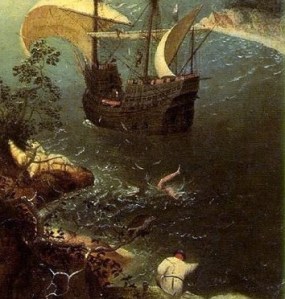
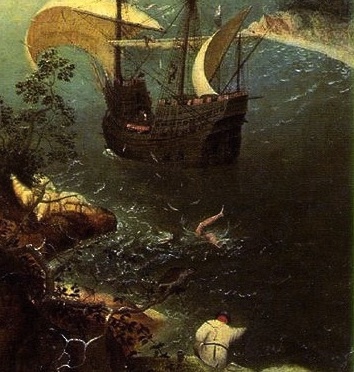
detai from painting: Icarus’ two legs in the water

Brueghel has depicted this grand, mythic tragedy as happening amidst the pedestrian goings-on of daily life.  If you look closely,  you can see Icarus’ legs darting into the water in the right hand corner of the canvas. If you are not looking for them –and did not have the title of the painting to clue you toward Icarus–you might miss them entirely in the busyness of the entire painting. There is a shepherd, a ploughman, a single fisherman, a stately ship and a far-away city, but the boy falling out of the sky barely registers on their existence.

A very famous painting, Landscape with the Fall of Icarus also has been the subject of several poems, most notably by Auden and William Carlos Williams.

Below is W.H.Auden’s poem about the painting which now hangs in the Musées Royaux des Beaux-Artes Belgique in Brussels:

Musée des Beaux Arts by W. H. Auden

About suffering they were never wrong,
The old Masters: how well they understood
Its human position: how it takes place
While someone else is eating or opening a window or just walking dully along;
How, when the aged are reverently, passionately waiting
For the miraculous birth, there always must be
Children who did not specially want it to happen, skating
On a pond at the edge of the wood:
They never forgot
That even the dreadful martyrdom must run its course
Anyhow in a corner, some untidy spot
Where the dogs go on with their doggy life and the torturer’s horse
Scratches its innocent behind on a tree.

In Brueghel’s Icarus, for instance: how everything turns away
Quite leisurely from the disaster; the ploughman may
Have heard the splash, the forsaken cry,
But for him it was not an important failure; the sun shone
As it had to on the white legs disappearing into the green
Water, and the expensive delicate ship that must have seen
Something amazing, a boy falling out of the sky,
Had somewhere to get to and sailed calmly on.

So yesterday, after the mortician took my mother’s body away, after my brother and sisters and I cleaned out her personal effects and donated her clothes to the needy, I drove away and stopped at a convenience store for a sandwich. The store was extra crowded, there was a particularly annoying man in line, and the cashier herself was particularly surly.  I wanted to yell to them, to say, “Hey, don’t you know my mother just died?!” But of course I didn’t and of course they couldn’t have. They were simply going about their normal Saturday routines.

Instead I thought of Brueghel and Auden and Landscape with the Fall of Icarus.

Yet, Auden missed another part of the equation.  While it is true that the world goes on despite, and during, moments of personal tragedy, it also does the same in moments of great personal triumph. We tend to think that much of this existence is about us, about our heartbreaks and our victories–and very little of it really is.

Anyway, my world is different today than it was yesterday.  I must meet with siblings to arrange funeral services, arrange affairs at work for missed time, try to find a wearable suit for the funeral…and the entire time the great big world will go spinning along, unaware of what any of us are dealing with.

As Auden said, “they were never wrong,/The Old Masters.”

Margaret (Peggy) Bohannon

nee McNeila

1929-2012

Requiescat in pace