The actual title of Olivier Assayas’ new film is Après Mai–a reference to the months following the student and worker demonstrations of May 1968 in France. And that, in many ways, is the focus of the film: young, sincere characters trying to maintain the commitments of 1968, but somewhat too young still to be a real part and unprepared for the crashing ordinariness of the life to come.
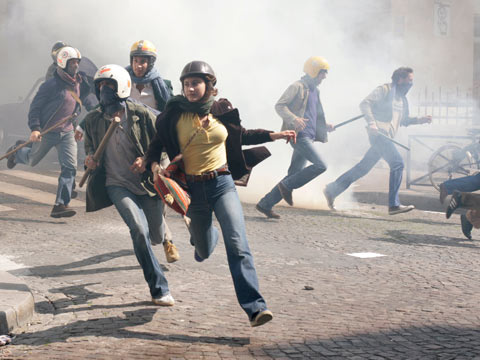
The film begins with high-school students’ listening to their teacher’s monotonous reading of Pascal’s Penseés. Within minutes of screen time, these same students are scrambling away from overzealous police dispelling a student demonstration. The life of the classroom and their political/social/activist lives are much, much different. The teachers give them Pascal and they are reading Gregory Corso, Chairman Mao and listening to Phil Ochs.
Early riot scene in Something in the Air
I had a friend who was a student in Paris at that time in 1968. When I asked her about it, she sort of shrugged. “The only difference,” she said, “was that afterwards we were permitted to call our professors tu rather than vous.
But for Gilles, Alain, Christine, Rachkam la Rouge, they want very much for the spirit of May 1968 to be carried on, to be carried through. They believe that May was not the climax but the beginning of the revolution. Stuck in their sleepy village outside of Paris, the students join political parties, pack debating halls, distribute the radical free-press, and organize guerrilla graffiti forays against the local establishment and police. One of these night raids goes wrong and a guard falls into a coma when hit with a bag of cement mix. The students decide to scatter.
Gilles (Clémont Métayer) and Christine (Lola Créton) hitch up with a radical collaborative on its way Italy where they become lovers and later part as she continues with the collaborative to make a film on Italian workers.
Christine and Giles on the road to Italy
Gilles (Clémont Métayer) and Christine (Lola Créton)
Gilles is torn in his radicalism–for his passion is art, and he is not convinced that his art must always serve the “cause.” Alain (Felix Armand) and Leslie (India Menduez), an American he meets in Rome, go East to Afghanistan, he an artist and she a dancer looking for spirituality. Disillusioned over time, they all return to France, and ultimately to Paris.
But there is another story running through Gilles life. Of course, in a story of a teenage-boy there needs to be friction between him and his father, a successful movie director. While there is never dramatic conflict between the two, as he grows, Gilles is able to tell his father how superficial and wrong-headed he believes his film adaptations are. (The father makes adaptations of George Simenon’s Maigret novels.)
But the more important sub-plot is about Gilles and his true love, Laure (Carole Combes). When she first appears early in the film, there is a jarring film switch from the smokey riots of their village to an Edenic, woodsy scene. She has come to meet Gilles and is in flowing white and the sun illuminates both her and the shimmering foliage around her. I felt however that I was in a 1970’s shampoo advertisement and that any minute I would hear Donovan singing “Wear Your Love Like Heaven.”
Gilles and Laure
Laure is a bit more worldly than Gilles and his mates, and her wealthy bohemian parents are taking her to London, as the father is the light-man for a fledgling rock band. She is willowy and bright and airy and full of sunshine. And she leaves a mark that even Christine knows she cannot undo. Later, when his father informs him that she has returned, he ventures out to her parents’ chateau for a party. Throughout the party, I was reminded of when the Stones had moved to the south of France in the early ’70s and had worked on Exile on Main Street. There was the same louche, blowsy freedom, the same drug use, the same music, the same comings-and-goings.
The party is important, though I am not positive how it ended. Gilles leaves. Laure jumps from a burning building and that is it.
And then real life steps in. Gilles is a “go-fer” for his father’s film company (although a left-wing broadsheet has begun using his drawings), Leslie abandons her “spirituality” and returns with her father to New York and Julliard, Rackham le Rouge leaves the Trotskyites for inconsequential anarchism, and Christine discovers that the earnest leftism of the man she is living with and the collective they are part of does not carry forward to women.
Olivier Assayas–who wrote and directed–gives us a nostalgic film, a film that even looks from an earlier period. The colors, the lighting, the cutting, the soundtrack all capture a particular moment in time. And the two leads, Créton and Métayer are likeable and familiar–we do care about them and their decisions.
Frequently in the film, we watch characters watching films–and these films within a film are rendered in wavering, sincere, gaudy, and innocent beauty. (Perhaps part of that innocence is the knowledge in hindsight that much of it is not going to last.) Indeed, film and film-making is such an integral part of the story that now I am not sure if Apres Mai (Something in the Air) isn’t a dissertation on film of that era disguised behind a story of that era.
In the end, Gilles is working on a science fiction film in London that features giant lizards and Nazis (and Dolores Chaplin, the granddaughter of Charlie and Oona!); Christine’s collective is releasing its first commercial documentary on Italian workers (though free to workers’ unions) and Gille’s dad is still turning out the Maigret mysteries. However, Apres Mai ends with a haunting, new wave, almost psychedelic clip of a willowy woman walking towards the camera.
We recognize her by the end.
♦ ♦ ♦ ♦ ♦ ♦
And for a treat, here’s the Stones live in 1972 doing “Tumbling Dice” from Exile on Main Street.
A while back, I had posted about a performance of Samuel Beckett’s Endgame that I ‘d seen at the Arden Theater in Philadelphia. In it, I quoted my favorite lines from the play:
HAMM: (letting go his toque) What’s he doing?
(Clov raises lid of Nagg’s bin, stoops, look into it. Pause.) CLOV: He’s crying.(He closes lid, straightens up.) HAMM:Then he’s living.
The character Hamm has made the immediate inference that if his father is crying, then he is alive. And we, by extension, apply it to the human condition. I remembered this line–and the act of crying– this week when teaching Waiting for Godot. (Actually, the crying seemed more appropriate than ever for someone trying to teach Godot to 18-year old boys during their last week of school when the temperatures are in the mid-70s and the sun is bright! Hah!)
Early in the play, Estragon and Vladimir point out the tree where they are supposed to wait for Godot. (It is the only piece of scenery. The scene description reads simply: A country road. A tree. )
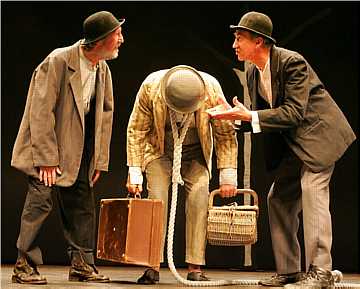
Mark Bedard (Vladimir) and Mark Anderson Phillips (Estragon) in Samuel Beckett s ‘Waiting for Godot,’ at Marin Theatre Company. photo 2013 by Kevin Berne
Estragon: [desparingly] Ah! [pause] You’re sure it was here?
Vladimir: What?
Estragon: That we were to wait.
Vladimir: He said by the tree. [They look at the tree.] Do you see any others?
Estragon: What is it?
Vladimir: I don’t know. A willow.
Estragon: Where are the leaves?
Vladimir: It must be dead.
Estragon: No more weeping.
This is the exact inverse of the lines from Endgame. In Endgame, the syllogism is that if you are crying then you are alive. In Waiting for Godot, the syllogism is that if you are dead, then there is no more crying. More or less the same thing.
Later on, as Vladimir and Estragon rebuke Pozzo for his treatment of his slave/servant, Lucky, there is more conversation about crying:
[Lucky weeps]
Estragon: He’s crying!
Pozzo: Old dogs have more dignity! [He proffers his handkerchief to Estragon.] Comfort him, since you pity him. [Estragon hesitates.] Come on. [Estragon takes the handkerchief.] Wipe away his tears, he’ll feel less forsaken.
[Estragon hesitates]
Vladimir: Here give it to me, I’ll do it.
[Estragon refuses to give the handkerchief. Childish gestures.]
Estragon and Vladimir with Lucky from samuel-beckett.net
Pozzo: Make haste before he stops. [Estragon approaches Lucky and makes to wipe his eyes. Lucky kicks him violently in the shin. Estragon drops the handkerchief, recoils, staggers about the stage, howling with pain.] Hanky!
[Lucky puts down bag and basket, picks up handkerchief and gives it to Pozzo, goes back to his place, picks up bag and basket.]
♦ ♦ ♦ ♦ ♦ ♦
What are we to make of that? What is the significance of Lucky’s crying? Of Estragon and Vladimir’s desire to comfort him? Of Lucky’s lashing out at his comforter? And of his immediate subservience to his persecutor.
There is, of course, much more going on here, but the small emphasis on tears should be noted. Earlier Beckett had equated crying with living. Are we simply to be reminded that Lucky is a living, human being, and leave it at that? (We knew that anyway.)
Or perhaps we are to examine the difficult symbiosis between the comforter and the comforted? The helper and the helped? The cry of pain and those who hear and those who refuse to hear?
What is our responsibility to those who are “crying”? To those who are inconsolable? Good questions, all. And ones that we should take the time to think about every so often.
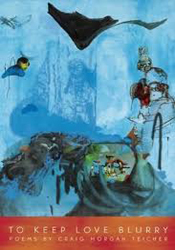
I must say that I did not enjoy Craig Morgan Teicher’s third collection of poems. That is not to say that they are not technically brilliant, that they are not impressively raw and honest, nor that there are not many moments that just knock you open. I admire it greatly; however, I do not like it. Even Teicher understands the sadness and dysfunction and sourness inherent in his verses. Here is his dedication:
To Cal and Simone–you should know that it’s a lot more fun than these poems suggest– and
for Brenda, who knows…
Brenda is Teicher’s wife, who makes many appearances in the collection (actually throughout his work– his first collection was entitled Brenda is in the Room and other poems.)
To Keep Love Blurry is tied together by two major themes. One his mother and father, particularly after his mother’s death. And two, his marriage to Brenda, their (apparently) special-needs son, and Teicher’s sullen acceptance of love. Indeed, for Teicher love–both familial and marital– is more of an anchor than a source of flight. Here is he about motherhood:
My wife is not my mom. My mom is not my mom. My father is not my mom. My boss is not my mom. She is a tooth with rot, a flower pressed between the pages of a lost book. My son is not my mom. She is a mare crushing my skull beneath her hoof. She is forever starved. I ride to the edge of the earth clutching her hair. Get it over with. It’s never OK, not ever. Fuck it, whatever. If Robert Frost is my mom, then so is Robert Lowell. She taught me to talk. She is where I’m headed, a bomb crater. She forgives me like a hunting hawk. Maybe she’s my boss’s boss, my wife’s other other lover, my son’s midnight cough. She loves me like a brother.
(“My Mom, d. 1994”)
The perfection of form–a modern Shakespearean sonnet with A-B-A-B…rhyme scheme, a regular rhythm, an unusual octet, quatrain, couplet construction–is made inconspicuous by the language, the odd identifications of motherhood, with unusually negative words: “tooth with rot,” “a mare crushing my skull,” ” a bomb crater,” “my wife’s other other lover.” What exactly are his feelings? “Loves me like a brother” does not cut it for me. Perhaps the secret lies in the allusion to Robert Frost and Robert Lowell. Teicher quotes a Lowell poem as an epigraph to his collection:
“Those blessed structures, plot and rhyme– why are they no help to me now…”
Perhaps Teicher is saying that the “blessed structures” of poetry–with which he is extraordiaryily adept–are no longer to sufficient to buoy one in the sourness of modern life. Here he is similarly on friendship, marriage and love:
In just the couple years since two by two we all began to partner off, already we’ve practically retired, passing though apartment doors shut tighter than a cough. There used to be long, wasted hours of talk, nothing secret between us, not even skin; at the conclusion of a wandering walk, the flirtatious dark would set in. Is marriage lonely by design,
in hopes that obeying an age-old law of I am only hers, she is only mine forms a brittle scab over the always-raw wound of too much intimacy between friends in favor of a duller aching that never ends.
(“Friendship”)
Again, the “plot and structure” to which Lowell refers are exquisite: a Shakespearean sonnet, intricately wrought and patterned. But for the speaker, the poetry is subsumed by the “duller aching” and “brittle scab.”
Mixed among the villanelles and sonnets, the rhyming couplets and the longer verse, there is a series of prose ruminations on the death of his mother and the subsequent loneliness of his father. These too are notable for their raw honesty, their unflinching introspection.
Well-wrought and linguistically daring, To Keep Love Blurry is evidence of Teicher’s impressive talent. However, I found it sullen and pouty and self-indulgent. Nevertheless, such is Teicher’s poetic cleverness and adroitness that I will surely keep my eye out for his future work.
As I said in “The End of April…part 1,” the month got away from me. What I mean is that all the great ideas I had for celebrating National Poetry Month were just that…great ideas. Just so much smoke. And so to make up for it, I am trying to put up several posts about a variety of poetry collections that I read during the month of April.
Back in the fall, I went to a conference of poets and heard Catherine Barnett read. I also bought her book The Game of Boxes which had just won the 2012 James Laughlin Award of the Academy of American Poets. And like too many of the books that I buy, it joined the stacks of “to read” books that are now towering next to my bed and next to my desk. Then, as if to increase my guilt for not reading it yet, in April, the Academy sent me a copy in the mail. (Fortunately, I was later able to give that away as a birthday gift to another poet.)
Assailed with the guilt of owning two copies and not having cracked the spine yet, I dived in. And was I glad.
Barnett’s collection is divided into three parts: “Endless Forms Most Beautiful,” “Of All Faces,” and “The Modern Period.” The poems in each section are informed by a mature wisdom and wonder and understanding and befuddlement while dealing with those very issues that simply befuddle a younger world. Lust, love, family loyalty, parents and parenting, self, partnership, Barnett touches upon all of these, assuring us that none of us ever really get a grip on everything swirling about us. The middle section, “Of All Faces” is subtitled “Sweet Double Talk-Talk” and delineates the love/lust/comfort/discomfort of a partnership worn smooth over time. This is my favorite part of the collection.
From the outset, there is an immediate comfort in their age and a delight in their familiarity:
It’s a different beauty, Your torso is stained and creased, you say your an old man–
the backs of your hands might be an old man’s hands but the tips of your fingers —
little shocks of pure mind, and I like theme there,, yes, ageless persuasion’s design and rush. (Sweet Double Talk-Talk, i)
There is a weariness in famliarity:
Sometimes he’s everything to me: yesterday, tomorrow, regret and shame.
And sometimes he’s nothing to me, an old cushion on an old couch:
a pin-cusion: something I think I can replace. (Sweet Double Talk-Talk, xvii)
But overall, there is a comforting lust and an accepted love:
I’m afraid you’ll die, and tonight’s your birthday, it’s no different, in fact it’s worse, come drink some wine–
Let’s sit at the bar. It’s winter, so I’m in your coat, I’m in your promises, your smooth worn promises sliding in and out of my own love of death so slick with want–
Soon, you say, your breath still warm in my ear. (Sweet Double Talk-Talk, xviii)
I cannot say why, but I love this couple. I love their honesty, their quirks, their enduring lusts, their enduring second-guessing. And while this section could almost be considered a narrative, each section is similarly anchored by a wise understanding of time and love and others.
I begin each April–designated in the U.S. as National Poetry Month–with all kinds of grand ideas. I will organize students into a poetry festival, we will stage poetry slams, another teacher and I will do readings together, we will invite celebrated, fascinating (and inexpensive) guests to speak. And then before I get any of it done, May comes around and I’ve done nothing.
This month the most I did was organize a festival for the following year and set out to go to Philadelphia Stories’ “Party Like a Poet” benefit. I made my way down to the location (a subway and a bus trip away), got there far too early, and talked myself out of it — I returned home before it started. Not very poetic, I guess.
But what I did do–not very celebratory or communal–was read a lot of poetry. And I mean a lot.
Some of the titles were by veteran poets such as Mark Doty and Edward Hirsch and others newer names such as David Livewell and Catherine Barnett. They ran the entire gamut of poetic offerings–free verse and formal verse; confessional poetry and nature poetry; poems about love, loss, sex and death; poems about animals and insects, planets and hardwiring. They were collections that I bought, that were given to me as gifts, and one that was sent to me by the Academy of American Poets. Mark Doty’s was a National Book Award Winner, Catherine Barnett’s was a James Laughlin Award winner, and David Livewell’s was T.S. Eliott Poetry Prize winner.
And they were each unique and very different from each other.
And so in celebration of April “the cruelest month,” each day I’ll give a quick run down of one of those titles that have come across my path in the past month or so.
Shackamaxon by David Livewell was fun because he is a talented local poet and his work is situated in the places and neighborhoods I am very familiar with. (How fun is that when in a movie you recognize a street, a diner, a department store, a park?!) The title “Shackamaxon” was the Native American settlement where William Penn made his famous treaty with the Leni Lenape tribe and began establishing what is now the city of Philadelphia.
Livewell’s work is gentle and honest and gritty and searing and, to a large degree, nostalgic, as he captures his blue-collar environs, the families, the struggles, the personal milestones and the larger changes over time. Looking back at the hardscrabble neighborhoods where he was raised, he elevates his urban experience–both memorable and familiar–into art. My favorite is “Summer Elegy,” a nostalgic piece that reminds me of my own father and his generation–loyal to their perennially awful baseball team–and of the passions they passed on to their children. Here is a short piece of it:
On the front step my Grandpop strained to hear Harry and Whitey* call the Phillies game from a crackling Philco hung on the wrought iron railing. He’d grind his teeth and move a toothpick left and right the way that on-dck players swung at air, a rhthym to Harry’s baritone and Whitey’s softer quips between the crowd noises and vendor calls. He seemed to wait on possibilities that hung like pop flies. Gramps would tisk at strikeouts, whistle for homers, and often blurt “About damn time!” or “Bum!” And all around the neighborhood were men from other families catching the baseball game…
(from “Summer Elegy”)
* beloved announcer (Harry) and color-man(Whitey) of the Philadelphia Phillies
A colleague came up to me with a problem–a problem with some unruly boys who had been displaying a growing disrespect towards her, coupled with a sophomoric sexism that went beyond their adolescent asininity and a smattering of racism. She then went on to say that to make matters worse, they were also very good writers. I wondered to myself if what she said was not necessarily atypical–that their innate creativity is being strangled by the dysfunctions of the modern educational system and that that is one cause of their intractability.
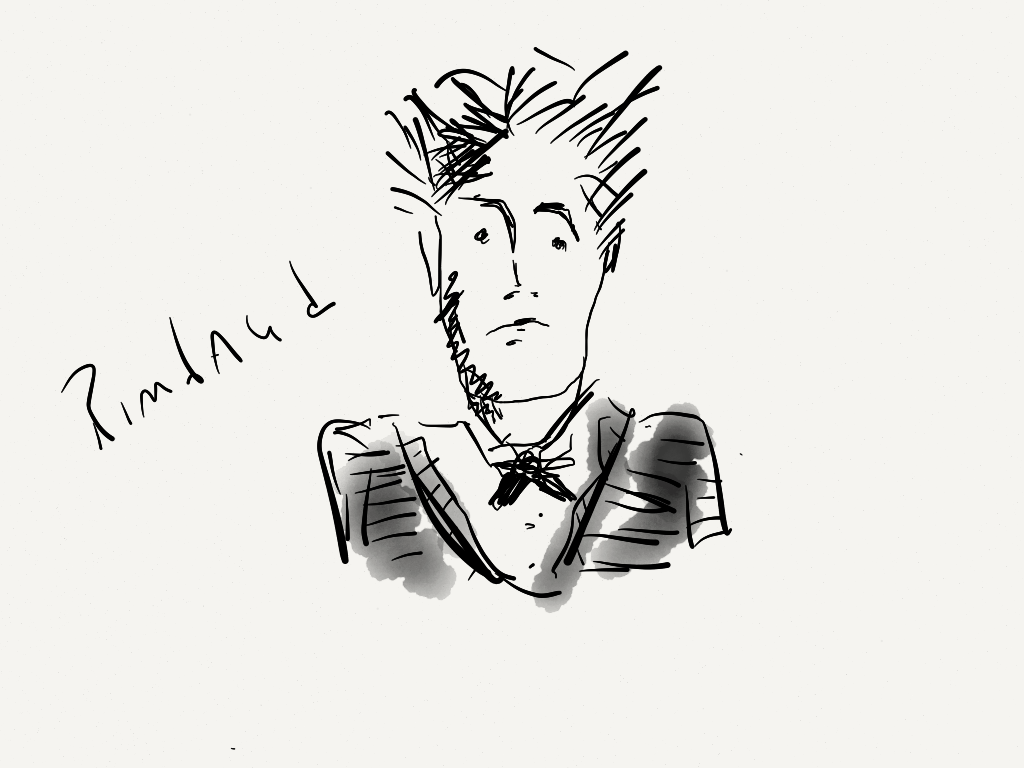
To make the point, I told her, I wouldn’t want to have taught Rimbaud.
Ah, Rimbaud, the boy-child terror who created haunting, mesmerizing verses until he was 21 and then quit to become a businessman, to dabble in gun-running in Africa, and to even try to join the U.S. Navy. But whatever he did from that point on, he had quit writing and refused to talk about it thereafter. Yet in those five or six years in late adolescence, he cut a swath of creativity and destruction, of love and violence, of intelligence and stupidity–and blazed into the pantheon of world poetry.
In actuality, however, Rimbaud was in fact a fine, model student. While he was in school, he usually walked away with the academic prizes given out at the end of a school year. He wrote poetry in in his native French, as well as in Latin and Greek, mature verse, some of which is still anthologized. Indeed, he was a stellar student. But then he quit school.
When he was still sixteen–and with the encouragement and support of the older Paul Verlaine whom he had enamored with some verses –Rimbaud first ran away to Paris. There he began a meteoric life of debauchery, anarchism, promiscuity, violence, substance abuse–and the most intense poetic creativity.
And like a meteor, Rimbaud burned out quickly. His intense and volatile love affair with Verlaine ended with Verlaine shooting him twice in the arm. Verlaine was arrested and served two years in prison.
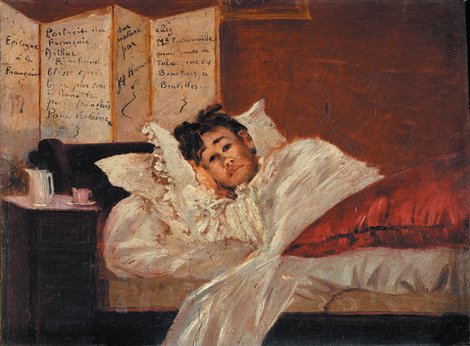
Wounded Rimbaud by Jef Rosman, 1873
When Verlaine was released from prison, Rimbaud handed him a sheaf of loose papers which would become Illuminations, his last major work. Rimbaud was but 21 years old. He was already an old poet. Verlaine had published his FIRST book at 21. Rimbaud was finished by then. (A series of prose reflections, Illuminations is akin–in its intent–to the epiphanies that Joyce gathered –at the beginning of his career, however. )
Here are some 4 stanzas from Rimbaud’s 100 line poem The Drunken Boat (Le Bateau Ivre). He was sixteen when he wrote it!
But now I, a boat lost under the hair of coves, Hurled by the hurricane into the birdless ether, I, whose wreck, dead-drunk and sodden with water, neither Monitor nor Hanse ships would have fished up;
Free, smoking, risen from violet fogs, I who bored through the wall of the reddening sky Which bears a sweetmeat good poets find delicious, Lichens of sunlight [mixed] with azure snot,
Who ran, speckled with lunula of electricity, A crazy plank, with black sea-horses for escort, When Julys were crushing with cudgel blows Skies of ultramarine into burning funnels;
I who trembled, to feel at fifty leagues’ distance The groans of Behemoth’s rutting, and of the dense Maelstroms Eternal spinner of blue immobilities I long for Europe with it’s aged old parapets!
(From Arthur Rimbaud, the Collected Works, translated by Oliver Bernard)
So the question remains “Would I want to have taught Rimbaud?” I am not sure. I am not sure of myself. Rimbaud–the excellent student, remember–was fortunate to have an exceptional school teacher and mentor, George Izambard, who fostered and encouraged the boy’s talent, gave him free access to his personal library and pushed him towards greatness. That is a big responsibility, to see and encourage greatness.
But in a large way, that is the true nature of teaching–whether it is a future Rimbaud or not. For how are we to know?
The rest of that line is “he had so many children he didn’t know what to do.”
Even Mother Goose could not have imagined the number of children that David Wozniak (Paul Huard) fathered. As a young man, Wozniak had visited a sperm bank close to 700 times in a 23-month period. At $25/35 dollars a visit, it was a nice source of income (and an implied source of great generosity later in the film). Unknown, to David, however, was that his sperm was very strong and very effective. From his nearly 700 donations, 533 children were born. And 142 of them have found each other, have united and are filing a class-action suit to discover who is the man behind the Agency’s alias known as STARBUCK.
Ironically, the day that David learns he has 533 children–most now in their late adolescence, early twenties– his girlfriend tells him she is pregnant. She also tells him that she wants nothing to do with him and does not want him to have a role in the life of their child. It is the film’s narrative that has Wozniak gain paternal responsibility through identifying and relating with the numerous children he already has.
Huard’s performance is endearing. In a lumbering way, he reminds one of a young Gerard Depardieu. He is a bit of a sad sack, a bit of a screw-up, a 40-something slacker, and the least effective of his father’s sons who all work together in a butcher shop. He is being hounded by loan sharks, discarded by his girlfriend, and advised by his cherub-faced croney who has let his legal license expire.
And then he finds out he is a father…and then some. The delight of the film is when Starbuck annonymously tracks down various of his children. There is a nationalsoccer star and a busker in the metro, a promiscuous gay man and unstable heroin addict, a son with severe disabilities and a daughter who makes heads turn when she walks down the street. Wozniak embraces them all and becomes part of their world–even to the point of allowing one “goth” son to live with him. Yet none of them know who he really is.
And as charming as Huard is, his lawyer friend, Antoine Bertrand, is a delight. Himself harried by his own large family–one loses count of how many school lunches he must make in the morning–haunted by his mother’s lack of faith in him, and nervous about taking on a case that is gaining in notoriety, Bertrand is both gentle and loveable. And like his friend, he too is a bit of a sad-sack, nearly ruining things completely as victory surrounds closes in.
Written by Ken Scott and Martin Petit and directed by Scott, Starbuck is a light film with a very good feeling. Towards the end, there is even a “group hug,” which, as cheesy as it may sound, works wonderfully in capturing the joyful spirit of the entire movie.
Montreal looks wonderful, and, as a plus, the soundtrack is infectious with original music by a French-Canadian singer named David Giguere. My next quest is to find more of his music.
The film was made in 2011 but is just now being shown in the U.S. A “remake” has already been spawned, entiltled Delivery Man, starring Vince Vaughn and scheduled for release in October 2013. Like so often happens, I can’t imagine the remake capturing the same charm as Starbuck. So here’s the trailer of the original. Enjoy it:
"Here is my secret. It is very simple: It is only with the heart that one can see rightly; what is essential is invisible to the eye.."- Antoine de Saint Exupéry














 j. p. bohannon