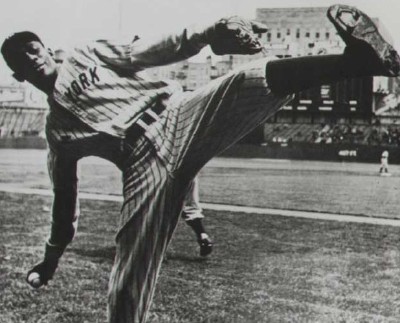
Baseball Poetry: “The Pitcher” by Robert Francis

Satchel Paige--a true poet

Satchel Paige–a true poet

I gave my students a poem today and asked them to wriggle around inside it and tell me everything they found in there.  The poem I gave them was “The Pitcher” by Robert Francis.  I was hoping there were some baseball players in the class, but none of them had played much past little league. But many of them were fans.  And I believe they achieved a pretty good literal reading–how a pitcher in baseball depends greatly on being misunderstood, at aiming at something he didn’t seem to be aiming at, at avoiding the obvious and varying the avoidance.  We went through it line by line, describing what aspect of a pitcher’s performance was being described. One student thought that maybe it might even be, in his words, “about a pitcher and maybe about a non-conformist.” That was interesting. He knew what he meant but was having trouble working himself through it. And then one student, somewhat self-doubting, said that he too saw the poem dealing with a baseball player and something else. But for him, that something else was “a poet.” He went on to say that a poet’s deception was that instead of saying something was brown, he would say something was like the “leaves of autumn.” Much like a pitcher’s throw looks like its coming one way but then intentionally breaks another. A part of him believed that he was really off-the-mark but, to his credit, he forged on. And he was pretty good. In fact, in the past, after a class has seen this poem, I ask them–as they are leaving–to think again about “The Pitcher” when they get home, but this time to think in terms of a poet and the poet’s craft, to think about the similarities between what some pitchers and some poets attempt to do. And the next days’ discussions are often quite good. But today’s student was the first ever to go there without my prompting.  And that’s a pretty cool thing.

The Pitcher by Robert Francis

His art is eccentricity, his aim

How not to hit the mark he seems to aim at,

His passion how to avoid the obvious,

His technique how to vary the avoidance.

The others throw to be comprehended. He

Throws to be a moment misunderstood.

Yet not too much. Not errant, arrant, wild,

But every seeming aberration willed.

Not to, yet still, still to communicate

Making the batter understand too late.
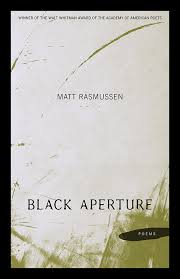
Book Review: Black Aperture by Matt Rasmussen

“Sponsored by the Academy of American Poets, the Walt Whitman
Award is given annually to the winner of an open competition
among American poets who have not yet published a book of poems.”

black aperture

Black Aperture by Matt Rasmussen

Each year the Academy of American Poets sends its members a copy of that year’s winning volume. This year the title was Black Aperture by Matt Rasmussen. And if good poetry is meant to rattle in your head, nestle there a while in the corners of your mind, and then come unbeckoned to the forefront of your consciousness, then Rasmussen’s poems pass the test and the Academy made an excellent choice.

Within the collection, there are poems about deer hunting and bird hunting: “when cleaning a grouse,/puncture the crop/to release the scent/of fresh clover.” (from “O”). There are poems that re-imagine the creation:

The animals gathered
and having cried enough

would never again.
God knew he had

asked too much. He threw himself

into the sun and burnt
into white ash. It fell

from the sky and covered
the mountains. The animal

who named everything
called it snow. (from “And God Said”)

And there are poems about poetry itself: “Through the mirror, it saw a house/of air falling inward. The poem heard/the poet calling and jumped.” (from “I am not a poem”)

But the overriding theme is the suicide of a brother.

There are three separate poems called “After Suicide” and one poem, “Reverse Suicide,” which takes the events in reverse to when both the speaker and his dead brother are once again raking and bagging leaves. In truth, the majority of poems take this momentous act as its subject. And those that don’t address it specifically are tinged with the shadow of it, a shadow that hovers over every poem.

Yet the poetry is not maudlin or morbid. It is, in fact, a source of liberation, as the speaker attempts to clarify through language both the act and his reactions, both his grief and his understanding of it, both his dead brother and his relationship with him.

Midway through the book, Ramussen places a poem called “Chekhov’s Gun.” Chekhov’s theory is that if a loaded gun appears in a play in Act 1, it must be fired by Act 5. Rasmussen begs to differ:

Nothing ever absolutely has to happen. The gun
doesn’t have to be fired. When our hero sits

on the edge of his bed contemplating the pistol
on his nightstand, you have to believe he might

not use it. … (from Chekhov’s Gun”)

It is a clever argument within the Black Aperture, because that gun–not only loaded but already fired–is present from the very beginning of the collection. The possibility of “not firing” that he posits in the Chekhov poem, is no longer a possibility. The speaker circles the once possible act of not-firing, while coming to grips with the already accomplished fact. That he does so with clarity, compassion, understanding and brilliance raises Matt Rasmussen’s Black Aperture from a mere elegy for a dead brother into something much more universal and accessible to us all.

Dylan’s rhythms and the 13-year old poet

dylanSo, out of the blue on Saturday morning I receive a poem by a young boy, Domenic Feola, thirteen years old.  I don’t know him, never taught him, probably never will.  He is a suburban kid who runs cross-country at one of the city parks. But his ear is impeccable and his language is crisp.  And the rhythm of his poem is infectious (until the last couplet where in trying to sum up his feelings he loses is footing) .

             The City

     by Domenic Feola

Bright lights, fast trains
Cold nights, heavy rains
Dirty air, bus fare
Pigeons flying everywhere
Crowded streets, traffic jams
Music beats, grand slams
Bugs fly, kids cry
No stars in the night sky
Noisy bars, littered trash
Big cars, no cash
Garbage smells, huge hotels
In the shadows, spiders dwell
Scary strangers, taxi cabs
Hidden dangers, science labs
Museums of art, cherry tart
Broken beat up shopping carts
If you say I’m biased, I would agree
I think the suburbs are more for me.

Pretty sophisticated for a thirteen-year-old boy. Or for anyone, for that matter.  Great imagery, great confidence and impressive rhythm.  If I could, I would talk to him about the rhythm. That is the strength of the poem–but there are a few times where it needs to be tightened, where some minor tweaking would make it even better.  But it is impressive nevertheless.

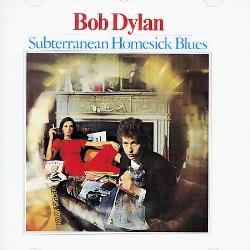
Album Cover Subterranean Homesick Blues

Album Cover Subterranean Homesick Blues

In fact when I first read the poem I could hear Dylan–specifically “Subterranean Homesick Blues” –in the rhythm. Here’s the second verse from Dylan’s song:

Maggie comes fleet foot
Face full of black soot
Talkin’ that the heat put
Plants in the bed but
The phone’s tapped anyway
Maggie says that many say
They must bust in early May
Orders from the DA
Look out kid
Don’t matter what you did
Walk on your tip toes
Don’t try, ‘No Doz’
Better stay away from those
That carry around a fire hose
Keep a clean nose
Watch the plain clothes
You don’t need a weather man
To know which way the wind blows.

from “Subterranean Homesick Blues”

The short 5 and 6 syllable lines are similar. The grammatical “packages” the same.

Now, I read someone say that this Dylan song was one of the first rap songs.  But that’s not true, it’s utter nonsense.  Dylan was influenced by “talking blues,” Chuck Berry’s rock-and-roll, and the Beats like Kerouac, Ginsberg, and Ferlinghetti. (Notice in the iconic picture at the top, Alan Ginsberg talking to folksinger Bob Neuwirth on the left side of the photo.)

On the other hand, Dominic Feloa (who probably doesn’t know who Bob Dylan is) more than likely has been influenced by rap and hip-hop.  It is all around him, in the music he listens to, the advertisements he is bombarded with, the zeitgeist of the culture.  Yet his rhythms are a bit different. It might be that his non-urban background (and his youth)  gives his rap rhythms a subtle difference, a blunter edge. But they are working.

So, cheers to Dominic Feloa.  Keep writing. Show your work to your teachers.  Find someone to work with, to work against.  Write–revise–and write again.  Send your work out.  Expect rejection.  Work harder.  Good luck to you.  Thanks for letting me read your poem.

And, of course, I couldn’t leave without sharing a video, a promotion for the 1965 Dylan documentary Don’t Look Back, a promotion that did have an enormous influence on what was to become “music videos.”  This was the original…it has been copied/parodied countless times:

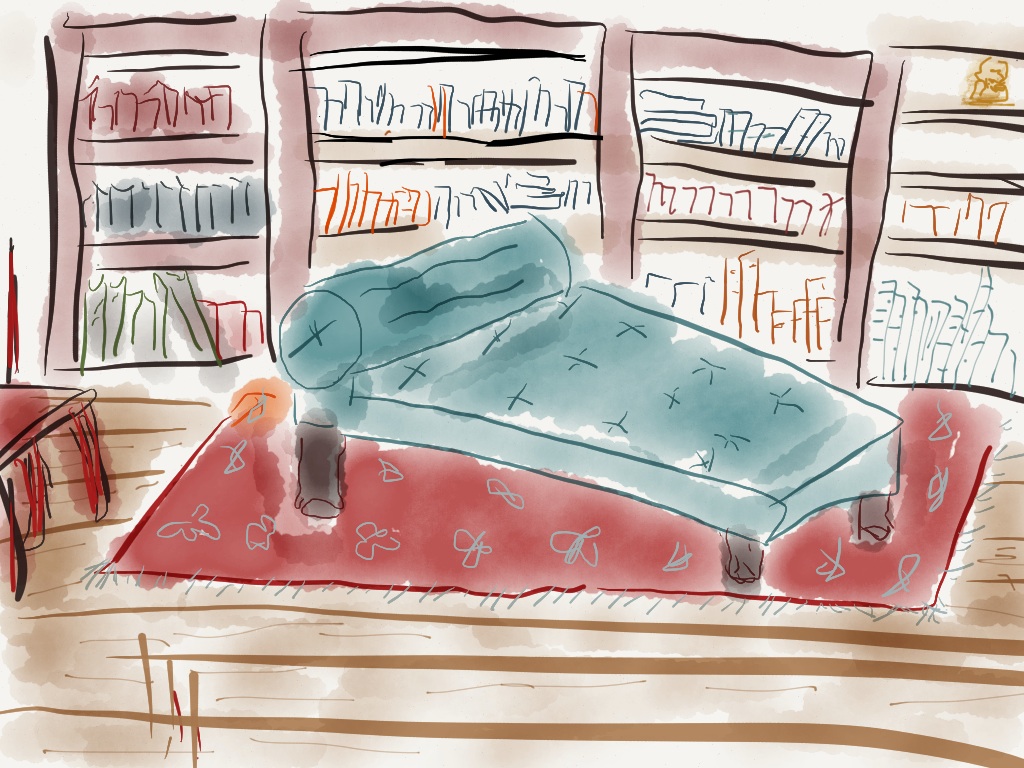
Adam Phillips: Promises, Promises: Essays on Psychoanalysis and Literature

illustration by jpbohannon

illustration by jpbohannon, 2013

In the office of a colleague a while back I noticed a towering pile of books on the desk, as if he were re-arranging his book shelves or carting out old titles to a different location.  But no,  it was his “to read” pile, and it was impressive and imposing.

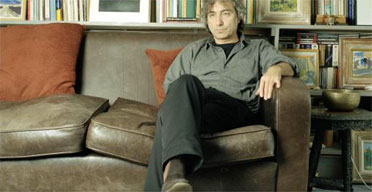
Among the authors gathered, there was one whom I had not heard of–Adam Phillips. A psychoanalyst by trade–specifically a children’s clinical psychotherapist–Phillips read literature at Oxford, specializing in the 19th century British romantics.  And as the “science” of psychoanalysis has always been symbiotically tied to literature,  a degree in literature seemed the perfect training ground.
Adam Phillips photo: Andy Hall

Adam Phillips
photo: Andy Hall

And so I decided to dive in.

Of Phillips’ seven or so titles, Promises, Promises: Essays on Psychoanalysis and Literature seemed a reasonable starting point. And, the frantic busyness at the end of the school term made a collection of independent essays more attractive and less of a task.
 

“As poets struggle to find a place in contemporary cultural reality, psychoanalysts, implicitly or explicitly,  are still promoting the poets as ego-ideals.”

Philips, “Poetry and Psychoanalysis”

The crux of Phillips’ essays is the mutual relationship between literature and psychoanalysis…and psychoanalysts’  established reverence for creative writers. Literature, according to Freud, gave birth to psychoanalysis and psychoanalysis often gives resonance to literature.

And so go his essays.

He begins with the essay “Poetry and Psychoanalysis” and brings in the young poet Keats–a former medical student–who famously stated that science ruined poetry when Newton reduced the rainbow to a prism.  Not so, Phillips says, for poetry (and you can read “creative writing” where Phillips says “poetry”) can do what the sciences cannot.  Indeed, much of his argument is that the science of psychoanalysis is bringing understanding to the vision of poetry.  Freud said, Phillips tells us, that the poets had long before discovered the unconscious, and that he only had devised a way to study it.

Phillips graciously gives way to “poetry” saying that the short history of psychoanalysis has been an attempt to study the unconscious that poetry reveals. And since both poetry and psychoanalysis–the “talking cure”–depend on language, and often, coded language, the two are intrinsically welded together.

And so he is off.

There are marvelous literary essays on Hamlet, Hart Crane, Martin Amis,  A.E. Housman and Frederick Seidel, all informed by an accessible shading of psychoanalytic theory, as well as masterful psychoanalytic pieces on Narcissism, Jokes, Anorexia and Clutter, informed by a broad knowledge of literature/poetry.  It is Phillips’ contention–his modus operandi, if you will–that the two disciplines can or should depend on each other for clarity.

Hamlet-and-skull-on-stampThe collection ends with the title piece, “Promises, Promises.”  In it, Phillips examines the “promise” that both literature and psychoanalysis offer. He writes:

“If we talk about promises now, as I think we should when we talk about psychoanalysis and literature, then we are talking about hopes and wishes, about what we are wanting from our relationship with these two objects in the cultural field.”

What does reading literature promise us?  What does analysis promise us?  Phillips contends that both promise us, to a degree, “the experience of a relationship in silence, the unusual experience of a relationship in which no one speaks.”  Of course, ultimately, the analyst must speak.  But it is in that silence that often we become “true to ourselves.”

Reading psychoanalytic theory can often be dry and dusty, but Phillips’ writing never is. Bringing in an encyclopedic knowledge of both creative literature and psychoanalytic literature (and, at times, arguing that there might not be a difference),  Phillips imaginatively and wittily plumbs past and current trends, canonical and esoteric literatures, clinical practice and private correspondence to bring to light his vision of psychoanalysis and literature’s potential and promise.

Quote of the week: #2, May 6, 2013

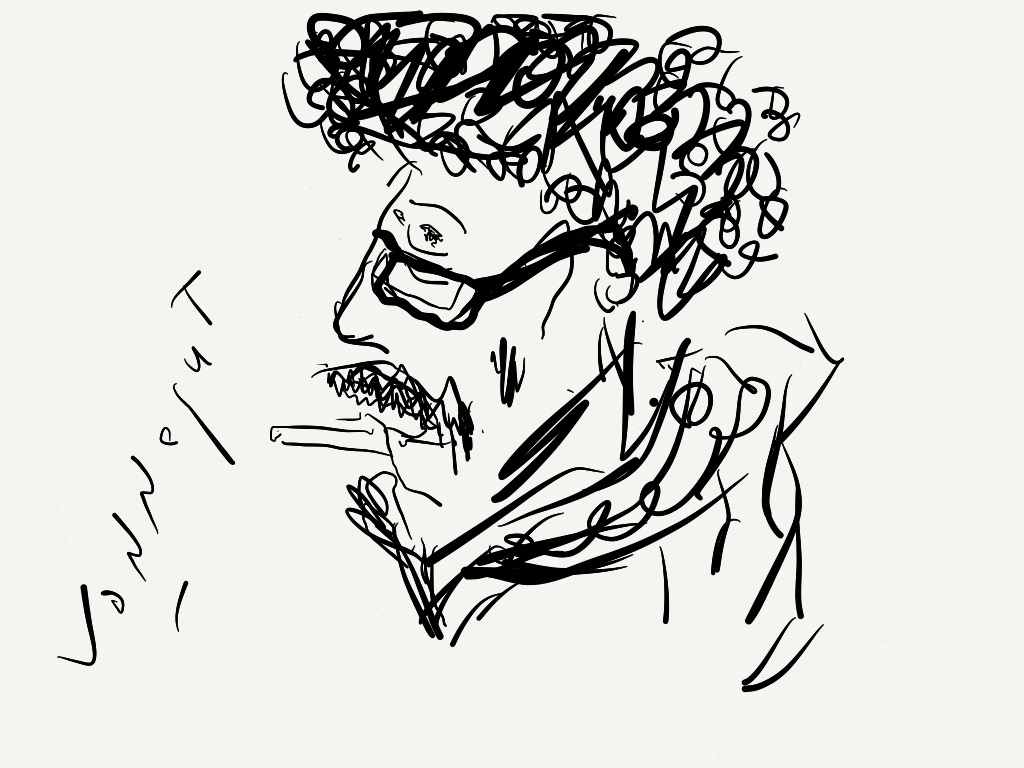
“…The arts are not a way to make a living. They are a very human way of making life more bearable. Practicing an art, no matter how well or badly, is a way to make your soul grow, for heaven’s sake. Sing in the shower. Dance to the radio. Tell stories. Write a poem to a friend, even a lousy poem. Do it as well as you possibly can. You will get an enormous reward. You will have created something.” — Kurt Vonnegut, Jr. A Man Without a Country, 2005

Kurt Vonnegut, 1922-2007. 2013 jpbohannon

Kurt Vonnegut, Jr., 1922-2007
illustration by jpbohannon © 2013

The End of April and National Poetry Month, part 3: To Keep Love Blurry by Craig Morgan Teicher

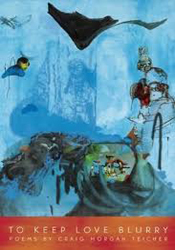
To-Keep-Love-BlurryI must say that I did not enjoy Craig Morgan Teicher’s third collection of poems.  That is not to say that they are not technically brilliant, that they are not impressively raw and honest, nor that there are not many moments that just knock you open. I admire it greatly; however, I do not like it.  Even Teicher understands the sadness and dysfunction and sourness inherent in his verses.  Here is his dedication:

To Cal and Simone–you should know that it’s a lot more fun than these poems suggest–
and

for Brenda, who knows…

Brenda is Teicher’s wife, who makes many appearances in the collection (actually throughout his work– his first collection was entitled Brenda is in the Room and other poems.)

To Keep Love Blurry is tied together by two major themes. One his mother and father, particularly after his mother’s death. And two, his marriage to Brenda, their (apparently) special-needs son, and Teicher’s sullen acceptance of love.  Indeed, for Teicher love–both familial and marital– is more of an anchor than a source of flight. Here is he about motherhood:

My wife is not my mom. My mom is not
my mom. My father is not my mom. My boss
is not my mom. She is a tooth with rot,
a flower pressed between the pages of a lost
book. My son is not my mom. She is a mare
crushing my skull beneath her hoof. She is forever
starved. I ride to the edge of the earth clutching her hair.
Get it over with. It’s never OK, not ever.
Fuck it, whatever.  If Robert Frost is my mom,
then so is Robert Lowell. She taught me to talk.
She is where I’m headed, a bomb
crater. She forgives me like a hunting hawk.
Maybe she’s my boss’s boss, my wife’s other other lover,
my son’s midnight cough. She loves me like a brother.

(“My Mom, d. 1994”)

The perfection of form–a modern Shakespearean sonnet with A-B-A-B…rhyme scheme, a regular rhythm, an unusual octet, quatrain, couplet construction–is made inconspicuous by the language, the odd identifications of motherhood, with unusually negative words: “tooth with rot,” “a mare crushing my skull,” ” a bomb crater,” “my wife’s other other lover.”  What exactly are his feelings?  “Loves me like a brother” does not cut it for me.  Perhaps the secret lies in the allusion to Robert Frost and Robert Lowell.  Teicher quotes a Lowell poem as an epigraph to his collection:

“Those blessed structures, plot and rhyme–
why are they no help to me now…”

Perhaps Teicher is saying that the “blessed structures” of poetry–with which he is extraordiaryily adept–are no longer to sufficient to buoy one in the sourness of modern life.  Here he is similarly on friendship, marriage and love:

In just the couple years since two by two
we all began to partner off,
already we’ve practically retired, passing though
apartment doors shut tighter than a cough.
There used to be long, wasted hours of talk,
nothing secret between us, not even skin;
at the conclusion of a wandering walk,
the flirtatious dark would set in.
Is marriage lonely by design,
in hopes that obeying an age-old law

of I am only hers, she is only mine
forms a brittle scab over the always-raw
wound of too much intimacy between friends
in favor of a duller aching that never ends.

(“Friendship”)

Again, the “plot and structure” to which Lowell refers are exquisite: a Shakespearean sonnet, intricately wrought and patterned. But for the speaker, the poetry is subsumed by the “duller aching” and “brittle scab.”

Mixed among the villanelles and sonnets, the rhyming couplets and the longer verse, there is a series of prose ruminations on the death of his mother and the subsequent loneliness of his father. These too are notable for their raw honesty, their unflinching introspection.

Well-wrought and linguistically daring, To Keep Love Blurry is evidence of Teicher’s impressive talent. However, I found it sullen and pouty and self-indulgent. Nevertheless, such is Teicher’s poetic cleverness and adroitness that I will surely keep my eye out for his future work.

The End of April and National Poetry Month part 2: the game of boxes by Catherine Barnett

calendarAs I said in “The End of April…part 1,” the month got away from me. What I mean is that all the great ideas I had for celebrating National Poetry Month were just that…great ideas. Just so much smoke. And so to make up for it, I am trying to put up several posts about a variety of poetry collections that I read during the month of April.

Back in the fall, I went to a conference of poets and heard Catherine Barnett read. I also bought her book The Game of Boxes which had just won the 2012 James Laughlin Award of the Academy of American Poets. And like too many of the books that I buy, it joined the stacks of “to read” books that are now towering next to my bed and next to my desk. Then, as if to increase my guilt for not reading it yet, in April, the Academy sent me a copy in the mail. (Fortunately, I was later able to give that away as a birthday gift to another poet.)

Assailed with the guilt of owning two copies and not having cracked the spine yet, I dived in. And was I glad.

the-game-of-boxes Barnett’s collection is divided into three parts: “Endless Forms Most Beautiful,” “Of All Faces,” and “The Modern Period.” The poems in each section are informed by a mature wisdom and wonder and understanding and befuddlement while dealing with those very issues that simply befuddle a younger world. Lust, love, family loyalty, parents and parenting, self, partnership, Barnett touches upon all of these, assuring us that none of us ever really get a grip on everything swirling about us. The middle section, “Of All Faces” is subtitled “Sweet Double Talk-Talk” and delineates the love/lust/comfort/discomfort of a partnership worn smooth over time. This is my favorite part of the collection.

From the outset, there is an immediate comfort in their age and a delight in their familiarity:

It’s a different beauty,
Your torso is stained and creased,
you say your an old man–

the backs of your hands
might be an old man’s hands
but the tips of your fingers —

little shocks of pure mind,
and I like theme there,, yes, ageless
persuasion’s design and rush. (Sweet Double Talk-Talk, i)

There is a weariness in famliarity:

Sometimes he’s everything to me:
yesterday, tomorrow, regret and shame.

And sometimes he’s nothing to me,
an old cushion on an old couch:

a pin-cusion:
something I think I can replace. (Sweet Double Talk-Talk, xvii)

But overall, there is a comforting lust and an accepted love:

I’m afraid you’ll die,
and tonight’s your birthday, it’s no different,
in fact it’s worse,
come drink some wine–

Let’s sit at the bar.
It’s winter,
so I’m in your coat,
I’m in your promises,
your smooth worn promises
sliding in and out of my own
love of death so slick
with want–

Soon, you say, your breath still warm in my ear. (Sweet Double Talk-Talk, xviii)

I cannot say why, but I love this couple. I love their honesty, their quirks, their enduring lusts, their enduring second-guessing. And while this section could almost be considered a narrative, each section is similarly anchored by a wise understanding of time and love and others.

The End of April and National Poetry Month part 1: Shackamaxon

flying calendarI begin each April–designated in the U.S. as National Poetry Month–with all kinds of grand ideas.  I will organize students into a poetry festival, we will stage poetry slams, another teacher and I will do readings together, we will invite celebrated, fascinating (and inexpensive) guests to speak.  And then before I get any of it done, May comes around and I’ve done nothing.

This month the most I did was organize a festival for the following year and set out to go to Philadelphia Stories’ “Party Like a Poet” benefit. I made my way down to the location (a subway and a bus trip away), got there far too early, and talked myself out of it — I returned home before it started.  Not very poetic, I guess.

But what I did do–not very celebratory or communal–was read a lot of poetry.  And I mean a lot.

Some of the titles were by veteran poets such as Mark Doty and Edward Hirsch and others newer names such as David Livewell and Catherine Barnett.  They ran the entire gamut of poetic offerings–free verse and formal verse; confessional poetry and nature poetry; poems about love, loss, sex and death; poems about animals and insects, planets and hardwiring. They were collections that I bought, that were given to me as gifts, and one that was sent to me by the Academy of American Poets.  Mark Doty’s was a National Book Award Winner, Catherine Barnett’s was a James Laughlin Award winner, and David Livewell’s was T.S. Eliott Poetry Prize winner.

And they were each unique and very different from each other.

And so in celebration of April “the cruelest month,” each day I’ll give a quick run down of one of those titles that have come across my path in the past month or so.

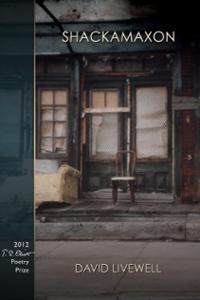
shackamaxon-david-livewell-paperback-cover-artShackamaxon by David Livewell was fun because he is a talented local poet and his work is situated in the places and neighborhoods I am very familiar with. (How fun is that when in a movie you recognize a street, a diner, a department store, a park?!) The title “Shackamaxon” was the Native American settlement where William Penn made his famous treaty with the Leni Lenape tribe and began establishing what is now the city of Philadelphia.

 Livewell’s work is gentle and honest and gritty and searing and, to a large degree, nostalgic, as he captures his blue-collar environs, the families, the struggles, the personal milestones and the larger changes over time.  Looking back at the hardscrabble neighborhoods where he was raised, he elevates his urban experience–both memorable and familiar–into art. My favorite is “Summer Elegy,” a nostalgic piece that reminds me of my own father and his generation–loyal to their perennially awful baseball team–and of the passions they passed on to their children.  Here is a short piece of it:

On the front step my Grandpop strained to hear
Harry and Whitey* call the Phillies game
from a crackling Philco hung on the wrought iron railing.
He’d grind his teeth and move a toothpick left and right
the way that on-dck players swung at air,
a rhthym to Harry’s baritone
and Whitey’s softer quips between the crowd
noises and vendor calls. He seemed to wait
on possibilities that hung like pop flies.
Gramps would tisk at strikeouts, whistle for homers,
and often blurt “About damn time!” or “Bum!”
And all around the neighborhood were men
from other families catching the baseball game…
(from “Summer Elegy”)

* beloved announcer (Harry) and color-man(Whitey) of the Philadelphia Phillies

“I is someone else”: Rimbaud–l’enfant terrible

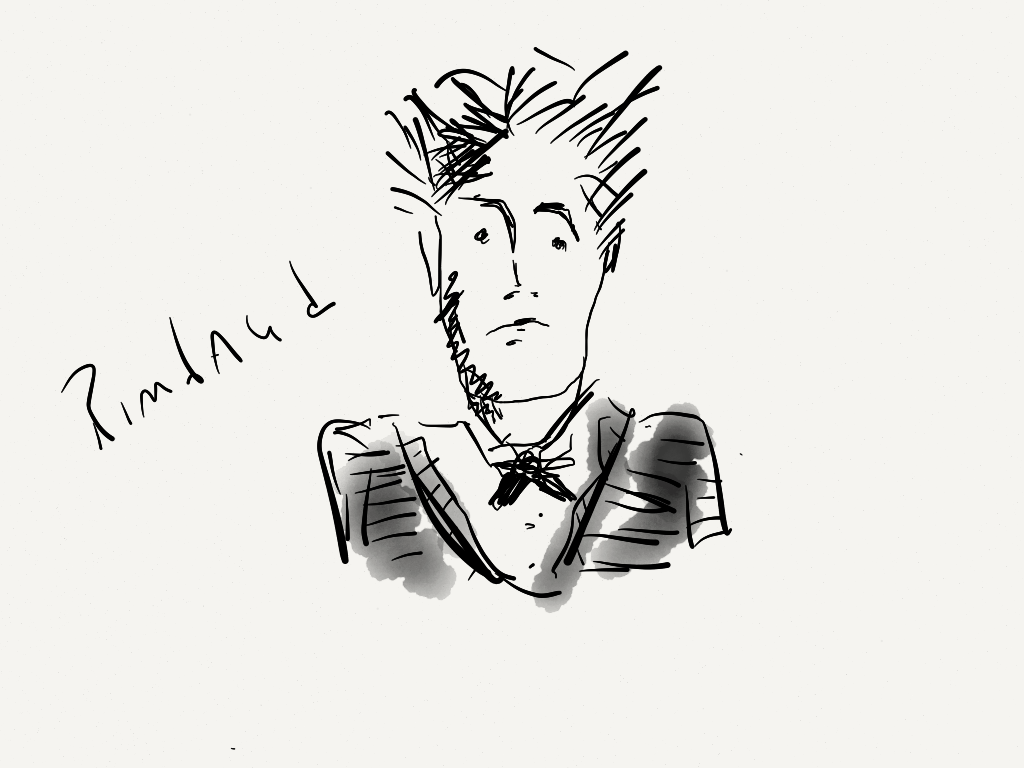
rimbaud drawing

Rimbaud
illustration by jpbohannon © 2013

A colleague came up to me with a problem–a problem with some unruly boys who had been displaying a growing disrespect towards her, coupled with a sophomoric sexism that went beyond their adolescent asininity and a smattering of racism. She then went on to say that to make matters worse, they were also very good writers. I wondered to myself if what she said was not necessarily atypical–that their innate creativity is being strangled by the dysfunctions of the modern educational system and that that is one cause of their intractability.

To make the point, I told her, I wouldn’t want to have taught Rimbaud.

Ah, Rimbaud, the boy-child terror who created haunting, mesmerizing verses until he was 21 and then quit to become a businessman, to dabble in gun-running in Africa, and to even try to join the U.S. Navy. But whatever he did from that point on, he had quit writing and refused to talk about it thereafter. Yet in those five or six years in late adolescence, he cut a swath of creativity and destruction, of love and violence, of intelligence and stupidity–and blazed into the pantheon of world poetry.

In actuality, however, Rimbaud was in fact a fine, model student. While he was in school, he usually walked away with the academic prizes given out at the end of a school year. He wrote poetry in in his native French, as well as in Latin and Greek, mature verse, some of which is still anthologized. Indeed, he was a stellar student. But then he quit school.

When he was still sixteen–and with the encouragement and support of the older Paul Verlaine whom he had enamored with some verses –Rimbaud first ran away to Paris. There he began a meteoric life of debauchery, anarchism, promiscuity, violence, substance abuse–and the most intense poetic creativity.

And like a meteor, Rimbaud burned out quickly. His intense and volatile love affair with Verlaine ended with Verlaine shooting him twice in the arm. Verlaine was arrested and served two years in prison.

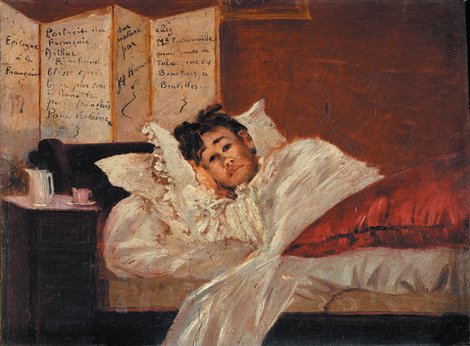
Wounded Rimbaud by Jef Rosman, 1873

Wounded Rimbaud by Jef Rosman, 1873

When Verlaine was released from prison, Rimbaud handed him a sheaf of loose papers which would become Illuminations, his last major work. Rimbaud was but 21 years old. He was already an old poet. Verlaine had published his FIRST book at 21. Rimbaud was finished by then. (A series of prose reflections, Illuminations is akin–in its intent–to the epiphanies that Joyce gathered –at the beginning of his career, however. )

Here are some 4 stanzas from Rimbaud’s 100 line poem The Drunken Boat (Le Bateau Ivre). He was sixteen when he wrote it!

But now I, a boat lost under the hair of coves,
Hurled by the hurricane into the birdless ether,
I, whose wreck, dead-drunk and sodden with water,
neither Monitor nor Hanse ships would have fished up;

Free, smoking, risen from violet fogs,
I who bored through the wall of the reddening sky
Which bears a sweetmeat good poets find delicious,
Lichens of sunlight [mixed] with azure snot,

Who ran, speckled with lunula of electricity,
A crazy plank, with black sea-horses for escort,
When Julys were crushing with cudgel blows
Skies of ultramarine into burning funnels;

I who trembled, to feel at fifty leagues’ distance
The groans of Behemoth’s rutting, and of the dense Maelstroms
Eternal spinner of blue immobilities
I long for Europe with it’s aged old parapets!
(From
Arthur Rimbaud, the Collected Works, translated by Oliver Bernard)

So the question remains “Would I want to have taught Rimbaud?” I am not sure. I am not sure of myself. Rimbaud–the excellent student, remember–was fortunate to have an exceptional school teacher and mentor, George Izambard, who fostered and encouraged the boy’s talent, gave him free access to his personal library and pushed him towards greatness. That is a big responsibility, to see and encourage greatness.

But in a large way, that is the true nature of teaching–whether it is a future Rimbaud or not. For how are we to know?

Book Review: Ask the Dust–Los Angeles, Obsession, and William Butler Yeats

Ask the dust

Ask the dust 3

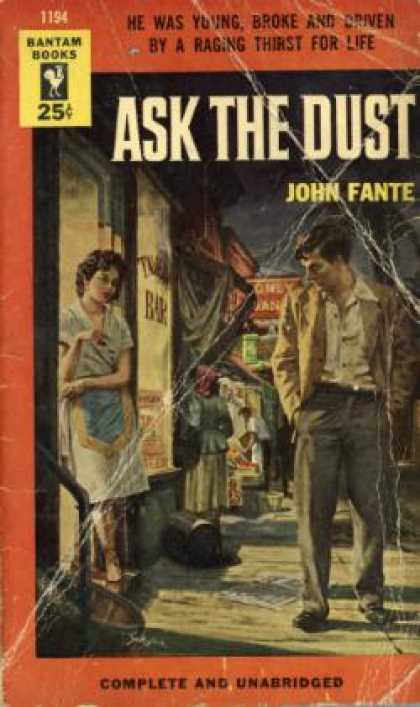
ask the dust 4One of those weird coincidences: I began reading John Fante’s 1938 novel Ask the Dust late this past Tuesday night. I didn’t get far–maybe three chapters–but the story of a young writer who had moved to L.A. from Colorado had grabbed me. Wednesday morning, I wake up early, check my messages and e-mails and a few blogs that I read. One of them–francescannotwrite–has a picture of the Disney Concert Hall at the top and a quote from Fante’s novel: “Los Angeles, come to me as I have come to you.” (Besides the weird coincidence of the novel, I also had, just a few weeks back, put the Disney Concert Hall on my computer as its wallpaper.) The blog-post offered some examples of the novel’s humor, its brief passages of romance, and its overall feeling of gloom. And then it segued into some extraordinary pictures of Vietnam.

Anyway, so I finish the novel and it was a good read, although one that left a few questions unanswered. Episodes where the act of writing were described were particularly memorable, for it is hard to put down on paper the art of ART. Most times, it comes off as stagy and overly dramatic. But the scenes where Fante gives us two or three paragraphs of Arturo Bandini in a “creative” groove are fun to read. For instance, here is Bandini–having sold two short stories for a handsome price–sitting down to begin his novel:

Out of my desperation, it came, an idea, my first sound idea, the first in my entire life, full-bodied and clean and strong, line after line, page after page. … I tried it and it moved easily. But it was not thinking, not cogitation. It simply moved of its own accord, spurted out like blood. This was it. I had it a last. Here I go, leave me be, oh boy do I love it. … big fat words, little fat words, big thin words, whee whee whee.

But primarily, Ask the Dust is about obsession. The hero, Arturo Bandini, self-conscious of his Italian heritage and full of fluctuating self hate, falls madly in love with Camilla Lopez, a Mexican waitress at a cheap coffee shop. The entire novel, his writing, his day to day living, his memories of home become wrapped around her–or around deliberately hating her. For the relationship is a strange sado/masochistic thing that yo-yos between love and hate, between tenderness and violence, but that never vascillates in its obsession. Camilla too has her obsessions and it is the thrust of the novel that they are not the same as Arturo’s.

I have always been attracted to obsession. I remember reading the novel Damage by Josephine Hart in one sitting and being floored by the destructive obsession of its characters. (I can still remember cancelling a lunch appointment because of my emotional exhaustion. The film version, by the way, tries, but does not do it justice.)

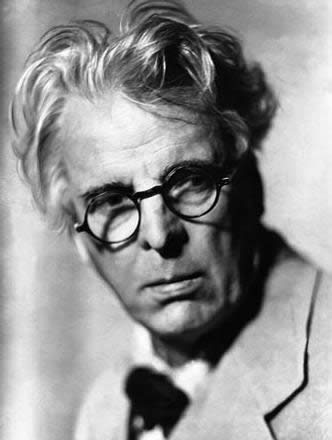
But mainly I think of obsession as a good thing…as a passion that forms and defines you. And in this I turn to Yeats. My favorite Yeats’ poem is “The Song of Wandering Aengus.” The poem tells of discovering a great passion…and of following it throughout one’s life. There is a sadness in it, but one tinged with hope, colored with the concept that chasing the obsession is more important than actually attaining it.yeats3

The Song of Wandering Aengus

by W. B. Yeats

WENT out to the hazel wood,
Because a fire was in my head,
And cut and peeled a hazel wand,
And hooked a berry to a thread;
And when white moths were on the wing,
And moth-like stars were flickering out,
I dropped the berry in a stream
And caught a little silver trout.
When I had laid it on the floor
I went to blow the fire a-flame,
But something rustled on the floor,
And some one called me by my name:
It had become a glimmering girl
With apple blossom in her hair
Who called me by my name and ran
And faded through the brightening air.
Though I am old with wandering
Through hollow lands and hilly lands,
I will find out where she has gone,
And kiss her lips and take her hands;
And walk among long dappled grass,
And pluck till time and times are done
The silver apples of the moon,
The golden apples of the sun.

And this is how, John Fante’s novel Ask the Dust leaves us. His Mexican girl has “faded through the brightening air” and, while he chases her through the foreboding desert, he is left to use her image, her memories, and his pain to create his next novel, to fashion his next work of art.

And so for something different on this snowy March day, here is a clip of the singer Christy Moore doing his version of Yeats’ poem. It never fails to bring a tear to my eye: