Wallace Stevens’ “The Man with the Blue Guitar”

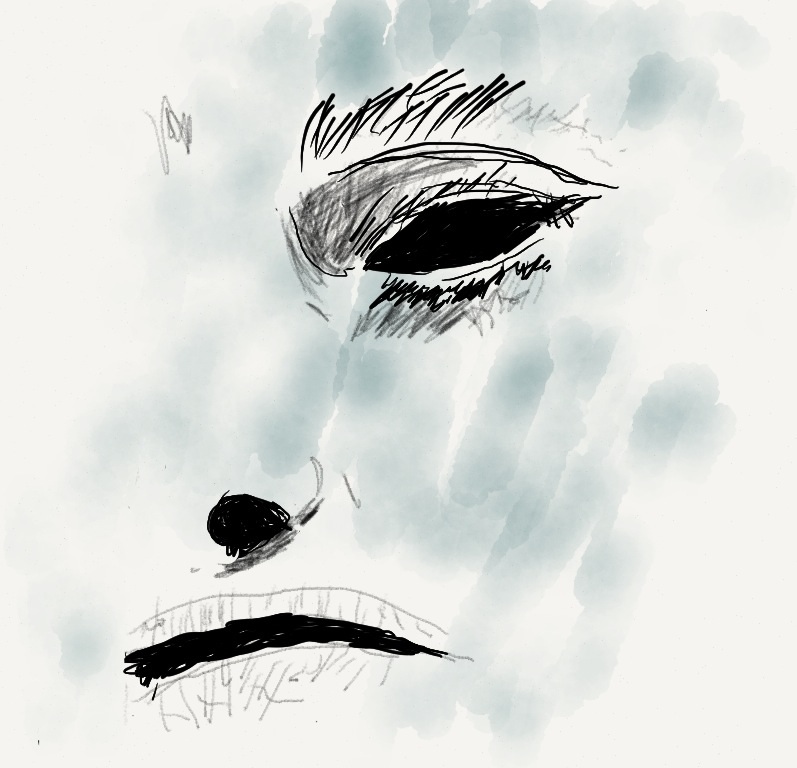
Blue Guitar illustration 2014 by jpbohannon

Blue Guitar
illustration 2014 by jpbohannon

The Book Review of the Sunday New York Times this week (July 20, 2014) focused on contemporary poetry. It reviewed five books of contemporary poetry and featured an essay by David Orr entitled “On Poetry.”  The front cover was a whimsical drawing with archaic poetic terms such as “forsooth,”  “twas,”  “alas-alack”  and “thither” graffitied onto walls, suit jackets and boots. And on page 4, where the Book Review often introduces the matter of chief focus in that particular issue, there is a brief recap of New York Times’ poetry criticism through the years.

The four paragraph piece remembers the 1937 review of Wallace Steven’s  The Man with the Blue Guitar,  a review of John Berryman’s 77 Dream Songs in 1964, a 1975 piece on John Ashbery’s Self-Portrait in a Convex Mirror, and a 1981 review of Sylvia Plath’s Collected Poems (18 years after her death). And it was the review of the Steven’s piece that caught my eye.  The reviewer–Eda Lou Walton–stated that “the skill of these plucked and strummed-out improvisations proves him again the master of the most subtle rhythmical effects.”

And so of course, I had to pull from my shelf my copy of Wallace Stevens’ Collected Poems and looked to “The Man with the Blue Guitar.”  Actually the title refers to both a particular poem and the book in which it was contained.  The individual poem is the piece that attracted the world’s attention. It is a long piece, thirty-three sections of between four and sixteen couplets.  Stevens claimed that he was inspired by Picasso’s painting Old Man with a Guitar. (Later David Hockney would paint a series of works inspired both by Picasso’s painting and Steven’s poem.)

Picasso's Old Man Playing Guitar

Picasso’s Old Man Playing Guitar

What is surprising is that the poem is so much more a “shattered” portrait than Picasso’s piece. Picasso’s Man with a Blue Guitar belongs (not surprisingly) to his Blue Period, but more importantly comes  several years before he is influenced by African art and–with Georges Braque–invents Cubism.  It is the cubism–and his art that follows–that is “shattered,” that most resembles the large schisms and small fractures running through society and which most resembles the world of Stevens’ guitar.  In fact, despite his referencing Picasso in the poem itself, it seems as if Stevens’ poem is more in tune with Hockney’s painting (impossible since it was painted in 1982, forty-five years after Stevens’ poem.)

David Hockney's Blue Hockney

David Hockney’s Blue Hockney

I

The man bent over his guitar,
A shearsman of sorts. The day was green

They said, “You have a blue guitar,
You do not play things as they are.”

The man replied, “Things as they are
Are changed upon the blue guitar.”

And they said then, “But play you must,
A tune beyond us, yet ourselves,

A tune upon the blue guitar
Of things exactly as they are.”

And so, we have the “man with the blue guitar” refusing to tell things as they are–or perhaps unable to. Or is he implying that even the imagination, the creative faculty, is unable to depict “things as they are”?  Or is this phrase “things as they are” simply a coded phrase for the physical world–and guitar and the player are able to sing of what is behind that physical world. And yet his audience seems somewhat philistine–they are slow to understand. For them, “Day is desire and night is sleep” and “the earth for us is flat and bare/there are no shadows anywhere.”  And yet, we–and the player of the blue guitar–know that if nothing else, the 20th century has taught us that shadows are everywhere.

The poem has often been depicted as a tension between the guitarist and his audience, between the imaginative truth and the surface perceptions.  I believe it shows the failure of the audience to see deeper, a failure of the audience’s imagination.  Modern life–and this is surely not original with Stevens–is deadening and routine, and we need the players of the blue guitars to break us out, to center our focus on the more important things than mere survival.

Because of copyright issues, the entire poem is not available on line. (Though I am sure some clever computer user has found it somewhere.) But it is worth finding. It is a Whitman-esque explosion of images and thoughts and debate and sound.

I had forgotten about it–and about where and who I was when I first read it–and so am grateful for last Sunday’s paper which mentioned it a tiny corner of a large section. Sunday’s paper was the blue guitar that sent me re-reading and re-thinking.

Here are the first six sections of the poem:

I
The man bent over his guitar,
A shearsman of sorts. The day was green

They said, “You have a blue guitar,
You do not play things as they are.”

The man replied, “Things as they are
Are changed upon the blue guitar.”

And they said then, “But play you must,
A tune beyond us, yet ourselves,

A tune upon the blue guitar
Of things exactly as they are.”

II
I cannot bring a world quite round,
Although I patch it as I can.

I sing a hero’s head, large eye
And bearded bronze, but not a man,

Although I patch him as I can
And reach through him almost to man.

If to serenade almost to man
Is to miss, by that, things as they are,

Say that it is the serenade
Of a man that plays a blue guitar.

III
Ah, but to play man number one,
To drive the dagger in his heart,

To lay his brain upon the board
And pick the acrid colors out,

To nail his thought across the door,
Its wings spread wide to rain and snow,

To strike his living hi and ho,
To tick it, tock it, turn it true,

To bang it from a savage blue,
Jangling the metal of the strings…..

IV
So that’s life, then: things as they are?
It picks its way on the blue guitar.

A million people on one string?
And all their manner in the thing.

And all their manner, right and wrong,
And all their manner, weak and strong?

The feelings crazily, craftily call,
Like a buzzing of flies in autumn air,

And that’s life, then: things as they are,
This buzzing of the blue guitar.

V
Do not speak to us of the greatness of poetry,
Of the torches wisping in the underground,

Of the structure of vaults upon a point of light.
There are no shadows in our sun,

Day is desire and night is sleep.
There are no shadows anywhere.

The earth, for us, is flat and bare.
There are no shadows. Poetry

Exceeding music must take the place
of empty heaven and its hymns,

Ourselves in poetry must take their place,
Even in the chattering of your guitar.

VI
A tune beyond us as we are,
Yet nothing changed by the blue guitar;

Ourselves in the tune as if in space,
Yet nothing changed, except the place

Of things as they are and only the place
As you play them, on the blue guitar,

Placed, so, beyond the compass of change,
Perceived in a final atmosphere;

For a moment final, in the way
The thinking of art seems final when

The thinking of god is smoky dew
The tune is space. The blue guitar

Becomes the place of things as they are,
A composing of senses of the guitar.

(27 more sections yet to come)
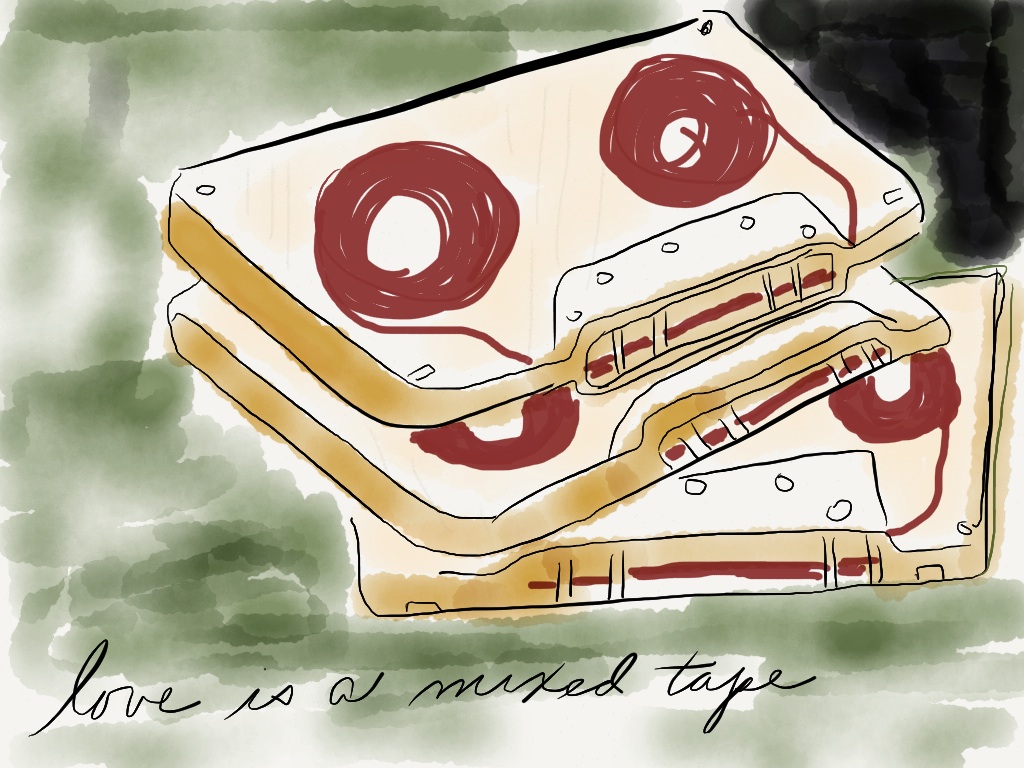
Book Review: Love is a Mixed Tape by Rob Sheffield

"Love is a Mixed Tape" illustration 2014 by jpbohannon (based on book cover)

“Love is a Mixed Tape”
illustration 2014 by jpbohannon
(based on book cover)


On two separate occasions, my friend Jim has stopped the car on the way to dropping me off at the train station to finish listening to Neil Young’s “Country Girl.”  For him, he remembers a particular girlfriend who broke up with him oddly and for whom this song is a reminder. For me, I remember hitchhiking across Canada, sitting on the floor of a Winnipeg record store (Winnipeg was where Neil was born) and copying down the chords from a fake book. For both of us, the song is a lot more than just music and lyrics.

Jim and I often do this. The “where” and “when” of a song, the lives we were leading, the dreams we were having, the people we were hanging with, are as much a part of a song than any of its recordable parts. And for each of us, those elements are different and recall a thousand different memories.

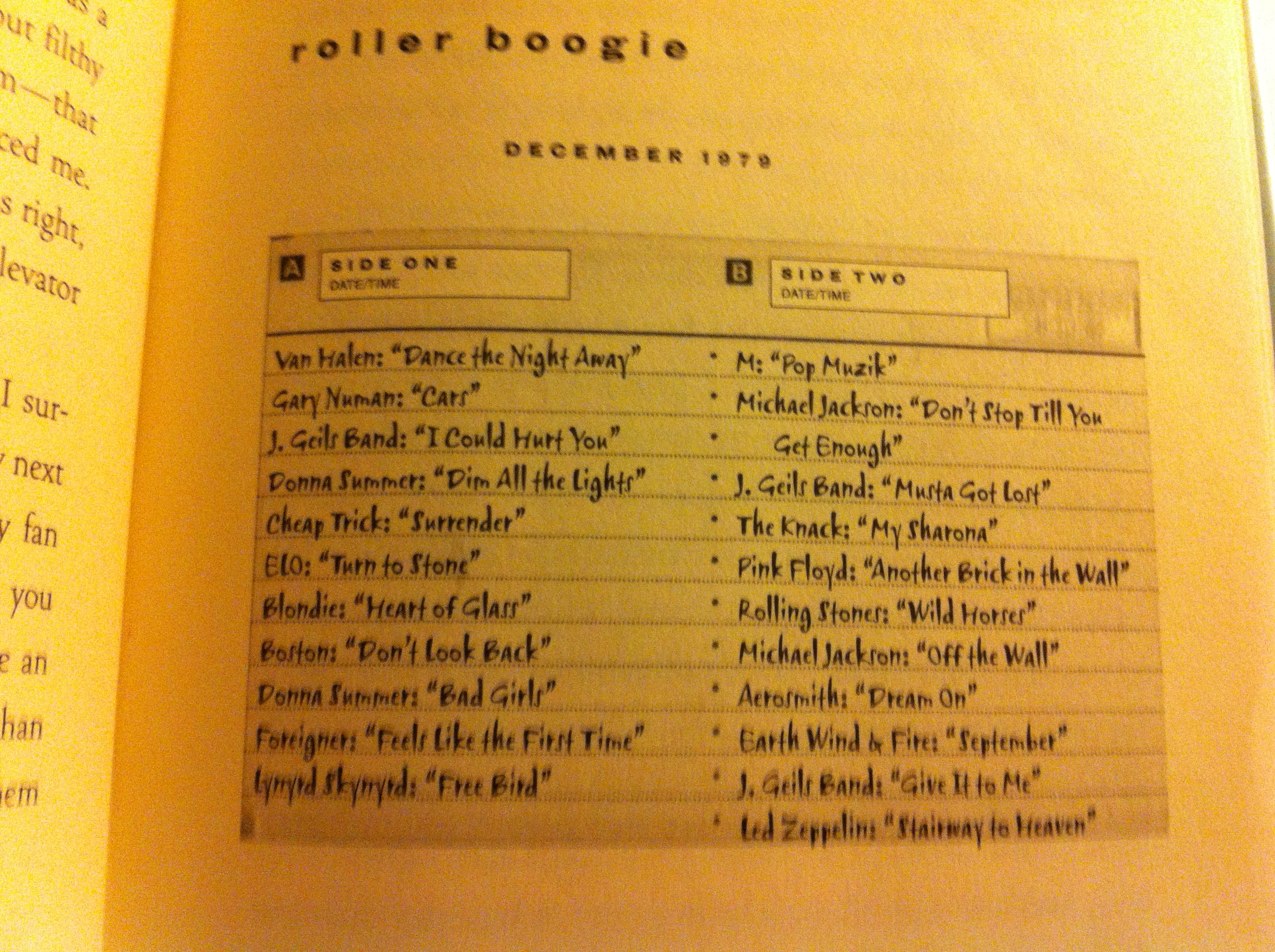
This is the basis of Rob Sheffield’s memoir Love is a Mixed Tape. Sheffield–a writer for Rolling Stone–writes about his late wife and himself through the skeleton of different mixed tapes. The sub-title of the book is Life and Loss, One Song at a Time, and this is exactly it: the life of a man and the life of the woman he loved told through the soundtrack of their lives. And, for some of us, it is our lives as well.

Sheffield starts off going through his dead wife Renee’s belongings and discovering several of her mixed tapes, spending a sad night listening to the first one–The Smiths, Pavement, 10,000 Maniacs, R.E.M., Morrissey, Mary Chapin Carpenter, and Boy George among them–commenting on her choices and their lives together when she made them. He talks about the various types of mixed tapes: the Party Tape, the “I Want You” tape, the “We’re Doing It” tape, the Road Tape, the “You Broke My Heart and Made Me Cry” tape, the Walking Tape, the Washing the Dishes tape. etc. From here he sets up his frame work–the tapes of our lives are the record of of our lives.

And so he begins. He starts by dissecting his own tapes, chronologically starting from a mixed tape he made as a thirteen-year old for an 8th-grade dance through his first romance and subsequent break up to his meeting Renee, their courtship and marriage, her sudden death and his struggles to continue on afterwards.  It is poignant and wise writing about  love and loss and survival.

Mixed Tape Sheffield made for his 8th-grade dance

Mixed Tape Sheffield made for his 8th-grade dance

Many of the bands I had never heard of–both he and his wife were music writers–but the pure affection and excitement that these two shared for new and old music was infectious. He was an Irish-Catholic boy from Boston who grew up on Led Zeppelin, the J. Giles Band, and Aerosmith; she, an Appalachian girl from West Virginia as familiar with George Jones and Hank Williams as she was with the punk bands she adored. Together they made a likeable pair. And their knowledge and love for music is wide and inclusive.

Sheffield met his wife in 1989 and she died in 1997. Their relationship lasted most of the 1990s and this is where Sheffield the music critic is at his best. His analysis of that decade, where the music was going and what it was doing is trenchant: he understands the phenomenon of Kurt Cobain, the importance of female empowerment in 90s’ music, the resurgence of guitar bands. (His discussion of Cobain’s late music/performances as the plights and pleas of a pained husband is unique and insightful and bittersweet.)

The naturally shy Sheffield–understandably–reverts into himself after his wife’s death. He is more and more asocial, awkward and uncomfortable. He writes eloquently about the pain of loss, of the condition of “widow-hood,” of unexpected kindness, and of the haunting of the past. Sadly, music–which once was his  buoy in life–is pulling him down, especially the music that he and Renee had shared.  In the end, however, it is music that pulls him together as well. He moves out of the south and to New York City, he reconnects with friends, makes new friends, and–of course–starts seeing and listening to new bands.

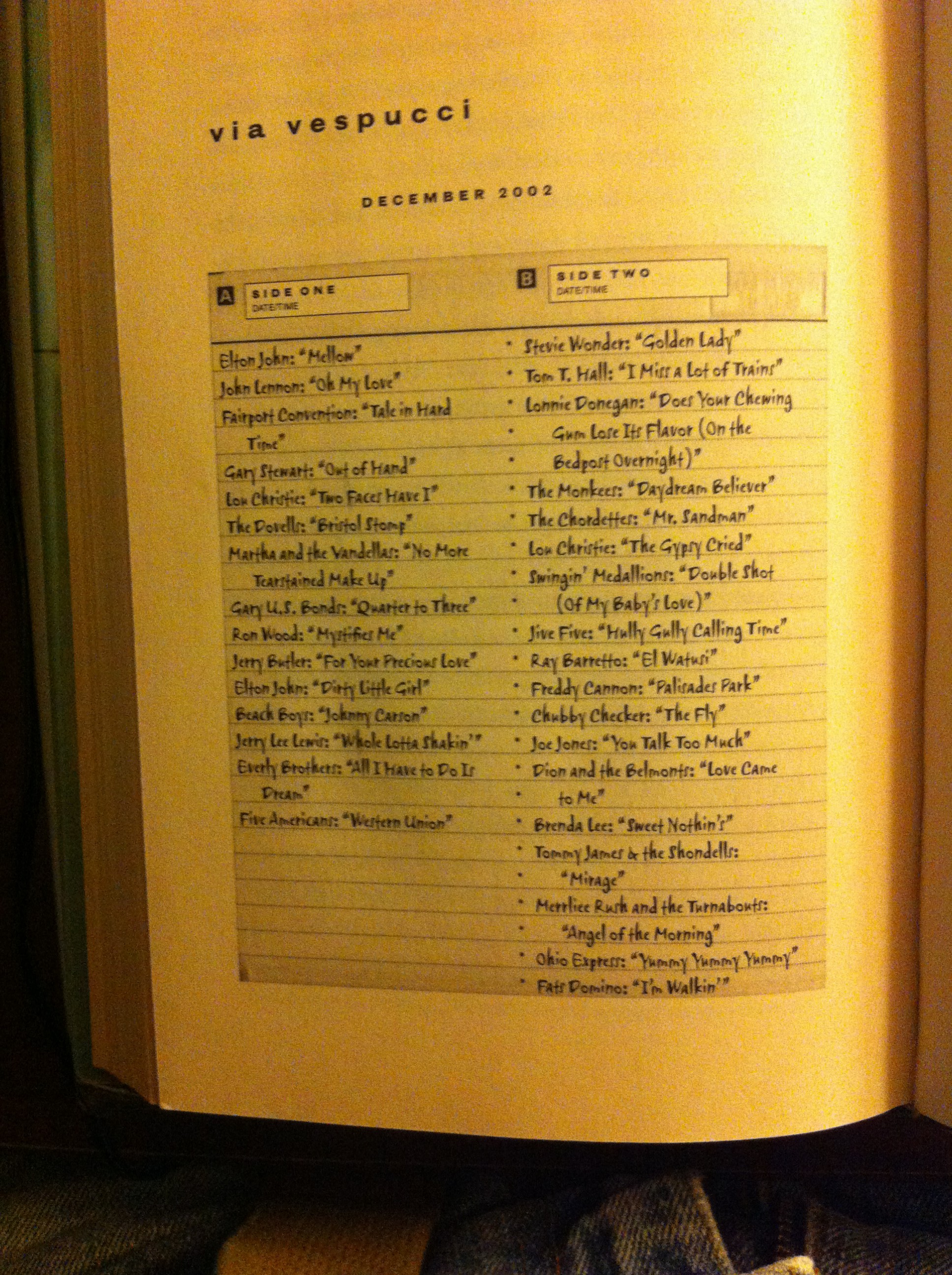
photo 3(1)

This is the tape–the last in the book–that Sheffield made when moving into a new apartment in Brooklyn, December 2002.

Love is a Mixed Tape was recommended to me by a friend, Brendan McLaughlin. Brendan was born in the mid-80’s, not long before Sheffield and his wife first met.  He is connected much more closely to the music than I am, and I am sure that he recognized a lot more of the bands and songs cited than I did.  But that is the great thing about Sheffield’s memoir: you don’t have to be completely tuned into what he is listening to, just to what he is saying.

And what he says is true.

Book Review: Submergence by J. M. Ledgard

image

“submergence” illustration 2014 by jpbohannon


There are some novels that do more than just examine a life, dissect a relationship, recount an adventure. They tell you things you do not know, often things you could not know. J. M. Ledgard’s Submergence is such a novel.

James More is a secret operative for the Secret Inteligence Service , dropped into Somalia under the guise of a water engineer and captured by al-Qaeda jihadists. Tortured–physically, mentally, and psychologically–he survives by remembering his past and observing keenly his present.  A very big part of his past is a recent love affair that he had the previous year in France with Danielle (Danny) Flinders, a bio-mathematician and a renowned expert in life at the bottom of the ocean. While More is submersed in chaotic Somalia, Flinders is on a dangerous diving expedition off Greenland where she will take the submersible, Nautilie,  into an oceanic fault to get samples of the microbiotic, chemosynthetic life that exists there.

More–an ancestor of Sir Thomas More, his father was Thomas More XVI–is an Englishman who is very fond of his native home. His memories of the stone walls and green fields, the beautiful churches and the glorious music are often set against the stark, impoverished sites that his captives periodically move him to.  Flinders, part French, part Australian, is more of a free spirit, a rootless and rogue scientist, whom this affair with More has seemingly tamed. Her thoughts are perhaps larger, going beyond the current events of Muslim Africa and modern conflicts, and contemplating human origins–and extinction, the primeval soup that is the ocean, and the mythic and cosmic implications of the studies she runs.

The actual love affair itself is quick and remembered periodically by James and Danny, as he is subjected to the harsh world of jihadists on the run and she on the prehistoric world of the ocean deeps.  But although it is quick–a week or so at Christmas–it creates a lasting–and perhaps permanent–bond for the both of them.

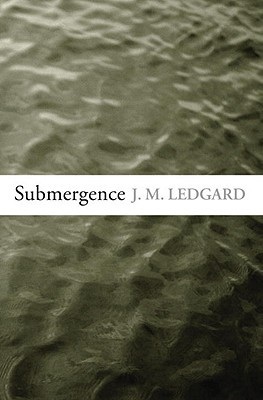
cover of the hardback edition of Submergence

cover of the hardback edition of Submergence

But then James is taken.

In the novel–informed so greatly by current events- we learn much about jihadists–about their training camps, their dreams, their aspirations, their hatreds, their violence. We see the extreme depredations that allows young boys to decide that the promise of Paradise to martyrs is much more attractive than the life they actually live.  We see primitive societies and their primitive justice. And we see the harsh landscape of Somalia.  We see the jihadists’ voiced hatred of things Western, yet their fascination with it at the same time. (Once very popular, Rambo fighting alongside the Afghans against the Soviets has been replaced by Disney animation. The leader of James’ captors sees Bambi as an allegory of the “Crusader” in the Muslim world.)

We learn about Islam, about the djinn and the promises of Paradise.  More’s education allows him to intelligently compare Islam with Christianity, for both good and bad, to discuss literature and his ancestor’s Utopia, and to give insight into the covert maneuvers of both sides in the “war on terror.”

And we learn much about violence.

We also learn a great deal about the ocean’s floor and the creatures that live there and the (few) people who explore it.

None of this is pedantic, however.  In fact, it is fascinating. It is couched in James More’s adventure story: his struggle to survive day in and day out propels the story forward. His memories and thoughts are what tie it together. Her memories and knowledge add to the banquet.

In all it is a wonderful read.

J. M. Ledgard

J. M. Ledgard

J.M Ledgard is a journalist who has been the political and war correspondent for the Economist. He now lives in Africa, where he consults developing countries on technology and risk.  His first novel Giraffe (2006) was inspired by the slaughter of 49 giraffes at a zoo in Czechoslovakia in 1975, which Ledgard uncovered in 2001 when he was working there as a correspondent.  Submergence is his 2nd novel.

words and pictures (part 2) …and the power of MUSIC

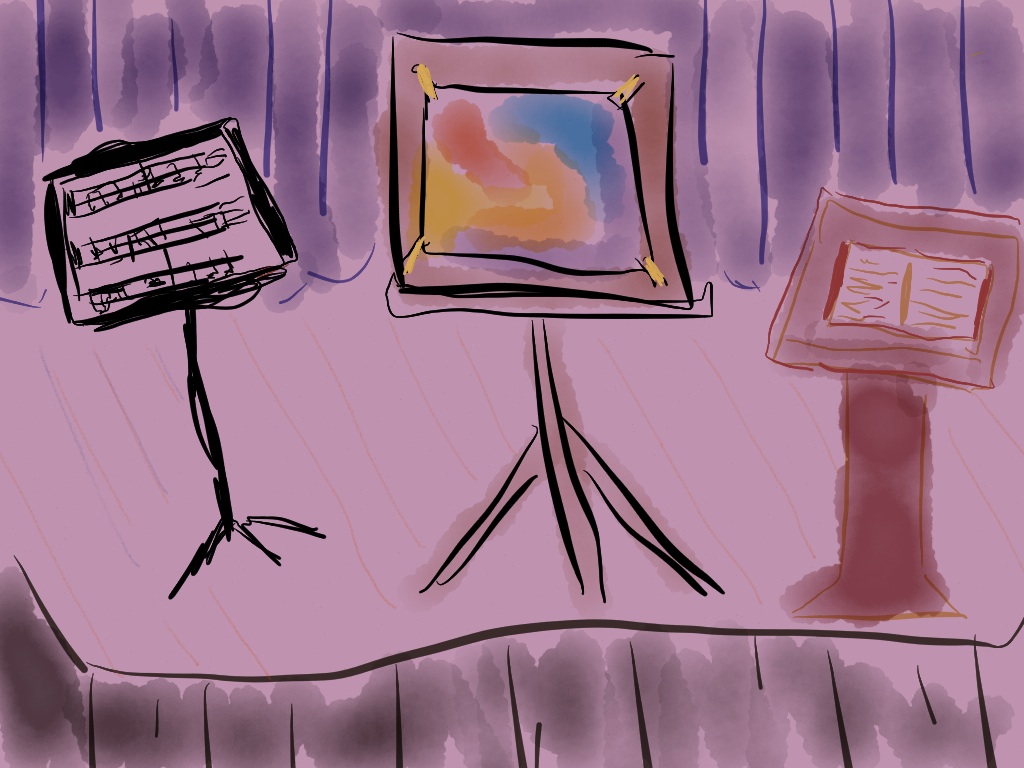
Music...Art...Literature Illustration 2014 by jpbohannon

Music…Art…Literature
Illustration 2014 by jpbohannon

Yesterday, I wrote a post about the film Words and Music, a sweet romance about a battle between an Art teacher and an English teacher. The film had interesting examples about the power of words and magnificent examples of the power of “pictures.”  But what I forgot about was the part that held it together and in a way redeemed it:

The Power of Music

In the film. after the male protagonist has made a bollocks of things and the female protagonist has had enough of his destructive behavior, it is music that is the most evocative, most informative, most powerful…and most healing.

Scene after scene the male (Jack Marcus) tries to contact the female (Dina Delsanto) to apologize for the drunken mess he made of her art. Scene after scene we see her aggressively stop his attempts or stoically ignore them. Until the moment, when she opens an e-mail and there is an audio attachment.  The piece–written for the film by Paul Grabowsky—is a chamber piece for piano, cello and clarinet entitled “I am a Small Poem.”  (This is also the name of the poem that Markus steals from his son.)  It is rich and resonant and connects with Delsanto more than any words or pictures could.

It is what saves their seemingly destroyed relationship.

I wish I could embed the music that was played when Delsanto opened her e-mail. but I can’t.  It isn’t available yet.  So instead, I will give you this: an extraordiary piece by Fauvre. It is what I often listen to when I am writing:

A while back, a music teacher (Manny DelPizzo), an art teacher (Jackie White) and I got together to make plans for a large project. (The educators call this kind of thing “Project Based Learning.”)  I was going to get my Creative Writing Students to submit their best work and the art teacher and music teacher would each have their students interpret it and we would have a performance.  Our ambitions were high–this seemed like the best outlet for student creativity– but the realities of schedules and time and curricula put many roadblocks in our way and we let it fizzle out.

The “performance” that the fictional students in Words and Pictures was much like what we were hoping for, minus the music. Our music component would have made it better.

A new school term is starting in a couple of weeks. I am newly energized (though not as drunken as Jack Marcus) and am excited about trying this for real. It doesn’t have to be a battle–as it was in the film–but a really cool examination of the power of words, of art, and of music–a real exercise in Creativity

Movie Review: Words and Pictures dir. by Fred Schepisi

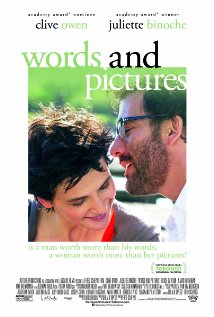
Poster for Words and Pictures

Poster for Words and Pictures

It wasn’t what I was expecting, so I should not hold that against it, but I found Words and Pictures just a tad disappointing. It is a very nice movie, not a great movie, but nice, and its heart is in the right place.

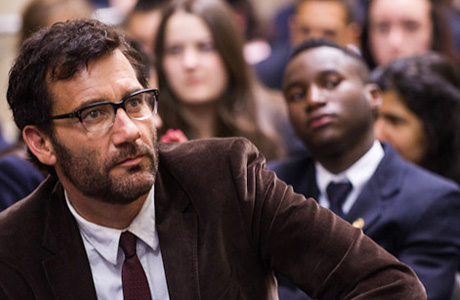
Clive Owen as Jack Marcus in Words and Pictures

Clive Owen as Jack Marcus in Words and Pictures

The film deals with an English teacher Jack Marcus (Clive Owen) who teaches at a very privileged prep school in Maine. Marcus–who once had a promising start as a writer– is brilliant, witty, energetic, and charming. The students love him; his colleagues tolerate him; his bosses are beginning to tire of him.  We immediately see him chastised for being late–an occurrence that is more and more frequent because at night he is drinking more and more. (I found this part a bit unbelievable because after his nightly excesses there is no way he could perform so elegantly in the classroom each day.  Add to that the thermos full of vodka he drinks with his lunch each day and his engaging classroom demeanor seems unreal.)

Because of cuts at another school, the school is able to hire a new art teacher, Dina Delsanto (Juliette Binoche). A successful gallery artist, Delsanto has left New York City due to crippling rheumatoid arthritis which forces her to walk with a cane, strap brushes to her wrists, and suffer intense pain, and she has come to rural Maine where she gets the necessary help from her sister.

Juliette Binoche as Dina Delsanto

Juliette Binoche as Dina Delsanto in Words and Pictures

She immediately clashes with Marcus, but not without hidden a smile of pleasure.

And this is where I got it wrong. As Hollywood usually goes, the film begins as a typical romantic comedy. Two strong-willed, feisty characters are thrown together–ala Tracy and Hepburn– battle and show their disdain for each other, and finally fall in love.  Yet, Words and Pictures takes another tack.

In her first class of Honors Art, Delsanto tells her class that “Words are lies, traps.” Since Marcus teaches the same students, her comments get back to him, and he initiates a war.  Words vs picture:  What is more powerful?  What is more true?  What is more dangerous?

And while the battle began between the two adults, the students get very much involved, and actually experience a truly great learning experience. (Educators now call this kind of thing “Project Based Learning.”) The “words” that the students use and the artwork they create as different sides in this battle of philosophies are impressive at the least.

As the battle goes on, Marcus learns that the school board is considering his dismissal, his relationship with his son is becoming more and more estranged, and his muse has completely dried up. And, he begins drinking even more heavily.

Delsanto’s condition worsens–she cannot undress herself or hold a brush without help–but her artistic output is becoming more and more robust.

Ultimately, these two flawed adults get together, but their lovely day together is sabotaged by Marcus’ destructive, drunken night.

It takes the final school assembly, where the contest between “words and pictures” is judged to bring some resolution to the film.  Here, Marcus gives a speech stating that there is no greater approach–that together words and pictures are often more powerful than apart. (I’m not sure I agree.)  Afterwards, we are left hanging–does Delsanto merely forgive Marcus or does she let him back into her life.

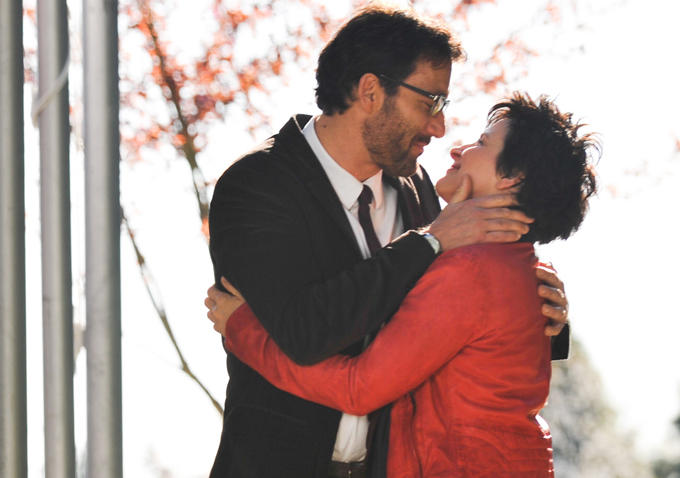
Clive Owen and Juliette Binoche as Jack MArcus and Dina Delsanto in Words and Pictures

Clive Owen and Juliette Binoche in Words and Pictures

To see a romantic film about two adults, seriously flawed in their own ways, is a rarity in film these days (at least in American movies). And to have this romance played out by the like of such actors as Juliette Binoche and Clive Owen is special. And this is where Words and Pictures promised a delight.

But somewhere along the line, the relationship between Marcus and Delsanto gets hijacked.  The philosophical arguments of “words vs. pictures” take center stage, and–by the very nature of film– can only be superficial at best, and ultimately unfulfilling.  And we are further distracted by the subplots of Marcus and his son’s disintegrating relationship and an annoying story of a predatory student who continually harasses a shy student in his class. (Granted both of these subplots can be tied into the overall argument of “words vs. pictures,” but again, it is weak.) And so, the “romance”–even the relationship–between Marcus and Delsanto too often gets pushed aside and loses its cinematic momentum,

In the end, I enjoyed Words and Pictures, but I wanted to like the film more than I did.  It had the makings of  a  sweet romance, but the un-fleshed-out philosophical argument got in the way.

What I found most interesting was that all of Dina Delsanto’s artwork was painted by Binoche herself.  That bit of info, coming late in the credits, is amazing, for the paintings are powerful expressionist and abstract works that to my untutored eye were dazzling. Binoche has always been one of my favorite actresses…now even more so.

Book Review: A Farewell to Arms by Ernest Hemingway

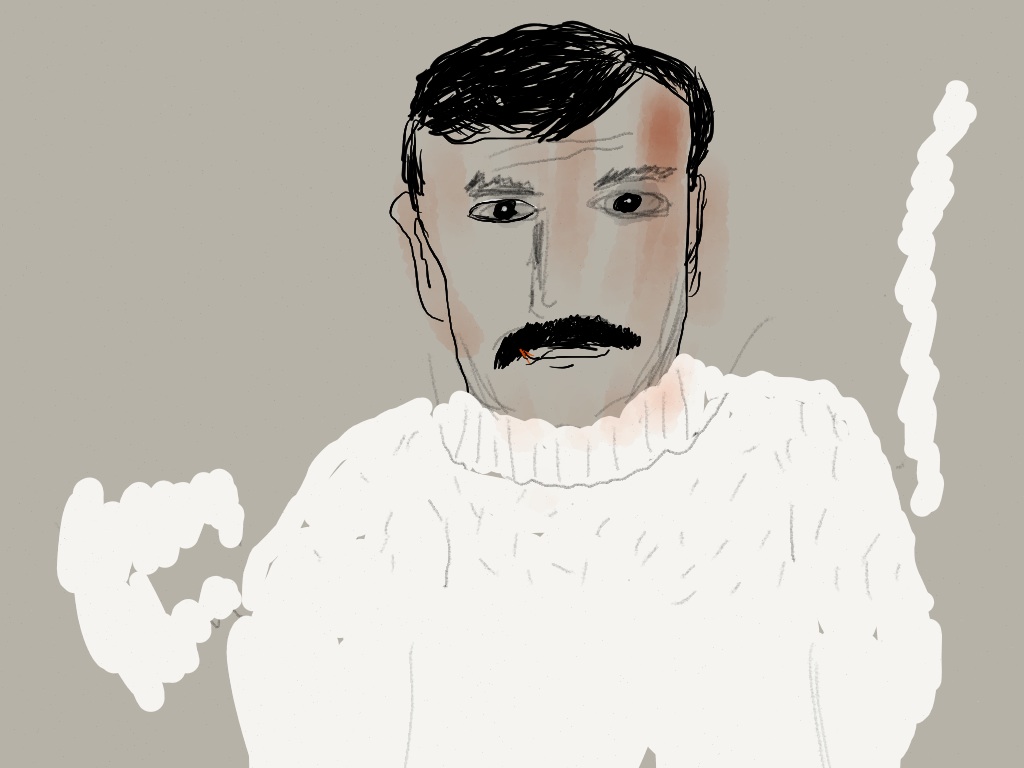
Hemingway as a young man.   illustration 2014 by jpbohannon

Hemingway as a young man.
illustration 2014 by jpbohannon

The most gaping hole in my formal education is a lack of courses in American Literature. In undergraduate and graduate school combined, I had taken only one course in American lit. My understanding is mostly self-directed–and often spurred on by the requirements of teaching American Lit survey courses for many years. Certainly, I know the school classics: The Great Gatsby, Huck Finn, The Scarlet Letter, The Old Man and the Sea, The Sound and the Fury.

And as a reader, I have discovered on my own Vonnegut and Pynchon, Heller and Elison, Mailer, Roth and Updike. And from my friends I have learned to love DeLillo, Wallace, and Johnson.  But I know there are gaps.

I took a tour, a few weeks back of Ernest Hemingway’s home in Key West. I respect and admire Hemingway’s short stories–and often teach them in writing classes for their craft–and have fond memories of reading The Sun Also Rises and A Moveable Feast,  but I never read much else. Anyway, the tour guide told us that it was here in the Key West house that Hemingway wrote a large portion of his work, in particularly A Farewell to Arms, which he stated is considered Hemingway’s greatest work. (Remember, he is a tour-guide, not a literary critic.)

And so I decided to give it a try. And to be truthful, in the beginning, it was slogging read at times.

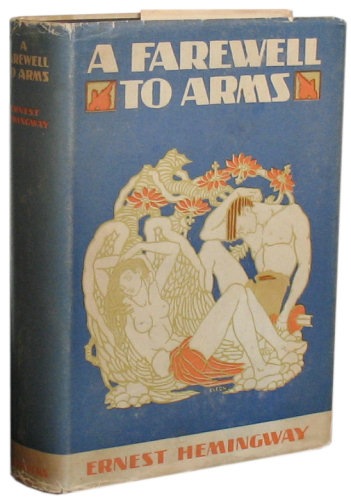
First Edition of A Farewell to Arms

First Edition of A Farewell to Arms

In brief, the novel is the semi-autobiographical story of an American ambulance driver, Frederic Henry, working for the Italian army during World War I, who is wounded, falls in love with his nurse, impregnates her and sneaks across the border with her into neutral Switzerland. There are pieces that are perfect Hemingway: the army’s long retreat, the Swiss countryside in winter, the view from a hotel room. These passages are clear and distinct and one can almost imagine Hemingway speaking them himself.

What one cannot imagine is anyone speaking the dialogue that Hemingway has given his characters to speak. The dialogue among the soldiers is stilted–but I thought perhaps that was intentional as the narrator is an American and the conversation is between him and his Italian comrades. But the conversation between the lovers–between Frederick and Catherine–is downright embarrassing.

Perhaps, it is dated. But I do not believe so. The dialogue in Fitzgerald’s Gatsby published four years earlier in 1925 is not as silly or inane. This can’t be how people talked 75 years ago. Perhaps, Hemingway is trying to capture the coded, playful language that lovers often engage in privately. Well if so, it should have remained private. While Catherine Barkley is a strong woman–a British nurse working in the Italian theater of war–when she speaks she sounds infantile and ditzy, hardly the type that Henry would fall for.

But then, perhaps, it is just me, the reader, far past the ages of the protagonists, a little bit wiser (one hopes) and a little bit more jaded.

And yet, having said all that, the slogging read and the cloying dialogue are more than made up for in the last chapter. It is here that Hemingway elevates the novel to something different, something larger. It succeeds not merely because of the drama–which in lesser hands would have become melodrama–but because of  the craft. The language is pared down–like Joyce had taught him–and there is simply life, death, man and woman. It doesn’t get more basic than that. In the end we admire Frederic Henry more than before–I found him hard to like or take seriously throughout much of the book– and we admire Hemingway too. We admire what he is doing and we understand how this novel placed Hemingway in the pantheon of American authors.

Hemingway famously once claimed that he rewrote that last chapter 39 times. Well, then it is a good advertisement for revision, for it is so superior to everything else.

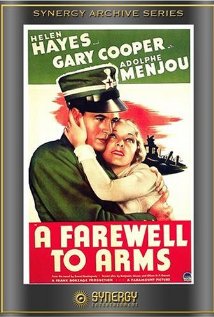
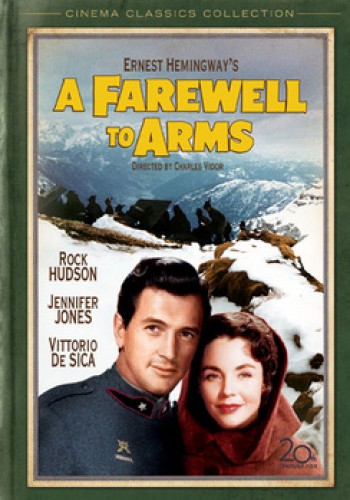
The novel was an instant–and huge–success.  Within a year of its publication a dramatization was staged and in 1932 Hollywood released a major film of the novel, featuring Gary Cooper and Helen Hayes.  In 1957, a second film was made, this time starring Rock Hudson and Jennifer Jones.

I have seen neither, and I won’t search for them. It is Hemingway’s language and style that is the star of A Farewell to Arms, not the story.  And much of that would be lost in film.

Movie Poster for 1932 film

Movie Poster for 1932 film

Movie Poster for 1957 film

Movie Poster for 1957 film

The Hemingway House, Key West

Hemingway House, Key West Illustration 2014 jpbohannon

Hemingway House, Key West
Illustration 2014 jpbohannon

I have always had a love/hate relationship with Ernest Hemingway. For a long time, all the machismo got in my way: the big game hunting, the bull fighting, the boxing, the boasting, the egoism, all seemed to be compensating for something, a sense of insecurity perhaps, to put it in simplest terms.

And yet, I love his writing. It is pure and clean and powerful and elemental. I can still feel the the visceral punch in  “Indian Camp” when the father removed the blanket from the young husband in the upper bunk. Or, the pared-down, gradual dawning of realization in reading “Hills Like White Elephants” or the existential abyss yawning at the end of a “A Clean Well Lighted Place.”

It’s been a while since I read one of the novels. I remember A Sun Also Rises fondly. The damaged romanticism of  Jake Barnes, the alluring aloofness of Brett Ashley, the thirsty landscape of Spain are all still vivid in my mind despite how long ago I last read it. And while critics claim A Farewell to Arms to be the better written novel, The Sun Also Rises remains more important to me.  (A colleague just last month called it the worst novel written in English! Oh well.)

And so, with this ambivalence about Hemingway, I visited his home while in Key West in early June.

The home is extraordinary–and rich in story and history.

photo

The front of the Hemingway House on Whitehead Street in Key West. Photograph 2014 jpbohannon

In the 1930s, Hemingway moved to Key West with his second wife–Pauline Pfeiffer–whose uncle purchased the house on the corner of Whitehead and Olivia Streets. And although, Hemingway claimed that he was “restless” in Key West, at this house he wrote a great deal of what would be his most important work.

The house is a two level structure built in 1851 by Asa Tift, a successful architect and salvager, and the Hemingways bought it in 1931.  Today, the home is an Historic Site and remains filled with the Hemingways’ furniture and artifacts.  Throughout each room are both original furnishings and memorabilia–posters of movies made from his novels, photos of Hemingway at various stages of his life, of his family, and of various celebrities and writers. The bed in the master bedroom is actually two double beds that Hemingway wired together and the headboard is a gate made of Spanish mahogany that Hemingway and his wife had seen in a monastery in Spain.  A bench in the foyer is from the same monastery.

Hemingway's Writing Studio in Key West Photograph 2014 jpbohannon

Hemingway’s Writing Studio in Key West
Photograph 2014 jpbohannon

Behind the main house is a “carriage house” in which Hemingway had built a writing studio on the second floor.  In order to ensure his privacy, Hemingway had a wrought-iron catwalk stretched across the patio from the bedroom to his studio.  This was the only means in and out.  Today, the catwalk has been taken down and there is a narrow stairway from the patio to the studio door.  It is an ideal working space.

The house also has a large pool–the first ever in Key West.  Hemingway and Pauline had wanted to build a pool, but cost was prohibitive.  They had bought the house for $8000 dollars, but building a pool in the remote Keys was expensive. Instead, Hemingway built a regulation sized boxing ring. Much to Pauline’s dismay, her dream of lounging poolside had given way to a ring side seat to her husband’s sparring bouts.

However, Pauline got her way (and ultimately the house itself).  Hemingway had started an affair with the writer Martha Gelhorn, and the two of them had met up in Spain to cover the Spanish Civil War.  When Pauline caught wind of the tryst, she promptly had a over-sized pool built–at the cost of $20,000, two and half times the cost of the house.

When Hemingway returned he was none too pleased.  In one gesture of comeuppance, he dragged a urinal from what was then Sloppy Joe’s (and is now Captain Tony’s) which had been thrown curbside during renovations, and brought it home as a watering trough for his many cats. As he told his wife, “you have your pool, and now I have mine.”

And it is the cats that retain their residency.  Hemingway loved cats, particularly 6-fingered, “polydactyl” cats. He believed them to be good luck. There are countless photos of Hemingway with them–while he wrote and while he lounged. (Apparently, they were the only others who had access to his studio.) Today, all of the 48 or so cats on the property are descendants of Hemingway’s cats–and all of them carry the gene for the polydactyl mutation.

One of the many six-fingered cats on the Hemingway Huse property. photograph 2014 by jpbohannon

One of the many six-fingered cats on the Hemingway Huse property.
photograph 2014 by jpbohannon

But after the cats and the pools and the writing studios, after the womanizing, the wives, and the bluster, after the houses and the legends and the suicide, what we are left with in the end is the writing.  As I said earlier, it is pristine and clear and purposeful.  Hemingway was a great reviser, mostly paring down and paring down to the very essence of what he wanted to say. As he famously told an interviewer, the hardest part is getting the words right:

Interviewer: How much rewriting do you do?
Hemingway: It depends. I rewrote the ending of Farewell to Arms, the last page of it, 39 times before I was satisfied.
Interviewer: Was there some technical problem there? What was it that had stumped you?
Hemingway: Getting the words right.
(Ernest Hemingway, “The Art of Fiction,” The Paris ReviewInterview, 1956)

Quote #40: “A page with a poem…” Anne Carson

illustration 2014 by jpbohannon

illustration 2014 by jpbohannon

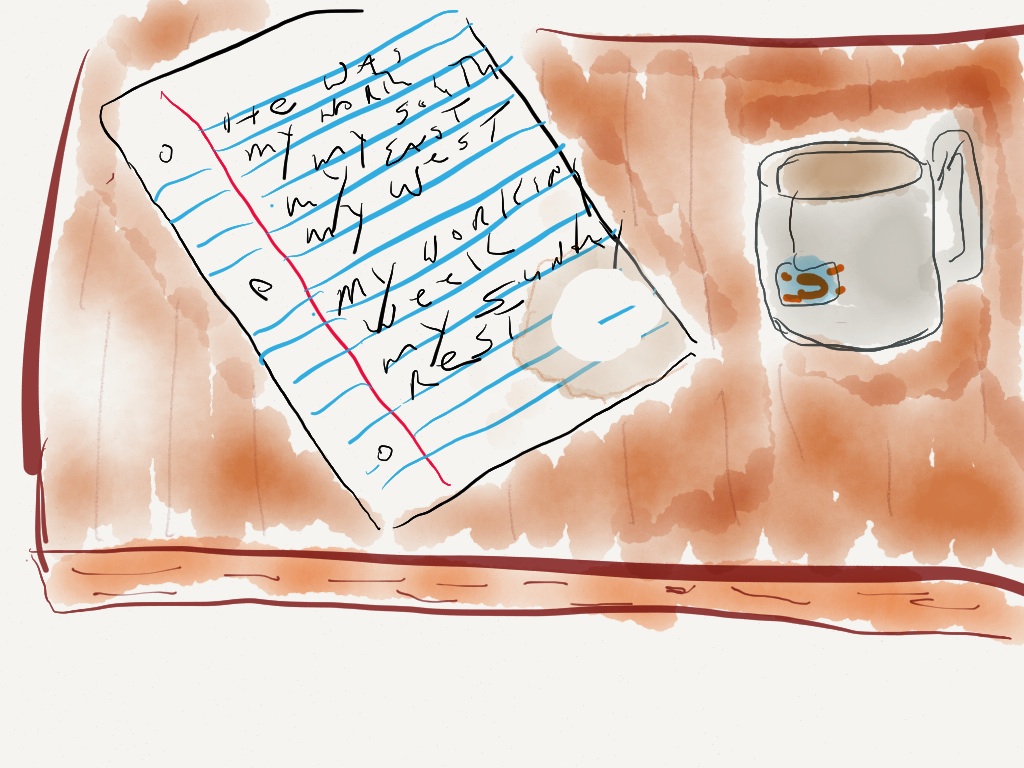
“A page with a poem on it is less attractive than a page with a poem on it and some tea stains.” —Anne Carson (as quoted in The Paris Review )

Book Review: Beautiful Losers by Leonard Cohen

illustration 2014 by jpbohannon

illustration 2014 by jpbohannon

A few weeks back I saw a photograph of Jonathan Letham’s favorite books.   Among the titles on the row of spines,  I noticed a book by Leonard Cohen called Beautiful Losers.

Now, I am a big Cohen fan.  I listen to and play his music frequently–both new and old– and I am well aware of his  poetry, so I assumed Beautiful Losers was one such poetry collection.

I was wrong. It was a novel, first published in 1964–several years before the release of his first album, The Songs of Leonard Cohen.

And so I thought, what the hell.

Beautiful Losers is very much a work of its times. Frenetic and speeding. Erotic and rambling. Big-hearted and narcissistic.

It is the story of an unnamed narrator whose other two partners in a odd love-triangle –his wife and an elusive shaman-like man named F.–are dead. (His wife committed suicide in the unconventional way of sitting at the bottom of an elevator shaft and having the elevator crush her. F. is a member of the Canadian Parliament.) The other object of his love/lust is also dead but she’s been dead for 300 years and is up for canonization by the Catholic Church, Catherine Tekakwitha, the virgin of the Iroquois.

There are betrayals and reversals and climaxes and re-unions.  There is sex and loneliness and more sex.  There is 17th-century genocide and 20th-century nationalism and separatism. (This is early 1960s Montreal, after all.)  There are Joycean lists and Henry Miller-like rhapsodies, but all and all the whole thing seemed to me to be very much a part of the 60’s gestalt. (One of my favorite scenes is when the naked narrator watches his wife and her/his lover shoot up, only to discover later that they are injecting an odd mix of heroin and Lourdes water. He found the advertisement/receipts for the Lourdes water in his wife’s dresser drawer)

The whole thing reminded me more of late Ken Kesey or even Gilbert Sorrentino than it reminded me of Joyce or Miller (which connection the book jacket blurbs go on and on about). The attempt seemed old and tired…but maybe because  the energy of those times seems so old these days as well.  True, it is a pastiche of Joyce–but then again how many young artists were trying the same at the time.

But more than anything else, Beautiful Losers is the announcement of a unique and individual voice.  That that voice ultimately decided to be heard through poetry and song rather than through fiction was a decision that the artist himself made.

And I for one believe it was a right decision.

In a very early poem, Cohen wrote:

So you’re the kind of vegetarian

Who only eats roses

Is that what you meant

with your beautiful losers?”

I’m not sure if this is where Cohen got the title for his novel or precisely what these lines might mean, but it reflects the  word usage and mindset of the novel.

Book Review: The Black-Eyed Blonde by Benjamin Black

In 2006, with the release of Christine Falls, the Booker-Prize-winning novelist John Banville began publishing “crime fiction” under the pen name Benjamin Black.  Like his “literary novels,” these crime novels are psychologically astute, intensely plotted, and keenly aware of language.The Black-Eyed Blonde

With The Black-Eyed Blonde, however, Banville decided to try something new:  to write a novel using Raymond Chandler’s most famous private detective, Philip Marlowe.

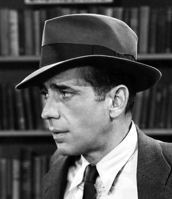
While Chandler’s fiction is read and esteemed, and his influence on detective fiction in particular and American literature in general widely acknowledged, his detective’s presence is mostly ingrained in the American consciousness through film and television.  There have been several television series featuring the L.A. detective and many movies.  Dick Powell and Robert Mitchum both played Marlowe, and successfully, but undoubtedly, the most iconic incarnation of Phillip Marlowe is that played by Humphrey Bogart. So pervasive are the film renditions of Chandler’s L.A., that I found myself casting the characters while reading The Black-Eyed Blonde.  Sure enough there was a role for all the usual suspects: there is a creepy, effeminate Peter Lorre type, an enormous, gang-lord Sydney Greenstreet, a fetching Lauren Bacall character, and, of course, there is Bogart as Marlowe.

Humphrey Bogart as Phillip Marlowe in The Big Sleep

Humphrey Bogart as Phillip Marlowe in The Big Sleep

Banville himself is certainly aware of the hold that film has on the literary characters and early in the book he gives a winking nod to Bogart. Marlowe is sitting in the offices of a fancy country-club. There are cigars and brandy, chintz armchairs and fine china. Marlowe says:

“At that point, I wouldn’t have been surprised if some fruity type in white shorts and a blazer had come bounding through the door, inquiring with a lisp if anyone was for tennis.”

This is Banville’s joke, and nod to Bogart.  Before he played tough guys in film, Bogart played in drawing-room comedies on Broadway. A long-lived story is that Bogart’s first professional line as an actor was as a young dandy, bouncing onto stage with his tennis whites and tennis racquet and inquiring “Tennis, anyone?”  That Bogart also had a slight lisp, makes Banville’s nod even more on target.

But The Black-Eyed Blonde is not a film, it is a novel, and a highly readable one at that. The title is one of several possibilities that Raymond Chandler had filed away and which Banville received permission to use from The Raymond Chandler Estate.  From there, somehow, Banville began channeling Chandler, because what he has created is an exceptional mirroring of Chandler’s style: the rapid-fire dialogue, the lyrical similes, and the sprawling, frenetic plot and subplots.

The plot is typical: the eponymous blonde, Clare Cavendish, enters Marlowe’s office and hires him to find a “friend”  who has gone missing.  When Marlowe discovers that the friend was killed and cremated two months earlier but that Cavendish had seen him just a few days ago, things get complicated.  There are betrayals, murders, cover-ups, flirtations, and deceptions.  And throughout it Marlowe maintains a strict code of honor–the characteristic that always set Marlowe apart from the rest. He protects his clients’ confidences, he takes no joy in the violence that is visited upon the deserving, he cannot be bought no matter what the price, and, while he can empathize with those on both sides of the law, he believes in justice.  It is this chivalric honor that became the hallmark of the American noir hero.

But always, when reading Chandler–and now Banville posing as Chandler–the story seems secondary.  It is the evocation of 1930s-40s Los Angeles, the elaborate metaphors (“He smelled like an over large man who had lain in the bath too long.”), the snappy dialogue that conjures up an entire world–a fictional world, perhaps, but one that we are very familiar with through both reading and film. And with The Black-Eyed Blonde, Banville re-captures that world perfectly,  note for note.

The Black-Eyed Blonde is a fun, a quick, and a memorable read.