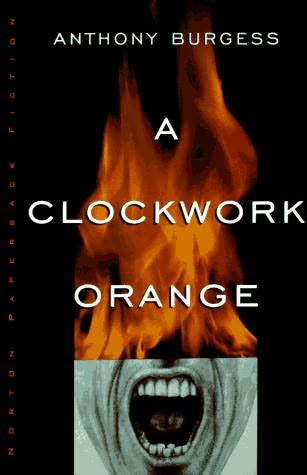
Clockwork Orange and City of Bohane

The Guardian had an article today noting the 50th Anniversary of Anthony Burgess’s A Clockwork Orange. Mind you, it is the anniversary of the book not Stanley Kubrick’s iconic movie, which has taken on a life of its own.

I first read the novel when I was seventeen. I read it a month later when I learned there was an edition with a glossary in the back. The glossary didn’t enhance the read that much; everything could be inferred from context  without too much trouble. (I had heard the glossary was only in the American edition, but I am not positive of that.) Anyway, what I remember most was the language: it was playful, edgy, smart, and alive. It was a mixture of joycean word play, street jive, cockney, rhyming, Slavic slang. And it was what set me off reading a lot of Burgess, from the Enderby novels to the majestic Napoleon’s Symphony to the various autobiographies.

The movie was another thing.  I was hitch-hiking across Canada from Vancouver to Toronto and winter was coming on a lot earlier than it came where I was from. It was only the last week of August, but we woke up under a thin sheet of snow in Regina.  Earlier, to stay out of the cold, and since nothing seemed to be coming along Canada’s Highway 1, we went into the town of Regina and bought tickets to see Kubrick’s A Clockwork Orange. It was very stylish and engrossing, with a narrative that I already knew.  I don’t remember now being struck by the ultra-violence. I do remember the music and the Skinner-like experiments and the tragic ending.  
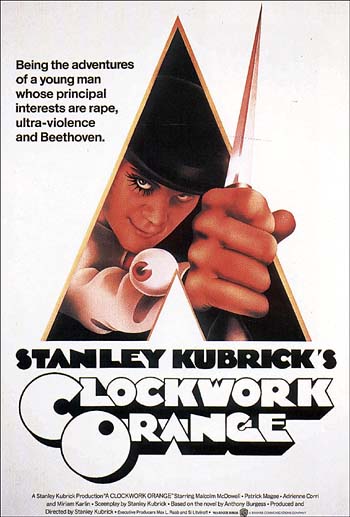
But anyway, today, in their piece on the 50th anniversary of the book, the Guardian said this:

Fifty years ago today, Anthony Burgess published his ninth novel, A Clockwork Orange. Reviewing it in the Observer, Kingsley Amis called the book “the curiosity of the day.” Five decades later there is still nothing like it.

I beg to differ.
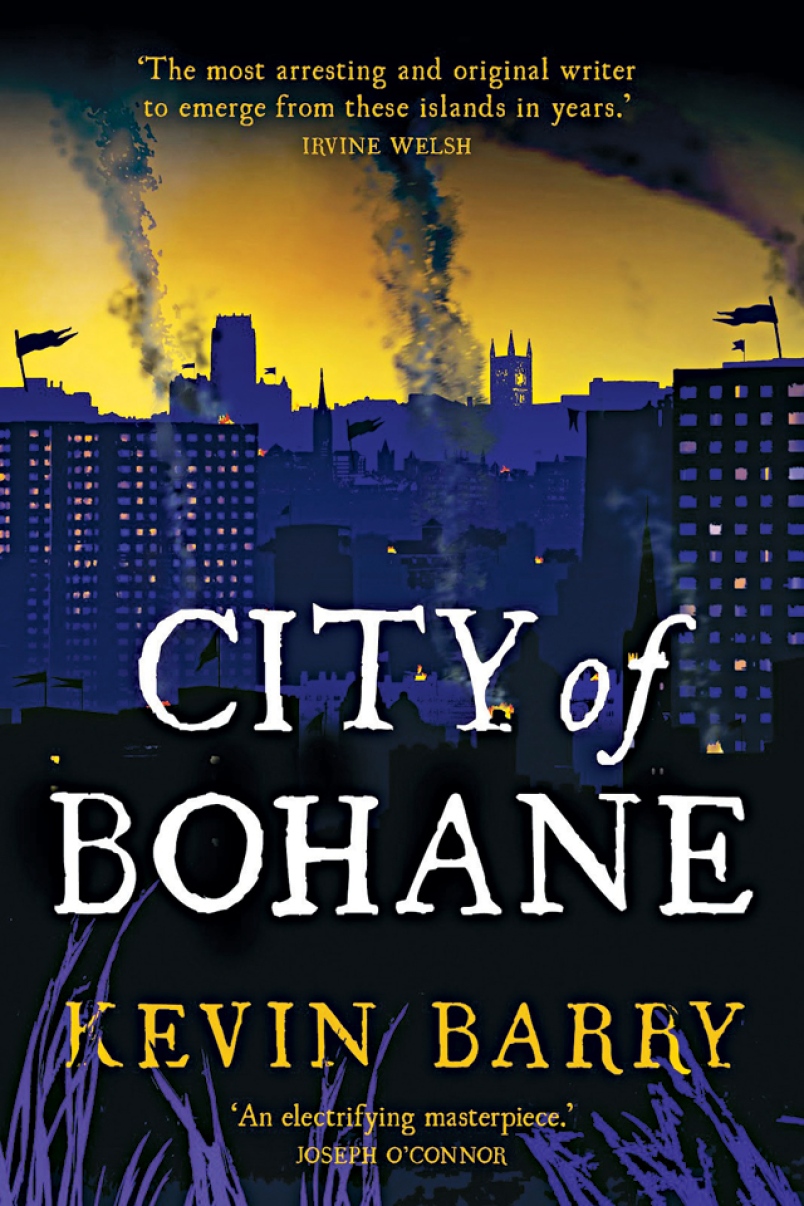
Kevin Barry’s first novel, The City of Bohane is channeling Burgess big time.  Set in a dystopian future, in what could be an unrecognizable Dublin of 2053, it is full of violence, sex, drugs, and turf wars. And again, the language  is at the forefront. Here is Barry describing DeValera Street:
[DeValera Street] leases are kept cheap and easy– bucksee enterprises appear overnight and fold as quick. There are soothsayers,. There are purveyors of goat’s blood cures for marital difficulties. There are dark caverns of record stores specialising in ancient  calypso 78s –oh we have an old wiggle to the hip in Bohane, if you get us going at all. There are palmists. There are knackers selling combination socket wrench sets. Discount threads are flogged from suitcases mounted on bakers’ pallets, there are cages of live poultry, and trinket stores devoted gaudily to the worship of the Sweet Baba Jay. There are herbalists, and veg stalls, and poolhalls. Such is the life of DeValera Street… .

Here again is Barry introducing Girly Hartnett, the 90-year old matriarch of the major family:

Here was Girly, after the picture show, drugged on schmaltz, in equatorial heat beneath the piled eiderdowns, a little whiskey-glazed and pill-zapped, in her ninetieth–Sweet Baba help us–Bohane winter, and she found herself with the oddest inclination.

I always found the world of A Clockwork Orange to be too sterile, too sharp-edged, even the thugs were dressed in sparkling white.  Bohane City is many things, but sterile it is not.  There is a richness of detail, texture, smell. Even in memory, Alex and his droogies seem too slick compared to the denizens of Bohane. For in this dystopic future, the world has not been re-shaped by technology–in fact, technology is surprisingly absent.  There is an elevated train, but no cars. Communication is done face-to-face…and at times angry-face-to-angry-face. Newspaper writers get their stories in pubs or brothels; the hunchback photographer pegs his developing photos in a morbid array across a room.  Although this is the future, it is not one overrun with gadgets!

The violence is real–but somehow not graphic. The economy runs on sex, alcohol, and drugs. There is an outer world, beyond the pale, but it doesn’t intervene, seemingly content to let Bohane run its own violent course.

And it is so, so visual.

Here’s a description of the major characters as they prepare for the momentous battle at the center of the novel:

“Logan Hartnett [the albino leader of the Bohane Trace] suavely walked the ranks and he offered his smiles and his whispers of encouragement. There was confidence to be read in the sly pursing of his lips, and atop a most elegant cut of an Eyetie suit he wore, ceremonially, an oyster-grey top hat.”

“Fucker Burke was bare-armed beneath a denim waistcoat and wore his finest brass-toed bovvers.”

“Jenni Ching carried a spiked ball on a chain and swung it over her head. She wore an all-in-one black nylon jumpsuit, so tightly fitted it might have been applied with a spray-can, and she smoked a black cheroot to match it, and her mouth was a hard slash of crimson lippy.”

“Wolfie Stanners, however, was widely acknowledged to have taken the prize. Wolfie was dressed to kill in an electric-blue ska suit and white vinyl brothel-creepers with steel toecaps inlaid. Four shkelps were readied on a custom-made cross-belt.”

[Macu–Logan’s wife–wore] “a pair of suede capri pants dyed to a shade approaching the dull radiance of turmeric, a ribbed black top of sheer silk that hugged her lithe frame, a wrap of golden fur cut from an Iberian lynx…and…an expression unreadable.”

My god, look at the attention to clothing–not futuristic, Buck Rogers’ one-pieces, but clothing that has been taken from a vibrant past.  It is as if the costume designers from Game of Thrones, Gangs of New York, and My Fair Lady got together to outfit the cast for this rumble.

And what City of Bohane also has that A Clockwork Orange doesn’t  is a love story.  Granted it is a story of disappointed love and jealous love and abandoned love, but the emotions of these characters are real and painful and poignant. For  while Logan Hartnett and his antagonist, the Broderick Gant, may have run the machinery of their town with brutality and violence, they are both bowed when set against the forces of love.

Now there’s something to pass on to Alex and his droogies!
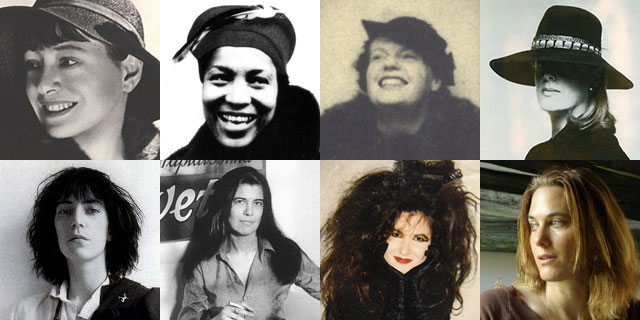
Women Writers and New York City–or all writers and everywhere.

Top row: Dorothy Parker, Zora Neale Hurston, Shirley Jackson, Gael Greene.
Bottom row: Patti Smith, Susan Sontag, Tama Janowitz, Kate Christensen.

I have a niece who is struggling in New York City to make it as a writer…and she is doing pretty well (see my blogroll and click on “Courtney Gillette.”) Nevertheless, it is a struggle. I have a friend whose son Brendan is carving his way as a comic/comedy writer–not the easiest of niches to crack into–and he is making headway. They are just two of thousands who go to NYC with dreams of making it big and –more power to them–they have the drive and determination to do so.  But it is not just New York, it is cities around the world where people intent on making something new, struggle to survive and to get their work out…and hopefully recognized.  So I thought of both of them–Courtney and Brendan–when I read this article this morning.  The article itself is from mid-April, but it is a fun piece highlighting some of my favorite people and writers.

Anyway, here is the article from a site called AWL. It tracks what particular writers arrived New York with before they “made it” and adjusts the value of their belongings and purchases for inflation.  It is a fun piece that ranges from Dorothy Parker and Zora Neale Huston to Patti Smith and Tama Janowitz:

What it Cost Eight Women Writers…

And speaking of Patti Smith, I have been on a Patti Smith kick for over a year now.  One day in December 2010, I actually received three separate copies of her memoir, Just Kids and of course read it in a night and then began giving out copies to everyone. Then I began to reacquaint myself with her music. (Her video singing “Helpless” with Neil Young is powerful.)

Just last week a friend sent me this new Patti Smith video/song. It’s about April and poetry and fools.  Enjoy.

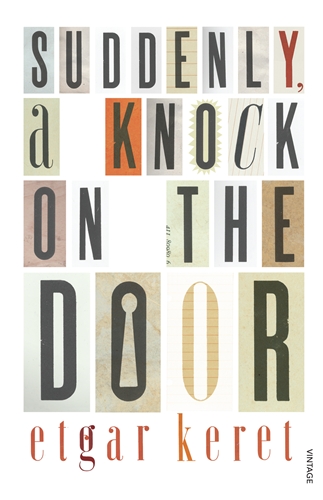
Book Review: Suddenly, A Knock on the Door by Etgar Keret

There is a weird zeitgeist about my reading these days.  I will pick up a book that I am unfamiliar with, because of a friend’s recommendation or a short review in the Sunday papers, and then all of a sudden I am seeing it everywhere.  I began reading Etgar Keret’s collection of short stories, Suddenly a Knock on the Door, after seeing it reviewed in the Sunday NYTimes two weeks ago (15 April). While I was half way through it, I was tidying up the house when a magazine from back in February fell open to a review of the book announcing its upcoming publication. I had read the review back then, but had forgotten completely about it. And then again on Wednesday in the Metro–the free paper given to commuters each day and hardly a go-to read for  literary suggestions–the book was advertised on the front page and reviewed inside. On Friday, a co-worker told me the library had called to tell him the book he had on hold had arrived: Suddenly a Knock on the Door.

What is with all the buzz?  Keret’s publicists must be very good.

And to a large degree it is worth it.  Keret’s thirty-seven stories (translated by three people) are short, zippy, and fun.  They straddle the world between stark realism (suicide bombers and bratty children) and magic (talking fish, pissed-off angels). The subject matter often seems to be fiction itself–the fictions of the literary mind and the fictions of liars.

The collection is bookended by two stories in which they author is forced to write a story in front of us.  In the final story, he is being filmed by German Television and they want to film him writing, want to record the actual creative process. In the first, he is being forced by three men–a terrorist, a poll taker, and pizza delivery man–who have invaded his home and demand a story. Violence is threatened if he doesn’t come through with a story they approve of.  When the narrator begins telling a story about what is actually happening at the time–the most current form of realism–the pizza delivery man demands something more magical: “Things are tough,” he says. “Unemployment, suicide bombings, Iranians. People are hungry for something else.”

And something else is what Keret gives us.

In one story, “Lieland,” a man is pulled into a world where all his past lies have come alive. The fabrications he has made up throughout his life in order to deceive his mother, his employers, his girlfriends all confront him in a world that is harrowing and freeing.  In “Unzipping,” a woman, tired of her current lover, finds a zipper in the man’s mouth, and unzips it to reveal a new person inside, who is indeed a different sort of lover. In still another, a woman has only slept with men named Ari–twenty-eight of them previously and now her current boyfriend and the landlord.

Yet all is not silliness.

The number of suicides and suicide bombings in the stories are many. One beautiful story, “Not Completely Alone” begins “Three of the guys she dated tried to commit suicide. …One of them even succeeded.”  The last paragraph begins “Four of the guys she dated tried to commit suicide. Two of them succeeded.”  It’s only after going back to read the first sentence that we realize the narrator is the fourth guy–and the second success. In another, a man’s life is completely changed after emerging from a extended coma that was caused by a  jumper landing on his head after falling eleven stories to his death.  In another story “Joseph,” a smarmy producer in a cafe boasts about his talent for reading people but is not clever enough to spot the sweating man with the bomb strapped to him.  After a discussion of final words by those who die a violent death, we learn of one bombing victim whose last words are the bathetic “Without cheese” as he orders a kosher “cheeseburger” in the story “Cheesus Christ.”

In “Pick a Color,” a black man is beaten badly when he moves into a white neighborhood. In the hospital, he falls in love with the white nurse who tends to him, and, whom, confined to a wheelchair, he marries  in a ceremony presided by a Yellow priest whose family also had been beaten because of their color. When the white nurse is murdered by brown men, the man turns to the Yellow priest for explanation, explanation of “the God who loves you and wishes you all the best.” When that God shows up, in a wheel chair like the black man, the explanation that God gives is not what any of us probably expected.

In relating these stories here , they seem much darker than they are upon first reading. The stories do zip by, some of them only a page and a half long.  There is much “smoke-and-mirror” playing with reality, turns with truth and illusion.  There is banality, as there is always in life, and there is beauty. A young son gives animal names to the prostitutes who visit the old man on the floor above…a dying man gets his dying wish for peace on earth…a mourning widow comes to some closure through cooking in her diner.

Nathan Englander, in the title story of his collection What We Talk About When We Talk About Anne Frank, has a character say that the difference between Israel and Miami is “the space” –that there is none in Israel.  In Etgar Keret’s collection (in which Englander translated seven of the stories), space is also the focus. Ketger looks closely at the spaces between lies and truth, between life and illusion, between hope and reality.  The stories are clever, witty, and fun. There are enough “wow” moments, enough times when you breathe out in relief or exasperation, and plenty of times when you simply smile knowingly to yourself.

In the blurbs on the paperback edition, there are statements by Salmon Rushdie, Amos Oz, Yann Martel.  But my favorite is by Gary Shteyngart, author of Super Sad True Love Story. Talking about Keret’s novel The Nimrod Flipout, Shteyngart calls it “the best work of literature to come out of Israel in the last five thousand years… .” That’s quite a claim.  Maybe I’ll see if it’s in our library.

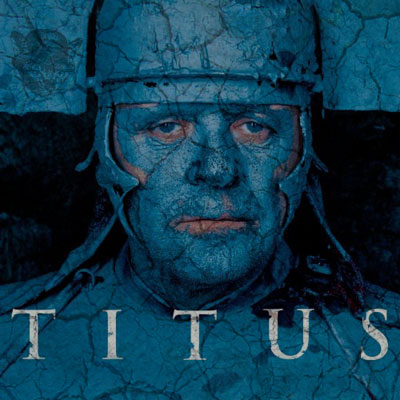
Titus Andronicus…A Shakespearean Bloodbath!

I had never seen it before.  I had never read it before. But I got cheap tickets to see Titus Andronicus Wednesday night at The Philadelphia Shakespeare Theater.

Not knowing anything about it, I took out my Penguin Collected Plays to read the editor’s introduction. Here’s what it said:

Titus Andronicus is a ridiculous play. This gallimaufry of murders, rape, lopped limbs, and heads baked in a pie, lavishly served with the rich purple sauce of rhetoric, may have been to the taste of the Elizabethans, but what is one to make of it to-day?”

Another comment I saw said to imagine it as if Shakespeare had written Pulp Fiction.

My god, what did I get myself into…all because of the lure of a $10 ticket.

The performance was electrifying. A group of seven actors who were engaging and competent, a dozen or so hand puppets, shadow-puppets, and lots and lots of blood presented what resembled a petite guigonol more than what we think of when we think of a Shakespearean play.

Some say that Hamlet is Shakespeare’s deadliest play, but it pales next to Titus, and the violence here is so much more gratuitous than the violence in the former play. To give you an idea, lying about the stage at the end of the last scene are an evil queen murdered by Titus,  her emperor husband murdered by Titus’ brother,  Titus’ daughter–who Titus kills shockingly by breaking her neck–and Titus himself. Yet the body count doesn’t even begin to describe the depravity.  The queen and emperor are dead, but only after Titus had fed them a pie made with the bones and entrails of the queen’s sons whom Titus has killed. He has slain these two sons because they  had raped his daughter, cut out her tongue, and cut off both her hands.

Had enough?  It is even stranger.  In an earlier scene, Titus is a broken man. His poor daughter sits next to him, unable to speak of or point at her attackers. Her husband has been murdered by the queen as well, and her two brothers (Titus’ sons) have been set up and charged with the crime.  In this particular scene, the queen’s henchman makes a deal with Titus.  He will return the sons to their father in exchange for his hand.  Titus chops off his hand and gives it to the man, who promptly returns with three bell jars, one containing Titus’ hand, the other two containing the heads of his sons.  As the scene ends, Titus leaves the stage with one of the containers that holds his son’s head, his brother (who has found Titus in this pitiful condition) carries the other, and his poor daughter, with no hands of her own, carries the container holding her father’s hand in her mouth. This is perhaps the only pitiful scene in the play because the rest is so “over-the-top” violent that it become cartoonish.  (I tried to count the number of dead, but kept losing track.  Not counting his twenty-one dead sons that Andronicus is returning to the family grave in Rome when the play begins, I come up with 14 corpses, three dismembered limbs and two beheadings. Geeesh!)

Titus Andronicus comes early in Shakespeare’s career. It is his first attempt at tragedy, and he was capitalizing on the Elizabethan penchant for these bloody, revenge tragedies.  And he was learning on the job. There seems to be little of the “interiority” in the characters, that self-awareness that will come later and that makes the characters of Hamlet, Macbeth, and Lear so human, and so tragic.  He is working through the language, the germs of genius are evident, but he has not yet the confidence to take the linguistic leaps that he demonstrates as early as a year later.

As I walked out of the theater, I mentioned to the usher that I couldn’t believe that I was chuckling and smiling after what I had just witnessed.  Maybe there IS something cathartic about it…but I don’t think so. Maybe it was the sheer boldness, the cleverness of the production, the wit of the design.  I don’t know.  I do know it was a very good night of theater and the Philadelphia Shakespeare Theater should be quite proud.

Later, when I got home I discovered that the play had  been made into a film by Julie Taymor, Titus. I vaguely remembered this now.  I guess it will be next on my movie list.  But then that poses a question: Why?

Why, in recent years, has there been a major motion picture by a major director? Why does a small local theater choose to do a Shakespeare play that very few people are aware of?  It had been all but forgotten until the mid-20th century when Peter Brooks famously staged it for the RSC with Vivian Leigh as the put-upon daughter, and then it took on a new life. In recent times, there have been many productions in the UK, in the US, in Japan, productions that emphasize the political…ones that emphasize the family dysfunction.  (Click here for an interesting article on the history of the play’s performances.)

But the question remains: why? Why has it been reborn in our time?

Have we become inured to violence? Completely desensitized?  Or does the extreme violence of the play now reflect our own violent world? Our own shattered realities?  I wonder about my own experience at the performance–the violence of the play was not upsetting or revolting; it was, in fact, silly–and I am a person who for the most part shies away from violence in the films and books that I choose. As I said, the production was cartoonish and even slapstick.  But then what does that say about us?

If  art is supposed to make us think beyond our initial reaction, then my experience with Titus Andronicus was a success.  I can’t get it out of my head.

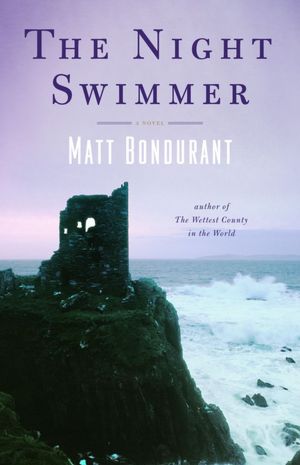
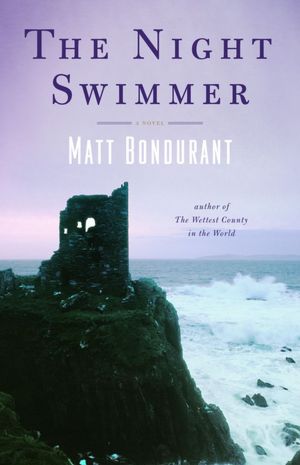
Book Review: The Night Swimmer by Matt Bondurant

A goat that walks on its hind legs…a woman who swims in the dangerously cold North Atlantic…hallucinogenics…two Irish pubs…a violent underworld…a blind goatherd…a dubious fiddler…9/11…an ancient tragedy.  These all are elements that come together in the magnificent novel The Night Swimmer by Matt Bondurant.

I wrote about this novel in an earlier blog; I had only been a few chapters in at the time and was focusing on the urge to live somewhere else. Indeed, the examination of this urge is part of the narrator’s train of thought. But I had no idea where this story was going and how vividly it would be told.

The novel is about an American couple who move to Ireland, when the husband wins a pub in the town of Baltimore in southwestern County Cork. The husband has aspirations of writing and feels that the pub will give him ample time and material to do something great. He certainly has both–but is unable to fashion anything with it.

The woman–the narrator–has an rare skin condition, a subcutaneous level of fat, that allows her to withstand extremely low water temperatures. She is an open sea swimmer and the move to Ireland allows her to revel in this activity, in water that is frigid and dangerous. She spends much of her time on Clear Island, where she swims and begins to attract the attention of the islanders as well as of a little goat that walks upright. The islanders are very suspicious of strangers–blow-ins they call them–and they are particularly concerned about this young woman who swims in their harbor. They are also going through some large shifts that threaten to change their centuries-old way of life.

As Elly, the narrator, spends more and more time on the island, she begins to feel, to a small degree, a part of the island–but she knows that this is a false feeling. She befriends a blind goat-herder and  learns of his heartbreaking personal tragedy, and then discovers a much larger tragedy that once wiped out an entire generation of islanders–except for two. She also begins to see that her marriage is not strong enough to withstand the battering that the move across the ocean occasions. She watches it erode and sadly understands why this is occurring.

The novel is many things–it is a domestic novel about marriage infused with a magical realism built on folk lore and village life.  It is a novel about enterprise and failure. About love and its withdraw. About the fear of strangers and the resistance to change. Elly attempts twice to swim to Fastnet Island–something no one has actually ever done–and in describing this momentous feat, Bondurant elevates his already lofty writing into something sublime.  Neither attempt is successful, but both are certainly memorable. In a whirling world of deep open-sea, hallucinogenic visions, and towering inspirations, Elly’s swimming anchors this already magnificent read.

Because of the epigraphs taken from the journals of John Cheever and the various allusions to him and his stories throughout The Night Swimmer, there have been the expected comparisons between the two. I find this a little wrong. For while the epigraphs from Cheever’s journals are appropriate and thoughtful,  and the thematic focus on dualities similar to that in Cheever’s own stories, the writing of The Night Swimmer seems so much fuller, fatter, more exuberant.  Cheever’s writing, for me, reflects the dessicated suburbias that he depicts, and reflects it in a much leaner style of writing.

In many ways I wish that the novel ended one chapter before it did. There is an epilogue of sorts, a tying-up of things, that I found unsatisfying. I would have rather left Elly on Clear Island, with both her and the reader trying to figure out the impact of what just happened, of where the future lies.

Midnight on Revolutionary Road in Paris, County Cork

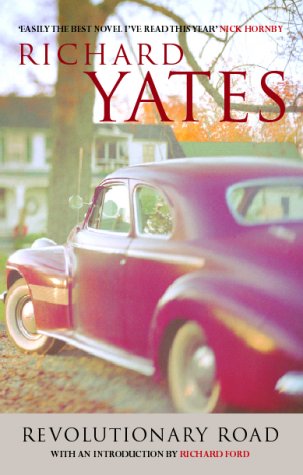
I am reading a book, The Night Swimmer by Matt Bondurant, where early in the novel, a young, successful couple have these yearnings to chuck it all and to move to Ireland.  They are intelligent and aware of the commonness of this trope–they intentionally nickname their street “Revolutionary Road” after the Richard Yates’ novel.  Earlier, before the dream of starting afresh in Ireland, the couple had wished to live in the time period when the novel Revolutionary Road takes place–a Cheever-esque world where pitchers of martinis and pyramids of cigarettes punctuated each evening. That glamorous “Mad-Men” world had not work out for them, but the dream of emigrating does: the husband wins a pub in County Cork, Ireland.  Needless to say, the paradise/excitement/vigor of the new life they imagined in this other world does not pan out they way it had in their dreams.  And like in Richard Yates’ novel, the marriage suffers more than greatly.

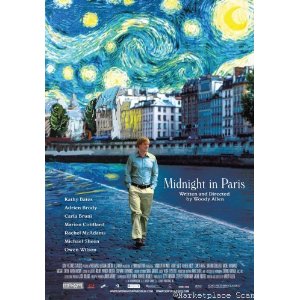
What is it about us that makes us often wish we were in some other place, some other time?  In Midnight in Paris,  Woody Allen wrestles with this question. The protagonist wishes he lived in 1920s Paris, but the 1920s woman he meets wishes she lived in the Paris of the 1890s?  And in fact, the life he is already experiencing in 2011 turns out to be full of promise. Why is this nostalgia for a world other than our own,  for an imagined place and an imagined time, so strong?  Is it  general among everyone?  Or only with a certain type of person?

I walked out to get a coffee today and on my walk home I cut down an alley.  Looking around me, I realized that I could have been walking in any foreign city with any foreign adventure around the corner.  I could have been in Paris, in Cork, but I was merely a short stroll from my own house. I took a picture with my phone.  The concept of a more exotic, romantic other place is just a whiff of smoke–it is always around us if we keep our eyes open.

Now it is often said that one doesn’t appreciated one’s home until one is separated from it. Joyce gave us a loving, photographic picture of Dublin, but only when he was writing in Switzerland and Paris.  Beckett too gives us an unnamed but undoubtedly Irish landscape in his novels and several of his plays and he too was across the sea.  But that is different than romanticizing a place one wishes for, a place that does not exist.  What Joyce and Beckett do is understand what they had left, see it without the distortion of being so close within. This is not the same as dream-manufacturing, as imagining a better world through the kaleidoscope of nostalgia and generalities.

Nevertheless, there are still many days when I wish I was somewhere else, when I don’t appreciate the vitality of the world around me. But in these daydreams, it seems that I am never working, that there is no concern about putting food on the table or where the next dollar is coming from–who wouldn’t find that attractive. And that’s what makes it all somewhat of a sham.

Central Park in Spring…Poetry in April

Went up to NYC for two days. The weather was glorious. Bright sunny skies and comfortable 70-degree weather. Central Park was bustling–workers extending their lunches, children climbing rocks, skateboarders, bikers, and roller-bladers whizzing around. There were even some early sun-bathers stripped down to the bare essentials. Good energy all around–New York at its finest.

The reason I went up to New York was to attend the 10th annual “Poetry and Creative Mind” gala held at the Alice Tulley Hall at Lincoln Center on Thursday night.  Sponsored by the Academy of American Poets, the gala celebrates National Poetry month by presenting various writers, directors, and personalities to read two or three poems of their choosing.  Simply, the night was fun. The presenters were relaxed and entertaining, and the audience was appreciative and receptive.

The readers were Meryl Streep, Brook Shields, Diana Reeves, Colum McCann, Chip Kidd, Bill Keller, Terrence Howard, John Wesley Harding, Claire Danes and Tom Brokow.

Chip Kidd (Master of Ceremonies) dressed in an extraordinary red-and-white striped suit jacket, Kidd was humorous and quick. He handled a small mishap very well when he introduced out-going Academy president Tree Svenson who reached the podium and had to leave stage to retrieve the speech she had forgotten.  He also performed a skit based on his assertion that all Emily Dickinson poems can be sung to the tune of the “Yellow Road of Texas,” “Gilligan’s Island,” and the 1970 theme song for Pepsi.

Colum McCann. McCann’s National Book Award winning novel, Let the Great World Spin was a dramatic, emotional,  exciting portrait of New York City in 1974.  (see and hear McCann talk about the novel here: http://www.amazon.com/Let-Great-World-Spin-Novel/dp/0812973992/ref=sr_1_1?s=books&ie=UTF8&qid=1333815282&sr=1-1).

McCann recited “The Road Not Taken.” He said that instead of gifts for Christmas, he asks his children to memorize a poem and gave us one that he had asked them to memorize. It was “A Meeting” by Wendell Berry and dedicated to Frank McCourt. His poems all tended to celebrate “the road not taken.” They included Rukeyser’s “Then I saw What the Calling Was” and Amy Clampitt’s “Blueberrying in August.” He ended with the very powerful poem by Nikky Finney called “I Have Been Somewhere.”

Claire Danes, the actress, recited e.e. cummings’ “if up’s the word.”  The poem had been read at her wedding.  She then read  Frank O’Hara’s “Having a Coke with you.”  It was new to me–although I inherited O’Hara’s completed poems from my uncle–and it was such a wonderful love poem. Here it is:

“Having a Coke with You” by Frank O’Hara

Having a Coke with you
is even more fun than going to San Sebastian, Irún, Hendaye, Biarritz, Bayonne
or being sick to my stomach on the Travesera de Gracia in Barcelona
partly because in your orange shirt you look like a better happier St. Sebastian
partly because of my love for you, partly because of your love for yoghurt
partly because of the fluorescent orange tulips around the birches
partly because of the secrecy our smiles take on before people and statuary
it is hard to believe when I’m with you that there can be anything as still
as solemn as unpleasantly definitive as statuary when right in front of it
in the warm New York 4 o’clock light we are drifting back and forth
between each other like a tree breathing through its spectacles

and the portrait show seems to have no faces in it at all, just paint
you suddenly wonder why in the world anyone ever did them

I look
at you and I would rather look at you than all the portraits in the world
except possibly for the Polish Rider occasionally and anyway it’s in the Frick
which thank heavens you haven’t gone to yet so we can go together the first time
and the fact that you move so beautifully more or less takes care of Futurism
just as at home I never think of the Nude Descending a Staircase or
at a rehearsal a single drawing of Leonardo or Michelangelo that used to wow me
and what good does all the research of the Impressionists do them
when they never got the right person to stand near the tree when the sun sank
or for that matter Marino Marini when he didn’t pick the rider as carefully
as the horse

it seems they were all cheated of some marvelous experience
which is not going to go wasted on me which is why I am telling you about it.

John Wesley Harding –John Wesley Harding is the stage, folk-singing name of the writer, Wesley Stace. As Wesley Stace he read Thomas Wyatt’s  “They Flee from Me”  which he calls the greatest poem ever written. (I’m not sure I agree). For his second poem, he brought out his guitar and sang the poem, “The Examiners”–which is on his latest album.   He had seen it in a contest in the Times Literary Supplement and was immediately struck by it.  As he noted, the poem may have come in 3rd in the contest, but “numbers 1 and 2 weren’t being played on the stage at Lincoln Center.” Here he is singing “The Examiners”:

Terence Howard, the stage and screen actor, seemed the less comfortable of them all. He haltingly read Stanley Kunitz’s “The Layers,”  but then hit his mark with Rod McKuen’s “Gifts from the Sea.”  It was moving and lovely.  And to me a surprise.

Brooke Shields gave perhaps the best performance of all.  She first read “The Spoilsport”  by Robert Graves, then the very funny “Nostalgia” by Billy Collins and then Howard Nemerov’s “To David, About His Education.” Her delivery was relaxed and humorous and each of the poems themselves were both light and thoughtful.

Bill Keller said that the only reason he had been invited to read was that he had written a NYTimes article in which he said that Congress would be a much better governing organization if they read more poetry. (He said that maybe that would be better than the “Congressional prayer breakfasts” that so many like to boast about.) He cited the late Adrian Rich who once said that “poetry was the perfect antidote to moral certainty” and felt that that was something sorely need in present day Washington. He read three love poems, one each by Brad Leithauser, Kay Ryan, and Frederick Seidel. He ended with Stephen Dunn’s “Our Parents.”

Dianne Reeves. The great jazz singer showed that she can also sing the blues. In the middle of  the Gwendolyn Brooks “Queen of the Blues,” she sang the middle verses in  throaty, bluesy voice that wound back into the poem gently into the poem. It was the high point of the evening. She also read a humorous one about a woman’s hips and another about language and grammar by Kenneth Koch in which the elements of a sentence vowed their love ”until the destruction of language”

Tom Brokaw. Affable and charming, surprisingly his remarks fell flat and his poetry selections were not that memorable. He joked about having been placed between Reeves and Streep. Affable enough, but not that great a performance.

Meryl Streep is always regal, even when she is casual and comfortable. She read W.H. Auden “As I walked out one evening” and then Bishop’s “At the Fishhouses”–she flubbed her lines at the end, but the performance was still spell-bounding.  To atone for her slip-up, she then recited a Chinese poem, first in English and then in Chinese.  It seems that she can do anything.

There was a large reception at the end–one could see in through the glass walls and it looked fine and sumptuous–but it was for the performers and the higher-priced ticket holders only.  Instead I walked across the street and had a whisky and replayed the night in my head.

Susan Sontag

I have always been fascinated by Susan Sontag. I envied her seeming crystal-sharp intelligence, her confidence in her opinions, her strength in writing, her omnivorous reading.  While I certainly have not read everything of hers, I have read quite a lot.  Once as a reader for The Franklin Library’s First Editions, I read the galleys of The Volcano Lover, her historical novel about the triangle between Sir William Hamilton, his wife Emma and Lord Nelson. It was the first piece of fiction of hers I had read. Like all of her writing it was intelligent, sharp and incisive.  And it had a truth that can only be found in fiction. Her following novel, In America, was not as satisfying for me–it seemed undone.  Or perhaps overdone, might be a better word, for the brilliant characters and storyline are over-examined and over analyzed as if Henry James were writing the screenplays for MadMan.  The novel is crushed by the intelligence.

However, I have read much of her non-fiction: Against Interpretation and Other Essays (1966),  On Photography (1977),  Illness as Metaphor and AIDS and Its Metaphors (1978 and 1988) and Regarding the Pain of Others (2003). (The Illness as Metaphor book was revamped in 1988 in order to address the scourge that was AIDS in the 1980’s.)  It is this non-fiction, her essays that make her an major figure of the late 20th-century.  It is in these essays that the true brilliance shines. Hers is a hard intelligence, but a very clear intelligence.  Her Against Interpretation gave readers an argument “against what something means” and for “what something is.” It includes insightful–and new–readings of  Sartre, of Beckett, of Bresson, among others.  Illness as Metaphor moves us from the tuberculosis and consumption that affected so many of the 19th century’s literary characters and creators to the cancer that became the overriding metaphor of the twentieth.  On Photography discusses the relatively new art of photography–only since the mid-19th century– in a way that will change how even the most amateur viewer–myself– views photographs again.  And at the beginning of the second Iraq war, I once gave a section of Regarding the Pain of Others to a class of 18-year olds, and it surprised me how well it worked with theml.

A few years ago, I went to the Brooklyn Art Museum to see a photographic exhibit on Sontag by Annie Liebovitz, perhaps America’s most famous and celebrated portraitist at the time. Liebovitz–who had had a decades long romantic relationship with Sontag–captured Sontag’s final years, among family and friends. Many of them were during her final days, during her final battle with cancer. To this day I don’t know if I am more affected by the words Sontag wrote or the images of her that I saw that day.  Both, suggest an admirable toughness and wit.

What I also don’t know is why today, the NYTimes decided to publish a sampler of Sontag’s work in the Week in Review section of the Sunday paper. There is no anniversary that I know of. It just appeared.  But good, it made for a good read on a Sunday morning, and a good afternoon going through some old books. The excerpts are just that–excerpts–but they show the range, the depth and the honesty of her writing and her mind.  The article is below: enjoy it.

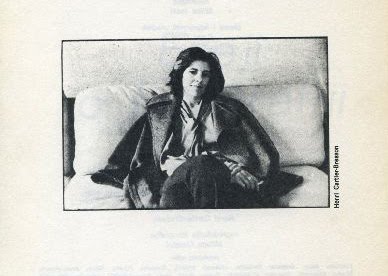
Sontag by Henri Cartier-Bresson

Opinion

A Sontag Sampler

By SUSAN SONTAG
Published: March 31, 2012

Art Is Boring

Schopenhauer ranks boredom with “pain” as one of the twin evils of life. (Pain for have-nots, boredom for haves — it’s a question of affluence.)

People say “it’s boring” — as if that were a final standard of appeal, and no work of art had the right to bore us. But most of the interesting art of our time is boring.

Jasper Johns is boring. Beckett is boring, Robbe-Grillet is boring. Etc. Etc.

Maybe art has to be boring, now. (This doesn’t mean that boring art is necessarily good — obviously.) We should not expect art to entertain or divert anymore. At least, not high art. Boredom is a function of attention. We are learning new modes of attention — say, favoring the ear more than the eye — but so long as we work within the old attention-frame we find X boring … e.g. listening for sense rather than sound (being too message-oriented).

If we become bored, we should ask if we are operating in the right frame of attention. Or — maybe we are operating in one right frame, where we should be operating in two simultaneously, thus halving the load on each (as sense and sound).

On Intelligence

I don’t care about someone being intelligent; any situation between people, when they are really human with each other, produces “intelligence.”

Why I Write

There is no one right way to experience what I’ve written.

I write — and talk — in order to find out what I think.

But that doesn’t mean “I” “really” “think” that. It only means that is my-thought-when-writing (or when- talking). If I’d written another day, or in another conversation, “I” might have “thought” differently.

This is what I meant when I said Thursday evening to that offensive twerp who came up after that panel at MoMA to complain about my attack on [the American playwright Edward] Albee: “I don’t claim my opinions are right,” or “just because I have opinions doesn’t mean I’m right.”

Love and Disease

Being in love (l’amour fou) a pathological variant of loving. Being in love = addiction, obsession, exclusion of others, insatiable demand for presence, paralysis of other interests and activities. A disease of love, a fever (therefore exalting). One “falls” in love. But this is one disease which, if one must have it, is better to have often rather than infrequently. It’s less mad to fall in love often (less inaccurate for there are many wonderful people in the world) than only two or three times in one’s life. Or maybe it’s better always to be in love with several people at any given time.

On Licorice, Bach, Jews and Penknives

Things I like: fires, Venice, tequila, sunsets, babies, silent films, heights, coarse salt, top hats, large long- haired dogs, ship models, cinnamon, goose down quilts, pocket watches, the smell of newly mown grass, linen, Bach, Louis XIII furniture, sushi, microscopes, large rooms, boots, drinking water, maple sugar candy.

Things I dislike: sleeping in an apartment alone, cold weather, couples, football games, swimming, anchovies, mustaches, cats, umbrellas, being photographed, the taste of licorice, washing my hair (or having it washed), wearing a wristwatch, giving a lecture, cigars, writing letters, taking showers, Robert Frost, German food.

Things I like: ivory, sweaters, architectural drawings, urinating, pizza (the Roman bread), staying in hotels, paper clips, the color blue, leather belts, making lists, wagon-lits, paying bills, caves, watching ice-skating, asking questions, taking taxis, Benin art, green apples, office furniture, Jews, eucalyptus trees, penknives, aphorisms, hands.

Things I dislike: television, baked beans, hirsute men, paperback books, standing, card games, dirty or disorderly apartments, flat pillows, being in the sun, Ezra Pound, freckles, violence in movies, having drops put in my eyes, meatloaf, painted nails, suicide, licking envelopes, ketchup, traversins [“bolsters”], nose drops, Coca-Cola, alcoholics, taking photographs.

This material is excerpted and adapted from the forthcoming book “As Consciousness Is Harnessed to Flesh: Journals and Notebooks, 1964-1980,” by Susan Sontag, edited by David Rieff.  A version of this was originally published in the NEW YORK TIMES, April 1, 2012.

Letter-writing, letters, Beckett and love

About five years ago, I traveled to Durban, South Africa.  I flew direct from Washington, D.C. to Johannesburg and then a short flight from Johannesburg to Durban. It is a grueling flight–19 hours in the air and plenty more in airports.  But during the flight, I read volume one of The Letters of Samuel Beckett, 1929-1940.  I must admit I was enthralled–and may be the only person to have read the nearly 900-page collection in one sitting. Nevertheless, three years later I am now reading volume two ( The Letters of Samuel Beckett, 1941-1956).  Certainly there is a touch of the voyeur in reading another’s letters, and, for me, not a little hero-worship in reading the letters of Beckett as he casually mentions Jack Yeats, Sartre, de Beauvoir, Nora Joyce, etc.  (The first letter in this collection is a postcard that he had sent to Joyce, a pre-printed, government regulated correspondence limited to family news because of the war.  Beckett sent the postcard from Paris to the Joyces in Switzerland, saying that he and Suzanne were all right.  He wrote it on January 12, 1941 and it arrived in Switzerland on the 17th. Joyce never received it, however, having died on the 13th, the day after Beckett wrote it. )

Anyway besides the snoopiness and the adolescent-like hero worship, the letters have me thinking of correspondence in general.  Except for writing thank-you notes –a good habit I learned from my father and my uncle–most of my correspondence now is through e-mail. Even the majority of my manuscript submissions are done electronically with the cover letter included in the submission.  Yet there is something about letter writing I miss.

A love letter, or any kind of letter for that matter, is so much more intriguing to receive–and more fulfilling to write–than a text or an e-mail. During a 10-day trip to Paris, I once wrote fourteen letters back home to the love of my life. I can still see the thin hotel stationery, the blue, white and red airmail envelopes, the soft lobby light in the ragged hotel under which I poured out my soul. Today, those letters probably mean more to me than to the person that received them. They capture a unique moment in my life, an amber-encased slice of who I once was.

In that sense,  I take pleasure  in reading  letters that I have written or received in the past–they transport me to where and who I was at the time they were written.

(Perhaps  the most beautiful love story I have ever read is by an Irish novelist named Niall Williams entitled Four Letters of Love.  It is a wonderful novel that revolves around letter writing–as well as around painting, fishing, the Aran Islands, death, heartbreak and redemptive love.)

What about you? Have you  given up on snail-mail completely? I worry about the impermanence of all our correspondence, of the ephemeral nature of e-mail and texting. True, they say that every stroke of your keyboard can ultimately be retrieved and that nothing in cyberspace really disappears, but are the biographers and historians of the future going to have access to these? Is the estate of a future Samuel Beckett going to allow some academic to sift through the computer files –deleted and saved–of the person whose name is entrusted to them?  I cannot say. But I do know the thrill of opening an envelope, of slipping out a hard-stock card, sheets of creamy stationery, or ripped pages of loose-leaf.  Am I simply missing some golden-hazed memory or have we truly lost something special?

E-mail me what you think.  Hah!

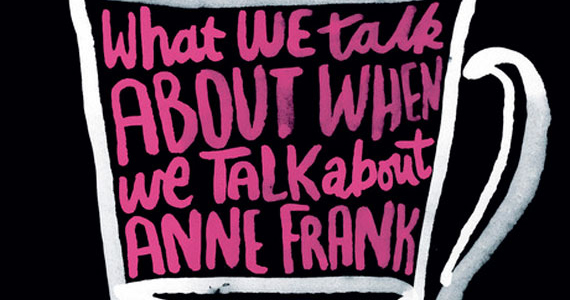
Book Review: What We Talk About When We Talk About Anne Frank by Nathan Englander

  I was prepared not to like this book.  The hype was too much.  I had read a “life-style” piece in the NYTimes Metropolitan section about Englander, an interview with him in The Guardian,  a front page review in the NYTimes Sunday Book Review, another in the London Review of Books, and a handful of smaller reviews. The title and the author seemed to be everywhere.  And yet, I was wrong.  The hype was deserved–the eight stories in the collection are gem-like in their perfection. Solid, thoughtful, inventive, poignant and droll.

The title of the collection famously alludes to Raymond Carver’s story and collection, What We Talk About When We Talk About Love.  In Englander’s title story two couples sit around in a sunny kitchen drinking hard–just as they did in Carver’s story. The difference is that we are not in Carver’s Mid-West; we are in Florida, and Englander’s two couples are a secular Jewish couple who live there and a Hasidic couple from Israel, visiting after many years.  The conversation is tense, the husband uneasy with these Hasidic guests that he has just met, and the ending surprising and sad. (Go here to read Carver’s original story: “What we Talk About… and here to read it as it finally appeared with editor Gordon Lish’s revisions, “What We Talk About…”)

Several of the reviews I read mentioned how Englander’s stories seem to channel Kafka through Woody Allen, and the example they site is the story “Peep Show.” In fact, this Kafka/Woody Allen connection is what drew me to the collection.  In this particular story, a secular Jewish man walks into a peep show, advertising “live girls” and gets 5 tokens. Inserting the first token, he encounters several women, one of whom particularly arouses him. After the partition closes, he deposits another token, but this time, when the barrier opens, it reveals three rabbis from his past who begin to scold him; subsequent tokens reveal his scolding mother, his pregnant wife, and himself.

There are other stories that touch have a similar absurdity and wryness–particularly one about a gang of Long Island Jewish boys dismally failing to wreak revenge on an anti-Semitic bully and another about a summer camp for senior citizens–but overall this is not the tone of the collection. The final story “Free Fruit for Young Widows” and the second story “Sister Hills”  are memorable and distinct vignettes of life in Jerusalem.  Both have a historical sweep and a personal sadness. Both are extraordinary.

“The Reader” and “Everything I Know About My Family on My Mother’s Side” seem the most personal of the collection, and they too are brilliant. The language in these–as in all the stories–is clean and efficient, but beautiful and evocative.

As I said, I was a little put off by all the hype. But it was well deserved.  These are stories that will stay with me for a while and which I will return to often.