Sylvia Plath
“[Sylvia Plath was] a poet with hair worthy of a Breck commercial and the incisive observational powers of a female surgeon cutting out her own heart.”
Patti Smith on Sylvia Plath
“[Sylvia Plath was] a poet with hair worthy of a Breck commercial and the incisive observational powers of a female surgeon cutting out her own heart.”
Patti Smith on Sylvia Plath
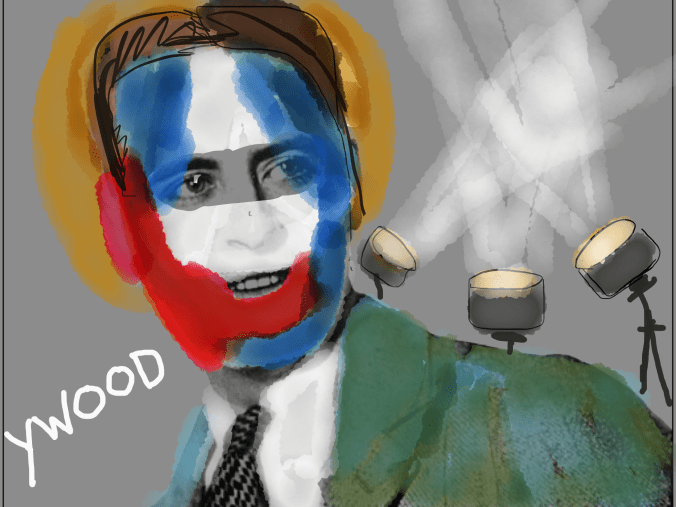
“American Dreamer” 2016 by jpbohannon
In the May 17th issue of The London Review of Books, the historian Michael Wood asked this question about two current jazz biopics–Miles Ahead and Born to be Blue:
“Why can’t we see early success as anything other than a burden?”
While he was talking about Miles Davis and Chet Baker, the subjects of the two films he was reviewing, there are scores of others to whom we can reference.
And probably no greater example is that of F. Scott Fitzgerald.
Always with high ambitions, Fitzgerald burst onto and into the literary scene in 1920 when he was merely 23 years old with his debut novel, This Side of Paradise. The first printing sold out in three days, but more importantly it allowed him to marry Zelda Sayer–who a year earlier had broken off their engagement when she considered he couldn’t support her in the style she was used to. They married a week after publication.
The Fitzgeralds’s fame was as pyrotechnic as the ‘twenties themselves. More than the fact that Fitzgerald’s stories were regularly appearing in the Saturday Evening Post and Collier’s (and were providing Scott with a very handsome income), their lives were the stuff of tabloids and gossip, of excess and extravagance.
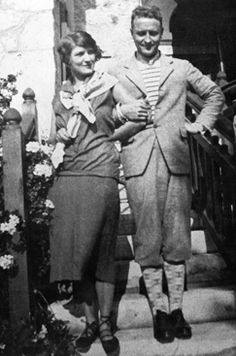
Scott and Zelda on the French Riviera/gettyimages
He was the King of “the Jazz Age” (a term that he coined) and Zelda was the Queen of the Flappers. Their escapades in New York, in Paris, in Rome, in the South of France were the stuff of legend. They burned brightly and largely.
In deed and in myth, the Fitzgeralds put the “roaring” into the “Roarin’ Twenties.”
But then like the decade itself, it all came to a crashing halt. Each of Fitzgerald’s subsequent novels were less and less successful. The Great Gatsby garnered little critical or commercial attention and Tender is the Night even less so. Beset by financial problems–exacerbated by his alcoholism, deteriorating health, and Zelda’s mental instability–Fitzgerald focused on writing “commercial stories” for the drying-up magazine market. Ultimately he headed to Hollywood, contracted to write screenplays for MGM.
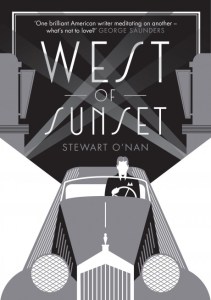
Cover of Stewart O’Nan’s West of Sunset
And it is here, just as he is about to leave for the West Coast, that Stewart O’Nan picks him up in West of Sunset, a poignant re-telling of Fitzgerald’s last three years.
It would not be a spoiler to say that the main character–F.Scott Fitzgerald–dies in the end. At 44 years of age. Nor to say that Dorothy Parker has the best lines (e.g. “She’s slept with everyone in Hollywood except Lassie.”) This is all common knowledge or is expected by anyone slightly aware of the literary world of the 20s and 30s.
But what is not commonly realized or considered or witnessed is the emotional pain, the loss of confidence and the genuine anguish that Fitzgerald suffered in those final three years of his life. This we glean from reading West of Sunset. In O’Nan’s novel we see a Fitzgerald struggling financially–his wife’s sanitarium fees and his daughter’s tuition are constants–as well as struggling with the seeming inanity of Hollywood productions and his own demons. Getting a “screen-credit” is essential and far too often projects are cancelled, rewritten beyond recognition, or given to another writer–writers that a once confident Fitzgerald had looked down upon at the height of his career. (Ultimately, he ended up with only one screen credit.)
At first, I felt that O’Nan was taking the easy road. Characters such as Hemingway and Bogart, both who enter the story early–are overlarge and don’t need much development. But they get it anyway. Bogart proves to be a good friend though an enabler to Fitzgerald’s alcoholism. (Despite Fitzgerald’s having split Bogart’s lip in a fight long before the book begins.) And Hemingway, enters the story early, asks a favor of Fitzgerald, and disappears, though never quite gone from Fitzgerald’s mind. We see the struggling and “washed-up” Fitzgerald, often wondering about Hemingway’s reaction to something he did or did not, to his successes and his screw-ups. The Hemingways and Bogarts, the Shirley Temples and Joan Crawfords, the Selzniks, Mankiewiczes, and Mayers, they are all extras, mere shades flitting by as Fitzgerald battles against the currents of rejection, failure, physical weakness and his past. Even Sheilah Graham, the strongest and most able of those around him, could not get close enough to save him from himself.
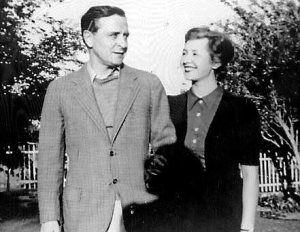
F. Scott Fitzgerald and Sheilah Graham/Princeton University Library
I anticipated –and enjoyed–the Hollywood gossip and the “inside” view of the golden days of the big studios, but what O’Nan has done so well in West of Sunset was to capture Fitzgerald as he struggled to deal with his wife Zelda’s madness, his daughter’s growing independence, his love affair with Sheilah Graham, and his debilitating alcoholism. (It seems every time that Fitzgerald leaves Hollywood to visit Zelda back East, he returns either sick or beaten-up as a result of his excesses.)
In the end, the novel is not solely about a famous American artist who burned out and died early. That story is almost hackneyed. (Take your pick, David Foster Wallace, Robert Bolaño, John Kennedy Toole. The list goes on for much too long.) Instead, it is a moving portrait of a man, a talented man, trying to keep his head above water while the world–and the fading hope of the American Dream– keeps dragging him under.
At times, O’Nan’s prose is evocative of Fitzgerald at his very best. The keen observations, the golden descriptions, the accurate judgement is richly reminiscent of Fitzgerald’s writing. But O’Nan is no mere parodist, and West of Sunset is not a pastische. It is a wonderful novel–it would have been wonderful even if we didn’t know the protagonist so well. As the writer George Saunders described the book, it is “one brilliant American writer meditating on another.” And that is very true. O’Nan’s West of Sunset is intelligent, imaginative and thought-provoking. It is a novel that echoes in one’s mind over and over again.
• • • • • • •
This spring I have thought a lot about F. Scott Fitzgerald. I have taught Gatsby in three separate courses, I have read Fitzgerald’s notebooks written during the last years of his life, and I have read Stewart O’Nan’s West of Sunset. (This all sounds more deliberate than it actually was–more coincidence than good planning.)
So much has Fitzgerald and Zelda and Sheila Graham, and Gatsby and Daisy and Nick Carraway been on my mind these days, that I have come to see our spring itself as a mirror of Fitzgerald’s career. Spring 2016 started out unseasonably warm in March, with records high temps, middled off in April, and has been abysmally cold and wet through most of May. It has followed the arc of Fitzgerald’s life.
However, the exception is that after his death, both he and his works have skyrocketed in estimation and entered the pantheon of American Literature.
Who knows what this summer will bring.
“Sometimes the best-educated people were those least inclined to take the Nazis seriously, dismissing them as too absurd to last.”
Sarah Bakewell, At the Existential Cafe

“After silence that which comes nearest to expressing the inexpressible is music.”
Aldous Huxley, “The Rest is Silence”
(As cited on BrainPickings)
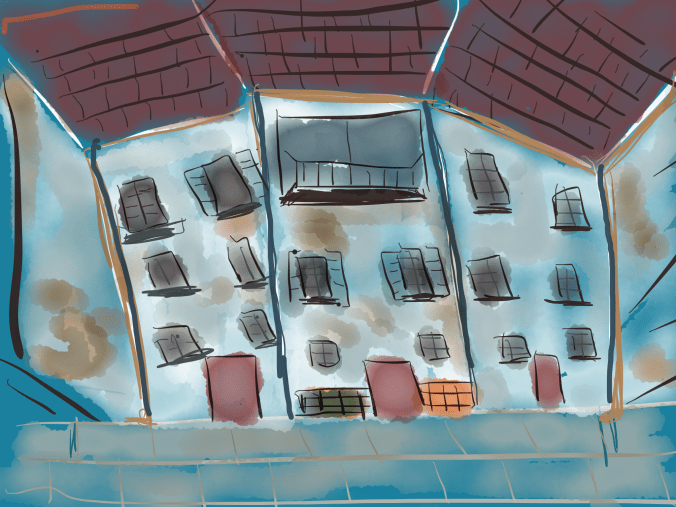
“Cellar Window in the Courtyard” –illustration 2016 by jpbohannon
The English translation of Elena Ferrante’s L’amica geniale has been given the title My Brilliant Friend and for much of the book we believe it to be a reference to Lila Cerullo, the daughter of the shoemaker and the much-admired friend of the narrator Elena Greco (known as Lenù). And indeed, the phrase fits, for Lila is a precociously wise, driven, and independently thinking little girl. (The novel spans the two girls’ lives from six to sixteen.) And yet, much later in the book, when Lila is being fitted for a wedding dress, it is she who utters the phrase, calling the quieter, less assured Lenù “my brilliant friend.” Much to Lenù’s delight.


But close readers come to understand this much earlier in the novel. Through the first two-thirds of the book we are caught up in Lenù’s appreciation, competition, and admiration of her friend Lila. Lenù is telling the story of HER BRILLIANT FRIEND. But gradually we realize that the novel is actually the story of Lenù, the story of her friendship with Lila, and the decisions the SHE ultimately makes not to be dragged down into the social stagnation that is their poor Neapolitan neighborhood. (Lenù is telling us this story as a 60-year old woman living in Turin after Lila’s son has called from Naples to say his mother has disappeared.)
That Lila is brilliant there is no doubt. She excels in grade school–always edging out her friend Lenù and everyone else–and wins the admiration of all the teachers. She is fierce and brave and sure of herself. Meanwhile, Lenù is like most every youngster, tentative, unsure of herself, and uncomfortable in her ever-changing body. Even after Lila has quit schooling at the age of twelve, she continues to learn and tutors Lenù in Latin and in Greek and sharpens Lenu’s mind with logic and politics and philosophy.
And while Lila finally succumbs to the fate circumscribed by the neighborhood courtyard, Lenù knows that her schooling–an “occupation’ that none of her neighbors or friends or family see the value of–is her only way to break beyond the poverty, the dirt, the violence.
And by this point we see that the novel is Lenù’s Icarus moment, her attempt to fly, to soar higher than those before her. We leave her “on the cliff’s edge,” as she begins to realize at Lila’s wedding the cords that the neighborhood could tie her down with. We readers had also hoped that her friend Lila would join her, but she cannot. At least for now.
Elena Ferrante may be the most written about novelist of the past five years. She is reviewed in the mainstream press and in literary journals. She is both critically and popularly acclaimed. And she is “anonymous”–no one knows her true identity. (Despite a mid-March break through, that cited a Florentine history professor who has denied that she is Ferrante.) This mystery certainly has added to her cachet. And has added to the millions of words written about her.
And yet, even if there were no “mystery,” Ferrante would stand out. Her writing is more than masterful–the narrative is a driving, relentless tour of childhood, filled with incisive details–both external and internal–and a realistic understanding of human fears, desires, needs and ambitions. My Brilliant Friend–the first of Ferrante’s four Neapolitan novels–follows the girls from six to sixteen, and captures exquisitely and perfectly, the pain and joy and dread and hopes of young children in a way that is unmatched in my reading.
Yet, like life itself when looking backwards, those ten years that Ferrante chronicles seem to fly by and are finished before we know it…or are ready for it.
I facetiously wrote to a friend that I found My Brilliant Friend “disappointing”: my great disappointment was that the 330-page novel was over so quickly. I wanted it not to end.
I will take a breather…and then begin the second volume.
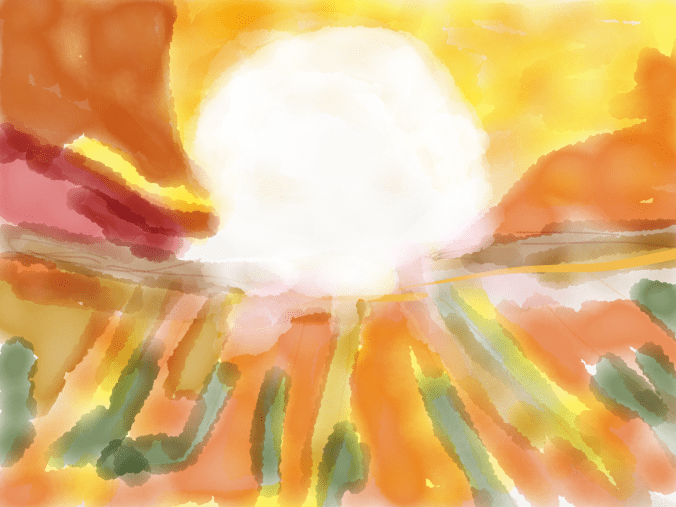
“Easter Morning” illustration 2016 by jpbohannon
“I have always been delighted at the prospect of a new day, a fresh try, one more start, with perhaps a bit of magic waiting somewhere behind the morning.”
J. B. Priestly
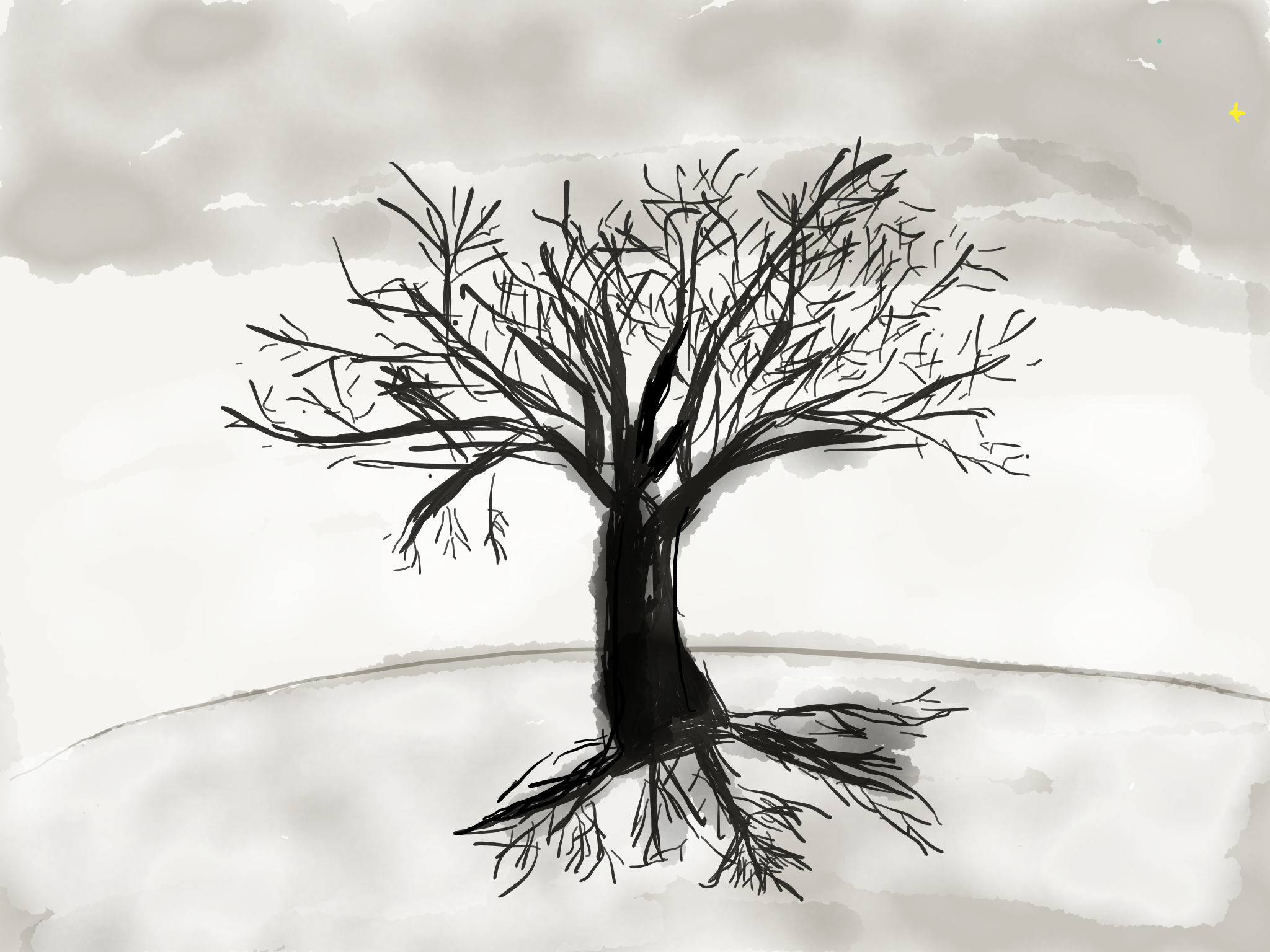
“Elm Tree” illustration 2016 by jpbohannon
“Then the big elm shot up ahead, lying in wait for them at the bend of the road, and he said between his teeth: ‘We can fetch it; I know we can fetch it–‘”
Edith Wharton, Ethan Frome
When things go wrong and will not come right,
Though you do the best you can,
When life looks black as the hour of night –
A pint of plain is your only man.
When money’s tight and hard to get
And your horse has also ran,
When all you have is a heap of debt –
A pint of plain is your only man.
When health is bad and your heart feels strange,
And your face is pale and wan,
When doctors say you need a change,
A pint of plain is your only man.
When food is scarce and your larder bare
And no rashers grease your pan,
When hunger grows as your meals are rare –
A pint of plain is your only man.
In time of trouble and lousey strife,
You have still got a darlin’ plan
You still can turn to a brighter life –
A pint of plain is your only man.
— Flann O’Brien (Brian O’Nolan)
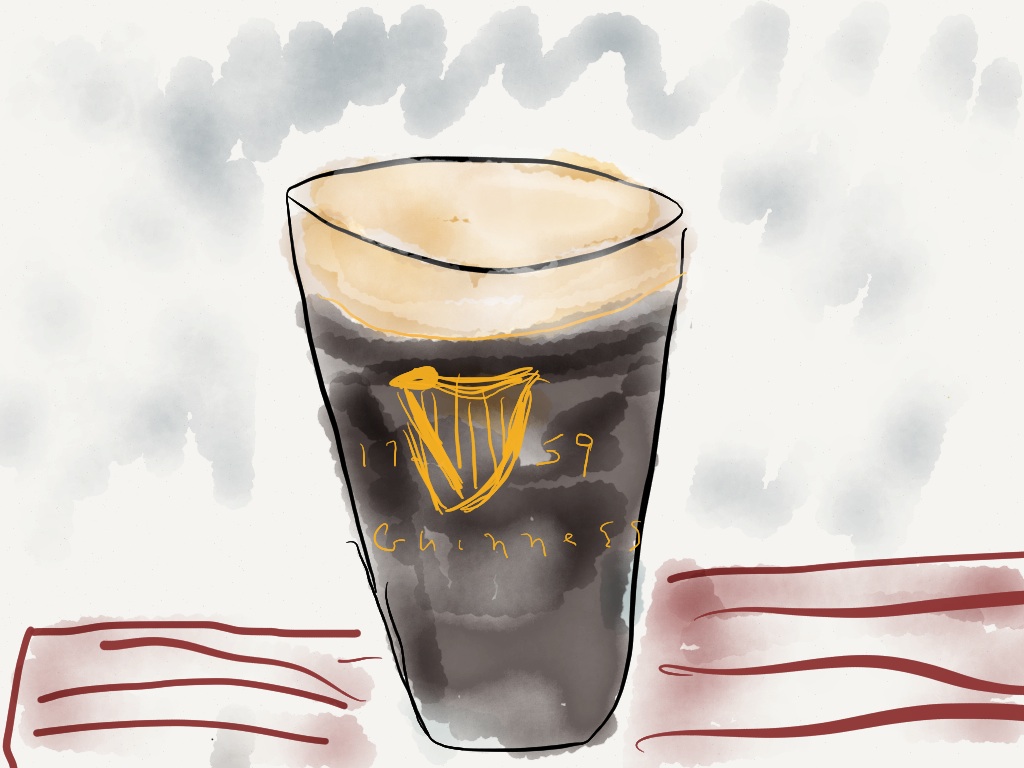
illustration 2014 by jpbohannon
As far as drinking is concerned I am a very simple man. I like my “pint of plain,” a glass of whiskey every so often, and a bottle of wine. That’s about it. I’ve never tasted a margarita or any of its offshoots, the great variety of martinis does not interest me, and anything blended or frozen seems more a dessert than a drink. And if a pint of Guinness is not available, I drink whatever stout is …or a simple lager.
So, I took my trash to the curb last Thursday night, a raw and a frozen night, and afterwards walked the three doors down to the corner taproom. Across the bar, two people were downing shots of a “Fireball.” The woman on my right told me it was a cinnamon flavored whiskey. “It tastes just like Big Red chewing gum,” she said.
Now that’s the problem right there.
I don’t want my whiskey to taste like cinnamon chewing gum. I want my whiskey to taste like whiskey. There are vodkas now that taste like cupcakes and chocolates, and mixed drinks that capture the delights of a sweet shop. I know what is going on. But I’m against it. It’s the infantilization of alcohol and it is a very lucrative business.
So fast forward a few days and I am in another city sitting in the hotel bar. I have no obligations for a good four hours, so I sit in a snug with a good book and a large glass of Jamesons. Life feels very good.
There must be a convention of sorts at the hotel because a number of similar young men come walking in, all at once. I’ll have a “Black and Blue” says the one. Make mine a “Black Apple” says another. The bartender guessed that the “Black and Blue” was a Guinness and Blue-Moon. And he was told that the “Black Apple” was Guinness and Cider. (I later learned that a “Black Apple” is also called a “poor man’s Black Velvet” which is a century-old mix of Guinness and champagne.)
But there was something in me that bristled at their orders. Leave a drink alone, why don’t you, I wanted to say. Why must you always be fussing with it?
Maybe I am getting old. (Actually no “maybe” about it!) And maybe I am getting crotchety. But for me, as the wonderful Flann O’Brien once wrote, “a pint of plain is your only man.”
Here’s Ronnie Drew and the rest of the Dubliners reciting Flann O’Brien’s poem, with pints of plain in their hands:
I was organizing a bit of a celebration of Irish poets for St. Patrick’s Day at my school, and I figured I might contribute by singing a tune or two. Really, I was only going to do an a capella version of “The Auld Triangle”–the wonderful song/poem from Brendan Behan’s play The Hostage.
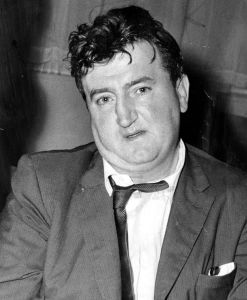
Brendan Behan
When a colleague e-mailed to ask if he could bring a penny whistle to the poetry thing I told him my plans. He wasn’t familiar with the tune, but said he would look it up on YouTube. I don’t know what he found–Luke Kelly’s version with the Dubliners is the first hit–but I went and found this Ceiliuradh (celebration) from 2014 at the Royal Albert Hall.
This video captures everything that should be celebrated about being Irish: it is cross-generational, it revels in its history, it enjoys itself and others. The camaraderie among the players–Donal Lunny, Andy Irvine and Paul Brady (all once members of Planxty), Imelda May, John Sheehan from the Dubliners, Lisa Hannigan, Glen Hansard, Elvis Costello, Conor O’Brien from Villagers–is infectious and joyful. But moreso it is the audience–an audience joyously celebrating its heritage in the “veddy-proper” Royal Albert Hall.
I watched the video three times and became more choked up with each viewing. Happy St. Patrick’s Day–watch the video here.
The Official Web Site of LeAnn Skeen
Grumpy younger old man casts jaded eye on whipper snappers
"Here is my secret. It is very simple: It is only with the heart that one can see rightly; what is essential is invisible to the eye.."- Antoine de Saint Exupéry
Of writing and reading
Photography from Northern Ontario
Musings on poetry, language, perception, numbers, food, and anything else that slips through the cracks.
philo poétique de G à L I B E R
Hand-stitched collage from conked-out stuff.
"Be yourself - everyone else is already taken."
Celebrate Silent Film
Indulge- Travel, Adventure, & New Experiences
Haiku, Poems, Book Reviews & Film Reviews
The blog for Year 13 English students at Cromwell College.
John Self's Shelves
writer, editor
In which a teacher and family guy is still learning ... and writing about it
A Community of Writers
visionary author
3d | fine art | design | life inspiration
Craft tips for writers
 j. p. bohannon