Book Review: The Reader by Bernhard Schlink

Cover of Bernhard Schlink’s book.

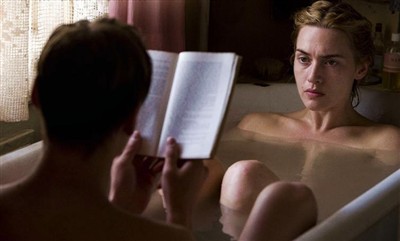
A scene from Stephen Daldry’s film, The Reader

The old question of the book and the movie: Can a film ever do a novel justice?  Or should we look at them as entirely separate works of art and not make the comparison at all?  Just the parameters of a roughly  two hour viewing experience seriously limits what a film maker can do with his source, a source that usually comprises a multi-hour/multi-day experience for a reader.

Certainly there are films that are more successful than others in capturing the essence of a novel. And just as certain there are real travesties. But the successes are such because they capture the spirit of the novel rather than getting lost in trying to relate every detail.  I am thinking of Mike Nichols Catch-22 based on the Joseph Heller novel.  The film works because it perfectly captures the inanity of bureaucracy, the numbness of war, and the black humor of Heller.  It is a large novel, non-linear in its arc, and Nichols captures its essence without getting bogged down in trying to capture every character and sub-plot.

I saw the film The Reader when it was released in 2008 and only got to reading the book in 2012. (I had two friends who refused to see the film because they had loved the novel so much.)  Regardless, it was a compelling film with a maddening and dramatic twist.  A young school boy (Michael) has an affair with a older woman who insists that he reads to her every time before they have sex.  He reads her all the classics–The Odyssey, War and Peace, etc. But she seems oddly aloof, and at the end we realize why. The boy, on the other hand, grows into an unfeeling man, and his coldness and inaction when needed is what is infuriating.

The novel–by its very nature–is quite different. First, it is much more internal, narrated by the boy who often questions and analyzes his own thoughts and his own actions. There are ruminations on the ethical choices made by ordinary citizens during the Holocaust, on the responses of the following generations on the actions of their own mothers and fathers. (These scenes take place in 1966, two decades after the war.) And yet while the narrator weighs, dissects, conjectures about these ethics, his own actions–many years after the war–must also be examined.  His coldness, his lack of human kindness, his decision not to act is all quite similar to that which he condemns in the female guards who are on trial in the second half of the novel.

When Hannah (the older woman) confesses to a crime she did not commit rather than reveal a secret she is much more ashamed of, she is given life imprisonment. Michael has information that could acquit her that he does not reveal.

To me, the ending is insignificant, despite the attempt to redeem Michael. Yes, he does reach out to Hannah, he does realize his own hardness, and he does try to do right.  But it is all too late. I had grown to dislike him so much by then that his redemption was all but impossible for me.

Most of the details of the plot remained the same from  book to  film but the internal voice was missing–or at least adulterated. The novel also starts out quite erotic which simply cannot be captured adequately on film with the same impact–words seem always more intimate and immediate than soft-lit actors and actresses.

The old question of book and movie?  In the case of The Reader, both.  They are two different things, two very good experiences, two separate ways of engaging a reader/viewer.

Music Review: Ray Davies and the Kinks

Girl, you really got me goin’
You got me so I don’t know what I’m doin’

(Go up an octave)

Yeah, you really got me now
You got me so I can’t sleep at night

You’ve really got me, you’ve really got me.

For me the beginning of the Kinks’ song “You’ve Really Got Me” and to a similar degree the opening of their “All Day and All of the Night” represent the early days of British rock more than anything else.  Yes, more than the opening of the Stones’ “Satisfaction,” more than the the iconic opening chord of the Beatles’ “Help” or even the early intros to “I Want to Hold Your Hand”  or “Twist and Shout.”  It just seems more primal, less produced, more rock-and-roll.

Someone once told me that Rock-and-Roll was basically about wanting to “do it,” that jazz was about “doing it” and that country music was about “doing it with the waitress because your wife wrecked your truck and ran off with your dog and your best friend.”  I always liked that definition–encapsulates things very nicely, I think.

Anyway, by those parameters, the Kinks first two hits were pure Rock-and Roll.

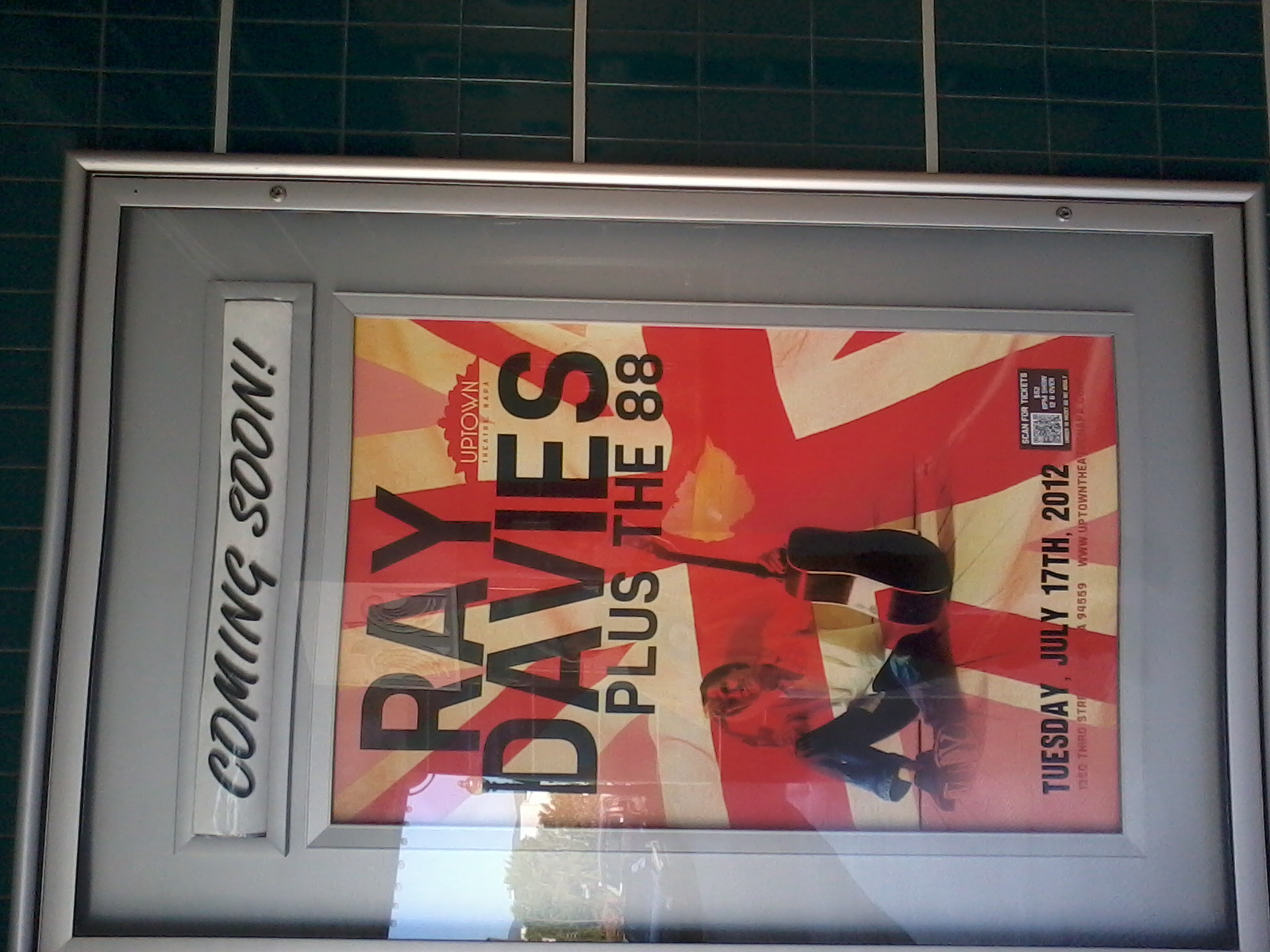
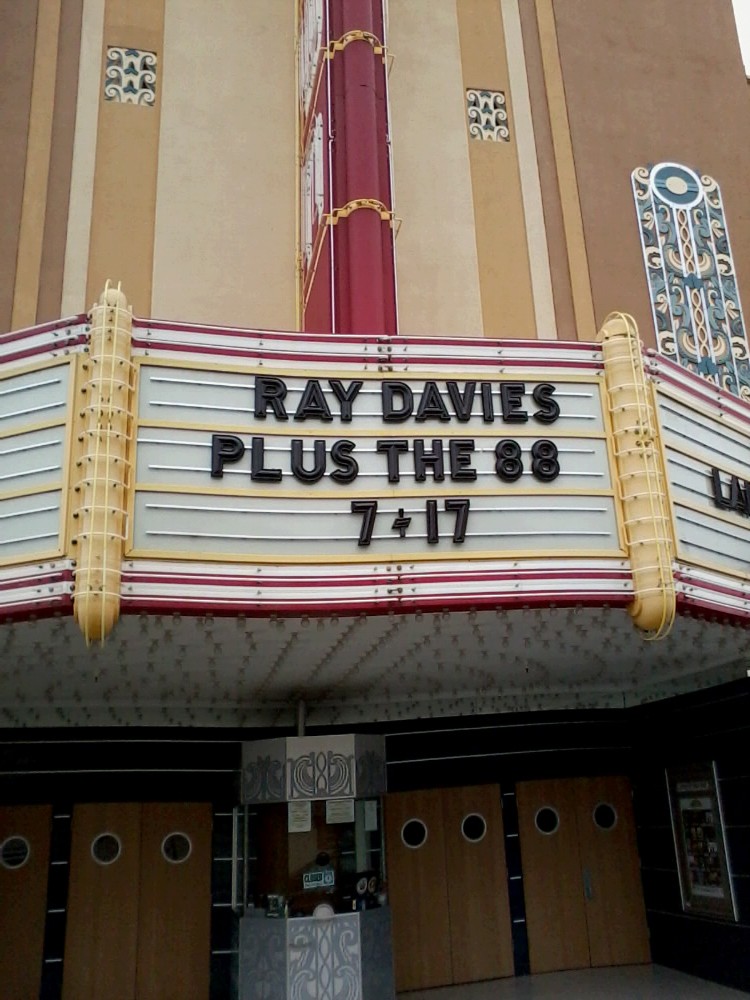
Ray Davies and The 88 at the Uptown Theater in Napa.

I drove into Napa last Friday night from San Francisco and just fifty yards away from where I was staying was the Uptown theater with Ray Davies advertised for Tuesday the 17th.  Didn’t know if I’d make it–had a lot of wine yet to drink and a lot of wineries yet to visit–but go I did.  And I was glad. The opening band The 88 were very good–the front man reminded me a lot of Larry Kirwan from Black 47–and later they acted as Ray Davies back-up band for the second half of Davies’ set.

And then Davies came on.  Nearly 50 years have passed since he and his brother Dave began the Kinks, and the years have taken their toll on his body–he looked thin and haggard and old. (Having experienced a terrible mugging in New Orleans a few years back also took its toll.) In fact often during the show he reminded me of the Bill Nighy character in the film Love Actually. (So much so, that I wonder if the director of the film had Ray Davies in mind when he cast and directed Nighy in the role.)
But his voice and his showmanship were still the same.  If you closed your eyes, no time had passed.  Accompanied by the Irish guitarist, Bill Shanley, and then by The 88, Davies put on a hell of a show with energy that belied his age.
It must be difficult for an artist whose major work is behind him.  Davies is still recording solo, still writing good music, but he is well aware that the majority of his audience wants to hear what he used to do…especially what he used to do with his old band.  He generously mixed many of his old Kinks tunes with newer things from later solo albums–but the majority of the set list  seemed to be the Kinks’ tunes. He introduced his new stuff by asking the audience “to just indulge me for a few minutes.”His new material is good, fine songwriting, fine melodies, but most of the audience wanted the past.
I didn’t write them down, but from the Kinks’ repertoire I know he did at least these titles:
•  Waterloo Sunset
•  Victoria
•  Celluloid Heroes
•  Low Budget
•  Apeman
•  Dedicated Follower of Fashion
•  Twentieth-Century Man
•  Dead-End Street
•  A Sunny Afternoon
•  All Day and All of the Night
•  You Really Got Me
So it was a great night of rock-and-roll, re-creating the sound of one of the seminal bands of the “first British invasion.”  I have always thought the Kinks were grossly underrated–and still do.  After their initial success with rocking tunes, they went on to create beautiful songs that often poked the stereotypical view of the “idyllic English life” in the eye.  They were clever, witty, and fun.  And Ray Davies is still capturing that on stage.
As a treat, here is a video of Ray Davies and the Kinks from a long, long time ago, but a treat nevertheless:

Northern California and Ireland, sea lions and selkies, and a powerful poem

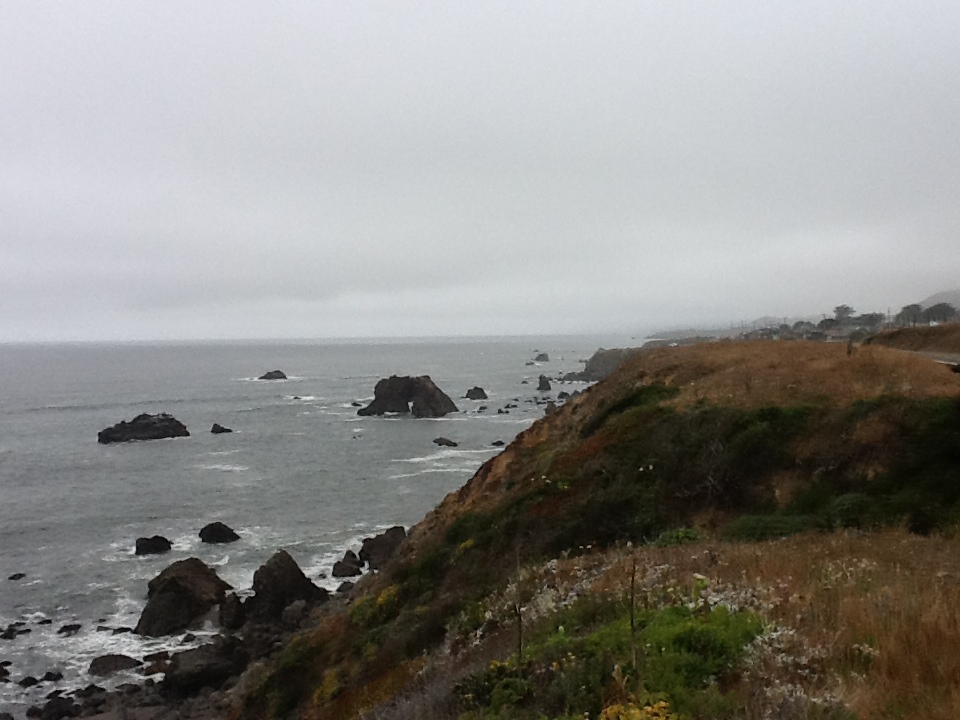
I am not the first to make the comparison between the Pacific Coast Highway in Northern California and Ireland. But that doesn’t make it any less true. It is a magnificent landscape, full of crashing surf and rock-strewn fields, dramatic cliffs and rolling mountains. The hills are more “golden” than green, and the roadways have much fewer sheep and doubledecker tour buses, but yes, it very much reminds me of the west coast of Ireland. Every turn in the corkscrewing highway offers another extraordinary vista.

But it is Goat Beach which is perhaps the most memorable. Goat Beach sits where the Russian River meets the Pacific Ocean. In July the river flow is feeble, but it is then–between March and July–that the area is a breeding ground for sea lions.

By July the sea lions have already pupped and the adult ones seemed quite tired. At first, it is a bit jolting to see twenty to thirty adult sea lions asleep by the rivers edge. It looks as if they have all been slaughtered. But then a fin rises to slap a companion or another waddles to find a more comfortable position. They are just resting–and continue to do so for the rest of the morning.

But the seal pups are another story. Frisky and active, they plunge into the crashing surf of the Pacific or slide into the muddy waters of the Russian River. There is something fascinating about these creatures: their sleekness, their eyes, their movement.

A stamp from the Faroe Islands featuring a selkie emerging from her skin.

Seals and sea lions have long played a part in Norse and Celtic myth.  The legend of the selkie is perhaps one of the most famous and there are a wide variety of stories about them.  These creatures are seals when in the water but humans when they go upon land and emerge from their sealskin. And while there are numerous variants on the stories, there are basically two version of the selkie myth: one female, one male.  The female selkie is often a beautiful woman who is  “captured” by the man who finds her, unable to return to the water because the man has taken possession of her discarded skin.  The male selkie is also renowned  for its beauty and charm when it comes upon land and sheds its skin, and he is often noted for his ability to satisfy the unhappy and dissatisfied women of the area.  Fairly often, these women bear his children, usually children with some sort of “deformity” or oddity about them. These women too are in possession of the creature’s skin.

I can immediately think of two wonderful movies that deal with this myth.  One, is a 2009 film, Ondine, featuring Colin Farrell (and my personal favorite actress Dervla Kirwan from Ballykissangel)  and the other is an older film from 1994 called The Secret of Roan Inish.  Both are well worth finding, however you find your movies these days. And both deal with the female version of the story.

Anyway, so I am reading The Guardian online this winter and I come a cross a video of the Scottish poet Robin Robertson reading his poem “At Roane Head.” It is a powerful poem, and perhaps the most powerful reading I have ever witnessed. In it a woman cares for her four children. Her drunken husband has disowned them–for they have seal-like characteristics as well as human. At the tragic end, the woman returns the seal skin to her lover.

Here is the video.  Give it a view–I find it very powerful.


Movie Review: Savages directed by Oliver Stone

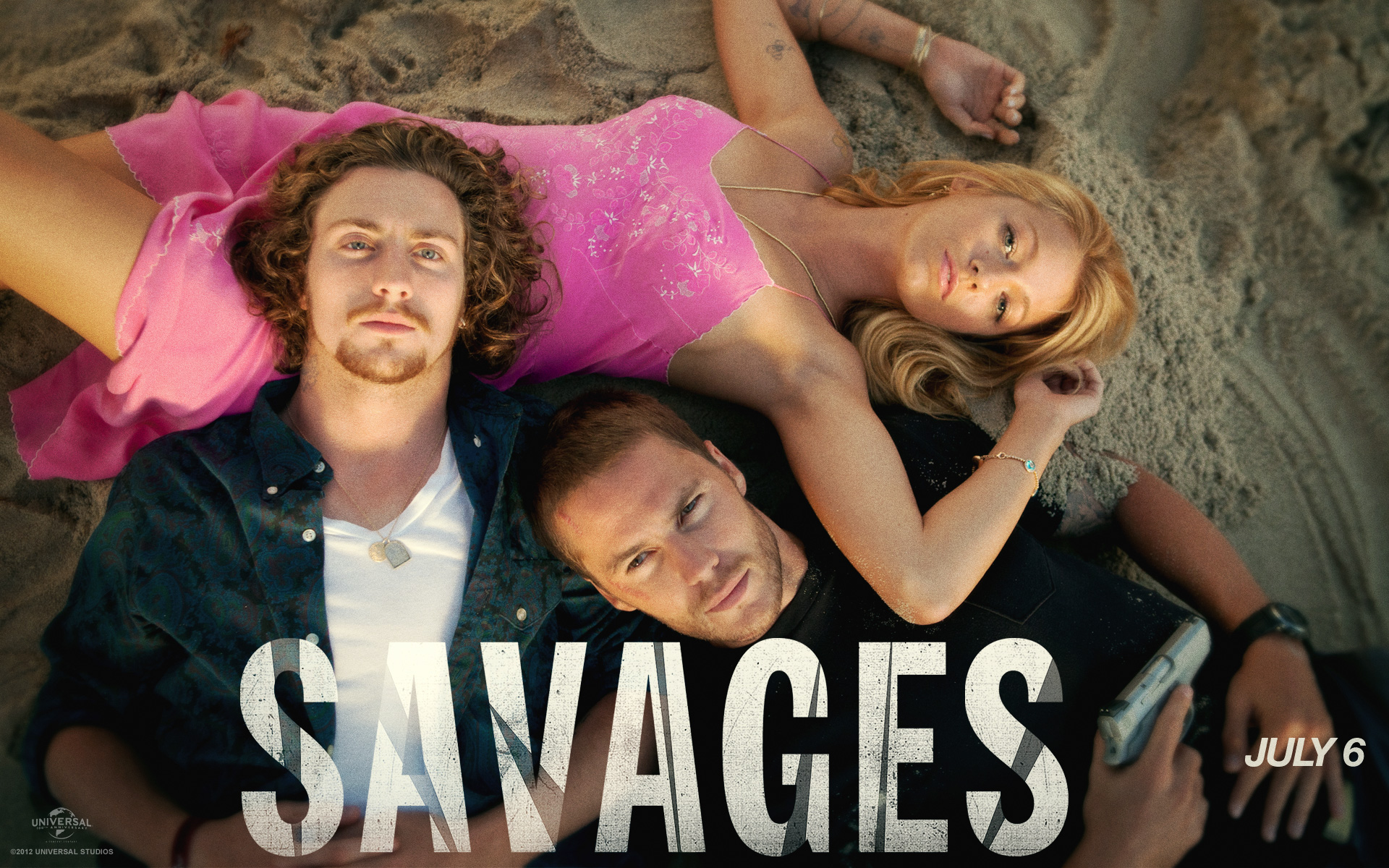
There are three important times when someone refers to someone else as “savages” in Oliver Stone’s film of the same name. The movie begins with a computer/video of a Mexican drug cartel beheading six men. The video has been sent as a warning to a young veteran of the Iraq and Afghanistan wars who with his partner has built an extraordinarily successful pot growing business in Southern California. After he sees the video, he mutters “savages.”

When his idealistic partner returns from global activisim, they have two very different responses to the cartel’s offer. The vet wants to go in hard; the idealistic partner wants to give them everything and get out of the dope industry–they have enough money to last several lifetimes.

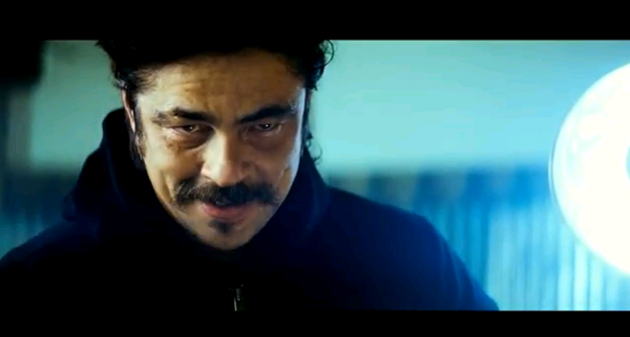
They also share the love and favors of one girl, O (for Ophelia). As the cartel stalks the trio, the cruelest of the Mexican cartel (Benicio Del Toro) notices the sexual arrangement of the three and calls them “savages.”

And finally, while walking on a beach in Indonesia, O notes that they have returned to nature, that they have become “savages.”

So the movie offers three definitions of the word “savage”:

1. utter cruelty
2. perceived perversion
3. stripped of civilization’s “refinements”

One knows what one is getting with an Oliver Stone film. Edgy cutting, great story, conspiracy, violence, magnificent cinematography and award winning performances. From JFK to Platoon to Born on the Fourth of July, his films have also had a political bent, examining modern society–sometimes controversially–with all its warts exposed and its naked emperors revealed.

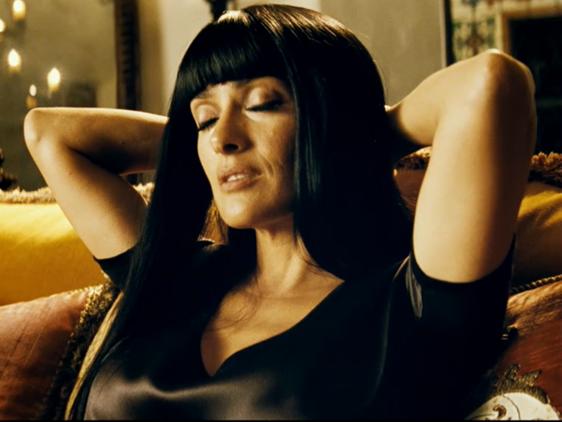
The story, based on the novel by Don Winslow, pits the two independent pot growers Ben and Chon against a powerful Mexican cartel led by Selma Hayek. There are betrayals, murders, kidnappings, and thefts–and there are conversations about love and parenting and trust. There is corrupt law enforcement (what would an Oliver Stone film be without it), horrible violence, and magnificent scenery.

In the end, what we have is an enjoyable film where the loveable “bad guys” have to outwit both the despicable “bad guys” and the corrupted “good guys.” We have seen this before but that doesn’t detract from the film at all. It is a plot that always seems to work for me. In fact, after seeing the film one might make a favorable reference to Butch Cassidy and the Sundance Kid–a film about two other loveable outlaws. Except the comparison is ruined because Ophelia herself makes the analogy early in the film. That is my only complaint–Oliver Stone should be more subtle than that.

A river of wine…and a clueless wine drinker

So we move up from San Francisco to Napa for a series of private parties. The drive into the Napa valley is impressive, acres and acres of vineyards, rigidly straight rows of vines that climb up mountainsides and spread out for as far as one can see.

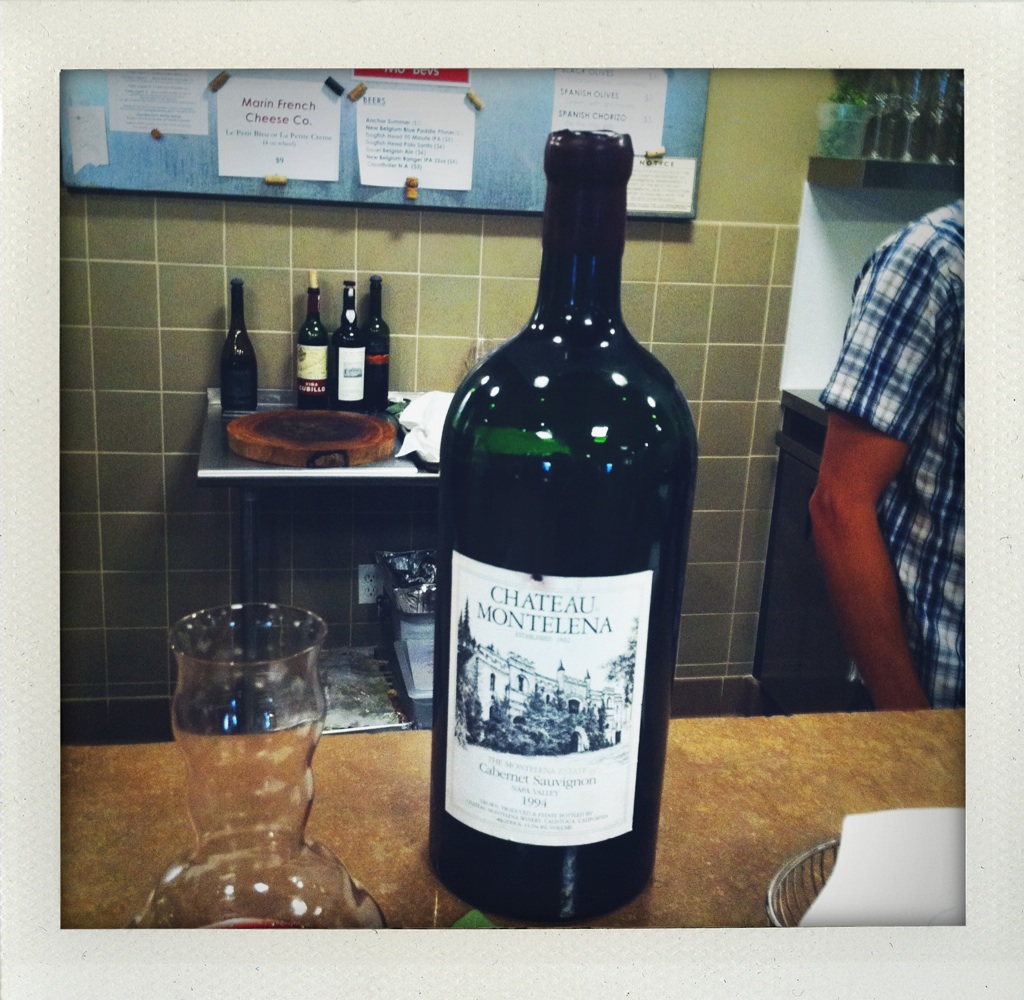
We got there Friday afternoon, in time to go to party number one.  The reception was held in The Backroom, a wine store in the town of Napa proper. It was hosted by Chateau Montelena. If you don’t know Chateau Montelena–and I certainly didn’t until someone pointed it out to me–it is the winery that famously won the blind-taste test against French wines, the “Judgement of Paris,” the first time a Napa wine ever won on the international scale and certainly the first time such a wine had beaten out the French wines. The story is the basis of the movie Bottle Shock, starring a delightfully snooty Alan Rickman.

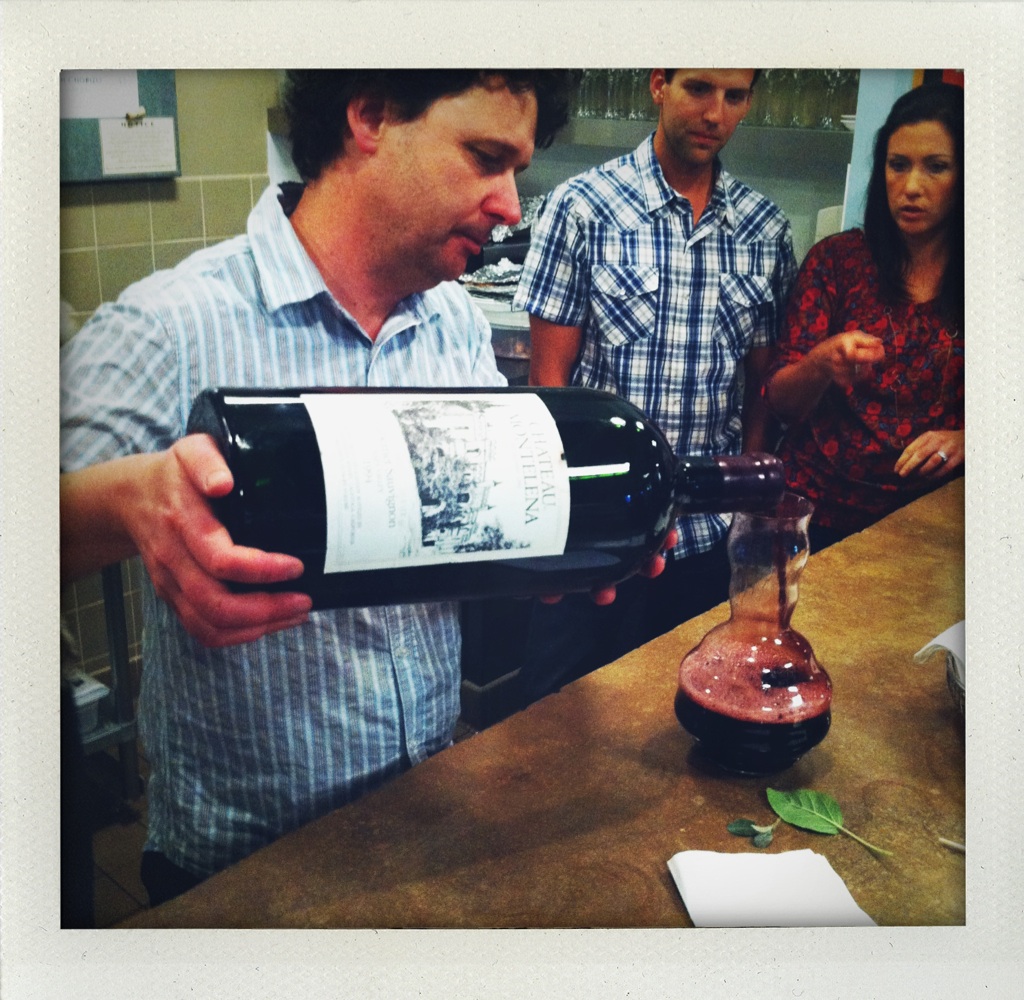
Anyway, a “variety of wines and heavy hors d’ouevres” was what was listed on our invitation, and it ran true to what it said. When we walked in, we were brought to a table and offered a glass of Cabernet Sauvignon which was to be paired with a skewer of mozzarella, basil, and cherry tomatoes. There were seven other tables with rows of various bottles and different foods–steaks, chicken, vegetables, polenta, cheeses, chocolate truffles–and we were to go from one to another for the next four hours. We tasted them all–many of them over and over again.  The night was capped when a jeroboam of the Montelena Reserve was uncorked.

The Jeroboam of Montelena

Giving a jeroboam some visual perspective

The next morning seemed to come very quickly, but we had to get moving, for we were to go to the Detert Family Vineyards–to “Grandma’s house” for a reception.  The Detert vineyards butt up against the Mondavi vineyards, and they provide the Mondavi winery with 75% of their Cabernet Franc crop–retaining the remaining crop for their own estate wines.

We drove up an old dirt road, parked between some olive trees, and then walked behind “Grandma’s House.”  The stone courtyard was set up with white-clothed tables and white umbrellas.  Small pots of lemon trees, pendulous with fruit, ran around the perimeter.  About thirty yards away, a swimming pool looked out over the ascending vineyards. And in the corner of the courtyard, in gleaming array were rows and rows of glasses of sparkling white wine. We grabbed a glass or two, mingled for a while and then walked out into the vineyards with the Detert brothers.  They  explained the nature of the soil, the cultivation of the grapes, and the business side of the winery, in terms simple enough for even the most ignorant of the group (me). But for me  the visuals were the most compelling. About twenty of us were standing between rows of shoulder-high vines, the sun glistening off the white wine in our glasses, and the real world seeming very far away.

When we returned to the courtyard, the table of sparkling white had been replaced with Cabernet Sauvignon and Cabernet Franc (the wine that the Deters are most proud of). Two long tables of food–roast beef, chicken, grilled vegetables, cheeses, breads, fruit–ran along two sides of the courtyard.  I was sure I would never eat and drink again after the night before, but I lied.  Conversation, laughter, food and wine–it is an irresistible combination.

Three hours later we were heading back to our apartment–we had to hurry though, there was another reception in less than an hour.

The reason we are in California at all is that our neighbors in Philadelphia, Rick and Laura, were celebrating their 20th-wedding anniversary and they wanted to share their love of Napa–and wine–with their friends.  Rick is very much a wine connoisseur, and apparently, is fairly well known around the wineries here.  There were several winemakers in attendance–as well as the largesse provided by the wineries at last night and this afternoon’s events. Well this later reception was hosted by them and featured wines from their own stock.  Again a beautiful setting, magnificent hors d’ouvres (to be followed by dinner), and a bottomless supply of wine.

On a table were ten double-magnums of Cabernet, one for each year from 2000 to 2009. The idea was that you were to taste them all–in order–and compare. You could repeat any particular year–many got stuck on the 2003 and 2005 vintages–or you could stay on the one you liked the best, but they encouraged you to try them all. Later in the evening, they brought out a double-magnum of Syrrah and a  double-magnum of a Gold Label Reserve Cabernet that a local winemaker had brought as a gift.

I am too ignorant about wines to distinguish greatly between any of them. I do know that they were all much, much better than what I usually buy at the grocery store.

And so, for a period of twenty-four hours, I have attended three private receptions in the Napa Valley.  I have eaten more than I eat in a week.  And I have drunk a river of wine.

And now, I am headed off to the final planned event of this Napa weekend–a Sunday champagne brunch!

A small whiskey, the Zoetrope Cafe and Francis Ford Coppola

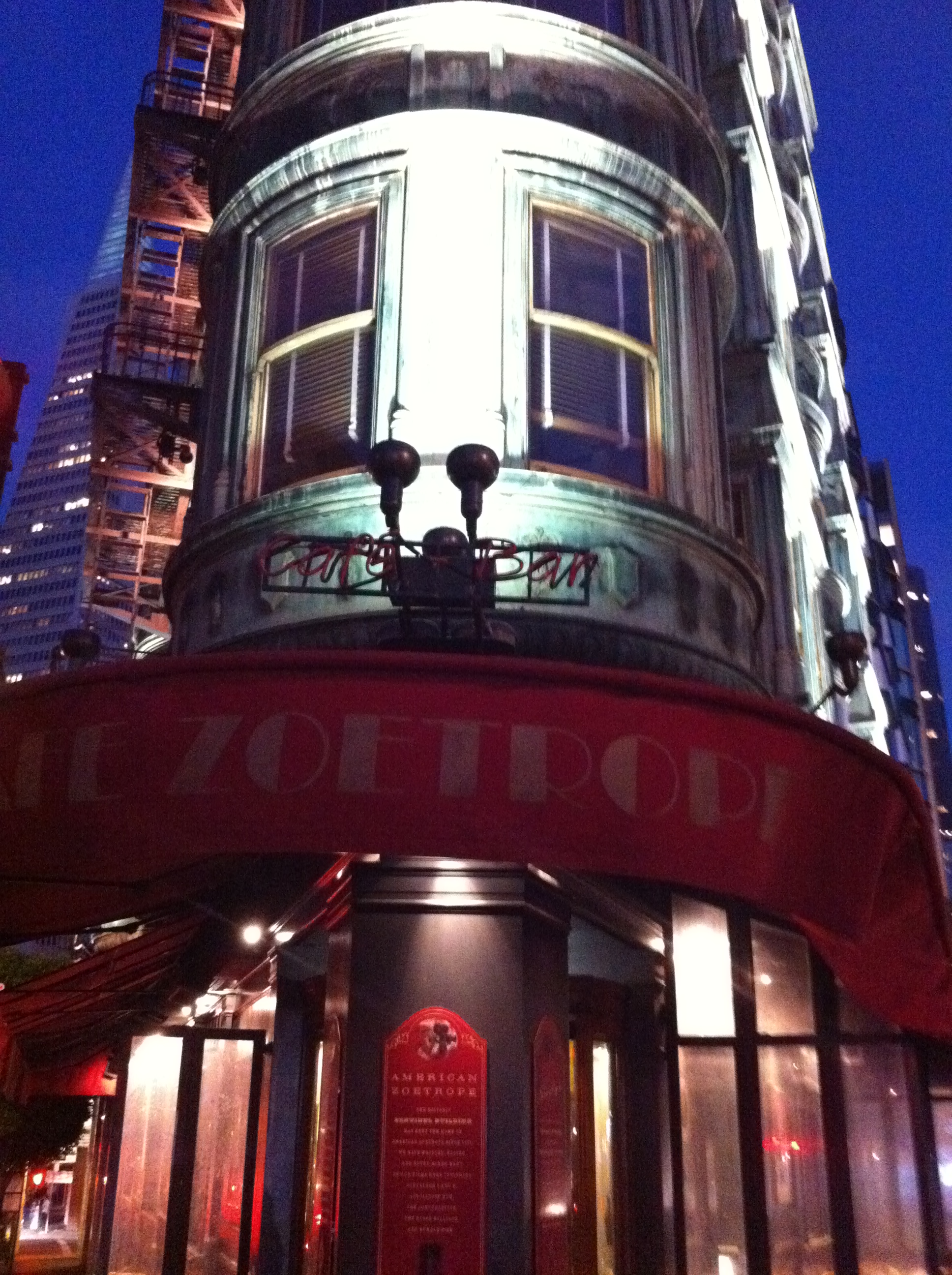
As one travels towards the end of North Beach in San Francisco, just before entering the financial district, there is a distinctive building on the corner of Columbus and Kearney. Its iron sheathing has been oxidized a gentle green color and, in a way, it resembles an ornate version of the Flat Iron Building in New York.

The building houses the offices of Francis Ford Coppola. Aside from the production duties, the writing, and script doctoring, it is here that Coppola does all his film editing–where all the Godfather movies, Apocalypse Now, Dracula and so many others were edited.

It is also where the literary journal Zoetrope: All Story is produced.  The journal presents some of the finest in contemporary fiction and one-act plays and has featured such established writers as David Mamet, Don DeLillo, Andrew Sean Greer,  Margaret Atwood, Salman Rushdie, Woody Allen,  Neil Jordan, and Haruki Murakami. (Full disclosure: I had submitted once when the magazine first started up, not realizing I was so far out of my depth.)

And on the bottom floor is the Zoetrope Cafe, an Italian bistro, featuring an Old World menu and, not surprisingly, a large selection of Coppola wines.

So last night, we stopped in for a nightcap. 

I noticed what I wanted on the shelf immediately. The whiskey was poured into the most unusual bar glass I’ve ever seen. It was more like a “petri-dish” than a drink glass, about an inch and a half-tall and 4 inches wide.  We asked if the barkeep had ever met Coppola, and she said she did for the first time that day. He told her to call him “Francis” which she said she was still a bit uncomfortable yet to do.

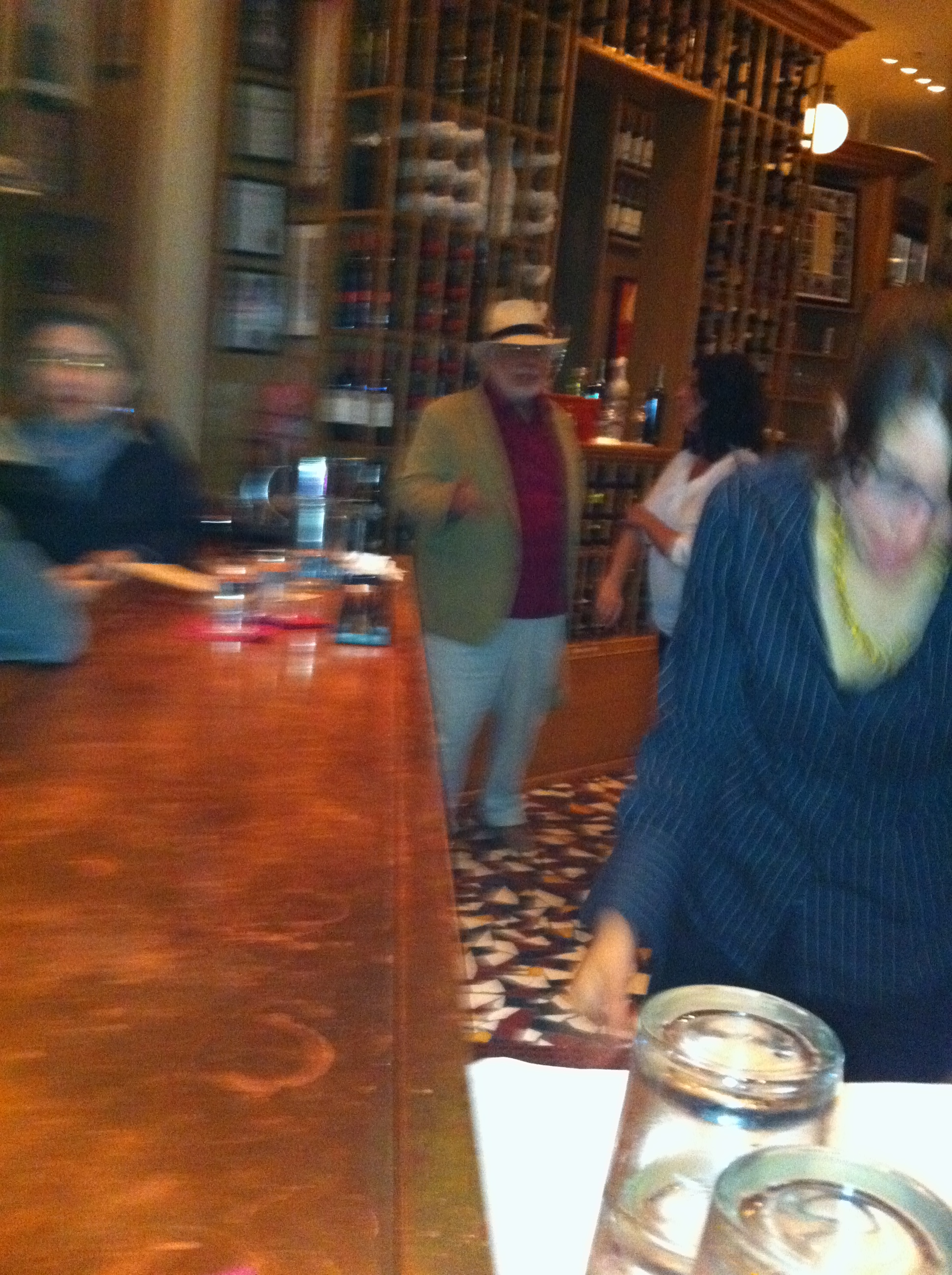
There were copies of Zoetrope in a corner so we brought a couple to the bar and began leafing through them when the bartender came back and with a jerk of her head whispered, “There he is.”  Coppola was chatting with the hostess, looking as if he was going over the wine stock.  About fifteen minutes later, he called to his wife who had been sitting in the corner next to us and they left the cafe, getting into an ordinary SUV.

I had seen the poet Lawrence Ferlinghetti the day before and now Francis Ford Coppola this night, and there was so much I would have liked to ask them both.  But their celebrity is mostly in our minds only–their audience.  They, themselves, must go through their days and nights much like you and I, and the intrusion of strangers certainly must be tiresome. At the same time, it is also good to see these literary/cultural lions in their daily routine–to see them simply as working men, no different than the rest of us.

Still, I would have loved to have bought another whiskey, offered each a drink, and listened to what they had to say.

Francis Ford Coppola, July 12,2012, Zoetrope Cafe

City Lights, Vesuvio Bar and sighting Lawrence Ferlinghetti

I had the chance to be across the country and in San Francisco for a few days this week, and I immediately went to City Lights Books in the North Beach section of the city.  If not the most famous bookstore in America, it is certainly one of them.

City Lights was founded by Peter D. Martin and named after the politico/literary magazine he had founded named City Lights in 1953. It was the very first paperback book store in the United States. As he was hanging the sign on the store at 291 Columbus Avenue, Larry Ferlinghetti walked past and asked to be a partner. Both Martin and Ferlinghetti invested $500. Martin sold his share to Ferlinghetti in 1955.

But the financial/founding history isn’t what is important. It is the store’s place in America literary  history that stands out.

In December, 1955, Ferlinghetti and City Lights published Alan Ginsberg’s Howl. Ferlinghetti had seen Ginsberg read at Six Galleries. It was an extraordinary evening. The reading was delayed until Jack Kerouac, who after collecting donations for wine, returned with several gallon jugs. Also performing and/or in attendance were Mike McLure, Kenneth Rexroth, Gary Snyder, Lawrence Ferlinghetti, Phillip Lamantia and Phillip Whalen–all bright lights in the Beat movement. The next morning, Ferlinghetti sent Ginsberg a telegram stating that he would like to publish the poem, the fourth book in City Lights’ Pocket-Rocket Series. Ferlinghetti’s telegram began: “I greet you at the beginning of a great career. When do I get the manuscript?

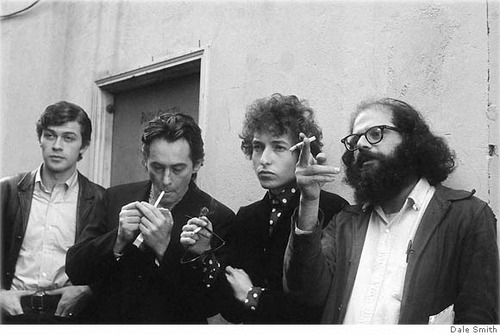
Robbie Robertson, Mike McLure, Bob Dylan, and Alan Ginsberg. City Lights Books, San Francisco 1965.

Four months after publication, the cashier at the store and Ferlinghetti were arrested for selling obscene material–Howl. The case riveted the nation–and made Howl one of the most notorious/famous books of its time. The judge’s decision–that Howl was fully protected by the First Amendment–became an important precedent in the future cases against Lawrence’s Lady Chatterley’s Lover and Miller’s Tropic of Cancer.

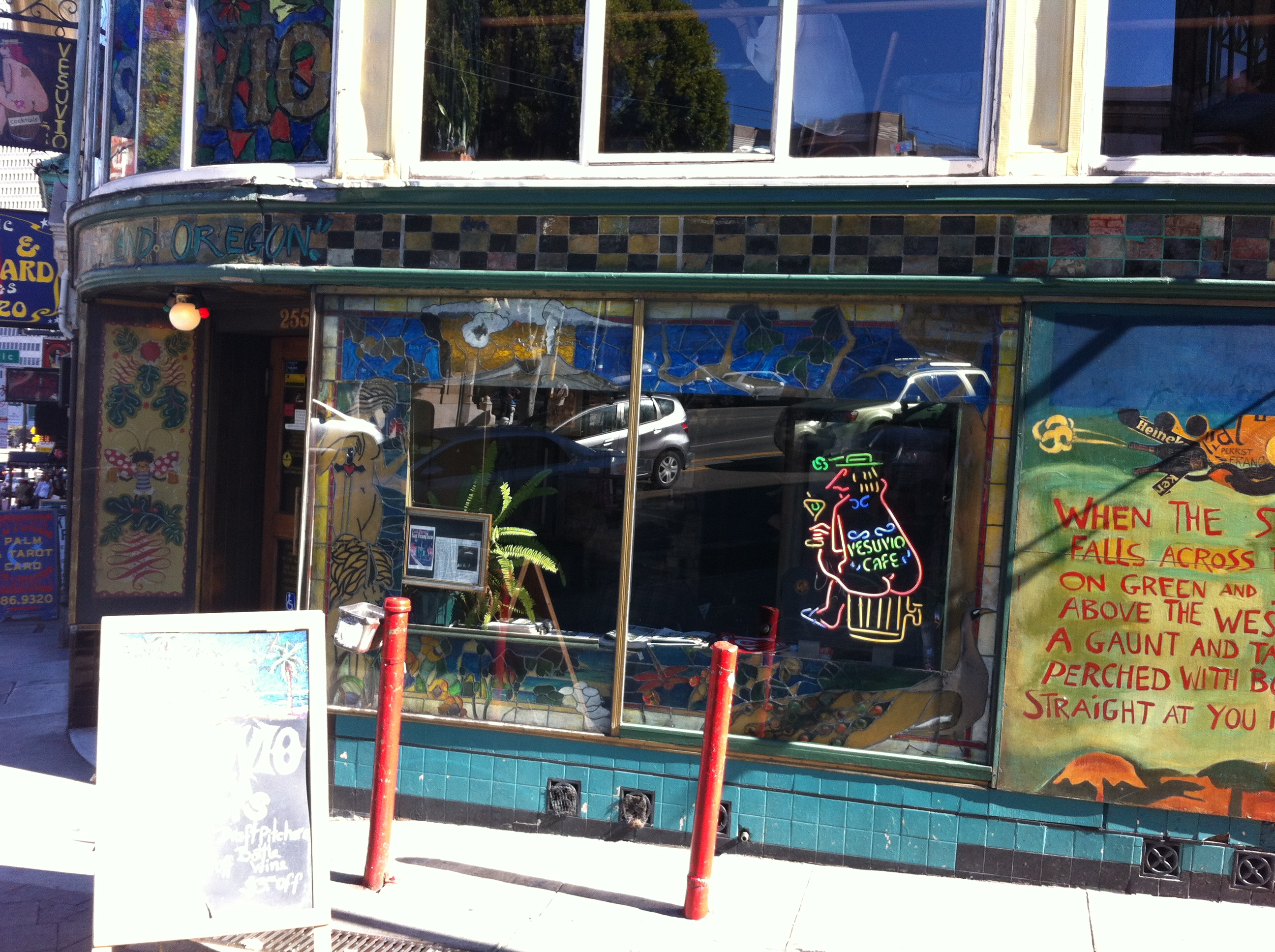
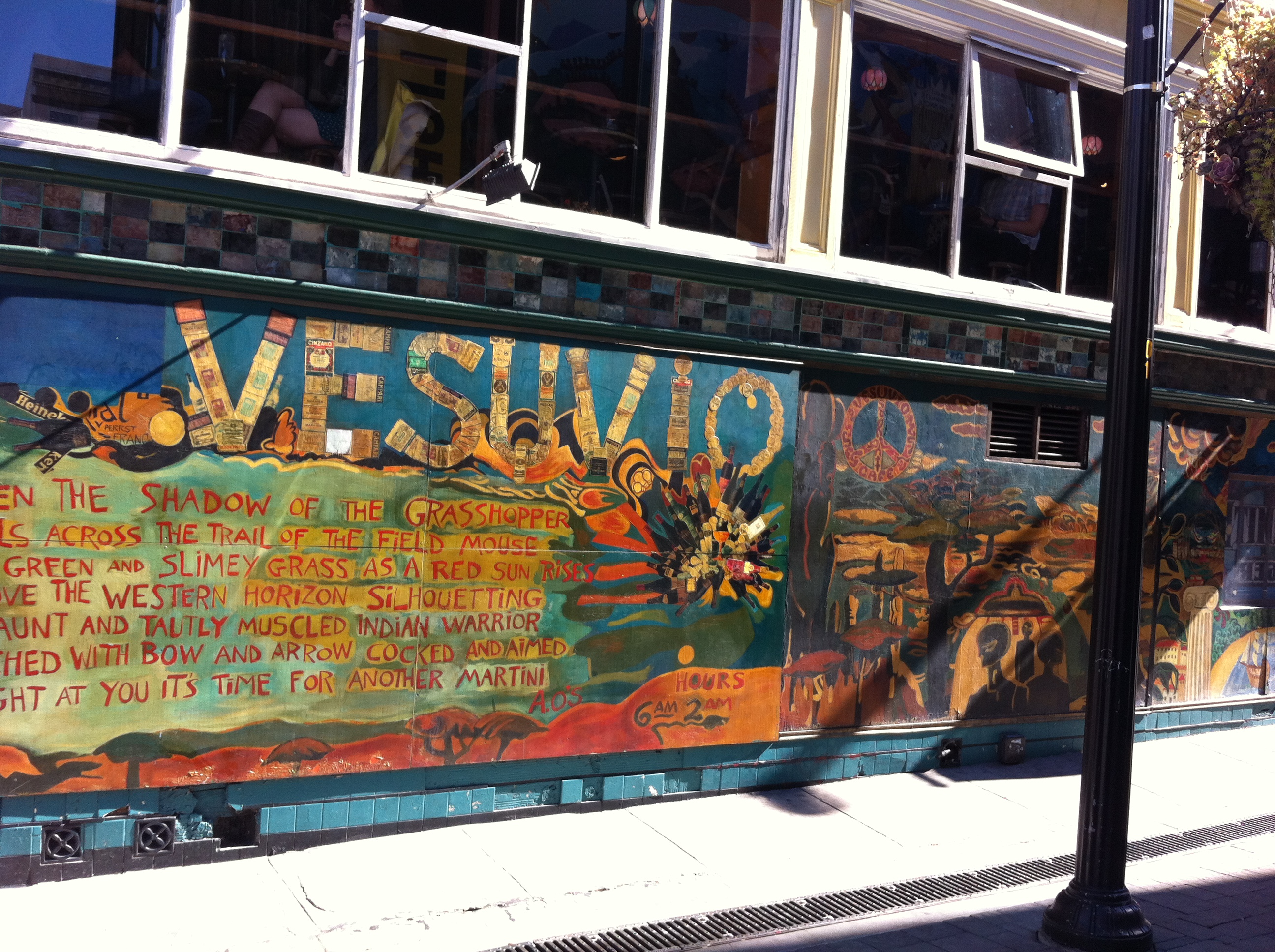
And so…after browsing  the three floors of the book-store, filled with memorabilia, photos, and more than just books, I went across the alley–Jack Kerouac Square–to  the Vesuvio bar. This wonderful bar –mismatched furniture, decals, art work, cheap drinks, two floors, old posters–is a step back into time, or at least in my head. Pictures of Jack London vie with pictures of Jack Kerouac vie with pictures of David Crosby and Grace Slick. A giant portrait of James Joyce hangs next to a photo of Joyce reading the paper in Paris on Bloomsday, June 16th.

Ienjoyed myself. Spent most of the time walking around and reading the walls–the vintage posters advertising readings by a who’s who of San Francisco poets and concerts from the early days, the photos of legendary writers, poets, activists and actors, and original art both bad and worse.

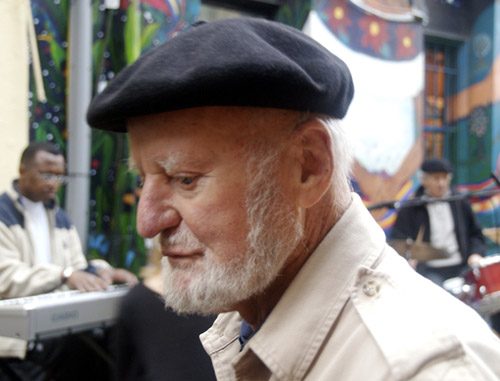
And then it was time to leave.  Outside, we took a few pictures and turned to leave.  And then, as I turned to look back, there coming out of the bar was Ferlinghetti himself.  He stopped, looked around, and placed a cap on his head. My first inclination was to go up to him and shake his hand, thanking him for his long battle against censorship, imperialism, and philistinism, for his support of art, poetry and the avant-garde.  But then I decided against it.  Let a man walk out of a bar, look into the sunshine and set on his way without being bothered by an admirer.

Lawrence Ferlinghetti. photo via Flickr by Steve Rhodes

“Love Poem” by John Frederick Nims…all the toys of the world would break.

Love Poem
(by John Frederick Nims)

John Frederick Nims (1913-1999)

My clumsiest dear, whose hands shipwreck vases,
At whose quick touch all glasses chip and ring,
Whose palms are bulls in china, burs in linen,
And have no cunning with any soft thing

Except all ill-at-ease fidgeting people:
The refugee uncertain at the door
You make at home; deftly you steady
The drunk clambering on his undulant floor.

Unpredictable dear, the taxi drivers’ terror,
Shrinking from far headlights pale as a dime
Yet leaping before apopleptic streetcars—
Misfit in any space. And never on time.

A wrench in clocks and the solar system. Only
With words and people and love you move at ease;
In traffic of wit expertly maneuver
And keep us, all devotion, at your knees.

Forgetting your coffee spreading on our flannel,
Your lipstick grinning on our coat,
So gaily in love’s unbreakable heaven
Our souls on glory of spilt bourbon float.

Be with me, darling, early and late. Smash glasses—
I will study wry music for your sake.
For should your hands drop white and empty
All the toys of the world would break.

I once read this poem in public to a group of twenty to twenty-five people. Afterwards, a woman came up to me and said that I had brought her to tears.  Although it was a nice compliment, I knew surely that it wasn’t I that did it.  For who could hear those final lines “For should your hands drop white and empty/All the toys of the world would break” and not get a catch in their throat?

I love this poem because it is an anti-ideal love poem.

Shakespeare did the same thing 400 years ago with his Sonnet 130 (“My mistress’ eyes are nothing like the sun.)

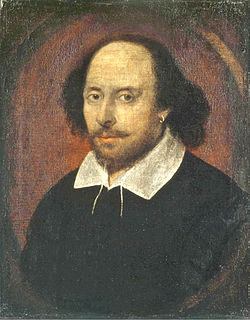
My favorite portrait of Shakespeare

My mistress’ eyes are nothing like the sun;
Coral is far more red than her lips’ red;
If snow be white, why then her breasts are dun;
If hairs be wires, black wires grow on her head.
I have seen roses damasked, red and white,
But no such roses see I in her cheeks;
And in some perfumes is there more delight
Than in the breath that from my mistress reeks.
I love to hear her speak, yet well I know
That music hath a far more pleasing sound;
I grant I never saw a goddess go;
My mistress when she walks treads on the ground.
And yet, by heaven, I think my love as rare
As any she belied with false compare.

Here too, the poet celebrates the flaws and the humanness of his beloved. In embracing her reality–and announcing that he has no need to “belie her with false compare” as so many other poets did–he claims a superior, purer love… “a love as rare” in Shakespeare’s words.

Both men, separated by four centuries, are similarly battling against a constructed “ideal.”  Whether it was the “ideal woman” presented by the Renaissance sonneteers or the “ideal woman” fashioned by Hollywood and Madison Avenue, it was a false image.  And both men knew it.  Their love, they claim, is special because it is grounded in the real world, not in an imaginary, air-brushed, wish-fulfillment world.  Their love exists in the everyday, “everyman/everywoman” world that most of us mortals inhabit.

We know little of Shakespeare’s beloved except for what she looks like: dark hair, pale-lipped and dun-skinned, bad-breathed, clunky-walking and shrilly-voiced. Nims, on the other hand, gives us more information about the object of his love.  She deftly handles those who are ill-at-ease, exiled or drunk; she moves easily with words and people and wit and love. Certainly, she has her frenetic failings–and Nims recounts them with affection– but that is not what makes her unique; that makes her human.  She is much more than that.  She is unique in the welcoming warmth of her love, in her compassion for and embrace of life.

Nims truly appreciates and loves her for what she is. And isn’t that what all of us is looking for?

Work in Progress

Selections from THE NOTEBOOK ON EVERYTHING
(Arranged in Alphabetical Order for Convenience)
By
J. P. Bohannon

Andromache: cf. Racine, Jean.

Antigone:  “Antigone inspired Hegel to his magisterial meditation on tragedy: two antagonists face to face, each of them inseparably bound to a truth that is partial, relative, but, considered in itself, entirely justifiable.” (The Curtain, Milos Kundera, page 110). Kundera then says that History cannot therefore be tragic. What in his definition allows him to say this:   “Inseparably bound”?   or “a truth that is partial, relative, but …entirely justifiable”?

Beauvoir, Simone de:  “There were other humiliations for Simone as well: she was the last chosen for any game or athletic contest, and her efforts to join any of the playground groups were usually greeted with hooting laughter.  With the innocent cruelty of children she was scorned by her schoolmates as much for her ill-fitting clothes and general untidiness as for her self-important pronouncements.  She was a gawky chatterbox, entirely friendless.  There really was no model, no influence, no one and nothing at all in her life to help her develop any social or societal graces.”  (Simone de Beauvoir: A Biography, Deidre Bair, p. 63.)  QUESTION: Does unpopularity on the playground and in the classroom affect children so that they have one of two choices when they reach adulthood: greatness or psychosis?

Brain Mass:  “One of his patients was a postgraduate student with an IQ of 126, a first-class honours degree in mathematics, a regular social life and virtually no brain. ‘Instead of the normal 4.5-centimetre thickness of brain tissue between the ventricles and the cortical surface, there was just a thin layer of mantle measuring a millimeter or so. His cranium is filled mainly with cerebrospinal fluid.’ ”
James Hamilton-Patterson, “Do Fish Feel Pain?” Granta: This
 Overheating World,  No 83, Fall 2003, pp161-173.

Cockney Slang:   I go into a pub in London and see some people I know.  I order a pint and ask the others if I can get them one.  “Nah, I’m Van Gogh,” says bald-headed Nick.  “Wha?”  I answer back. “I’m Van Gogh,” he says. “I’ve got one ‘ere.”

The Colombo Club: I worked for a while for a group of bricklayers, the Calabrese Brothers. On Fridays, in the summer we would quit early and go to the Colombo Italian Club on the Lansdowne Road.  There were darts, shuffleboard, and cards. They always paid us in cash. Much of it stayed there on a Friday night.

Drew, Ronnie (of The Dubliners):  As a teenager, my friend Justin once dated Ronnie Drew’s daughter.  He went for tea one afternoon at their house, and while the women were busy in the kitchen, Ronnie spoke his first words to him: “If you get her up the pole, I’ll feking kill you.”  Despite this Justin and the girl remained friends, and at her 21st birthday bash, he met Van the Man.  Wikipedia cites Ronnie Drew in its article on Finnegans Wake for his recitation of the Humpty Dumpty poem.

Eliot, T.S.:  Pound X’d out the entire first 54 lines of The Wasteland and Eliot accepted his changes.  (And that was just the first 54 lines. Pound’s heavy pen is crossing things out throughout the original typescript.) The poem originally began: “First we had a couple of feelers down at Tom’s place,/There was old Tom, boiled to the eyes, blind.”  For some reason, I never imagine Eliot getting sloshed or womanizing but there it is: “Get me a woman, I said; you’re too drunk, she said,/ But she gave me a bed, and a bath, and ham and eggs.”  Even if it is another character and not the poet (isn’t that some sort of fallacy we learned once in school) that particular world seems alien to that pursey-lipped banker.

The Ginger Man: A woman accosted me on the 110 Bus from 69th Street to West Chester while I was reading The Ginger Man by J. P. Dunleavy. She called it sexist, misogynist and misanthropic.  I told her I always loved the guy drinking at the pub in a kangaroo costume and that’s why I wanted to read it again.  She had bright red lipstick with much of it stuck on her beautiful teeth.

Ibsen:  Someone compared Billy Wilder’s The Apartment with Ibsen’s plays. The comparison made sense.  In fact, it was said that Torvald’s bank seemed enlightened compared to the work place in Wilder.

Irish Phrases:  
Aris, mo bhuachailin Ní thagann ciall roimh aois  = Sense doesn’t come before age

Joyce, Lucia.  She had strabisimus and was an accomplished dancer.  She was also highly intelligent, although wasn’t given much credit for it. She was diagnosed schizophrenic. A very tall shadow blocked her sun.

Kafka:  Kafka means crow in Czech.

Kundera, Milos: In The Incredible Lightness of Being, the character Sammy says that she thinks of New York as “Beauty by Mistake.”  What a great phrase!  I copy it down in my journal.  It will be the title of my next novel, CD, film, whatever.  I begin a short story with the title, but do not get very far.  Last month, the NYTIMES featured an article tracing Kundera’s appearances in its Book Reviews.  The article is titled “Beauty by Mistake.”    AAAARRRGH!

Madonna:   A good pun for the iron Madonna sculpture in my cemetery story: “A ferrous-wheeled Madonna.”  I love it.

Madonna (the singer): Toni, who flew out to LA to waitress at the Vanity Fair Oscar party, told me that Madonna seemed to want to talk only to other faux-Brits.

New Words:
Parp  1. (verb) To break wind, to fart.
2. (noun) Nonsense, rubbish.
…a green double-decker bus that parped its horn at him.

Paine, Thomas:   (Letter to the Editor, London Review of Books, 4 January 2007).  “In John Barrell, the London Review tasked a truffle hunter to examine Christopher Hitchen’s book Thomas Paine’s ‘Rights of Man‘ (30th November 2006).  But instead of sniffing out tasty morsels for salivating LRB readers, Professor Barrell chose to stick his snout in a cow pie.”  Marvelous!!!!

The Puck Building:  Originally built in 1886.  A second building was added on in 1893 when Lafayette Street pushed through.  The statue of Puck is a duplicate of the original.  The original stood over the doorway.  It’s the building where Grace worked in the television show, Will and Grace.

Quiche Lorainne:
1 9-in. unbaked pie shell
8 slices of bacon
6 ounces Swiss Cheese, shredded
1 tbsp flour
½ tsp salt
Dash ground nutmeg
3 eggs
1 ½ cups of light cream

Cook & crumble bacon. Reserving 2 tbsp crumbled backon, place remaining bacon in partially baked pastry shell (450° for five minutes).  Add shredded cheese.  Combie (beat) flour, salt, nutmeg, eggs, & cream.  Pour over bacon & cheese in pasty shell.. Trim with reserved bacon.
Bake at 325° till knife comes out clean, about 25-40 minutes.

Racine, Jean.   Andromache: Orestes →Hermione; Hermione→King Pyrruss; King Pyrruss →Andromache; Andromache→Hector.  (Hector is dead.)  Check out Hector in the made for TV mini-series, The Odyssey.  His death had to be divinely manipulated.

Romanticism:  “The battle of the outs against the ins must be older than history, but the idiosyncratic psychological coloring of the Romantic struggle came from the Romantics’ passionate pride in being out—while, of course, they were struggling to get in.”   (Romanticism and Realism, Charles Rosen and Henri Zerner).

Russian Woman on train:  6/12/06—Russian woman on train. Beautiful. Very dark but with eyes that in one light might be called green but today are sparkling grey—beautiful and literally attractive: they pull you in.  She has two children. One about five in a stroller, another a large baby, slung in some sort of sling.  The R8 out of Philadelphia travels westward towards Chestnut Hill.  It is typically urban. Cement pillars, graffiti, discarded tires, old RR ties, glass.  At one point the tracks cross the Schuylkill River. It is the same scene.  The five year old—who up until this time has been speaking Russian—speaks out in English to his mother: “Look Momma.  It is beautiful.” The Mother also speaks in English only once. A young boy—16 or 17—gets on the train. “Oh, it’s Alex,” she says.  “Alex, Raisa, Hi Alex.”  She was brilliant.  He gave her an adolescent grunt. I wanted to strangle him.

Stevenson, Adlai.  Janet Flanner (in Paris Journal: 1965-1970) quotes Stevenson’s obituary in Le Monde: “The tragedy of Dallas assured to John F. Kennedy a posthumous radiance that memories of Stevenson will never know.  Yet Stevenson during his lifetime was no less an influence than the assassinated President. … Without doubt, Stevenson’s integrity and intelligence were loftier than those of even the elite of American political personalities.

Unacceptable CD Players:
Students may not use CD Players that:
Require an electrical outlet
Accept more than one CD
Have duplication or recording capabilities
                   (from the SAT® Program Associate Supervisor’s Manual, 2006-2007)

Vietnam:  The French lost control of Vietnam after the battle of Dien Bien Phu.  It was in 1954.

While My Guitar Gently Weeps:  How cool is the string quartet in George Martin’s remastered version for the Cirque du Soleil production, Love?  How sweet is George Harrison’s thin voice on the demo tape.

Women:
“Cette fois, c’est la Femme que j’ai vue dans la Ville, et à qui j’ai parlé et qui me parle.” Rimbaud. (“This time I found and spoke to the woman in the city.”)  I don’t know what this means. It often happens with me and Rimbaud.

Zorro:   In the early 1960s my aunt took me to a department store to see Guy Williams dressed as Zorro.  There was an entire set, Spanish-style adobe building, cactus, rough-hewn fence.  I spoke to him for about three minutes.  On another floor, children were lining up to see Santa.  The last time that the actor who played Sgt. Garcia was seen on television was in October, 1967.  He appeared on an episode of Mannix.
Movie Review: The Best Exotic Marigold Hotel…meh

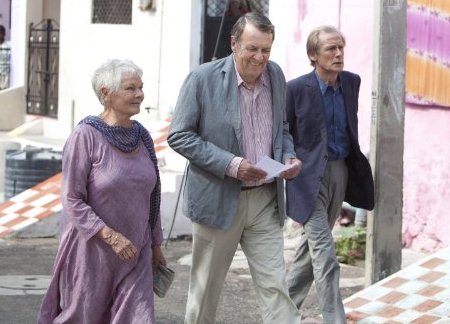
A handful of retirees move to India because elder-care is cheaper there and recent events have altered their vision of what their lives would be like back home in England.  And so separately they move to the Best Exotic Marigold Hotel, advertised for the beautiful and the elderly… a hotel which is still in the early stages of reconstruction.

I wanted to like this film very much.

Afterall, there were magnificent actors:

 Judi Dench
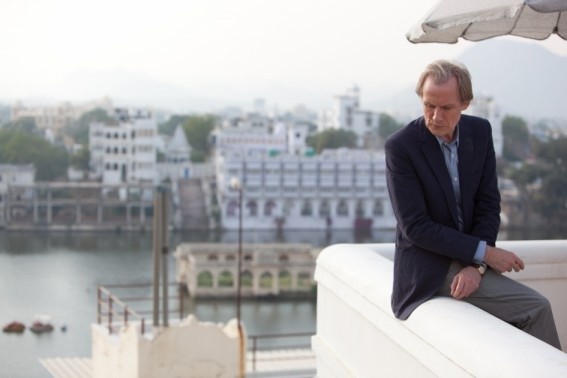
Bill Nighy
Maggie Smith
Tom Wilkerson
Dev Patel
Celie Imrie
Penelope Wilton
Ronald Pickup

There were touching and interesting stories:

• A gay man returning to find an ex-love he believed he had ruined
• A widowed woman trying to be responsible for herself for the first time in forty years
• Young lovers being thwarted by a mother’s demand on arranged marriage
• A decent husband battered by an over-demanding, narrow-minded wife
• A woman wanting one last try at romance
• A man wanting one last try at romance
• Another woman wanting one last try at romance
• A bigoted woman going to India for a hip replacement because she can’t wait for the NHS
• A couple who lost everything in bad investments

And there was extraordinary photography and marvelous settings.

And yet, it all seemed too much…it all seemed to run together.  The film couldn’t seem to decide whether it wanted to be a mad-cap comedy, a fish-out-of-water study, a sentimental love story, a heart-breaking love story, a droll study of old imperialists visiting a once held colony, a humorous clash of cultures. It seem to need a tighter focus.

There is a point made in the film that India is a barrage on the senses; sounds, smells, tastes, sights, textures all come crashing upon the visitor in a way that is often overwhelming.  This seems to describe The Best Exotic Marigold Hotel as well. There was just much too much.

Did I enjoy it?  Yes, it was enjoyable.

Will I forget it? Yes, it is forgettable.