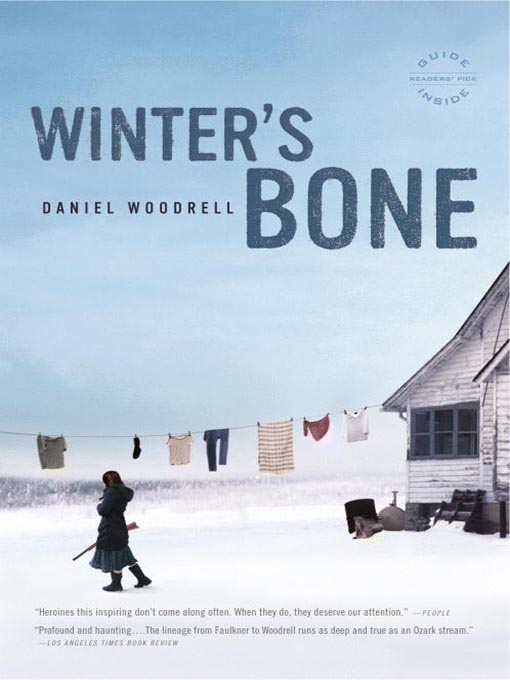
Book Review: Winter’s Bone by Darrell Woodrell–can you find a better heroine in all of literature?

I have a tendency to exaggerate, to think that whatever I have read, heard or seen lately and liked  is the BEST!  I am much more nuanced about things I dislike and usually soften the blows rather than exaggerate them.

But with Daniel Woodrell’s novel Winter’s Bone, I feel confident in stating what a truly fine book it is.

In fact, since I have read it, I have tried to think of a heroine in an American novel who matches Ree Dolly for grit, perseverance, wisdom and sheer moxie. These are the suggestions I have gotten so far:

1. Scarlett O’Hara in Margaret Mitchell’s Gone with the Wind (too spoiled, mercurial and self-centered)
2. Scout Finch in Harper Lee’s To Kill a Mockingbird (not really her story but her father’s–who, by the way, may be the best father in literature.)
3. Hester Prynne in Nathaniel Hawthorne The Scarlet Letter (interesting suggestion, but her props come from accepting her punishment and not revealing who the father of her child was, while letting the simpy Rev. Dimmesdale preach his sermons and fill himself with self-loathing. I don’t see her as a particularly active heroine.)
4. Katniss in Susan Collins The Hunger Games (must say, I don’t know enough about her, except that Jennifer Lawrence played both Katnis in the Hunger Games AND Ree Dolly in Winter’s Bone.)
5. Mattie Ross in Charles Portis’ True Grit (Mattie is a good second to Ree Dolly. Her challenges just don’t seem as daunting as Ree’s.)

Please feel free to add your own selections.

But my point is, I can’t remember any heroine–or any protagonist for that matter–who is so admirable in her refusal to not back down, in her persistence in doing what she must, and in her bravery in standing up to the very nasty forces that surround her.

In case you don’t know, Winter’s Bone is the story of Ree Dolly, a seventeen-year old girl who is raising her two younger siblings and caring for her catatonic, demented mother. Her meth-cooking father has just skipped bail and he had put up their hovel of a home as bond.  If he doesn’t show up for court, Ree and her family are out on the streets–or more realistically out in the fields of this very hardscrabble Missouri Ozarks setting.

Suffice it to say that her father is dead. And people aren’t real happy about Ree poking into their business. This is a community whose main economy and main diversion is crystal meth-amphetamine, and there are a whole lot of very, very nasty people.  No one talks. Talking creates witnesses.

In the course of her journey, Ree gets a truly horrible beating, she allies herself with her rough Uncle Teardrop (named such because of the three tears self-tattooed on his face), and finally proves her father’s death by sawing off his two hands (with a chain-saw from where he is sunken in a murky lake) and bringing the “identification” back to the authorities.

If it sounds gruesome. It is. But it is also one of those books that hooks you immediately and which you wish would go on forever. And it is all because of the character of Ree.  It is Ree that rises above all the violence, the poverty, the bleakness. But while Ree completes her quest at the end, while a few things begin to go right for her and her family, one is left feeling that in another five or ten years Ree will have turned into one of the many harridans that populate this mountain.  I hope not.

♦     ♦     ♦     ♦     ♦
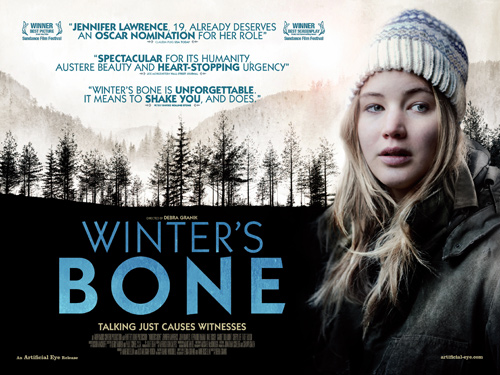
I read the novel for a film class I am teaching.  And so, I also had to show the film. As in all translations, there are various changes–her two brothers for some reason become a brother and a sister–and particular scenes are deleted.  Yet the film very much captures the spirit and the landscape of the novel.

Jennifer Lawrence is, at times, magnificent. There are moments when the camera captures the soft plumpness of her face adding even a greater vulnerability to this girl/woman who has to face such ordeals.  At other times, that softness works against her, straining our credibility that she is who she is supposed to be.

Not so with John Hawkes.  Hawkes, who was the soft-spoken hardware salesman in Deadwood–a similar world of extreme dirtiness and corruption, plays Teardrop perfectly. Hard as Ozark flint, creased and shaky, Hawkes captures the violence, the drug addled paranoia and stupor, and the family loyalty of these inbred mountain folk with studied truthfulness and credibility.  While Winter’s Bone is Lawrence’s movie, you don’t forget Hawkes for too long.

Jennifer Lawrence as Ree Dolly in Winter’s Bone.
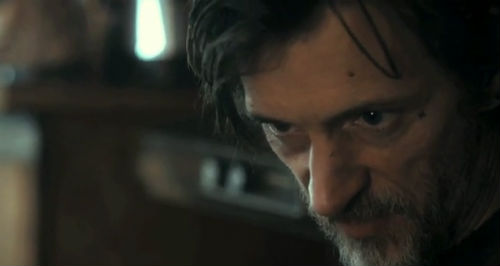
John Hawkes as Teardrop in Winter’s Bone
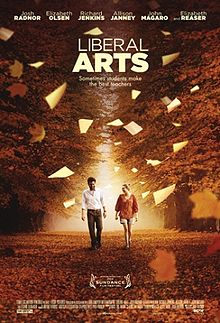

Movie Review: Liberal Arts–Light but Enjoyable

David Foster Wallace famously gave a commencement speech at Kenyon College in 2005. The speech –Wallace’s only know public speech–had been printed and reprinted, e-mailed and downloaded time and again, and now is published as the book, This Is Water: Some Thoughts, Delivered on a Significant Occasion, about Living a Compassionate Life.  Wallace, whose magnificent and enormous novel Infinite Jest is perhaps for the millennium generation what Gravity’s Rainbow was for the Viet Nam generation, is known for his intricate plots and subplots, his baroque sentences, his numerous footnotes, and his expansive and enormous intellect.

Well, Kenyon College and Wallace meet up again in the 2012 comedy Liberal Arts.  Actually, Wallace isn’t there physically, but Infinite Jest is, and the novel and its author play a significant part in a poignant subplot about a depressed, genius undergraduate. In fact, towards the end of the film, the hero tells the hospitalized boy to put down Infinite Jest  (he has already read it three times) and pick up one of the Twilight books! 

Kenyon College, on the other hand, is very much visible–and looks torn right out of a college brochure. The leafy campus, the quaint town, the rural surroundings, all make Kenyon look like a movie set for the perfect college.  However, although Kenyon is one of the more illustrious and demanding liberal arts colleges in the U.S., it offers up a pretty “easy-A” with Liberal Arts. Nothing too difficult, too taxing , or too subtle.

The film tells the story of Jesse (Josh Radnor), a bookish and sensitive admissions officer at a New York City college (read NYU) who is dissatisfied with his job and his life. When he is called back to Kenyon to attend the retirement party of one of his favorite professors (Richard Jenkins), he meets Zibby (Elizabeth Olsen), an undergraduate studying Improv Theater.

Elizabeth Olsen and Josh Radnor in Liberal Arts

The 35-year old Jesse and the 19-year old Zibby hit it off immediately and enjoy each other’s company as they wander around the bucolic campus. When Jesse returns to New York, he begins a “pen-pal” relationship with “Zibby” that is sweet, literate and full of hope.

However, when he returns to visit her, the differences in their age–and life experience–plays very much on his mind. (To me, since the actors do not seem all that greatly separated in age,  the age difference did not really seem all that jarring.)  Her attempt to bed him on this second visit is the moral center of the movie.

There are some wonderful performances–Allison Janney as an ice-hearted professor of the British Romantics is marvelous and Zac Efron as a chorus-like sprite that pops in and out of the story is charming and enigmatic. And the lead characters are very likeable.  The camera work between Ohio and New York is beautiful and perfectly captures the shift in energy that Jesse feels in moving between the two places. And the subplot with the depressive undergraduate is interesting enough, if rather slight. (It might have made a better movie in itself.)

In all, the film is concerned with life and its trajectory, with love and its various shadings, and with contentment and its frequent elusiveness. It is funny and literate at times, but for the most part it is a simple story, simply told.  Liberal Arts could have been a much weightier film–but that’s not the film the director chose to make.

I can’t imagine David Foster Wallace liking it. There isn’t much layering here, not much that he could footnote.  It would  have made a very slim novel.

The house that Barnes built…now relocated

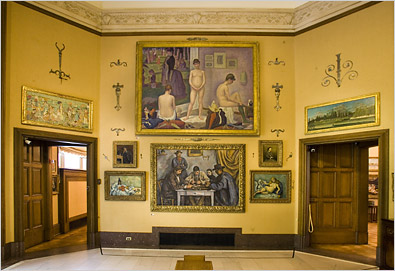
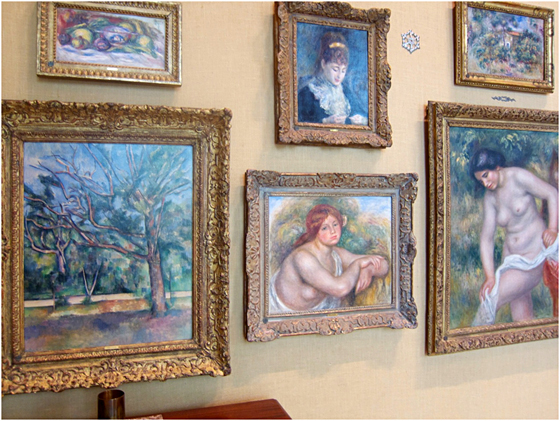
Yesterday I went to the new home of the Barnes Collection.  The building is light and airy and relaxing and peaceful.  And the art there is second to none. Even to the least knowledgeable visitor, there must be ten paintings in each room that are recognizable.  In many ways, it is like walking into a primer of Modern Art.

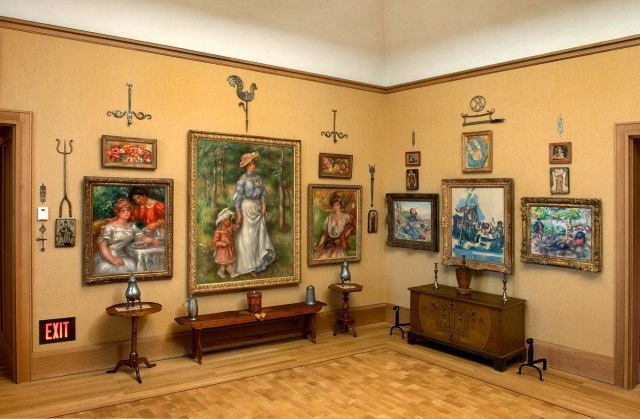
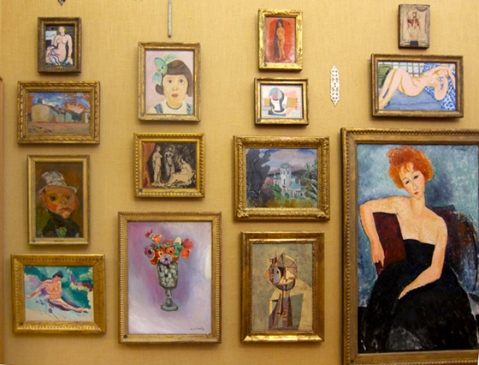
To give you some idea of the scope of this collection, it holds 181 Renoirs, 69 Cezannes, 59 Matisses, 46 Picassos, 16 Modiglianis, 11 Degas,  7 Van Goghs, 6 Seurats, as well as numerous works by Manet, Utrillo, Demuth, Prendergast, de Chirico, Gauguin. And shoring up these masters is the odd El Greco, Rubens, or Titian.  There is also a large array of African sculptures, modernist textiles, ceramics, American folk art, Pennsylvania-Dutch cabinetry, and a large assembly of ironwork that, like the delicate chain of a rosary, seems to link the paintings together in each room.

And all in a private collection!

There are so many stories behind the Barnes Foundation. Having amassed what is arguably the most famous personal collection of modern art in the world, Albert C. Barnes had willed that his collection remain at his residence in  Merion, a suburb of Philadelphia. He had stipulated that the collection would be open to the public for no more than two hours a week and that reservations had to be made two-weeks in advance. He wanted the works to be used solely by artists, students and educators for study, and so the paintings  were not to be loaned or reproduced. After what would be the first of many legal challenges, these stipulations were first amended to two-and-a-half hours a week  and visitors were limited to 500 people a week.

(Originally, Barnes wanted his collection for art students and laborers only, and he had little time for the rich and celebrated. In a room outside the galleries, there are documents from Barnes’ life. One is a letter to the automobile tycoon,  William Chrysler, stating that he must refuse his request to visit the collection because at the moment he is practicing goldfish swallowing and can not be bothered!  Another form was a bill of sale for eight Picasso’s. He had spent $1490.00)

In 1992, the Barnes Foundation was in some straits, the house itself needed some repair, and after a great deal of legal wrangling much of the collection went on a world tour. For the first time, the collection, which had been so limited in the numbers of people who had actually seen it, was now being viewed by millions in cities around the world.

But the tour still did not bring in enough funds.  When the foundation tried to extend its hours, the local municipal government balked, and after several years of suits and counter-suits, of bitter and arcane legal wrangling, it was decided that the collection would be moved to a new location on Philadelphia’s Benjamin Franklin Parkway. The move was (and still is) highly controversial and was the subject of the 2009 documentary, The Art of the Steal.

But to be honest, the museum is beautiful.

The new location recreates the rooms of Barnes’ home to the finest detail–baseboards the exact height, wall paper the exact texture, paneling the exact wood–and encases them in a building that is peaceful, modern, and relaxing. And the bonus is that now so many more people are now able to see what was before limited to such small numbers.

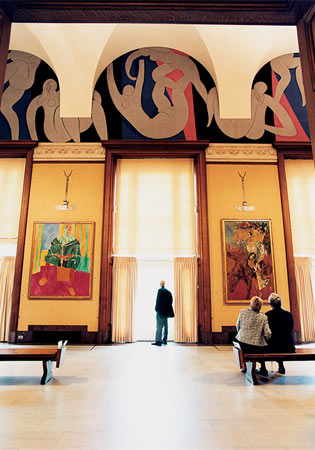
How impressive is Barnes’ collection? It literally takes one’s breath away–you walk into the first room and you gasp! The sheer number is overwhelming. Above the windows of the first room are the three large panels of Matisse’s Dancers. You are in a room with several Picasso’s and yet that is not where your eyes go immediately.

The paintings are hung with precision and deliberation–two small Renoir landscapes will surround a large Renoir portrait which will contrast with the Matisse portrait above it.  And the ornamental ironwork that is placed throughout reflects the patterns, shapes and themes of the pictures they  accent.  For instance, a sinuous iron bar  echoes the curves of an odalisque by Cezanne.

A single day is rarely sufficient to see any museum, and this is truly so with the Barnes. A person could easily spend an entire day in one room and feel sated. (And one could certainly post an entire blog on any single room…if not on any single painting.)

While so many of the paintings are very familiar and are such a part of Western culture, they were not so when Barnes first bought them. (The $1490.00 that he spent on the eight Picasso’s attests to that!)  He had traveled to Europe on his honeymoon and had befriended Leo Stein, who with his sister Gertrude had become such great patrons of Picasso and Matisse. Barnes then commissioned his high-school friend, the artist William Glackens, to Paris to buy art for him. Barnes trusted him completely, and Glackens purchased the first twenty paintings of the collection.

Another story, tells how Barnes himself went into one particular gallery, liked what he saw and bought 52 paintings. Could you imagine a gallery owner today with that sort of sell? Could you imagine the cost?  But aside from having money, Barnes also had an extraordinary eye–and an extraordinary vision.

Barnes had made his money by inventing a chemical preparation used to disinfect the eyes of  newborns. He spent his money on opening our eyes to the glories of twentieth century art.

Today, despite the wrangling and the bad blood, despite the legal pyrotechnics and the extra-legal manipulations, the Barnes Foundation is nevertheless one of the great centers of modern art–and the controversial relocation is truly a masterpiece.

And more importantly: amid all this hubbub, amid all the controversy, it is a place of extraordinary peace and beauty.

It’s not a bad place to spend a Sunday afternoon.

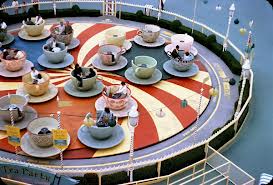
Watching the wheels go round and round

photo from “Gorillas don’t Blog,” November 3, 2011

I woke today in one of those states.  I didn’t know who I was or where I was or what I was supposed to be doing. And as I seeped into clearer consciousness, I felt in a rut…already in a rut at 4:45 a.m. Geeesh!

The day begins: the 57 bus, the Market-Frankford El, the R5 train and then a brisk walk, hoping for a co-worker to come driving by. I will do the reverse in the evening. And then again tomorrow and tomorrow and tomorrow.

But the commute is not what was getting me. I enjoy it. I get plenty of reading done–and not a little dozing as well.  But something wasn’t sitting well.

Simply, I am not sure what I am doing. 

For work, I am teaching Atwood’s The Handmaid’s Tale, Woodrell’s Winter’s Bone, and Jim Shepherd’s Like You’d Understand Anyway. But I ask myself, “What am I teaching?” Sure they are great reads. They are more than that: they are thoughtful, engaging, and well-suited for introspection, reflection, and–hopefully–understanding.  But, as for today…meh.

I know that it is a passing feeling, the not uncommon question of  “Is that all there is?”

And I know I will get pumped by the next great book I encounter, by the old song that I hear from someone else’s radio, by a magnificent movie that comes in under the radar, by good craíc shared with friends. 

But today the feeling is real. It is simply something you work through.

I was listening today to John Lennon’s “Watching the Wheels Go Round.”  I was thinking beforehand that it reflected my own feelings today.  But it was just the opposite.

Lennon is watching “the wheels go round” because he had gotten off the merry-go-round, had walked out of the maze, was no longer “playing the game.”  He was enjoying the real things–his wife, his child, his new life.

But at the moment, for me (as for most of us),  I need to stay on the merry-go-round as it continues to spin, mindlessly, pointlessly and without destination. 

Nevertheless, today I am listening to what John says and that always seems hopeful.

Hackles, Philly Fringe Festival and a personal ghost

Photo courtesy of Groundswell Players

The Philly Fringe Festival and the Live Arts Festival have been running concurrently in Philadelphia for the past few weeks.  This usually means that there is an abundance of cutting edge theater, dance, performance, readings going on throughout the city, and this year it seems even more so.

For the past three years we have had a friend, Pia Agarwal, who worked for the festivals and always gave us a heads-up on what to see.  And she was never wrong.

But she’s moved to Austin, so we were on our own.

Fortunately, I know Nick Gillette, who is finding some success in the local theater scene.  This year, for the Fringe Festival,  he directed one play, Myths and Monsters,  at the Adrienne Mainstage and performed in another Hackles at the Crane Arts Old School White Space.

On Saturday night I went and saw Hackles. I have been in this venue twice before and each time have been wowed and impressed. This night was no different.

Groundswell Players in rehearsal for Hackles
(photo: Emma Lee/for NewsWorks)

“Devised” by the Groundswell Players–students at the Pig Iron School for Advance Performance Training–the play features four actors who take on a variety of roles. The main roles however are a blind old man, his daughter, his cockatoo, and Death itself. Scott Shepherd, who played the cockatoo–incredibly well by the way–also played the daughter’s hesitant boyfriend. The other additional roles–teacher, fellow students, policeman–were negligible and merely stock figures to keep the plot moving.

When  the cockatoo dies, the daughter–played by Martha Stuckey–believes she sees Death come and take the bird’s soul. Later, she witnesses an accident (off-stage) and sees this female incarnation of Death (played by Alice Yorke) more clearly and more definitely.

She tells her blind father (Nick Gillette), who is fascinated by what she relates and who believes that the dead continue to contact us through the holes in the static of his off-station transistor radio.

There is still more death, in the past and yet to come, but there is also great hope: the play ends with the awkward daughter and her boyfriend figuring out how to slow dance while Al Green’s version of  “How Can You Mend a Broken Heart” plays on the father’s no-longer-static radio.

The set was very cool–pure white walls with clear plastic opened umbrellas suspended from the ceiling. There was minimum furniture–the father’s table and chairs and a cabinet-like piece that was spun around–and great lighting.  There were two or three scenes with a scooter and roller-blades which could have been discarded, but as for the rest, it was perfect.

The play combined physical performance, comedy, metaphysics and domestic drama in a piece that was entrancing, engaging and thoughtful.

But the play was not what raised the “hackles” on my neck!

After the play, a number of us met in the parking lot, going over what we were doing and where we were going next.  Someone had an iPhone and asked someone else to take a picture of us all gathered.

No one, however, invited the ghost, who appears behind my head.

I have now studied this picture backwards and forwards, have enlarged it as much as I could and still see clearly, and it doesn’t make sense. Granted, the play dealt with death and the afterlife and the conviction that spirits communicate with us regularly, but I didn’t expect them to come out to an abandoned grammar-school parking lot. She seems to be in period costume–and our play was in modern dress; In fact, Death was dressed in a sexy black cocktail dress.  So she’s not from the play and she isn’t from the audience; her proportions seem larger than those walking out of the building; and she wasn’t with us.

So where do we go with this?

Nothing, nothingness, and the world: a book review of Why Does the World Exist? by Jim Holt

I am reading about nothing.  Literally, about nothing.  I am reading about the concept of nothingness, and it’s a pretty difficult thing to get one’s head around.

Philosophers, theologians, mathematicians, and physicists have been puzzling the concept for a very long time, and it is quite a hot button in philosophical and scientific circles today.

In the West the concept of nothing is relatively new. 

In fact, it wasn’t until the mid-14th century that the idea of “zero” came to the West. And then, it came to us through accounting.  Something had to stand between asset and debit.

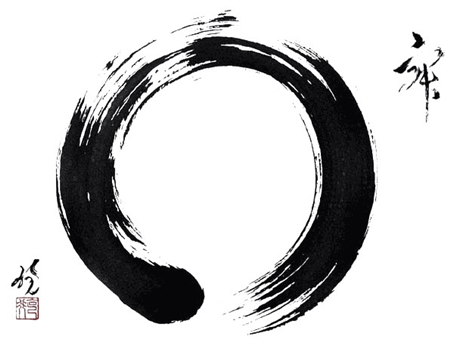
The East, however, had long dealt with nothingness not only in their mathematics but in their spirituality as well. For after all, attaining “nirvana” was equal to attaining nothingness, to achieving “emptiness.”

The Hindu word for this nothingness was sunya, which became in Arabic sefir, which came to Europe in the Middle Ages and is the root of our word “zero” and “cipher.”  And when it came to Europe, it came along with the rest of the Arabic numerals that we use today.

And yet what is nothing? There are many who say that no such thing exists.

The philosopher Henri Bergson tried to imagine nothingness. He simply kept subtracting all that he knew existed. However, when he reached the end he felt there was still something–his inner self which was doing all this subtracting. (An enlightened Buddhist would perhaps be able to extinguish that entity, but most of us cannot.) He concluded that imagining absolute nothingness is impossible.

Another philospher, Bede Rendell, saw that the failure in imagining nothingness is that after one had subtracted everything that was in the universe, one still had the space where those things once existed–a universe skin collapsed on itself.

The entire conversation is both intriguing and maddening, puzzling and wondrous.  (Sort of like in Alice in Wonderland when the Red King concludes that since nobody passed the messenger on the road, then nobody should have arrived first.)

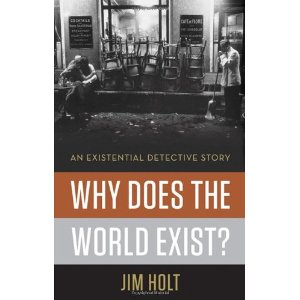
I am having this “conversation” with myself because of the book Why Does the World Exist?–An Existential Deterctive Story by Jim Holt.  Holt’s book, which is somewhat addressed to the lay reader (I can only imagine what a technical book on this subject might be like), springs from the question “Why is there Something rather than Nothing?” 

This question, I have learned, is one that has puzzled philosophers for aeons.

And when you get to the question of “something” and “nothing” you are led to the question of what “existed” in the universe before the “Big Bang” created the universe. The theologians have their answer. The scientists are not all that sure.  But they have their theories.

And both try to define or dismiss “nothing.”

All of which makes for fascinating reading.  Even the mathematical equations (which Holt has to explain to me or which I run to my resident philosopher/mathematician) are fascinating. For instance, his mathematical equation for absolute nothingness is

(X) ˜ (x=x)

and now seems to makes some sense to me. But it took a while for me to get to. (The equation means that X [the empty universe] is not where x = x [where something is something.]) He explains it much better and is  much more entertaining.

I am no philosopher or mathematician. My sense of the void, of nothingness–aside from my own existential angst and probings seeemingly hardwired in my soul–comes from Satre, Camus and Beckett.  And Holt brings these into the mix as well. (The cover of the book features a photograph of the Café de Flore, a favorite haunt of Sartre’s.) The book, in many ways,  is almost a primer of thinkers, ancient and new, and a wonderful introduction to the confluence of metaphysics, philosophy, literature and science.

And what  they ask is:  Why is there something rather than nothing?  Why is there a world?  A universe?

These are pretty big questions to roll around with and Holt’s book makes it a entertaining and informative  ride.

But to be truthful, I still don’t know the answer.

Job’s question, the Death of a Child and Ben Jonson’s poetry

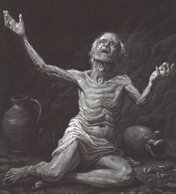
Job asking “Why?” Asking “How much more?”

Last year, a friend of my sister had a 4-year old child drown in a neighborhood swimming pool.  One would think that was enough for any parent to bear.

Last week, the very same woman’s 4-month old baby died in her crib—a case of SIDS.

This is a Job-like battering.   How much more can two people take?  How much more? They can’t be looking to sense, or reason, or “God’s plan.”  None of that can help, certainly not at the moment.

Lately, I have had a number of friends and relatives  who have lost aging parents. Sad as that is, it is reasonable and acceptable—part of the pattern of life.  But the death of a child?  No.

And there are thousands of children all over the world who die every day of disease, mal-nourishment, war, violence, and mere accident.

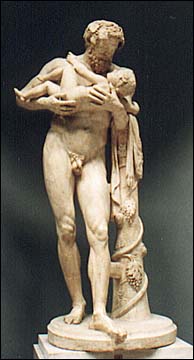
Statue of Father and Son
Vatican Museums. ©1999 A. Jokinen.

I used to teach a poem by Ben Jonson. If Shakespeare had not come along the era would have probably been known as “the Age of Jonson.”  He was much more successful, much more popular than Shakespeare was during his life.  And yet, he is not really part of the common culture today.  Shakespeare has pushed him aside.  But he is good and he is important. Here is the poem in which Jonson tries to deal with the death of his son: 

On My First Son
by Ben Jonson

Farewell, thou child of my right hand, and joy ;
    My sin was too much hope of thee, lov’d boy.
Seven years thou wert lent to me, and I thee pay,
    Exacted by thy fate, on the just day.
Oh, could I lose all father now ! For why
    Will man lament the state he should envy?
To have so soon ‘scaped world’s and flesh’s rage,
    And if no other misery, yet age !
Rest in soft peace, and, asked, say, Here doth lie
    Ben Jonson his best piece of poetry.
For whose sake henceforth all his vows be such
    As what he loves may never like too much.

Jonson’s first son—also named Benjamin, which in Hebrew means “Son of My Right Hand”—died when he was seven years old. Jonson, renowned and celebrated for his poetry and drama, puts it all in perspective and rates this dead son as the best thing he has ever created.  One can feel the father’s pain in the final two lines–the fear of “liking too much” that which one loves.

Movie Review: City Lights by Charlie Chaplin

I began showing City Lights to my students last week. It is for my “Literature and Film” class and while I don’t necessarily have a “literature” to couple with,  I think it is a film that everyone should see.

In fact, I believe it is one of the finest movies ever.

(The AFI ranks it as number 76 of the 100 best American movies of all time. Chaplain’s  The Gold Rush is ranked two slots before it at 74 and his Modern Times several below it at 81. Chaplin leads all directors with having three in the top 100.)

Yet art is not a contest. And City Lights is pure art.

Most of my students have never seen a movie in black-and-white! And they immediately say (and moan)  that they have never seen a silent movie. Yet, City Lights is not a silent movie. Chaplin made the movie well past the advent of the “talkies.” He chose silence for his “Little Tramp” because giving him a voice–and a language–would impair his universally beloved appeal. In speaking no language, the Little Tramp belonged to all languages. And so Chaplain dubbed City Lights a romantic pantomine.

But it is false to state that it is a silent movie.  There is a omnipresent score (written by Chaplin) as well as several moments of sound. In the boxing ring, the bell signalling the end of a round clangs time and time again–the rope pulling the bell is tied around the Little Tramp’s neck and every time he hits the floor the bell sounds. An opera singer’s performance at a high society party is disrupted by the piercing whistle that the Little Tramp has inadvertently swallowed. And perhaps the best of all is the nonsensical sounds that emit from the braying politician and socialite at the film’s beginning.  Chaplin did not suffer fools easily and pompous power brokers are a large and easy target. (There is a series of holiday Charlie Brown television specials here in the States and in them all the adults speak no language; they simply bray these “wah, wah, wah” sounds.  I have to wonder if they picked it up from Chaplin’s City Lights.)

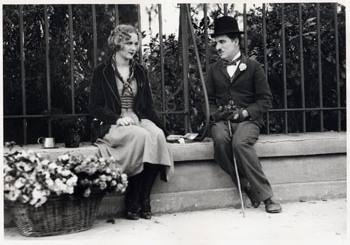
Charlie first meets the blind flower girl

But aside from the superb technicalities, the dramatic lighting, and the slapstick choreography, what anchors the film and raises it above mere madcap film-making is the story itself.

The Little Tramp has fallen in love with a blind flower girl, and she with him, but she mistakenly believes he is a millionaire. (When we–and Charlie–first meet her, a fleet of fancy cars had just pulled up to where she sells her wares. She believes that Charlie belongs with them. Several other coincidences add more credence to her misunderstanding.) As the story moves forward,  Charlie goes to great lengths to get her money not only to avoid eviction but to take part in a experimental cure for blindness, and his efforts finally land him in jail.

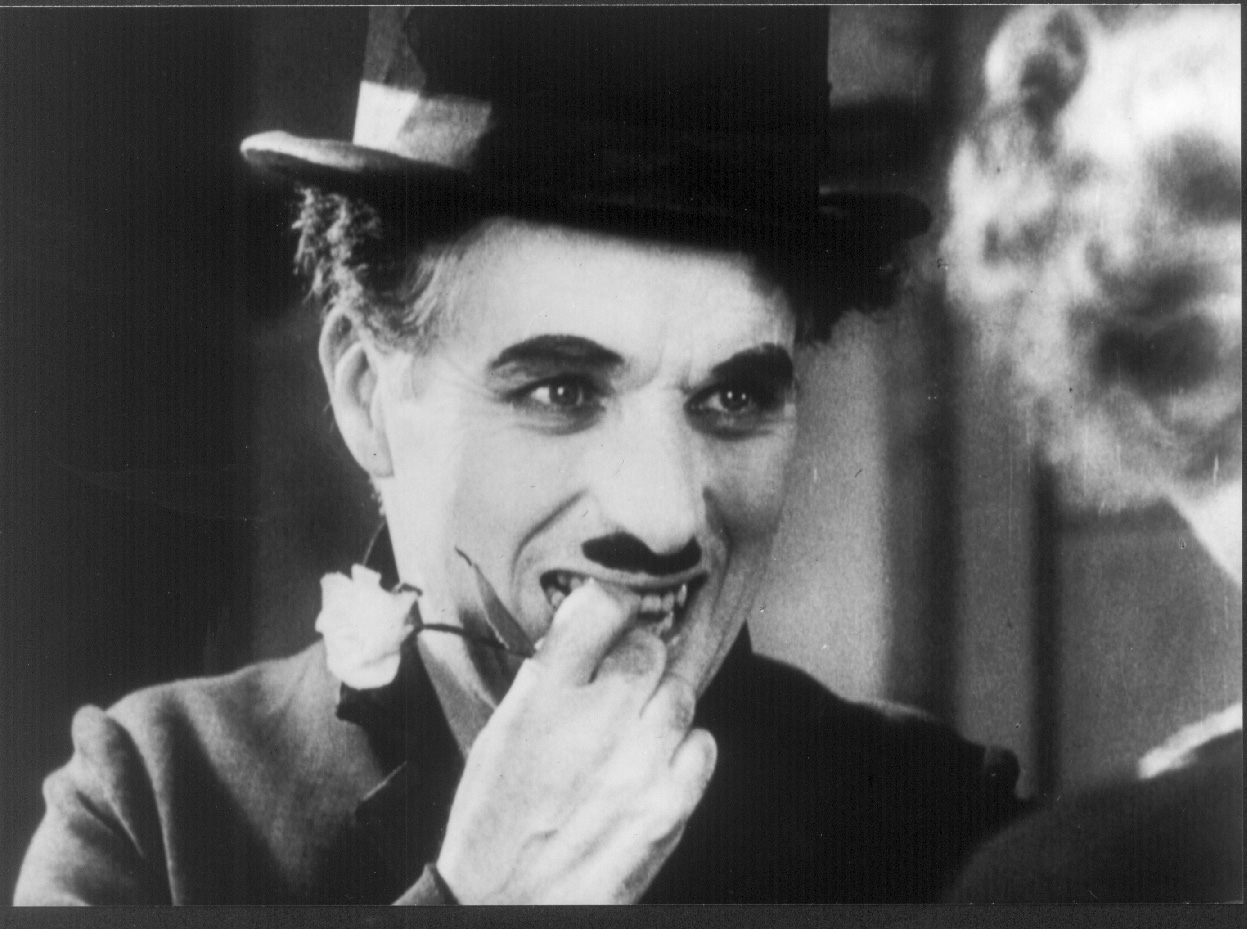
By the time  he is released from prison, she is cured. She can see.  And yet the rich prince she had imagined as her benefactor is a far cry from the Little Tramp she notices at the end. The scene where this is discovered has been called one of the high points of movie making.  The acting is all in the face. It is subtle, internal and real. (see the picture at the top of the post, look at Chaplain’s eyes, imagine what he is thinking.) And it is very hard not to beome a little teary when viewing it. It is not cloyingly sentimental–and it very well could have been. It is perfect.

The Little Tramp was a masterful creation. Always gentle, polite, and kind, he often acted as a foil to the crassness and cold-heartedness of modern life. From his position at the bottom of the social ladder, the Little Tramp sweetly pointed out the foibles of those above him.

Here is a delightful clip from the movie Chaplin in which Chaplin (played by Robert Downey, Jr.) creates the character of “the Little Tramp.”  Enjoy.

Reading, writing, and laughing with Anne Lamott

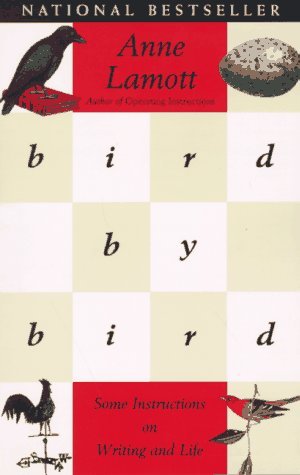
A woman I work with is teaching a course in Creative Writing that I will be teaching in January. She has assigned a book for her students to read: bird by bird: Some Instructions on Writing and Life by Anne Lamott.

And in a marvelous feat of procrastination, I decided to begin reading it as well–instead of the three other books that I need to be reading right now for the classes I am currently teaching.

And it was a good decision.  I have not yet completed it–but I have laughed through much of it.  Lamott has a voice–a way with words– that seems nurturing, real, wise and funny.

For instance: “We are a species that needs and wants to understand who we are. Sheep lice do not seem to share this longing, which is one reason why they write so very little.”
Where in the world did those “sheep lice” come from? But better yet, look at the next to the last word–“very.”  How perfect is “very” in this instance.

She gives us a bit of her own background, her bookish parents, her father the writer, her feelings of insecurity and isolation–the gist of many a writer’s baggage. And she gives us episodes from the writing courses she teaches.  Many of her students, it seems, don’t want to write, they want to be published. They want the fame, the riches, the sense of satisfaction that they believe they will attain when they are published.  And they are so wrong.  And yet, time and again in her courses questions about agents, editors and publishers  maddeningly outnumber questions about writing.  She tells them to try to get a refund on their tuition!

There are no special formulas, secret tricks, magic keys that will get you published, she tells them. And to illustrate that she tells this story:

My son, Sam, at three and a half, had these keys to a set of plastic handcuffs, and one morning he intentionally locked himself out of the house. I was sitting on the couch reading the newspaper when I heard him stick his plastic keys into the doorknob and try to open the door. Then I heard him say, “Oh, shit.” My whole face widened, like the guy in Edvard Munch’s Scream. After a moment I got up and opened the front door.

“Honey,” I said, “what’d you just say?”

I said, ‘Oh, shit,” he said.

“But, honey, that’s a naughty word. Both of us have absolutely got to stop using it. Okay?”

He hung his head for a moment, nodded, and said, “Okay, Mom.” Then he leaned forward and said confidentially, “But i’ll tell you why I said ‘shit.’ I said Okay, and he said, “Because of the fucking keys!”

There are no “fucking keys” that will get you in, she tells her students–and some get it and some don’t.

The best advice she says she ever received about writing–and which she passes on to her students–came from  the writer Natalie Goldberg.  When asked for the best possible writing advice, Goldberg picked up a pad of paper and mimicked the act of writing, page after page after page. The best advice?  Write and write and write and write.

So I am enjoying this book immensely but not necessarily for its writerly advice. I am enjoying Lamott’s voice, the natural flow of her words, the wise humor of her thought.

In describing, a person she does not like, whom she believes even God dislikes, she repeats this observation that a priest friend of hers passed on: “…you can safely assume you’ve created God in your own image when it turns out that God hates all the same people you do.”

How perfect.

First day of school…wait ’til you see the books!

School started this week.  And I’ve got a whale of a course load–five separate courses with five separate reading lists.  But the nice part about it, I got to choose the books.  So here is what we’re reading:

AP Literature and Composition

Brave New World. Aldous Huxley
The Handmaid’s Tale. Margaret Atwood
Crime and Punishment. Fyodor Dostoyevsky
The Stranger Albert Camus
Oedipus Rex Sophocles
Antigone Sophocles
A Doll’s House Henrik Ibsen
Hedda Gabler Henrik Ibsen
Hamlet William Shakespeare
Rosencrantz and Guildenstern are Dead Tom Stoppard
Slaughterhouse-5 Kurt Vonnegut
Catch-22 Joseph Heller
Invisible Man Ralph Ellison
The Piano Lesson August Wilson
Who’s Afraid of Virginia Woolf Edward Albee

Literature and Film

One Flew Over the Cuckoo’s Nest Joseph Heller
Winter’s Bone Daniel Woodrell
Revolutionary Road Richard Yates
The Commitments  Roddy Doyle
The Human Stain  Phillip Roth

The Contemporary Short Story

Best American Short Stories of 2011 Geraldine Books (editor)
The New Yorker magazine

Creative Writing

The 3AM Epiphany Brian Kiteley
The Practice of Creative Writing Heather Sellers
Bird by Bird: Some Instructions on Writing and Life Annie Lamott

Modern Irish Literature

A Portrait of the Artist as a Young Man  James Joyce
Dubliners James Joyce
Butcher Boy Patrick McCabe
Waiting for Godot Samuel Beckett
The Complete Plays of John Millington Synge
The Lonesome West Martin MacDonagh

Now, I have to admit this is a pretty hefty reading list.  Many of the titles I have read multiple times, and some as recently as last year and each of the three years before that.  But as for others, it has been a good while and I’m going to have dig in and get them read.

And of course this is all supplemented with various handouts of Yeats and Heaney and MacNiece, of Hemingway and O’Connor (Flannery and Frank), of modern poets and ancient classical texts.

My boys are getting quite a load.  Some appreciate it. Many don’t.

But that’s okay.  At least they’ve been exposed to the things I love–and sometimes I think that could be contagious.