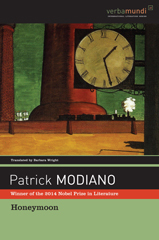
Book Cover for Honeymoon by Patrick Mondiano
It is perhaps a sad testimony to how parochial my reading has become. There was once a time where I knew almost every Nobel Prize for Literature winner–would have yearly bets with colleagues and follow the London odds makers’ short lists. And while my knowledge was primarily eurocentric/american, I was an early reader of the Egyptian Naguib Mahfouz before he won and I understood that his time was eminent and important. (My sister, after a trip to Egypt, had turned me on to him. I don’t know how, but she brought me back two uncorrected proofs of his novels.)
But again, I am increasingly ignorant of the world’s literature.
Which is why discovering Patrick Modiano is such a wonderful treat. The French Modiano is the 2014 Nobel Prize for Literature winner. And until a New Yorker review of his most recent novel, I had not heard of him nor his winning. Lately, I must have my head very deeply buried in the sand.

Patrick Modiano illustration by Niklas Elmehed © Nobel Media
Honeymoon (published in 1990 in France/1995 in the U.S.) is the novel I decided to start out on. The language is direct, bare and sparse–reminding me much of the first half of Camus’ The Stranger. But the story is intricate and convoluted, told in such an honest style that makes the intricacies and coincidences of life seem matter-of-fact.
There are two stories that braid themselves around two middle and connected ones. On the first page the narrator discovers that a woman in the hotel in Milan where he is staying has committed suicide. He then learns that he had known her once decades when she and her husband had picked him up hitchhiking and had taken him in and cared for him for several days.
This coincidence sets the man on a quest–of sorts. After his wife and his business partner (her lover) drop him off at the airport where he is to fly to Rio de Janeiro for business, he disappears. He takes a plane back to Milan and then returns to Paris, where he goes to ground and hides in the outer arrondissements.
His purpose is to make sense of the woman’s suicide, of her life.
We find that he has been obsessed with this couple for a long time, ever since his youth, long before the knowledge of her death. He has taken numerous notes, cut out clippings, and prepared to write a memoir of the couple, and so he tells us of their hardships and trials during the Nazi occupation of France.
While we at the same time are following his exploits in the Parisian neighborhoods, aware of his wife’s comings and goings, and preparing for a new life in his rougher world.
All the plot threads, in a way, revolve around a single newspaper clipping from the 1940s searching for the woman who suddenly went missing when she was sixteen years old. (From what I have learned, the actual clipping is what sent Modiano himself to fashion his story.) She had simply stepped out of the Metro and moved from one world–a constricting and dangerous world in Nazi occupied Paris–to another. Her abrupt relocation parallels the narrator’s who moves from his bourgeoise life as a documentary filmmaker married to a high-fashion model to an uncertain world in the boondocks of Paris, seeking for understanding of the couple who once showed him much kindness.
I said that I had started out on Patrick Modiano by selecting Honeymoon. It is only a starting point. I look forward to picking up another.

 was going “tomak stuffing.” She had texted hurriedly and meant to say that she was going “to make stuffing.”
 j. p. bohannon