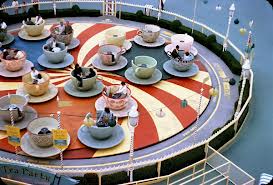
Watching the wheels go round and round

photo from “Gorillas don’t Blog,” November 3, 2011

I woke today in one of those states.  I didn’t know who I was or where I was or what I was supposed to be doing. And as I seeped into clearer consciousness, I felt in a rut…already in a rut at 4:45 a.m. Geeesh!

The day begins: the 57 bus, the Market-Frankford El, the R5 train and then a brisk walk, hoping for a co-worker to come driving by. I will do the reverse in the evening. And then again tomorrow and tomorrow and tomorrow.

But the commute is not what was getting me. I enjoy it. I get plenty of reading done–and not a little dozing as well.  But something wasn’t sitting well.

Simply, I am not sure what I am doing. 

For work, I am teaching Atwood’s The Handmaid’s Tale, Woodrell’s Winter’s Bone, and Jim Shepherd’s Like You’d Understand Anyway. But I ask myself, “What am I teaching?” Sure they are great reads. They are more than that: they are thoughtful, engaging, and well-suited for introspection, reflection, and–hopefully–understanding.  But, as for today…meh.

I know that it is a passing feeling, the not uncommon question of  “Is that all there is?”

And I know I will get pumped by the next great book I encounter, by the old song that I hear from someone else’s radio, by a magnificent movie that comes in under the radar, by good craíc shared with friends. 

But today the feeling is real. It is simply something you work through.

I was listening today to John Lennon’s “Watching the Wheels Go Round.”  I was thinking beforehand that it reflected my own feelings today.  But it was just the opposite.

Lennon is watching “the wheels go round” because he had gotten off the merry-go-round, had walked out of the maze, was no longer “playing the game.”  He was enjoying the real things–his wife, his child, his new life.

But at the moment, for me (as for most of us),  I need to stay on the merry-go-round as it continues to spin, mindlessly, pointlessly and without destination. 

Nevertheless, today I am listening to what John says and that always seems hopeful.

Hackles, Philly Fringe Festival and a personal ghost

Photo courtesy of Groundswell Players

The Philly Fringe Festival and the Live Arts Festival have been running concurrently in Philadelphia for the past few weeks.  This usually means that there is an abundance of cutting edge theater, dance, performance, readings going on throughout the city, and this year it seems even more so.

For the past three years we have had a friend, Pia Agarwal, who worked for the festivals and always gave us a heads-up on what to see.  And she was never wrong.

But she’s moved to Austin, so we were on our own.

Fortunately, I know Nick Gillette, who is finding some success in the local theater scene.  This year, for the Fringe Festival,  he directed one play, Myths and Monsters,  at the Adrienne Mainstage and performed in another Hackles at the Crane Arts Old School White Space.

On Saturday night I went and saw Hackles. I have been in this venue twice before and each time have been wowed and impressed. This night was no different.

Groundswell Players in rehearsal for Hackles
(photo: Emma Lee/for NewsWorks)

“Devised” by the Groundswell Players–students at the Pig Iron School for Advance Performance Training–the play features four actors who take on a variety of roles. The main roles however are a blind old man, his daughter, his cockatoo, and Death itself. Scott Shepherd, who played the cockatoo–incredibly well by the way–also played the daughter’s hesitant boyfriend. The other additional roles–teacher, fellow students, policeman–were negligible and merely stock figures to keep the plot moving.

When  the cockatoo dies, the daughter–played by Martha Stuckey–believes she sees Death come and take the bird’s soul. Later, she witnesses an accident (off-stage) and sees this female incarnation of Death (played by Alice Yorke) more clearly and more definitely.

She tells her blind father (Nick Gillette), who is fascinated by what she relates and who believes that the dead continue to contact us through the holes in the static of his off-station transistor radio.

There is still more death, in the past and yet to come, but there is also great hope: the play ends with the awkward daughter and her boyfriend figuring out how to slow dance while Al Green’s version of  “How Can You Mend a Broken Heart” plays on the father’s no-longer-static radio.

The set was very cool–pure white walls with clear plastic opened umbrellas suspended from the ceiling. There was minimum furniture–the father’s table and chairs and a cabinet-like piece that was spun around–and great lighting.  There were two or three scenes with a scooter and roller-blades which could have been discarded, but as for the rest, it was perfect.

The play combined physical performance, comedy, metaphysics and domestic drama in a piece that was entrancing, engaging and thoughtful.

But the play was not what raised the “hackles” on my neck!

After the play, a number of us met in the parking lot, going over what we were doing and where we were going next.  Someone had an iPhone and asked someone else to take a picture of us all gathered.

No one, however, invited the ghost, who appears behind my head.

I have now studied this picture backwards and forwards, have enlarged it as much as I could and still see clearly, and it doesn’t make sense. Granted, the play dealt with death and the afterlife and the conviction that spirits communicate with us regularly, but I didn’t expect them to come out to an abandoned grammar-school parking lot. She seems to be in period costume–and our play was in modern dress; In fact, Death was dressed in a sexy black cocktail dress.  So she’s not from the play and she isn’t from the audience; her proportions seem larger than those walking out of the building; and she wasn’t with us.

So where do we go with this?

Nothing, nothingness, and the world: a book review of Why Does the World Exist? by Jim Holt

I am reading about nothing.  Literally, about nothing.  I am reading about the concept of nothingness, and it’s a pretty difficult thing to get one’s head around.

Philosophers, theologians, mathematicians, and physicists have been puzzling the concept for a very long time, and it is quite a hot button in philosophical and scientific circles today.

In the West the concept of nothing is relatively new. 

In fact, it wasn’t until the mid-14th century that the idea of “zero” came to the West. And then, it came to us through accounting.  Something had to stand between asset and debit.

The East, however, had long dealt with nothingness not only in their mathematics but in their spirituality as well. For after all, attaining “nirvana” was equal to attaining nothingness, to achieving “emptiness.”

The Hindu word for this nothingness was sunya, which became in Arabic sefir, which came to Europe in the Middle Ages and is the root of our word “zero” and “cipher.”  And when it came to Europe, it came along with the rest of the Arabic numerals that we use today.

And yet what is nothing? There are many who say that no such thing exists.

The philosopher Henri Bergson tried to imagine nothingness. He simply kept subtracting all that he knew existed. However, when he reached the end he felt there was still something–his inner self which was doing all this subtracting. (An enlightened Buddhist would perhaps be able to extinguish that entity, but most of us cannot.) He concluded that imagining absolute nothingness is impossible.

Another philospher, Bede Rendell, saw that the failure in imagining nothingness is that after one had subtracted everything that was in the universe, one still had the space where those things once existed–a universe skin collapsed on itself.

The entire conversation is both intriguing and maddening, puzzling and wondrous.  (Sort of like in Alice in Wonderland when the Red King concludes that since nobody passed the messenger on the road, then nobody should have arrived first.)

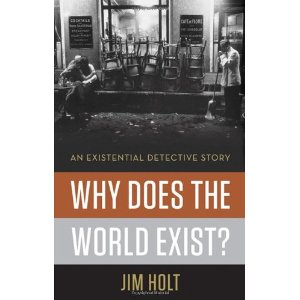
I am having this “conversation” with myself because of the book Why Does the World Exist?–An Existential Deterctive Story by Jim Holt.  Holt’s book, which is somewhat addressed to the lay reader (I can only imagine what a technical book on this subject might be like), springs from the question “Why is there Something rather than Nothing?” 

This question, I have learned, is one that has puzzled philosophers for aeons.

And when you get to the question of “something” and “nothing” you are led to the question of what “existed” in the universe before the “Big Bang” created the universe. The theologians have their answer. The scientists are not all that sure.  But they have their theories.

And both try to define or dismiss “nothing.”

All of which makes for fascinating reading.  Even the mathematical equations (which Holt has to explain to me or which I run to my resident philosopher/mathematician) are fascinating. For instance, his mathematical equation for absolute nothingness is

(X) ˜ (x=x)

and now seems to makes some sense to me. But it took a while for me to get to. (The equation means that X [the empty universe] is not where x = x [where something is something.]) He explains it much better and is  much more entertaining.

I am no philosopher or mathematician. My sense of the void, of nothingness–aside from my own existential angst and probings seeemingly hardwired in my soul–comes from Satre, Camus and Beckett.  And Holt brings these into the mix as well. (The cover of the book features a photograph of the Café de Flore, a favorite haunt of Sartre’s.) The book, in many ways,  is almost a primer of thinkers, ancient and new, and a wonderful introduction to the confluence of metaphysics, philosophy, literature and science.

And what  they ask is:  Why is there something rather than nothing?  Why is there a world?  A universe?

These are pretty big questions to roll around with and Holt’s book makes it a entertaining and informative  ride.

But to be truthful, I still don’t know the answer.

Job’s question, the Death of a Child and Ben Jonson’s poetry

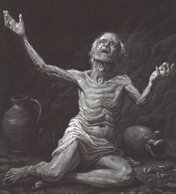
Job asking “Why?” Asking “How much more?”

Last year, a friend of my sister had a 4-year old child drown in a neighborhood swimming pool.  One would think that was enough for any parent to bear.

Last week, the very same woman’s 4-month old baby died in her crib—a case of SIDS.

This is a Job-like battering.   How much more can two people take?  How much more? They can’t be looking to sense, or reason, or “God’s plan.”  None of that can help, certainly not at the moment.

Lately, I have had a number of friends and relatives  who have lost aging parents. Sad as that is, it is reasonable and acceptable—part of the pattern of life.  But the death of a child?  No.

And there are thousands of children all over the world who die every day of disease, mal-nourishment, war, violence, and mere accident.

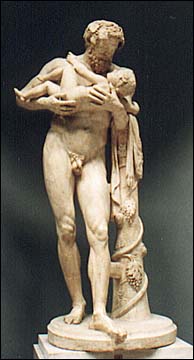
Statue of Father and Son
Vatican Museums. ©1999 A. Jokinen.

I used to teach a poem by Ben Jonson. If Shakespeare had not come along the era would have probably been known as “the Age of Jonson.”  He was much more successful, much more popular than Shakespeare was during his life.  And yet, he is not really part of the common culture today.  Shakespeare has pushed him aside.  But he is good and he is important. Here is the poem in which Jonson tries to deal with the death of his son: 

On My First Son
by Ben Jonson

Farewell, thou child of my right hand, and joy ;
    My sin was too much hope of thee, lov’d boy.
Seven years thou wert lent to me, and I thee pay,
    Exacted by thy fate, on the just day.
Oh, could I lose all father now ! For why
    Will man lament the state he should envy?
To have so soon ‘scaped world’s and flesh’s rage,
    And if no other misery, yet age !
Rest in soft peace, and, asked, say, Here doth lie
    Ben Jonson his best piece of poetry.
For whose sake henceforth all his vows be such
    As what he loves may never like too much.

Jonson’s first son—also named Benjamin, which in Hebrew means “Son of My Right Hand”—died when he was seven years old. Jonson, renowned and celebrated for his poetry and drama, puts it all in perspective and rates this dead son as the best thing he has ever created.  One can feel the father’s pain in the final two lines–the fear of “liking too much” that which one loves.

Movie Review: City Lights by Charlie Chaplin

I began showing City Lights to my students last week. It is for my “Literature and Film” class and while I don’t necessarily have a “literature” to couple with,  I think it is a film that everyone should see.

In fact, I believe it is one of the finest movies ever.

(The AFI ranks it as number 76 of the 100 best American movies of all time. Chaplain’s  The Gold Rush is ranked two slots before it at 74 and his Modern Times several below it at 81. Chaplin leads all directors with having three in the top 100.)

Yet art is not a contest. And City Lights is pure art.

Most of my students have never seen a movie in black-and-white! And they immediately say (and moan)  that they have never seen a silent movie. Yet, City Lights is not a silent movie. Chaplin made the movie well past the advent of the “talkies.” He chose silence for his “Little Tramp” because giving him a voice–and a language–would impair his universally beloved appeal. In speaking no language, the Little Tramp belonged to all languages. And so Chaplain dubbed City Lights a romantic pantomine.

But it is false to state that it is a silent movie.  There is a omnipresent score (written by Chaplin) as well as several moments of sound. In the boxing ring, the bell signalling the end of a round clangs time and time again–the rope pulling the bell is tied around the Little Tramp’s neck and every time he hits the floor the bell sounds. An opera singer’s performance at a high society party is disrupted by the piercing whistle that the Little Tramp has inadvertently swallowed. And perhaps the best of all is the nonsensical sounds that emit from the braying politician and socialite at the film’s beginning.  Chaplin did not suffer fools easily and pompous power brokers are a large and easy target. (There is a series of holiday Charlie Brown television specials here in the States and in them all the adults speak no language; they simply bray these “wah, wah, wah” sounds.  I have to wonder if they picked it up from Chaplin’s City Lights.)

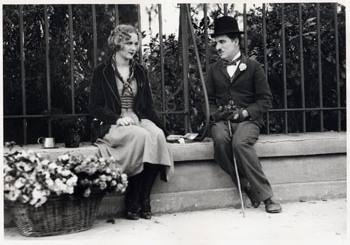
Charlie first meets the blind flower girl

But aside from the superb technicalities, the dramatic lighting, and the slapstick choreography, what anchors the film and raises it above mere madcap film-making is the story itself.

The Little Tramp has fallen in love with a blind flower girl, and she with him, but she mistakenly believes he is a millionaire. (When we–and Charlie–first meet her, a fleet of fancy cars had just pulled up to where she sells her wares. She believes that Charlie belongs with them. Several other coincidences add more credence to her misunderstanding.) As the story moves forward,  Charlie goes to great lengths to get her money not only to avoid eviction but to take part in a experimental cure for blindness, and his efforts finally land him in jail.

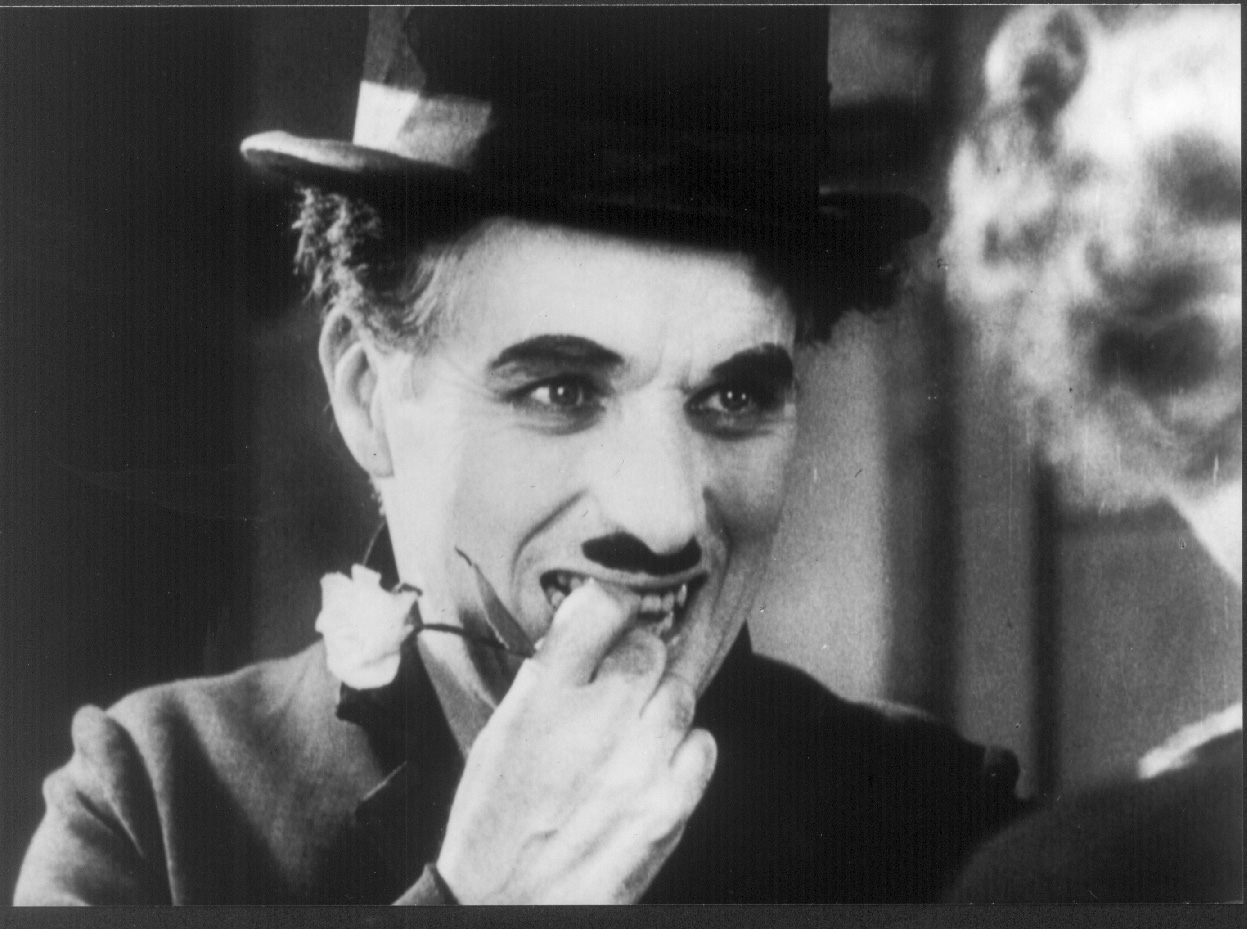
By the time  he is released from prison, she is cured. She can see.  And yet the rich prince she had imagined as her benefactor is a far cry from the Little Tramp she notices at the end. The scene where this is discovered has been called one of the high points of movie making.  The acting is all in the face. It is subtle, internal and real. (see the picture at the top of the post, look at Chaplain’s eyes, imagine what he is thinking.) And it is very hard not to beome a little teary when viewing it. It is not cloyingly sentimental–and it very well could have been. It is perfect.

The Little Tramp was a masterful creation. Always gentle, polite, and kind, he often acted as a foil to the crassness and cold-heartedness of modern life. From his position at the bottom of the social ladder, the Little Tramp sweetly pointed out the foibles of those above him.

Here is a delightful clip from the movie Chaplin in which Chaplin (played by Robert Downey, Jr.) creates the character of “the Little Tramp.”  Enjoy.

Reading, writing, and laughing with Anne Lamott

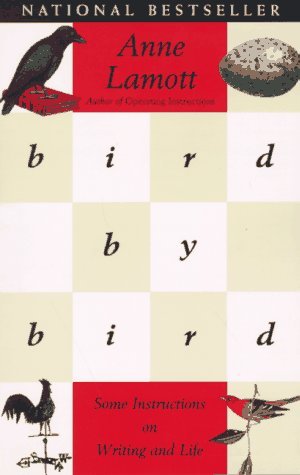
A woman I work with is teaching a course in Creative Writing that I will be teaching in January. She has assigned a book for her students to read: bird by bird: Some Instructions on Writing and Life by Anne Lamott.

And in a marvelous feat of procrastination, I decided to begin reading it as well–instead of the three other books that I need to be reading right now for the classes I am currently teaching.

And it was a good decision.  I have not yet completed it–but I have laughed through much of it.  Lamott has a voice–a way with words– that seems nurturing, real, wise and funny.

For instance: “We are a species that needs and wants to understand who we are. Sheep lice do not seem to share this longing, which is one reason why they write so very little.”
Where in the world did those “sheep lice” come from? But better yet, look at the next to the last word–“very.”  How perfect is “very” in this instance.

She gives us a bit of her own background, her bookish parents, her father the writer, her feelings of insecurity and isolation–the gist of many a writer’s baggage. And she gives us episodes from the writing courses she teaches.  Many of her students, it seems, don’t want to write, they want to be published. They want the fame, the riches, the sense of satisfaction that they believe they will attain when they are published.  And they are so wrong.  And yet, time and again in her courses questions about agents, editors and publishers  maddeningly outnumber questions about writing.  She tells them to try to get a refund on their tuition!

There are no special formulas, secret tricks, magic keys that will get you published, she tells them. And to illustrate that she tells this story:

My son, Sam, at three and a half, had these keys to a set of plastic handcuffs, and one morning he intentionally locked himself out of the house. I was sitting on the couch reading the newspaper when I heard him stick his plastic keys into the doorknob and try to open the door. Then I heard him say, “Oh, shit.” My whole face widened, like the guy in Edvard Munch’s Scream. After a moment I got up and opened the front door.

“Honey,” I said, “what’d you just say?”

I said, ‘Oh, shit,” he said.

“But, honey, that’s a naughty word. Both of us have absolutely got to stop using it. Okay?”

He hung his head for a moment, nodded, and said, “Okay, Mom.” Then he leaned forward and said confidentially, “But i’ll tell you why I said ‘shit.’ I said Okay, and he said, “Because of the fucking keys!”

There are no “fucking keys” that will get you in, she tells her students–and some get it and some don’t.

The best advice she says she ever received about writing–and which she passes on to her students–came from  the writer Natalie Goldberg.  When asked for the best possible writing advice, Goldberg picked up a pad of paper and mimicked the act of writing, page after page after page. The best advice?  Write and write and write and write.

So I am enjoying this book immensely but not necessarily for its writerly advice. I am enjoying Lamott’s voice, the natural flow of her words, the wise humor of her thought.

In describing, a person she does not like, whom she believes even God dislikes, she repeats this observation that a priest friend of hers passed on: “…you can safely assume you’ve created God in your own image when it turns out that God hates all the same people you do.”

How perfect.