“Love Poem” by John Frederick Nims…all the toys of the world would break.

Love Poem
(by John Frederick Nims)

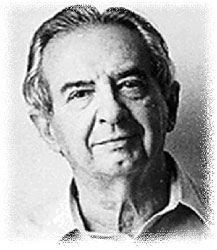
John Frederick Nims (1913-1999)

My clumsiest dear, whose hands shipwreck vases,
At whose quick touch all glasses chip and ring,
Whose palms are bulls in china, burs in linen,
And have no cunning with any soft thing

Except all ill-at-ease fidgeting people:
The refugee uncertain at the door
You make at home; deftly you steady
The drunk clambering on his undulant floor.

Unpredictable dear, the taxi drivers’ terror,
Shrinking from far headlights pale as a dime
Yet leaping before apopleptic streetcars—
Misfit in any space. And never on time.

A wrench in clocks and the solar system. Only
With words and people and love you move at ease;
In traffic of wit expertly maneuver
And keep us, all devotion, at your knees.

Forgetting your coffee spreading on our flannel,
Your lipstick grinning on our coat,
So gaily in love’s unbreakable heaven
Our souls on glory of spilt bourbon float.

Be with me, darling, early and late. Smash glasses—
I will study wry music for your sake.
For should your hands drop white and empty
All the toys of the world would break.

I once read this poem in public to a group of twenty to twenty-five people. Afterwards, a woman came up to me and said that I had brought her to tears.  Although it was a nice compliment, I knew surely that it wasn’t I that did it.  For who could hear those final lines “For should your hands drop white and empty/All the toys of the world would break” and not get a catch in their throat?

I love this poem because it is an anti-ideal love poem.

Shakespeare did the same thing 400 years ago with his Sonnet 130 (“My mistress’ eyes are nothing like the sun.)

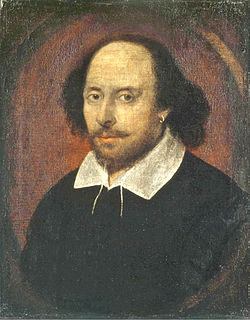
My favorite portrait of Shakespeare

My mistress’ eyes are nothing like the sun;
Coral is far more red than her lips’ red;
If snow be white, why then her breasts are dun;
If hairs be wires, black wires grow on her head.
I have seen roses damasked, red and white,
But no such roses see I in her cheeks;
And in some perfumes is there more delight
Than in the breath that from my mistress reeks.
I love to hear her speak, yet well I know
That music hath a far more pleasing sound;
I grant I never saw a goddess go;
My mistress when she walks treads on the ground.
And yet, by heaven, I think my love as rare
As any she belied with false compare.

Here too, the poet celebrates the flaws and the humanness of his beloved. In embracing her reality–and announcing that he has no need to “belie her with false compare” as so many other poets did–he claims a superior, purer love… “a love as rare” in Shakespeare’s words.

Both men, separated by four centuries, are similarly battling against a constructed “ideal.”  Whether it was the “ideal woman” presented by the Renaissance sonneteers or the “ideal woman” fashioned by Hollywood and Madison Avenue, it was a false image.  And both men knew it.  Their love, they claim, is special because it is grounded in the real world, not in an imaginary, air-brushed, wish-fulfillment world.  Their love exists in the everyday, “everyman/everywoman” world that most of us mortals inhabit.

We know little of Shakespeare’s beloved except for what she looks like: dark hair, pale-lipped and dun-skinned, bad-breathed, clunky-walking and shrilly-voiced. Nims, on the other hand, gives us more information about the object of his love.  She deftly handles those who are ill-at-ease, exiled or drunk; she moves easily with words and people and wit and love. Certainly, she has her frenetic failings–and Nims recounts them with affection– but that is not what makes her unique; that makes her human.  She is much more than that.  She is unique in the welcoming warmth of her love, in her compassion for and embrace of life.

Nims truly appreciates and loves her for what she is. And isn’t that what all of us is looking for?

Work in Progress

Selections from THE NOTEBOOK ON EVERYTHING
(Arranged in Alphabetical Order for Convenience)
By
J. P. Bohannon

Andromache: cf. Racine, Jean.

Antigone:  “Antigone inspired Hegel to his magisterial meditation on tragedy: two antagonists face to face, each of them inseparably bound to a truth that is partial, relative, but, considered in itself, entirely justifiable.” (The Curtain, Milos Kundera, page 110). Kundera then says that History cannot therefore be tragic. What in his definition allows him to say this:   “Inseparably bound”?   or “a truth that is partial, relative, but …entirely justifiable”?

Beauvoir, Simone de:  “There were other humiliations for Simone as well: she was the last chosen for any game or athletic contest, and her efforts to join any of the playground groups were usually greeted with hooting laughter.  With the innocent cruelty of children she was scorned by her schoolmates as much for her ill-fitting clothes and general untidiness as for her self-important pronouncements.  She was a gawky chatterbox, entirely friendless.  There really was no model, no influence, no one and nothing at all in her life to help her develop any social or societal graces.”  (Simone de Beauvoir: A Biography, Deidre Bair, p. 63.)  QUESTION: Does unpopularity on the playground and in the classroom affect children so that they have one of two choices when they reach adulthood: greatness or psychosis?

Brain Mass:  “One of his patients was a postgraduate student with an IQ of 126, a first-class honours degree in mathematics, a regular social life and virtually no brain. ‘Instead of the normal 4.5-centimetre thickness of brain tissue between the ventricles and the cortical surface, there was just a thin layer of mantle measuring a millimeter or so. His cranium is filled mainly with cerebrospinal fluid.’ ”
James Hamilton-Patterson, “Do Fish Feel Pain?” Granta: This
 Overheating World,  No 83, Fall 2003, pp161-173.

Cockney Slang:   I go into a pub in London and see some people I know.  I order a pint and ask the others if I can get them one.  “Nah, I’m Van Gogh,” says bald-headed Nick.  “Wha?”  I answer back. “I’m Van Gogh,” he says. “I’ve got one ‘ere.”

The Colombo Club: I worked for a while for a group of bricklayers, the Calabrese Brothers. On Fridays, in the summer we would quit early and go to the Colombo Italian Club on the Lansdowne Road.  There were darts, shuffleboard, and cards. They always paid us in cash. Much of it stayed there on a Friday night.

Drew, Ronnie (of The Dubliners):  As a teenager, my friend Justin once dated Ronnie Drew’s daughter.  He went for tea one afternoon at their house, and while the women were busy in the kitchen, Ronnie spoke his first words to him: “If you get her up the pole, I’ll feking kill you.”  Despite this Justin and the girl remained friends, and at her 21st birthday bash, he met Van the Man.  Wikipedia cites Ronnie Drew in its article on Finnegans Wake for his recitation of the Humpty Dumpty poem.

Eliot, T.S.:  Pound X’d out the entire first 54 lines of The Wasteland and Eliot accepted his changes.  (And that was just the first 54 lines. Pound’s heavy pen is crossing things out throughout the original typescript.) The poem originally began: “First we had a couple of feelers down at Tom’s place,/There was old Tom, boiled to the eyes, blind.”  For some reason, I never imagine Eliot getting sloshed or womanizing but there it is: “Get me a woman, I said; you’re too drunk, she said,/ But she gave me a bed, and a bath, and ham and eggs.”  Even if it is another character and not the poet (isn’t that some sort of fallacy we learned once in school) that particular world seems alien to that pursey-lipped banker.

The Ginger Man: A woman accosted me on the 110 Bus from 69th Street to West Chester while I was reading The Ginger Man by J. P. Dunleavy. She called it sexist, misogynist and misanthropic.  I told her I always loved the guy drinking at the pub in a kangaroo costume and that’s why I wanted to read it again.  She had bright red lipstick with much of it stuck on her beautiful teeth.

Ibsen:  Someone compared Billy Wilder’s The Apartment with Ibsen’s plays. The comparison made sense.  In fact, it was said that Torvald’s bank seemed enlightened compared to the work place in Wilder.

Irish Phrases:  
Aris, mo bhuachailin Ní thagann ciall roimh aois  = Sense doesn’t come before age

Joyce, Lucia.  She had strabisimus and was an accomplished dancer.  She was also highly intelligent, although wasn’t given much credit for it. She was diagnosed schizophrenic. A very tall shadow blocked her sun.

Kafka:  Kafka means crow in Czech.

Kundera, Milos: In The Incredible Lightness of Being, the character Sammy says that she thinks of New York as “Beauty by Mistake.”  What a great phrase!  I copy it down in my journal.  It will be the title of my next novel, CD, film, whatever.  I begin a short story with the title, but do not get very far.  Last month, the NYTIMES featured an article tracing Kundera’s appearances in its Book Reviews.  The article is titled “Beauty by Mistake.”    AAAARRRGH!

Madonna:   A good pun for the iron Madonna sculpture in my cemetery story: “A ferrous-wheeled Madonna.”  I love it.

Madonna (the singer): Toni, who flew out to LA to waitress at the Vanity Fair Oscar party, told me that Madonna seemed to want to talk only to other faux-Brits.

New Words:
Parp  1. (verb) To break wind, to fart.
2. (noun) Nonsense, rubbish.
…a green double-decker bus that parped its horn at him.

Paine, Thomas:   (Letter to the Editor, London Review of Books, 4 January 2007).  “In John Barrell, the London Review tasked a truffle hunter to examine Christopher Hitchen’s book Thomas Paine’s ‘Rights of Man‘ (30th November 2006).  But instead of sniffing out tasty morsels for salivating LRB readers, Professor Barrell chose to stick his snout in a cow pie.”  Marvelous!!!!

The Puck Building:  Originally built in 1886.  A second building was added on in 1893 when Lafayette Street pushed through.  The statue of Puck is a duplicate of the original.  The original stood over the doorway.  It’s the building where Grace worked in the television show, Will and Grace.

Quiche Lorainne:
1 9-in. unbaked pie shell
8 slices of bacon
6 ounces Swiss Cheese, shredded
1 tbsp flour
½ tsp salt
Dash ground nutmeg
3 eggs
1 ½ cups of light cream

Cook & crumble bacon. Reserving 2 tbsp crumbled backon, place remaining bacon in partially baked pastry shell (450° for five minutes).  Add shredded cheese.  Combie (beat) flour, salt, nutmeg, eggs, & cream.  Pour over bacon & cheese in pasty shell.. Trim with reserved bacon.
Bake at 325° till knife comes out clean, about 25-40 minutes.

Racine, Jean.   Andromache: Orestes →Hermione; Hermione→King Pyrruss; King Pyrruss →Andromache; Andromache→Hector.  (Hector is dead.)  Check out Hector in the made for TV mini-series, The Odyssey.  His death had to be divinely manipulated.

Romanticism:  “The battle of the outs against the ins must be older than history, but the idiosyncratic psychological coloring of the Romantic struggle came from the Romantics’ passionate pride in being out—while, of course, they were struggling to get in.”   (Romanticism and Realism, Charles Rosen and Henri Zerner).

Russian Woman on train:  6/12/06—Russian woman on train. Beautiful. Very dark but with eyes that in one light might be called green but today are sparkling grey—beautiful and literally attractive: they pull you in.  She has two children. One about five in a stroller, another a large baby, slung in some sort of sling.  The R8 out of Philadelphia travels westward towards Chestnut Hill.  It is typically urban. Cement pillars, graffiti, discarded tires, old RR ties, glass.  At one point the tracks cross the Schuylkill River. It is the same scene.  The five year old—who up until this time has been speaking Russian—speaks out in English to his mother: “Look Momma.  It is beautiful.” The Mother also speaks in English only once. A young boy—16 or 17—gets on the train. “Oh, it’s Alex,” she says.  “Alex, Raisa, Hi Alex.”  She was brilliant.  He gave her an adolescent grunt. I wanted to strangle him.

Stevenson, Adlai.  Janet Flanner (in Paris Journal: 1965-1970) quotes Stevenson’s obituary in Le Monde: “The tragedy of Dallas assured to John F. Kennedy a posthumous radiance that memories of Stevenson will never know.  Yet Stevenson during his lifetime was no less an influence than the assassinated President. … Without doubt, Stevenson’s integrity and intelligence were loftier than those of even the elite of American political personalities.

Unacceptable CD Players:
Students may not use CD Players that:
Require an electrical outlet
Accept more than one CD
Have duplication or recording capabilities
                   (from the SAT® Program Associate Supervisor’s Manual, 2006-2007)

Vietnam:  The French lost control of Vietnam after the battle of Dien Bien Phu.  It was in 1954.

While My Guitar Gently Weeps:  How cool is the string quartet in George Martin’s remastered version for the Cirque du Soleil production, Love?  How sweet is George Harrison’s thin voice on the demo tape.

Women:
“Cette fois, c’est la Femme que j’ai vue dans la Ville, et à qui j’ai parlé et qui me parle.” Rimbaud. (“This time I found and spoke to the woman in the city.”)  I don’t know what this means. It often happens with me and Rimbaud.

Zorro:   In the early 1960s my aunt took me to a department store to see Guy Williams dressed as Zorro.  There was an entire set, Spanish-style adobe building, cactus, rough-hewn fence.  I spoke to him for about three minutes.  On another floor, children were lining up to see Santa.  The last time that the actor who played Sgt. Garcia was seen on television was in October, 1967.  He appeared on an episode of Mannix.
Movie Review: The Best Exotic Marigold Hotel…meh

A handful of retirees move to India because elder-care is cheaper there and recent events have altered their vision of what their lives would be like back home in England.  And so separately they move to the Best Exotic Marigold Hotel, advertised for the beautiful and the elderly… a hotel which is still in the early stages of reconstruction.

I wanted to like this film very much.

Afterall, there were magnificent actors:

 Judi Dench
Bill Nighy
Maggie Smith
Tom Wilkerson
Dev Patel
Celie Imrie
Penelope Wilton
Ronald Pickup

There were touching and interesting stories:

• A gay man returning to find an ex-love he believed he had ruined
• A widowed woman trying to be responsible for herself for the first time in forty years
• Young lovers being thwarted by a mother’s demand on arranged marriage
• A decent husband battered by an over-demanding, narrow-minded wife
• A woman wanting one last try at romance
• A man wanting one last try at romance
• Another woman wanting one last try at romance
• A bigoted woman going to India for a hip replacement because she can’t wait for the NHS
• A couple who lost everything in bad investments

And there was extraordinary photography and marvelous settings.

And yet, it all seemed too much…it all seemed to run together.  The film couldn’t seem to decide whether it wanted to be a mad-cap comedy, a fish-out-of-water study, a sentimental love story, a heart-breaking love story, a droll study of old imperialists visiting a once held colony, a humorous clash of cultures. It seem to need a tighter focus.

There is a point made in the film that India is a barrage on the senses; sounds, smells, tastes, sights, textures all come crashing upon the visitor in a way that is often overwhelming.  This seems to describe The Best Exotic Marigold Hotel as well. There was just much too much.

Did I enjoy it?  Yes, it was enjoyable.

Will I forget it? Yes, it is forgettable.

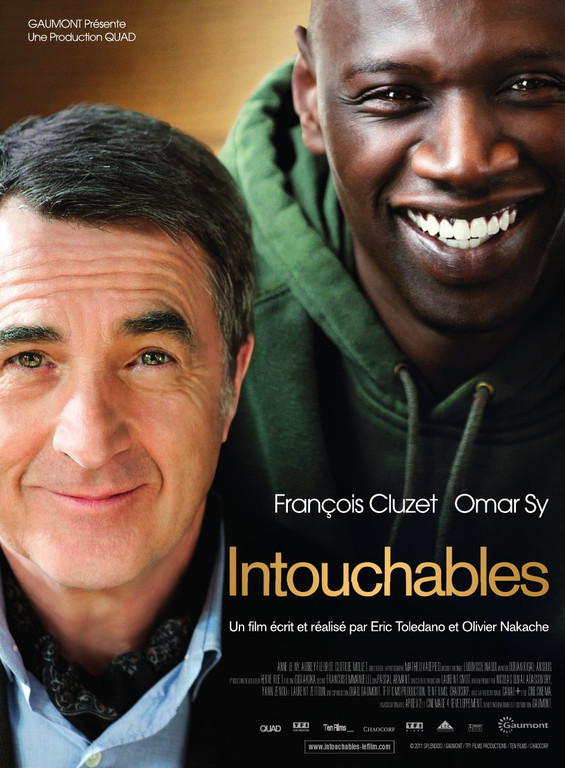
Monday Movie Review: The Intouchables

This is, without a doubt, the most enjoyable movie I’ve seen in a long time.

Two men, from vastly different backgrounds, form a relationship that is simply a delight to watch.

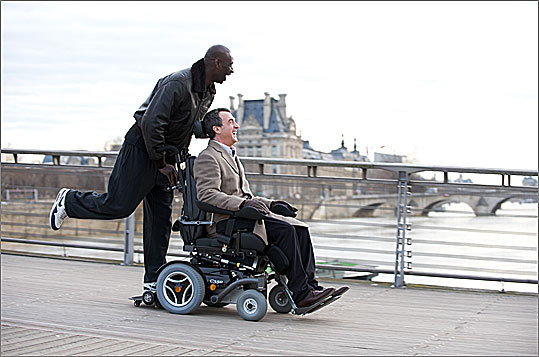
François Cluzet plays Philippe, a very wealthy business magnate who is now a quadriplegic after a para-gliding accident.  Omar Sy plays Driss, a Senegalese thug who lives in the Parisian projects and who becomes Cluzet’s live-in nurse.

The story line is predictable. Driss gets the job, bristles initially at some of its requirements, is overwhelmed by the luxuries of his new world, and rubs up against the expectations of his new boss. Phillipe, on the other hand, admires his new nurse’s honesty and his love of life. By movie’s end, they are very close and very good for each other.

So if the plot is predictable, what is it about the movie that has made the second most popular movie in the history of France film-making? It is the perfect combination of Omar Sy’s over-the-top acting and Cluzet’s subtlety.  Cluzet, because of the physical handicaps of his character, must do all his acting through his face–and his enjoyment of Sy’s infectious joie de vivre is more than obvious.

Sy, on the other hand, dances, mugs, flirts, mimics, and roars laughing–in the rarefied environs of salon receptions, opera boxes, and art galleries.

Driss “pimps” Philippe’s motorized wheel chair so it can go 12 km/hr; he joyfully shares with Cluze the joints he is always carrying around; and in the end, he makes him face his greatest fear.

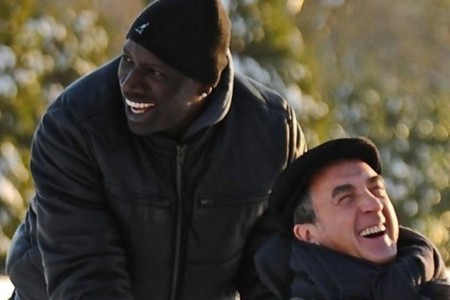
The chemistry between the two actors (and the two characters) is more than charming, and Sy’s relationships with the people around him–Philippe’s  household staff, Philippe’s daughter and her boyfriend, his own extended family in the projects–are both comical and touching, as well.

Based on a true story, Intouchables shows two men, from worlds as different as possible, becoming better human beings because of the presence of each other.

In writing about the film, it is all too tempting to give in to cliché:  It is a buddy movie like no other, a “feel-good” comedy, a lovely entertainment.  But the clichés should not take away from the truth.  Intouchables is in fact a very good film and thoroughly enjoyable from the beginning to the end

As I walked out of the theater I immediately texted a friend to tell him to be sure to get down to see it before it leaves the theaters. I can’t remember when I last enjoyed a movie as much.

Sunday Book Review: Hitch-22: A Memoir by Christopher Hitchens

It is a cliché that one should never meet the writer’s that one admires–disappointment is surely to be the outcome.  Well, Christopher Hitchens is the exception to the rule.

I admire him even more having read his memoir.

As one of the most prolific and provocative essayists of the last thirty-odd years, Hitchens seemed to be everywhere–his journalist’s beat the places where injustice, cruelty, and war loomed most horribly.  From Belfast during the heights of the “Troubles,” to Argentina during the period of the “disappeared,” to Poland at the beginnings of the “Solidarity” movement, to Zimbabwe, Mogadishu, Romania, Cyprus, Iraq, and Iran, Hitchens brought his sensible eye and exquisite writing style to reveal to the world the frequent cruelty and inanity of world politics, exposing the greed and stupidity of many of the political leaders who claim to have the “peoples’ interests” at heart.

It is that principled, observant eye and the exquisite sense of writing that defines Hitchens memoir–for his biography is one of two sides: the principled, political advocate and the Oxford educated, man of letters. And the people he encounters come from both of these worlds as well.

On one hand, he is with a young Bill Clinton at Oxford when he infamously “did not inhale.”  (Hitchens says that is probably correct because Clinton was terribly allergic to smoke. However, he adds, he certainly consumed more than his share of the “brownies.”) He meets Margaret Thatcher when she is made head of the Tory party. (He immediately got in a disagreement with her and she smacked his bottom with rolled up program to terminate the discussion.)  He meets the vile General Videla of Argentina; the future first elected president of Iraq,  Jalal Talabani; the Cypriot president, Archbishop Makarios. He debates Western pundits and arranges lectures for some of the world’s most unsung champions of the people.

On the other hand, his closest friends are major lights of the British literary world: the novelists, Martin Amis and Ian McEwan, and the poet James Fenton.  His accounts of their times together rival any of the apocryphal stories of the Algonquin Table.  (My favorite line is the critic’s Clive James’ review of Pumping Iron, the documentary on body-building that introduced Arnold Schwarzneggger to the world.  James said that Schwarzenegger looked like “a brown condom stuffed with walnuts.”)

But what stands out in Hitch-22 is not the list of notables with whom Hitchens associated or fought against. It is the dedication to principle with which he lived his life.  As a young man he was a dedicated member of the International Socialist party and later became a dedicated member of the Labour Party. Both of these he jettisoned when he believed that the party had strayed from its principles–and he continually called them on it.

As he traveled from hot-spot to hot-spot, he began to trust the leaders of all these revolutionary movements less and less. Here’s what he says:

I eventually came to appreciate a feature of the situation that since helped me to understand similar obduracy in Lebanon, Gaza, Cyprus, and several other spots. The local leadership that are generated by the “troubles” in such places do not want there to be a solution. A solution would mean that they were no longer deferred to by visiting UN or American mediators, no longer invited to ritzy high-profile international conferences, no longer treated with deference by the mass media, and no longer able to make a second living by smuggling and protection-racketeering.

A bit cynical to be sure, but this is from a man who has entered the belly of the beast and refuses to swallow the muck he sees there.

Always an iconoclast, Hitchens attacks those he believes deserve it, no matter what their status or reputation. For example, early on, he admits that he felt separated from the rest of the world in November, 1963 for not mourning sufficiently  the assassination of the American president.   The sainted Jack Kennedy he condemns as a “high risk narcissist” for the game of chicken that he played with Russia over the Cuba missile crisis.  (This event  very likely sowed his interest in geopolitics.) He very famously debunked Mother Theresa and was called in by the Vatican to present a case against her when she was up for canonization. (This used to be called “The Devil’s Advocate,”  a position that the Vatican eliminated by the time Hitchens was called in. He jokingly said that he  must then be advocating for the devil, pro bono.)

Like any good thinker, Hitchens is not afraid to change his mind, to reconsider his position, when presented by new facts.

More than anything else, it is this life as a DELIBERATE THINKING HUMAN that impresses me more than anything else in his story. Hitchens considered the world around him with open, unprejudiced eyes, tried to make sense of it, and tried to expose what he saw as nonsense.

Hitchens died 15, December 2011, after a struggle with esophagal cancer.  His writings live on. I have two collections of his essays on hold at our public library.  I can’t wait to tackle them.