Book Review: Deadman’s Pedal by Alan Warner…coming of age in Scotland

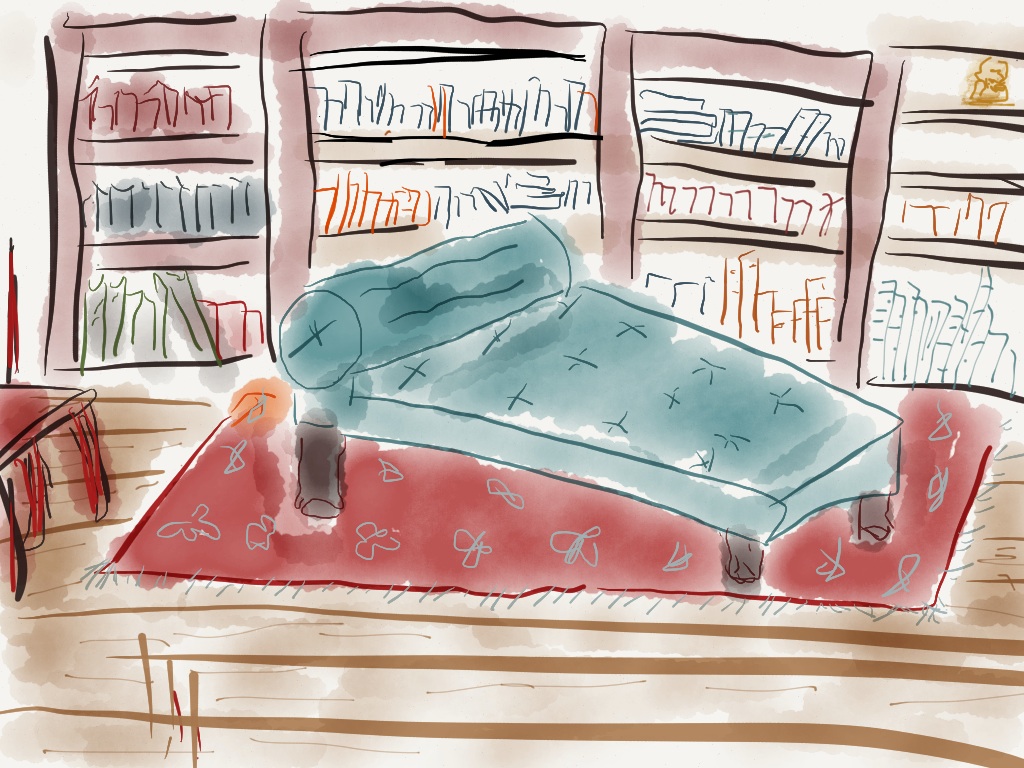
Chisolm Tartan 2013 jpbohannon

Chisolm Tartan
illustration © 2013 jpbohannon

Alan Warner belongs to a certain group of writers who came of age in Scotland in the last decades of the 20th century. Those with more recognizable names would included Irvin Welsh who gave us Trainspotting, James Kelman with his unique voice of urban rootlessness, Ian Banks (who died last week) and A.L. Kennedy with their distinctive fictions, and Ian Rankin who gave us Inspector Rebus and his Edinburgh detective novels. Among these, Alan Warner seems the one who has gained less recognition over here in the States. And that is a shame.

Warner’s first novel Morvern Caller was a magnificent tale of a young woman who steals her dead boyfriend’s novel from his computer, changes the name on the manuscript and quickly and decadently burns through the advance that the novel garners, moving from her dilapidated Scottish town through the ravages of the European rave scene. A later novel with the unfortunate title The Sopranos follows a group of high school choir girls from a rural western outpost on its class trip to Edinburgh. Both novels are memorable for their voice, for the seeming accuracy of Warner’s portrayals of 16 and 17-year olds. And both are fun.

Warner returns to the same locale from which Morvern Caller and the girls from The Sopranos escape in his newest novel, The Deadman’s Pedal. And again, he is dealing with characters of a certain age, characters who are between childhood and adulthood, characters who are innocents even as they are losing their innocence.deadman-s
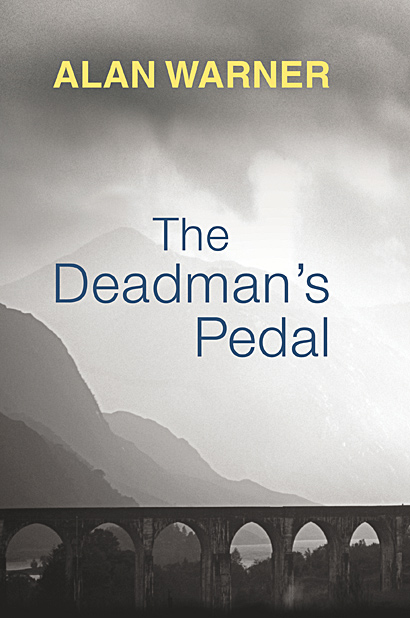
The novel takes place around “the Port,” Warner’s fictionalized treatment of the town of Oban in western Scotland and is held together by the train line that serves the area and which is dwindling in impact. In fact the title “Deadman’s Pedal” refers to a device that on a runaway train is set to brake in the case of an engineer losing consciousness.

Simon Crimmons is turning sixteen and wants to quit school, get a motorbike, and get a job. He is considered well-to-do by his companions because his father owns a trucking company, but wealth is a relative thing, and the Crimmons family is certainly working class in comparison to the lordly Bultitude’s. In fact, Simon, the town and the novel itself are greatly aware of class distinctions. And this is a running theme throughout.

Yet it is in terms of young Simon’s desires that the class distinctions are most evident. For he is torn between the beautiful and always available Nikki Caine from the Estate houses and the enigmatic Varie Bultitude–of the town’s legendary, aristocracy. Managing such affairs is always risky and managing one between such two disparate worlds is like being on a run-away train.

When Simon mistakenly gets a job as a trainee train driver–he thought he was applying for a hospital position–he discovers the extent of these class divisions. He says to Vaire, “I’ve got the whole railway telling me I’m not working class enough and I’ve got you telling me I’m not middle class enough. This country needs to sort out the class question. As far as it applies to me.”

And to make matters more difficult, Simon’s father is caught up in it as well. He sees his son’s work on the trains as a betrayal, as his son’s working for a competitor that could ultimately put him out of business. It’s never easy being sixteen. It seems much harder for Simon Crimmons.

The joy of the novel–apart from the very real depictions of young desire, lust, and confusion–is the language itself. Some may find the dialect off-putting at first, but it quickly becomes second nature, but the narration itself is pure genius: A funeral for a dead train man is told with humor, nostalgia and poignancy; Simon’s first kiss is described as sweet, anxious, innocent and thrilling; the grounds of the Bultitude property are given an almost gothic eeriness and grandeur. (The Bultitudes are said to bury their dead in glass coffins…the aristocracy is always with us!)

Early in the novel, Simon and his friend Galbraith show Nikki the secret hideout they have built out in the wilds. They make her promise not to mention it to the other boys knowing that it is a childish thing and that the others would tease them for it. It is here that Simon and Nikki first have sex– in a short scene that is both innocent and knowing. It is a scene–positioned in his boyhood escape– that captures the very tension of this novel, the tension between innocence and adulthood, between desire and attainment, between the people and their landscape.

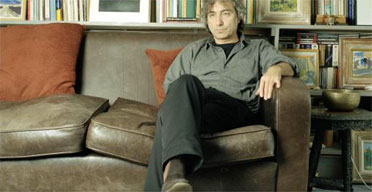
Alan Warner Photo: Jayne Wright

Alan Warner
Photo: Jayne Wright

Alan Warner is an extraordinary writer. That his name is little known outside Britain is an injustice, but one that may be set aright by Deadman’s Pedal–a novel that is larger than its Scottish setting, a novel that is universal in its wonders, its desires, and its struggles.

“Likes…and Dislikes”: something to think about

I’ve been reading a lot of Susan Sontag lately: her journals, her book Illness as Metaphor, and a slew of blog posts. One of these excerpted a journal entry in which Sontag not only analyzed why we humans like lists but that produced a list of her own likes and dislikes. Essentially, she was standing up for or against particular aspects of modern life. Most of us “jot down” lists, but this is probably the wrong phrase for this activity, because thinking about what one actually likes and dislikes is a more difficult thing to do than I first imagined, more involved than mere jotting. I know, because I tried.

2013 jpbohannon

© 2013 jpbohannon

At first I worried that making such a list bordered on the narcissistic. Who really cares what a person likes or dislikes? Do we make conscious decisions with any of this knowledge about other people? I doubt it, particularly in our day to day interactions.

But making such a list could be enlightening, for oneself. No one else needs to know. Sit down and think about the world and what you actually enjoy and what you find annoying, painful, sad.

However, if created lightly, without much thought, this list ends up sounding like the profile of some air-headed celebrity: “I like moonlit walks on the beach…, etc.” A far cry from the list Sontag created.

And to put any such a list out there is a bit risky…and again a bit self-involved.

I spent a good bit of time thinking about what I like–which writers and musicians, what art forms and what cities, what quirks of my own and what indulgences, what parts of everyday life and what special dreams. It was harder thinking of those things I didn’t like–the things I find annoying seemed petty when put on paper, seemed like too much kvetching, and was beginning to be forced.

So I put my list together and I worked hard at it and I decided it didn’t need posting, after all. It was good enough for me: “the examined life and all that.” Hah!

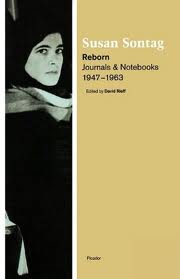
Book Review: Reborn: Journals and Notebooks 1947-1966 Susan Sontag

illustration by jpbohannon 2013

Susan Sontag (1933-2004)
illustration by jpbohannon 2013 (based on painting by Juan Bastos)

There is a danger in reading memoirs, diaries, journals. Certainly, there are times when our angels are shown to have feet of clay. Or other instances, when we weigh the turmoils and angst of a particular life with the end product that impelled you to read the memoir in the first place.

But with Sontag it is quite, quite different.

Next to even her young self, I feel so inadequate, so shallow, so wasteful of time.

Here is a young woman–14 years of age when the journals begin–embarking on a intellectual career that would put most of us to shame. Her reading lists, her “to-do” lists, her debates with herself, her analysis of events, readings, concerts and people she meets, her experiences, all are more fervent, more intelligent, more thoughtful in the years between her 14th birthday and her 30th, than mine have been for most of my life.

Susan Sontag bookcover

I teach a group of extremely bright 18-year old boys. They have great intelligence, and some are quite creative. But every so often they need to be reminded that their superior intelligence is frequently measured within the very small pond of our school.  Here’s what I read them from Sontag’s journal:

…Yet we do exist, + affirm that. We affirm the life of lust. Yet there is more. One flees not from one’s real nature which is animal, id, to a self-torturing externally imposed conscience, super-ego, as Freud would have it–but the reverse, as Kierkegaard says. Our ethical sensitivity is what is natural to man + we flee from it to the beast…

I ask them to describe the person who would write this in his or her personal journal.  And they are always far off…in both gender and age.  Sontag wrote this (a snippet of a much larger journal entry) two weeks after she had turned 17!  Already her depth of reading and understanding and active thoughtfulness is evident.

Immediately in this first volume of the journals, one meets a brilliant, thoughtful intelligence. She attended Berkeley at the age of 16, transfered to University of Chicago, married Phillip Reiff–a sociology professor–at 17, taught at the University of Connecticut when she was 19, and attended graduate school at Harvard, where she got her degree in philosophy and theology. And throughout these years, she recorded her thoughts and criticisms and interpretations, as well as her fears, her doubts and her insecurities.  As her marriage began to falter, she received a fellowship to Oxford and then moved to Paris. When she moved back to New York in 1959 (26 years old), her marriage was dissolved and she had gained custody of her son. Established in New York, she began teaching at various colleges, completed her first novel, The Benefactor, and witnessed her reputation as part of New York’s  intelligentsia begin to grow.

These are the years covered in the volume. Aside from the inquisitiveness, interpretation, and analysis of what she reads, sees and watches (she was a rabid film-goer), there is the struggle of understanding who she was. The marriage was unsatisfying, the lovers often hurtful, and in reading the journals we see a young woman trying to discover herself and come to terms with her own individuality, her own bi-sexuality, her own identity. There are times when one feels she is too hard on herself…when one wants to warn her, NO, this is going to end bad, but then again, one can’t.

Beginning when she was 14 and ending when she was 30, the journals are remarkable for their honesty and the peek into her rigorous mind.  But at the end, one is moved by the ever-going struggle between her sexuality and her intelligence, by the vulnerabilities and insecurities she reveals in her two major love affairs with Harriet Sohmers Zwerling  and Irene Fornés.  For her extraordinary mind struggled continually to understand the extraordinary pull of the flesh.

Her last two entries for 1963 read:

The intellectual ecstasy I have had access to since early
childhood. But ecstasy is ecstasy.

Intellectual “wanting” like sexual wanting.

♦     ♦     ♦     ♦     ♦     ♦

Reborn is the first of a proposed three volumes of journals. The next volume–As Consciousness Is Harnessed to Flesh– covers the years 1963 to 1964, when Sontag develops her reputation, her political activism, and her writing. It is now on my “to-read” list.

Adam Phillips: Promises, Promises: Essays on Psychoanalysis and Literature

illustration by jpbohannon

illustration by jpbohannon, 2013

In the office of a colleague a while back I noticed a towering pile of books on the desk, as if he were re-arranging his book shelves or carting out old titles to a different location.  But no,  it was his “to read” pile, and it was impressive and imposing.

Among the authors gathered, there was one whom I had not heard of–Adam Phillips. A psychoanalyst by trade–specifically a children’s clinical psychotherapist–Phillips read literature at Oxford, specializing in the 19th century British romantics.  And as the “science” of psychoanalysis has always been symbiotically tied to literature,  a degree in literature seemed the perfect training ground.
Adam Phillips photo: Andy Hall

Adam Phillips
photo: Andy Hall

And so I decided to dive in.

Of Phillips’ seven or so titles, Promises, Promises: Essays on Psychoanalysis and Literature seemed a reasonable starting point. And, the frantic busyness at the end of the school term made a collection of independent essays more attractive and less of a task.
 

“As poets struggle to find a place in contemporary cultural reality, psychoanalysts, implicitly or explicitly,  are still promoting the poets as ego-ideals.”

Philips, “Poetry and Psychoanalysis”

The crux of Phillips’ essays is the mutual relationship between literature and psychoanalysis…and psychoanalysts’  established reverence for creative writers. Literature, according to Freud, gave birth to psychoanalysis and psychoanalysis often gives resonance to literature.

And so go his essays.

He begins with the essay “Poetry and Psychoanalysis” and brings in the young poet Keats–a former medical student–who famously stated that science ruined poetry when Newton reduced the rainbow to a prism.  Not so, Phillips says, for poetry (and you can read “creative writing” where Phillips says “poetry”) can do what the sciences cannot.  Indeed, much of his argument is that the science of psychoanalysis is bringing understanding to the vision of poetry.  Freud said, Phillips tells us, that the poets had long before discovered the unconscious, and that he only had devised a way to study it.

Phillips graciously gives way to “poetry” saying that the short history of psychoanalysis has been an attempt to study the unconscious that poetry reveals. And since both poetry and psychoanalysis–the “talking cure”–depend on language, and often, coded language, the two are intrinsically welded together.

And so he is off.

There are marvelous literary essays on Hamlet, Hart Crane, Martin Amis,  A.E. Housman and Frederick Seidel, all informed by an accessible shading of psychoanalytic theory, as well as masterful psychoanalytic pieces on Narcissism, Jokes, Anorexia and Clutter, informed by a broad knowledge of literature/poetry.  It is Phillips’ contention–his modus operandi, if you will–that the two disciplines can or should depend on each other for clarity.

Hamlet-and-skull-on-stampThe collection ends with the title piece, “Promises, Promises.”  In it, Phillips examines the “promise” that both literature and psychoanalysis offer. He writes:

“If we talk about promises now, as I think we should when we talk about psychoanalysis and literature, then we are talking about hopes and wishes, about what we are wanting from our relationship with these two objects in the cultural field.”

What does reading literature promise us?  What does analysis promise us?  Phillips contends that both promise us, to a degree, “the experience of a relationship in silence, the unusual experience of a relationship in which no one speaks.”  Of course, ultimately, the analyst must speak.  But it is in that silence that often we become “true to ourselves.”

Reading psychoanalytic theory can often be dry and dusty, but Phillips’ writing never is. Bringing in an encyclopedic knowledge of both creative literature and psychoanalytic literature (and, at times, arguing that there might not be a difference),  Phillips imaginatively and wittily plumbs past and current trends, canonical and esoteric literatures, clinical practice and private correspondence to bring to light his vision of psychoanalysis and literature’s potential and promise.

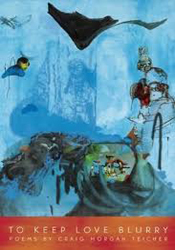
The End of April and National Poetry Month, part 3: To Keep Love Blurry by Craig Morgan Teicher

To-Keep-Love-BlurryI must say that I did not enjoy Craig Morgan Teicher’s third collection of poems.  That is not to say that they are not technically brilliant, that they are not impressively raw and honest, nor that there are not many moments that just knock you open. I admire it greatly; however, I do not like it.  Even Teicher understands the sadness and dysfunction and sourness inherent in his verses.  Here is his dedication:

To Cal and Simone–you should know that it’s a lot more fun than these poems suggest–
and

for Brenda, who knows…

Brenda is Teicher’s wife, who makes many appearances in the collection (actually throughout his work– his first collection was entitled Brenda is in the Room and other poems.)

To Keep Love Blurry is tied together by two major themes. One his mother and father, particularly after his mother’s death. And two, his marriage to Brenda, their (apparently) special-needs son, and Teicher’s sullen acceptance of love.  Indeed, for Teicher love–both familial and marital– is more of an anchor than a source of flight. Here is he about motherhood:

My wife is not my mom. My mom is not
my mom. My father is not my mom. My boss
is not my mom. She is a tooth with rot,
a flower pressed between the pages of a lost
book. My son is not my mom. She is a mare
crushing my skull beneath her hoof. She is forever
starved. I ride to the edge of the earth clutching her hair.
Get it over with. It’s never OK, not ever.
Fuck it, whatever.  If Robert Frost is my mom,
then so is Robert Lowell. She taught me to talk.
She is where I’m headed, a bomb
crater. She forgives me like a hunting hawk.
Maybe she’s my boss’s boss, my wife’s other other lover,
my son’s midnight cough. She loves me like a brother.

(“My Mom, d. 1994”)

The perfection of form–a modern Shakespearean sonnet with A-B-A-B…rhyme scheme, a regular rhythm, an unusual octet, quatrain, couplet construction–is made inconspicuous by the language, the odd identifications of motherhood, with unusually negative words: “tooth with rot,” “a mare crushing my skull,” ” a bomb crater,” “my wife’s other other lover.”  What exactly are his feelings?  “Loves me like a brother” does not cut it for me.  Perhaps the secret lies in the allusion to Robert Frost and Robert Lowell.  Teicher quotes a Lowell poem as an epigraph to his collection:

“Those blessed structures, plot and rhyme–
why are they no help to me now…”

Perhaps Teicher is saying that the “blessed structures” of poetry–with which he is extraordiaryily adept–are no longer to sufficient to buoy one in the sourness of modern life.  Here he is similarly on friendship, marriage and love:

In just the couple years since two by two
we all began to partner off,
already we’ve practically retired, passing though
apartment doors shut tighter than a cough.
There used to be long, wasted hours of talk,
nothing secret between us, not even skin;
at the conclusion of a wandering walk,
the flirtatious dark would set in.
Is marriage lonely by design,
in hopes that obeying an age-old law

of I am only hers, she is only mine
forms a brittle scab over the always-raw
wound of too much intimacy between friends
in favor of a duller aching that never ends.

(“Friendship”)

Again, the “plot and structure” to which Lowell refers are exquisite: a Shakespearean sonnet, intricately wrought and patterned. But for the speaker, the poetry is subsumed by the “duller aching” and “brittle scab.”

Mixed among the villanelles and sonnets, the rhyming couplets and the longer verse, there is a series of prose ruminations on the death of his mother and the subsequent loneliness of his father. These too are notable for their raw honesty, their unflinching introspection.

Well-wrought and linguistically daring, To Keep Love Blurry is evidence of Teicher’s impressive talent. However, I found it sullen and pouty and self-indulgent. Nevertheless, such is Teicher’s poetic cleverness and adroitness that I will surely keep my eye out for his future work.

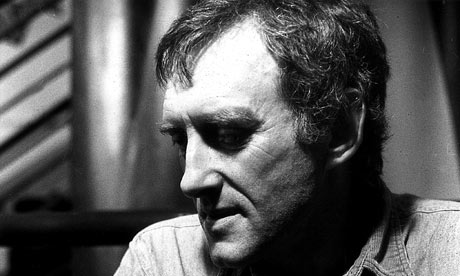
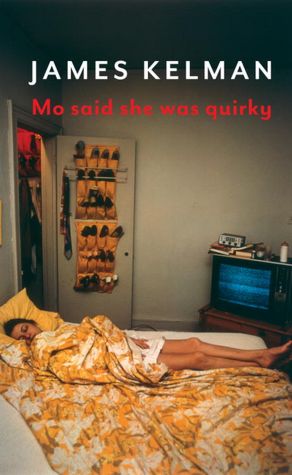
Book Review: Mo Said She Was Quirky by James Kelman

James Kelman

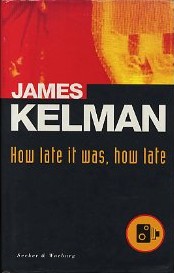
I first started reading James Kelman back in 1994 when his novel How Late It Was, How Late had just won the Man Booker Award. The novel was entrancing. Driven by a rough Glaswegian dialect that was musical, whimsical and earthy, the novel followed the Kafkaesque troubles of an ex-con who has been beaten, blinded and abandoned.  I remember the plot only faintly, but the language itself will stay with me forever. It was as if Samuel Beckett had plopped down into Glasgow, went on a long bender, and lived to tell the tale.

After that introduction, I read his short story collection, Busted Scotch. Again, while I enjoyed the stories, it was the language that remained. Lively, working-class language, filled with imaginative slang and time-born wisdom.

I remember being excited when I learned of his next novel, You Have to Be Careful In the Land of the Free when it came out in 2005. How wonderful, I thought, to hear that raspy, magical, glittering voice unleashed in the vastness of the Americas. But I was greatly disappointed.  Storyline was never his strong point, but here even the voice had faded. I was off Kelman for a while.

And I guess to my detriment, because Kelman’s next work was widely praised.  Kieron Smith, Boy was a story of an urban and lonely childhood and it was called both “magnificent and important.”  But I missed it and now it’s at the bottom of a long list of must reads.

But I did pick up Kelman’s latest novel, Mo Said She Was Quirky–mainly because of the intriguing title. And once again, the language is at the forefront. Once again we are in a Beckettian world of isolation and words. Yet, unlike anything he did before, in Mo Said She Was Quirky, Kelman’s lyrical speaker is a woman, Helen. The novel is told primarily in the first person, much an extended interior monologue. Other characters appear, but we see and hear them only through Helen’s eyes.

Helen works the night shift at a London casino, where she and her daughter have moved to get away from her no-account husband in Glasgow and where they now share a small, one-bedroom flat with her Pakistani lover, Mo.

In a cab on the way home one night, Helen stares at two homeless men stagger across the intersection in front of the taxi. One of the me stares intently into the cab and Helen recognizes him as her brother. This recognition begins her long night of self-examination, self-incrimination, and self-rationalization. Why is she here? Why is he there? How dysfunctional was her and her brother’s growing up or is this the state of all humanity? Helen is generous in her compassion and stingy with her self-pity. Many have it worse than she, she deliberates, and then realizes that misery, sorrow, and pain are  very relative and the fact that she has a hot shower and another person does not does not make her pain any easier or lighter to bear.

Completely knackered and unused to the night-shift, Helen, nevertheless, cannot sleep. Her mind races with memories of her brother, her damaged parents, her child, her ex, and the kind man she lives with, Mo. She waits until Mo and her daughter waken, watches them go off to school, and yet, still, she cannot sleep.  She thinks greatly about the differences between men and women, the posturing and bullying of those she has known, the favorites that her parents very obviously played. She thinks about racism and worries about Mo. She thinks of the urban jungle and worries about her daughter.

As night turns into day, as Mo takes her child to work, she grabs a few hours of rest but her mind is increasingly racing. And as it does we learn more why this simple-hearted woman is so fraught with worry about the future, so done-in by her present, and so haunted by her past.

I give Kelman a lot of credit for trying what he does so well in a woman’s voice. At times, Helen’s monologue seems to drag but at others it is riveting, revealling bits and bits of a single life and illuminating the mind of a  woman who lives in constant worry about the world around her–and the past that formed her.

I’m not really sure yet how I feel about Mo Said She Was Quirky. I do know that Kelman’s voice in it has me returning to reread How Late It Was, How Late. That’s the novel of his that I loved the most, and the others have yet to measure up.

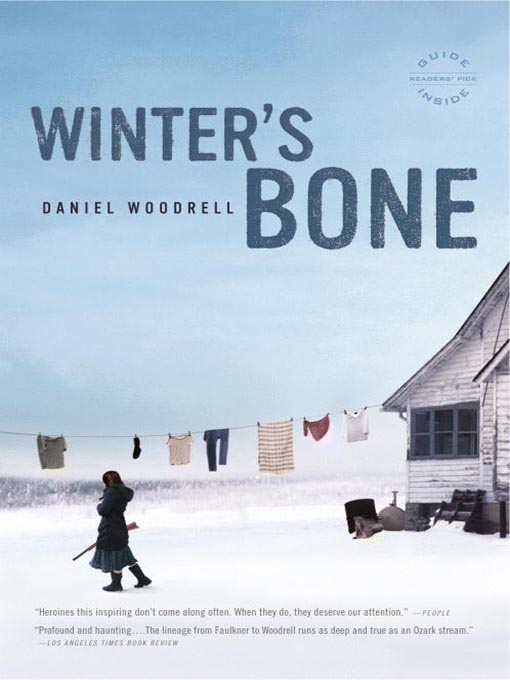
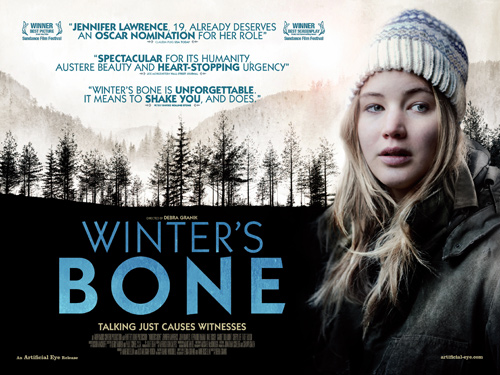
Book Review: Winter’s Bone by Darrell Woodrell–can you find a better heroine in all of literature?

I have a tendency to exaggerate, to think that whatever I have read, heard or seen lately and liked  is the BEST!  I am much more nuanced about things I dislike and usually soften the blows rather than exaggerate them.

But with Daniel Woodrell’s novel Winter’s Bone, I feel confident in stating what a truly fine book it is.

In fact, since I have read it, I have tried to think of a heroine in an American novel who matches Ree Dolly for grit, perseverance, wisdom and sheer moxie. These are the suggestions I have gotten so far:

1. Scarlett O’Hara in Margaret Mitchell’s Gone with the Wind (too spoiled, mercurial and self-centered)
2. Scout Finch in Harper Lee’s To Kill a Mockingbird (not really her story but her father’s–who, by the way, may be the best father in literature.)
3. Hester Prynne in Nathaniel Hawthorne The Scarlet Letter (interesting suggestion, but her props come from accepting her punishment and not revealing who the father of her child was, while letting the simpy Rev. Dimmesdale preach his sermons and fill himself with self-loathing. I don’t see her as a particularly active heroine.)
4. Katniss in Susan Collins The Hunger Games (must say, I don’t know enough about her, except that Jennifer Lawrence played both Katnis in the Hunger Games AND Ree Dolly in Winter’s Bone.)
5. Mattie Ross in Charles Portis’ True Grit (Mattie is a good second to Ree Dolly. Her challenges just don’t seem as daunting as Ree’s.)

Please feel free to add your own selections.

But my point is, I can’t remember any heroine–or any protagonist for that matter–who is so admirable in her refusal to not back down, in her persistence in doing what she must, and in her bravery in standing up to the very nasty forces that surround her.

In case you don’t know, Winter’s Bone is the story of Ree Dolly, a seventeen-year old girl who is raising her two younger siblings and caring for her catatonic, demented mother. Her meth-cooking father has just skipped bail and he had put up their hovel of a home as bond.  If he doesn’t show up for court, Ree and her family are out on the streets–or more realistically out in the fields of this very hardscrabble Missouri Ozarks setting.

Suffice it to say that her father is dead. And people aren’t real happy about Ree poking into their business. This is a community whose main economy and main diversion is crystal meth-amphetamine, and there are a whole lot of very, very nasty people.  No one talks. Talking creates witnesses.

In the course of her journey, Ree gets a truly horrible beating, she allies herself with her rough Uncle Teardrop (named such because of the three tears self-tattooed on his face), and finally proves her father’s death by sawing off his two hands (with a chain-saw from where he is sunken in a murky lake) and bringing the “identification” back to the authorities.

If it sounds gruesome. It is. But it is also one of those books that hooks you immediately and which you wish would go on forever. And it is all because of the character of Ree.  It is Ree that rises above all the violence, the poverty, the bleakness. But while Ree completes her quest at the end, while a few things begin to go right for her and her family, one is left feeling that in another five or ten years Ree will have turned into one of the many harridans that populate this mountain.  I hope not.

♦     ♦     ♦     ♦     ♦

I read the novel for a film class I am teaching.  And so, I also had to show the film. As in all translations, there are various changes–her two brothers for some reason become a brother and a sister–and particular scenes are deleted.  Yet the film very much captures the spirit and the landscape of the novel.

Jennifer Lawrence is, at times, magnificent. There are moments when the camera captures the soft plumpness of her face adding even a greater vulnerability to this girl/woman who has to face such ordeals.  At other times, that softness works against her, straining our credibility that she is who she is supposed to be.

Not so with John Hawkes.  Hawkes, who was the soft-spoken hardware salesman in Deadwood–a similar world of extreme dirtiness and corruption, plays Teardrop perfectly. Hard as Ozark flint, creased and shaky, Hawkes captures the violence, the drug addled paranoia and stupor, and the family loyalty of these inbred mountain folk with studied truthfulness and credibility.  While Winter’s Bone is Lawrence’s movie, you don’t forget Hawkes for too long.

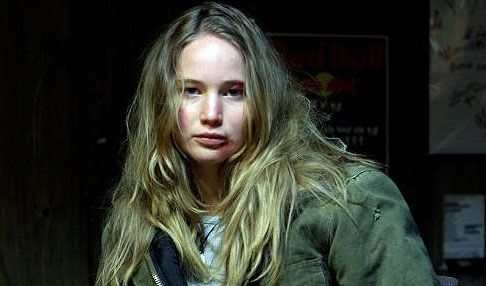
Jennifer Lawrence as Ree Dolly in Winter’s Bone.

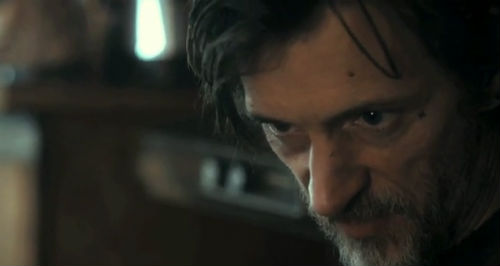
John Hawkes as Teardrop in Winter’s Bone

Movie Review: The Footnote: fathers and sons, parents and children

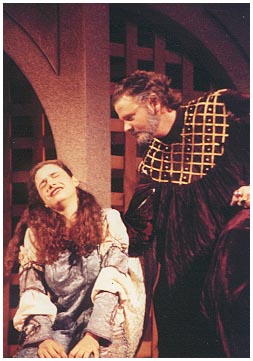
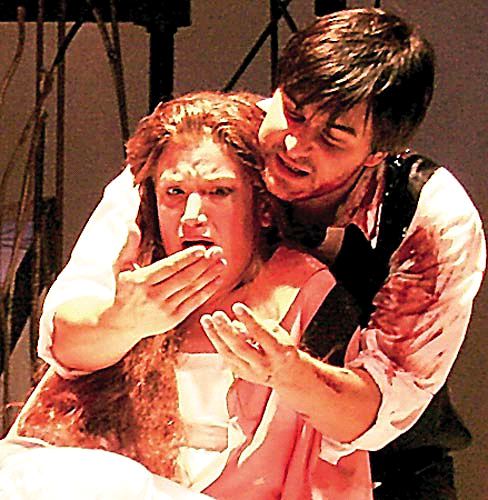
Juliet being bullied by her father

I have always been fascinated by the importance of parent/child relationships in Shakespeare. As school children, one of the first plays we read is Romeo and Juliet and aside from the love story, the second major story is Juliet’s relationship with her parents. The mother is cold and aloof and the father, while seemingly sensible in the beginning, shows himself an insensitive brute. Then there is Hamlet–a psychiatrist’s field-guide to dysfunctional parenting. In the histories, there is Henry IV, parts 1 and 2; the tragedies also give us King Lear–a tragedy of parenting if ever there were one; the romances give us The Tempest with the sorcerer Prospero manipulating his daughter’s–and everyone else’s–life. Throughout the canon, there are lovers blocked by parents, young nobles obeying the edicts of  fathers, and even a childless woman declaring what violence she would wreak on her children if she had them.

Hamlet berating his mother

And then I thought how much all of literature is tied in with this theme. From the earliest fairy-tales like Snow White, Cinderella, and Rumpelstiltskin to the Greek plays–where does one begin with Oedipus?–the dynamic between parent and child is in the foreground. As for the great epics: The Odyssey is really a tale of a son trying to find his father, as is its modern counterpoint, Ulysses,where “fatherless” Stephen is cared for by Bloom who mourns the death of his own infant son; and what is Paradise Lost but a father punishing his errant children?  In Great Expectations Pip is orphaned and raised by a beastly sister and her kind and understanding husband. In Huck Finn, Huck is trying to survive in spite of the obstacles that the disreputable Pap has put in his way. And even a modern potboiler like the Girl with the Dragon Tattoo trilogy is founded on several perverse father/child relationships.

Lisbeth Salander and her father from The Girl With the Dragon Tattoo

So I thought of all of this as I left the theater Sunday after watching The Footnote. An Israeli film, The Footnote follows a father and son, both Talmudic scholars through their strained relationship. The father’s career–rightly or wrongly–stalled early in its course. The son, on the other hand, is immensely successful. The film opens with an award ceremony where the son is being inducted into the Academy of Sciences. In his thank-you speech, the son focuses on what an inspiration and model his father was, but the father is so filled with envy, anger, and bile that he walks out of the theater.

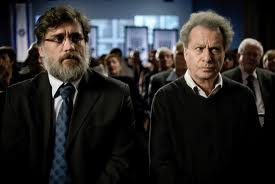
Son and father from The Footnote

Later, the father receives a telephone call informing him that he has won the prestigious Israeli Prize, an award given by the President of Israel to an important scholar. The call is actually a mistake and was intended for the son who naturally has the same last name.  The son is informed of the mistake and told that he must be the one to tell his father. What ensues is riveting, heartwrenching, and sad.

The soured relationship between the two is echoed with the son’s strained relationship with his own adolescent child. At times, it seems the women are holding things in place, but I am not completely sure. There is a lot of dishonesty, a terrible lack of communication, and an underlying egoism that is poisoning the family dynamic.

The film is very good.  It is one of those films that you talk about long after, and think about much longer than that.