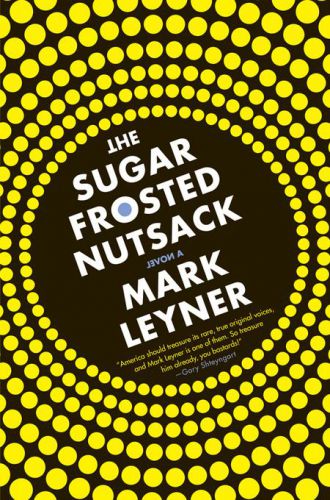
The Sugar Frosted Nutsack by Mark Leyner: When does one stop reading a book?

When is it time to stop reading a novel?  And why do I feel so guilty about it?

I decided today to go no further in Mark Leyner’s The Sugar Frosted Nutsack.  Was it bad?  No, it was quite entertaining?  Was it difficult?  No, not in the way say Joyce’s Finnegans Wake or DFW’s Infinite Jest is difficult.

To be truthful, it is simply a tiring read.

The title refers to poor Ike Karton, the “nutbag” as he is called in his neighborhood in Jersey City, New Jersey.  Here is his introduction (35 pages in):

“What subculture is evinced by Ike‘s clothes and his shtick, by the non-Semitic contours of his nose and his dick, by the feral fatalism of all his looney tics–like the petit-mal fluttering of his long-lashed lids and the Mussolini torticollis of his Schick-nicked neck, and the staring and the glaring and the daring and the hectoring, and the tapping on the table with his aluminum wedding ring, as he hums those tunes from his childhood albums and, after a spasm of Keith Moon air-drums, returns to his lewd mandala of Italian breadcrumbs?

So begins the story of Ike Karton, a story variously called throughout history Ike‘s Agony, T.G.I.F. (Ten Gods I’d Fuck), and The Sugar Frosted Nutsack. This is a story that’s been told, how many times? –over and over and over again, …”

Ike is a believer in a pantheon of Gods who have played havoc with the universe for billions of years.  Earlier we learn that

The Sugar Frosted Nutsack is the story of a man, a mortal, an unemployed butcher, in fact, who lives in Jersey City, New Jersey, in a two-story brick house that is approximately twenty feet tall. This man is the hero IKE KARTON. The epic ends with Ike’s violent death.  If only Ike had used for his defense “silence, exile, and cunning.” But that isn’t Ike. Ike is the Warlord of his Stoop.  Ike is a man who is “singled out.” A man marked by fate. A man of Gods, attuned to the Gods. A man anathematized by his neighbors. A man beloved by La Felina and Fast-Cooking Ali, and a man whose mind is ineradicably inscribed by XOXO. [these are the names of gods we’ve already met]. Ike’s brain is riddled with the tiny, meticulous longhand of the mind-fucking God XOXO, whose very name bespeaks life’s irreconcilable conntradictions, symbolizing both love (hugs and kisses) and war (the diagramming of football plays).

Are you tired yet?  I am…(but I have such a developed sense of guilt that I will probably return to it before the evening’s out.)

The  novel begins with the beginnings of the universe. This gaggle of gods arrive on a school-bus, blaring the Mister Softee jingle, like a bunch of college students “Gone Wild” on spring break.  Like the gods of other mythologies, they are petty and mischievous and promiscuous and quite often harmful to humanity. Now, they are living in the tallest (and most opulent) building in the world (now they are in Dubai, but they have had to move several times as humans keep building taller buildings.) Bored and propelled by their own machinations and relations they have become obsessed with Ike Kantor.

The novel plays with meta-fiction to a large degree. A sentence is repeated. Then the sentence that makes the repetition is repeated again including the original sentence. And again. And again.  It is tiring…and soon loses its cleverness.

But the book is not the theme of this post; it is is the decision to give up on one.  Why do some people (myself to be sure) feel a sense of obligation to finish a book once he or she has begun it?  Is it financial, in that you’ve invested fifteen bucks in a book you might as well get your money’s worth?  I don’t think so.

Is it something that happened to us when we were school children? Are we afraid that the nuns, headmasters, schoolmarms are going to rap our knuckles with a ruler for not completing our assignment?

Or is it respect for the artist?  Do we feel the need to stick with something, to see where it leads to, out of respect and admiration for the writer’s work?

I don’t know.

But I have a day and half free–so I’ll probably end up finishing it anyway.

Tuesday Book Review: Wonder Boys by Michael Chabon

I read Wonder Boys last week.  I had read it previously, at least twenty years ago, and, boy, had I misremembered it.  As a younger man, I found inspiration in the “wunderkind” writing student and was fascinated by the famous writing teacher who is famously blocked with his novel (also called Wonderboys) that is going on past 2600 pages long.  This time around I did not have the same reactions.

Part of the problem is also that I could not get the film adaptation out of my head– a film I had seen in the long interim between readings.  In the film, the famous writing teacher is played by Michael Douglas, his cynical, jaded literary agent by Robert Downey, Jr., and the fabulous writing student by Tobey Maguire.  And while I remember enjoying the movie greatly–and understand why marquee actors are used–I think  it was terribly miscast.

Grady Tripp is the dissolute writing teacher.  He smokes way too much dope, he is cavalier in his relationships, and he is always looking out to score. In the novel, he is over-large, a big hulking bear of a man.  In one scene, when he is spiraling into what might be a catastrophic relationship with a young student who rents a room in his basement, he notices his reflection in the mirror. He sees a middle-aged, bearish man slumped down over this young college girl as they slow dance together. It is a moment of self-awareness–aided by a large quantity of pills, dope, and alcohol enhanced by pounding adrenelain after a slapstick night of antics. The man he sees in the mirror no way is the stylish professor played by Michael Douglas.

The young writing student is a-social and painfully awkward which Tobey Maguire captures but he is not nearly dark enough. In the novel, James Leer is very dark, in a long overcoat of indeterminate material and age.  And Robert Downey Jr. did not match my vision either. I know that most people quibble with the casting of books they’ve read when they are made into movies.  And this is my quibble: the cast is too handsome.

But enough about the movie…

The novel starts out on a rollicking tear. On the night that the novel begins Grady Tripp finds a note from his wife saying she has left him, he picks up his agent and the transvestite he met on the plane, his mistress–Chancellor of the school and wife of his Department Chairman–tells him she is pregnant, he gets bit in the leg by a dog, and he is traveling around with a tuba, a dead dog, the coat Marilyn Monroe wore at her wedding to Joe DiMaggio and a student who may or may not be suicidal…or truthful.  It reminded me of John Irving at his best.

An academic farce, there are set scenes of college gatherings and festival lectures. There are Tripp’s musings on the requirements of good writing, his praise for James Leer’s young but promising work, and insights into a truly blocked artist–one who comes to no longer believe in the work he is doing.

The female characters, his wife, his mistress, the student living in his house, however, are very shallow–cardboard figures created for Tripp to act or react against.

Michael Chabon

That the novel famously echoes Chabon’s early writing life makes reading it this much later in his career offer its own rewards.  Like James Lear, the young student, Chabon received a book contract for The Mysteries of Pittsburgh when his writing professor–unknown to Chabon–passed the manuscript on to his own literary agent.  And like Grady Tripp, Chabon worked years on a follow-up novel–a novel that grew enormously large before he himself destroyed it.

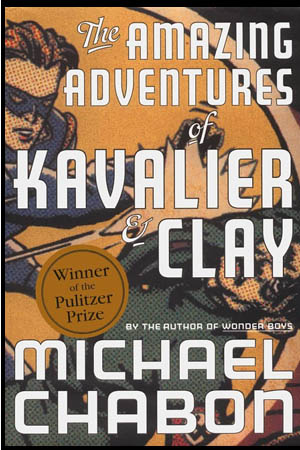
Since The Mysteries of Pittsburgh and Wonderboys, Chabon has continued to win great praise and loyal readership.  His novel, The Adventures of Kavalier and Clay won the Pulitizer Prize for fiction in 2000 and his 2007 novel The Yiddish Policemen’s Union won the Hugo, Nebula, Sidewise and Ignotus awards. (An aside–I was in Quebec city one week and needed something to read. There was primarily only French book stores. In one that I stepped into there was a small rack with about a dozen books written in English. It was there that I bought the Yiddish Policemen’s Union.)

And while his first novel–The Mysteries of Pittsburgh–and the novels following Wonderboys deal directly with Jewishness and Judaism, it is a very minor theme in Wonderboys.  There are touches of it when Tripp and James go visit his Korean ex-wife for Passover Seder and bumps against it when James’ own history is revealed, but it is not forefront in the novel.

Instead this is very much a novel about writing–or not writing as is Tripp’s case.  It is academic because it takes place on a university campus and deals with chancellors and professors and students and chairmen, but there is no scenes within a classroom. It tries to be a novel about love and contentment–but Tripp’s long road there, it is his third wife that leaves him and his tentative gestures towards his pregnant mistress are filled with doubt and fear.

All in all, though, Wonderboys is a wonderful read.  The beginning is peerless–quick moving, deft character sketches, and hilarious plotting. If the second-half seems to suffer from a bit of a hangover, it is because nothing could keep up with the original momentum. The novel must switch rhythms to mirror Grady Tripp’s more thoughtful musings, fears, and discoveries.

Do read Wonderboys or, if you want, rent the film.  Both are very enjoyable.  Just don’t do both too close together. And when you finish with those give Chabon’s other titles a try. Any of them are well worth the time spent.

Next Post

I thought this was an interesting post. She seems an intelligent and thoughtful writer, and I am going to try to track down her book.

phdincreativewriting's avatarph.d. in creative writing

As writers, we live double lives: lived once in the world of others, and again, in the quiet of our own minds. It takes a certain amount of will and courage to leave with regularity the circle of humanity in order to enact a kind of theft, which is one aspect of what the writing life seems to be.

Anne Germanacos is the author of the short story collection In the Time of Girls (BOA Editions). Born in San Francisco, she has lived in Greece for over thirty years. Together with her husband, Nick Germanacos, she ran the Ithaka Cultural Studies Program on the islands of Kalymnos and Crete, and taught writing, literature, and Modern Greek. She holds an MFA from the Bennington Writing Seminars. Her work has appeared in over eighty literary reviews and anthologies, including Dzanc’s Best of the Web 2009. She and her husband have four…

View original post 1,063 more words

Quibble with electronic publishing, part 2:

♦ ♦ ♦ ♦ ♦ ♦ ♦ ♦ ♦ ♦ ♦ ♦

Who would have thought it?

Well, I guess quite a few people.  Yesterday, I posted a piece worrying about the future of writings “published” on the Internet and used as an example the disappearance of two particular stories of mine.

I said that I knew that nothing ever really disappears from cyberspace, but asked, “Would the common man have the tools necessary to recover those materials that are missing?”

Apparently he does.

Sure enough, someone a lot cleverer than I am went and found one of the stories I had cited. Three cheers for Gerry Bracken. He said the tool he used was the “Wayback Machine” (see picture above) and I know I definitely don’t have one of those.  Anyway, he found the “Dublin work-shopped” version of the story “Nadja and the Dream of Teeth.”  I don’t remember the difference between this and the final version, but it’s been a long while since I read it, so that was fun it itself.

Anyway,  I posted the first few paragraphs below.  If you’re interested, the rest of the story is at

http://web.archive.org/web/20040102060543/http://www.dublinwriters.org/eacorn/EA13/bohannonstory.htm

Again, thank you Gerry Bracken. It’s been a good day all around.

from “Nadja and the Dream of Teeth”

At the time there are three distinct women. Two orbit around his person like meteors that arrive and disappear, pendulous and pending, with the rigidity and regularity of the calendar. They are dark and light, one and the other. The fair one is more than fair. Her skin is pellucid. Thin webs of capillaries and veins map her arms, her breasts, the small of her back. The other, the dark one, is Mediterranean, raven-haired, Homeric. She smells of cigarette smoke and has hands older than her age. There is a husband somewhere. Cruel. Oafish. He keeps her meanly and she stays. The third is Nadja, herself. She is his earth, past which the others streak.

“I have made you an appointment,” she tells him. “At half-nine tomorrow.”

He presses his fingers to his face, toward the eye socket. The pain is there, where he touches. Not in the tooth itself, but on his face. Always he has avoided dentistry. But now, she has made the appointment and, when the time comes, she will drive him there.

The two others, the dark and light ones, we shall call Mim and Mam.

Mim keeps exotic animals. Large brilliant birds, ataractic reptiles, silky-haired dogs. She walks a wolfhound, Erté-like, on a tartan leash, its dusky coat shimmering in the sunlight. She wears black always and walks with catlike grace, taut muscles rippling effortlessly and surely. On certain evenings she will stride into McLoughlin’s and the big dog will stay at her feet through two and sometimes three gin-and-tonics. The dog is said to be gentle.

The other one, the dark one, he calls “Calypso,” and when she kept him, the moment seemed infinite and timeless. She fusses about him yet, fusses about what he eats and drinks and thinks, pleasuring him with a maternal concern that he had long forgotten. To his soul, dusty and cretaceous by nature, she brings the mist of the sea, the juices and oils of the fields, the energy of the sun. She gives him hope and calls him her “Father Confessor,” for she too has her secrets, her venom, her lusts. He never touches her but for her hand and her crone-like fingers.

It is to Nadja however that he has decided to remain grounded, connected. For her, too, he has given up the drink, the three-o’clock whiskeys, the bottle of Beaujolais at dinner, the Armagnac before bed. Of course, he has lied. He is always aware of his duplicity, for he said, in a moment of self-incriminating fury, that she would never again see him with a drink in his hand. And he keeps that promise, to be sure. But he continues when she is not there, when he is alone, when she is away. …

A quibble with electronic publishing

I’m a little worried.

Just a little worried.

The majority of things I’ve had published are in print. They  haven’t earned me a fortune–five dollars here, twenty dollars there–but a least I have a copy of them. Actually, two copies of them, because most of the ” legitimate” small journals pay in copies. They publish your story, poem, essay and pay you with two copies of the issue in which you appear. Two copies placed with the others in a chest at the foot of my bed.

And then along comes the Internet. Instant gratification. Electronic submissions. Electronic responses. Usually much quicker than traditional ways.

The best story I think I’ve ever wrote was published on line. “Nadja and the Dream of Teeth” first appeared through the Dublin Writer’s Workshop in the journal The Electric Acorn.

Then it was published electronically by The Richmond Review (UK). The editor at The Richmond Review was wonderful. She asked questions, made good suggestions, and, overall, made me tighten things up.  All through e-mails. From across the pond. This was the internet at its best.

And then it appeared electronically. It was beautiful. Nice layout. Clean font. Well done. I was proud of the story and proud of its being out there.

Now several years later, the site is down. Just a blank white page. Try it. Google “Richmond review uk” and you’ll find the link.  And then a pure white page. Where is my story? Not there. Not archived. Nowhere. And it was a legitimate journal!

Sort of the same thing with another story– “Pierced.” Except the journal it appeared in didn’t disappear; it sold its domain name to a Japanese company. Try to find my story and you’ll be staring at a beautiful chrysanthemum surrounded by Japanese writing. I am pretty sure that it is not my story translated into Japanese.

So. No big deal. Two short stories that meant something to me but certainly not to anyone else. Vanished. Pouf! But what if this was important material? Is there a fear that important things might simply disappear after a given time?

I know the saying that nothing ever disappears in cyberspace, but will future researchers, historians, students all have the tools necessary to recover those things that have?

Granted there is much that is superfluous, so much that is ephemeral on the Web. Much of it–my own scribblings included– really doesn’t deserve a long shelf life. But, by caching materials away so easily are we also tossing away things of lasting value.  I don’t mean the works of a future Shakespeare or a document of “Declaration of Independence” import.  I mean things like the novelist Rick Moody’s music reviews on Rumpus or Margaret Atwood’s book reviews for The Guardian or the Scottish poet Robin Robertson’s powerful reading of “At Roane Head.”  My fear is that this stuff–which is important stuff, important aspects of our culture, glimpses into who we are–will someday disappear.  Without a trace.  Without record.

Is it the nature of blogging or on-line writing in general to be ephemeral? Is that what is the draw? Do we read it not expecting ever to go back to it.  I don’t know.

But it does worry me at times.

Poetry on TV: The Song of Lunch by Christopher Reid

Farewell to long lunches
and other boozy pursuits!
Hail to the new age
of the desk potato, …

Sometimes, though, a man needs
to go out on the rampage,
throw conscientious time-keeping
to the winds,
kill a few bottles
and bugger the consequences.

Ah, I too miss those boozy lunches. I worked for more than a decade in an in-house advertising agency, and some of our Friday lunches were both epic and legendary.  But I ultimately left advertising for the more sedate, sober world of academia–or at least the more sedate, sober lunches of academia.

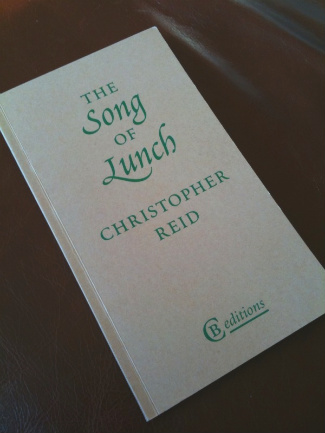
The man who is lamenting the lost tradition of long lunches above is the rather bitter and sarcastic subject of Christopher Reid’s The Song of Lunch. Yet on this particular day he sticks a note on his computer screen saying that he is headed out to lunch and that indeed it is going to be a long one.

Probably, unwisely, he has arranged to meet an ex-lover for lunch at one of their old haunts. He, a copy-editor at a famous publishing house; she, the wife of an extremely successful novelist, living in Paris. The novelist is also the man she left the narrator for.

He isn’t sure what he expects from this rendezvous but little of it goes the way he hopes.

Lunch has never been more poetic, or sexier, or frustrating.  The dance of tension and attraction between the two begins immediately.

There! she says, and smiles
Lips, eyes, eyebrows
and the new lines in her forehead
fill out the harmony.

Here! he replies.

She has just entered with “There” and he counters with “Here.”

He bemoans the fact that “their” restaurant has changed so much in the fifteen year interim: the menu features:

pizzas by the yard.
More pizzas than there should be.
And too much designer pizazz.

He turns it over:
choose the right wine
and have it ready breathing
for when she arrives.

There’s a mid-price Chianti,
which won’t come plump
in tight straw swaddling,

byt will do for auld lang syne.

In fact, it is for the “auld lang syne” that he is here, crumpled by the present, dashed in his literary hopes, and obsessed with a long-gone love.  This lunch is very much not the best idea of his.

But she on the other hand is charming.  Personable, open, interested, determined to enjoy the day.  But he cannot. When she asks about his life he goes on a rant about modern publishing:

Confessions of  Copy Editor ,
chapter 93.
It;s an ordinary day
in a publishing house
of ill repute.

Another moronic manuscript
comes crashing down the chute
to be turned into art.
This morning it was Wayne Wanker’s
latest dog’s dinner
of sex, teenage philosophy,
and writing-course prose.

In contrast, she is accepting and pleased with her life as:

Me? Oh, the good wife,
and loving mother.
That keeps me occupied.
I’ve no complaints.
And Paris is a fabulous city.
You really should visit.

(He has by the way, visited. Stalked her a while back but lost the nerve to ring the bell when he was at her door.)

Throughout the lunch, he observes her every move. He watches her daub her mouth with a napkin,  slice into her ravioli, ask the waiter for advice. And all of these observations are described in a rich language filled with a keen ache, for he remembers every whorl of her knuckles, every dilation of her pupil, every crinkle of her lips.

To deal with his ache, his confusion, his lust, he drinks.  Far too much.  Much more than she.

She had arrived at the lunch full of good will and charm, but his sarcastic, bitter demeanor pushes her away.

But, it is a narrative poem–it tells a story–so I won’t spoil the ending.

Now, in 2010, the BBC did something extraordinary.  Rather than digging in the vaults of the classics (there is an endless list of Dickens and Austen productions) or dramatizing the latest Scandinavian thriller or Scottish mystery, they decided to do something quite different.  They decided to dramatize a contemporary work of poetry.  And they did it well.

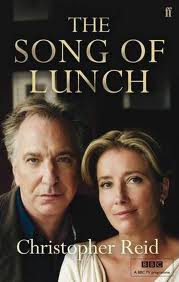
The BBC2’s production of The Song of Lunch–made to celebrate National Poetry Day in Britain– was genius simply in the choice of the actors.  Alan Rickman and Emma Thompson.  For who can better play a put-upon man, dour and drunken, and rising with lust and regrets better.  I cannot think of anyone else.  And Emma Thompson, literally shines in the role–literally that is. In one scene where Rickman is looking at her through his half empty wine glass she is glimmering.  There is a fresh aura of rightness about her that works in perfect contrast to the curmudgeonly Rickman.

The Song of Lunch is a strange one for me, for I saw the film production before I read the book.  In fact, it was BECAUSE of the dramatization that I got the book. “Making words come alive” is such a cliche, yet in this case it is very much true.  The tiny narrative of Reid’s is served quite well when animated by Rickman and Thompson.

I’ve read the poem several times now, finding something new to enjoy each time.  I You-tubed the BBC production and watched a few scenes, but the BBC came in and took certain “chapters” off, so one loses the continuum.

I do remember those long boozy lunches.  Though I wish at the time I was as observant as Christopher Reid.  His The Song of Lunch is as rich as the carpaccio and pumpkin ravioli that were ordered for appetizers and as heady as the grappa that finished the meal.

Book Review: Suddenly, A Knock on the Door by Etgar Keret

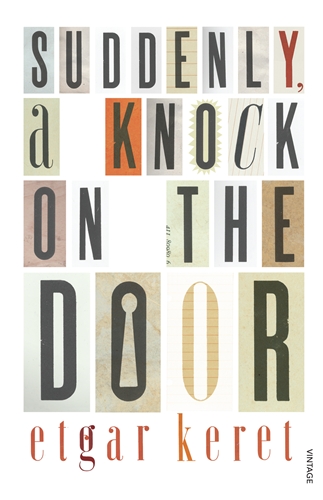
There is a weird zeitgeist about my reading these days.  I will pick up a book that I am unfamiliar with, because of a friend’s recommendation or a short review in the Sunday papers, and then all of a sudden I am seeing it everywhere.  I began reading Etgar Keret’s collection of short stories, Suddenly a Knock on the Door, after seeing it reviewed in the Sunday NYTimes two weeks ago (15 April). While I was half way through it, I was tidying up the house when a magazine from back in February fell open to a review of the book announcing its upcoming publication. I had read the review back then, but had forgotten completely about it. And then again on Wednesday in the Metro–the free paper given to commuters each day and hardly a go-to read for  literary suggestions–the book was advertised on the front page and reviewed inside. On Friday, a co-worker told me the library had called to tell him the book he had on hold had arrived: Suddenly a Knock on the Door.

What is with all the buzz?  Keret’s publicists must be very good.

And to a large degree it is worth it.  Keret’s thirty-seven stories (translated by three people) are short, zippy, and fun.  They straddle the world between stark realism (suicide bombers and bratty children) and magic (talking fish, pissed-off angels). The subject matter often seems to be fiction itself–the fictions of the literary mind and the fictions of liars.

The collection is bookended by two stories in which they author is forced to write a story in front of us.  In the final story, he is being filmed by German Television and they want to film him writing, want to record the actual creative process. In the first, he is being forced by three men–a terrorist, a poll taker, and pizza delivery man–who have invaded his home and demand a story. Violence is threatened if he doesn’t come through with a story they approve of.  When the narrator begins telling a story about what is actually happening at the time–the most current form of realism–the pizza delivery man demands something more magical: “Things are tough,” he says. “Unemployment, suicide bombings, Iranians. People are hungry for something else.”

And something else is what Keret gives us.

In one story, “Lieland,” a man is pulled into a world where all his past lies have come alive. The fabrications he has made up throughout his life in order to deceive his mother, his employers, his girlfriends all confront him in a world that is harrowing and freeing.  In “Unzipping,” a woman, tired of her current lover, finds a zipper in the man’s mouth, and unzips it to reveal a new person inside, who is indeed a different sort of lover. In still another, a woman has only slept with men named Ari–twenty-eight of them previously and now her current boyfriend and the landlord.

Yet all is not silliness.

The number of suicides and suicide bombings in the stories are many. One beautiful story, “Not Completely Alone” begins “Three of the guys she dated tried to commit suicide. …One of them even succeeded.”  The last paragraph begins “Four of the guys she dated tried to commit suicide. Two of them succeeded.”  It’s only after going back to read the first sentence that we realize the narrator is the fourth guy–and the second success. In another, a man’s life is completely changed after emerging from a extended coma that was caused by a  jumper landing on his head after falling eleven stories to his death.  In another story “Joseph,” a smarmy producer in a cafe boasts about his talent for reading people but is not clever enough to spot the sweating man with the bomb strapped to him.  After a discussion of final words by those who die a violent death, we learn of one bombing victim whose last words are the bathetic “Without cheese” as he orders a kosher “cheeseburger” in the story “Cheesus Christ.”

In “Pick a Color,” a black man is beaten badly when he moves into a white neighborhood. In the hospital, he falls in love with the white nurse who tends to him, and, whom, confined to a wheelchair, he marries  in a ceremony presided by a Yellow priest whose family also had been beaten because of their color. When the white nurse is murdered by brown men, the man turns to the Yellow priest for explanation, explanation of “the God who loves you and wishes you all the best.” When that God shows up, in a wheel chair like the black man, the explanation that God gives is not what any of us probably expected.

In relating these stories here , they seem much darker than they are upon first reading. The stories do zip by, some of them only a page and a half long.  There is much “smoke-and-mirror” playing with reality, turns with truth and illusion.  There is banality, as there is always in life, and there is beauty. A young son gives animal names to the prostitutes who visit the old man on the floor above…a dying man gets his dying wish for peace on earth…a mourning widow comes to some closure through cooking in her diner.

Nathan Englander, in the title story of his collection What We Talk About When We Talk About Anne Frank, has a character say that the difference between Israel and Miami is “the space” –that there is none in Israel.  In Etgar Keret’s collection (in which Englander translated seven of the stories), space is also the focus. Ketger looks closely at the spaces between lies and truth, between life and illusion, between hope and reality.  The stories are clever, witty, and fun. There are enough “wow” moments, enough times when you breathe out in relief or exasperation, and plenty of times when you simply smile knowingly to yourself.

In the blurbs on the paperback edition, there are statements by Salmon Rushdie, Amos Oz, Yann Martel.  But my favorite is by Gary Shteyngart, author of Super Sad True Love Story. Talking about Keret’s novel The Nimrod Flipout, Shteyngart calls it “the best work of literature to come out of Israel in the last five thousand years… .” That’s quite a claim.  Maybe I’ll see if it’s in our library.

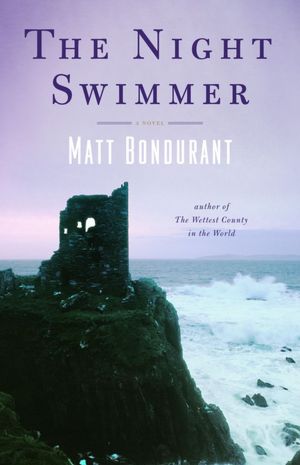
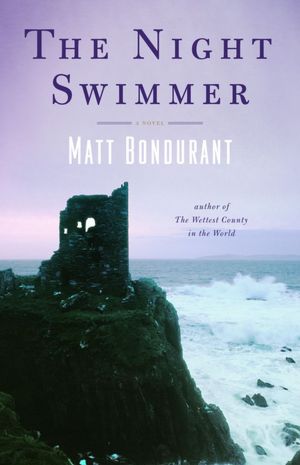
Book Review: The Night Swimmer by Matt Bondurant

A goat that walks on its hind legs…a woman who swims in the dangerously cold North Atlantic…hallucinogenics…two Irish pubs…a violent underworld…a blind goatherd…a dubious fiddler…9/11…an ancient tragedy.  These all are elements that come together in the magnificent novel The Night Swimmer by Matt Bondurant.

I wrote about this novel in an earlier blog; I had only been a few chapters in at the time and was focusing on the urge to live somewhere else. Indeed, the examination of this urge is part of the narrator’s train of thought. But I had no idea where this story was going and how vividly it would be told.

The novel is about an American couple who move to Ireland, when the husband wins a pub in the town of Baltimore in southwestern County Cork. The husband has aspirations of writing and feels that the pub will give him ample time and material to do something great. He certainly has both–but is unable to fashion anything with it.

The woman–the narrator–has an rare skin condition, a subcutaneous level of fat, that allows her to withstand extremely low water temperatures. She is an open sea swimmer and the move to Ireland allows her to revel in this activity, in water that is frigid and dangerous. She spends much of her time on Clear Island, where she swims and begins to attract the attention of the islanders as well as of a little goat that walks upright. The islanders are very suspicious of strangers–blow-ins they call them–and they are particularly concerned about this young woman who swims in their harbor. They are also going through some large shifts that threaten to change their centuries-old way of life.

As Elly, the narrator, spends more and more time on the island, she begins to feel, to a small degree, a part of the island–but she knows that this is a false feeling. She befriends a blind goat-herder and  learns of his heartbreaking personal tragedy, and then discovers a much larger tragedy that once wiped out an entire generation of islanders–except for two. She also begins to see that her marriage is not strong enough to withstand the battering that the move across the ocean occasions. She watches it erode and sadly understands why this is occurring.

The novel is many things–it is a domestic novel about marriage infused with a magical realism built on folk lore and village life.  It is a novel about enterprise and failure. About love and its withdraw. About the fear of strangers and the resistance to change. Elly attempts twice to swim to Fastnet Island–something no one has actually ever done–and in describing this momentous feat, Bondurant elevates his already lofty writing into something sublime.  Neither attempt is successful, but both are certainly memorable. In a whirling world of deep open-sea, hallucinogenic visions, and towering inspirations, Elly’s swimming anchors this already magnificent read.

Because of the epigraphs taken from the journals of John Cheever and the various allusions to him and his stories throughout The Night Swimmer, there have been the expected comparisons between the two. I find this a little wrong. For while the epigraphs from Cheever’s journals are appropriate and thoughtful,  and the thematic focus on dualities similar to that in Cheever’s own stories, the writing of The Night Swimmer seems so much fuller, fatter, more exuberant.  Cheever’s writing, for me, reflects the dessicated suburbias that he depicts, and reflects it in a much leaner style of writing.

In many ways I wish that the novel ended one chapter before it did. There is an epilogue of sorts, a tying-up of things, that I found unsatisfying. I would have rather left Elly on Clear Island, with both her and the reader trying to figure out the impact of what just happened, of where the future lies.

Midnight on Revolutionary Road in Paris, County Cork

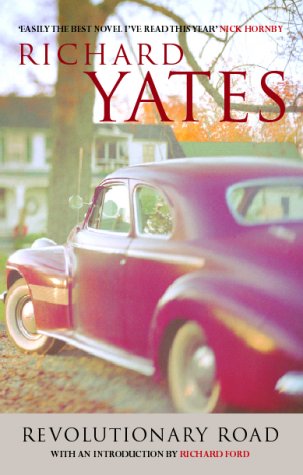
I am reading a book, The Night Swimmer by Matt Bondurant, where early in the novel, a young, successful couple have these yearnings to chuck it all and to move to Ireland.  They are intelligent and aware of the commonness of this trope–they intentionally nickname their street “Revolutionary Road” after the Richard Yates’ novel.  Earlier, before the dream of starting afresh in Ireland, the couple had wished to live in the time period when the novel Revolutionary Road takes place–a Cheever-esque world where pitchers of martinis and pyramids of cigarettes punctuated each evening. That glamorous “Mad-Men” world had not work out for them, but the dream of emigrating does: the husband wins a pub in County Cork, Ireland.  Needless to say, the paradise/excitement/vigor of the new life they imagined in this other world does not pan out they way it had in their dreams.  And like in Richard Yates’ novel, the marriage suffers more than greatly.

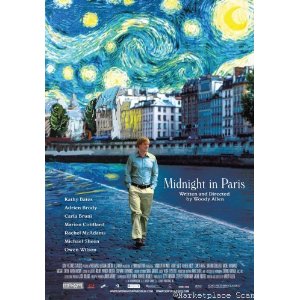
What is it about us that makes us often wish we were in some other place, some other time?  In Midnight in Paris,  Woody Allen wrestles with this question. The protagonist wishes he lived in 1920s Paris, but the 1920s woman he meets wishes she lived in the Paris of the 1890s?  And in fact, the life he is already experiencing in 2011 turns out to be full of promise. Why is this nostalgia for a world other than our own,  for an imagined place and an imagined time, so strong?  Is it  general among everyone?  Or only with a certain type of person?

I walked out to get a coffee today and on my walk home I cut down an alley.  Looking around me, I realized that I could have been walking in any foreign city with any foreign adventure around the corner.  I could have been in Paris, in Cork, but I was merely a short stroll from my own house. I took a picture with my phone.  The concept of a more exotic, romantic other place is just a whiff of smoke–it is always around us if we keep our eyes open.

Now it is often said that one doesn’t appreciated one’s home until one is separated from it. Joyce gave us a loving, photographic picture of Dublin, but only when he was writing in Switzerland and Paris.  Beckett too gives us an unnamed but undoubtedly Irish landscape in his novels and several of his plays and he too was across the sea.  But that is different than romanticizing a place one wishes for, a place that does not exist.  What Joyce and Beckett do is understand what they had left, see it without the distortion of being so close within. This is not the same as dream-manufacturing, as imagining a better world through the kaleidoscope of nostalgia and generalities.

Nevertheless, there are still many days when I wish I was somewhere else, when I don’t appreciate the vitality of the world around me. But in these daydreams, it seems that I am never working, that there is no concern about putting food on the table or where the next dollar is coming from–who wouldn’t find that attractive. And that’s what makes it all somewhat of a sham.

Central Park in Spring…Poetry in April

Went up to NYC for two days. The weather was glorious. Bright sunny skies and comfortable 70-degree weather. Central Park was bustling–workers extending their lunches, children climbing rocks, skateboarders, bikers, and roller-bladers whizzing around. There were even some early sun-bathers stripped down to the bare essentials. Good energy all around–New York at its finest.

The reason I went up to New York was to attend the 10th annual “Poetry and Creative Mind” gala held at the Alice Tulley Hall at Lincoln Center on Thursday night.  Sponsored by the Academy of American Poets, the gala celebrates National Poetry month by presenting various writers, directors, and personalities to read two or three poems of their choosing.  Simply, the night was fun. The presenters were relaxed and entertaining, and the audience was appreciative and receptive.

The readers were Meryl Streep, Brook Shields, Diana Reeves, Colum McCann, Chip Kidd, Bill Keller, Terrence Howard, John Wesley Harding, Claire Danes and Tom Brokow.

Chip Kidd (Master of Ceremonies) dressed in an extraordinary red-and-white striped suit jacket, Kidd was humorous and quick. He handled a small mishap very well when he introduced out-going Academy president Tree Svenson who reached the podium and had to leave stage to retrieve the speech she had forgotten.  He also performed a skit based on his assertion that all Emily Dickinson poems can be sung to the tune of the “Yellow Road of Texas,” “Gilligan’s Island,” and the 1970 theme song for Pepsi.

Colum McCann. McCann’s National Book Award winning novel, Let the Great World Spin was a dramatic, emotional,  exciting portrait of New York City in 1974.  (see and hear McCann talk about the novel here: http://www.amazon.com/Let-Great-World-Spin-Novel/dp/0812973992/ref=sr_1_1?s=books&ie=UTF8&qid=1333815282&sr=1-1).

McCann recited “The Road Not Taken.” He said that instead of gifts for Christmas, he asks his children to memorize a poem and gave us one that he had asked them to memorize. It was “A Meeting” by Wendell Berry and dedicated to Frank McCourt. His poems all tended to celebrate “the road not taken.” They included Rukeyser’s “Then I saw What the Calling Was” and Amy Clampitt’s “Blueberrying in August.” He ended with the very powerful poem by Nikky Finney called “I Have Been Somewhere.”

Claire Danes, the actress, recited e.e. cummings’ “if up’s the word.”  The poem had been read at her wedding.  She then read  Frank O’Hara’s “Having a Coke with you.”  It was new to me–although I inherited O’Hara’s completed poems from my uncle–and it was such a wonderful love poem. Here it is:

“Having a Coke with You” by Frank O’Hara

Having a Coke with you
is even more fun than going to San Sebastian, Irún, Hendaye, Biarritz, Bayonne
or being sick to my stomach on the Travesera de Gracia in Barcelona
partly because in your orange shirt you look like a better happier St. Sebastian
partly because of my love for you, partly because of your love for yoghurt
partly because of the fluorescent orange tulips around the birches
partly because of the secrecy our smiles take on before people and statuary
it is hard to believe when I’m with you that there can be anything as still
as solemn as unpleasantly definitive as statuary when right in front of it
in the warm New York 4 o’clock light we are drifting back and forth
between each other like a tree breathing through its spectacles

and the portrait show seems to have no faces in it at all, just paint
you suddenly wonder why in the world anyone ever did them

I look
at you and I would rather look at you than all the portraits in the world
except possibly for the Polish Rider occasionally and anyway it’s in the Frick
which thank heavens you haven’t gone to yet so we can go together the first time
and the fact that you move so beautifully more or less takes care of Futurism
just as at home I never think of the Nude Descending a Staircase or
at a rehearsal a single drawing of Leonardo or Michelangelo that used to wow me
and what good does all the research of the Impressionists do them
when they never got the right person to stand near the tree when the sun sank
or for that matter Marino Marini when he didn’t pick the rider as carefully
as the horse

it seems they were all cheated of some marvelous experience
which is not going to go wasted on me which is why I am telling you about it.

John Wesley Harding –John Wesley Harding is the stage, folk-singing name of the writer, Wesley Stace. As Wesley Stace he read Thomas Wyatt’s  “They Flee from Me”  which he calls the greatest poem ever written. (I’m not sure I agree). For his second poem, he brought out his guitar and sang the poem, “The Examiners”–which is on his latest album.   He had seen it in a contest in the Times Literary Supplement and was immediately struck by it.  As he noted, the poem may have come in 3rd in the contest, but “numbers 1 and 2 weren’t being played on the stage at Lincoln Center.” Here he is singing “The Examiners”:

Terence Howard, the stage and screen actor, seemed the less comfortable of them all. He haltingly read Stanley Kunitz’s “The Layers,”  but then hit his mark with Rod McKuen’s “Gifts from the Sea.”  It was moving and lovely.  And to me a surprise.

Brooke Shields gave perhaps the best performance of all.  She first read “The Spoilsport”  by Robert Graves, then the very funny “Nostalgia” by Billy Collins and then Howard Nemerov’s “To David, About His Education.” Her delivery was relaxed and humorous and each of the poems themselves were both light and thoughtful.

Bill Keller said that the only reason he had been invited to read was that he had written a NYTimes article in which he said that Congress would be a much better governing organization if they read more poetry. (He said that maybe that would be better than the “Congressional prayer breakfasts” that so many like to boast about.) He cited the late Adrian Rich who once said that “poetry was the perfect antidote to moral certainty” and felt that that was something sorely need in present day Washington. He read three love poems, one each by Brad Leithauser, Kay Ryan, and Frederick Seidel. He ended with Stephen Dunn’s “Our Parents.”

Dianne Reeves. The great jazz singer showed that she can also sing the blues. In the middle of  the Gwendolyn Brooks “Queen of the Blues,” she sang the middle verses in  throaty, bluesy voice that wound back into the poem gently into the poem. It was the high point of the evening. She also read a humorous one about a woman’s hips and another about language and grammar by Kenneth Koch in which the elements of a sentence vowed their love ”until the destruction of language”

Tom Brokaw. Affable and charming, surprisingly his remarks fell flat and his poetry selections were not that memorable. He joked about having been placed between Reeves and Streep. Affable enough, but not that great a performance.

Meryl Streep is always regal, even when she is casual and comfortable. She read W.H. Auden “As I walked out one evening” and then Bishop’s “At the Fishhouses”–she flubbed her lines at the end, but the performance was still spell-bounding.  To atone for her slip-up, she then recited a Chinese poem, first in English and then in Chinese.  It seems that she can do anything.

There was a large reception at the end–one could see in through the glass walls and it looked fine and sumptuous–but it was for the performers and the higher-priced ticket holders only.  Instead I walked across the street and had a whisky and replayed the night in my head.