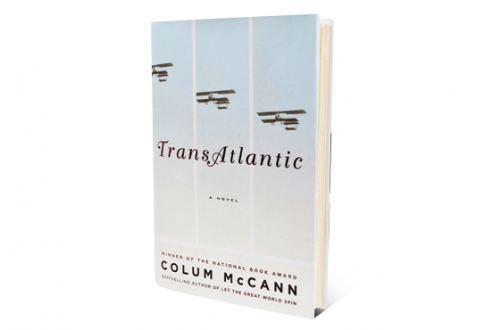
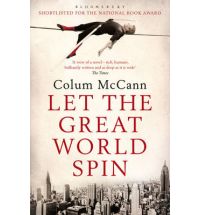
Around this time last year, a friend of mine lent me a paperback copy of Colum McCann’s Let the Great World Spin. It was nothing short of masterful, an eloquent novel filled with beauty, wit, humor, and wisdom–and a helluva story as well. A variety of personal histories are threaded around the dazzling 1974 tight-rope walk of Philippe Petite between the World Trade Towers and set against the more resonant chapter in the Towers’ history, with the tragedy of 9/11 looming in the background. The writing was dizzily beautiful, every page an extraordinary read.
Writing
Quote of the week # 12: July 14, 2013
“After so many years, I’ve learned that being creative is a full-time job with its own daily patterns. That’s why writers, for example, like to establish routines for themselves. The most productive ones get started early in the morning, when the world is quiet, the phones aren’t ringing, and their minds are rested, alert, and not yet polluted by other people’s words. They might set a goal for themselves — write fifteen hundred words, or stay at their desk until noon — but the real secret is that they do this every day. In other words, they are disciplined. Over time, as the daily routines become second nature, discipline morphs into habit.
“It’s the same for any creative individual, whether it’s a painter finding his way each morning to the easel, or a medical researcher returning daily to the laboratory. The routine is as much a part of the creative process as the lightning bolt of inspiration, maybe more. And this routine is available to everyone.
“Creativity is a habit, and the best creativity is a result of good work habits.”
Twyla Tharp, The Creative Habit
Movie Review: Hannah Arendt dir. by Margarethe von Trotta
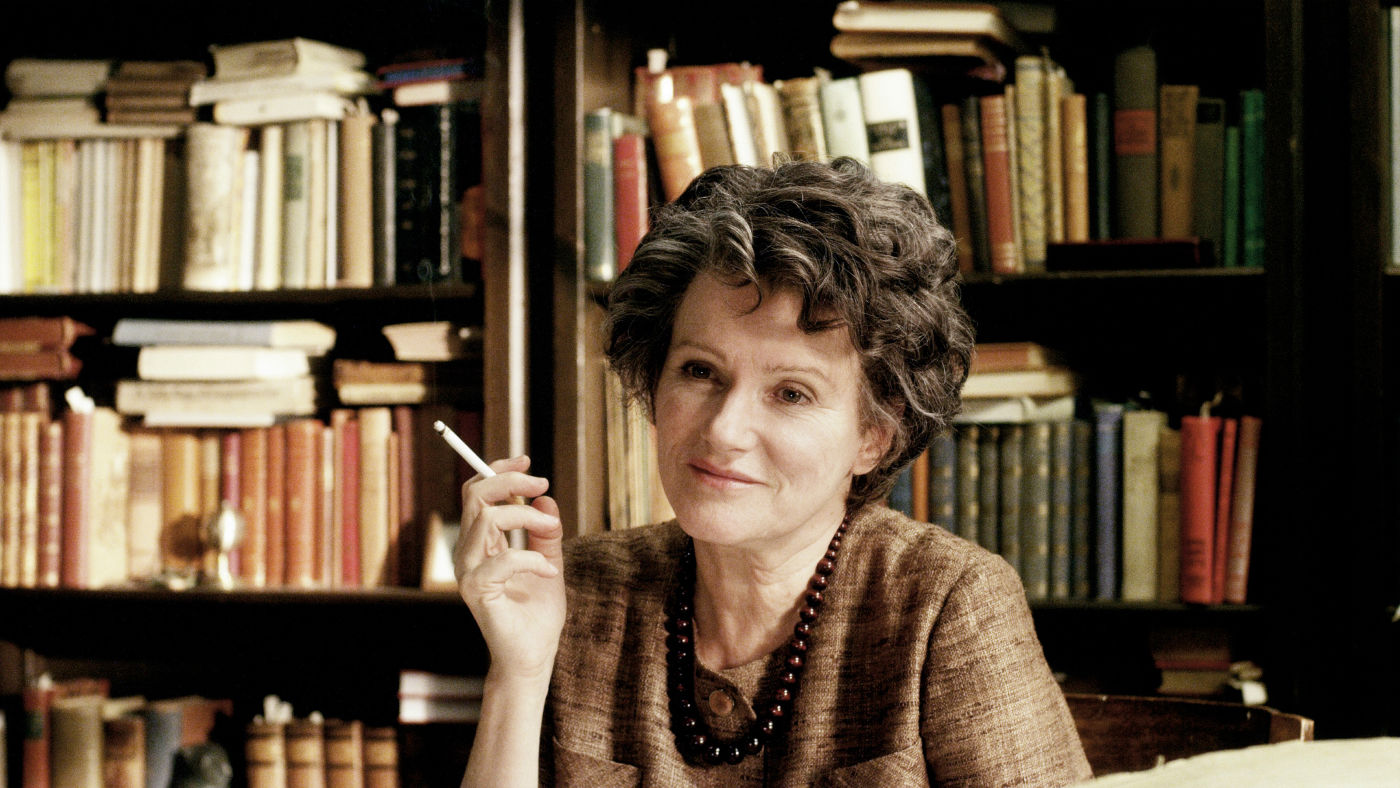
The philosopher, political theorist and writer, Hannah Arendt has received a thoughtful and deserving biopic from director Margarethe von Trotta, in her eponymous film, Hannah Arendt. The film’s intelligence reflects the life of the mind that Arendt lived–and an honest and hard intelligence at that. Concentrating on the period when Arendt covered the Adolph Eichmann trials for New Yorker magazine–and the fury that it unleashed– it shows Arendt resolute in her thinking, uncolored by prejudice or sympathies.
Her coverage of the Eichmann trial ended with these words, this pronouncement:
Just as you [Eichmann] supported and carried out a policy of not wanting to share the earth with the Jewish people and the people of a number of other nations—as though you and your superiors had any right to determine who should and who should not inhabit the world—we find that no one, that is, no member of the human race, can be expected to want to share the earth with you. This is the reason, and the only reason, you must hang.
♦ ♦ ♦ ♦ ♦ ♦ ♦ ♦
Arendt’s biography is well know. Born into a secular Jewish family, she studied under Martin Heidegger with whom she reportedly had a long affair. Her dissertation was on Love and Saint Augustine, but after its completion she was forbidden to teach in German universities because of being Jewish. She left Germany for France, but while there she was sent to the Grus detention camp, from which she escaped after only a few weeks. In 1941, Arendt, her husband Heinrich Blücher, and her mother escaped to the United States.
From there she embarked on an academic career that saw her teaching at many of the U.S.’s most prestigious universities (she was the first female lecturer at Princeton University) and publishing some of the most influential works on political theory of the time.
♦ ♦ ♦ ♦ ♦ ♦ ♦ ♦
But the film, concerns a small time period in her life–but one for which many people still hold a grudge. The film begins darkly with the Mosada snatching Eichmann off a dark road in Argentina. Back in New York City, Arendt (Barbara Sukowa) and the American novelist, Mary McCarthy (Janet McTeer) are sipping wine and gossipping about the infidelities of McCarthy’s suitors. Even genius can be mundane–perhaps a subtle reference to Arendt’s conclusions from the trial. When news of Eichmann’s arrest–and trial in Israel–is announced, Arendt writes to William Shawn (Nicholas Woodeson) at the New Yorker, asking if she might cover the trial for the magazine. Shawn is excited; his assistant, Francis Wells (Megan Gay,) less so.
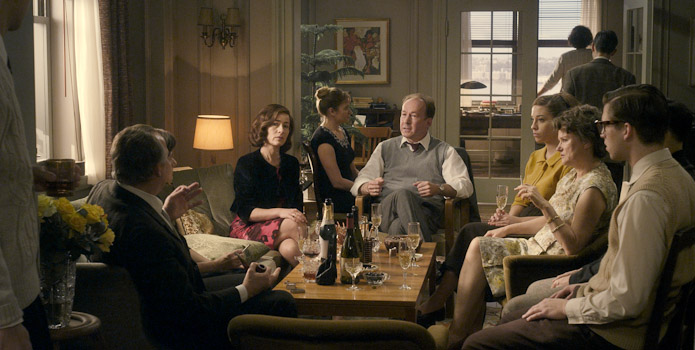
Of course, the trial–and Arendt’s commission to follow it–is fascinating and controversial and we listen in on Arendt and her husband and their circle of friends as they debate and argue and opine. Aside from Mary McCarthy and the head of the German department at the New School where Arendt is teaching, the guests at Arendt’s apartment are all friends from Europe, German-Jews who have escaped the Shoah/Holocaust. Listening to their different conversations is fascinating and electrifying. This is a movie about “thinking.”
In Israel, Arendt meets with old friends, friends who remember her argumentative spirit, and stays with the Zionist, Kurt Blumenfeld. From the outset, one sees that Arendt is not thinking along the same lines as the masses following the trial.
“Under conditions of tyranny it is much easier to act than to think.”
Hannah Arendt
At the trial, there is a telling moment, when Arendt watches Eichmann in his glass cage sniffling, rubbing his nose and dealing with a cold. It is then, a least in the film, that she comes to understand that this monster is not a MONSTER. She sees him as simply a mediocre human being who did not think. It is from here that she coins the idea of the “banality of evil.”
Upon returning home–with files and files of the trial’s transcripts–her article for the New Yorker is slow in coming. Her husband has a stroke, and the enormity of what she has to say needs to be perfect.
When it is finally published, the angry reaction is more than great. The critic Irving Howe called it a “civil war” among New York intellectuals. (Just last week, the word “shitstorm” was added to the German dictionary, the Duden, partly due to Chancellor Angela Merkel’s use of the word to describe the public outcry she faced over the Eurozone’s finacial crisis. It is an apt term for what occurred upon publication of Arendt’s coverage.)
It is this extraordinary anger towards Arendt–and her staunch defense–that makes up the final moments of the film. In the closing moments, Arendt speaks to a packed auditorium of students (and a few administrators). She has just been asked to resign, which she refuses to do. These are her closing words:
“This inability to think created the possibility for many ordinary men to commit evil deeds on a gigantic scale, the like of which had never been seen before. The manifestation of the wind of thought is not knowledge but the ability to tell right from wrong, beautiful from ugly. And I hope that thinking gives people the strength to prevent catastrophes in these rare moments when the chips are down.”
This is, more than anything else, a film about thinking.
♦ ♦ ♦ ♦ ♦ ♦ ♦ ♦
The extraordinary anger shown in the film is still felt by many today and, in fact, seems to have colored some of the reviews that I have read and heard. Some of these reviewers seem to be reviewing the life and work of Arendt and not the film of Margarethe von Trotta, for von Trotta’s film is a unique, masterpiece. It is more than a biography of a controversial thinker…it is a portrait of thought itself. Arendt attempts to define “evil”–certainly an apt exercise at the time. She defines it–to her friends, to her classes, to her colleagues, and to herself–and finds that it is not “radical” as she once had posited. It is merely ordinary. Goodness, she sees, is what has grandeur.
The film, Hannah Arendt, is well worth seeking out. It is thoughtful, provoking, controversial, and, at times, even funny. You can’t ask for much more for the price of a movie ticket. As always, here’s a trailer:
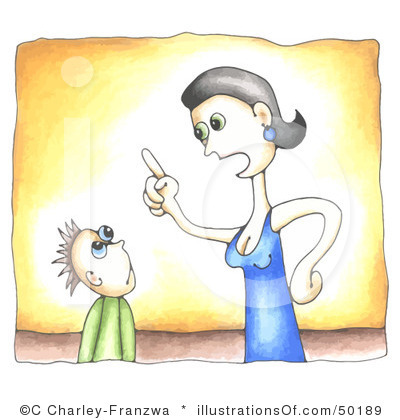
Mother’s advice: “if you have nothing nice to say…”
I went to the movies on Monday afternoon to see a film that I had been wanting to see for the past month or so. But I left the theater greatly disappointed. And as I walked up 3rd street, I thought to myself, I am not even going to write about this one.
And I think I am right.
I am not a critic–of film, books or music–I simply enjoy these things. And I enjoy writing about them and sharing my enthusiasms about them. But, I don’t feel comfortable bad-mouthing the ones I don’t like. On Wednesday I posted a piece about a book I didn’t like and I feel more than a little discomforted about it.
In this vast “blogosphere” where everyone so easily can send out his or her opinions, I want to rein myself in. Of course, BAD ART exists–there are books that are dreadful, movies that are deadening, music that irks me, but they will find their own levels of acceptance, they will find their own audiences (or not) without my weighing in.
And besides, I don’t have the time to waste on negativity.
After all, all creativity is risk…risk of missing the mark, of being misunderstood, of being ripped apart. But one has to put it out there and let it find its own life. (As Woody Allen says, “Eighty percent of success is just showing up.”)
So, I’m sitting in a shop having a coffee after the movie and am asked what I thought. “I didn’t like it,” I say, and I give my reasons, listen to counter-positions, discuss the pluses and minuses. This is good, this is what Art should engender–conversation, dialogue, thought, and, yes, even judgment.
But is there really a need for me to blast it on the internet? I’m not so sure, but I don’t think so.
Don’t get me wrong; I will point out inconsistencies in the things that I like, choices and perspectives I disagree with, differences and surprises that throw me, things I see as flaws or would have wished the artist had done differently.
But with things that I don’t like…? Well, as my mother would say, “if I have NOTHING nice to say, I’m not going to say it.”
I can’t write, so I read Denis Johnson…
…and now I know I can’t write.
At times I feel I’m kidding myself. Who do I think I am pretending to be a writer, a poet, a thinker? I am just an everyday slug without the discipline to get anything really worthwhile done. And discipline is what you need. How many times do we hear that just showing up is 90% of the struggle? Just do the work, day in and day out, we are told, and the creation will come.
I don’t do the work.
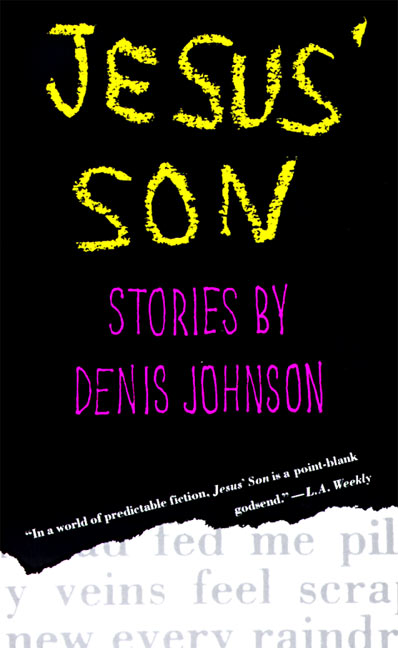
And so as I sneak off for my hour-and-a-half, two hours, I try to jump-start my atrophied mind by reading for a while at first. Unfortunately today, I began re-reading Denis Johnson’s Jesus’ Son, a collection of eleven wise, lively, brutal, intense, truthful short-stories.
I’ve never felt so washed up in my life!
The first story, “Car Crash While Hitchhiking” is riveting. It’s like a very bad car accident that you can’t turn away from. The narrator, the hitchhiker, has been on the road from Texas to Kansas City. The first driver fed him amphetamines and Canadian Club; the second ride was a hashish filled bubble to the city limits; and the third ride was the fateful ride–a family of four with a nine-month old baby on the back seat, destined to be brutalized in a head-on collision. The narrator is flawed and generous and seemingly prescient, for he seems to know that it is this family that picks him up that will suffer. His final words long after the car accident and while being admitted to the Detox at Seattle General are puzzling–if not telling: “And you, you ridiculous people, you expect me to help you.”
God, could it be Jesus’ son?
Much later in the collection–one could label Jesus’ Son an episodic novel rather than a collection of short stories with its single narrator and progressive (though disjointed) chronology–the narrator is in detox and is shaving another man. (The drugs they are giving him have steadied his hands to such a degree that he has taken to shaving fellow patients.) Here is part of the scene:
Just below one cheekbone, Bill had a small blemish where a bullet had entered his face, and in the other cheek a slightly larger scar where the slug had gone on its way.
“When you were shot right through your face like that, did the bullet go on to do anything interesting?”
“How would I know? I didn’t take notes. Even if it goes on through, you still feel like you just got shot in the head?”
But they aren’t Bill’s only wounds. “I’ve been shot twice,” Bill reveals. …”Once by each wife for a total of three bullets, making four holes, three ins and one out.”
This is the world of Jesus’ Son. There are bullet wounds and heartaches. There is addiction and abortion, love and lovelessness, disease and car-crashes and murder. Johnson once said about his stories “Some of us go to the movies to see everybody shooting each other, and then there’s another bunch who actually shoot each other.” It is this latter bunch that people Johnson’s stories. But in addition to “shoot[ing] each other,” they seek salvation, search for love, and try to survive on the wrong track that life has set them on.
Intense and unsettling, witty and thrilling, the stories are both unforgettable and beautiful. Something any writer should aspire to.
So, Another Weird Coincidence…
So, I had sneaked out to this coffee house to do this wee bit of writing and reading. And I was considering saying something about the title–Jesus’ Son–and how it was taken from the Lou Reed song “Heroin.” I had just decided against it when Lou Reed’s “Sweet Jane” comes on the sound-system and that sealed the deal. When I mentioned the coincidence to the guy at the counter, he replied, “Lou is everywhere.” I didn’t know, hah!
So, if you want, here’s a recent version of Lou Reed singing “Heroin” from where the title came:
Quote of the week #8: June 16, 2013
“Mythical heroes are of obviously superhuman dimensions, an aspect which helps to make these stories acceptable to the child. Otherwise the child would be overpowered by the implied demand that he emulate the hero in his own life. Myths are useful in forming not the total personality, but only the superego. The child knows that he cannot possibly live up to the hero’s virtue, or parallel his deeds; all he can be expected to do is emulate the hero to some small degree so the child is not defeated by the discrepancy between this ideal and his own smallness.”
Bruno Bettelheim, The Uses of Enchantment
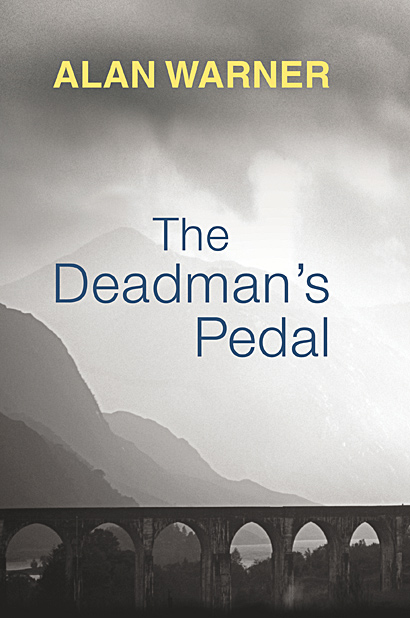
Book Review: Deadman’s Pedal by Alan Warner…coming of age in Scotland
Alan Warner belongs to a certain group of writers who came of age in Scotland in the last decades of the 20th century. Those with more recognizable names would included Irvin Welsh who gave us Trainspotting, James Kelman with his unique voice of urban rootlessness, Ian Banks (who died last week) and A.L. Kennedy with their distinctive fictions, and Ian Rankin who gave us Inspector Rebus and his Edinburgh detective novels. Among these, Alan Warner seems the one who has gained less recognition over here in the States. And that is a shame.
Warner’s first novel Morvern Caller was a magnificent tale of a young woman who steals her dead boyfriend’s novel from his computer, changes the name on the manuscript and quickly and decadently burns through the advance that the novel garners, moving from her dilapidated Scottish town through the ravages of the European rave scene. A later novel with the unfortunate title The Sopranos follows a group of high school choir girls from a rural western outpost on its class trip to Edinburgh. Both novels are memorable for their voice, for the seeming accuracy of Warner’s portrayals of 16 and 17-year olds. And both are fun.
Warner returns to the same locale from which Morvern Caller and the girls from The Sopranos escape in his newest novel, The Deadman’s Pedal. And again, he is dealing with characters of a certain age, characters who are between childhood and adulthood, characters who are innocents even as they are losing their innocence.
The novel takes place around “the Port,” Warner’s fictionalized treatment of the town of Oban in western Scotland and is held together by the train line that serves the area and which is dwindling in impact. In fact the title “Deadman’s Pedal” refers to a device that on a runaway train is set to brake in the case of an engineer losing consciousness.
Simon Crimmons is turning sixteen and wants to quit school, get a motorbike, and get a job. He is considered well-to-do by his companions because his father owns a trucking company, but wealth is a relative thing, and the Crimmons family is certainly working class in comparison to the lordly Bultitude’s. In fact, Simon, the town and the novel itself are greatly aware of class distinctions. And this is a running theme throughout.
Yet it is in terms of young Simon’s desires that the class distinctions are most evident. For he is torn between the beautiful and always available Nikki Caine from the Estate houses and the enigmatic Varie Bultitude–of the town’s legendary, aristocracy. Managing such affairs is always risky and managing one between such two disparate worlds is like being on a run-away train.
When Simon mistakenly gets a job as a trainee train driver–he thought he was applying for a hospital position–he discovers the extent of these class divisions. He says to Vaire, “I’ve got the whole railway telling me I’m not working class enough and I’ve got you telling me I’m not middle class enough. This country needs to sort out the class question. As far as it applies to me.”
And to make matters more difficult, Simon’s father is caught up in it as well. He sees his son’s work on the trains as a betrayal, as his son’s working for a competitor that could ultimately put him out of business. It’s never easy being sixteen. It seems much harder for Simon Crimmons.
The joy of the novel–apart from the very real depictions of young desire, lust, and confusion–is the language itself. Some may find the dialect off-putting at first, but it quickly becomes second nature, but the narration itself is pure genius: A funeral for a dead train man is told with humor, nostalgia and poignancy; Simon’s first kiss is described as sweet, anxious, innocent and thrilling; the grounds of the Bultitude property are given an almost gothic eeriness and grandeur. (The Bultitudes are said to bury their dead in glass coffins…the aristocracy is always with us!)
Early in the novel, Simon and his friend Galbraith show Nikki the secret hideout they have built out in the wilds. They make her promise not to mention it to the other boys knowing that it is a childish thing and that the others would tease them for it. It is here that Simon and Nikki first have sex– in a short scene that is both innocent and knowing. It is a scene–positioned in his boyhood escape– that captures the very tension of this novel, the tension between innocence and adulthood, between desire and attainment, between the people and their landscape.
Alan Warner is an extraordinary writer. That his name is little known outside Britain is an injustice, but one that may be set aright by Deadman’s Pedal–a novel that is larger than its Scottish setting, a novel that is universal in its wonders, its desires, and its struggles.
Book Review: Ancient Light by John Banville
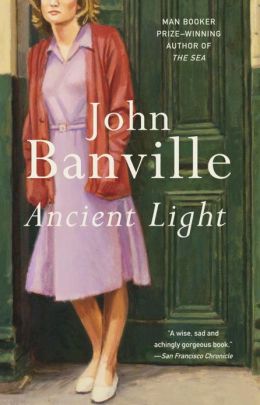
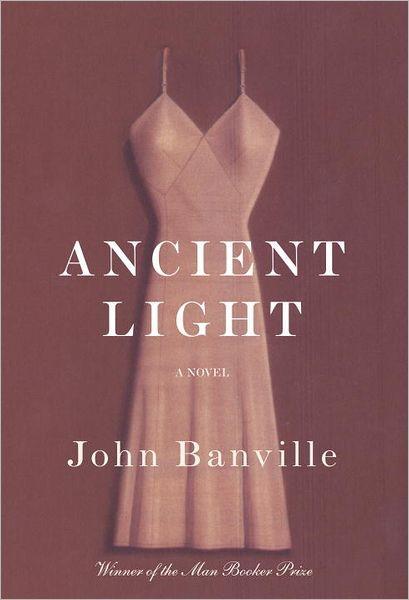
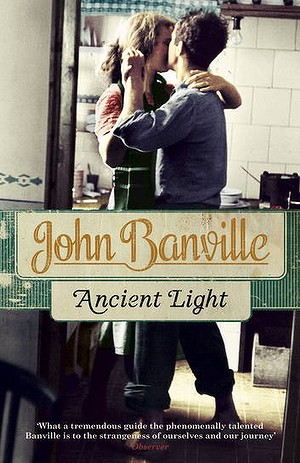
It seems appropriate that there are three book-covers for John Banville’s Ancient Light. For confusion–or perhaps”uncertainty” –is the appropriate word for the various threads that form the cloth of Banville’s novel. Weaving together three stories (at the very least), Ancient Light details the aging actor Alex Cleave’s misted memories and the challenges of his present life.
Particularly important in his mind are the affair he had when he was 15 with the 35-year old mother of his best friend, his daughter who killed herself in Italy ten years before the novel begins, and the young “movie-star”with whom he–a respected stage actor– is filming his first movie. And hovering in the background, drinking tea in the kitchen while Cleave writes these “memoirs” is his wife, Lydia, who is struggling with their daughter’s death in her own way.
So who are the women represented on the book covers? Is that Mrs. Gray, his first love standing in front of the shop? Or his daughter waiting impatiently for his arrival? Is that the actress Dawn Davenport’s slip? Or Mrs. Gray’s? Or his daughter’s? And who can that be dancing? Mrs. Gray and young Alex seems obvious. But could it also be the characters that Cleave and Davenport are playing in their film? Or his daughter and the mysterious man she was working for (and whose child she was carrying) when she flung herself into the rock-strewn sea?
That we can not be sure is part of the joy and wonder–and admiration–one feels in reading Ancient Light. Banville is an exquisite writer–and I do not use that word lightly. Character description, dialogue, setting, interior life–all are rendered with keenly sensitive language and thoughtfulness. At one point, the sky is the color of “wetted jute“; at another, it is described as “a layering of bands of clay-white, peach, pale green, all this reflected as a vaguely mottled mauve wash on the motionless…canal.” Some of the writing is heart-wrenching in its perfection; some is amusing. Here is Cleave describing a “researcher” sent by the movie company to help him with his role:
Billie, however, is obviously a native of these parts, a short pudgy person in, I judge, her middle to late thirties. She really is of remarkable shape, and might have been assembled from a collection of cardboard boxes of varying sizes that were first left out in the rain and then piled soggily any old way one on top of the other. The general effect was not improved by the extremely tight jeans she was wearing, and the black polo-necked jumper that made her large head look like a rubber ball set squarely atop those precariously stacked cartons.
Here is what the aging Alex has to say early about love:
I should like to be in love again, I should like to fall in love again, just once more.
He is aware of both the poignancy of those words and the sadness of the thought in the presence of his wife.
What Ancient Light is most surely about is the past. Cleave–believing he is nearing the end of his career–is enamored by it, by the love affair with Mrs. Gray (he notes the inexactness of this phrase) and by the death of his daughter.
Because I am getting old and the past has begun to seem more vivid than the present, he states, and then later, when he learns of what he mis-remembered, he concludes that often the past seems a puzzle from which the most vital pieces are missing.
When in Italy with Dawn Davenport he meets a mysterious Argentinian, (a ghost? his doppelgänger?) who over a bottle of wine says this too him:
“Even here,” he said, ” at this table, the light that is the image of my eyes takes time…to reach your eyes, and so it is that everywhere we look, everywhere, we are looking into the past.”
But the past is slippery for both Cleave and the memoir he is writing. He notices instances when the progression of time seems to slip, to miss a cog:
There are moments, infrequent though marked, when it seems that by some tiny shift or lapse in time I have become misplaced, have outstripped or lagged behind myself.
Cleave’s stories ultimately come together in subtle and satisfying ways. There are coincidences, but Cleave does not believe in coincidences. There are “apparitions,” though Cleave is reluctant to but wishes to believe in an afterlife. (Twenty years ago, Banville did write a novel Ghosts.) There is doubling and there are doubles. There is a subtle knowledge of and reference to Greek mythology, and a faint feeling that the ancient gods are still at work in the lives of these mortals. And it is all done in a lush, rich style that is the very antithesis of modernity’s spare and sparse writing.
John Banville is an author who writes intelligent and dense books that deserve a much wider readership. His novel The Sea won the Man Booker Prize (much to the dismay of critics who felt it wasn’t commericial enough.) And lately he has also been writing detective novels under the pseudonym Benjamin Black. And I just learned, when I mentioned Ancient Light to a friend that this novel is in fact the third of a loose triology featuring Alex Cleave, his wife Lydia and their daughter Cass.
I will have to hunt them down.
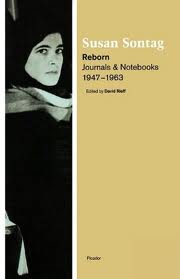
Book Review: Reborn: Journals and Notebooks 1947-1966 Susan Sontag
There is a danger in reading memoirs, diaries, journals. Certainly, there are times when our angels are shown to have feet of clay. Or other instances, when we weigh the turmoils and angst of a particular life with the end product that impelled you to read the memoir in the first place.
But with Sontag it is quite, quite different.
Next to even her young self, I feel so inadequate, so shallow, so wasteful of time.
Here is a young woman–14 years of age when the journals begin–embarking on a intellectual career that would put most of us to shame. Her reading lists, her “to-do” lists, her debates with herself, her analysis of events, readings, concerts and people she meets, her experiences, all are more fervent, more intelligent, more thoughtful in the years between her 14th birthday and her 30th, than mine have been for most of my life.
I teach a group of extremely bright 18-year old boys. They have great intelligence, and some are quite creative. But every so often they need to be reminded that their superior intelligence is frequently measured within the very small pond of our school. Here’s what I read them from Sontag’s journal:
…Yet we do exist, + affirm that. We affirm the life of lust. Yet there is more. One flees not from one’s real nature which is animal, id, to a self-torturing externally imposed conscience, super-ego, as Freud would have it–but the reverse, as Kierkegaard says. Our ethical sensitivity is what is natural to man + we flee from it to the beast…
I ask them to describe the person who would write this in his or her personal journal. And they are always far off…in both gender and age. Sontag wrote this (a snippet of a much larger journal entry) two weeks after she had turned 17! Already her depth of reading and understanding and active thoughtfulness is evident.
Immediately in this first volume of the journals, one meets a brilliant, thoughtful intelligence. She attended Berkeley at the age of 16, transfered to University of Chicago, married Phillip Reiff–a sociology professor–at 17, taught at the University of Connecticut when she was 19, and attended graduate school at Harvard, where she got her degree in philosophy and theology. And throughout these years, she recorded her thoughts and criticisms and interpretations, as well as her fears, her doubts and her insecurities. As her marriage began to falter, she received a fellowship to Oxford and then moved to Paris. When she moved back to New York in 1959 (26 years old), her marriage was dissolved and she had gained custody of her son. Established in New York, she began teaching at various colleges, completed her first novel, The Benefactor, and witnessed her reputation as part of New York’s intelligentsia begin to grow.
These are the years covered in the volume. Aside from the inquisitiveness, interpretation, and analysis of what she reads, sees and watches (she was a rabid film-goer), there is the struggle of understanding who she was. The marriage was unsatisfying, the lovers often hurtful, and in reading the journals we see a young woman trying to discover herself and come to terms with her own individuality, her own bi-sexuality, her own identity. There are times when one feels she is too hard on herself…when one wants to warn her, NO, this is going to end bad, but then again, one can’t.
Beginning when she was 14 and ending when she was 30, the journals are remarkable for their honesty and the peek into her rigorous mind. But at the end, one is moved by the ever-going struggle between her sexuality and her intelligence, by the vulnerabilities and insecurities she reveals in her two major love affairs with Harriet Sohmers Zwerling and Irene Fornés. For her extraordinary mind struggled continually to understand the extraordinary pull of the flesh.
Her last two entries for 1963 read:
The intellectual ecstasy I have had access to since early
childhood. But ecstasy is ecstasy.
Intellectual “wanting” like sexual wanting.
♦ ♦ ♦ ♦ ♦ ♦
Reborn is the first of a proposed three volumes of journals. The next volume–As Consciousness Is Harnessed to Flesh– covers the years 1963 to 1964, when Sontag develops her reputation, her political activism, and her writing. It is now on my “to-read” list.
Adam Phillips: Promises, Promises: Essays on Psychoanalysis and Literature
In the office of a colleague a while back I noticed a towering pile of books on the desk, as if he were re-arranging his book shelves or carting out old titles to a different location. But no, it was his “to read” pile, and it was impressive and imposing.
“As poets struggle to find a place in contemporary cultural reality, psychoanalysts, implicitly or explicitly, are still promoting the poets as ego-ideals.”
Philips, “Poetry and Psychoanalysis”
The crux of Phillips’ essays is the mutual relationship between literature and psychoanalysis…and psychoanalysts’ established reverence for creative writers. Literature, according to Freud, gave birth to psychoanalysis and psychoanalysis often gives resonance to literature.
And so go his essays.
He begins with the essay “Poetry and Psychoanalysis” and brings in the young poet Keats–a former medical student–who famously stated that science ruined poetry when Newton reduced the rainbow to a prism. Not so, Phillips says, for poetry (and you can read “creative writing” where Phillips says “poetry”) can do what the sciences cannot. Indeed, much of his argument is that the science of psychoanalysis is bringing understanding to the vision of poetry. Freud said, Phillips tells us, that the poets had long before discovered the unconscious, and that he only had devised a way to study it.
Phillips graciously gives way to “poetry” saying that the short history of psychoanalysis has been an attempt to study the unconscious that poetry reveals. And since both poetry and psychoanalysis–the “talking cure”–depend on language, and often, coded language, the two are intrinsically welded together.
And so he is off.
There are marvelous literary essays on Hamlet, Hart Crane, Martin Amis, A.E. Housman and Frederick Seidel, all informed by an accessible shading of psychoanalytic theory, as well as masterful psychoanalytic pieces on Narcissism, Jokes, Anorexia and Clutter, informed by a broad knowledge of literature/poetry. It is Phillips’ contention–his modus operandi, if you will–that the two disciplines can or should depend on each other for clarity.
The collection ends with the title piece, “Promises, Promises.” In it, Phillips examines the “promise” that both literature and psychoanalysis offer. He writes:
“If we talk about promises now, as I think we should when we talk about psychoanalysis and literature, then we are talking about hopes and wishes, about what we are wanting from our relationship with these two objects in the cultural field.”
What does reading literature promise us? What does analysis promise us? Phillips contends that both promise us, to a degree, “the experience of a relationship in silence, the unusual experience of a relationship in which no one speaks.” Of course, ultimately, the analyst must speak. But it is in that silence that often we become “true to ourselves.”
Reading psychoanalytic theory can often be dry and dusty, but Phillips’ writing never is. Bringing in an encyclopedic knowledge of both creative literature and psychoanalytic literature (and, at times, arguing that there might not be a difference), Phillips imaginatively and wittily plumbs past and current trends, canonical and esoteric literatures, clinical practice and private correspondence to bring to light his vision of psychoanalysis and literature’s potential and promise.