Bowler Hats: Chaplin and Bloom…Sally Bowles and Sabina

A few decades ago, I remember having to read a piece on “the sociology of clothing in the Victorian era.” The author’s intent was to show that fashion had a subtext. I remember clearly the argument about men’s hats. The thesis was that the height of a man’s hat in Victorian England was proportionate to his status on the social scale.  i.e. The society toffs wore tall top hats, the navvies and farmers wore flat caps.

I thought of this again after a conversation about “bowlers.” A friend and I had just finished reading Milos Kundera’s The Unbearable Lightness of Being and were commenting on the bowler hat that the character Sabina is attached to (it reminds her of her grandfather) and which she often wears during sex.

“It’s a silly hat,” my friend said. “There is really nothing sexy about it.”

Silly or sexy?  I’d state that both things are true, depending on who’s wearing it.

For Christmas this year, my young nephew gave me a tee-shirt imprinted with the text of Joyce’s Ulysses on it. The text is manipulated to depict Leopold Bloom’s mustache and bowler hat. (Though I argue that Bloom would never wear his hat tilted at such a jaunty angle.)

Image-1

Leopold Bloom t-shirt

Now, although the book ends with Bloom’s wife repeatedly affirming her husband’s worth (“yes,  yes I said yes I will Yes.”), throughout much of the novel, Bloom is a figure of ridicule.  And a bowler hat only underscores that. (In truth, those who most ridicule him wear flat caps or no hats at all.)

When I was little my parents enjoyed Laurel and Hardy. (How politically incorrect we all 354845-laurel-and-hardywere then: I didn’t know their names were “Laurel and Hardy” until much later. My mom had always called them “Fats and Skinny.”)  They both wore bowlers, doffing them in times of embarrassment or playing with them in times of nervousness.

Now, Chaplin’s bowler represents something else. As the Little Tramp, he is at the very bottom of the social scale, and yet his dignity, manners and goodheartedness far outshine those socially above him. Perhaps, it is that chiasmus between the tramp and gentle-behavior and “gentlemen” and their boorishness that the bowler suggests. It could also simply be that the “little tramp” is wearing whatever has been tossed aside.  Nevertheless, it is part of his comic ensemble. In the film Chaplin, there is a marvelous scene where Robert Downey Jr. as Chaplin, first puts together his iconic “Little Tramp” costume, beginning with the hat.

The-Little-Tramp-charlie-chaplin-85240_250_338

But then you have the women. On the female, the bowler hat moves from an object of comedy or ridicule to something sexy, even forbidding.

It seems in every dance revue–whether a toddlers’ dance recital or the Rockettes at Radio City Music Hall–there is one number where the females are dressed in stockings and shorts, tux shirts and ties…and a bowler hat. The hat acts as a prop, an accessory and the dancers put them on and off, dance with them held in front or waving above their heads.

In the film Cabaret, Sally Bowles is played by Liza Minnelli–perhaps the greatest role of her career. And while the film is certainly different than the play –and the novels from whichcabaret it was drawn–it is Minnelli that people most closely associate with Cabaret and Sally Bowles. Straddling a chair, her bowler hat rakishly tilted on her head, Bowles lustily sings and performs at the Kit Kat Klub in Berlin as the Third Reich begins its ascent. She–and the cabaret she works at–are the very symbols of the sexuality and decadence that the Nazi’s demonize in their rise to power, symbols of the “other” that the Nazis want to purge.

And in Minnelli’s performance, it is the bowler hat that represents this decadence–a symbol of transgression, of otherness, of living life as SHE wants it.

(Please note: I know that there have been extraordinary actresses who have taken on the role of Sally Bowles on the stage, from Julie Harris and Judi Dench to Natasha Richardson and Brooke Shields to Emma Stone and Michelle Williams. But still it is Minnelli’s film version that has the most resonance with the most people.)

Just as Sally Bowles performs her cabaret in Berlin during the Nazis’ rise to power, so too is Sabina creating her art as the Soviet Union crushes the Czech Spring in Milos Kundera’s The Unbearable Lightness of Being. Although we have moved from 1920 Berlin to 1960s Prague,  the same tensions exist–the forces of love, freedom, and humanity in opposition to the bureaucratic autocracy of the State. This time the state is the USSR.

For the painter Sabina, her bowler is a sort of fetish–a memory of her grandfather and a quirk of her sexuality. It is very much a part of her.   Kundera describes Sabina’s hat as such:

The bowler hat was a motif in the musical composition that was Sabina’s life. It returned again and again, each time with a different meaning, and all the meanings flowed through the bowler hat like water through a riverbed. … each time the same object would give rise to a new meaning, though all former meanings would resonate (like an echo, like a parade of echoes) together with the new one.

Thus the bowler hat has apotheosized from a mere garment and quirky accessory to something much more. And in the politically charged world of Prague in 1968, that tumblr_mdy9zuvYH01rhlu7wo1_500something more is crucial to life, to a sense of independence, to a sense of identity. And on Lena Olin, who played Sabina in the 1988 film version of the book, it also looks incredibly sexy.

So whether it accompanies John Cleese’s ungainly stride within the Ministry of Silly Walks or Lena Olin steaming up scenes in The Unbearable Lightness of Being, one finds that the bowler fills both extremes–from the ridiculous to the erotic.  That often seems to be the divide.

That is until you bring in Alex from A Clockwork Orange. And then it’s a whole different story…

a-clockwork-orange


Book Review: M Train by Patti Smith–like listening to an old friend


Punk-rock legend Patti Smith

Patti Smith (photo: MPR/Nate Ryan)

Reading Patti Smith is like listening to an old friend–but an old friend who is better read, better traveled and better experienced than you. And certainly wiser. And though she states several times at the beginning of M Train she has nothing to write about, her sense of nothing is quite different than mine.

As a means of remembering and reminiscing about her deceased husband–Fred “Sonic” Smith, who died in 1994–M Train begins by documenting a trip to French Guiana that the two of them took with the express purpose of gathering pebbles at an abandoned jail in Saint-Laurent-du-Maroni. It is a trip filled with obstacles and difficulties, but the three pebbles she has gathered are for placing on Jean Genet’s grave– the type of gesture of reverence and respect that Smith repeats throughout her account. And though her remembered moments with her husband anchor the memoir, more of it chronicles her life that continues on afterwards.

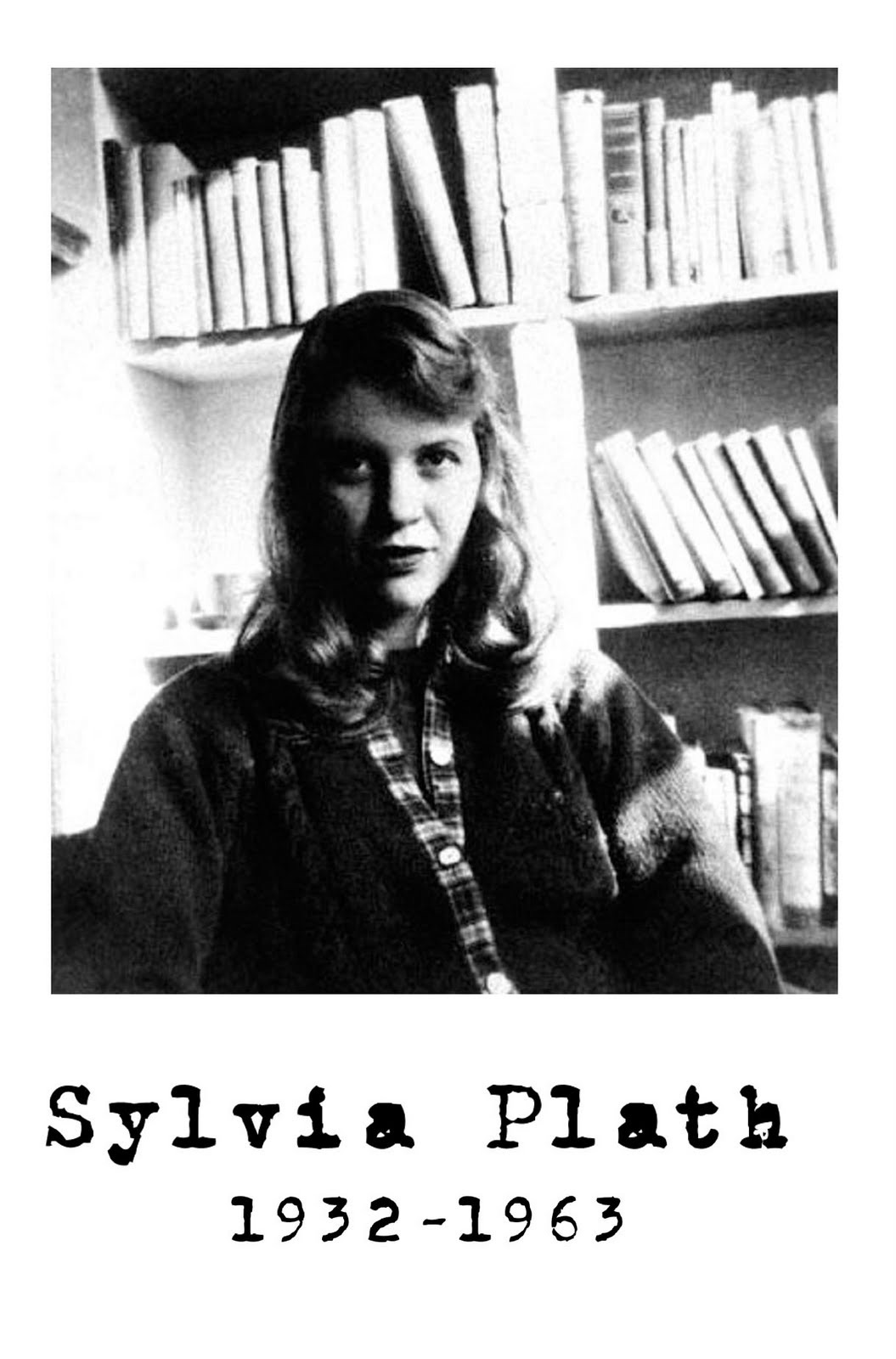
And what we find in that chronicle is an extraordinarily interested human being. (And generally, those who are most interested in the world around them are usually the most interesting themselves!) Smith is a voracious reader and much of her writing deals with what she is reading and the directions it sends her. (Here is a list of books–from Rimbaud to Susan Sontag–that Patti Smith once recommended.) The writer Maria Popova, in her wonderful blog BrainPickings, also has amassed a list of Smith’s literary references from M Train alone.

Her relationship with books goes well beyond the printed page. She engages with the authors and the characters and the places. (In actuality, she knew a good number of writers: Burroughs, Bowles, Ginsberg.) When she first reads Murakami, she reads nothing else, going from one novel to the next (though not in chronological order.) When she reads his The Wind Up Bird Chronicle, she immediately rereads it, fixating on a specific fountain that appears in the novel.

For Smith, the writers and artists who create the things she loves are very real–and she feels very close to them and their spirits. Thus, she visits Frieda Kahlo’s bedroom and Sylvia Plath’s grave, photographs Virginia Woolf’s walking stick, Beckett’s spectacles, Tolstoy’s bear. In Japan she makes pilgrimages to the graves of her most beloved writers and honors them reverently.  To her, the spirit of these creative individuals remains. Like her husband, they too are dead, but still inform her world.

And while she is an extraordinary reader and traveler, she is also very much an ordinary person: addicted to detective shows (The Killing, Law and Order, and the gamut of BBC detectives), sits on her front stoop to smoke a cigarette, feeds her cats, and hangs out in a favorite coffee shop. (A hilarious scene occurs when a woman takes her regular table while she’s in the bathroom and Smith fantasizes how the woman’s murdered body would be positioned in various detective shows.)

It is this ordinariness that is the most charming. We easily forget that she is more than an artist–is in some senses a celebrity. But one never meets the celebrity; instead we meet a woman who is at times gregarious and at other times meditative, who lives simply and cherishes the little moments of our lives, and who is still capable of being overpowered by  a book she has read or awed by a celebrity she has met. (She tells an amusing tale of running into the British actor, Robbie Coltrane, who starred in the rarely televised detective series Cracker.)

She reads with an artist’s eye and a writer’s ear; yet she writes like an old lost friend. And that is what has made both of her memoirs —Just Kids and M Train–such a joy to read.

Below is a lovely (6 minute) video of Patti Smith “giving advice to the young.” It is a good example of her wisdom, her kindness, and her hope.


Heaney and Plath: Two Poems about blackberry picking

Blackberries in a white bowl.

Blackberries in a white bowl.

We read two poems about Blackberries the other day. One by Seamus Heaney, one by Sylvia Plath. While both are dark, the latter is much darker. I did not tell them the facts of Plath’s life or how near in time the poem was written before her suicide. I will let them find that out on their own. (We try to downplay the biographical.)

Here is Heaney’s poem:

Blackberry-Picking by Seamus Heaney

Late August, given heavy rain and sun
For a full week, the blackberries would ripen.
At first, just one, a glossy purple clot
Among others, red, green, hard as a knot.
You ate that first one and its flesh was sweet
Like thickened wine: summer’s blood was in it
Leaving stains upon the tongue and lust for
Picking. Then red ones inked up and that hunger
Sent us out with milk cans, pea tins, jam-pots
Where briars scratched and wet grass bleached our boots.
Round hayfields, cornfields and potato-drills
We trekked and picked until the cans were full
Until the tinkling bottom had been covered
With green ones, and on top big dark blobs burned
Like a plate of eyes. Our hands were peppered
With thorn pricks, our palms sticky as Bluebeard’s.

We hoarded the fresh berries in the byre.
But when the bath was filled we found a fur,
A rat-grey fungus, glutting on our cache.
The juice was stinking too. Once off the bush
The fruit fermented, the sweet flesh would turn sour.
I always felt like crying. It wasn’t fair
That all the lovely canfuls smelt of rot.
Each year I hoped they’d keep, knew they would not.

And here is Heaney reading it:

What we have are the thrills and joys of nature’s bounty, of love, of lust, followed by its ultimate disappointment, and capped by the human facility to continue even with the knowledge that disappointment is almost always assured.

But that last line is hopeful despite the odds: “Each year I hoped they’d keep, knew they would not.”

*     *     *     *     *     *

Hopeful is what Sylvia Plath’s poem is not! It too holds the gathering of blueberries in awe, is humbled by their abundance and their promise, but in the end there is nothing. Though that should not be a surprise. The first line itself drums in that nothingness, repeating the words “nothing,” “nothing,” “nobody.”

Blackberrying by Sylvia Plathimage

Nobody in the lane, and nothing, nothing but blackberries,
Blackberries on either side, though on the right mainly,
A blackberry alley, going down in hooks, and a sea
Somewhere at the end of it, heaving. Blackberries
Big as the ball of my thumb, and dumb as eyes
Ebon in the hedges, fat
With blue-red juices. These they squander on my fingers.
I had not asked for such a blood sisterhood; they must love me.
They accommodate themselves to my milkbottle, flattening their sides.

Overhead go the choughs in black, cacophonous flocks—
Bits of burnt paper wheeling in a blown sky.
Theirs is the only voice, protesting, protesting.
I do not think the sea will appear at all.
The high, green meadows are glowing, as if lit from within.
I come to one bush of berries so ripe it is a bush of flies,
Hanging their bluegreen bellies and their wing panes in a Chinese screen.
The honey-feast of the berries has stunned them; they believe in heaven.
One more hook, and the berries and bushes end.

The only thing to come now is the sea.
From between two hills a sudden wind funnels at me,
Slapping its phantom laundry in my face.
These hills are too green and sweet to have tasted salt.
I follow the sheep path between them. A last hook brings me
To the hills’ northern face, and the face is orange rock
That looks out on nothing, nothing but a great space
Of white and pewter lights, and a din like silversmiths
Beating and beating at an intractable metal.

The speaker, who is traveling downward on a path lined with blackberry bushes, believes that there is something at the end–the sea. Earlier, when she sees a swarm of flies satiated with blackberry juice she states that the flies “believe in heaven.” (Is her statement that “they believe in heaven” an implication that she does not?)

Perhaps the flies believe they have found it.

For the speaker, however, no reward awaits. The sea–to which she had looked forward to throughout her journey–is a pale wasteland. Again there is the repetition of the word “nothing”: “…that looks out on nothing, nothing but a great space” and from within this void she hears the “Beating and beating of an intractable metal.”

That ‘beating and beating” reminds me of the sea in “Dover Beach” where:

you hear the grating roar
Of pebbles which the waves draw back, and fling,
At their return, up the high strand,
Begin, and cease, and then again begin,
With tremulous cadence slow, and bring
The eternal note of sadness in.

It’s that eternal note of sadness that Plath’s speaker also hears, an empty, pale silence. After her walk, after her hoping to be loved, after her wanting a heaven, she comes to this cliff. And this is what she hears.

Perhaps we’ll do “Dover Beach” next.

Review: My Face for the World to See by Alfred Hayes

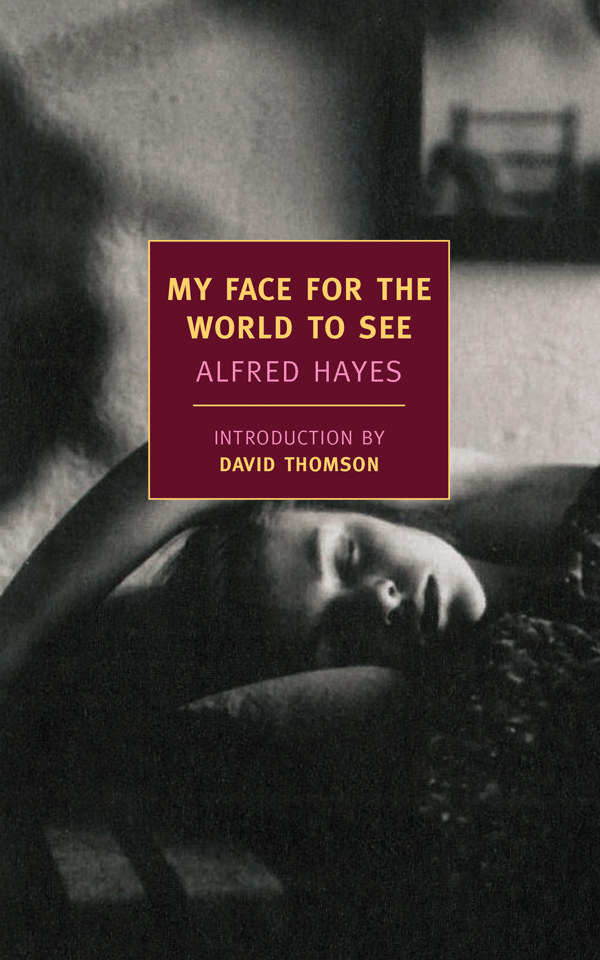
Book cover of the NYRB edition of My Face for the World to See

Cover for the NYRB edition of My Face for the World to See

The narrator of Alfred Hayes’ novel works in Hollywood. That is all we know. He is semi-separated from his wife; he lives alone for months at a time in L.A. and for months in New York with his wife, though his marriage, from his perspective,  is a failed and sad relationship.

In fact, the narrator finds his life and work as a failure. He sees no value in the work he does, although, as he says, the studio pays him handsomely. (He states that he is a “writher” rather than a “writer.”) He condescendingly (and somewhat snobbishly) observes the people around him, their vanities and egos, their manipulating and positioning, their theatrics and ambitions.

At a party one night, the narrator–bored with this gathering at an expensive beach house–steps outside for a smoke and sees a young woman walk into the sea. When she goes under, he rescues her and resuscitates her. And thus begins a relationship that he did not want to happen. That the woman is disturbed is revealed gradually, and she is much more than simply a young girl with unrealized Hollywood dreams.

Initially, it is her cynicism towards the business, towards love and towards life that draws him to her, that allows himself to give in to what he is also trying to hold back from. And as the two become more closely entwined–and as more of her anxieties are displayed–it becomes apparent that the two of them are very similar, a realization that is devastating to the narrator. In truth, it may be that it is the narrator whose face is now “for the world to see.”

The narrator’s deliberate and reflective thinking, his cool, detached observations, his knowing emotional cover-up, all work to create a modern anti-hero, an existentialist who is “forced” to live and work in a world that celebrates the superficial and is built basically on the dissemination of lies. It is a taut and harrowing read, a tale of self-discovery, acceptance, and angst.

My Face for the World to See was originally published in 1958. At the time, Hayes was more known as a scriptwriter. He had twice been nominated for an Oscar, had written successful screenplays for films directed by Fritz Lang, John Huston, and Fred Zinnemann, and also wrote many pieces for television including Alfred Hitchcock Presents and The Twilight Zone.  As a novelist, he was most celebrated for The Girl on the Via Flaminia,  and as a poet, for “Joe Hill” which was later put to music and became an anthem for workers’ rights. (Joan Baez famously sang it at Woodstock. See below.)

The New York Review of Books re-issued My Face for the World to See in 2013, with an introduction by the film critic, David Thomson.  But this novel is by no means a Hollywood novel. Apart from the brief description of the initial party where the narrator rescues the suicidal young woman, there is no glamor, no behind the scenes peeks, no tabloid scandals. There is simply a couple of apartments and the narrator’s self-examination and his lover’s revealed past.  It is discrete yet raw, fast-paced yet thoughtful.  It is memorable novel that deserves this re-issue.

And here’s a treat. A sweetly innocent Joan Baez singing Alfred Hayes’ “Joe Hill” at Woodstock. Enjoy:


Book Review: Echo’s Bones by Samuel Beckett

Samuel Beckett Illustration 2014 by jpbohannon

Samuel Beckett
Illustration 2014 by jpbohannon

Coincidences are no more than that, though I am very well aware of the research on them. (Freud once stated that  there were no such things as accidents, but I believe coincidences to be a lesser, less conscious form of accident. In the latter, the subconscious is directing you towards what might seem to be a accident but is actually rooted in one’s memory, suppressed or on the surface. Coincidence, on the other hand, is simply the awareness of a multiplication of events, of which one wasn’t completely cognizant or prepared for beforehand.)

So anyway, I attended an intense two-week workshop on education-on assessments and feedback and good old Bloom’s taxonomy. However, much of it was rooted in the teachings of Augustine–and much of the feedback I received  referenced Dante.

Before the workshop, however, I had bought a book, Echo’s Bones by Samuel Beckett. I knew it was something I would need to concentrate on–a 52 page short-story, accompanied by 58 pages of annotations, and complete with an introduction,  copies of the original typescript, letters from Beckett’s publishers, and a bibliography. This was not simply reading a short story, but sort an academic adventure. The type of diversion I hadn’t had in a while.

Cover of Samuel Beckett's Echo's Bones

Cover of Samuel Beckett’s Echo’s Bones

And so I waited until my Augustinian-laced workshop was over.

And then I began reading.  After I got  through the introduction and  into the story I began to smile. It was Augustine all over again with a large dollop of Dante.  In the first three pages alone there are five allusions to Augustine and four allusions to the Divine Comedy. And the main character, Belacqua, is given the nickname, Adeodatus–the name of Augustine’s illegitimate son.

So why all this hubbub about a short story that was written more than eighty years ago?  Well, Beckett had written a collection of interrelated short stories entitled More Pricks than Kicks.  Right before publication, however,  his publisher asked if Beckett would add a final story to the collection, to fatten it up, so to speak.

Beckett agreed, except there was one problem.  All the characters in the collection were now dead.  And so Beckett wrote “Echo’s Bones,”  which told the story of the dead Belacqua’s return to life in his short interim between death and eternity.  The publisher rejected the story, stating that it was too dark, too odd, and that it would make readers shudder.  And so More Pricks than Kicks was published as it was originally intended, and “Echo’s Bones” was assigned to the crypt of oblivion.  Until now.

The title refers to the mythological figure Echo, who tragically fell in love with Narcissus. (He was never a good catch for any woman. Too much competition with himself alone!)  Anyway, when she died, all that was left were her bones and her voice. Thus, we have “Echo’s Bones.”  If the editors had only known how perfectly the story’s title would foretell the nature of Beckett’s future work: a work of spotlighted voices–often disembodied (Krapp’s Last Tape), often body-less (HappyDays), and often flowing in a rushing stream (Ponzo’s soliloquy in Godot).

The plot is secondary to the wordplay, the erudition, the humor, and Beckett’s world view. Quickly: the dead Belacqua suddenly finds himself on a fence in a empty Beckettian landscape. A woman arrives and brings him to Lord Gall, a giant of a man with a paradisaical estate which he will lose because he is sterile and lacks a male heir. He convinces Belacqua  to bed his wife, in hope of an heir, but–in a twist of telescoped time–the woman gives birth to a daughter.  The story concludes with Belacqua conversing with his own grave digger (from an earlier story) and searching his own coffin for his body. The story ends with a familiar phrase in Beckett’s work and letters: “So it goes in the world.”  These are the last words of “Echo’s Bones,” but they are also the last words of “Draff,” the final story in the version of More Pricks than Kicks that was ultimately published.  A phrase that Beckett had picked up from the Brothers Grimm story “How the Cat and the Mouse Set up House,” it is a phrase that encapsulates Beckett’s life view and one that he used often even in his personal correspondence.

While I respect and love Beckett’s drama, I particularly enjoy his early fiction. Still under the influence of Joyce, Beckett, at this time, was  full of his verbal powers, delighting in the wordplay, and confident in his free association. It is always, for me, a treat to read.


Book Review: A Farewell to Arms by Ernest Hemingway

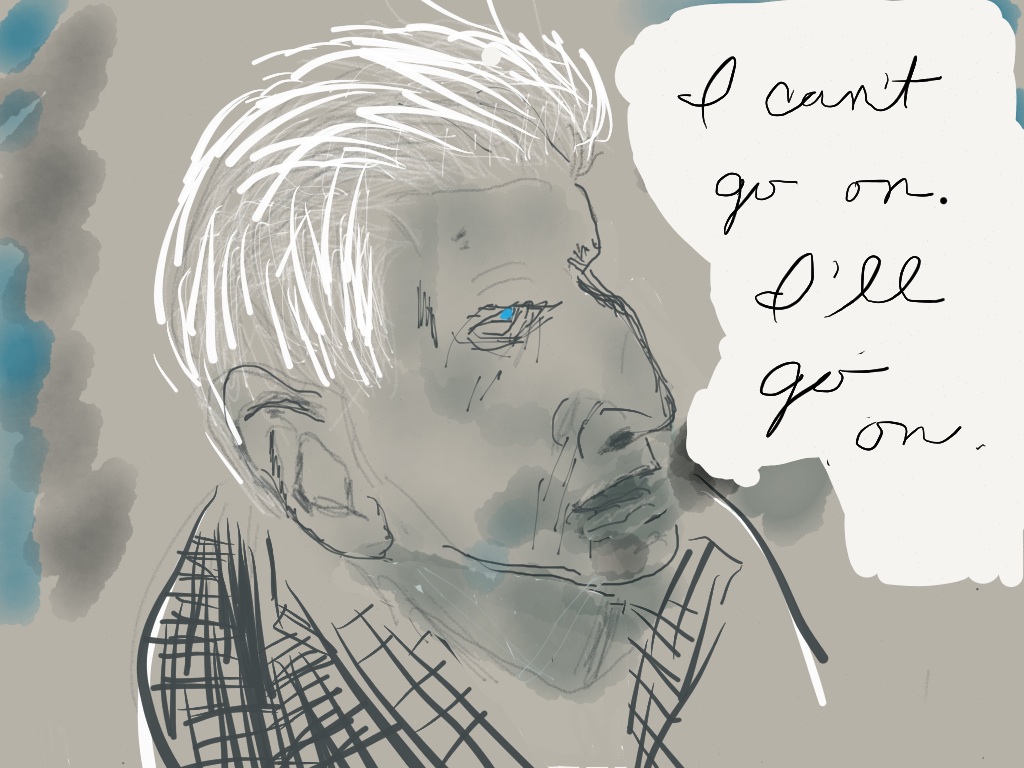
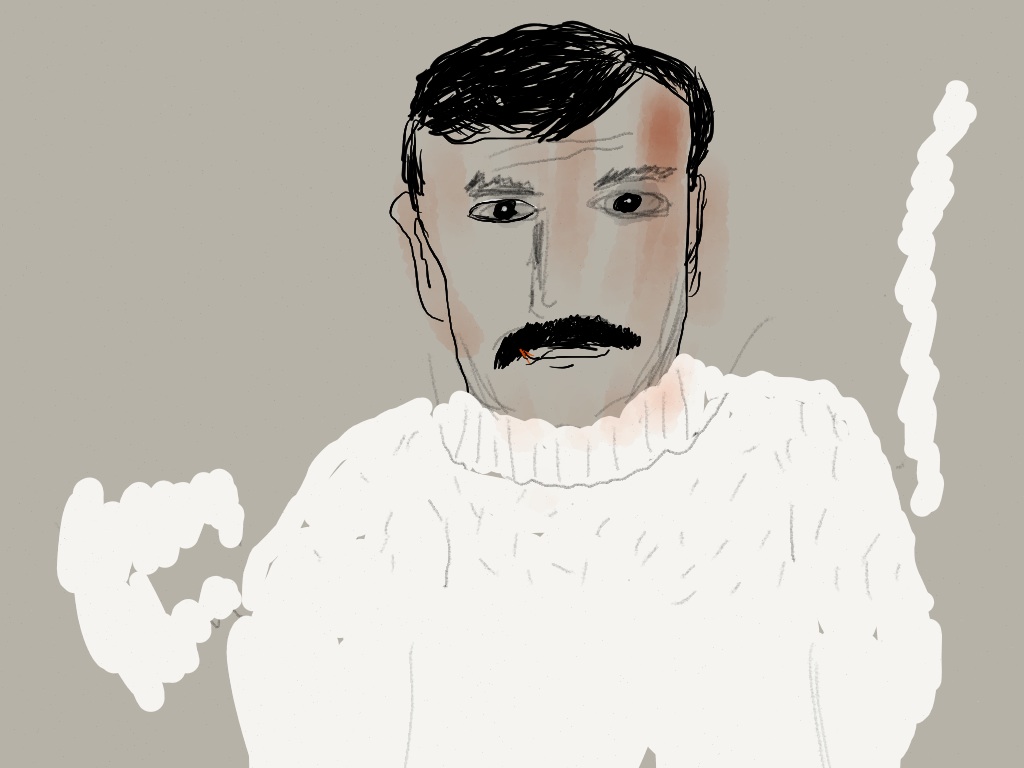
Hemingway as a young man.   illustration 2014 by jpbohannon

Hemingway as a young man.
illustration 2014 by jpbohannon

The most gaping hole in my formal education is a lack of courses in American Literature. In undergraduate and graduate school combined, I had taken only one course in American lit. My understanding is mostly self-directed–and often spurred on by the requirements of teaching American Lit survey courses for many years. Certainly, I know the school classics: The Great Gatsby, Huck Finn, The Scarlet Letter, The Old Man and the Sea, The Sound and the Fury.

And as a reader, I have discovered on my own Vonnegut and Pynchon, Heller and Elison, Mailer, Roth and Updike. And from my friends I have learned to love DeLillo, Wallace, and Johnson.  But I know there are gaps.

I took a tour, a few weeks back of Ernest Hemingway’s home in Key West. I respect and admire Hemingway’s short stories–and often teach them in writing classes for their craft–and have fond memories of reading The Sun Also Rises and A Moveable Feast,  but I never read much else. Anyway, the tour guide told us that it was here in the Key West house that Hemingway wrote a large portion of his work, in particularly A Farewell to Arms, which he stated is considered Hemingway’s greatest work. (Remember, he is a tour-guide, not a literary critic.)

And so I decided to give it a try. And to be truthful, in the beginning, it was slogging read at times.

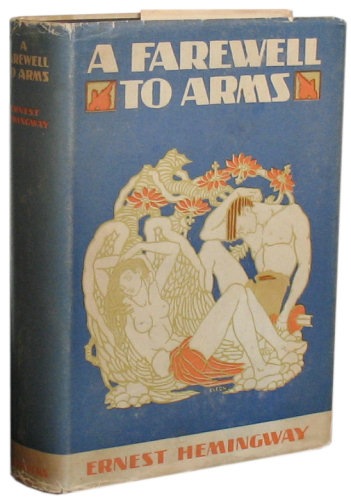
First Edition of A Farewell to Arms

First Edition of A Farewell to Arms

In brief, the novel is the semi-autobiographical story of an American ambulance driver, Frederic Henry, working for the Italian army during World War I, who is wounded, falls in love with his nurse, impregnates her and sneaks across the border with her into neutral Switzerland. There are pieces that are perfect Hemingway: the army’s long retreat, the Swiss countryside in winter, the view from a hotel room. These passages are clear and distinct and one can almost imagine Hemingway speaking them himself.

What one cannot imagine is anyone speaking the dialogue that Hemingway has given his characters to speak. The dialogue among the soldiers is stilted–but I thought perhaps that was intentional as the narrator is an American and the conversation is between him and his Italian comrades. But the conversation between the lovers–between Frederick and Catherine–is downright embarrassing.

Perhaps, it is dated. But I do not believe so. The dialogue in Fitzgerald’s Gatsby published four years earlier in 1925 is not as silly or inane. This can’t be how people talked 75 years ago. Perhaps, Hemingway is trying to capture the coded, playful language that lovers often engage in privately. Well if so, it should have remained private. While Catherine Barkley is a strong woman–a British nurse working in the Italian theater of war–when she speaks she sounds infantile and ditzy, hardly the type that Henry would fall for.

But then, perhaps, it is just me, the reader, far past the ages of the protagonists, a little bit wiser (one hopes) and a little bit more jaded.

And yet, having said all that, the slogging read and the cloying dialogue are more than made up for in the last chapter. It is here that Hemingway elevates the novel to something different, something larger. It succeeds not merely because of the drama–which in lesser hands would have become melodrama–but because of  the craft. The language is pared down–like Joyce had taught him–and there is simply life, death, man and woman. It doesn’t get more basic than that. In the end we admire Frederic Henry more than before–I found him hard to like or take seriously throughout much of the book– and we admire Hemingway too. We admire what he is doing and we understand how this novel placed Hemingway in the pantheon of American authors.

Hemingway famously once claimed that he rewrote that last chapter 39 times. Well, then it is a good advertisement for revision, for it is so superior to everything else.

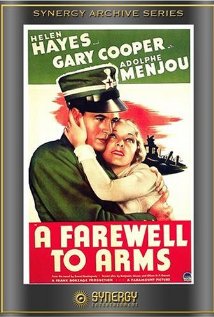
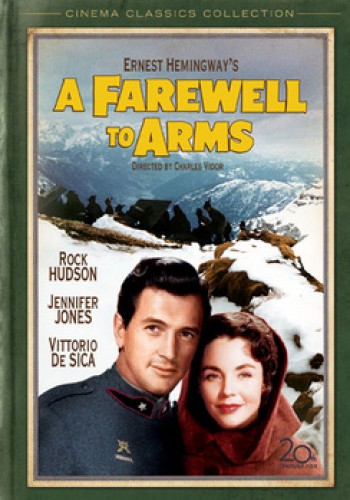
The novel was an instant–and huge–success.  Within a year of its publication a dramatization was staged and in 1932 Hollywood released a major film of the novel, featuring Gary Cooper and Helen Hayes.  In 1957, a second film was made, this time starring Rock Hudson and Jennifer Jones.

I have seen neither, and I won’t search for them. It is Hemingway’s language and style that is the star of A Farewell to Arms, not the story.  And much of that would be lost in film.

Movie Poster for 1932 film

Movie Poster for 1932 film

Movie Poster for 1957 film

Movie Poster for 1957 film

The Hemingway House, Key West

Hemingway House, Key West Illustration 2014 jpbohannon

Hemingway House, Key West
Illustration 2014 jpbohannon

I have always had a love/hate relationship with Ernest Hemingway. For a long time, all the machismo got in my way: the big game hunting, the bull fighting, the boxing, the boasting, the egoism, all seemed to be compensating for something, a sense of insecurity perhaps, to put it in simplest terms.

And yet, I love his writing. It is pure and clean and powerful and elemental. I can still feel the the visceral punch in  “Indian Camp” when the father removed the blanket from the young husband in the upper bunk. Or, the pared-down, gradual dawning of realization in reading “Hills Like White Elephants” or the existential abyss yawning at the end of a “A Clean Well Lighted Place.”

It’s been a while since I read one of the novels. I remember A Sun Also Rises fondly. The damaged romanticism of  Jake Barnes, the alluring aloofness of Brett Ashley, the thirsty landscape of Spain are all still vivid in my mind despite how long ago I last read it. And while critics claim A Farewell to Arms to be the better written novel, The Sun Also Rises remains more important to me.  (A colleague just last month called it the worst novel written in English! Oh well.)

And so, with this ambivalence about Hemingway, I visited his home while in Key West in early June.

The home is extraordinary–and rich in story and history.

photo

The front of the Hemingway House on Whitehead Street in Key West. Photograph 2014 jpbohannon

In the 1930s, Hemingway moved to Key West with his second wife–Pauline Pfeiffer–whose uncle purchased the house on the corner of Whitehead and Olivia Streets. And although, Hemingway claimed that he was “restless” in Key West, at this house he wrote a great deal of what would be his most important work.

The house is a two level structure built in 1851 by Asa Tift, a successful architect and salvager, and the Hemingways bought it in 1931.  Today, the home is an Historic Site and remains filled with the Hemingways’ furniture and artifacts.  Throughout each room are both original furnishings and memorabilia–posters of movies made from his novels, photos of Hemingway at various stages of his life, of his family, and of various celebrities and writers. The bed in the master bedroom is actually two double beds that Hemingway wired together and the headboard is a gate made of Spanish mahogany that Hemingway and his wife had seen in a monastery in Spain.  A bench in the foyer is from the same monastery.

Hemingway's Writing Studio in Key West Photograph 2014 jpbohannon

Hemingway’s Writing Studio in Key West
Photograph 2014 jpbohannon

Behind the main house is a “carriage house” in which Hemingway had built a writing studio on the second floor.  In order to ensure his privacy, Hemingway had a wrought-iron catwalk stretched across the patio from the bedroom to his studio.  This was the only means in and out.  Today, the catwalk has been taken down and there is a narrow stairway from the patio to the studio door.  It is an ideal working space.

The house also has a large pool–the first ever in Key West.  Hemingway and Pauline had wanted to build a pool, but cost was prohibitive.  They had bought the house for $8000 dollars, but building a pool in the remote Keys was expensive. Instead, Hemingway built a regulation sized boxing ring. Much to Pauline’s dismay, her dream of lounging poolside had given way to a ring side seat to her husband’s sparring bouts.

However, Pauline got her way (and ultimately the house itself).  Hemingway had started an affair with the writer Martha Gelhorn, and the two of them had met up in Spain to cover the Spanish Civil War.  When Pauline caught wind of the tryst, she promptly had a over-sized pool built–at the cost of $20,000, two and half times the cost of the house.

When Hemingway returned he was none too pleased.  In one gesture of comeuppance, he dragged a urinal from what was then Sloppy Joe’s (and is now Captain Tony’s) which had been thrown curbside during renovations, and brought it home as a watering trough for his many cats. As he told his wife, “you have your pool, and now I have mine.”

And it is the cats that retain their residency.  Hemingway loved cats, particularly 6-fingered, “polydactyl” cats. He believed them to be good luck. There are countless photos of Hemingway with them–while he wrote and while he lounged. (Apparently, they were the only others who had access to his studio.) Today, all of the 48 or so cats on the property are descendants of Hemingway’s cats–and all of them carry the gene for the polydactyl mutation.

One of the many six-fingered cats on the Hemingway Huse property. photograph 2014 by jpbohannon

One of the many six-fingered cats on the Hemingway Huse property.
photograph 2014 by jpbohannon

But after the cats and the pools and the writing studios, after the womanizing, the wives, and the bluster, after the houses and the legends and the suicide, what we are left with in the end is the writing.  As I said earlier, it is pristine and clear and purposeful.  Hemingway was a great reviser, mostly paring down and paring down to the very essence of what he wanted to say. As he famously told an interviewer, the hardest part is getting the words right:

Interviewer: How much rewriting do you do?
Hemingway: It depends. I rewrote the ending of Farewell to Arms, the last page of it, 39 times before I was satisfied.
Interviewer: Was there some technical problem there? What was it that had stumped you?
Hemingway: Getting the words right.
(Ernest Hemingway, “The Art of Fiction,” The Paris ReviewInterview, 1956)

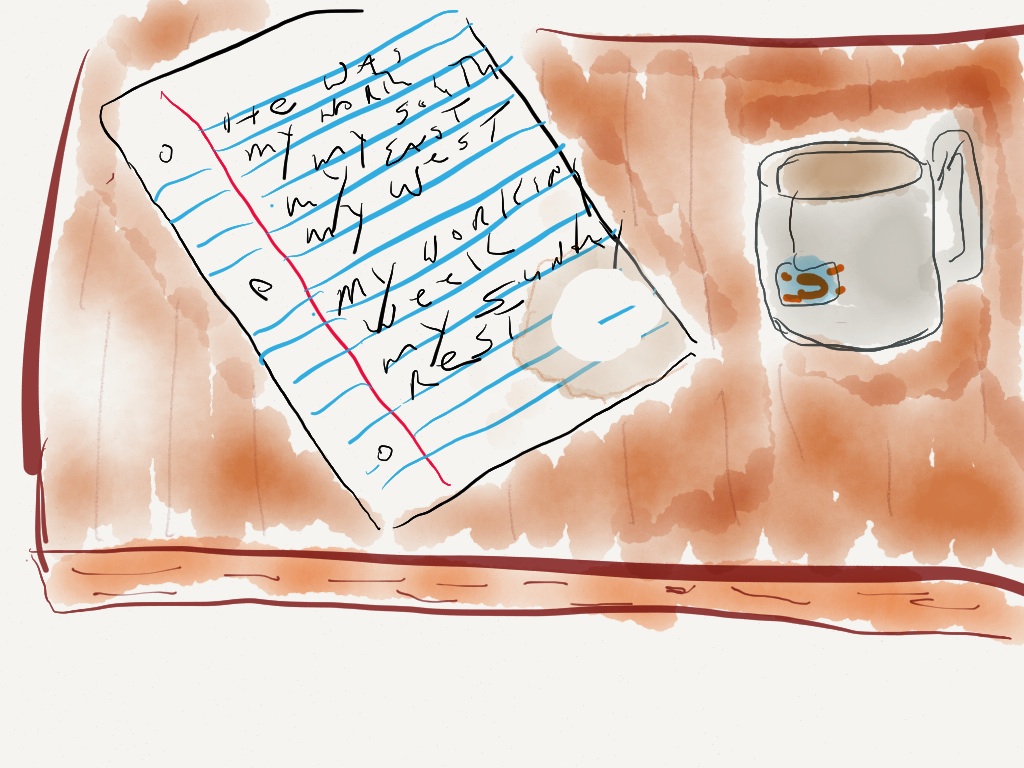
Quote #40: “A page with a poem…” Anne Carson

illustration 2014 by jpbohannon

illustration 2014 by jpbohannon

“A page with a poem on it is less attractive than a page with a poem on it and some tea stains.” —Anne Carson (as quoted in The Paris Review )

Book Review: The Black-Eyed Blonde by Benjamin Black

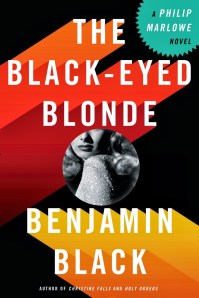
In 2006, with the release of Christine Falls, the Booker-Prize-winning novelist John Banville began publishing “crime fiction” under the pen name Benjamin Black.  Like his “literary novels,” these crime novels are psychologically astute, intensely plotted, and keenly aware of language.The Black-Eyed Blonde

With The Black-Eyed Blonde, however, Banville decided to try something new:  to write a novel using Raymond Chandler’s most famous private detective, Philip Marlowe.

While Chandler’s fiction is read and esteemed, and his influence on detective fiction in particular and American literature in general widely acknowledged, his detective’s presence is mostly ingrained in the American consciousness through film and television.  There have been several television series featuring the L.A. detective and many movies.  Dick Powell and Robert Mitchum both played Marlowe, and successfully, but undoubtedly, the most iconic incarnation of Phillip Marlowe is that played by Humphrey Bogart. So pervasive are the film renditions of Chandler’s L.A., that I found myself casting the characters while reading The Black-Eyed Blonde.  Sure enough there was a role for all the usual suspects: there is a creepy, effeminate Peter Lorre type, an enormous, gang-lord Sydney Greenstreet, a fetching Lauren Bacall character, and, of course, there is Bogart as Marlowe.

Humphrey Bogart as Phillip Marlowe in The Big Sleep

Humphrey Bogart as Phillip Marlowe in The Big Sleep

Banville himself is certainly aware of the hold that film has on the literary characters and early in the book he gives a winking nod to Bogart. Marlowe is sitting in the offices of a fancy country-club. There are cigars and brandy, chintz armchairs and fine china. Marlowe says:

“At that point, I wouldn’t have been surprised if some fruity type in white shorts and a blazer had come bounding through the door, inquiring with a lisp if anyone was for tennis.”

This is Banville’s joke, and nod to Bogart.  Before he played tough guys in film, Bogart played in drawing-room comedies on Broadway. A long-lived story is that Bogart’s first professional line as an actor was as a young dandy, bouncing onto stage with his tennis whites and tennis racquet and inquiring “Tennis, anyone?”  That Bogart also had a slight lisp, makes Banville’s nod even more on target.

But The Black-Eyed Blonde is not a film, it is a novel, and a highly readable one at that. The title is one of several possibilities that Raymond Chandler had filed away and which Banville received permission to use from The Raymond Chandler Estate.  From there, somehow, Banville began channeling Chandler, because what he has created is an exceptional mirroring of Chandler’s style: the rapid-fire dialogue, the lyrical similes, and the sprawling, frenetic plot and subplots.

The plot is typical: the eponymous blonde, Clare Cavendish, enters Marlowe’s office and hires him to find a “friend”  who has gone missing.  When Marlowe discovers that the friend was killed and cremated two months earlier but that Cavendish had seen him just a few days ago, things get complicated.  There are betrayals, murders, cover-ups, flirtations, and deceptions.  And throughout it Marlowe maintains a strict code of honor–the characteristic that always set Marlowe apart from the rest. He protects his clients’ confidences, he takes no joy in the violence that is visited upon the deserving, he cannot be bought no matter what the price, and, while he can empathize with those on both sides of the law, he believes in justice.  It is this chivalric honor that became the hallmark of the American noir hero.

But always, when reading Chandler–and now Banville posing as Chandler–the story seems secondary.  It is the evocation of 1930s-40s Los Angeles, the elaborate metaphors (“He smelled like an over large man who had lain in the bath too long.”), the snappy dialogue that conjures up an entire world–a fictional world, perhaps, but one that we are very familiar with through both reading and film. And with The Black-Eyed Blonde, Banville re-captures that world perfectly,  note for note.

The Black-Eyed Blonde is a fun, a quick, and a memorable read.


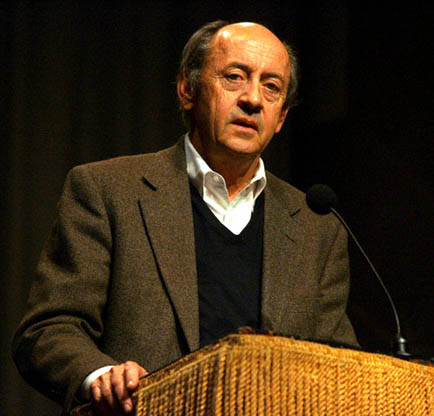
Billy Collins … and how to think better of poetry

Billy Collins

Billy Collins

The other night I went to see the poet Billy Collins deliver a lecture. It was a pretty fancy event–I’d been given the tickets– held in the  beautiful Verizon Hall at the Kimmel Center in Philadelphia. As Billy Collins remarked, it is like standing inside an enormous cello.

Verizon Hall at the Kimmel Center, Philadelphia, PA

Verizon Hall at the Kimmel Center, Philadelphia, PA

Anyway, I don’t know a lot of Collins’ poetry, except maybe two or three poems, but I always use his poem “Introduction to Poetry” at the beginning of any course I teach in poetry.  In it, Collins claims:

I ask them to take a poem
and hold it up to the light
like a color slide

or press an ear against its hive.

I say drop a mouse into a poem
and watch him probe his way out,

or walk inside the poem’s room
and feel the walls for a light switch.

I want them to waterski
across the surface of a poem
waving at the author’s name on the shore.

But all they want to do
is tie the poem to a chair with rope
and torture a confession out of it.

They begin beating it with a hose
to find out what it really means.

It is those last five lines that are important. They describe why poetry is met with such an “ugh” from people whose only experience with it has been in classes where the well-intentioned teacher urged them to “find the meaning.”

I tell my students that human beings are innately wired to respond positively to poetry (think infant lullabies, toddlers’ picture books, nonsense riddles, jump-roping songs). It is the English teachers who teach students to dislike it. To think of it as something to fear and dread.

And that is a shame.

For last night, Collins (who repeated what I said about poetry being innate) was as entertaining as could be. He told the audience a bit of his life and his term as Poet Laureate of the U.S.  He spoke of his influences and literary influences in general. He spoke of the death of humor in poetry–he blames the Romantics who he said “replaced sex and humor with landscape.” And he spoke of the difficulty for some people used to hearing formalist poetry to hear the acoustics of what is commonly called free verse. (He doesn’t like the term.)
He also read several of his poems, although half of what he read came from others. Here is a wonderful two line poem by Howard Nemerov called “Bacon and Eggs”:

The chicken contributes,
But the pig gives his all.

See it’s good to laugh.  And have fun in poetry.

And so he spoke of the importance of humor and used a poem by Ruth L. Schwartz to demonstrate how humor can be used as a transition point, moving from light to darkness (or vise versa). He got a laugh on the line “look at that DUCK,” which is how he wanted it to be:

The Swan at Edgewater Park

Isn’t one of your prissy richpeoples’ swans
Wouldn’t be at home on some pristine pond
Chooses the whole stinking shoreline, candy wrappers, condoms
in its tidal fringe
Prefers to curve its muscular, slightly grubby neck
into the body of a Great Lake,
Swilling whatever it is swans swill,
Chardonnay of algae with bouquet of crud,
While Clevelanders walk by saying Look
at that big duck!
Beauty isn’t the point here; of course
the swan is beautiful,
But not like Lorie at 16, when
Everything was possible—no
More like Lorie at 27
Smoking away her days off in her dirty kitchen,
Her kid with asthma watching TV,
The boyfriend who doesn’t know yet she’s gonna
Leave him, washing his car out back—and
He’s a runty little guy, and drinks too much, and
It’s not his kid anyway, but he loves her, he
Really does, he loves them both—
That’s the kind of swan this is.

But the most effecting poem that he read was the one that he read last. It is his beautiful poem about the love between a mother and son–told with sweet humor:

The Lanyard
by Billy Collins

The other day I was ricocheting slowly
off the blue walls of this room,
moving as if underwater from typewriter to piano,
from bookshelf to an envelope lying on the floor,
when I found myself in the L section of the dictionary
where my eyes fell upon the word lanyard.

No cookie nibbled by a French novelist
could send one into the past more suddenly—
a past where I sat at a workbench at a camp
by a deep Adirondack lake
learning how to braid long thin plastic strips
into a lanyard, a gift for my mother.

I had never seen anyone use a lanyard
or wear one, if that’s what you did with them,
but that did not keep me from crossing
strand over strand again and again
until I had made a boxy
red and white lanyard for my mother.

She gave me life and milk from her breasts,
and I gave her a lanyard.
She nursed me in many a sick room,
lifted spoons of medicine to my lips,
laid cold face-cloths on my forehead,
and then led me out into the airy light

and taught me to walk and swim,
and I, in turn, presented her with a lanyard.
Here are thousands of meals, she said,
and here is clothing and a good education.
And here is your lanyard, I replied,
which I made with a little help from a counselor.

Here is a breathing body and a beating heart,
strong legs, bones and teeth,
and two clear eyes to read the world, she whispered,
and here, I said, is the lanyard I made at camp.
And here, I wish to say to her now,
is a smaller gift—not the worn truth

that you can never repay your mother,
but the rueful admission that when she took
the two-tone lanyard from my hand,
I was as sure as a boy could be
that this useless, worthless thing I wove
out of boredom would be enough to make us even.