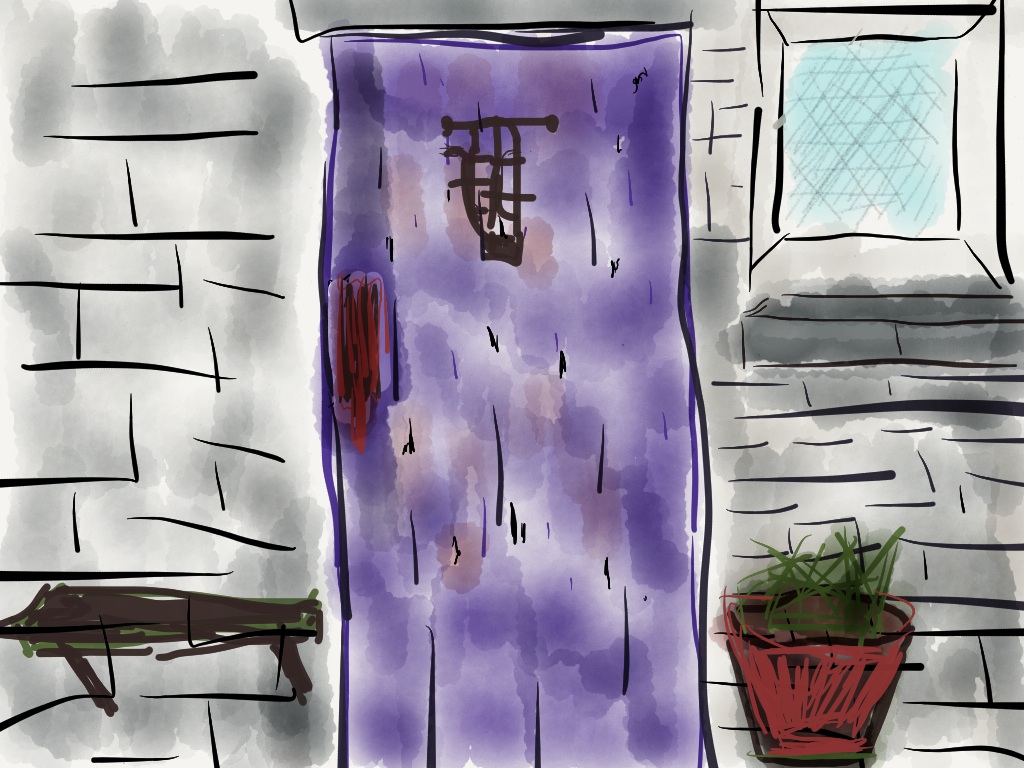
Illustration 2013 jpbohannon
“The truth knocks on the door and you say, ‘Go away, I’m looking for the truth,’ and so it goes away. Puzzling.”
Robert M. Pirsig, Zen and the Art of Motorcycle Maintenance
Illustration 2013 jpbohannon
“The truth knocks on the door and you say, ‘Go away, I’m looking for the truth,’ and so it goes away. Puzzling.”
Robert M. Pirsig, Zen and the Art of Motorcycle Maintenance

Henry David Thoreau (letter to Harrison Blake, 1856)
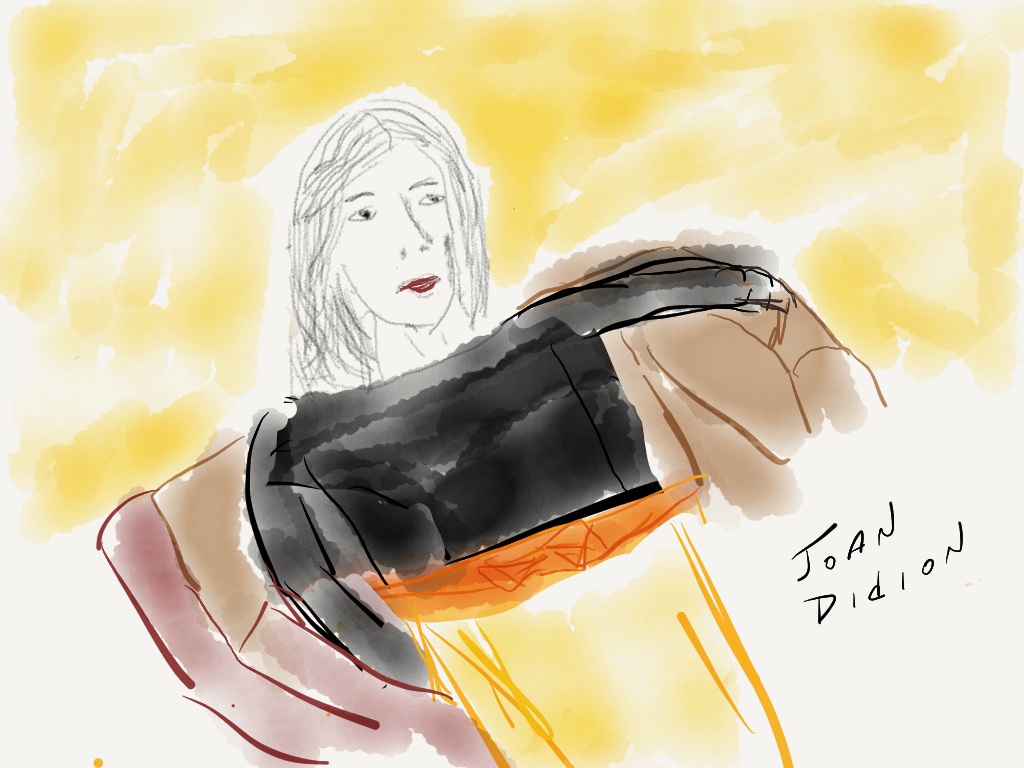
Joan Didion.
illustration 2013 jpbohannon
based on portrait by Lisa Congdon for Reconstructionists project
A few days ago I received a message from my friend Gerry Bracken who started off with the words “I rarely read fiction, but I picked up a copy…” And he recommended a detective novel based in L.A. to where I was then flying.

Maria Popova’s Brain Pickings
Yesterday, I was browsing through Maria Popova’s blog, “brain pickings,” and I clicked on her bookshelf. (http://bookpickings.brainpickings.org/) Her site routinely discusses books, authors, and readers. And the titles she list are predominantly non-fiction: titles that I jot down and often pick up at the library.
And then last night, I read the ExPlore twitter posting (also managed by Maria Popova). It listed Bill Gates’ reading list for the Summer of 2013. The list is daunting, fascinating and wide-ranging, but except for a single novel, it was all non-fiction. (Click here to see list.)
What is with this reluctance to read fiction? Are we wasting our time? Or more importantly, am I wasting my time.
There once was a time, when the reading of fiction–particular of novels–was considered by many as a harmless past-time for idle girls and not the pursuit of serious, intelligent people. But that was 200 years ago. In the interim, fiction has taken on a bit more gravitas, a bit more legitimacy.
At times, however, I feel haunted by that ancient attitude. And at other times, I feel deliciously guilty for sinking into a novel. Shouldn’t I be learning something? Shouldn’t I be boning up on something? Refining what I know? Discovering new ideas?
Well, I don’t know.
A while back, I ghostwrote a book on the history of Ireland. I researched assiduously, read primary and secondary sources, talked and listened to people and their stories, pored over all the news reports, particularly those on the current events that were unfolding before my eyes.
Colum McCann’s true fiction TransAtlantic
But I know I never got near the truth that I got in reading Colum MCCann’s novel Trans Atlantic. The section(s) on George Mitchell and the Irish peace negotiations, for instance, was better history than I could have ever gleaned in a biography or history book. There was life in those pages, in the account of Mitchell’s days in Belfast, on his dealings with the myriad politicians and organizations, in his observations of the ordinary people and the details around him. Did everything happen the way McCann described it? Probably not. Was it true? I believe very much so. A bigger truth than the historians can share.
I have learned much from fiction–I have learned about people: people in drastic circumstances, in simple ordinariness, in great passion, and in wrenching heartbreak. I have learned about pride and hubris, of great loyalty and great betrayal, of sacrifice and of love. I have met more people in the pages that I have read than I ever could have in the life that I led.
And, in a way, after all, that is what we’re here for–to learn about the wide variety of fellow human beings who share our moment in time and space.

illustration 2013 jpbohannon
“After so many years, I’ve learned that being creative is a full-time job with its own daily patterns. That’s why writers, for example, like to establish routines for themselves. The most productive ones get started early in the morning, when the world is quiet, the phones aren’t ringing, and their minds are rested, alert, and not yet polluted by other people’s words. They might set a goal for themselves — write fifteen hundred words, or stay at their desk until noon — but the real secret is that they do this every day. In other words, they are disciplined. Over time, as the daily routines become second nature, discipline morphs into habit.
“It’s the same for any creative individual, whether it’s a painter finding his way each morning to the easel, or a medical researcher returning daily to the laboratory. The routine is as much a part of the creative process as the lightning bolt of inspiration, maybe more. And this routine is available to everyone.
“Creativity is a habit, and the best creativity is a result of good work habits.”
Twyla Tharp, The Creative Habit
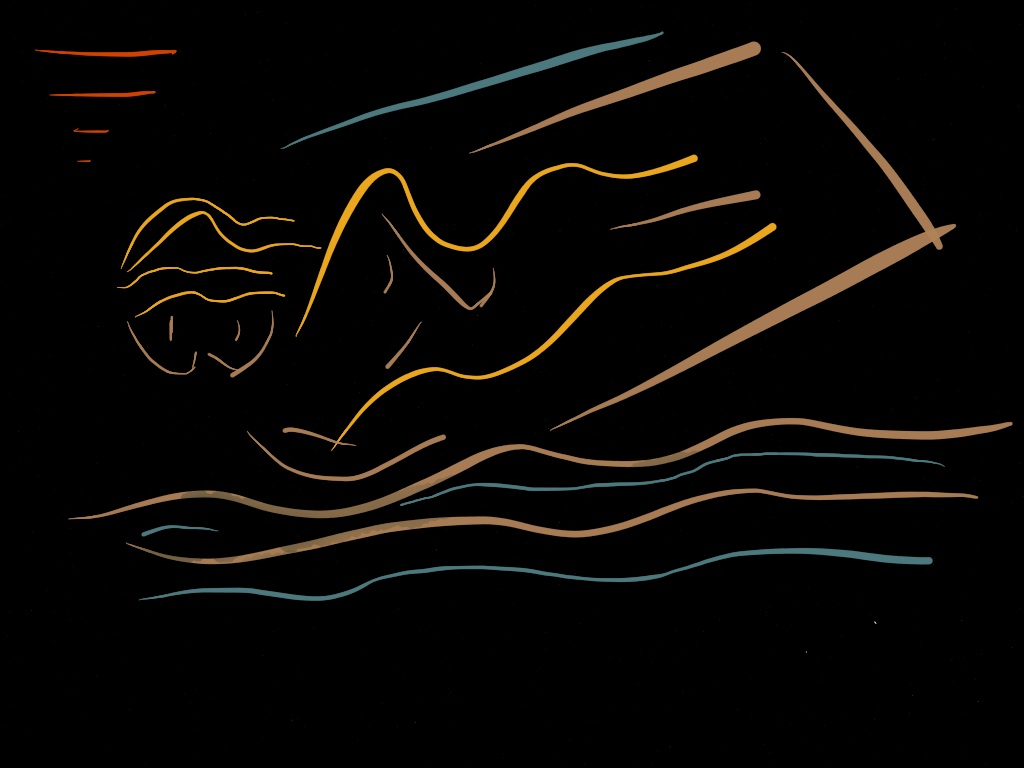
illustration 2013 jpbohannon
My reading list these days is erratic and wide. I am picking up things that pique my interest without any plan, without any connection to what I previously had been reading. But that’s okay for these summer days.
A colleague had forwarded an article from Maria Popova’s brain pickings blog. It was a review of Rosalind D. Cartwright’s book on the role of sleeping and 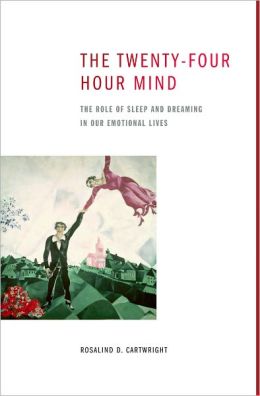 dreaming in our lives. The review (like nearly everything on “brain pickings”) was intriguing and interesting. So of course, I had to find it in our library.
Cartwright is one of the preeminent scientists studying sleep–a relatively new area in scientific research. Her thesis is that sleep is essential to our health, particularly to our emotional health, and that the modern penchant (and desire) for sleeping less is damaging both physically and psychically.
Indeed, the mind does not sleep when we sleep–it goes into over-drive, cataloging memories, cementing new knowledge, mapping neural pathways. Cartwright states:
We can now begin to answer the question, “Where do we go when we got to sleep?” Clearly we do not sink into a void, but instead into a mental workshop where emotionally important information is kept active until it is saved in neural networks. When the highly activated REM sleep comes along, perceptual dreams reveal the matching of new information to old… . Through the night, from REM to REM, new information is integrated, drawing together more and more remote associations.
She continues that there is short-term functionality to these rhythms– “down-regulation of negative mood” –and long-term functionality. The long-term benefits, she lists as “continuously test[ing] and modify[ing] those non-conscious habitual schemas that make up our self-system and influence our behavior choices, based on our emotional evaluation of whether the new experience supports or challenges our present self-definition.”
This is a lot of responsibility thrown onto a good night sleep, and Cartwright’s argument is that we, as modern human beings, are sabotaging that essential need.
Aside from emotional turmoil–and Cartwright’s expertise is on sleep disorders, particular sleepwalking–Cartwright points out physical dangers as well. Those with long-term insomnia are more prone to obesity and diabetes. A famous study by the American Cancer Society was done over a 10-year period and found a puzzling pattern. Those who slept less than six hours a night AND those who slept more than nine hours a night had a higher mortality rate for their age. The conclusion is that we humans are built to sleep about 1/3 of our 24 hour cycles, that magic 7 to 9 hour range.
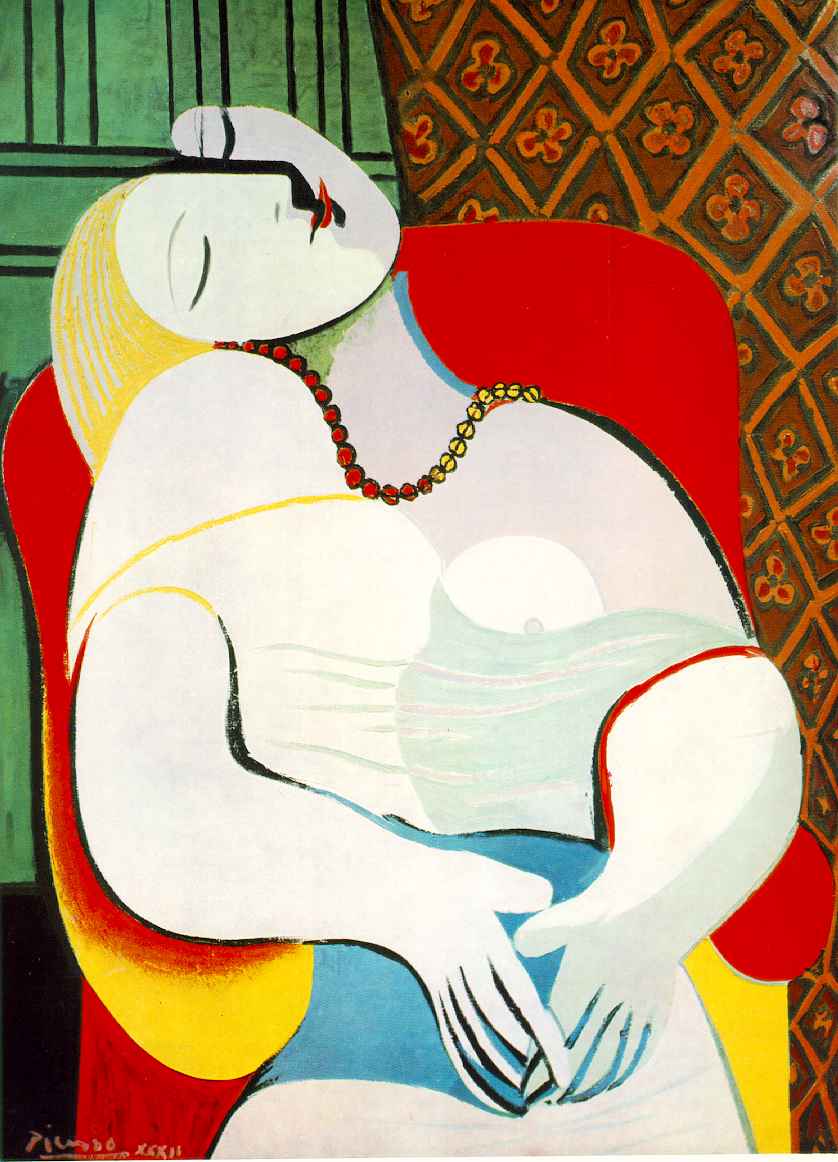
“The Dream,” 1932 Pablo Picasso
Yet, for Cartwright’s thesis, it is not merely sleep that is essential to human health, but dreaming as well. In her profession, Cartwright is known as “the Queen of Dreams,” and dream-research is what she is interested in and battles for. Here is how Cartwright explains the symbiotic functioning of the waking and dreaming life.
“…[T]he mind is continuously active, although in different modes of expression, during the two major alterating states of waking and sleep. … In waking, there is a wider lens open to receive and respond more to the external world, while in sleep we are mostly confined to a narrower base of internal information both new and old.”
It is this “internal” information that sets us dreaming, that allows us to fit old information with new information, to anticipate new situations and reconcile old. Cartwright firmly believes that our emotions are greatly tied to the functioning of our dreaming, and of our sleeping.
While Cartwright acknowledges the contributions of Freud to dream-analysis and the understanding of the unconscious, she moves decidedly apart from him. (The technological abilities for brain-image mapping, sleep studies, etc. give her a great advantage.) The Freudian concept of the preconscious, unconscious and conscious mind is much too simplistic for what Cartwright sees happening. Here is her take on dreaming:
“So in good sleepers, the mind is continuously active, reviewing experience from yesterday, sorting which new information is relevant and important to save due to its emotional saliency. Dreams are not without sense, nor are they best understood to be expressions of infantile wishes. They are the result of the interconnectedness of new experience with that already stored in memory networks. But memory is never a precise duplicate of the original; instead, it is a contining act of creation. Dream images are the product of that creation. They are formed by pattern recognition between some current emotionally valued experience matching the condensed representation of similarly toned memories. Networks of these become our familiar style of thinking, which gives our behavior continuity and us a coherent sense of who we are. Thus, dream dimensions are elements of the schemas, and both represent accumulated experience and serve to filter and evaluate the new day’s input.”
It all is a lot to digest. But it is something to sleep upon.
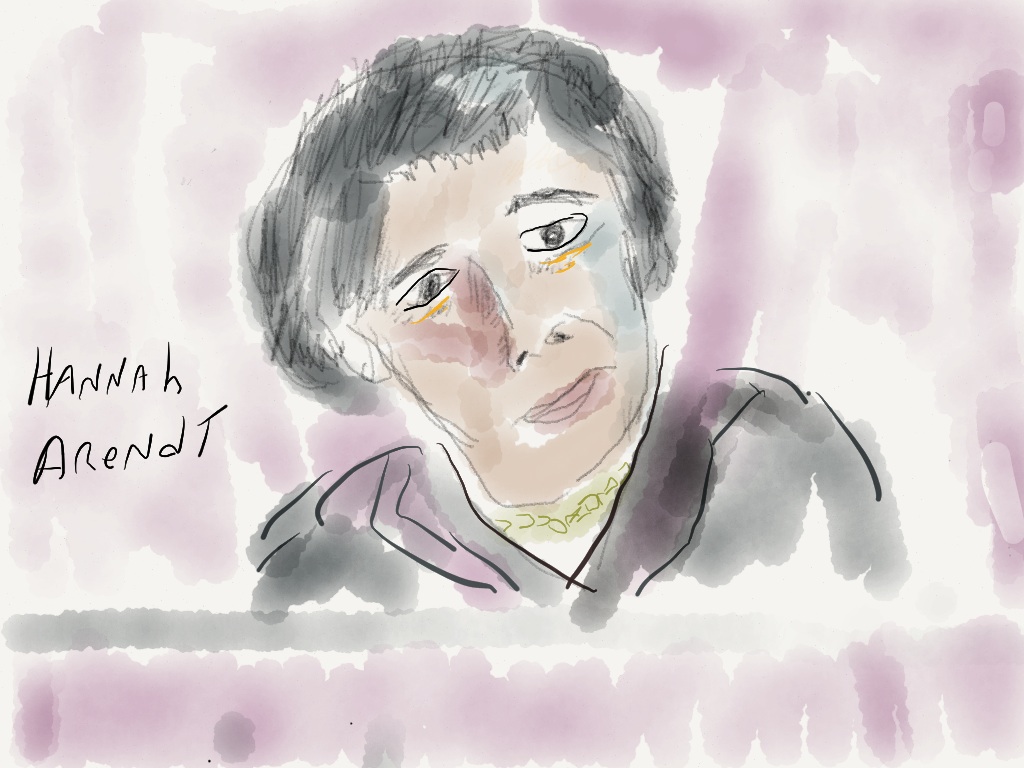
illustration 2013 jpbohannon
The philosopher, political theorist and writer, Hannah Arendt has received a thoughtful and deserving biopic from director Margarethe von Trotta, in her eponymous film, Hannah Arendt. The film’s intelligence reflects the life of the mind that Arendt lived–and an honest and hard intelligence at that. Concentrating on the period when Arendt covered the Adolph Eichmann trials for New Yorker magazine–and the fury that it unleashed– it shows Arendt resolute in her thinking, uncolored by prejudice or sympathies.
Her coverage of the Eichmann trial ended with these words, this pronouncement:
Just as you [Eichmann] supported and carried out a policy of not wanting to share the earth with the Jewish people and the people of a number of other nations—as though you and your superiors had any right to determine who should and who should not inhabit the world—we find that no one, that is, no member of the human race, can be expected to want to share the earth with you. This is the reason, and the only reason, you must hang.
♦ ♦ ♦ ♦ ♦ ♦ ♦ ♦
Arendt’s biography is well know. Born into a secular Jewish family, she studied under Martin Heidegger with whom she reportedly had a long affair. Her dissertation was on Love and Saint Augustine, but after its completion she was forbidden to teach in German universities because of being Jewish. She left Germany for France, but while there she was sent to the Grus detention camp, from which she escaped after only a few weeks. In 1941, Arendt, her husband Heinrich Blücher, and her mother escaped to the United States.
From there she embarked on an academic career that saw her teaching at many of the U.S.’s most prestigious universities (she was the first female lecturer at Princeton University) and publishing some of the most influential works on political theory of the time.
♦ ♦ ♦ ♦ ♦ ♦ ♦ ♦
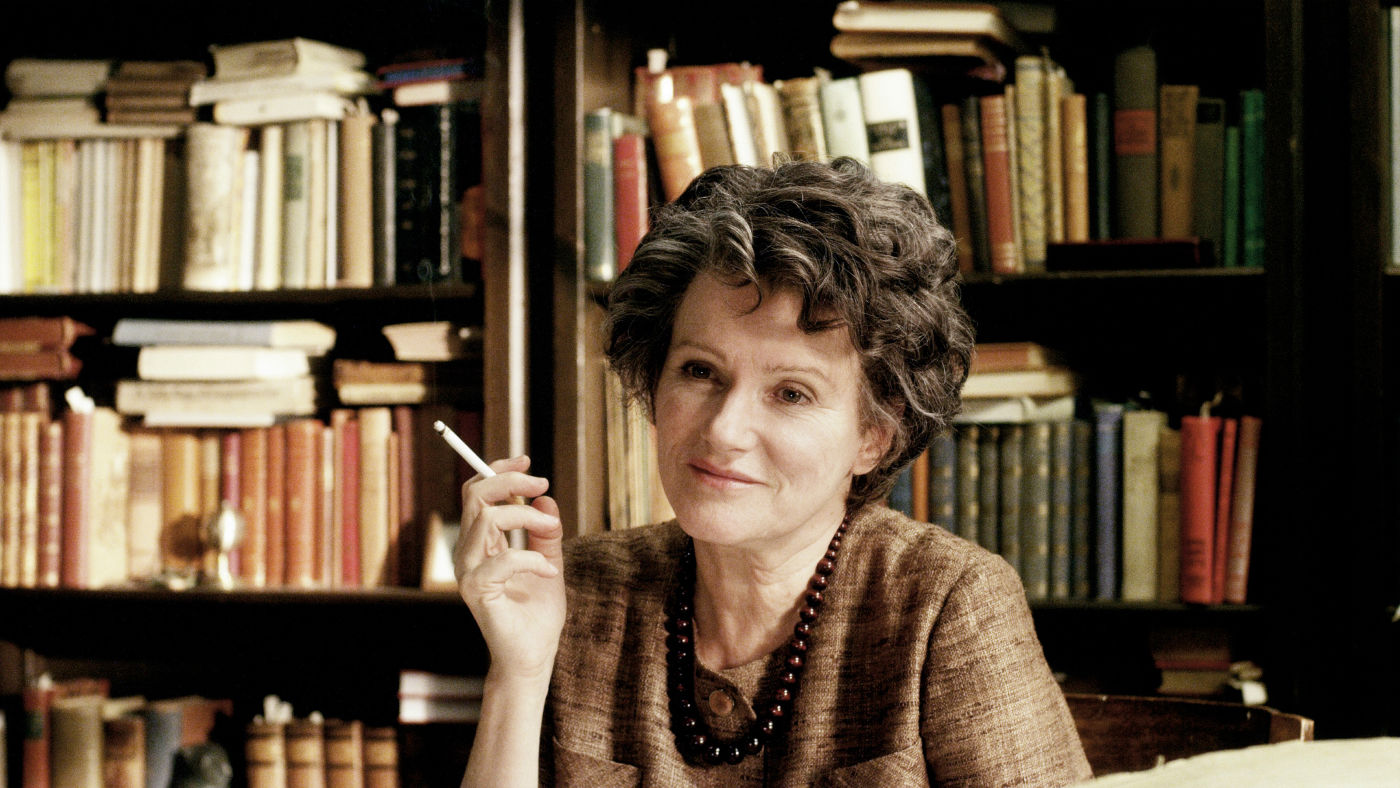 But the film, concerns a small time period in her life–but one for which many people still hold a grudge. The film begins darkly with the Mosada snatching Eichmann off a dark road in Argentina. Back in New York City, Arendt (Barbara Sukowa) and the American novelist, Mary McCarthy (Janet McTeer) are sipping wine and gossipping about the infidelities of McCarthy’s suitors. Even genius can be mundane–perhaps a subtle reference to Arendt’s conclusions from the trial. When news of Eichmann’s arrest–and trial in Israel–is announced, Arendt writes to William Shawn (Nicholas Woodeson) at the New Yorker, asking if she might cover the trial for the magazine. Shawn is excited; his assistant, Francis Wells (Megan Gay,) less so.
Of course, the trial–and Arendt’s commission to follow it–is fascinating and controversial and we listen in on Arendt and her husband and their circle of friends as they debate and argue and opine. Aside from Mary McCarthy and the head of the German department at the New School where Arendt is teaching, the guests at Arendt’s apartment are all friends from Europe, German-Jews who have escaped the Shoah/Holocaust. Listening to their different conversations is fascinating and electrifying. This is a movie about “thinking.”
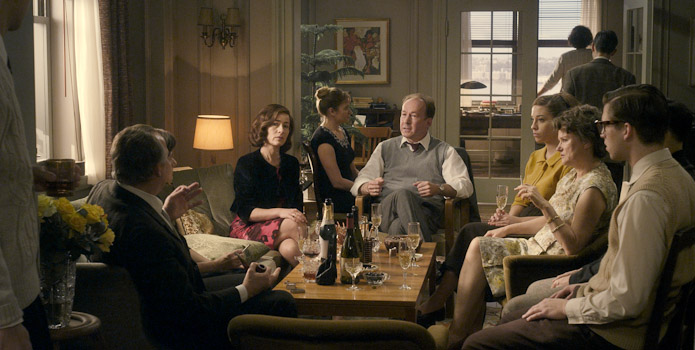
Conversing in Arendt’s apartment.
In Israel, Arendt meets with old friends, friends who remember her argumentative spirit, and stays with the Zionist, Kurt Blumenfeld. From the outset, one sees that Arendt is not thinking along the same lines as the masses following the trial.
At the trial, there is a telling moment, when Arendt watches Eichmann in his glass cage sniffling, rubbing his nose and dealing with a cold. It is then, a least in the film, that she comes to understand that this monster is not a MONSTER. She sees him as simply a mediocre human being who did not think. It is from here that she coins the idea of the “banality of evil.”
Upon returning home–with files and files of the trial’s transcripts–her article for the New Yorker is slow in coming. Her husband has a stroke, and the enormity of what she has to say needs to be perfect.
When it is finally published, the angry reaction is more than great. The critic Irving Howe called it a “civil war” among New York intellectuals. (Just last week, the word “shitstorm” was added to the German dictionary, the Duden, partly due to Chancellor Angela Merkel’s use of the word to describe the public outcry she faced over the Eurozone’s finacial crisis. It is an apt term for what occurred upon publication of Arendt’s coverage.)
It is this extraordinary anger towards Arendt–and her staunch defense–that makes up the final moments of the film. In the closing moments, Arendt speaks to a packed auditorium of students (and a few administrators). She has just been asked to resign, which she refuses to do. These are her closing words:
“This inability to think created the possibility for many ordinary men to commit evil deeds on a gigantic scale, the like of which had never been seen before. The manifestation of the wind of thought is not knowledge but the ability to tell right from wrong, beautiful from ugly. And I hope that thinking gives people the strength to prevent catastrophes in these rare moments when the chips are down.”
This is, more than anything else, a film about thinking.
♦ ♦ ♦ ♦ ♦ ♦ ♦ ♦
The extraordinary anger shown in the film is still felt by many today and, in fact, seems to have colored some of the reviews that I have read and heard. Some of these reviewers seem to be reviewing the life and work of Arendt and not the film of Margarethe von Trotta, for von Trotta’s film is a unique, masterpiece. It is more than a biography of a controversial thinker…it is a portrait of thought itself. Arendt attempts to define “evil”–certainly an apt exercise at the time. She defines it–to her friends, to her classes, to her colleagues, and to herself–and finds that it is not “radical” as she once had posited. It is merely ordinary. Goodness, she sees, is what has grandeur.
The film, Hannah Arendt, is well worth seeking out. It is thoughtful, provoking, controversial, and, at times, even funny. You can’t ask for much more for the price of a movie ticket. As always, here’s a trailer:
I went to the movies on Monday afternoon to see a film that I had been wanting to see for the past month or so. But I left the theater greatly disappointed. And as I walked up 3rd street, I thought to myself, I am not even going to write about this one.
And I think I am right.
I am not a critic–of film, books or music–I simply enjoy these things. And I enjoy writing about them and sharing my enthusiasms about them. But, I don’t feel comfortable bad-mouthing the ones I don’t like. On Wednesday I posted a piece about a book I didn’t like and I feel more than a little discomforted about it.
In this vast “blogosphere” where everyone so easily can send out his or her opinions, I want to rein myself in. Of course, BAD ART exists–there are books that are dreadful, movies that are deadening, music that irks me, but they will find their own levels of acceptance, they will find their own audiences (or not) without my weighing in.
And besides, I don’t have the time to waste on negativity.
After all, all creativity is risk…risk of missing the mark, of being misunderstood, of being ripped apart. But one has to put it out there and let it find its own life. (As Woody Allen says, “Eighty percent of success is just showing up.”)
 So, I’m sitting in a shop having a coffee after the movie and am asked what I thought. “I didn’t like it,” I say, and I give my reasons, listen to counter-positions, discuss the pluses and minuses. This is good, this is what Art should engender–conversation, dialogue, thought, and, yes, even judgment.
But is there really a need for me to blast it on the internet? I’m not so sure, but I don’t think so.
Don’t get me wrong; I will point out inconsistencies in the things that I like, choices and perspectives I disagree with, differences and surprises that throw me, things I see as flaws or would have wished the artist had done differently.
But with things that I don’t like…? Well, as my mother would say, “if I have NOTHING nice to say, I’m not going to say it.”

illustration ©2013 jpbohannon
“Mythical heroes are of obviously superhuman dimensions, an aspect which helps to make these stories acceptable to the child. Otherwise the child would be overpowered by the implied demand that he emulate the hero in his own life. Myths are useful in forming not the total personality, but only the superego. The child knows that he cannot possibly live up to the hero’s virtue, or parallel his deeds; all he can be expected to do is emulate the hero to some small degree so the child is not defeated by the discrepancy between this ideal and his own smallness.”
Bruno Bettelheim, The Uses of Enchantment
I’ve been reading a lot of Susan Sontag lately: her journals, her book Illness as Metaphor, and a slew of blog posts. One of these excerpted a journal entry in which Sontag not only analyzed why we humans like lists but that produced a list of her own likes and dislikes. Essentially, she was standing up for or against particular aspects of modern life. Most of us “jot down” lists, but this is probably the wrong phrase for this activity, because thinking about what one actually likes and dislikes is a more difficult thing to do than I first imagined, more involved than mere jotting. I know, because I tried.

© 2013 jpbohannon
At first I worried that making such a list bordered on the narcissistic. Who really cares what a person likes or dislikes? Do we make conscious decisions with any of this knowledge about other people? I doubt it, particularly in our day to day interactions.
But making such a list could be enlightening, for oneself. No one else needs to know. Sit down and think about the world and what you actually enjoy and what you find annoying, painful, sad.
However, if created lightly, without much thought, this list ends up sounding like the profile of some air-headed celebrity: “I like moonlit walks on the beach…, etc.” A far cry from the list Sontag created.
And to put any such a list out there is a bit risky…and again a bit self-involved.
I spent a good bit of time thinking about what I like–which writers and musicians, what art forms and what cities, what quirks of my own and what indulgences, what parts of everyday life and what special dreams. It was harder thinking of those things I didn’t like–the things I find annoying seemed petty when put on paper, seemed like too much kvetching, and was beginning to be forced.
So I put my list together and I worked hard at it and I decided it didn’t need posting, after all. It was good enough for me: “the examined life and all that.” Hah!
The Official Web Site of LeAnn Skeen
Grumpy younger old man casts jaded eye on whipper snappers
"Here is my secret. It is very simple: It is only with the heart that one can see rightly; what is essential is invisible to the eye.."- Antoine de Saint Exupéry
Of writing and reading
Photography from Northern Ontario
Musings on poetry, language, perception, numbers, food, and anything else that slips through the cracks.
philo poétique de G à L I B E R
Hand-stitched collage from conked-out stuff.
"Be yourself - everyone else is already taken."
Celebrate Silent Film
Indulge- Travel, Adventure, & New Experiences
Haiku, Poems, Book Reviews & Film Reviews
The blog for Year 13 English students at Cromwell College.
John Self's Shelves
writer, editor
In which a teacher and family guy is still learning ... and writing about it
A Community of Writers
visionary author
3d | fine art | design | life inspiration
Craft tips for writers
 j. p. bohannon