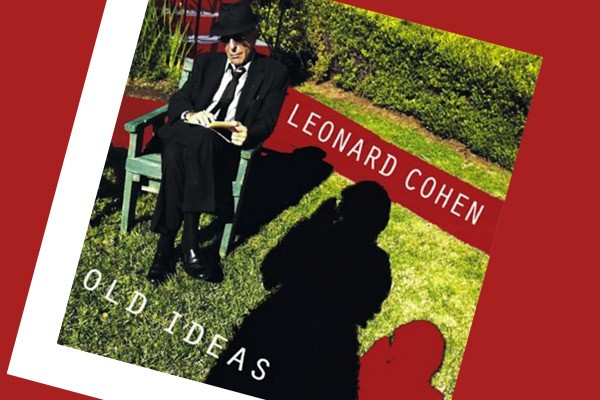
Sunday Music: Leonard Cohen Old Ideas

His voice is unmistakeable, his lyrics are second to none. And I’m not talking Dylan here. For nearly as long as Dylan has, Leonard Cohen has been creating incomparable songs–songs that deal with pain, sexuality, religion, the miscarriages of history, the ravages of love, and finality. And now at 77 years old, Cohen seems even more focused on the finality.

For instance, “Going Home,” the first song on his new album Old Ideas, is a description of a  “lazy bastard living in a suit” named Leonard. In the realization that he is “going home,” the fictional Leonard is wishing he had had a user’s manual for living, for living in defeat.

(If you know little about Leonard Cohen, you might be unaware that his manager did a “Bernie Madoff” on him and left him completely broke which is why he is touring the world and putting out new stuff at this stage in his life.  Unfortunately, he has to. Fortunately, it is still very good stuff.)

The music, like so much of Cohen’s work, is often just an understated support to Cohen’s enigmatic lyrics. Simple piano or guitar set up against the words.  At other times, the production  has beautiful, choir-like  singers (the Webb Sisters), whose voices are often in bright opposition to the darkness of his ideas. His work has frequently had the tenor of southern spirituals (cf. “Hallelujah”) and on this record, “Amen,”  “Show Me the Place” and “Come Healing” follow suit, while “Crazy to Love You” recalls the acoustic guitar work of Cohen’s early days.

But the music is ALWAYS secondary to the words.  How heartbreaking is a love song that begs “I know you have to hate me/But could you hate me less?” It is this heart-wrenching sadness, the jaded philosophy that makes Cohen so beguiling. And I find that in his old age, this jaded attitude is even more compelling–for underneath it all, there is something hopeful, poetically hopeful in the continuance of things. In a odd way, Cohen’s complaining about the world and its injustice implies that he wants to see it better, that it can be better, that it will be better.

Having Leonard Cohen’s voice in the world, having his striking words propped up by the most simple instrumentation, makes my world better. Hallelujah!

Central Park in Spring…Poetry in April

Went up to NYC for two days. The weather was glorious. Bright sunny skies and comfortable 70-degree weather. Central Park was bustling–workers extending their lunches, children climbing rocks, skateboarders, bikers, and roller-bladers whizzing around. There were even some early sun-bathers stripped down to the bare essentials. Good energy all around–New York at its finest.

The reason I went up to New York was to attend the 10th annual “Poetry and Creative Mind” gala held at the Alice Tulley Hall at Lincoln Center on Thursday night.  Sponsored by the Academy of American Poets, the gala celebrates National Poetry month by presenting various writers, directors, and personalities to read two or three poems of their choosing.  Simply, the night was fun. The presenters were relaxed and entertaining, and the audience was appreciative and receptive.

The readers were Meryl Streep, Brook Shields, Diana Reeves, Colum McCann, Chip Kidd, Bill Keller, Terrence Howard, John Wesley Harding, Claire Danes and Tom Brokow.

Chip Kidd (Master of Ceremonies) dressed in an extraordinary red-and-white striped suit jacket, Kidd was humorous and quick. He handled a small mishap very well when he introduced out-going Academy president Tree Svenson who reached the podium and had to leave stage to retrieve the speech she had forgotten.  He also performed a skit based on his assertion that all Emily Dickinson poems can be sung to the tune of the “Yellow Road of Texas,” “Gilligan’s Island,” and the 1970 theme song for Pepsi.

Colum McCann. McCann’s National Book Award winning novel, Let the Great World Spin was a dramatic, emotional,  exciting portrait of New York City in 1974.  (see and hear McCann talk about the novel here: http://www.amazon.com/Let-Great-World-Spin-Novel/dp/0812973992/ref=sr_1_1?s=books&ie=UTF8&qid=1333815282&sr=1-1).

McCann recited “The Road Not Taken.” He said that instead of gifts for Christmas, he asks his children to memorize a poem and gave us one that he had asked them to memorize. It was “A Meeting” by Wendell Berry and dedicated to Frank McCourt. His poems all tended to celebrate “the road not taken.” They included Rukeyser’s “Then I saw What the Calling Was” and Amy Clampitt’s “Blueberrying in August.” He ended with the very powerful poem by Nikky Finney called “I Have Been Somewhere.”

Claire Danes, the actress, recited e.e. cummings’ “if up’s the word.”  The poem had been read at her wedding.  She then read  Frank O’Hara’s “Having a Coke with you.”  It was new to me–although I inherited O’Hara’s completed poems from my uncle–and it was such a wonderful love poem. Here it is:

“Having a Coke with You” by Frank O’Hara

Having a Coke with you
is even more fun than going to San Sebastian, Irún, Hendaye, Biarritz, Bayonne
or being sick to my stomach on the Travesera de Gracia in Barcelona
partly because in your orange shirt you look like a better happier St. Sebastian
partly because of my love for you, partly because of your love for yoghurt
partly because of the fluorescent orange tulips around the birches
partly because of the secrecy our smiles take on before people and statuary
it is hard to believe when I’m with you that there can be anything as still
as solemn as unpleasantly definitive as statuary when right in front of it
in the warm New York 4 o’clock light we are drifting back and forth
between each other like a tree breathing through its spectacles

and the portrait show seems to have no faces in it at all, just paint
you suddenly wonder why in the world anyone ever did them

I look
at you and I would rather look at you than all the portraits in the world
except possibly for the Polish Rider occasionally and anyway it’s in the Frick
which thank heavens you haven’t gone to yet so we can go together the first time
and the fact that you move so beautifully more or less takes care of Futurism
just as at home I never think of the Nude Descending a Staircase or
at a rehearsal a single drawing of Leonardo or Michelangelo that used to wow me
and what good does all the research of the Impressionists do them
when they never got the right person to stand near the tree when the sun sank
or for that matter Marino Marini when he didn’t pick the rider as carefully
as the horse

it seems they were all cheated of some marvelous experience
which is not going to go wasted on me which is why I am telling you about it.

John Wesley Harding –John Wesley Harding is the stage, folk-singing name of the writer, Wesley Stace. As Wesley Stace he read Thomas Wyatt’s  “They Flee from Me”  which he calls the greatest poem ever written. (I’m not sure I agree). For his second poem, he brought out his guitar and sang the poem, “The Examiners”–which is on his latest album.   He had seen it in a contest in the Times Literary Supplement and was immediately struck by it.  As he noted, the poem may have come in 3rd in the contest, but “numbers 1 and 2 weren’t being played on the stage at Lincoln Center.” Here he is singing “The Examiners”:

Terence Howard, the stage and screen actor, seemed the less comfortable of them all. He haltingly read Stanley Kunitz’s “The Layers,”  but then hit his mark with Rod McKuen’s “Gifts from the Sea.”  It was moving and lovely.  And to me a surprise.

Brooke Shields gave perhaps the best performance of all.  She first read “The Spoilsport”  by Robert Graves, then the very funny “Nostalgia” by Billy Collins and then Howard Nemerov’s “To David, About His Education.” Her delivery was relaxed and humorous and each of the poems themselves were both light and thoughtful.

Bill Keller said that the only reason he had been invited to read was that he had written a NYTimes article in which he said that Congress would be a much better governing organization if they read more poetry. (He said that maybe that would be better than the “Congressional prayer breakfasts” that so many like to boast about.) He cited the late Adrian Rich who once said that “poetry was the perfect antidote to moral certainty” and felt that that was something sorely need in present day Washington. He read three love poems, one each by Brad Leithauser, Kay Ryan, and Frederick Seidel. He ended with Stephen Dunn’s “Our Parents.”

Dianne Reeves. The great jazz singer showed that she can also sing the blues. In the middle of  the Gwendolyn Brooks “Queen of the Blues,” she sang the middle verses in  throaty, bluesy voice that wound back into the poem gently into the poem. It was the high point of the evening. She also read a humorous one about a woman’s hips and another about language and grammar by Kenneth Koch in which the elements of a sentence vowed their love ”until the destruction of language”

Tom Brokaw. Affable and charming, surprisingly his remarks fell flat and his poetry selections were not that memorable. He joked about having been placed between Reeves and Streep. Affable enough, but not that great a performance.

Meryl Streep is always regal, even when she is casual and comfortable. She read W.H. Auden “As I walked out one evening” and then Bishop’s “At the Fishhouses”–she flubbed her lines at the end, but the performance was still spell-bounding.  To atone for her slip-up, she then recited a Chinese poem, first in English and then in Chinese.  It seems that she can do anything.

There was a large reception at the end–one could see in through the glass walls and it looked fine and sumptuous–but it was for the performers and the higher-priced ticket holders only.  Instead I walked across the street and had a whisky and replayed the night in my head.

A goddess’s eyes, a museum’s treasures, and the fall of civilizations

The old man laughed indulgently, holding in check a deeper, more explosive delight. “Rome was destroyed, Greece was destroyed, Persia was destroyed, Spain was destroyed. All great countries are destroyed.  Why not yours. How much longer do you think your own country will last? Forever? Keep in mind that the earth itself is destined to be destroyed by the sun in twenty-five million years or so.”  Catch-22, Joseph Heller
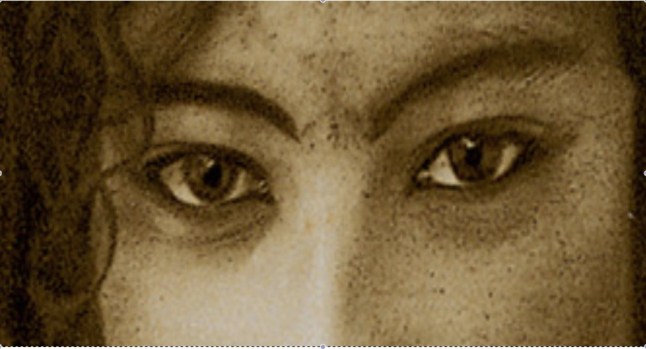

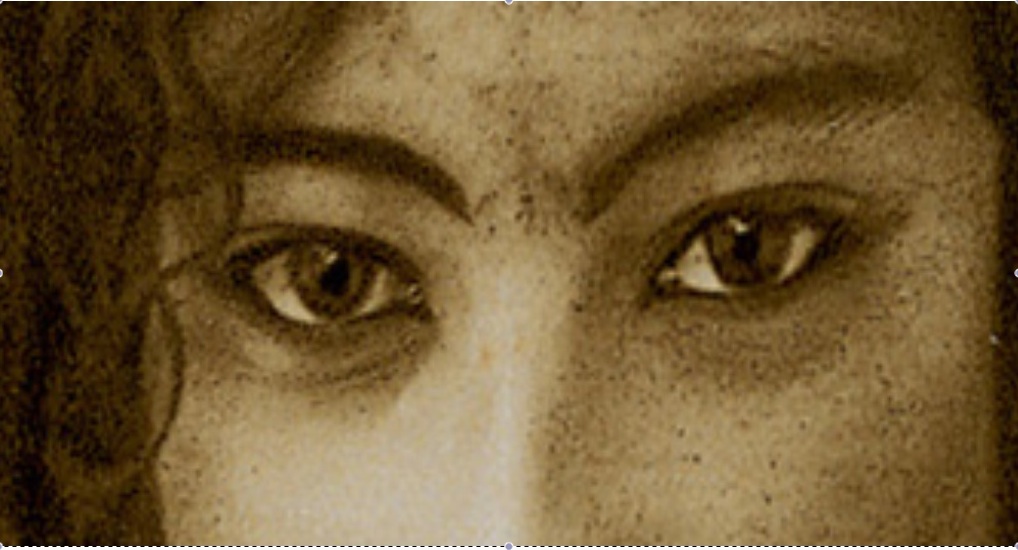
I spent the day yesterday in The University of Pennsylvania Museum of Archaeology and Anthropology.  Part of a photographic-mural, the woman above looks over you as you enter the Mid-Eastern galleries; her almond eyes seem those of a goddess, knowing, far-seeing, beautiful.  And then one wonders, what might she have actually seen in her life. What is her life like?  Is she still alive? Still in her native land?

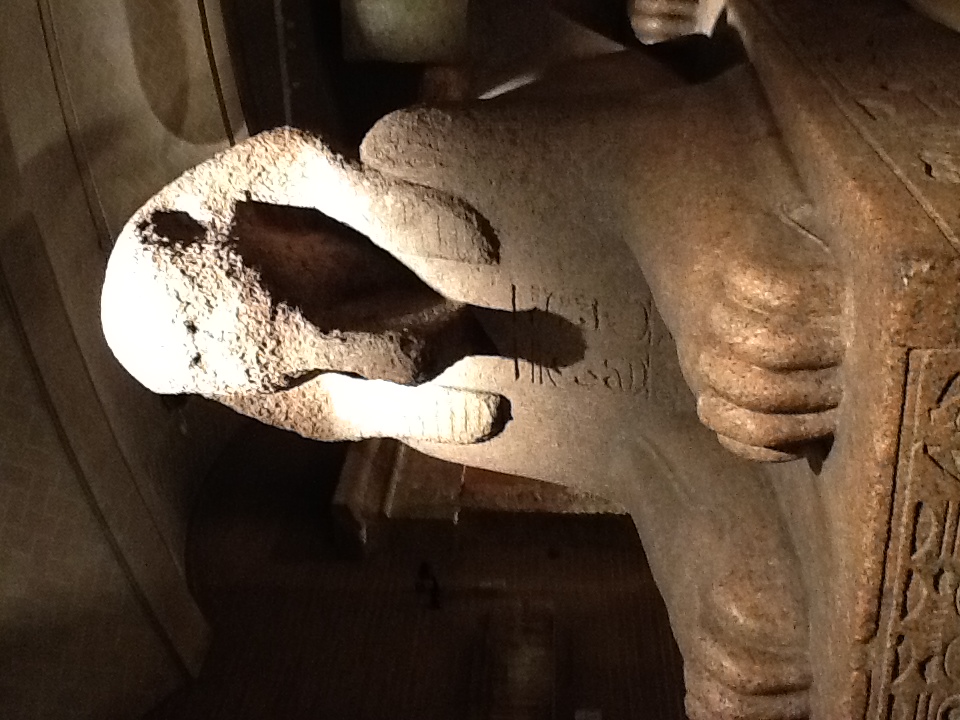
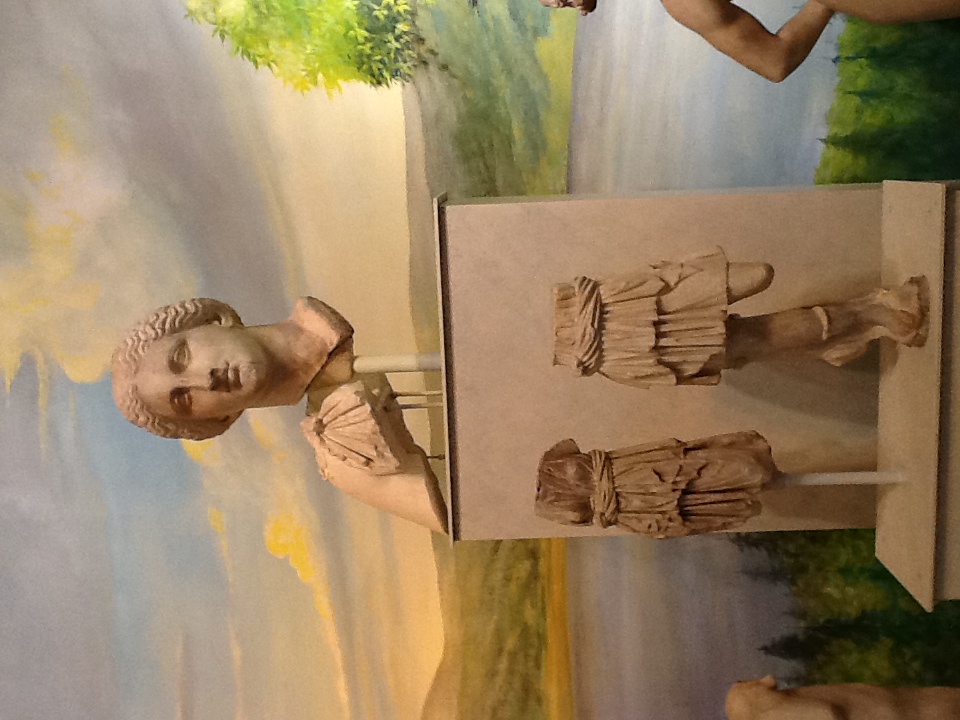
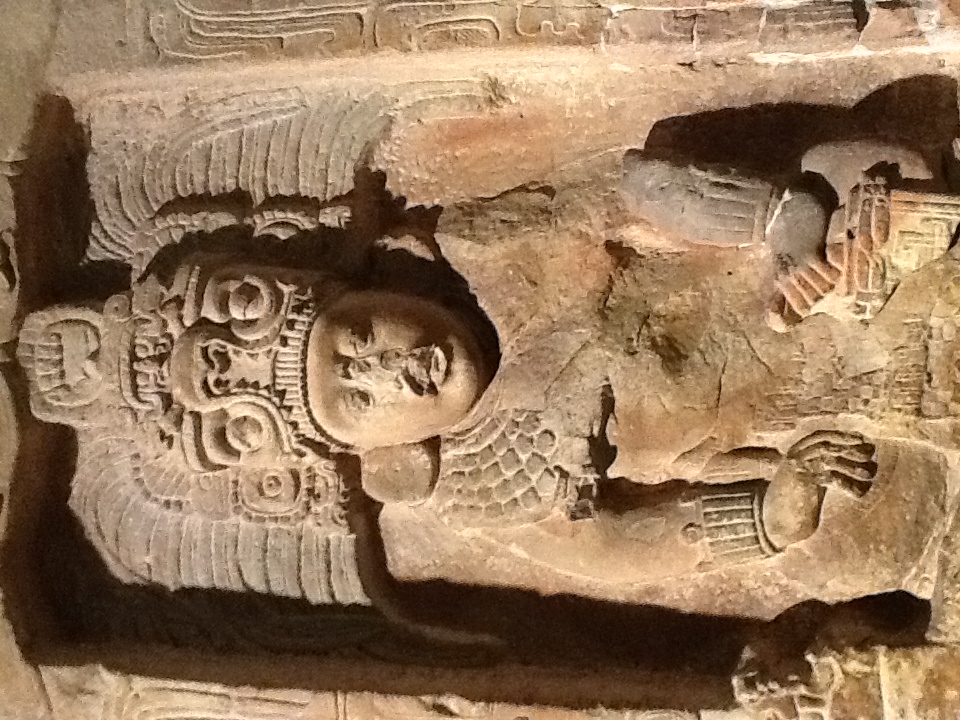
Afterwards, when I was thinking about the various galleries in the museum that  I had lingered in, I was struck by this: I had visited Persia, Greece, Rome, Mexico, Egypt–high-points of human civilization and, in 2012,  flashpoints of suffering and discontent, violence, confusion and uncertainty.

The poets are helpful here–though not necessarily hopeful–and the photos I took seemed to have their own poetic soundtrack in my mind.  Here is Yeats:

THE SECOND COMING                                                                                              

Turning and turning in the widening gyre
The falcon cannot hear the falconer;
Things fall apart; the centre cannot hold;
Mere anarchy is loosed upon the world,
The blood-dimmed tide is loosed, and everywhere                         
The ceremony of innocence is drowned;
The best lack all conviction, while the worst
Are full of passionate intensity.

Surely some revelation is at hand;
Surely the Second Coming is at hand.
The Second Coming! Hardly are those words out
When a vast image out of Spiritus Mundi
Troubles my sight: a waste of desert sand;
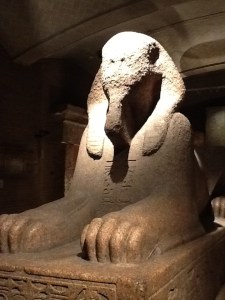
A shape with lion body and the head of a man,
A gaze blank and pitiless as the sun,
Is moving its slow thighs, while all about it
Wind shadows of the indignant desert birds.

The darkness drops again but now I know
That twenty centuries of stony sleep
Were vexed to nightmare by a rocking cradle,
And what rough beast, its hour come round at last,
Slouches towards Bethlehem to be born?

And then here’s Shelley on the same tack although not as apocalyptic:

Ozymandias

I met a traveller from an antique land
Who said: “Two vast and trunkless legs of stone
Stand in the desert. Near them on the sand,
Half sunk, a shattered visage lies, whose frown
And wrinkled lip and sneer of cold command
Tell that its sculptor well those passions read
Which yet survive, stamped on these lifeless things,
The hand that mocked them and the heart that fed.
And on the pedestal these words appear:
`My name is Ozymandias, King of Kings:
Look on my works, ye mighty, and despair!’
Nothing beside remains. Round the decay
Of that colossal wreck, boundless and bare,
The lone and level sands stretch far away”.
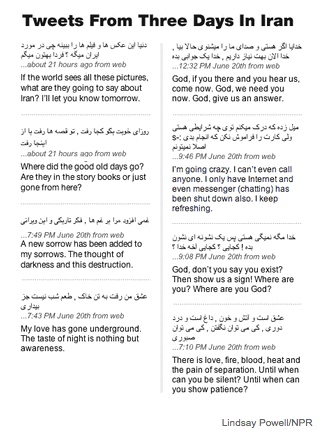
“If the world sees all these pictures, what are they going to say about Iran? I’ll let you know tomorrow.”

“Where did the good old days go? Are they in the story books or just gone from here.”

“A new sorrow has been added to my sorrow. The thought of darkness and this destruction.”

“My love has gone underground. The taste of night is nothing but awareness.”

“God, if you’re there and you hear us, come now. God, we need you now. God, give us an answer.”

The Persians have long been known for their poetry. Lush, emotional, spiritual and clear. The poems to the left were tweets sent during the contested elections in Iran in June 2009.  It is evidence of my theory that poetry–in fact all written expression– is an innate desire, beaten out of children by well-meaning but misinformed teachers. While the immediate world seems to be spinning out of control (see Yeats’ spiral above), these young Iranians find the need to put their thoughts on paper–or onto some kind of device in 140 characters or less.

GREECE — Poor Greece, so beautiful, so lovely, and so fragile to economic decisions that seem far removed from the people themselves.

Headless Statue by  Kyriakos Haralambdis
(translated by Kimon Friar). Hellenic Quarterly, Summer, 2000.

I have heard that your head
has been sent as a sacred skull to Constantinople.
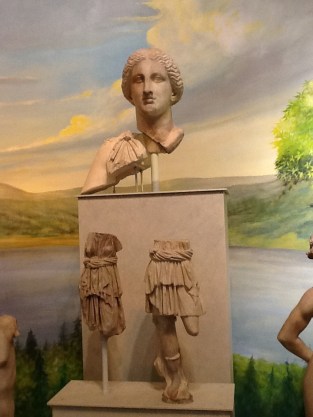
Byzantine emperors manfully
placed you in red and gold.
The star of God’s Holy Wisdom
studies you and covers you.
And you, a woman, in a late hour
open your closed eyelashes.
You look fruitlessly, for we have gone away on a journey,
and you call out to us “come to my guest room.”
But we, artful head, seek your whole body,
in a city that resembles you. If we succeed,
we shall call this bone our own.

Poor city, ten years in bed,
without the lamp stead at our head,
as headless and cold as lead.

I don’t want to be distressed by seeing you, my bird.
I know you are absent, all has been heard.
Your skill in a huge box
embellished with small serpents and small stars
all made of paper, seed of manliness
travelled around the world to be placed
in houses of ill repute and cabarets
in the sky of the city where it reigned.

You who hear me, do not misunderstand me.
Such things serve the natural remembrance of mortals,
others the cleansing of memory.

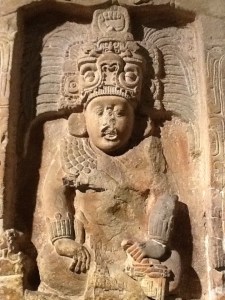
MEXICO— one murder is always too many. Poor Mexico is  far beyond too many, far beyond human understanding, far beyond humanity.

“And every time they opened, it was night and the moon, while they climbed the great terraced steps, his head hanging down backward now, and up at the top were the bonfires, red columns of perfumed smoke, and suddenly he saw the red stone, shiny with the blood dripping off it, and the spinning arcs cut by the feet of the victim whom they pulled off to throw him rolling down the north steps. With a last hope he shut his lids tightly, moaning to wake up. For a second he thought he had gotten there, because once more he was immobile in the bed, except that his head was hanging down off it, swinging. But he smelled death, and when he opened his eyes he saw the blood-soaked fig­ure of the executioner-priest coming toward him with the stone knife in his hand. He managed to close his eyelids again, although he knew now he was not going to wake up, that he was awake, that the marvelous dream had been the other, absurd as all dreams are-a dream in which he was going through the strange avenues of an astonishing city, with green and red lights that burned without fire or smoke, on an enormous metal insect that whirred away between his legs. In the infinite he of the dream, they had also picked him up off the ground, some­one had approached him also with a knife in his hand, approached him who was lying face up, face up with his eyes closed between the bonfires on the steps.”  from “The Night Face-Up” by Julio Cortazar
ROME–And on a happier note, this from Catallus:

–5–

Let’s you and me live it up, my Lesbia,

and make some love, and let old cranks

go cheap talk their fool heads off.
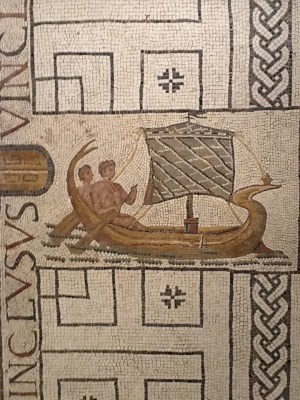
Maybe suns can set and come back up again,

but once the brief light goes out on us

the night’s one long sleep forever.

First give me a kiss, a thousand kisses,

then a hundred, and then a thousand more,

then another hundred, and another thousand,

and keep kissing and kissing me so many times

we get all mixed up and can’t count anymore,

that way nobody can give us the evil eye

trying to figure how many kisses we’ve got.

I spent the majority of my visit in the Greco-Roman-Estruscan galleries, though I took a guided tour through the Meso-American gallery and the Southwest American gallery.  These dealt with the ancient peoples of the Yucatan peninsula and the southwest corner of what is now the United States.  Current theories claim that these wide reaching people actually traded and influenced one another over the centuries: the Incans, the Mayans, the Hopi, the Pueblo.  Yet they too–the Mayan cities seem so much more advanced than the Athens, Roman, Cairo counterparts–all were subsumed by human violence and  human greed.

It is an impressive museum, The University of Pennsylvania Museum of Archaeology and Anthropology.  But it left me feeling a bit desperate…a little hopeless…a little sad.  Sad, except for the women in the photographic mural whose eyes are so beguiling. Perhaps the poets are right all along, and it is beauty and love that will carry us through.
Canadian Pennies, the Nation of Texas and a poem

April is National Poetry Month.  All sorts of organizations, schools, and institutions have all sorts of things planned to bring poetry into American life. But I heard a pretty cool one on March 30, a few days before it begins.

All Things Considered on NPR had done a story on the demise of the Canadian penny. (Canada is one of ten countries to jettison its lower denomination coins because they are just too expensive to make. The cost to make a U.S. penny is 2.41 cents–a losing proposition, but the U.S. has no immediate for its elimination, despite yearly pleas to do so. There must be a very strong “penny lobby.” ) All Things Considered had also done a faux “what-if” story on Texas seceding from the union and forming its own nation.  There were all kinds of speakers–serious and not–who took part in the piece.  My favorite was Kinky Friedman, the novelist, humorist, rockabilly guitarist who ran for governor a few years back. As foreign minister, Friedman felt that Texas should send a delegation to third world countries to teach the women how to have “big hair”!

So what has this to do with poetry?

Well, aside from its normal news day, All Things Considered also has taken on a poet in residence who follows the news team through a given day and then at the end must make up a poem on some aspect of that particular news day.

Yesterday there was Kevin Young  as the “news poet.” His task was to write a poem about anything he had witnessed, heard, learned throughout the day, and he chose the Texas story and the Canadian penny story. Here is the result, his poem “Anthem”:

ANTHEM

Kevin Young, NPR's Poet in Residence

Life is a near
death experience.

You can go
to hell, I’m goin

to Texas. It costs
more than a penny

to make a penny.
A dollar for your

thoughts, and a dream.
People have to breathe

where they live.
A town big

as her hair.
Aren’t there more

worlds than three?
Texas is finally

free, but not its lunch.
Cleave
can mean

to sunder
or to meet. The threat

must be imminent.
Look and see—

the daffodils, the rain sage
upright, the high

desert, fire warnings,
the scorched trees. Cloven,

clove, clave, cleavage,
cleft. Every day’s
a lottery. Hoods,
blood. The death

of the Canadian penny
means we all may need

to round up. Leaves,
left. Bereave,

bereft.

To understand many of the references you would have to have had heard the “TEXAS-AS-NATION” original story. (Click on link above). I was fortunate; I heard both the Texas story and then the poem.  (It seems he threw in a line about the Mega-Millions lottery madness that was happening that day, as well.) What a great way to end the week and to end the month.  To hear Kevin Young read the poem, click here. It’s pretty good for a poem that was made to order.

“It is always a matter, my darling, of life and death…”

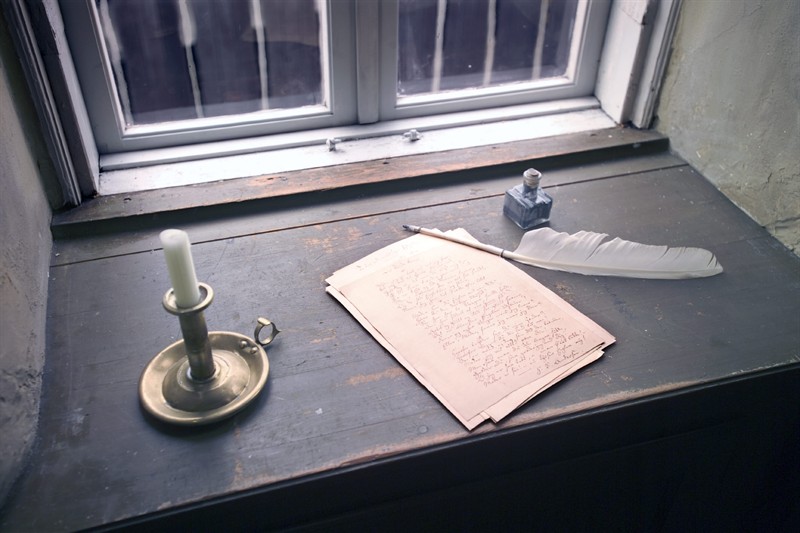
Hans Christian Andersen's Window-sill Desk

“It is always a matter, my darling,
Of life or death, as I had forgotten.  I wish
What I wished you before, but harder.”

I teach eighteen year old boys. They are very bright, quite talented, and well-situated so as to take advantage of the most amazing opportunities.  And yet they are still eighteen years old–filled with false bravado and insecurities, dreams and fears, uncertainties and confusion.

And this is the week!

In the States, April 1 is the arbitrary deadline that most colleges and universities set for informing applicants whether they have been accepted or rejected. The three or four days beforehand is a time period when these students believe that their lives sit in a balance.  I try to tell them–not flippantly–that it is not the end of the world, that perhaps rejection from one school and acceptance to a lesser-desired one might be the best thing to happen to them.  Who can tell?

But I have to remember as the poet says, at that age “it is always a matter of life and death.”

I don’t envy them their angst.  And I don’t downplay it. It is very real–and almost palpable in the school hallways. Instead I give them this poem, which I think is good for them to know.

The Writer by Richard Wilbur

In her room at the prow of the house
Where light breaks, and the windows are tossed with linden,
My daughter is writing a story.

I pause in the stairwell, hearing
From her shut door a commotion of typewriter-keys
Like a chain hauled over a gunwale.

Young as she is, the stuff
Of her life is a great cargo, and some of it heavy:
I wish her a lucky passage.

But now it is she who pauses,
As if to reject my thought and its easy figure.
A stillness greatens, in which

The whole house seems to be thinking,
And then she is at it again with a bunched clamor
Of strokes, and again is silent.

I remember the dazed starling
Which was trapped in that very room, two years ago;
How we stole in, lifted a sash

And retreated, not to affright it;
And how for a helpless hour, through the crack of the door,
We watched the sleek, wild, dark

And iridescent creature
Batter against the brilliance, drop like a glove
To the hard floor, or the desk-top,

And wait then, humped and bloody,
For the wits to try it again; and how our spirits
Rose when, suddenly sure,

It lifted off from a chair-back,
Beating a smooth course for the right window
And clearing the sill of the world.

It is always a matter, my darling,
Of life or death, as I had forgotten.  I wish
What I wished you before, but harder.

There are two important pieces in that last verse.  One, I realize that for them everything–a university rejection, a break-up with a girlfriend, a strike-out when a game is on the line–everything is “a matter of life or death.”  The second is that wish that the speaker “wished you before, but harder.”  Undoubtedly, they will be battered and smacked up against hard obstacles. Even the most fortunate among them–and they are mostly fortunate–will have moments where things seem hopeless.  And so, like the poet, I wish them well, I wish them smooth sailing, and I wish it even harder.

Book Review: Remainder by Tom McCarthy and You and Three Others are Approaching a Lake by Anna Moschovakis

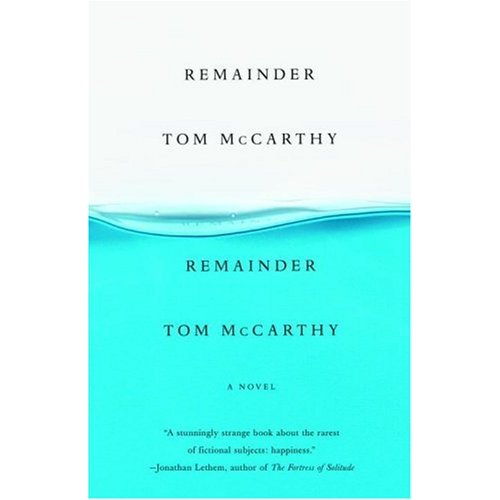
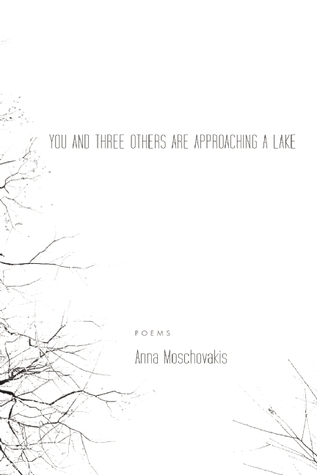
My intention was to talk about one book a week, and originally I wanted that to happen on a Friday. But then, I realized that a large bulk of my outside reading–my non-class reading–is finished up over the weekend, so a posting on Monday makes much better sense. And since, this is the first venture out with a post about books, I figured I would start out with two.  Remainder by Tom McCarthy and You and Three Others are Approaching a Lake by Anna Moschovakis.

Tom McCarthy’s novel about a post-coma, post-trauma survivor who receives a “settlement” for eight-and-half million pounds is at times aggravating and at other times marvelous. The narrator has lost much of his memory after being hit by an untold object that placed him hospital and in a coma for an extended period. When he returns to “normal” life, he is given an enormous payout by the responsible parties. His only vivid memory, however, is one that involves an apartment house with a crack in the bathroom wall, a woman cooking liver in the flat below him, another tenant  playing piano in the room above, and a man working on his motorcycle in the courtyard. With an almost unlimited amount of money, he arranges to “re-enact” the entire memory, buying several buildings, re-doing them to the specifications that he remembers, and hiring actors around the clock to play the tenants that haunt his memory. From here, he begins to re-create other more recent occurrences.  McCarthy’s–and the narrator’s–attention to detail is precise and minute, a true feat of writing and observation, but Nicholas Baker did it much better in his earlier works.  The payoff for me, however, comes at the end of the novel. Early on, when the narrator first learns of his windfall, he is set in a circuitous route between a telephone booth and his home. He travels the distance back and forth three or four times within a short period, stymied by his forgetfulness and his demand for exactitude.  I enjoyed this scene; it verged on the slapstick; and I even related it to other people. At the end of the novel, the same type of scene is played out, though this time with more dire and impending consequences.  It brought the novel together. Remainder certainly contained moments of brilliance yet they were couched in much larger moments of cloudiness and frustration.

Anna Moschovakis’, award-winning book of poetry, You and Three Others are Approaching a Lake, is another work that has me of two minds.  The topics, the observations, the connections, all are intriguing, mind-jarring, fresh. Yet the poetry itself leaves me wanting. The book contains four long poems, plus a prologue and an epilogue.  They touch upon the contemporary and allude to the past. They are geographical and internal. They play with typography and they play with presumptions. They deal with our technological world and the examine our anthropological past.  Indeed, having read the collection at one sitting, my first reaction was to read it again, to try to wrap my head around the numerous ideas and permutations.

In the poem “The Human Machine” there is an extended conversation between “annabot” and “the human machine” which questions what we know about and how we love, questions the substance of spirit, dissects the more mechanical part of our being. In a letter to the Human Machine, Annabot writes:

Dear Human Machine,

Resolve, reason, ration, rational, rationale, rationalize

ratiocination, rationing, ratify, rather, rate,

ratios, ratio, rat

According to Peter Singer, a rat who is loved by a person

is more worthy of being pulled from a fire

than a person who is unloved by persons

This is taking into account Singer’s technical definition

of “person”

As I said, this is truly a marvelous book for thinking, for exploring, for discovering new ways of seeing the world.  It is a book that I have–and will again–return to.  However, I am not sure of the poetry of the pieces. I found them wanting.

“Modern Love”

The word “modern” is such a subjective term.  The 19th century poet, George Meredith, wrote a poetic sequence of 50 poems and entitled it Modern Love. The poems, each having 16 lines in 4 rhymed quatrains,  describe the relationship between a man and his wife.  It is “modern” for him because it is describing his current life in the 1860s.  Yet, it is extraordinarily modern to us, in that it is timeless.  It doesn’t seem filtered by the past, but emotionally contemporary. The distant couple, the repressed emotions, the sleepless night, these all seem to be taken from the late-20th-century, early -21st. I swear I have seen countless movies where a modern woman and modern man lie on their backs, thinking, wishing, wondering–the very emotions that Meredith attaches to his “modern lovers.”  All it needs is a plaintive soundtrack by  Bonnie “Prince” Billy.

Here is the first poem in the sequence.  Notice the dread, the sadness, the angst; it seems all so very real, very contemporary.

By this he knew she wept with waking eyes:
That, at his hand’s light quiver by her head,
The strange low sobs that shook their common bed                                             
Were called into her with a sharp surprise,
And strangely mute, like little gasping snakes,
Dreadfully venomous to him. She lay
Stone-still, and the long darkness flowed away
With muffled pulses. Then, as midnight makes
Her giant heart of Memory and Tears
Drink the pale drug of silence, and so beat
Sleep’s heavy measure, they from head to feet
Were moveless, looking through their dead black years,
By vain regret scrawled over the blank wall.
Like sculptured effigies they might be seen
Upon their marriage-tomb, the sword between;
Each wishing for the sword that severs all.
——-
(For those who like the “biographical” strategy, check out George Meredith’s life. It makes the poem all the more poignant.)

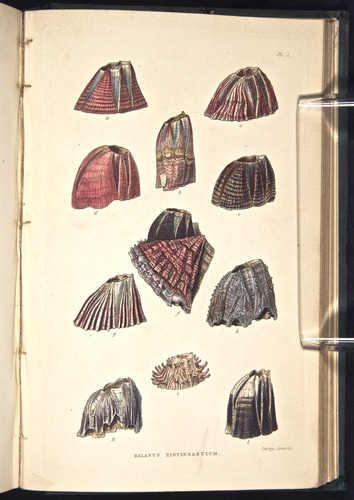
Darwin’s Barnacles

This is a page from Darwin’s journals on which he illustrated some of the barnacles he was working on. Before coming out with his Origin of the Species, Darwin had spent the previous eight years studying barnacles, publishing two monographs on the subject in that period.

In the actual drawings, the colors pop with much more brilliance and clarity, each barnacle delicately and exquisitely drawn.  The petticoat-like, pastel-colored illustrations are so different from the connotations that the word “barnacle” brought to my mind.  I had always associated the word, “barnacle” with roughness, coarseness, ugliness, but apparently I was mistaken, for these drawings are nothing but beautiful.  I saw them at an exhibit on Darwin at the American Philosophical Society Museum in Philadelphia.  The exhibit  was entitled “Dialogs with Darwin” and it included many of Darwin’s journals, scientific specimens, artifacts, personal effects and taxidermy.  Around the ceiling of the room was stenciled the words of a letter he wrote that began “There is a grandeur in this view of life … .”

The museum requested poetry to accompany the show, poetry inspired by one or more items in the show, poems that started a “dialog” with the items displayed and what they evoked.  I was drawn to the barnacles, to his life, to the death of his daughter, and to his discovery of emotion in animals.  The poem appears below:

There is grandeur in this view of life

There is grandeur in this view of life
where Victorian petticoats parachute along an ivory sheet,
barnacles floating on a women’s fashion page,
with precious pleats and twinkling color.

There is grandeur in this view of life
where elephants weep and moan and scream,
for the death of daughters, the loss of certainty,
where joy stretches true across a small chimp’s face.

There is grandeur in this view of life
where a captain’s gentleman unpacks
his crated books, his amateur’s tools
and sails to the bottom of a burgeoning world
beneath those stars from where these tracks begin.

Big Debut

I spent much too long Saturday night–and far into Sunday morning–reading different writers’ blogs from the journals I was reading (Annalemma, The Coffin Factory, Pank, Cabinet des Fees etc.) I figure it’s about time I gave this blogging thing a try. Anyway, I am diving in completely unprepared. But, I have been on a bit of a roll lately–two poems, one short story published and another story finished and sent out–so I guess the time is right for me to begin this undertaking. As with all things, I appreciate any comments, any suggestions, any ideas. Cheers.