Women Writers and New York City–or all writers and everywhere.

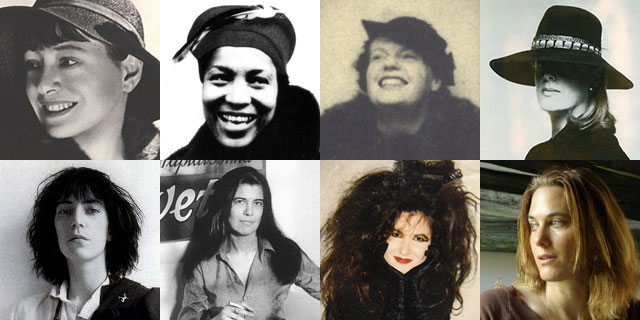
Top row: Dorothy Parker, Zora Neale Hurston, Shirley Jackson, Gael Greene.
Bottom row: Patti Smith, Susan Sontag, Tama Janowitz, Kate Christensen.

I have a niece who is struggling in New York City to make it as a writer…and she is doing pretty well (see my blogroll and click on “Courtney Gillette.”) Nevertheless, it is a struggle. I have a friend whose son Brendan is carving his way as a comic/comedy writer–not the easiest of niches to crack into–and he is making headway. They are just two of thousands who go to NYC with dreams of making it big and –more power to them–they have the drive and determination to do so.  But it is not just New York, it is cities around the world where people intent on making something new, struggle to survive and to get their work out…and hopefully recognized.  So I thought of both of them–Courtney and Brendan–when I read this article this morning.  The article itself is from mid-April, but it is a fun piece highlighting some of my favorite people and writers.

Anyway, here is the article from a site called AWL. It tracks what particular writers arrived New York with before they “made it” and adjusts the value of their belongings and purchases for inflation.  It is a fun piece that ranges from Dorothy Parker and Zora Neale Huston to Patti Smith and Tama Janowitz:

What it Cost Eight Women Writers…

And speaking of Patti Smith, I have been on a Patti Smith kick for over a year now.  One day in December 2010, I actually received three separate copies of her memoir, Just Kids and of course read it in a night and then began giving out copies to everyone. Then I began to reacquaint myself with her music. (Her video singing “Helpless” with Neil Young is powerful.)

Just last week a friend sent me this new Patti Smith video/song. It’s about April and poetry and fools.  Enjoy.
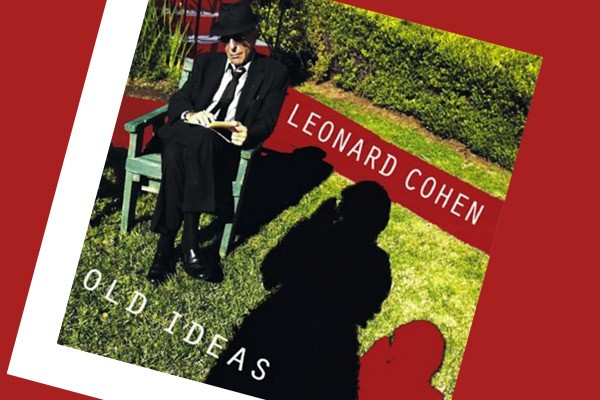
Sunday Music: Leonard Cohen Old Ideas

His voice is unmistakeable, his lyrics are second to none. And I’m not talking Dylan here. For nearly as long as Dylan has, Leonard Cohen has been creating incomparable songs–songs that deal with pain, sexuality, religion, the miscarriages of history, the ravages of love, and finality. And now at 77 years old, Cohen seems even more focused on the finality.

For instance, “Going Home,” the first song on his new album Old Ideas, is a description of a  “lazy bastard living in a suit” named Leonard. In the realization that he is “going home,” the fictional Leonard is wishing he had had a user’s manual for living, for living in defeat.

(If you know little about Leonard Cohen, you might be unaware that his manager did a “Bernie Madoff” on him and left him completely broke which is why he is touring the world and putting out new stuff at this stage in his life.  Unfortunately, he has to. Fortunately, it is still very good stuff.)

The music, like so much of Cohen’s work, is often just an understated support to Cohen’s enigmatic lyrics. Simple piano or guitar set up against the words.  At other times, the production  has beautiful, choir-like  singers (the Webb Sisters), whose voices are often in bright opposition to the darkness of his ideas. His work has frequently had the tenor of southern spirituals (cf. “Hallelujah”) and on this record, “Amen,”  “Show Me the Place” and “Come Healing” follow suit, while “Crazy to Love You” recalls the acoustic guitar work of Cohen’s early days.

But the music is ALWAYS secondary to the words.  How heartbreaking is a love song that begs “I know you have to hate me/But could you hate me less?” It is this heart-wrenching sadness, the jaded philosophy that makes Cohen so beguiling. And I find that in his old age, this jaded attitude is even more compelling–for underneath it all, there is something hopeful, poetically hopeful in the continuance of things. In a odd way, Cohen’s complaining about the world and its injustice implies that he wants to see it better, that it can be better, that it will be better.

Having Leonard Cohen’s voice in the world, having his striking words propped up by the most simple instrumentation, makes my world better. Hallelujah!

Barney McKenna–R.I.P.

So.  The mother-in-law of a fiddler I used to play with died last week. I went to  visit early Monday morning, but didn’t stay for the funeral.  When I got home, a friend called to say that he had just missed me at the church.  He also said–I thought –that the woman who died had been a relative of Barney McKenna, the great banjo player for The Dubliners.

Later in the week, I get another message from another friend that Barney McKenna had died earlier in the week.  Too weird.  I call my pal to tell him about the strange coincidence. Turns out that I had misheard his original message from the start.  The first friend knew about McKenna’s death and merely told me that Barney McKenna’s obituary was on the same page as the woman’s whose funeral I had just gone to.  There was no connection, no relation. Man, had I misheard.

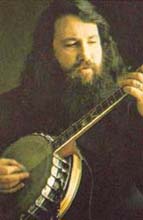
A young Barney McKenna

One of the founding members of The Dubliners, Barney McKenna helped changed Irish music forever, moving it from the back rooms of O’Donahue’s pub on Merion Row to concert halls in the Europe and U.S.   With the original line up of Luke Kelley, Ronnie Drew, and Ciaran Bourke, Barney McKenna and the Dubliners were prolific and talented. In various incarnations and through changes of players, they played for more than 50 years.

As it happens, last week, McKenna was having tea at the kitchen table with a friend when he appeared to have “nodded off.”  If you gotta go–and we all have to–what a great a way to do it, place your chin on your chest and simply nod off.  Anyway, in memory of Barney McKenna, here’s a short clip of his playing in Germany sometime in the mid-90s.:

Sunday Music–Black 47

For the next two weeks, Philadelphia is awash with “Irish” bands.  Most of them are home-grown and are playing at bars that are on the maps of organized pub crawls for the next two weekends. (Why do so many “Irish” pubs have initials. P.J. O’Toole’s, J.D. McGullicuddy’s, J.P. Monaghan’s?  Wasn’t any Irish kid called by his full name? Or was calling him by his initials a way to ensure that  he becomes a bar-owner?)  Anyway, there is a lot of live Irish music around right now–some of it great, some of it less so.  It is also the time when a slew of national/international Irish-music acts come through the area.  The Chieftains played here Friday night; the SawDoctors are in town Tuesday night; and Lunasa is here on Wednesday night.

Black 47 was at the World Cafe on Friday night, the 9th.  They were brilliant. It had been 10 years since I saw them last, and they are still musically tight, politically raucous, and extraordinary fun. The front man, Larry Kirwan is a dynamo of energy, the brass section is still stellar, and the newer additions (for me, that is) have added to the fun and musicianship. Black 47’s music is raucous and tender,  a mix of Springsteen and the Clash, heavily infused with Celtic melodies and themes.  The songs are filled with stories about life in NYC,  paeans to Irish heroes, recollected broken hearts and broken bones, and clarions for political action.

Larry Kirwan, as I said, is prolific. I once saw a play of his on Governor’s Island at the Guinness Fleadh in 1997–now collected in his book of plays, Mad Angels: The Plays of Larry Kirwan.  At the moment he is doing publicity for his latest novel, Rocking the Bronx; he has his own radio-show Celtic Crush on Sirrus/XM radio, has put together a Celtic Kid’s album and book, and is working on a musical with Thomas Kenneally (author of Schindler’s List).

But put that aside for the time.  Two nights ago I saw Larry Kirwan and Black 47 do what they do so well–deliver a raucous, fun rock show.  Below is an old video from perhaps their most famous song–anyone who was in NYC during the 90s heard in every joint that had a jukebox.  So here it is: Black 47’s “Funky Ceili” (The video ends abruptly before the classic line, “Does he have red hair and glasses” and showing an infant with Larry’s horn-rims, hah!):

Sunday Music–“Immigraniada”

Sunday is a chance to listen to–and to think about– music. I don’t get to listen much during the week. So on Sundays, when the afternoons are slow, I listen.

I found GOGOL BORDELLO by accident in the fall of 2011 in, of all places, a special fashion/style supplement of the New York Times. There was a pictorial of various “edgy” bands and only Florence and the Machine was familiar to me.  So I YouTubed the first one–and it was forgettable. Can’t even remember the band’s name. The next one was Gogol Bordello and a performance on the Letterman show.  I was hooked.  Theater, music, message, and what looked like frenetic fun.  (I apparently was late to the game since the Letterman clip was from 2007, but they are still playing and touring and creating great music.)

Anyway, I moved from song to song, downloading from iTunes and checking out videos.  I was floored by songs with allusions to Foucault, to Kafka, to Diogenes–these are not the usual touchstones for modern music.  The band has a Russian fiddler, an Israeli accordionist, a Ukranian guitarist/vocalist, a Chinese vocalist, an Ecuadorian, an Italian, an Ethiopian, a Trinidadian and many more that seem to float in and out of the lineup. And the music is infectious. (They were in NYC on New Year’s Eve this year, but my hopeful plans never amounted to anything.)

This particular song–and the accompanying video– “Immigraniada” is powerful. At first, I watched it over and over;  I gave it to a friend who teaches a course in social justice, hoping his students might understand; I wanted everyone to see it.  So now here it is.  If you like it, share it with someone.  If you really like it, if it somehow connects with you, go to aclu.org/immigrants-rights.