Neil Young’s Harvest was an album filled with gentle acoustic numbers, some spirited rockers, and two songs backed by The London Symphony Orchestra. Young’s piano playing and the backing of the orchestral strings give “A Man Needs a Maid” its haunting and plaintive tone. For me it works stripped down to just an acoustic guitar. Enjoy.
Music
“From Galway to Graceland”
A guitar virtuoso and a wonderful story-teller in song, Richard Thompson humorously describes this as “an Elvis song…an Irish Elvis song.” I find it moving and sad. I hope you like it.
DAN HICKS AND ME
Last week I played at a little club in New Hope, Pa. The club had opened in 1972 and it still had a really cool vibe from that era. On the walls they had posters of all the acts that had played there: Jonathan Edwards and Steve Forbert. Mary Chapin Carpenter and Norah Jones. John Gorka and Rhett Miller. Penn and Teller and Commander Cody. But the picture that caught my eye was of Dan Hicks. Dan Hicks and the Hot Licks were one of my favorite bands of that era. Incredible musicianship, intricate harmonies, and clever wordplay, their music was unlike anything else that was heard at the time. I used to call it “good-timey music.” And I hadn’t listened for a while. So when I got home from that gig, I spent the following week listening to the two Dan Hicks and the Hot Licks albums that I owned and watching them whatever YouTube videos that existed. So I thought that for this Sunday I would do a Hot Licks song. I don’t have all the instruments or the female harmonies, but I plowed on. I hope you like it.
Original song: “Headed Straight to Nowhere”
Most of my Sunday Morning Tunes are covers of other people’s songs. This week, however, I’m putting up an original song. Hope you like it.
J. P. Bohannon at John and Peter’s in New Hope, PA
This Saturday, March 23, J. P. Bohannon will be opening for the indie-rock band, Black Cat Habitat. His set will consist entirely of original songs. Music starts at 3:00 pm. Come out enjoy the music and the scenic town of New Hope.

Playing in NYC

On Saturday, April 2, 2022, I will be playing at the New Old Rock Deli in NYC. (11 Trinity Place, NY, NY 10006). It will be my first show in which I am doing only my own songs–no covers, so I am quite excited. If you are in the area, come on out, or if you have friends or relations in the area, please tell them to come on down. It is already turning out to be a fun night.
You can get tickets by scanning the QCR code on the poster above. Or by clicking on https://www.eventbrite.com/e/j-p-bohannon-new-old-rock-deli-tickets-292208793367
I’d love to see as many of you as possible. Thanks.
Book Review: Beeswing–Losing My Way and Finding My Voice 1967-1975 by Richard Thompson
 Richard Thompson (© by jpbohannon 2018)
Beeswing: Losing My Way and Finding My Voice 1967-1975
Algonquin Books, 2001
At the beginning of the pandemic, in late March 2020, Bob Dylan released a near 17-minute song, “Murder Most Foul.” Among the many, various reviews, one of the most consistent comments was on Dylan’s encyclopedic knowledge of music. The song references scores and scores of songs, familiar and un.
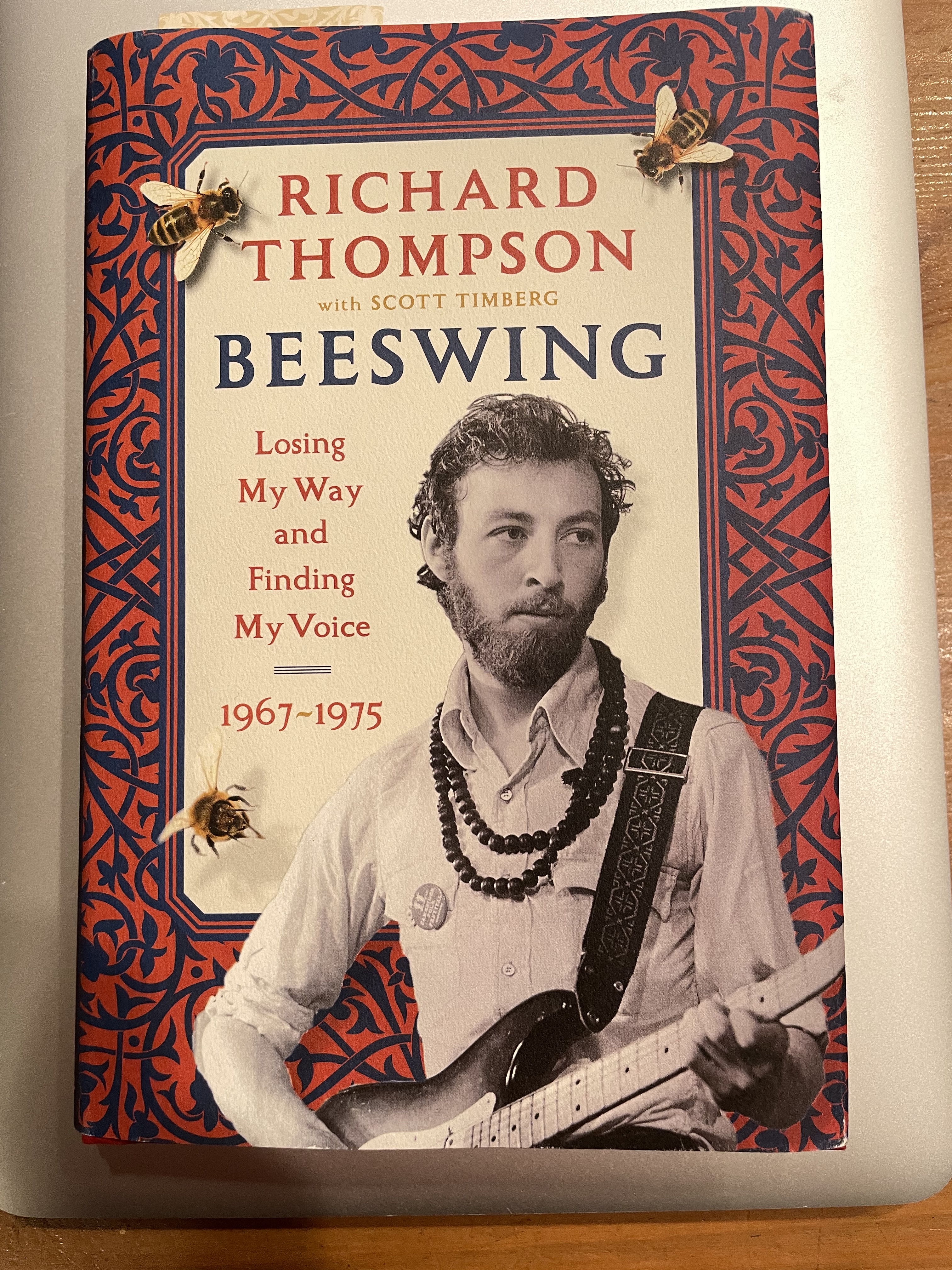
Well, anyone who reads Richard Thompson’s new memoir of his formative years (1967-1975) will likely also be amazed at the range of music that Thompson cites as influences. From French jazz to American blues, from Highland traditional songs to African rhythms, from classical music to British music halls, Thompson seems to have absorbed it all and writes intelligently and knowledgeably about them.
From early on, Thompson and his mates seemed to have had a vision and knew what they, as Fairport Convention, wanted and did not want. They did not want to be like the earlier “British Invasion” bands that were exploring and copying American blues and R&B and often bringing that music back to America. They wanted to use native British themes and rhythms taken from centuries-old British traditions and meld it with rock-and-roll. And thus, Fairport Convention gave birth to what became known as British folk-rock.
While admittedly influenced by Dylan, Joni Mitchell, and other American singer-songwriters and American forms (Thompson claims that what The Band did for “Americana” music with Music from Big Pink was essential in confirming what they wanted to do with British traditional music), Fairport Convention took what it learned and applied it to British themes. For example Thompson took a 15th-century British poem, married it to a 19th century Appalachian tune and electrified it (“Matty Groves”). “Matty Groves” was one of five “reworked” traditional tunes–along with three originals–that appeared on the Liege and Lief album (1969), which is unarguably considered the beginning (and high point) of British folk rock. The claim that Fairport Convention “invented” the form can be appreciated by considering the bands later begun by former members: Pentangle, Frothingay, Steeleye Span.
But Beeswing is more than a musical history. If it were only about music, its appeal would be limited. Richard Thompson’s story is a testament of persistence, resilience and a search for peace, a cultural memoir of the zeitgeist of London and the music world in those frantic years. Its focus on music arises from the fact that after leaving school, Thompson never worked at anything else but as a working musician.
And his is a story that has an almost Shakespearean plot arc.
There is much tragedy: early on, when the band is on the rise and returning from a gig, their van goes off the road killing their driver/roadie, their drummer, and Thompson’s girlfriend. Thompson himself spent a good while in hospital. At another time, a truck missed a sharp turn and plowed through the second floor rooms where he and fiddle-player, David Swarbrick, were living. There were firings–how do you fire Sandy Denny, the greatest vocalist of the day–and there were leavings. Thompson left Fairport Convention to tour with his wife as Richard and Linda Thompson. And then there was the fiery divorce that colored their North American tour.
But there is also–not so much redemption, for he was no more lost than anyone else at that time–but a sense of achieved contentment, of understanding. Much of that is due to his discovery of Sufism, which for Thompson has a “nobility of being … it seem[s] like the way human being should be.”

photo © 2007 by Anthony Pepiton
Anyone who has seen Richard Thompson in the past 20 years know him to be a gentle, humorous, friendly performer. (He is, by the way, also considered one of the finest guitarists in the world. The L.A. Times calls him “the finest rock songwriter after Dylan” and “the best electric guitarist since Hendrix.” And anyone who has attempted to emulate his acoustic guitar playing is often quickly daunted.) Whether playing with the excellent musicians he surrounds himself with or performing solo, Thompson regularly puts on shows that always leave the audience with the feeling that they have just seen/heard something memorable and remarkable.
And it is this genial manner that one observes on stage that
informs the tone and pacing of his memoir.
Richard Thompson seems very much at peace with himself–perhaps this is where the “finding my voice” in the subtitle comes from–and this feeling of contentment permeates his memoir. Although Beeswing deals with a mere nine years–from the time he was 18 years old to when he was 27–they were nine years that helped form one of the trailblazers and icons of modern music.
Shel Silverstein: the Little Library Where the Sidewalk Ends and Jennifer Johnson
A few years ago, in an attempt to be a cutting-edge, high-tech institution, the powers-that-be decided that the school I teach in didn’t need a library. The library is superfluous, they claimed. Students have all the information they need on their phones in their hands. (As if information was all that students need.) And so, quickly, the library was gutted, the librarian dismissed, and the books were donated, destroyed, or “disappeared.” From its ashes rose a Maker-Space and a Learning Commons. (If you are not currently involved in modern education, don’t ask.)

“The Library Where the Sidewalk Ends” on Valentine’s Day
A few colleagues and I couldn’t imagine a school without a library, so we built our own. A “little library” it was, and ones like it appear in neighborhoods, towns and cities throughout the U.S. (I once was at a ribbon-cutting ceremony for such a library on the porch of a bar in Key West, although it was much more of a Key West celebration than a library opening.)
Anyway, the library thrived with people taking and leaving a variety of books, CDs, and even art works.
The library itself was located in an odd place in the middle of campus. There was a cement sidewalk that jutted into a swatch of grass and then just ended. When I would announce new additions to the library, I would refer to it as “the library WHERE THE SIDEWALK ENDS.”
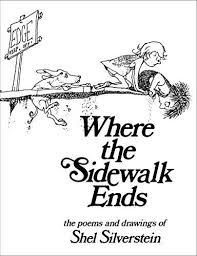 And every student and every adult knew what I was referring to: the delightful first collection of poems by Shel Silverstein that every student had loved as a child and every adult of a certain age remembered reading to his or her own. The poems in Where the Sidewalk Ends are silly, irreverent, charming, and knowing. It’s the silly irreverence that children most love: as if the adult Silverstein—unlike other adults in their world— was clued into the fears, the joys, the silliness, the incomprehension, the absurdity with which they view the world.
Yet, Silverstein was more than a children’s poet. He began as a cartoonist, and a successful one. It was his cartoons that prompted his publisher to suggest a book of poems. He was also a playwright–David Mamet called him his best friend–with over 100 one-act plays under his belt.
And he was a prolific songwriter. He had a number of hits with what could be called novelty
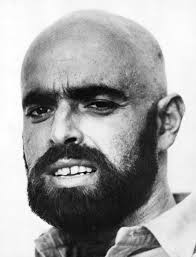
Shel Silverstein
songs: “On the Cover of the Rolling Stone,” “Sylvia’s Mother,” “A Boy Named Sue,” and the “Unicorn” song ( you know, “green alligators and long necked geese… .”) But he also had a solid stable of songs recorded by a slew of people: Dr. Hook and his Medicine Show, Loretta Lynn, Bobby Bare, Belinda Carlisle, Waylon Jennings, Emmylou Harris, Marianne Faithful, Johnny Cash among others. I remember the first Judy Collins’ album I ever bought featured a rousing protest song called “Hey Nelly Nelly.” I didn’t recognize the name at the time, but it was written by someone named Shel Silverstein.
And so it comes to a song I have recently rediscovered. I was buying tickets to see Todd Snider in concert and was looking for the one Todd Snider album I own. I couldn’t find it. So instead I pulled out a Robert Earl Keen album West Textures which features a charming Shel Silverstein song, “Jennifer Johnson and Me.” (Snider mentions a Robert Earl Keen song in one of his own songs which is what originally had driven me to this album.)
Anyway, the song tells the story of a man who finds in an old suit jacket pocket a black-and-white photo (‘three for a quarter”) from an arcade photo booth. The picture is of him and an old girlfriend, Jennifer Johnson. The singer is well into adulthood now, and the photo is of him when he was in late adolescence, sitting with Jennifer Johnson.There is a sweet nostalgia in his memories of their innocence, their hope, and the belief in “forever.”
It’s a sweet song, and I opened up with it on Saturday. I think I will keep it in my set list. Here’s the tune, by Robert Earl Keen:
“It Ain’t Over Yet”

Rodney Crowell
It ain’t over yet, ask someone who ought to know
Not so very long ago we were both hung out to dry
It ain’t over yet, you can mark my word
I don’t care what you think you heard, we’re still learning how to fly
It ain’t over yet
“It Ain’t Over Yet,” Rodney Crowell
I recently discovered this song. It’s a few years old. But it spoke to me…and probably speaks to a number of my friends as well. It’s about second chances. Regrets replaced by hope. About “keeping on keeping on.”
I and a number of people I know and love are either going through some big changes or preparing to. I had one friend quit her job to spend more time with her adolescent daughter, only to be blindsided by her husband’s abandonment. She went looking for anything that could pay the bills. Another lost his job when some powerful people complained about his style of teaching. He landed on his feet, heartbroken but resilient.
Then there are others who are voluntarily leaving their jobs. A teacher friend of mine is quitting to be a full-time photographer. Another returned to Ireland.
They are all of a certain age. I could go on and on.
F. Scott Fitzgerald famously said “there are no second acts in American lives.” Rodney Crowell would dispute that idea. Throughout his song he lists his faults and his regrets, his successes and failures, his highs and his lows. But he insists in the “hook” of the chorus: it ain’t over yet. And by the end of the song, he’s in a good space.
I am quitting my teaching job in June. I quit once before but came back to it eleven years later. I’ve been doing it a long time.
A lot of people ask me worriedly what am I going to do with myself. I have plenty to do. I have my writing, which has been on hold for a few years–a novel needing a final draft, dozens of poems and short-stories to polish. (There’s a reason this is first post in 2019.) I have my painting, which I had been working hard on and then just ceased.
And then there is my music. (Click here for future show dates.)
I’ve played about 35 gigs in 2019 and I am enjoying them and I think I’m getting better with each of them. I started out doing only covers but now am including 5 or 6 originals in each show. As I said, I think I am getting better.
And at my gig today, I am covering the Rodney Crowell song, “It Ain’t Over Yet.” I think of it almost as a fight song, fist in the air defiant: IT AIN’T OVER YET.
Here’s a wonderful video of Rodney Crowell performing with John Paul White and Roseanne Cash. I don’t know about you, but I think the words speak to a lot of us.
Seeing Things and then “Seeing Things”
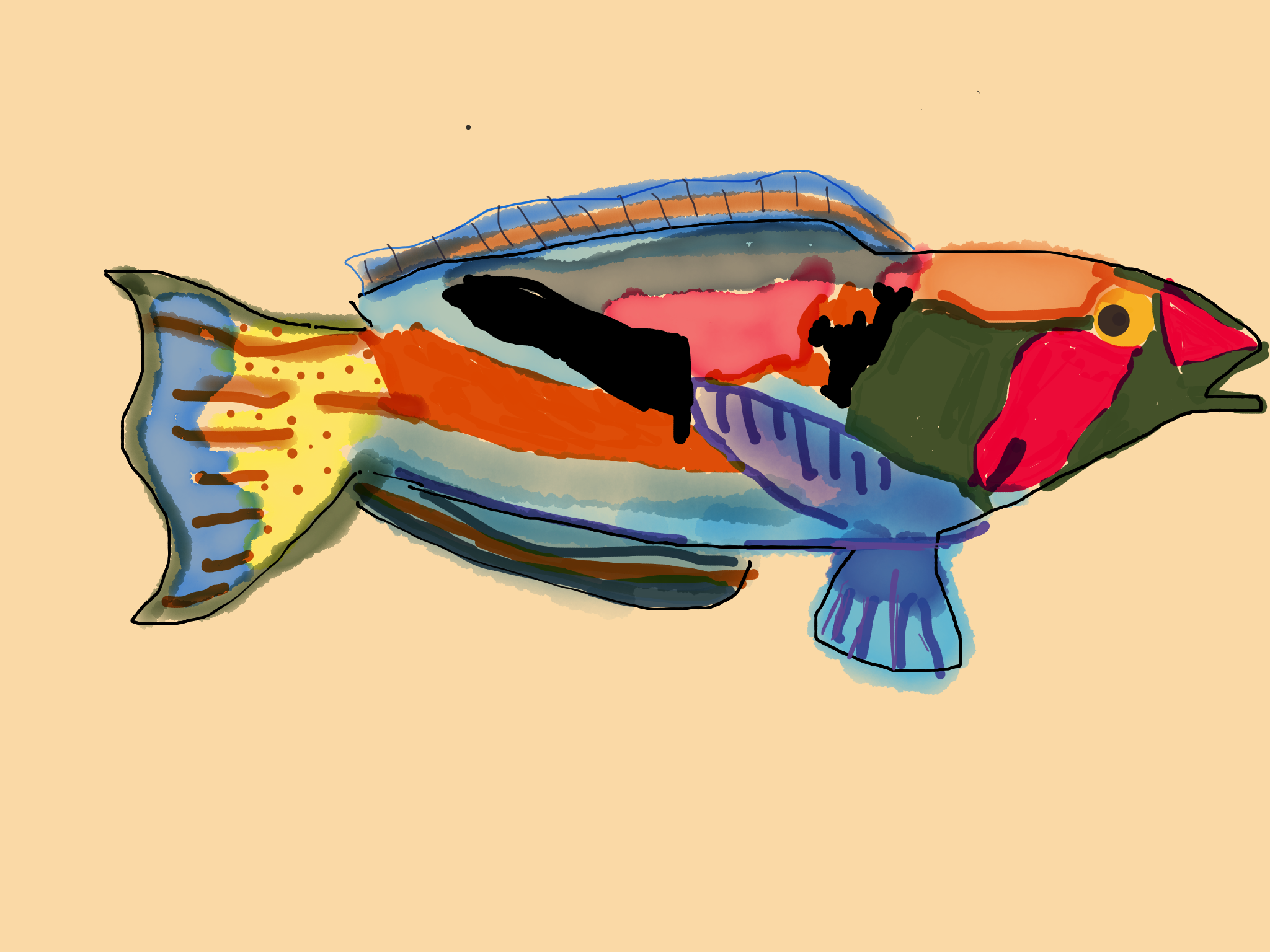
“Fish” by jpbohannon, 2017
One of Seamus Heaney’s later collections of poetry was entitled Seeing Things, and indeed the Irish poet was a master of detailed observation. His career was built on seeing and noticing things.

Andrew Barker, in his on-line lecture on Heaney’s early poem “Digging,” comments on the phrase “seeing things,” saying that we usually mean one of two things when we say it.
The first is what he is emphasizing in Heaney’s poems, the art of closely observing detail: in the case of “Digging,” the sound of a spade sliding through gravel, the squelch of the turf being sliced from the bog, the coolness of potatoes fresh from the ground.
But, Barker points out, there is also another meaning of someone “seeing things”– where it does not refer to someone with keenness of perception, but to someone who sees things that are not there. “He’s seeing things” quite often means that someone is seeing things that are not visible to others, someone who is delusional or fantasizing.
And then Barker names the poet William Butler Yeats as one who sees things that are not there.
I’ve let that percolate in my mind for a while. And then I thought of Yeats’ poem, “The Song of Wandering Aengus,” perhaps my favorite poem of all and one that I can recite at will.
The poem goes like this:
The Song of Wandering Aengus
I went out to the hazel wood,
Because a fire was in my head,
And cut and peeled a hazel wand,
And hooked a berry to a thread.
And when white moths were on the wing,
And moth-like stars were flickering out,
I dropped the berry in a stream
And caught a little silver trout.
When I had laid it on the floor
I went to blow the fire a-flame,
But something rustled on the floor,
And someone called me by my name.
It had become a glimmering girl
With apple blossom in her hair
Who called me by my name and ran
And faded through the brightening air.
Though I am old with wandering
Through hollow lands and hilly lands,
I will find out where she has gone
And kiss her lips and take her hands;
And walk among long dappled grass,
And pluck till time and times are done,
The silver apples of the moon,
The golden apples of the sun.
Apart from the subtle rhymes (“wand” and “wood” or “moon” and “sun”) or the beautiful images of “moth like stars” and “a glimmering girl/with apple blossom in her hair,” the poem is notable because Yeats is seeing things that are not necessarily visible.
(Do I need to mention that a silver trout transforms into a human female as the speaker turns to “blow the fire a-flame.”)
And yet there is a larger truth sitting on that cottage floor and running out the door. A larger truth that has the speaker spending his lifetime chasing that vision–and believing that he will catch it.
I used the word “vision” purposefully, for it is in that unseen vision that Yeats reveals a truth, a truth about passion, aspiration, dreams and goals. It is the dream of what one wants and the dedication of following that dream, of chasing that dream “till time and times are done.” For it is in chasing the dream–not in catching it– that a full life resides.
Yeats saw that truth…and saw it in a way not visible to most. (Never mind, that Yeats actually spent much of his life chasing after his “glimmering girl,” Maude Gonne. That’s beside the point!)
Certainly, we are all not going to fully realize our dreams; we will not all achieve what we set out to do. And often times not attaining what we thought we wanted may be the best thing to happens to us. But the chase must continue –and it defines our lives. If we are not looking forward–through “hollow lands and hilly lands”–if we have given up on that “glimmering girl,” then we are merely alive.
As I have said, this is one of my favorite poems–and it has often been put to music. If you search YouTube for “The Song of Wandering Aengus,” you will find scores of versions done by everyone from Christy Moore or The Waterboys to Dave Van Ronk and Judy Collins. Donovan did a version, as did Don MacLean on banjo.
Anyway, below is my favorite version, by Christy Moore. Give it a listen…
 j. p. bohannon