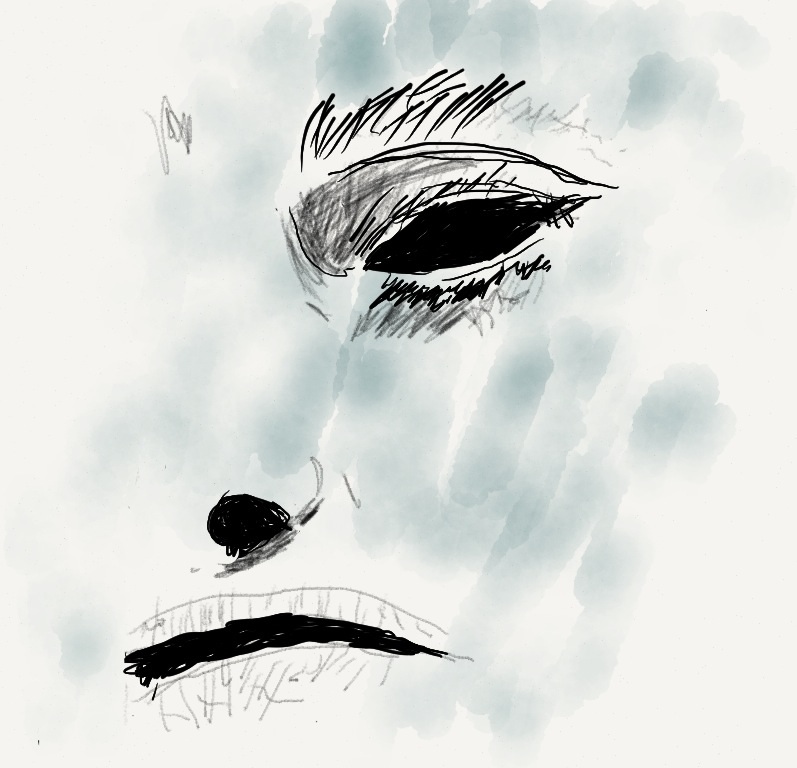
illustration 2014 by jpbohannon
A few weeks back I saw a photograph of Jonathan Letham’s favorite books. Among the titles on the row of spines, I noticed a book by Leonard Cohen called Beautiful Losers.
Now, I am a big Cohen fan. I listen to and play his music frequently–both new and old– and I am well aware of his poetry, so I assumed Beautiful Losers was one such poetry collection.
I was wrong. It was a novel, first published in 1964–several years before the release of his first album, The Songs of Leonard Cohen.
And so I thought, what the hell.
Beautiful Losers is very much a work of its times. Frenetic and speeding. Erotic and rambling. Big-hearted and narcissistic.
It is the story of an unnamed narrator whose other two partners in a odd love-triangle –his wife and an elusive shaman-like man named F.–are dead. (His wife committed suicide in the unconventional way of sitting at the bottom of an elevator shaft and having the elevator crush her. F. is a member of the Canadian Parliament.) The other object of his love/lust is also dead but she’s been dead for 300 years and is up for canonization by the Catholic Church, Catherine Tekakwitha, the virgin of the Iroquois.
There are betrayals and reversals and climaxes and re-unions. There is sex and loneliness and more sex. There is 17th-century genocide and 20th-century nationalism and separatism. (This is early 1960s Montreal, after all.) There are Joycean lists and Henry Miller-like rhapsodies, but all and all the whole thing seemed to me to be very much a part of the 60’s gestalt. (One of my favorite scenes is when the naked narrator watches his wife and her/his lover shoot up, only to discover later that they are injecting an odd mix of heroin and Lourdes water. He found the advertisement/receipts for the Lourdes water in his wife’s dresser drawer)
The whole thing reminded me more of late Ken Kesey or even Gilbert Sorrentino than it reminded me of Joyce or Miller (which connection the book jacket blurbs go on and on about). The attempt seemed old and tired…but maybe because the energy of those times seems so old these days as well. True, it is a pastiche of Joyce–but then again how many young artists were trying the same at the time.
But more than anything else, Beautiful Losers is the announcement of a unique and individual voice. That that voice ultimately decided to be heard through poetry and song rather than through fiction was a decision that the artist himself made.
And I for one believe it was a right decision.
In a very early poem, Cohen wrote:
So you’re the kind of vegetarian
Who only eats roses
Is that what you meant
with your beautiful losers?”
I’m not sure if this is where Cohen got the title for his novel or precisely what these lines might mean, but it reflects the word usage and mindset of the novel.
 j. p. bohannon