Book Review: Colorless Tsukuru Tazaki by Haruki Murakami

colorless I used to think that it was only Americans who were so caught up with the experience of  “High School.”  I had believed it was an American construct, an over-idealized rite of passage that had spawned too many bad television series and “coming of age” films. I had believed it was strictly an American thing.

I’ve known many men for whom those “high school” years were the very pinnacle of their lives. It is those days that they keep referring to, those days by which they measure all others.  I mean I know men in their 40s and 50s, in their 60s and 70s, even in their 80s whose conversation invariably turn to the high-jinks and glories of their high-school days.

But I was wrong.

Haruki Murakami’s novel Colorless Tsukuru Tazaki and His Years of Pilgrimage revolves around five Japanese high school friends and the long-lasting effects of the decisions they made when they were twenty years old.  They are now in their mid-thirties; two are living in their hometown, one has moved to far-away Finland, one to cosmopolitan Tokyo, and the fifth one is dead, murdered.  The one-time connectedness of these five high-school friends haunts the hero, Tsukuru Tazaki.

Tsukuru–whose name is the only one the five which does not have a color attached and who believes himself to be “colorless–was abruptly dropped from the group when he was a sophomore in college in Tokyo. And he never was given an explanation, just the order to never contact them again.  The separation caused Tsukuri months of suicidal depression and then years of self-doubt, wonder, and the inability to relate to people. For Tsukuru, the five high school friends were an unprecedented harmony of spirits.  And yet there were several cracks in this group which he was too nice to notice.

Tsukuru’s name in Japanese means “one who makes things,” and indeed, that’s what he does. He makes railroad stations.  And in Japan, railroad stations are a very big deal and making connections is an intrinsic part of Tokyo life. Yet his treatment by his high-school friends has left him unable to make connections with people. There have been several romantic liaisons, but nothing serious and nothing he wished to pursue further. There was a friendship–tinged with a touch of homo-eroticism–that ended as abruptly as his friendship with his high-school mates. He was simply abandoned one day, his friend moving away from Tokyo with no forewarning and no intention of staying in touch.

And so we follow “colorless” Tsukuru as he tries to make his way in the world.

I needed a novel like Colorless Tsukuru Tazaki. There had been too few novels lately that gripped me from the beginning and made me read obsessively until I was finished. And Murakami has done that for me before. While I can’t remember the exact plots of his Kafka on the Shore or NorwegianWood, I do remember the obsessiveness with which I read them.  I can remember jotting down notes, following up allusions, taking notes. I remember protagonists who were like Tsukuru Tazaki: thoughtful, introspective, aware young men, burdened by what they cannot change in the past and fearful of the uncertainties of the future. And I remember getting caught up in their sadness and their serious attempts to make sense of their world. Murakami’s novels are both thoughtful and fascinating, outwardly exotic and inwardly philosophic.

And also I remember the fascinating side-trips of information. In Colorless Tsukuru Tazaki, there is an odd but brief discussion of the genetic dominance of a sixth finger; there is a continual look at the music of Listz, particularly the “Le Mal du Pays” section of his suite “The Years of Pilgrimage.”  It is a piece that the young murdered friend played often when they all were together, and it is a record that his friend Haida had coincidentally left at Tsukuru’s apartment before he had left him. Towards the end of the novel, Tsukuru visits one of his old high-school friends–still seeking enlightenment as to why he was so unceremoniously dropped–and the friend has the piece in her pile of CDs. The two reach some reconcilliation listening to Listz.

Watching the trains

Watching the trains

Watching the people

Watching the people


And then finally there is the subject of trains and of Tokyo’s public transportation. When Tsukuru needs time alone, when he is filled with angst and confusion, he goes to the train platforms and watches the trains and the people. There is a certain peace he finds in the uniformity and the precision which such a place exhibits, against what seems impossible odds. (Shinjuko Station handles 3.5 million passengers a day!)

I had skipped Marukami’s novel before this, 1Q84, for a variety of reasons. It was a mistake on my part and one I will rectify shortly.


You can listen to the very recording of Listz that Tsukura played on his stereo in his apartment here:

Heaney and Plath: Two Poems about blackberry picking

Blackberries in a white bowl.

Blackberries in a white bowl.

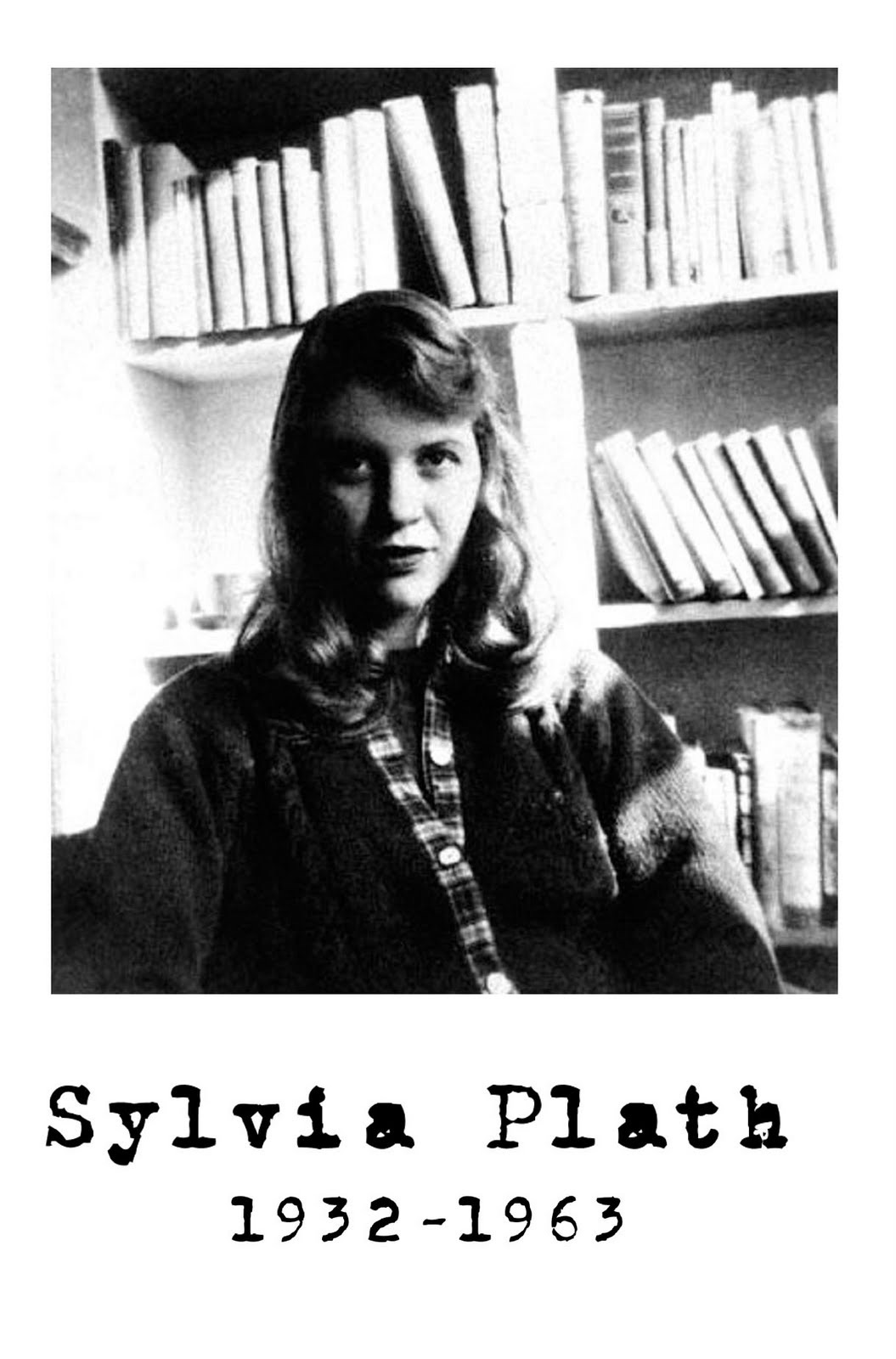
We read two poems about Blackberries the other day. One by Seamus Heaney, one by Sylvia Plath. While both are dark, the latter is much darker. I did not tell them the facts of Plath’s life or how near in time the poem was written before her suicide. I will let them find that out on their own. (We try to downplay the biographical.)

Here is Heaney’s poem:

Blackberry-Picking by Seamus Heaney

Late August, given heavy rain and sun
For a full week, the blackberries would ripen.
At first, just one, a glossy purple clot
Among others, red, green, hard as a knot.
You ate that first one and its flesh was sweet
Like thickened wine: summer’s blood was in it
Leaving stains upon the tongue and lust for
Picking. Then red ones inked up and that hunger
Sent us out with milk cans, pea tins, jam-pots
Where briars scratched and wet grass bleached our boots.
Round hayfields, cornfields and potato-drills
We trekked and picked until the cans were full
Until the tinkling bottom had been covered
With green ones, and on top big dark blobs burned
Like a plate of eyes. Our hands were peppered
With thorn pricks, our palms sticky as Bluebeard’s.

We hoarded the fresh berries in the byre.
But when the bath was filled we found a fur,
A rat-grey fungus, glutting on our cache.
The juice was stinking too. Once off the bush
The fruit fermented, the sweet flesh would turn sour.
I always felt like crying. It wasn’t fair
That all the lovely canfuls smelt of rot.
Each year I hoped they’d keep, knew they would not.

And here is Heaney reading it:

What we have are the thrills and joys of nature’s bounty, of love, of lust, followed by its ultimate disappointment, and capped by the human facility to continue even with the knowledge that disappointment is almost always assured.

But that last line is hopeful despite the odds: “Each year I hoped they’d keep, knew they would not.”

*     *     *     *     *     *

Hopeful is what Sylvia Plath’s poem is not! It too holds the gathering of blueberries in awe, is humbled by their abundance and their promise, but in the end there is nothing. Though that should not be a surprise. The first line itself drums in that nothingness, repeating the words “nothing,” “nothing,” “nobody.”

Blackberrying by Sylvia Plathimage

Nobody in the lane, and nothing, nothing but blackberries,
Blackberries on either side, though on the right mainly,
A blackberry alley, going down in hooks, and a sea
Somewhere at the end of it, heaving. Blackberries
Big as the ball of my thumb, and dumb as eyes
Ebon in the hedges, fat
With blue-red juices. These they squander on my fingers.
I had not asked for such a blood sisterhood; they must love me.
They accommodate themselves to my milkbottle, flattening their sides.

Overhead go the choughs in black, cacophonous flocks—
Bits of burnt paper wheeling in a blown sky.
Theirs is the only voice, protesting, protesting.
I do not think the sea will appear at all.
The high, green meadows are glowing, as if lit from within.
I come to one bush of berries so ripe it is a bush of flies,
Hanging their bluegreen bellies and their wing panes in a Chinese screen.
The honey-feast of the berries has stunned them; they believe in heaven.
One more hook, and the berries and bushes end.

The only thing to come now is the sea.
From between two hills a sudden wind funnels at me,
Slapping its phantom laundry in my face.
These hills are too green and sweet to have tasted salt.
I follow the sheep path between them. A last hook brings me
To the hills’ northern face, and the face is orange rock
That looks out on nothing, nothing but a great space
Of white and pewter lights, and a din like silversmiths
Beating and beating at an intractable metal.

The speaker, who is traveling downward on a path lined with blackberry bushes, believes that there is something at the end–the sea. Earlier, when she sees a swarm of flies satiated with blackberry juice she states that the flies “believe in heaven.” (Is her statement that “they believe in heaven” an implication that she does not?)

Perhaps the flies believe they have found it.

For the speaker, however, no reward awaits. The sea–to which she had looked forward to throughout her journey–is a pale wasteland. Again there is the repetition of the word “nothing”: “…that looks out on nothing, nothing but a great space” and from within this void she hears the “Beating and beating of an intractable metal.”

That ‘beating and beating” reminds me of the sea in “Dover Beach” where:

you hear the grating roar
Of pebbles which the waves draw back, and fling,
At their return, up the high strand,
Begin, and cease, and then again begin,
With tremulous cadence slow, and bring
The eternal note of sadness in.

It’s that eternal note of sadness that Plath’s speaker also hears, an empty, pale silence. After her walk, after her hoping to be loved, after her wanting a heaven, she comes to this cliff. And this is what she hears.

Perhaps we’ll do “Dover Beach” next.

Series: The Deadly Sins–Sloth


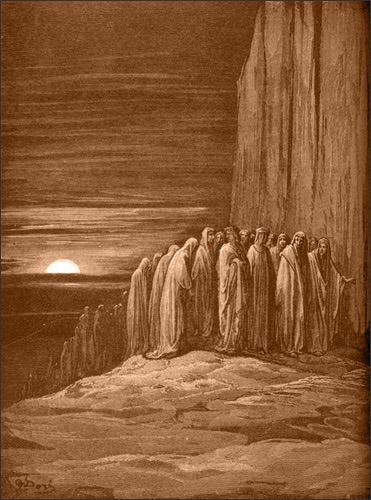
Gustave Doré Slothful Penitents (Abbot of St. Zeno)

Gustave Doré
Slothful Penitents (Abbot of St. Zeno)

“In the world sloth … is the sin that believes in nothing, cares for nothing, seeks to know nothing, interferes with nothing, enjoys nothing, loves nothing, hates nothing, finds purpose in nothing, lives for nothing and remains alive only because there is nothing it would die for. We have known it far too well for many years.”

Dorothy Sayers, “The Other Six Deadly Sins”

Series: The Deadly Sins–Greed

"Gordon Gecko" Silkscreen 2015 by jpbohannon

“Gordon Gecko”
Silkscreen 2015 by jpbohannon

But let me briefly make my purpose plain,
I preach for nothing but for greed of gain,
And use the same old text, as bold as brass,
Radix malorum est cupiditas.

Chaucer, “The Pardoner’s Tale”

Series: The Deadly Sins–Lust

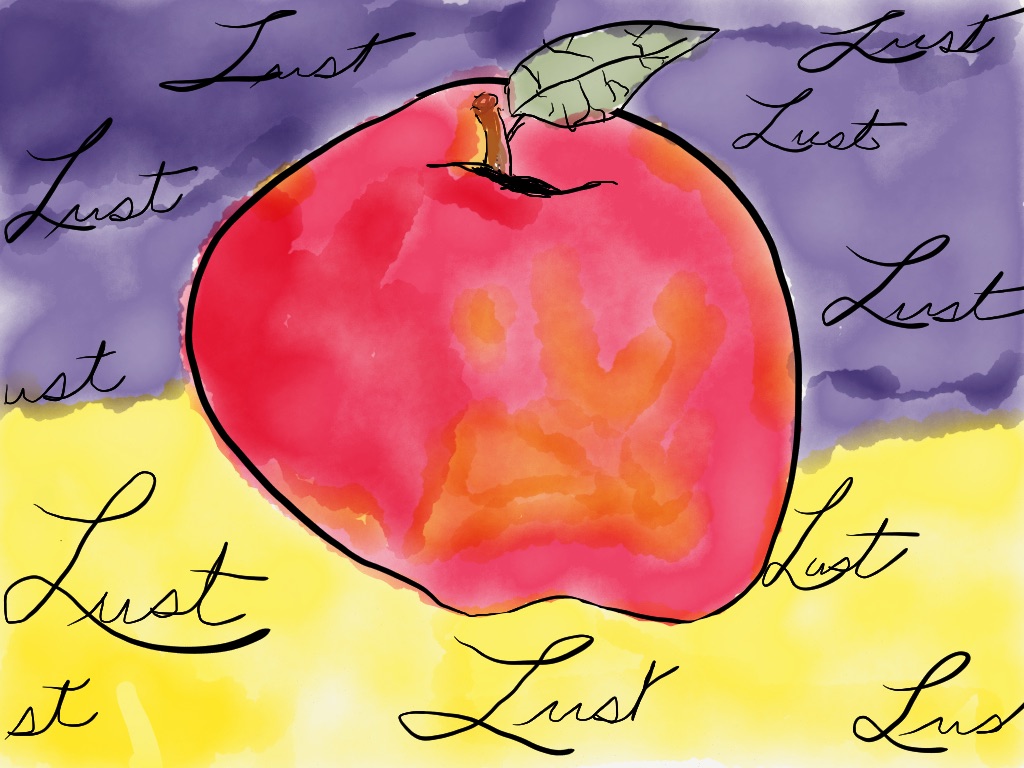
"Lust" illustration 2015 by jpbohannon

“Lust”
illustration 2015 by jpbohannon

“And there we lay. Not speaking, not stirring until finally I moved my face across hers, and kissed her. And at last the age-old ritual possessed us, and I bit and tore and held her, round and round. . . . Later there would be time for the pain and pleasure lust lends to love. Time for body lines and angles that provoke the astounded primitive to leap delighted from the civilised skin, and tear the woman to him. There would be time for words obscene and dangerous.”

Josephine Hart, Damage

Series: The Deadly Sins–Anger

"Anger" illustration 2015 by jpbohannon

“Anger”
illustration 2015 by jpbohannon

“One night I accidentally bumped into a man, and perhaps because of the near darkness he saw me and called me an insulting name. I sprang at him, seized his coat lapels and demanded that he apologize. He was a tall blond man, and as my face came close to his he looked insolently out of his blue eyes and cursed me, his breath hot in my face as he struggled. I pulled his chin down sharp upon the crown of my head, butting him as I had seen the West Indians do, and I felt his flesh tear and the blood gush out, and I yelled, “Apologize! Apologize!” But he continued to curse and struggle, and I butted him again and again until he went down heavily, on his knees, profusely bleeding. I kicked him repeatedly, in a frenzy because he still uttered insults though his lips were frothy with blood. Oh yes, I kicked him! And in my outrage I got out my knife and prepared to slit his throat, right there beneath the lamplight in the deserted street, holding him by the collar with one hand, and opening the knife with my teeth — when it occurred to me that the man had not seen me, actually; that he, as far as he knew, was in the midst of a walking nightmare! And I stopped the blade, slicing the air as I pushed him away, letting him fall back to the street. I stared at him hard as the lights of a car stabbed through the darkness. He lay there, moaning on the asphalt; a man almost killed by a phantom. It unnerved me. I was both disgusted and ashamed.”

Ralph Ellison, Invisible Man

Series: The Deadly Sins–Envy

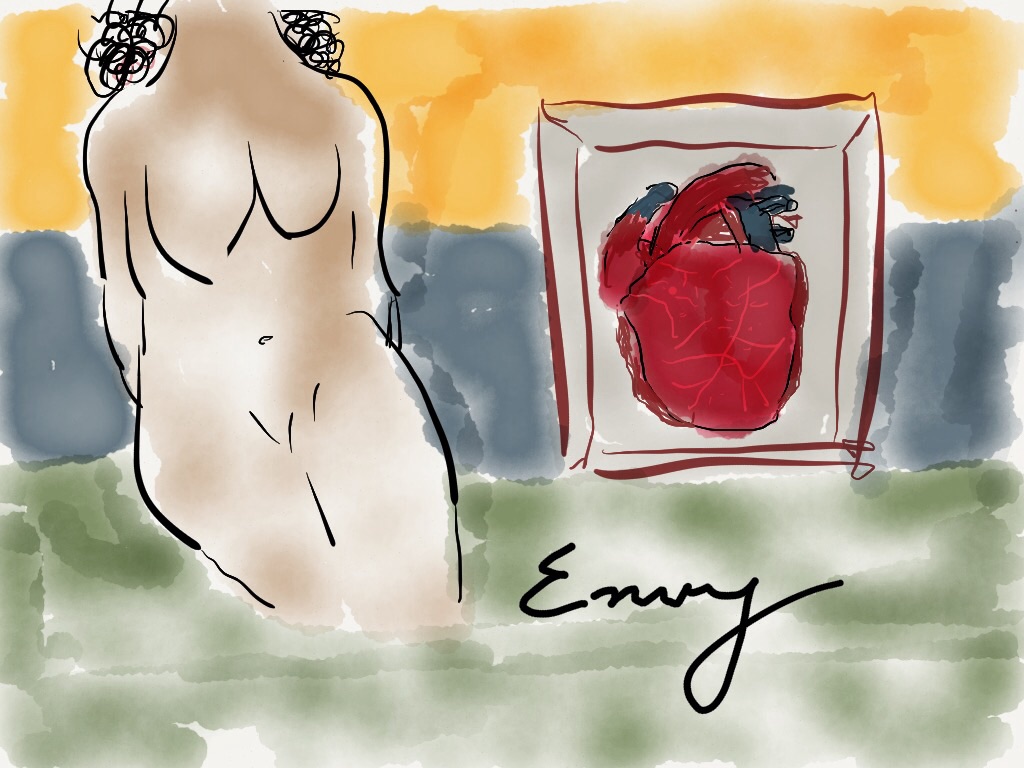
"ENVY"   illustration 2015 by jpbohannon

“ENVY”
illustration 2015 by jpbohannon

“In this dream, though, he burned with desire for a woman. It wasn’t clear who she was. She was just there. And she had a special ability to separate her body and her heart. I will give you one of them, she told Tsukuru. My body or my heart. But you can’t have both. You need to choose one or the other, right now. I’ll give the other part to someone else, she said. But Tsukuru wanted all of her. He wasn’t about to hand over one half to another man. He couldn’t stand that. If that’s how it is, he wanted to tell her, I don’t need either one. But he couldn’t say it. He was stymied, unable to go forward, unable to go back.”

Haruki Murakami
Colorless Tsukuru Tazaki and His Years of Pilgrimage

Review: My Face for the World to See by Alfred Hayes

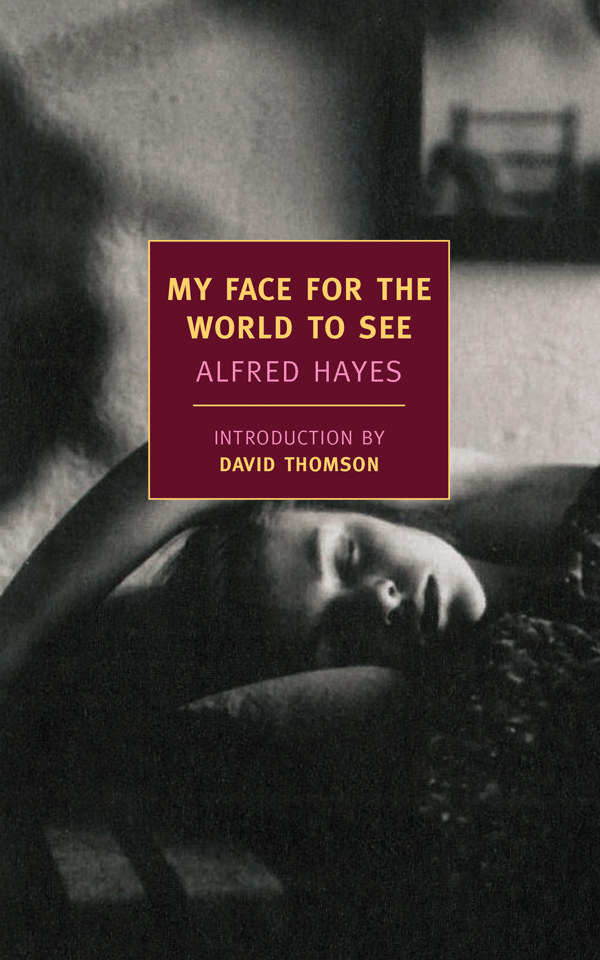
Book cover of the NYRB edition of My Face for the World to See

Cover for the NYRB edition of My Face for the World to See

The narrator of Alfred Hayes’ novel works in Hollywood. That is all we know. He is semi-separated from his wife; he lives alone for months at a time in L.A. and for months in New York with his wife, though his marriage, from his perspective,  is a failed and sad relationship.

In fact, the narrator finds his life and work as a failure. He sees no value in the work he does, although, as he says, the studio pays him handsomely. (He states that he is a “writher” rather than a “writer.”) He condescendingly (and somewhat snobbishly) observes the people around him, their vanities and egos, their manipulating and positioning, their theatrics and ambitions.

At a party one night, the narrator–bored with this gathering at an expensive beach house–steps outside for a smoke and sees a young woman walk into the sea. When she goes under, he rescues her and resuscitates her. And thus begins a relationship that he did not want to happen. That the woman is disturbed is revealed gradually, and she is much more than simply a young girl with unrealized Hollywood dreams.

Initially, it is her cynicism towards the business, towards love and towards life that draws him to her, that allows himself to give in to what he is also trying to hold back from. And as the two become more closely entwined–and as more of her anxieties are displayed–it becomes apparent that the two of them are very similar, a realization that is devastating to the narrator. In truth, it may be that it is the narrator whose face is now “for the world to see.”

The narrator’s deliberate and reflective thinking, his cool, detached observations, his knowing emotional cover-up, all work to create a modern anti-hero, an existentialist who is “forced” to live and work in a world that celebrates the superficial and is built basically on the dissemination of lies. It is a taut and harrowing read, a tale of self-discovery, acceptance, and angst.

My Face for the World to See was originally published in 1958. At the time, Hayes was more known as a scriptwriter. He had twice been nominated for an Oscar, had written successful screenplays for films directed by Fritz Lang, John Huston, and Fred Zinnemann, and also wrote many pieces for television including Alfred Hitchcock Presents and The Twilight Zone.  As a novelist, he was most celebrated for The Girl on the Via Flaminia,  and as a poet, for “Joe Hill” which was later put to music and became an anthem for workers’ rights. (Joan Baez famously sang it at Woodstock. See below.)

The New York Review of Books re-issued My Face for the World to See in 2013, with an introduction by the film critic, David Thomson.  But this novel is by no means a Hollywood novel. Apart from the brief description of the initial party where the narrator rescues the suicidal young woman, there is no glamor, no behind the scenes peeks, no tabloid scandals. There is simply a couple of apartments and the narrator’s self-examination and his lover’s revealed past.  It is discrete yet raw, fast-paced yet thoughtful.  It is memorable novel that deserves this re-issue.

And here’s a treat. A sweetly innocent Joan Baez singing Alfred Hayes’ “Joe Hill” at Woodstock. Enjoy:


Review: “The Heart of the Heart of the Country” by William H. Gass

"I dreamed my lips would drift down your back like a skiff on a river." Gass "in the heart of the heart of the country." P.179

“I dreamed my lips would drift down your back like a skiff on a river.” William H. Gass “In the Heart of the Heart of the Country.” illustration 2014 by jpbohannon

Because of some administrative hic-cough, I was sent two copies this weekend of the same book: William H. Gass’ In the Heart of the Heart of the Country. I had not heard of it, although I recognized the name of the author (and immediately confused him with the novelist, William Gaddis). Having two copies, I gave one to my friend Tim Dougherty, who very well may be the best-read person I know.

Here was the text he sent me later that day:

John,

Thanks so much for the book. Gass’ “In the Heart of the Heart of the Country” is a seminal postmodern short story. The collection is one of my favorites, and the new edition blows my flea market paperback out of the water. And now I can throw that one away!

Who’d have thunk it.

So, on my train-ride to work the next morning, I read “In the Heart of the Heart of the Country.”  The story is the final piece in a collection of the same name that includes two novellas and three short stories, but I went to the last story right away.
And it is everything that Tim’s message had intimated.

First it is broken into short chunks with headings such as “People” or “Weather” or “Places” or “My House.” It is a sort of stream of consciousness, movie-like postcard of a town in Indiana and the people who live there, and at the same time it is a self-portrait of the narrator who has lately lost love (through death or separation I am unsure) and who is both crushed and buoyed by the vastness of the Midwest.

But it is the language that is so remarkable, that stands out yet does not make a show of it. There are exquisite lists. This is the narrator describing a neighbor’s basement:

...stacks of newspapers reaching to the ceiling, boxes of leaflets and letters and programs, racks of photo albums, scrapbooks, bundles of rolled-up posters and maps, flags and pennants and slanting piles of dusty magazines devoted mostly to motoring and the Christian ethic. I saw a bird cage, a tray of butterflies, a bugle, a stiff straw boater, and all kinds of tassels tied to a coat tree.

And here he is describing the town itself in a section called “Vital Data”:

There are two restaurants here and a tearoom. two bars. one bank, three barbers, one with a green shade with which he blinds his window. two groceries, a dealer in Fords. one drug, one hardware, and one appliance store. several that sell feed, grain, and farm equipment. an antique shop. a poolroom. a laundromat. three doctors. a dentist. a plumber. a vet. a funeral home in elegant repair the color of a buttercup. numerous beauty parlors which open and shut like night-blooming plants. …

But it is his memories of the lost love and of lost childhood, the feelings of being trapped in a dying world, and his description of the decadent monotony of small town life that resonates the most, in which the fiction writer becomes one with the poet, and where the language becomes as integral to the story as the story itself, where inside and outside, the public and the private, that which is thought and  that which is felt, all merge into one.

It is majestic and memorable.

And I can’t wait to finish the rest of the collection.

Book Review: Echo’s Bones by Samuel Beckett

Samuel Beckett Illustration 2014 by jpbohannon

Samuel Beckett
Illustration 2014 by jpbohannon

Coincidences are no more than that, though I am very well aware of the research on them. (Freud once stated that  there were no such things as accidents, but I believe coincidences to be a lesser, less conscious form of accident. In the latter, the subconscious is directing you towards what might seem to be a accident but is actually rooted in one’s memory, suppressed or on the surface. Coincidence, on the other hand, is simply the awareness of a multiplication of events, of which one wasn’t completely cognizant or prepared for beforehand.)

So anyway, I attended an intense two-week workshop on education-on assessments and feedback and good old Bloom’s taxonomy. However, much of it was rooted in the teachings of Augustine–and much of the feedback I received  referenced Dante.

Before the workshop, however, I had bought a book, Echo’s Bones by Samuel Beckett. I knew it was something I would need to concentrate on–a 52 page short-story, accompanied by 58 pages of annotations, and complete with an introduction,  copies of the original typescript, letters from Beckett’s publishers, and a bibliography. This was not simply reading a short story, but sort an academic adventure. The type of diversion I hadn’t had in a while.

Cover of Samuel Beckett's Echo's Bones

Cover of Samuel Beckett’s Echo’s Bones

And so I waited until my Augustinian-laced workshop was over.

And then I began reading.  After I got  through the introduction and  into the story I began to smile. It was Augustine all over again with a large dollop of Dante.  In the first three pages alone there are five allusions to Augustine and four allusions to the Divine Comedy. And the main character, Belacqua, is given the nickname, Adeodatus–the name of Augustine’s illegitimate son.

So why all this hubbub about a short story that was written more than eighty years ago?  Well, Beckett had written a collection of interrelated short stories entitled More Pricks than Kicks.  Right before publication, however,  his publisher asked if Beckett would add a final story to the collection, to fatten it up, so to speak.

Beckett agreed, except there was one problem.  All the characters in the collection were now dead.  And so Beckett wrote “Echo’s Bones,”  which told the story of the dead Belacqua’s return to life in his short interim between death and eternity.  The publisher rejected the story, stating that it was too dark, too odd, and that it would make readers shudder.  And so More Pricks than Kicks was published as it was originally intended, and “Echo’s Bones” was assigned to the crypt of oblivion.  Until now.

The title refers to the mythological figure Echo, who tragically fell in love with Narcissus. (He was never a good catch for any woman. Too much competition with himself alone!)  Anyway, when she died, all that was left were her bones and her voice. Thus, we have “Echo’s Bones.”  If the editors had only known how perfectly the story’s title would foretell the nature of Beckett’s future work: a work of spotlighted voices–often disembodied (Krapp’s Last Tape), often body-less (HappyDays), and often flowing in a rushing stream (Ponzo’s soliloquy in Godot).

The plot is secondary to the wordplay, the erudition, the humor, and Beckett’s world view. Quickly: the dead Belacqua suddenly finds himself on a fence in a empty Beckettian landscape. A woman arrives and brings him to Lord Gall, a giant of a man with a paradisaical estate which he will lose because he is sterile and lacks a male heir. He convinces Belacqua  to bed his wife, in hope of an heir, but–in a twist of telescoped time–the woman gives birth to a daughter.  The story concludes with Belacqua conversing with his own grave digger (from an earlier story) and searching his own coffin for his body. The story ends with a familiar phrase in Beckett’s work and letters: “So it goes in the world.”  These are the last words of “Echo’s Bones,” but they are also the last words of “Draff,” the final story in the version of More Pricks than Kicks that was ultimately published.  A phrase that Beckett had picked up from the Brothers Grimm story “How the Cat and the Mouse Set up House,” it is a phrase that encapsulates Beckett’s life view and one that he used often even in his personal correspondence.

While I respect and love Beckett’s drama, I particularly enjoy his early fiction. Still under the influence of Joyce, Beckett, at this time, was  full of his verbal powers, delighting in the wordplay, and confident in his free association. It is always, for me, a treat to read.