Quote # 52: DFW defining “Lynchian”

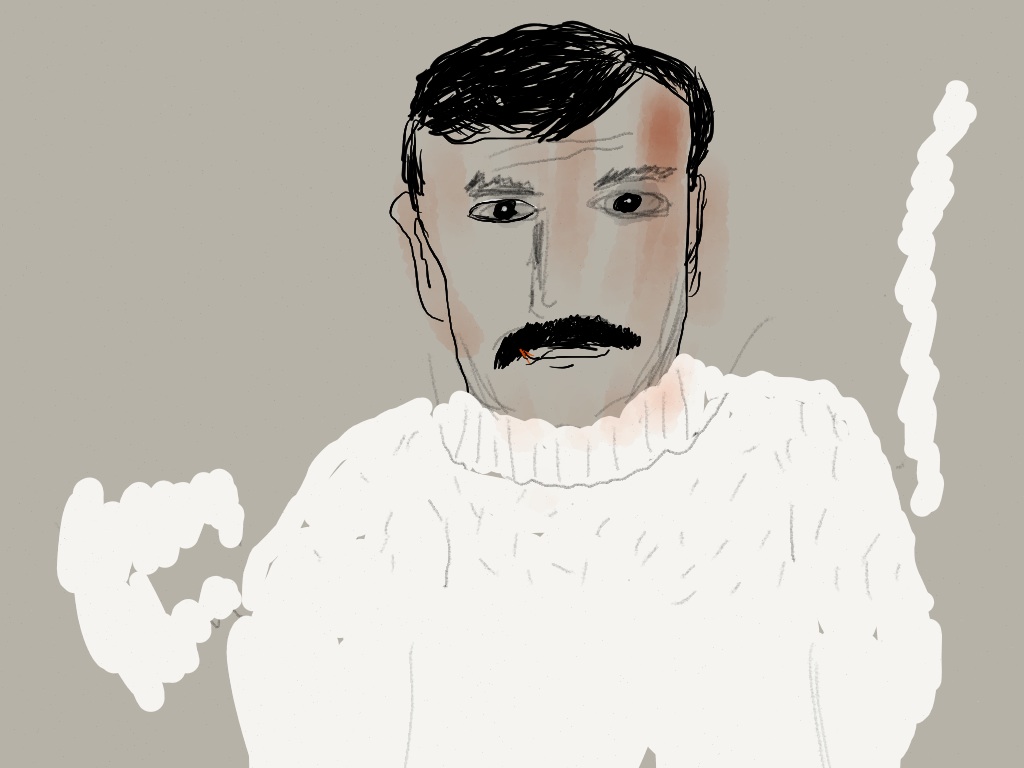
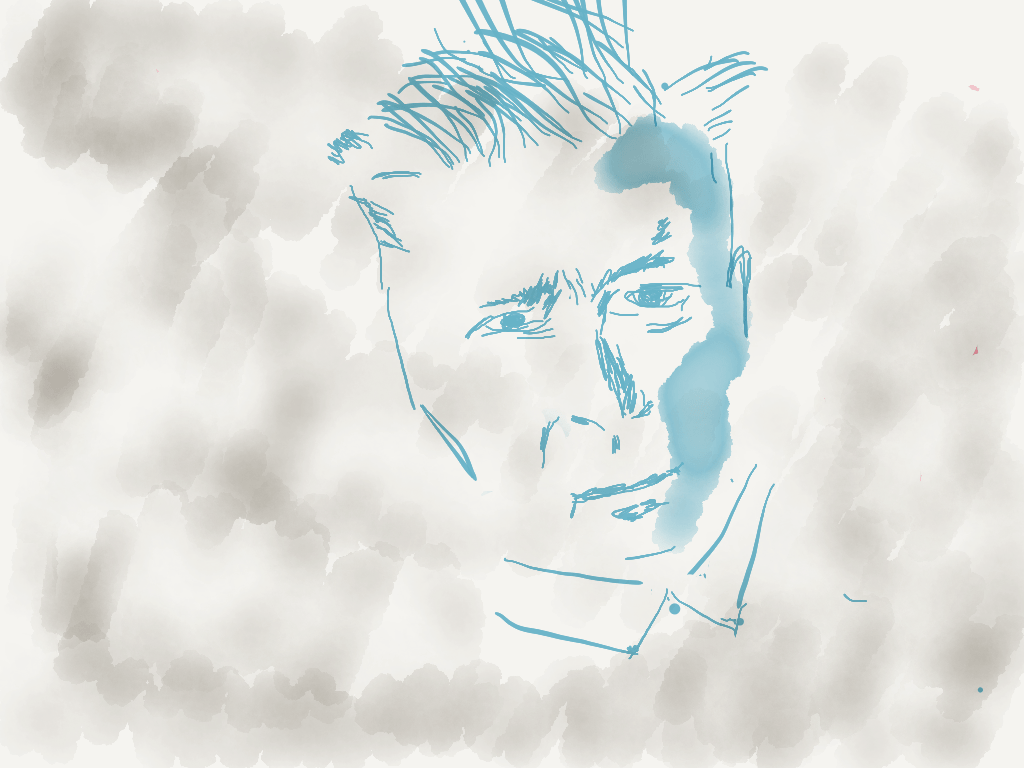
“David Lynch” illustration 2016 by jpbohannon


“A good 65% of the people in metropolitan bus terminals between the hours of midnight and 6:00 A.M. tend to qualify as [David] Lynchian figures–flamboyantly unattractive, enfeebled, grotesque, freighted with a woe out of all proportion to evident circumstances.”

David Foster Wallace defining “Lynchian”as quoted in
David Lynch: The Man from Another Place by David Lim

Video Poem #2: “To a woman watching Desk Set while making mushroom soup”

I saw a friend of mine whom I rarely see anymore.  We used to work closely together and were in each others’ company continually throughout the workday. I had an office next to hers, a class across the hall from her, and, at one time, a homeroom within her clay studio.

But times change, careers take different paths, and schedules get more and more hectic. And so, I rarely see her at all, maybe three or four times a quarter.

But I saw her a few weeks ago and she told me that she had spent that Sunday–a lovely, rainy fall day– making mushroom soup while the television in front of her ran the Katharine Hepburn-Spencer Tracy film, Desk Set.

The  combination of the two intrigued me. And so I came up with the title “To a Woman Watching Desk Set while Making Mushroom Soup.” I loved it. I had nothing else but the title, but I loved the contrast of a fog of steam from a soup pot and the clarity of Hepburn and Tracy (in their first color film together.)

I played with the title for a while and then with the idea.  I combined soup recipes with snippets from the film and with my own take on that legendary Hollywood couple.

I had my poem where I thought I wanted, and so I decided to make a film.

So here it is, enjoy. It is a work in progress in a technique that I am completely new at. (But I am enjoying it madly.)

https://www.youtube.com/watch?v=Bm4QBk4T43o


Movie Review: Another Woman by Woody Allen–claiming a masterpiece

Poster for Woody Allen's 1988 film Another Woman

Poster for Woody Allen’s 1988 film Another Woman

In Woody Allen’s film Stardust Memories, a Martian invader gives Woody Allen’s character, Sandy Bates, the following advice: “You want to do mankind a real service? Tell funnier jokes.”  At the time, one didn’t have to talk to aliens  to hear some people saying the same thing about Allen’s movies. They wanted funny, funnier, funniest.  Raised on Take the Money and a Run, Bananas, and Sleeper,  his fans wanted more of the sameantic, bumbling, wise-cracking Woody Allen.

And instead he created some dramatic masterpieces, which will long be remembered after Everything You Always Wanted to Know About Sex.. has faded into irrelevance.

Another Woman appeared in 1988. In the eleven years between Annie Hall (1977) and Another Woman, Allen had written and directed eleven films (and starred in eight of them) Two years earlier in 1986, he had had great success–both critically and with the public–with Hannah and Sisters. 

However, there seemed to be a pattern with the public’s acceptance of these films at the time. Generally, fewer people went to his movies in which he did not act. (They needed their clown.) And the films in which he did not appear were usually his more serious work. Or at least, his “heavier” work. And thus, Another Woman failed to attract the audiences that most of his previous work had been garnering.

All of which is a shame, because Another Woman is a masterpiece.

Gena Rowlands in Another Woman

Gena Rowlands in Another Woman

Geena Rowlands plays Marion, chairman of the philosophy department, successful author, and a woman who believes she is better off not examining her own life and choices. (An odd choice in itself for a philosopher.) She is married to an eminent cardiologist and has a close relationship with his sixteen-year-old daughter from a previous marriage. He relationship with her brother, her father, and even with herself is not as close nor honest.

In order to write undisturbed, Marion rents an apartment. (New York cardiologists must do very well because Marion and his apartment is gorgeous, as is her “get-away” apartment where she writes. Apartment prices in NYC must have been quite cheaper in 1988 than they are today!)

The building has a quirk in the ventilation and unless she puts sofa cushions up against the ventilators, she can hear everything in the psychiatrist’s office next door.  Which she soon begins to do purposefully. Removing the cushions, sends Marion down a rabbit-hole, a path which she is not sure she wants to pursue.

She becomes obsessed with one of the psychiatrist’s patients, a frail, pregnant, unhappy woman named Hope (Mia Farrow). From what she says, Hope is certainly unhappy, quite insecure and perhaps, even, suicidal. After a while, Hope’s overheard questioning of the choices she has made in life, leads Marion on a journey of her own self-discovery. And it is revelatory.

That Woody Allen reveres and has been influenced by the great European film-makers, especially of Ingmar Bergman is well known. (Ten years earlier in 1978 Allen made Interiors, a particular homage to the films of Bergman.) Another Woman is again inspired by Bergman, particularly his film Wild Strawberries. There are similarities in plot–the main characters must examine the coldness with which they have lived their lives–and technique–there are similar surreal dream sequences and scenes where the main characters are able to enter the scenes of their childhood.

And yet what makes Another Woman a masterpiece is not the bows to Bergman that Allen deftly offered, but the extraordinary performance he had engendered in Gena Rowlands. In several very long takes, the camera focuses on Rowlands’ face at different times as she listens to the patients next door. There is more emotional revelation in those moments than most actors can depict in an entire movie.

In fact, this quiet intensity seems startling compared to the Oscar-nominated performances she gave for her director husband, John Cassavetes. In films such as A Woman Under the Influence and Gloria, Rowlands exploded her emotions onto the screen. For Woody Allen, there is a intense quietness to her acting, an interiority that she allows us to see. And which draws us in to her pain and her self-examination.

The title Another Woman can be though of as referencing various things: Marion is the “other woman” for whom her husband left his wife; there is “another woman” with whom her husband is now involved; Hope is “another woman” whose analysis seems to be applicable to Marion; she has spurned passion in the past for comfort and security, and now “another woman” is enjoying the spark of that zest for life; and Marion herself is, at the end of the film, “another woman” than what she had earlier believed.

The Martians in Stardust Memories might have wanted funnier jokes, but with Another Woman they couldn’t have wanted a better film.

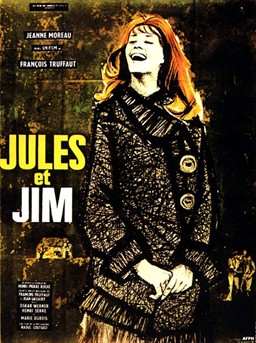
Movie Review: Jules et Jim by Francois Truffaut

Poster for Jules et Jim

Poster for Jules et Jim

In many Woody Allen films, there is a scene where Allen’s characters enter a New York movie house to see an old film. In Annie Hall, it was Bergman’s Face to Face; in Manhattan Murder Mystery, it was Wilder’s Double Indemnity.

I have always envied that: going to a theater and watching a classic on the big screen. It doesn’t happen much where I am from.

Until recently, that is. One of the city’s major theaters began showing the newly mastered version of Carol Reed’s 1939 thriller The Third Man, and another theater was screening Truffaut’s Jules et Jim.  I saw The Third Man earlier in the summer (which, by the way, is the first film I ever recorded on VHS, a long time ago when the local PBS was airing classic films at midnight.)

This past weekend, I saw Jules et Jim for the first time.
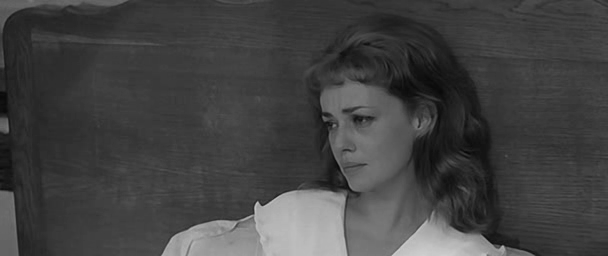
Jeanne Moreau as

Jeanne Moreau as “Catherine” in Jules et Jim

Truffaut’s Jules et Jim is a primer for anyone wanting to understand the French Nouvelle Vague that blossomed in the 50s and 60s. The loose and fluid camera work, the montages, the freeze frames, the newsreels, the voice overs, the simple location sets (allowing for the breezy filming), these are the defining attributes of the New Wave, and they are used masterfully in this 1962 film.

And, as much as technical innovations defined the moment, so did the narratives. The films focused on youth, on iconoclastic characters outside the mainstream, and on ambiguity. One is never sure what to think at the end–and that is intentional.

Jules et Jim is basically the story of a love triangle. The film opens with a frenetic piece showing the carefree life of two friends, the French Jim and the Austrian, Jim. Jules is overly shy. Jim is a comfortable and adept womanizer.
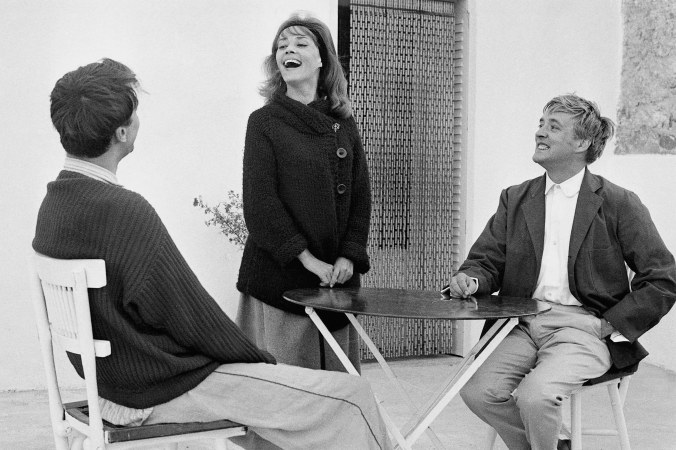
The Love Triangle Jim, Catherine, and Jules (Serre, Moreau, and Werner)
Jim, Catherine, and Jules
(Serre, Moreau, and Werner)

Catherine (Jeanne Moreau) and Jim (Henri Serre) in Jules et Jim

Catherine and Jim
(Jeanne Moreau and Henri Serre)
in Jules et Jim

Their friendship is intense and true.

One day, another friend Albert introduces them to Catherine, a woman with a captivating smile and quirky personality.

When the normally shy Jules sees Catherine, he famously says to his playboy friend “Pas celle-là, Jim” (“Not this one, Jim”), asking that Jim does not use his charm to sweep this one away.
Jules (Oscar Werner) and Catherine (Jeanne Moreau) in ,i>Jules et Jim,/i.

Jules and Catherine
(Oscar Werner and Jeanne Moreau)
in Jules et Jim.

For this is the woman for him. And Jim, who is equally as attracted to her, acquiesces. The three have rollicking adventures together in the countryside, around Paris, and at the beach and they thoroughly enjoy each other’s company.

Soon after, Jules and Catherine marry, but then World War I breaks out. Jules and Jim find themselves in opposing armies and pray that they don’t kill each other.

But Truffaut focuses on more personal conflicts than the global cataclysm of World War I. After the war, Catherine is quite unhappy in her marriage and in her motherhood. She has several affairs, one of which is with Albert who originally introduced her to Jules and Jim and who now is recuperating in the village below. (There is a hint that her child is actually his and not Jules’)

When Jim comes to visit them, she seduces him (he is an easy seduction since he too is in love with her) and ultimately they plan to marry and have children. Jules is okay with this–he loves both Jim and Catherine– and the three live together in an odd but comfortable arrangement.

That the arrangement and the plans fail is the descending path of Truffaut’s narrative arc. How they fail–spectacularly–is the thrill of the movie (and which I won’t reveal here.) Nevertheless, I can say that Jeanne Moreau as Catherine is wonderful and is the anchor of the film. Oddly, a young Oscar Werner resembles a young William F. Buckley, though his shyness and awkwardness is painful to watch. And Henri Serre makes a charming partner–both for Jules and for Catherine.

*     *     *     *     *
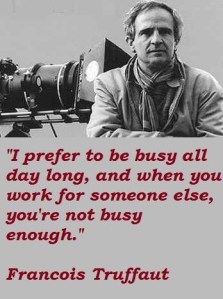
Francois Truffaut

Francois Truffaut

In the first paragraph of this post, I mentioned Woody Allen’s films, Bergman’s films, Wilder’s films. It is largely because of Truffaut that we identify films in this way. Before he directed films, Truffaut was a writer–and then editor–for the famous Cahiers du cinema (“Notebooks on Cinema”), a seminal journal that helped bring film into the realm of serious study.  In the journal, Truffaut often argued his point that a director is the true author of the film, as much as a Picasso or a Hemingway is the creator of his work.

It is only fitting then that when discussing the classics of twentieth century cinema, the phrase “a Truffaut film” is a necessary component of the conversation.
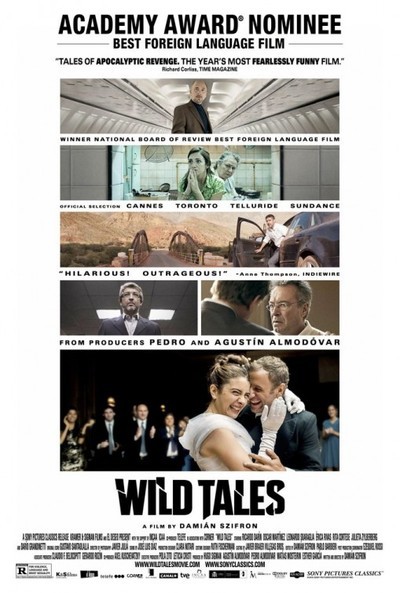
Movie Review: Wild Tales (Relatos Salvajes) written and directed by Damien Szifron

A friend sent me a text the other day about a movie he had recently seen: Wild

Movie Poster for Wild Tales

Movie Poster for Wild Tales

Tales. His description was that it was “six vignettes on modern life and its frustrations.”  He later texted that he had been careful with choosing his words and with not wanting to be a spoiler but that “violence and vengeance” better captured the gist of the vignettes than “modern frustrations.” He also stated that he was going to go see it a second time the following weekend.

He was right in amending his description and in his decision to go see it a second time.

For it is a worthwhile film.

Written and directed by the young Argentinian filmmaker Damien Szifron and produced by the Almodovar brothers, Wild Tales is just that: Six wild stories about modern life pushed to the extreme.  An unhappy man takes vengeance on all the people in his past; a waitress is confronted with a customer who had ruined her father’s life; two men are caught up in road-rage gone to the extreme; an engineer fights against a DMV system that seems to indiscriminately tow cars; a wealthy man must deal with a world of bribery and corruption; and a wedding reception goes wonderfully wrong.

Seven characters from six of the "Wild Tales"

Seven characters from six of the “Wild Tales”

To give more detail would indeed be “spoiling” it, for much of the fun comes from the twists these tales take–twists that we probably saw coming, but that leave us incredulous that they did.

In each of these stories, there is frustration and violence and suppressed anger that we all can understand, and because of that, because of their vague familiarity, they become amusing. These tales are cartoonish episodes that seem all too real, and in our recognition of them we also find something that is both wince-evincing and laugh-inducing.

Of course, some of the narratives are better than others. One or two is a “one-liner”–a joke that is elaborately set up and then smacks us with the “aha” (or better yet the “oh no”) moment. And others are quite elaborate. But they all succeed. They all pull us in with their story–unique yet familiar.  The frustrations of modern life tempered by dreams of vengeance.

And if for nothing else, Wild Tales leaves us with one of the most memorable wedding receptions in film history.

Here’s the trailer for your enjoyment:


Series: The Deadly Sins–Greed

"Gordon Gecko" Silkscreen 2015 by jpbohannon

“Gordon Gecko”
Silkscreen 2015 by jpbohannon

But let me briefly make my purpose plain,
I preach for nothing but for greed of gain,
And use the same old text, as bold as brass,
Radix malorum est cupiditas.

Chaucer, “The Pardoner’s Tale”

words and pictures (part 2) …and the power of MUSIC

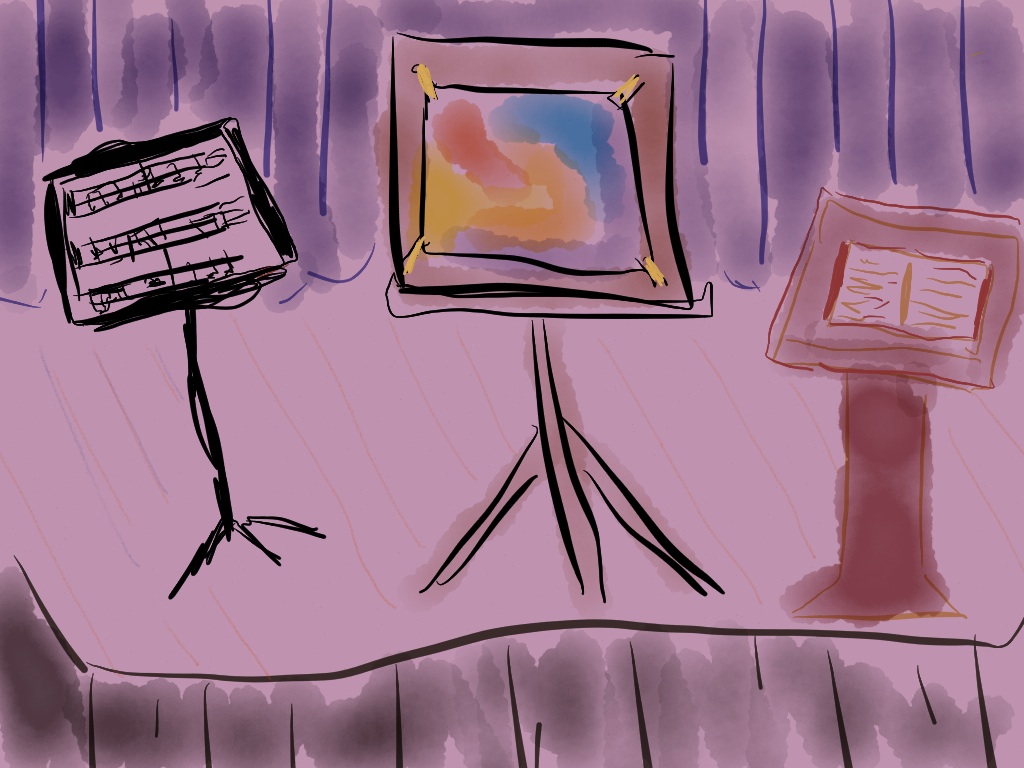
Music...Art...Literature Illustration 2014 by jpbohannon

Music…Art…Literature
Illustration 2014 by jpbohannon

Yesterday, I wrote a post about the film Words and Music, a sweet romance about a battle between an Art teacher and an English teacher. The film had interesting examples about the power of words and magnificent examples of the power of “pictures.”  But what I forgot about was the part that held it together and in a way redeemed it:

The Power of Music

In the film. after the male protagonist has made a bollocks of things and the female protagonist has had enough of his destructive behavior, it is music that is the most evocative, most informative, most powerful…and most healing.

Scene after scene the male (Jack Marcus) tries to contact the female (Dina Delsanto) to apologize for the drunken mess he made of her art. Scene after scene we see her aggressively stop his attempts or stoically ignore them. Until the moment, when she opens an e-mail and there is an audio attachment.  The piece–written for the film by Paul Grabowsky—is a chamber piece for piano, cello and clarinet entitled “I am a Small Poem.”  (This is also the name of the poem that Markus steals from his son.)  It is rich and resonant and connects with Delsanto more than any words or pictures could.

It is what saves their seemingly destroyed relationship.

I wish I could embed the music that was played when Delsanto opened her e-mail. but I can’t.  It isn’t available yet.  So instead, I will give you this: an extraordiary piece by Fauvre. It is what I often listen to when I am writing:

A while back, a music teacher (Manny DelPizzo), an art teacher (Jackie White) and I got together to make plans for a large project. (The educators call this kind of thing “Project Based Learning.”)  I was going to get my Creative Writing Students to submit their best work and the art teacher and music teacher would each have their students interpret it and we would have a performance.  Our ambitions were high–this seemed like the best outlet for student creativity– but the realities of schedules and time and curricula put many roadblocks in our way and we let it fizzle out.

The “performance” that the fictional students in Words and Pictures was much like what we were hoping for, minus the music. Our music component would have made it better.

A new school term is starting in a couple of weeks. I am newly energized (though not as drunken as Jack Marcus) and am excited about trying this for real. It doesn’t have to be a battle–as it was in the film–but a really cool examination of the power of words, of art, and of music–a real exercise in Creativity

Book Review: A Farewell to Arms by Ernest Hemingway

Hemingway as a young man.   illustration 2014 by jpbohannon

Hemingway as a young man.
illustration 2014 by jpbohannon

The most gaping hole in my formal education is a lack of courses in American Literature. In undergraduate and graduate school combined, I had taken only one course in American lit. My understanding is mostly self-directed–and often spurred on by the requirements of teaching American Lit survey courses for many years. Certainly, I know the school classics: The Great Gatsby, Huck Finn, The Scarlet Letter, The Old Man and the Sea, The Sound and the Fury.

And as a reader, I have discovered on my own Vonnegut and Pynchon, Heller and Elison, Mailer, Roth and Updike. And from my friends I have learned to love DeLillo, Wallace, and Johnson.  But I know there are gaps.

I took a tour, a few weeks back of Ernest Hemingway’s home in Key West. I respect and admire Hemingway’s short stories–and often teach them in writing classes for their craft–and have fond memories of reading The Sun Also Rises and A Moveable Feast,  but I never read much else. Anyway, the tour guide told us that it was here in the Key West house that Hemingway wrote a large portion of his work, in particularly A Farewell to Arms, which he stated is considered Hemingway’s greatest work. (Remember, he is a tour-guide, not a literary critic.)

And so I decided to give it a try. And to be truthful, in the beginning, it was slogging read at times.

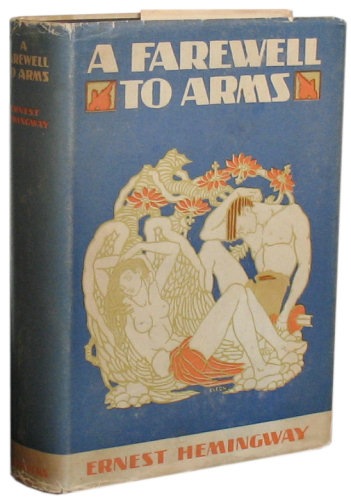
First Edition of A Farewell to Arms

First Edition of A Farewell to Arms

In brief, the novel is the semi-autobiographical story of an American ambulance driver, Frederic Henry, working for the Italian army during World War I, who is wounded, falls in love with his nurse, impregnates her and sneaks across the border with her into neutral Switzerland. There are pieces that are perfect Hemingway: the army’s long retreat, the Swiss countryside in winter, the view from a hotel room. These passages are clear and distinct and one can almost imagine Hemingway speaking them himself.

What one cannot imagine is anyone speaking the dialogue that Hemingway has given his characters to speak. The dialogue among the soldiers is stilted–but I thought perhaps that was intentional as the narrator is an American and the conversation is between him and his Italian comrades. But the conversation between the lovers–between Frederick and Catherine–is downright embarrassing.

Perhaps, it is dated. But I do not believe so. The dialogue in Fitzgerald’s Gatsby published four years earlier in 1925 is not as silly or inane. This can’t be how people talked 75 years ago. Perhaps, Hemingway is trying to capture the coded, playful language that lovers often engage in privately. Well if so, it should have remained private. While Catherine Barkley is a strong woman–a British nurse working in the Italian theater of war–when she speaks she sounds infantile and ditzy, hardly the type that Henry would fall for.

But then, perhaps, it is just me, the reader, far past the ages of the protagonists, a little bit wiser (one hopes) and a little bit more jaded.

And yet, having said all that, the slogging read and the cloying dialogue are more than made up for in the last chapter. It is here that Hemingway elevates the novel to something different, something larger. It succeeds not merely because of the drama–which in lesser hands would have become melodrama–but because of  the craft. The language is pared down–like Joyce had taught him–and there is simply life, death, man and woman. It doesn’t get more basic than that. In the end we admire Frederic Henry more than before–I found him hard to like or take seriously throughout much of the book– and we admire Hemingway too. We admire what he is doing and we understand how this novel placed Hemingway in the pantheon of American authors.

Hemingway famously once claimed that he rewrote that last chapter 39 times. Well, then it is a good advertisement for revision, for it is so superior to everything else.

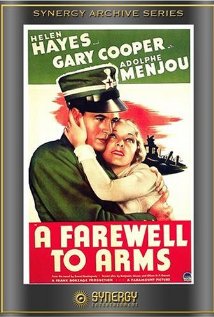
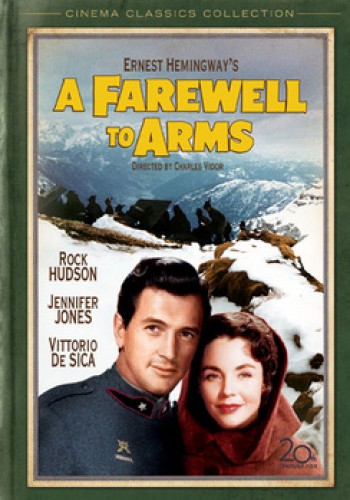
The novel was an instant–and huge–success.  Within a year of its publication a dramatization was staged and in 1932 Hollywood released a major film of the novel, featuring Gary Cooper and Helen Hayes.  In 1957, a second film was made, this time starring Rock Hudson and Jennifer Jones.

I have seen neither, and I won’t search for them. It is Hemingway’s language and style that is the star of A Farewell to Arms, not the story.  And much of that would be lost in film.

Movie Poster for 1932 film

Movie Poster for 1932 film

Movie Poster for 1957 film

Movie Poster for 1957 film

Beware of Maya: Illusion, Cary Grant, Wes Anderson and Owen in Paris

The Grand Budapest Hotel

The Grand Budapest Hotel

Towards the end of Wes Anderson’s latest film, The Grand Budapest Hotel, the elderly Moustafa (played by F. Murray Abrahams) says this about his mentor, the concierge M. Gustav H.:

“His world had vanished long before he entered it. But he sustained the illusion with a marvelous grace.”

And this reminded me of Cary Grant.

I saw three movies this week. And oddly–and not purposefully– they dovetailed into a similar theme.  I was sick as a dog in the beginning of the week and so, lazing around, I  watched two films on television.

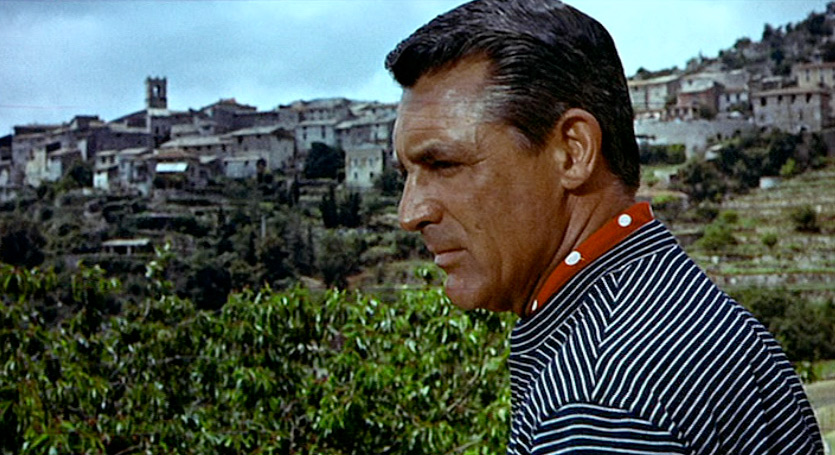
The first was To Catch a Thief.  How gloriously campy it now seems.  Cary Grant’s ascots alone are only outdone by the sweet innuendos that he and Grace Kelly ad-libbed with Hitchcock’s permission.

Cary Grant in To Catch a Thief

Cary Grant in To Catch a Thief

It is all pure fantasy. Pure illusion.

One time, when Cary Grant was told by an interviewer that countless men would love to be “like Cary Grant,” he replied that so would he.  For he knew it was all illusion: the sophisticated banter, the artless seductions, the calm equanimity.  It was his job, being Cary Grant.  In the end, Grant ultimately left the movie business when the illusion gave way to reality. His type of character–as unreal as it was–was no longer in fashion in the gritty, realism of modern cinema.

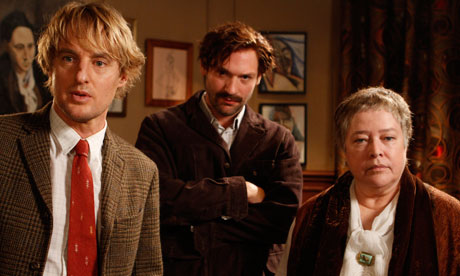
A few days later I watched Woody Allen’s Midnight in Paris. The entire movie is built on illusion, one that we all suffer from. The plot deals with the idea that we all believe that an earlier time was more exciting, more inspiring, more fulfilling.  The fallacy of the belief is wonderfully depicted, as Owen Wilson’s character–Gil Pender–returns to the 1920s and falls in love with a beautiful woman whose dream is to live in the 1890s. Even in the presence of his literary and artistic idols, Wilson’s character comes to realize that the past is painted with gold dust and that our image of that past is greatly unreal.

penderhemingwaystein

Owen Wilson with Corey Stoll as Ernest Hemingway and Kathy Bates as Gertrude Stein.

And in the end, it is all illusion. Many of us believe that another time was better than the one we live in. And some believe that, if only, they had been born at a different time their lives would be so much different–and better. (At this point read, E. A. Robinson’s poem “Miniver Cheevy” which is referenced in the film as well.)

And so, I finally go out and go to the movies and I see Wes Anderson’s The Budapest Grand Hotel.  It is a beautiful movie to look at and the performances of Ralph Fiennes and his young protege, Tony Revolori, are extraordinary.  But it too is all illusion. The world it describes is long gone, if it ever existed at all. And the heroism of the film–if it can be called such–is that Fiennes’ character maintains the illusion that that world still exists, still matters. And we are even more removed from it than he.

And after all that is what movie making is about.  Sixty years ago, Cary Grant left movie making because he believed the magic had left, that hard-nosed grittiness had blown the magic away.

But that is not the case.  Most of the time, we still go to the movies for the magic. Whether it is the unreal pleasures of the moneyed classes in Monte Carlo or the time-tripping adventures of a sincere romantic in Paris, the movies still provide a good dollop of magic. And in The Grand Budapest Hotel all that magic comes full circle. For not only is the set and the landscape and the costumes and the cartoonish villainy not part of our real world, but even the characters themselves are clinging to an illusion, to a world that has longed passed, but which in our “Golden Age” memories is a thing of refinement, class and excitement…more civilized world than the one we know.

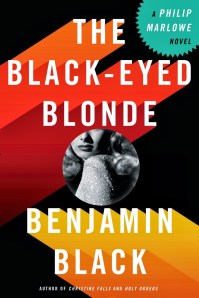
Book Review: The Black-Eyed Blonde by Benjamin Black

In 2006, with the release of Christine Falls, the Booker-Prize-winning novelist John Banville began publishing “crime fiction” under the pen name Benjamin Black.  Like his “literary novels,” these crime novels are psychologically astute, intensely plotted, and keenly aware of language.The Black-Eyed Blonde

With The Black-Eyed Blonde, however, Banville decided to try something new:  to write a novel using Raymond Chandler’s most famous private detective, Philip Marlowe.

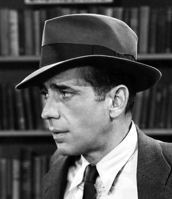
While Chandler’s fiction is read and esteemed, and his influence on detective fiction in particular and American literature in general widely acknowledged, his detective’s presence is mostly ingrained in the American consciousness through film and television.  There have been several television series featuring the L.A. detective and many movies.  Dick Powell and Robert Mitchum both played Marlowe, and successfully, but undoubtedly, the most iconic incarnation of Phillip Marlowe is that played by Humphrey Bogart. So pervasive are the film renditions of Chandler’s L.A., that I found myself casting the characters while reading The Black-Eyed Blonde.  Sure enough there was a role for all the usual suspects: there is a creepy, effeminate Peter Lorre type, an enormous, gang-lord Sydney Greenstreet, a fetching Lauren Bacall character, and, of course, there is Bogart as Marlowe.

Humphrey Bogart as Phillip Marlowe in The Big Sleep

Humphrey Bogart as Phillip Marlowe in The Big Sleep

Banville himself is certainly aware of the hold that film has on the literary characters and early in the book he gives a winking nod to Bogart. Marlowe is sitting in the offices of a fancy country-club. There are cigars and brandy, chintz armchairs and fine china. Marlowe says:

“At that point, I wouldn’t have been surprised if some fruity type in white shorts and a blazer had come bounding through the door, inquiring with a lisp if anyone was for tennis.”

This is Banville’s joke, and nod to Bogart.  Before he played tough guys in film, Bogart played in drawing-room comedies on Broadway. A long-lived story is that Bogart’s first professional line as an actor was as a young dandy, bouncing onto stage with his tennis whites and tennis racquet and inquiring “Tennis, anyone?”  That Bogart also had a slight lisp, makes Banville’s nod even more on target.

But The Black-Eyed Blonde is not a film, it is a novel, and a highly readable one at that. The title is one of several possibilities that Raymond Chandler had filed away and which Banville received permission to use from The Raymond Chandler Estate.  From there, somehow, Banville began channeling Chandler, because what he has created is an exceptional mirroring of Chandler’s style: the rapid-fire dialogue, the lyrical similes, and the sprawling, frenetic plot and subplots.

The plot is typical: the eponymous blonde, Clare Cavendish, enters Marlowe’s office and hires him to find a “friend”  who has gone missing.  When Marlowe discovers that the friend was killed and cremated two months earlier but that Cavendish had seen him just a few days ago, things get complicated.  There are betrayals, murders, cover-ups, flirtations, and deceptions.  And throughout it Marlowe maintains a strict code of honor–the characteristic that always set Marlowe apart from the rest. He protects his clients’ confidences, he takes no joy in the violence that is visited upon the deserving, he cannot be bought no matter what the price, and, while he can empathize with those on both sides of the law, he believes in justice.  It is this chivalric honor that became the hallmark of the American noir hero.

But always, when reading Chandler–and now Banville posing as Chandler–the story seems secondary.  It is the evocation of 1930s-40s Los Angeles, the elaborate metaphors (“He smelled like an over large man who had lain in the bath too long.”), the snappy dialogue that conjures up an entire world–a fictional world, perhaps, but one that we are very familiar with through both reading and film. And with The Black-Eyed Blonde, Banville re-captures that world perfectly,  note for note.

The Black-Eyed Blonde is a fun, a quick, and a memorable read.