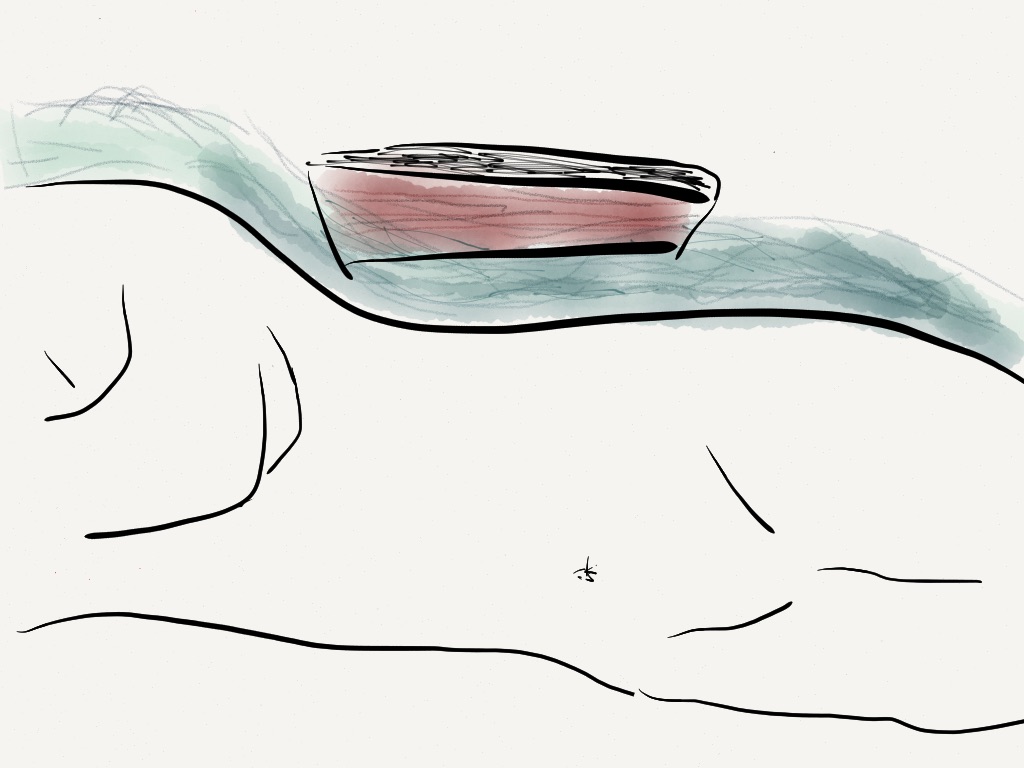
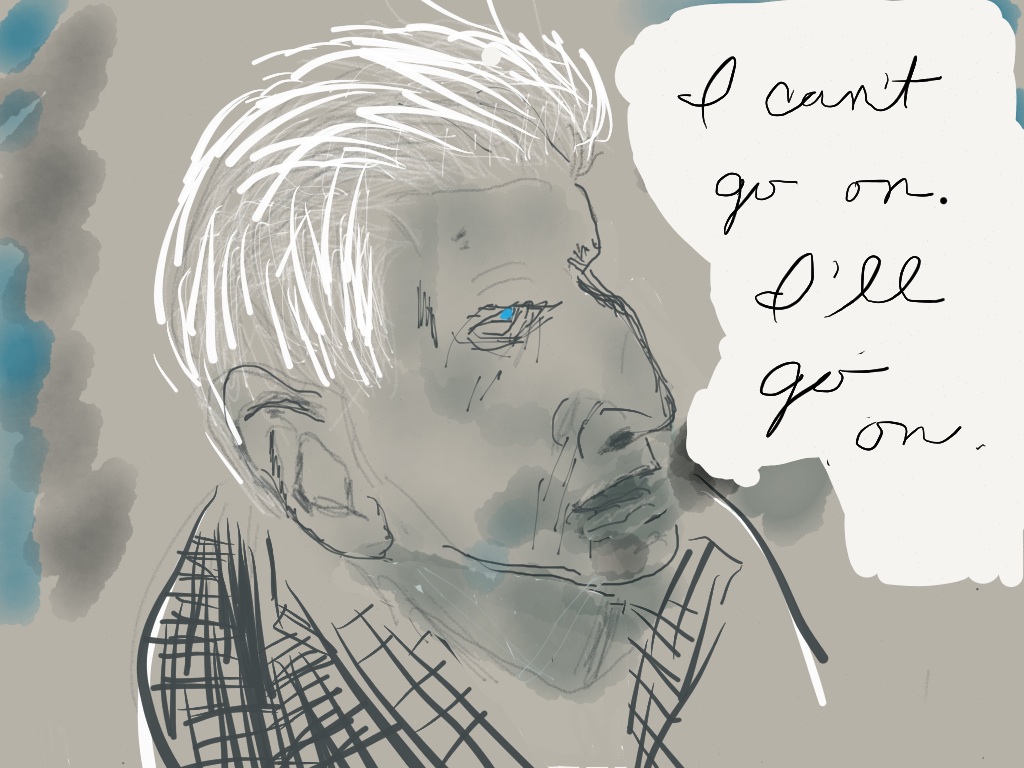
Quote #57: “Then the big elm shot up ahead…”

“Elm Tree” illustration 2016 by jpbohannon

 “Then the big elm shot up ahead, lying in wait for them at the bend of the road, and he said between his teeth: ‘We can fetch it; I know we can fetch it–‘”
                                                        Edith Wharton, Ethan Frome

Bowler Hats: Chaplin and Bloom…Sally Bowles and Sabina

A few decades ago, I remember having to read a piece on “the sociology of clothing in the Victorian era.” The author’s intent was to show that fashion had a subtext. I remember clearly the argument about men’s hats. The thesis was that the height of a man’s hat in Victorian England was proportionate to his status on the social scale.  i.e. The society toffs wore tall top hats, the navvies and farmers wore flat caps.

I thought of this again after a conversation about “bowlers.” A friend and I had just finished reading Milos Kundera’s The Unbearable Lightness of Being and were commenting on the bowler hat that the character Sabina is attached to (it reminds her of her grandfather) and which she often wears during sex.

“It’s a silly hat,” my friend said. “There is really nothing sexy about it.”

Silly or sexy?  I’d state that both things are true, depending on who’s wearing it.

For Christmas this year, my young nephew gave me a tee-shirt imprinted with the text of Joyce’s Ulysses on it. The text is manipulated to depict Leopold Bloom’s mustache and bowler hat. (Though I argue that Bloom would never wear his hat tilted at such a jaunty angle.)

Image-1

Leopold Bloom t-shirt

Now, although the book ends with Bloom’s wife repeatedly affirming her husband’s worth (“yes,  yes I said yes I will Yes.”), throughout much of the novel, Bloom is a figure of ridicule.  And a bowler hat only underscores that. (In truth, those who most ridicule him wear flat caps or no hats at all.)

When I was little my parents enjoyed Laurel and Hardy. (How politically incorrect we all 354845-laurel-and-hardywere then: I didn’t know their names were “Laurel and Hardy” until much later. My mom had always called them “Fats and Skinny.”)  They both wore bowlers, doffing them in times of embarrassment or playing with them in times of nervousness.

Now, Chaplin’s bowler represents something else. As the Little Tramp, he is at the very bottom of the social scale, and yet his dignity, manners and goodheartedness far outshine those socially above him. Perhaps, it is that chiasmus between the tramp and gentle-behavior and “gentlemen” and their boorishness that the bowler suggests. It could also simply be that the “little tramp” is wearing whatever has been tossed aside.  Nevertheless, it is part of his comic ensemble. In the film Chaplin, there is a marvelous scene where Robert Downey Jr. as Chaplin, first puts together his iconic “Little Tramp” costume, beginning with the hat.

The-Little-Tramp-charlie-chaplin-85240_250_338

But then you have the women. On the female, the bowler hat moves from an object of comedy or ridicule to something sexy, even forbidding.

It seems in every dance revue–whether a toddlers’ dance recital or the Rockettes at Radio City Music Hall–there is one number where the females are dressed in stockings and shorts, tux shirts and ties…and a bowler hat. The hat acts as a prop, an accessory and the dancers put them on and off, dance with them held in front or waving above their heads.

In the film Cabaret, Sally Bowles is played by Liza Minnelli–perhaps the greatest role of her career. And while the film is certainly different than the play –and the novels from whichcabaret it was drawn–it is Minnelli that people most closely associate with Cabaret and Sally Bowles. Straddling a chair, her bowler hat rakishly tilted on her head, Bowles lustily sings and performs at the Kit Kat Klub in Berlin as the Third Reich begins its ascent. She–and the cabaret she works at–are the very symbols of the sexuality and decadence that the Nazi’s demonize in their rise to power, symbols of the “other” that the Nazis want to purge.

And in Minnelli’s performance, it is the bowler hat that represents this decadence–a symbol of transgression, of otherness, of living life as SHE wants it.

(Please note: I know that there have been extraordinary actresses who have taken on the role of Sally Bowles on the stage, from Julie Harris and Judi Dench to Natasha Richardson and Brooke Shields to Emma Stone and Michelle Williams. But still it is Minnelli’s film version that has the most resonance with the most people.)

Just as Sally Bowles performs her cabaret in Berlin during the Nazis’ rise to power, so too is Sabina creating her art as the Soviet Union crushes the Czech Spring in Milos Kundera’s The Unbearable Lightness of Being. Although we have moved from 1920 Berlin to 1960s Prague,  the same tensions exist–the forces of love, freedom, and humanity in opposition to the bureaucratic autocracy of the State. This time the state is the USSR.

For the painter Sabina, her bowler is a sort of fetish–a memory of her grandfather and a quirk of her sexuality. It is very much a part of her.   Kundera describes Sabina’s hat as such:

The bowler hat was a motif in the musical composition that was Sabina’s life. It returned again and again, each time with a different meaning, and all the meanings flowed through the bowler hat like water through a riverbed. … each time the same object would give rise to a new meaning, though all former meanings would resonate (like an echo, like a parade of echoes) together with the new one.

Thus the bowler hat has apotheosized from a mere garment and quirky accessory to something much more. And in the politically charged world of Prague in 1968, that tumblr_mdy9zuvYH01rhlu7wo1_500something more is crucial to life, to a sense of independence, to a sense of identity. And on Lena Olin, who played Sabina in the 1988 film version of the book, it also looks incredibly sexy.

So whether it accompanies John Cleese’s ungainly stride within the Ministry of Silly Walks or Lena Olin steaming up scenes in The Unbearable Lightness of Being, one finds that the bowler fills both extremes–from the ridiculous to the erotic.  That often seems to be the divide.

That is until you bring in Alex from A Clockwork Orange. And then it’s a whole different story…

a-clockwork-orange


Book Review: M Train by Patti Smith–like listening to an old friend


Punk-rock legend Patti Smith

Patti Smith (photo: MPR/Nate Ryan)

Reading Patti Smith is like listening to an old friend–but an old friend who is better read, better traveled and better experienced than you. And certainly wiser. And though she states several times at the beginning of M Train she has nothing to write about, her sense of nothing is quite different than mine.

As a means of remembering and reminiscing about her deceased husband–Fred “Sonic” Smith, who died in 1994–M Train begins by documenting a trip to French Guiana that the two of them took with the express purpose of gathering pebbles at an abandoned jail in Saint-Laurent-du-Maroni. It is a trip filled with obstacles and difficulties, but the three pebbles she has gathered are for placing on Jean Genet’s grave– the type of gesture of reverence and respect that Smith repeats throughout her account. And though her remembered moments with her husband anchor the memoir, more of it chronicles her life that continues on afterwards.

And what we find in that chronicle is an extraordinarily interested human being. (And generally, those who are most interested in the world around them are usually the most interesting themselves!) Smith is a voracious reader and much of her writing deals with what she is reading and the directions it sends her. (Here is a list of books–from Rimbaud to Susan Sontag–that Patti Smith once recommended.) The writer Maria Popova, in her wonderful blog BrainPickings, also has amassed a list of Smith’s literary references from M Train alone.

Her relationship with books goes well beyond the printed page. She engages with the authors and the characters and the places. (In actuality, she knew a good number of writers: Burroughs, Bowles, Ginsberg.) When she first reads Murakami, she reads nothing else, going from one novel to the next (though not in chronological order.) When she reads his The Wind Up Bird Chronicle, she immediately rereads it, fixating on a specific fountain that appears in the novel.

For Smith, the writers and artists who create the things she loves are very real–and she feels very close to them and their spirits. Thus, she visits Frieda Kahlo’s bedroom and Sylvia Plath’s grave, photographs Virginia Woolf’s walking stick, Beckett’s spectacles, Tolstoy’s bear. In Japan she makes pilgrimages to the graves of her most beloved writers and honors them reverently.  To her, the spirit of these creative individuals remains. Like her husband, they too are dead, but still inform her world.

And while she is an extraordinary reader and traveler, she is also very much an ordinary person: addicted to detective shows (The Killing, Law and Order, and the gamut of BBC detectives), sits on her front stoop to smoke a cigarette, feeds her cats, and hangs out in a favorite coffee shop. (A hilarious scene occurs when a woman takes her regular table while she’s in the bathroom and Smith fantasizes how the woman’s murdered body would be positioned in various detective shows.)

It is this ordinariness that is the most charming. We easily forget that she is more than an artist–is in some senses a celebrity. But one never meets the celebrity; instead we meet a woman who is at times gregarious and at other times meditative, who lives simply and cherishes the little moments of our lives, and who is still capable of being overpowered by  a book she has read or awed by a celebrity she has met. (She tells an amusing tale of running into the British actor, Robbie Coltrane, who starred in the rarely televised detective series Cracker.)

She reads with an artist’s eye and a writer’s ear; yet she writes like an old lost friend. And that is what has made both of her memoirs —Just Kids and M Train–such a joy to read.

Below is a lovely (6 minute) video of Patti Smith “giving advice to the young.” It is a good example of her wisdom, her kindness, and her hope.


Quote 48: “Siempre imaginé que el Paraíso sería algún tipo de biblioteca.”  Jorge Luis Borges

big book

“Siempre imaginé que el Paraíso sería algún tipo de biblioteca.”
(I always imagined that paradise would be some sort of library.)

library steps                    Jorge Luis Borges


unusual-and-desirable-bookshelves-designs-celebrity-equinox-library

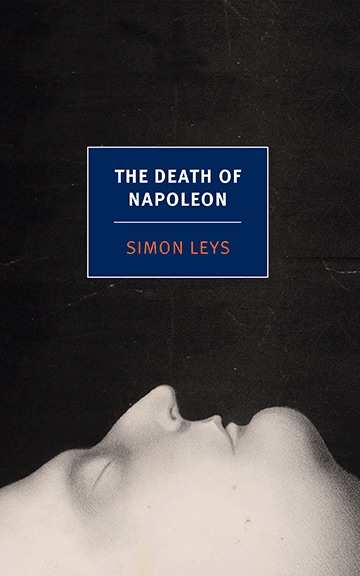
Book Review: The Death of Napoleon by Simon Leys

Simon Ley’s 1986 novella, La Mort de Napoleon was translated from the French in 1991 by Patricia Clancy. Twenty years later it was re-issued by The New York Review of Books as part of its Classics series. The decision was a wise one, for the novel is one that should be more greatly known. It is likely not to be forgotten by any who read it.Cover of NYRB Classics edition

The novel begins with these words:

As he bore a vague resemblance to the Emperor, the sailors on board the Hernamm-Augustus Stoeffer had nicknamed him Napoleon. And so, for convenience, that is what we shall call him.

Besides, he was Napoleon.

And so the story begins. Napoleon has been smuggled off his St. Helena-exile and replaced by a look-alike, a sergeant who in the past had acted as the Emperor’s double. The crew of the hunting-ship is unaware of the identity of the new man among them. They knew only that as a sea-man, he is pretty ineffective. The plan was that when the ship stopped in Bordeaux, Napoleon would be met by an agent of the vast conspiracy that had freed him. This agent would bring him to the organization that would then propel him once more onto the world’s stage.

Unfortunately, at the last moment, the ship is given orders to sail past Bordeaux and head straight to Antwerp. From then on, what occurs to the Emperor is both comical and poignant, heart-wrenching and hopeful. From his visit to the tourist trap that is now Waterloo–he visits two separate places where Napoleon slept on the eve of the battle, not recognizing either; gets in an argument with a tour-guide about the positioning of the Grand Army; and is arrested for forgetting to pay his hotel bill–to his return to Paris, we follow the emperor as he tries to regain his footing in the world.

However, return to Paris he does. Though not necessarily in the way he thought he would.

Having attracted the love and devotion of an old fruit seller, he demonstrates his genius by rallying some old loyal soldiers into a more efficient program of selling melons and cantaloupes. And on the night when he intends to reveal himself to an old campaigner, he is brought to a sanitarium filled with men who believe they are Napoleon.

And in the end he dies.

The novel is short and momentous and moves quite quickly, and yet with every sentence you realize that you are in the hands of a master. Ley’s language is at times sublime. Here he is describing the sun-rise on Napoleon’s last day on-board the Hernamm-Augustus Stoeffer:

The sky was divided between night and dawn–blue-black from the west to the zenith, pearl-white in the east–and was completely filled with the most fantastic cloud architecture one could possibly imagine. The night breeze had erected huge unfinished palaces, colonnades, towers, and glaciers, and then had abandoned this heavenly chaos in solemn stillness, to be a pedestal for the dawn. The highest crest of a windblown cumulous was already brushed with yellow, the first beam of daylight against the rood of fading night. …

The unrecognized emperor had by wakened by the African cook and brought up on deck to witness this scene. At the end of the novel, it is this scene that greets him in death.

And so we are left with a wonderful read that makes us ask the all-important questions: What is real? And what is true?  Is Edmund, the ineffective cabin-hand, actually Napoleon? Is Edmund’s belief that he is Napoleon any different than the inmates’ of the asylum in Paris? (We are told on page one that he IS Napoleon.) Are the stories passed on to the tourists at Waterloo any truer or less true than the jumbled memories of our hero? These are the fun little boxes that Ley opens up for us, and which ultimately makes The Death of Napoleon such a satisfying read.

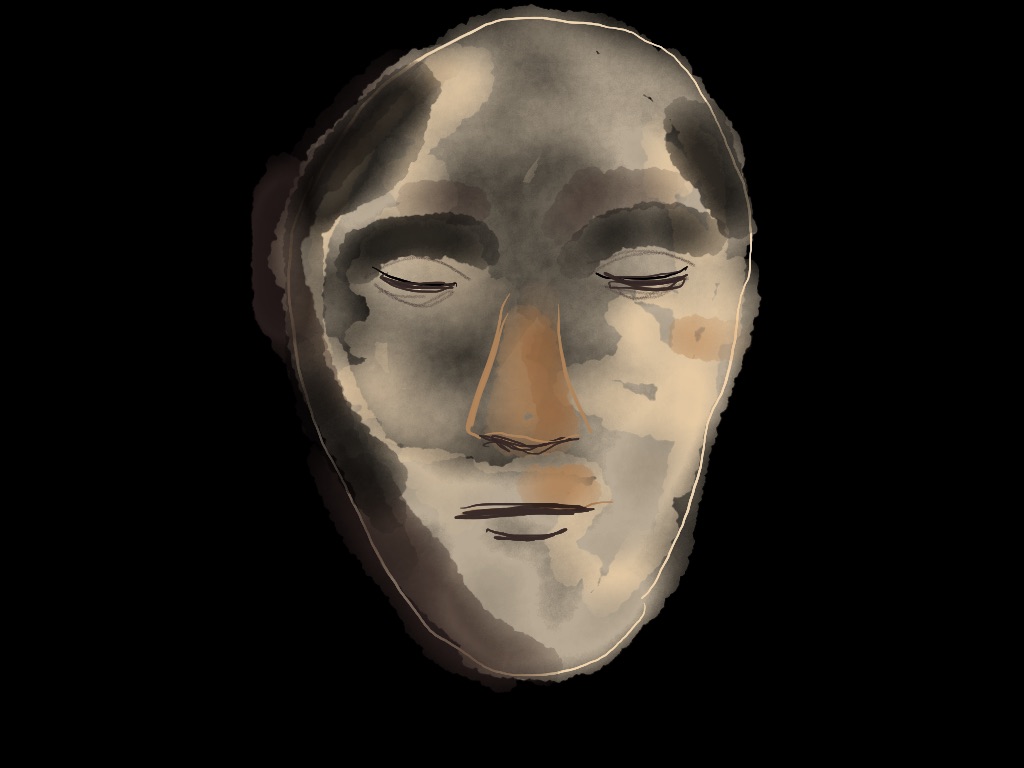
Death Mask of Napoleon illustration © 2015 by jpbohannon

Death Mask of Napoleon
                                                                     illustration  © 2015 by jpbohannon

Book Review: Colorless Tsukuru Tazaki by Haruki Murakami

colorless I used to think that it was only Americans who were so caught up with the experience of  “High School.”  I had believed it was an American construct, an over-idealized rite of passage that had spawned too many bad television series and “coming of age” films. I had believed it was strictly an American thing.

I’ve known many men for whom those “high school” years were the very pinnacle of their lives. It is those days that they keep referring to, those days by which they measure all others.  I mean I know men in their 40s and 50s, in their 60s and 70s, even in their 80s whose conversation invariably turn to the high-jinks and glories of their high-school days.

But I was wrong.

Haruki Murakami’s novel Colorless Tsukuru Tazaki and His Years of Pilgrimage revolves around five Japanese high school friends and the long-lasting effects of the decisions they made when they were twenty years old.  They are now in their mid-thirties; two are living in their hometown, one has moved to far-away Finland, one to cosmopolitan Tokyo, and the fifth one is dead, murdered.  The one-time connectedness of these five high-school friends haunts the hero, Tsukuru Tazaki.

Tsukuru–whose name is the only one the five which does not have a color attached and who believes himself to be “colorless–was abruptly dropped from the group when he was a sophomore in college in Tokyo. And he never was given an explanation, just the order to never contact them again.  The separation caused Tsukuri months of suicidal depression and then years of self-doubt, wonder, and the inability to relate to people. For Tsukuru, the five high school friends were an unprecedented harmony of spirits.  And yet there were several cracks in this group which he was too nice to notice.

Tsukuru’s name in Japanese means “one who makes things,” and indeed, that’s what he does. He makes railroad stations.  And in Japan, railroad stations are a very big deal and making connections is an intrinsic part of Tokyo life. Yet his treatment by his high-school friends has left him unable to make connections with people. There have been several romantic liaisons, but nothing serious and nothing he wished to pursue further. There was a friendship–tinged with a touch of homo-eroticism–that ended as abruptly as his friendship with his high-school mates. He was simply abandoned one day, his friend moving away from Tokyo with no forewarning and no intention of staying in touch.

And so we follow “colorless” Tsukuru as he tries to make his way in the world.

I needed a novel like Colorless Tsukuru Tazaki. There had been too few novels lately that gripped me from the beginning and made me read obsessively until I was finished. And Murakami has done that for me before. While I can’t remember the exact plots of his Kafka on the Shore or NorwegianWood, I do remember the obsessiveness with which I read them.  I can remember jotting down notes, following up allusions, taking notes. I remember protagonists who were like Tsukuru Tazaki: thoughtful, introspective, aware young men, burdened by what they cannot change in the past and fearful of the uncertainties of the future. And I remember getting caught up in their sadness and their serious attempts to make sense of their world. Murakami’s novels are both thoughtful and fascinating, outwardly exotic and inwardly philosophic.

And also I remember the fascinating side-trips of information. In Colorless Tsukuru Tazaki, there is an odd but brief discussion of the genetic dominance of a sixth finger; there is a continual look at the music of Listz, particularly the “Le Mal du Pays” section of his suite “The Years of Pilgrimage.”  It is a piece that the young murdered friend played often when they all were together, and it is a record that his friend Haida had coincidentally left at Tsukuru’s apartment before he had left him. Towards the end of the novel, Tsukuru visits one of his old high-school friends–still seeking enlightenment as to why he was so unceremoniously dropped–and the friend has the piece in her pile of CDs. The two reach some reconcilliation listening to Listz.

Watching the trains

Watching the trains

Watching the people

Watching the people


And then finally there is the subject of trains and of Tokyo’s public transportation. When Tsukuru needs time alone, when he is filled with angst and confusion, he goes to the train platforms and watches the trains and the people. There is a certain peace he finds in the uniformity and the precision which such a place exhibits, against what seems impossible odds. (Shinjuko Station handles 3.5 million passengers a day!)

I had skipped Marukami’s novel before this, 1Q84, for a variety of reasons. It was a mistake on my part and one I will rectify shortly.


You can listen to the very recording of Listz that Tsukura played on his stereo in his apartment here:

Series: The Deadly Sins–Anger

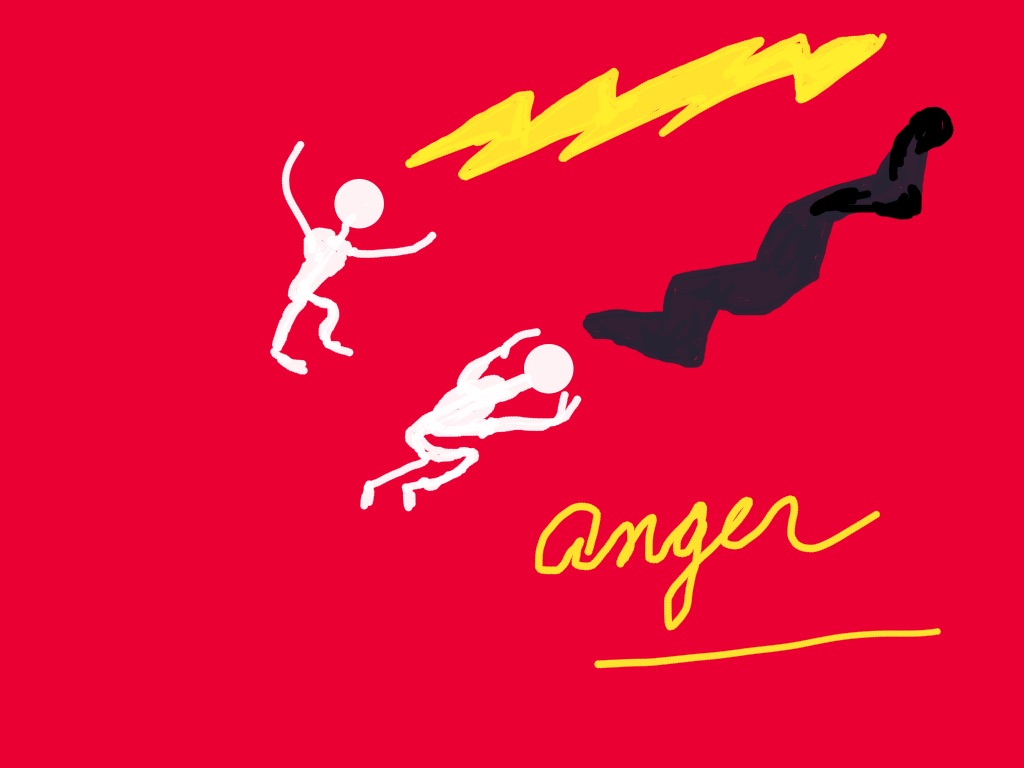
"Anger" illustration 2015 by jpbohannon

“Anger”
illustration 2015 by jpbohannon

“One night I accidentally bumped into a man, and perhaps because of the near darkness he saw me and called me an insulting name. I sprang at him, seized his coat lapels and demanded that he apologize. He was a tall blond man, and as my face came close to his he looked insolently out of his blue eyes and cursed me, his breath hot in my face as he struggled. I pulled his chin down sharp upon the crown of my head, butting him as I had seen the West Indians do, and I felt his flesh tear and the blood gush out, and I yelled, “Apologize! Apologize!” But he continued to curse and struggle, and I butted him again and again until he went down heavily, on his knees, profusely bleeding. I kicked him repeatedly, in a frenzy because he still uttered insults though his lips were frothy with blood. Oh yes, I kicked him! And in my outrage I got out my knife and prepared to slit his throat, right there beneath the lamplight in the deserted street, holding him by the collar with one hand, and opening the knife with my teeth — when it occurred to me that the man had not seen me, actually; that he, as far as he knew, was in the midst of a walking nightmare! And I stopped the blade, slicing the air as I pushed him away, letting him fall back to the street. I stared at him hard as the lights of a car stabbed through the darkness. He lay there, moaning on the asphalt; a man almost killed by a phantom. It unnerved me. I was both disgusted and ashamed.”

Ralph Ellison, Invisible Man

Review: My Face for the World to See by Alfred Hayes

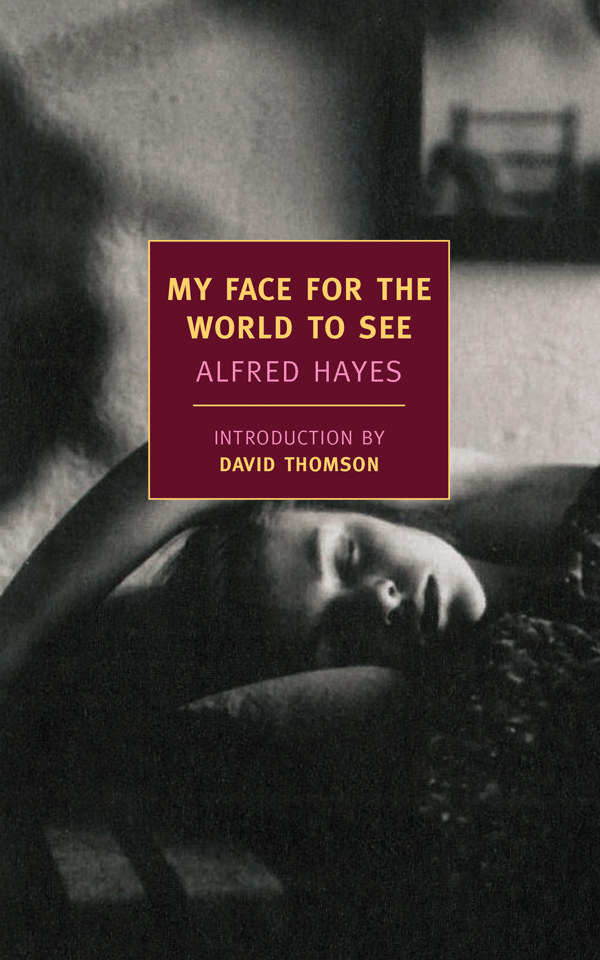
Book cover of the NYRB edition of My Face for the World to See

Cover for the NYRB edition of My Face for the World to See

The narrator of Alfred Hayes’ novel works in Hollywood. That is all we know. He is semi-separated from his wife; he lives alone for months at a time in L.A. and for months in New York with his wife, though his marriage, from his perspective,  is a failed and sad relationship.

In fact, the narrator finds his life and work as a failure. He sees no value in the work he does, although, as he says, the studio pays him handsomely. (He states that he is a “writher” rather than a “writer.”) He condescendingly (and somewhat snobbishly) observes the people around him, their vanities and egos, their manipulating and positioning, their theatrics and ambitions.

At a party one night, the narrator–bored with this gathering at an expensive beach house–steps outside for a smoke and sees a young woman walk into the sea. When she goes under, he rescues her and resuscitates her. And thus begins a relationship that he did not want to happen. That the woman is disturbed is revealed gradually, and she is much more than simply a young girl with unrealized Hollywood dreams.

Initially, it is her cynicism towards the business, towards love and towards life that draws him to her, that allows himself to give in to what he is also trying to hold back from. And as the two become more closely entwined–and as more of her anxieties are displayed–it becomes apparent that the two of them are very similar, a realization that is devastating to the narrator. In truth, it may be that it is the narrator whose face is now “for the world to see.”

The narrator’s deliberate and reflective thinking, his cool, detached observations, his knowing emotional cover-up, all work to create a modern anti-hero, an existentialist who is “forced” to live and work in a world that celebrates the superficial and is built basically on the dissemination of lies. It is a taut and harrowing read, a tale of self-discovery, acceptance, and angst.

My Face for the World to See was originally published in 1958. At the time, Hayes was more known as a scriptwriter. He had twice been nominated for an Oscar, had written successful screenplays for films directed by Fritz Lang, John Huston, and Fred Zinnemann, and also wrote many pieces for television including Alfred Hitchcock Presents and The Twilight Zone.  As a novelist, he was most celebrated for The Girl on the Via Flaminia,  and as a poet, for “Joe Hill” which was later put to music and became an anthem for workers’ rights. (Joan Baez famously sang it at Woodstock. See below.)

The New York Review of Books re-issued My Face for the World to See in 2013, with an introduction by the film critic, David Thomson.  But this novel is by no means a Hollywood novel. Apart from the brief description of the initial party where the narrator rescues the suicidal young woman, there is no glamor, no behind the scenes peeks, no tabloid scandals. There is simply a couple of apartments and the narrator’s self-examination and his lover’s revealed past.  It is discrete yet raw, fast-paced yet thoughtful.  It is memorable novel that deserves this re-issue.

And here’s a treat. A sweetly innocent Joan Baez singing Alfred Hayes’ “Joe Hill” at Woodstock. Enjoy:


Review: “The Heart of the Heart of the Country” by William H. Gass

"I dreamed my lips would drift down your back like a skiff on a river." Gass "in the heart of the heart of the country." P.179

“I dreamed my lips would drift down your back like a skiff on a river.” William H. Gass “In the Heart of the Heart of the Country.” illustration 2014 by jpbohannon

Because of some administrative hic-cough, I was sent two copies this weekend of the same book: William H. Gass’ In the Heart of the Heart of the Country. I had not heard of it, although I recognized the name of the author (and immediately confused him with the novelist, William Gaddis). Having two copies, I gave one to my friend Tim Dougherty, who very well may be the best-read person I know.

Here was the text he sent me later that day:

John,

Thanks so much for the book. Gass’ “In the Heart of the Heart of the Country” is a seminal postmodern short story. The collection is one of my favorites, and the new edition blows my flea market paperback out of the water. And now I can throw that one away!

Who’d have thunk it.

So, on my train-ride to work the next morning, I read “In the Heart of the Heart of the Country.”  The story is the final piece in a collection of the same name that includes two novellas and three short stories, but I went to the last story right away.
And it is everything that Tim’s message had intimated.

First it is broken into short chunks with headings such as “People” or “Weather” or “Places” or “My House.” It is a sort of stream of consciousness, movie-like postcard of a town in Indiana and the people who live there, and at the same time it is a self-portrait of the narrator who has lately lost love (through death or separation I am unsure) and who is both crushed and buoyed by the vastness of the Midwest.

But it is the language that is so remarkable, that stands out yet does not make a show of it. There are exquisite lists. This is the narrator describing a neighbor’s basement:

...stacks of newspapers reaching to the ceiling, boxes of leaflets and letters and programs, racks of photo albums, scrapbooks, bundles of rolled-up posters and maps, flags and pennants and slanting piles of dusty magazines devoted mostly to motoring and the Christian ethic. I saw a bird cage, a tray of butterflies, a bugle, a stiff straw boater, and all kinds of tassels tied to a coat tree.

And here he is describing the town itself in a section called “Vital Data”:

There are two restaurants here and a tearoom. two bars. one bank, three barbers, one with a green shade with which he blinds his window. two groceries, a dealer in Fords. one drug, one hardware, and one appliance store. several that sell feed, grain, and farm equipment. an antique shop. a poolroom. a laundromat. three doctors. a dentist. a plumber. a vet. a funeral home in elegant repair the color of a buttercup. numerous beauty parlors which open and shut like night-blooming plants. …

But it is his memories of the lost love and of lost childhood, the feelings of being trapped in a dying world, and his description of the decadent monotony of small town life that resonates the most, in which the fiction writer becomes one with the poet, and where the language becomes as integral to the story as the story itself, where inside and outside, the public and the private, that which is thought and  that which is felt, all merge into one.

It is majestic and memorable.

And I can’t wait to finish the rest of the collection.

Book Review: Echo’s Bones by Samuel Beckett

Samuel Beckett Illustration 2014 by jpbohannon

Samuel Beckett
Illustration 2014 by jpbohannon

Coincidences are no more than that, though I am very well aware of the research on them. (Freud once stated that  there were no such things as accidents, but I believe coincidences to be a lesser, less conscious form of accident. In the latter, the subconscious is directing you towards what might seem to be a accident but is actually rooted in one’s memory, suppressed or on the surface. Coincidence, on the other hand, is simply the awareness of a multiplication of events, of which one wasn’t completely cognizant or prepared for beforehand.)

So anyway, I attended an intense two-week workshop on education-on assessments and feedback and good old Bloom’s taxonomy. However, much of it was rooted in the teachings of Augustine–and much of the feedback I received  referenced Dante.

Before the workshop, however, I had bought a book, Echo’s Bones by Samuel Beckett. I knew it was something I would need to concentrate on–a 52 page short-story, accompanied by 58 pages of annotations, and complete with an introduction,  copies of the original typescript, letters from Beckett’s publishers, and a bibliography. This was not simply reading a short story, but sort an academic adventure. The type of diversion I hadn’t had in a while.

Cover of Samuel Beckett's Echo's Bones

Cover of Samuel Beckett’s Echo’s Bones

And so I waited until my Augustinian-laced workshop was over.

And then I began reading.  After I got  through the introduction and  into the story I began to smile. It was Augustine all over again with a large dollop of Dante.  In the first three pages alone there are five allusions to Augustine and four allusions to the Divine Comedy. And the main character, Belacqua, is given the nickname, Adeodatus–the name of Augustine’s illegitimate son.

So why all this hubbub about a short story that was written more than eighty years ago?  Well, Beckett had written a collection of interrelated short stories entitled More Pricks than Kicks.  Right before publication, however,  his publisher asked if Beckett would add a final story to the collection, to fatten it up, so to speak.

Beckett agreed, except there was one problem.  All the characters in the collection were now dead.  And so Beckett wrote “Echo’s Bones,”  which told the story of the dead Belacqua’s return to life in his short interim between death and eternity.  The publisher rejected the story, stating that it was too dark, too odd, and that it would make readers shudder.  And so More Pricks than Kicks was published as it was originally intended, and “Echo’s Bones” was assigned to the crypt of oblivion.  Until now.

The title refers to the mythological figure Echo, who tragically fell in love with Narcissus. (He was never a good catch for any woman. Too much competition with himself alone!)  Anyway, when she died, all that was left were her bones and her voice. Thus, we have “Echo’s Bones.”  If the editors had only known how perfectly the story’s title would foretell the nature of Beckett’s future work: a work of spotlighted voices–often disembodied (Krapp’s Last Tape), often body-less (HappyDays), and often flowing in a rushing stream (Ponzo’s soliloquy in Godot).

The plot is secondary to the wordplay, the erudition, the humor, and Beckett’s world view. Quickly: the dead Belacqua suddenly finds himself on a fence in a empty Beckettian landscape. A woman arrives and brings him to Lord Gall, a giant of a man with a paradisaical estate which he will lose because he is sterile and lacks a male heir. He convinces Belacqua  to bed his wife, in hope of an heir, but–in a twist of telescoped time–the woman gives birth to a daughter.  The story concludes with Belacqua conversing with his own grave digger (from an earlier story) and searching his own coffin for his body. The story ends with a familiar phrase in Beckett’s work and letters: “So it goes in the world.”  These are the last words of “Echo’s Bones,” but they are also the last words of “Draff,” the final story in the version of More Pricks than Kicks that was ultimately published.  A phrase that Beckett had picked up from the Brothers Grimm story “How the Cat and the Mouse Set up House,” it is a phrase that encapsulates Beckett’s life view and one that he used often even in his personal correspondence.

While I respect and love Beckett’s drama, I particularly enjoy his early fiction. Still under the influence of Joyce, Beckett, at this time, was  full of his verbal powers, delighting in the wordplay, and confident in his free association. It is always, for me, a treat to read.