My intention was to talk about one book a week, and originally I wanted that to happen on a Friday. But then, I realized that a large bulk of my outside reading–my non-class reading–is finished up over the weekend, so a posting on Monday makes much better sense. And since, this is the first venture out with a post about books, I figured I would start out with two. Remainder by Tom McCarthy and You and Three Others are Approaching a Lake by Anna Moschovakis.
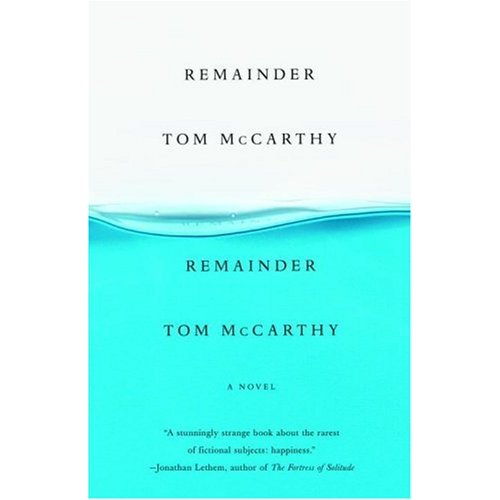 Tom McCarthy’s novel about a post-coma, post-trauma survivor who receives a “settlement” for eight-and-half million pounds is at times aggravating and at other times marvelous. The narrator has lost much of his memory after being hit by an untold object that placed him hospital and in a coma for an extended period. When he returns to “normal” life, he is given an enormous payout by the responsible parties. His only vivid memory, however, is one that involves an apartment house with a crack in the bathroom wall, a woman cooking liver in the flat below him, another tenant playing piano in the room above, and a man working on his motorcycle in the courtyard. With an almost unlimited amount of money, he arranges to “re-enact” the entire memory, buying several buildings, re-doing them to the specifications that he remembers, and hiring actors around the clock to play the tenants that haunt his memory. From here, he begins to re-create other more recent occurrences. McCarthy’s–and the narrator’s–attention to detail is precise and minute, a true feat of writing and observation, but Nicholas Baker did it much better in his earlier works. The payoff for me, however, comes at the end of the novel. Early on, when the narrator first learns of his windfall, he is set in a circuitous route between a telephone booth and his home. He travels the distance back and forth three or four times within a short period, stymied by his forgetfulness and his demand for exactitude. I enjoyed this scene; it verged on the slapstick; and I even related it to other people. At the end of the novel, the same type of scene is played out, though this time with more dire and impending consequences. It brought the novel together. Remainder certainly contained moments of brilliance yet they were couched in much larger moments of cloudiness and frustration.
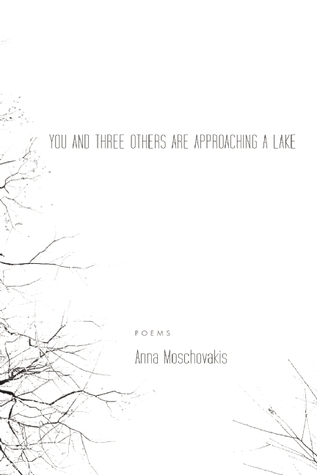 Anna Moschovakis’, award-winning book of poetry, You and Three Others are Approaching a Lake, is another work that has me of two minds. The topics, the observations, the connections, all are intriguing, mind-jarring, fresh. Yet the poetry itself leaves me wanting. The book contains four long poems, plus a prologue and an epilogue. They touch upon the contemporary and allude to the past. They are geographical and internal. They play with typography and they play with presumptions. They deal with our technological world and the examine our anthropological past. Indeed, having read the collection at one sitting, my first reaction was to read it again, to try to wrap my head around the numerous ideas and permutations.
In the poem “The Human Machine” there is an extended conversation between “annabot” and “the human machine” which questions what we know about and how we love, questions the substance of spirit, dissects the more mechanical part of our being. In a letter to the Human Machine, Annabot writes:
Dear Human Machine,
Resolve, reason, ration, rational, rationale, rationalize
ratiocination, rationing, ratify, rather, rate,
ratios, ratio, rat
According to Peter Singer, a rat who is loved by a person
is more worthy of being pulled from a fire
than a person who is unloved by persons
This is taking into account Singer’s technical definition
of “person”
As I said, this is truly a marvelous book for thinking, for exploring, for discovering new ways of seeing the world. It is a book that I have–and will again–return to. However, I am not sure of the poetry of the pieces. I found them wanting.

 j. p. bohannon