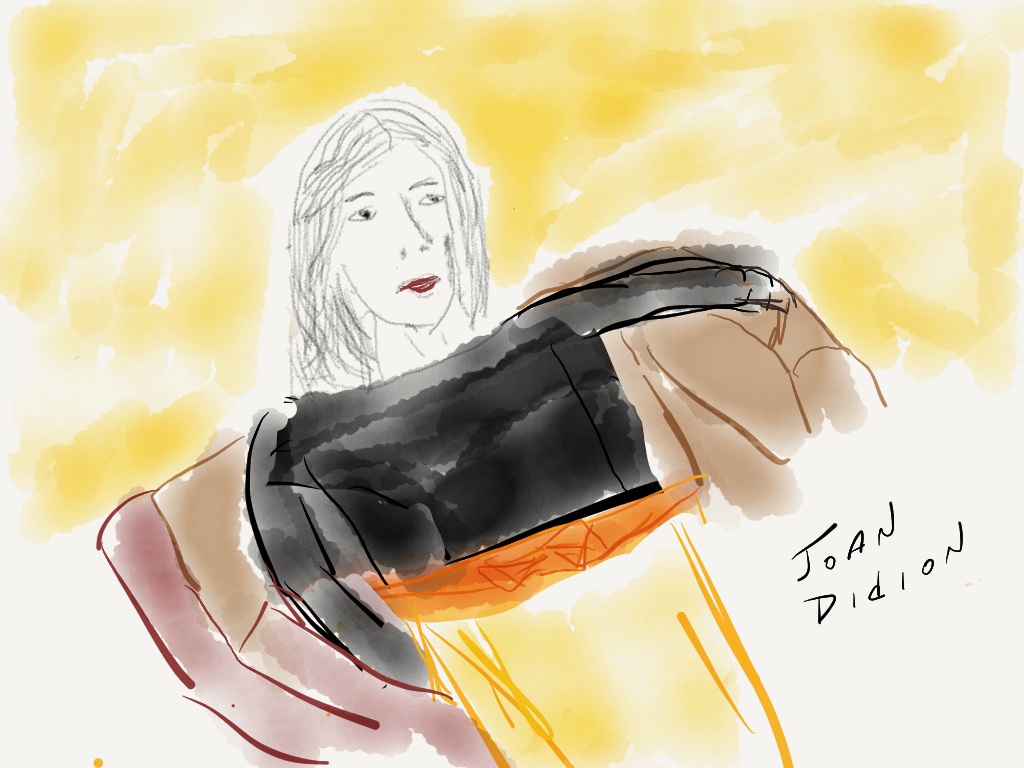
Joan Didion.
illustration 2013 jpbohannon
based on portrait by Lisa Congdon for Reconstructionists project
Joan Didion.
illustration 2013 jpbohannon
based on portrait by Lisa Congdon for Reconstructionists project
 Julian Barnes latest work is a slim, tripartite volume that encompasses a 19th century history of ballooning and the beginnings of portrait photography, a semi-fictional account of the love affair between an English “balloonatic” and the divine Sarah Bernhardt, and a searingly honest examination of the author’s own grief upon the loss of his wife, Pat Kavanagh, in 2008.
As always, Barnes writing is careful, thoughtful, and precise. His insight into the heights of ballooning and its accompanying crashes, the flights of romance and the desperation of rejection, and the comfort of love and the devastation of its loss are intelligent, beautiful, and memorable. It is the type of book that one reads with a pencil nearby so to copy the phrases that so often hit their marks squarely.
In the first section, “The Sin of Height,” Barnes describes the flights of three different balloonists over the course of nineteen years–all of the passengers whose paths cross at times throughout the years. The first is Nadar the French photographer, whose balloon basket carried a developing lab and who was one of the first to ever give us aerial photographs, albeit very vague and poor ones. (moving from Nadar’s early aerial photographs to the Earthrise photos that were taken on the first trip to the moon a century later, Barnes writes beautifully about our tiny planet, swirling with gasses and storms and blue beauty.)
Nadar did however go on to be a great portrait photographer, and his photographs of the actress Sarah Bernhardt are the first we have of her. She too is one of the balloonists that Barnes features. The third balloonist, Fred Burnaby is a English military man–a member of the Royal Horse Guard–an adventurer, and a noted bohemian. It is a history that captures the excitement and controversy of the modern age–encapsulated by the birth of photography, electricity, and aviation. Victor Hugo believed that flight would bring about democracy while Balzac believed that photography steals a layer of the sitter’s persona.
It is Burnaby’s romance with Sarah Bernhardt that makes up the second section, “On the Level.” Reading like part of a novel, this section depicts Burnaby–very much a man of the world–now very much in love and very articulate about how he feels. He is aware of the dizzying heights to which Bernhardt has taken him, and, as a ballonist, he is always aware of the heights from which he will fall when she releases him. His dispassionate accounting of his heartbreak, his pain, his desolation is telling, but despite the level-headedness of his account we never doubt the intensity of the love that he experienced.
But it is the third and longest section–“The Loss of Depth”–that is the most moving, that often feels like a punch in the heart. For in it, Barnes examines his own grief upon losing his wife. “Thirty-seven days from diagnosis to death” is the quickness with which this blow was dealt, and Barnes delineates his pain, his grief, his loneliness with extraordinary honesty and bravery and clarity. It is a exceptional feat, this incise, self-examination of utter loss, put down in words.
While the section surprises us, coming as it does after the previous two sections, in a way he was preparing us for it as well. Burnaby’s meditation on the loss of love, the discussion of crashing being part of the risk of rising, the uxorious care that Nadar took of his stroke-stricken wife, all these point to the marriage of Barnes and Pat Kavanagh.
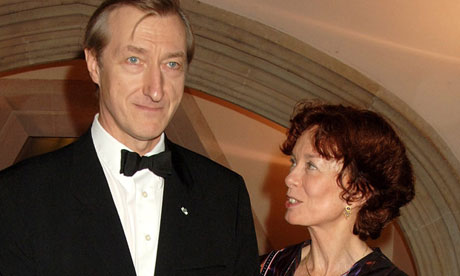
Julian Barnes with his wife, Pat Kavanagh in 2005.
Photograph: Dave M. Benett/Getty Images
He discusses the reactions of those he knows, the kind but often inept remarks that friends attempt, the plans they suggest to help him “through it.” He discusses his daily patterns, emptied now of half the players. He considers suicide, but checks that because if his wife lives in his memory, killing himself would be killing her a second time. He examines the Orpheus legend and takes refuge in meaningless soccer games and overly-emotional opera. And through this all he continues to miss his wife terribly and daily, and the pain of her absence seems never to go away.
But at no times is this meditation maudlin. Indeed, I found myself thinking what a wonderful thing this would have been if he could have shown it to his wife when she was alive. But then, he wouldn’t have had the wrenching grief that allowed him to write it.
Levels of Life is more than a beautiful book. It is powerful and loving. Intelligent and thoughtful. Honest and real. Perhaps after reading it, we should then ask our partners to read it as well, to let them know now what they mean to each of us and how their absence would affect us.
I was a young boy living for one year in a suburb of Chicago–Arlington Heights. I don’t remember much of that year: a monstrous ice-storm that shut everything down and men ice-skating to work; an enormous and popular race-track that burned down after we left; a candy store and a record shop. I don’t remember much else.
I do remember however that my parents did not give me permission to go see Goldfinger. Secret Agents were all the rage–that Christmas my little brother had even received a toy briefcase that fired missiles–and here was the ultimate secret agent of them all: 007… Bond, James Bond.
My buddies were all going, I argued–but still I was not allowed. (At the time, the Catholic Church still had a large influence on the “rating” of films, and Goldfinger surely must have been on some list singled out by the Legion of Decency. A list my parents believed in.)
And so now, several decades later, I saw Goldfinger for the first time. I watched it this weekend.
Boy, have times changed.
Let’s consider the reasons that one would not let their children see a movie (and in America there is only ONE reason, followed by a simpering second.) First there is SEX and then there is Violence (which Americans find preferable to viewing sex.) The violence in Goldfinger is cartoonish. There is a car chase scene where Bond is able to test the extras on his Aston Martin: smoke screen fogger, oil slick sprayer, ejector seat, bullet proof armor and machine guns. There is a later “fight scene” where the American military (which was “pretending” to be knock out by nerve gas) take back Fort Knox. The violence is much less than what appears in a saturday morning cartoon today.
And of course there is the first of the great Bond villains–OddJob.
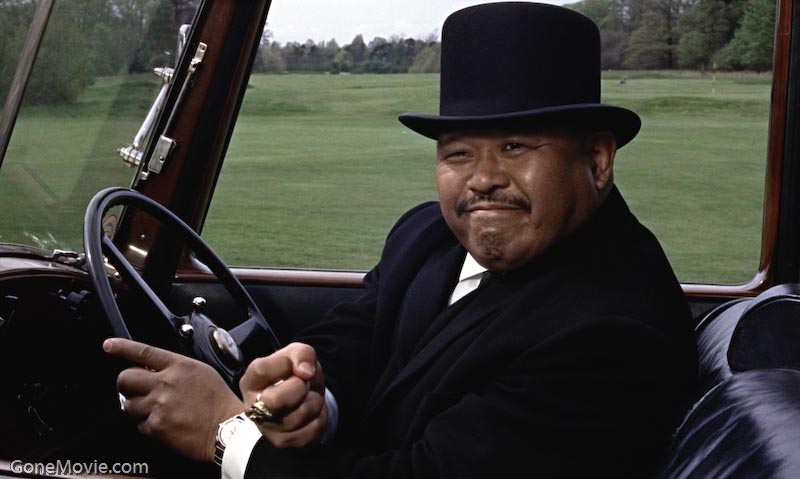
Harold Sakata as Oddjob
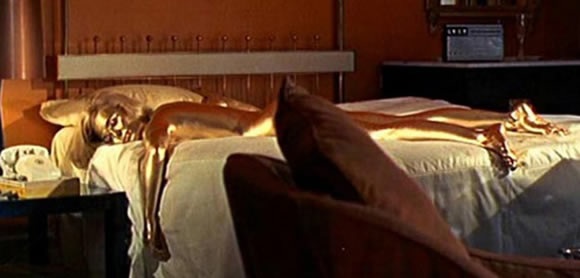
As for the sex. Well, there is none. In the beginning of the film, Bond charms and disarms one of Goldfinger’s sexy “henchmen” who is helping him cheat poolside at a game of gin. (Egads, what criminality!) We assume there has been sex, because there is some post-coital conversation–she lying wrapped in sheets and Bond standing in some sort of sleep wear. When he goes to his fridge for another bottle of Dom Perignon, he is attacked and knocked out. When he regains consciousness, his lady friend is naked, painted in gold, and dead from suffocation.
The next “sex scene” is a jiu-jitsu struggle in a barn with Pussy Galore. Bond is thrown a few times, she is thrown a few times and the two end up in the hay (literally), kissing–fully clothed. That is it.
And my parents wouldn’t let me see it.
Excepting for the sophomoric double entendre on Pussy Galore’s name, the film is squeaky clean–at least by current standards.
And still today, the coolest part of the film is the car. Certainly not the girls and hardly the “action.”
And yet, in hindsight, the film is intriguing: we are witnessing the birth of a franchise. There are those who argue that no other Bond can match Sean Connery and they may be right. He is suave and stylish, resourceful and droll. From this vantage point, he seems to understand that he is already a parody of himself. And yet, he is always a gentleman. And like any secret agent worth his salt he is extremely cool under pressure. Truly, he invented the type.
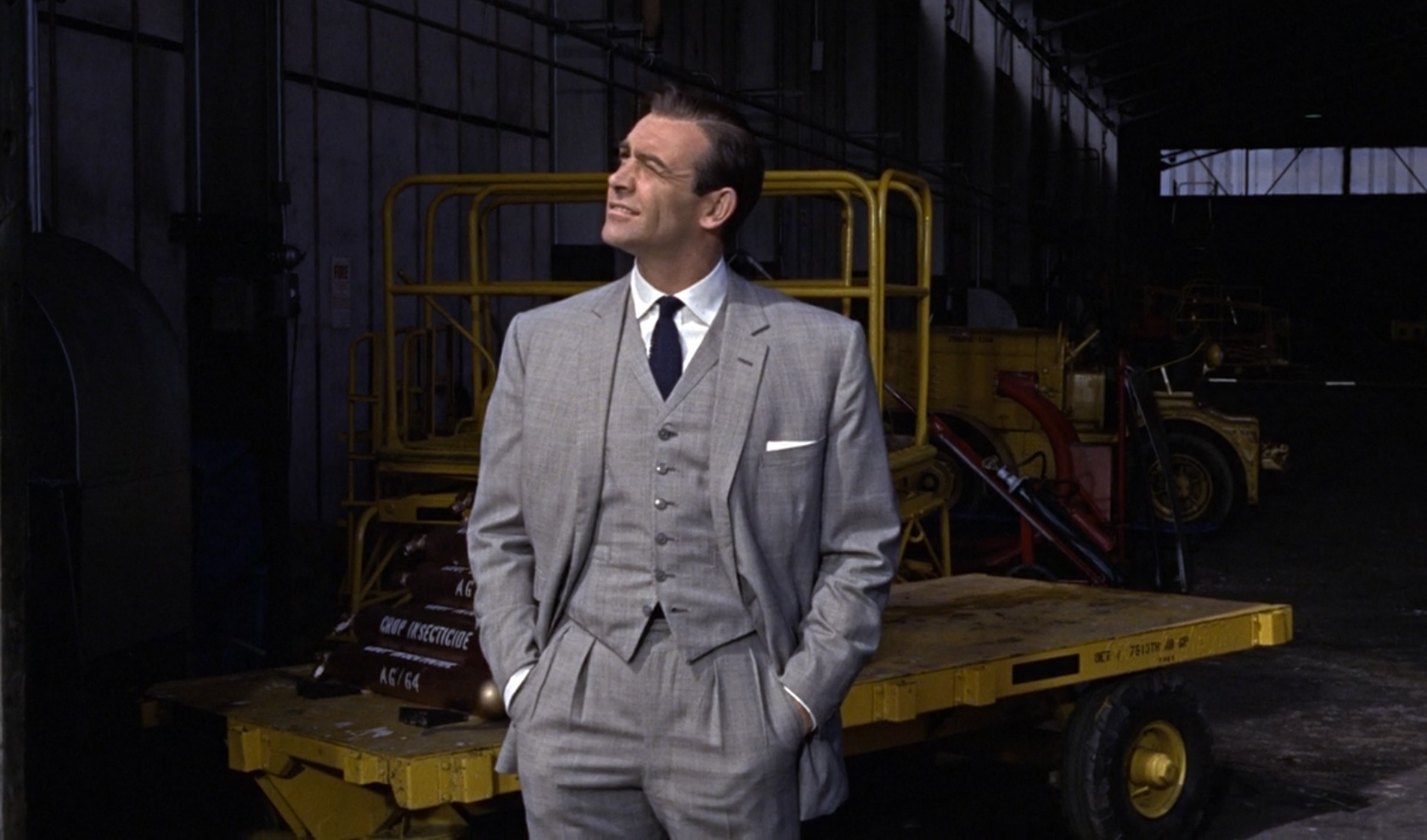
Sean Connery as James Bond
So much so, that the Ian Fleming Publishing Ltd. recently commissioned the British novelist, William Boyd, to write a new Bond novel. Boyd, a critically and commercially successful novelist, took the commission gladly–he loved the Bond novels and figured his plots would be better than Fleming’s. (And when you examine the plot of Goldfinger, you’re pretty likely to agree.) Boyd’s novel Solo will be released on September 26 in Britain and on October 8th in the States. It is not like Bond ever went away…except now he is newer and fresher.
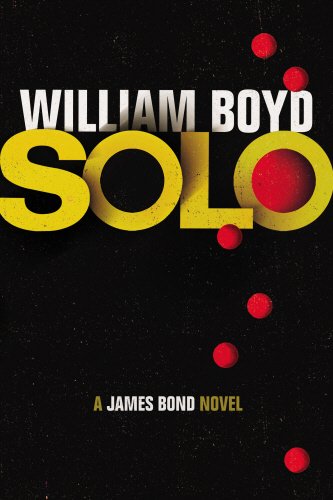
William Boyd’s novel Solo
I wonder if my parents would let me read it.
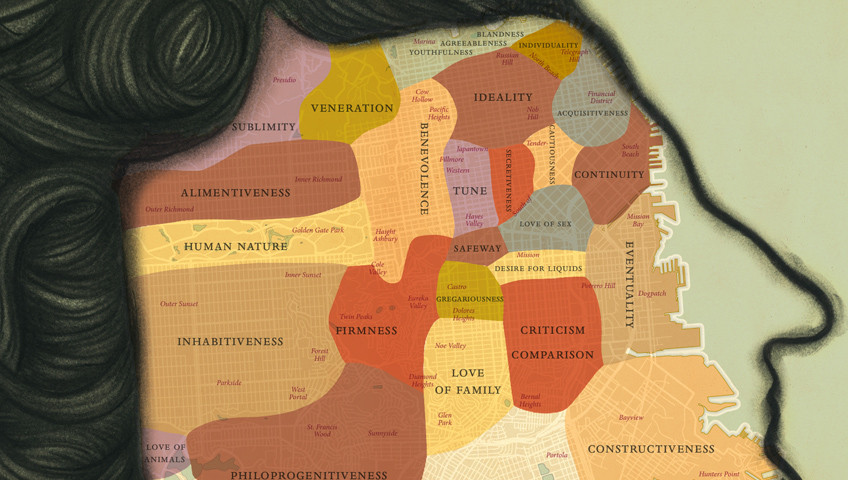
Phrenological San Francisco (page 128-129)
Rebecca Solnit begins her book with this quotation from Thoreau:
“I have traveled widely in Concord.”
Concord really isn’t that big a place to “travel widely” in, but that is the argument of Solnit’s Infinite City: every place contains an infinite number of “maps” with which we travel, and within her book Solnit creates a unique, intriguing, and entertaining series of maps of her city, San Francisco.
Now, you know you are in heady territory when in the first three paragraphs Solnit makes multiple references to Borges and Calvino, both fantastic cartographers and creators of worlds that have never existed. Yet, Solnit is every bit as imaginative and perceptive. She reveals a given place (San Francisco) in ways that had never been categorized before and introduces new perspectives on the city that have never before been imagined.
In her introduction, Solnit explains her method thus:
Every place is if not infinite then practically inexhaustible, and no quantity of maps will allow the distance to be completely traversed. Any single map can depict only an arbitrary selection of the facts on its two-dimensional surface… . For Infinite City, this selection has been a pleasure, an invitation to map death and beauty, butterflies and queer histories, together, with the intention not of comprehensively describing the city but rather of suggesting through these pairings the countless further ways it could be described. (I also chose pairs in order to use the space more effectively to play up this arbitrariness, and because this city is, as all good cities are, a compilation of coexisting differences, of the Baptist church next to the Dim Sum dispensary, the homeless outside the Opera House.)
And this is how the book works. The “arbitrary selection of facts” are surprising and unconventional. There are maps of industries and bee migrations and “tribal neighborhoods” and gang-lands and right-wing bastions and bygone areas of entertainment and carousal. And the pairings are both startling and sensible. For instance, the map entitled “Poison/Palate: The Bay Area in your Body” is accompanied by Solnit’s essay “What Doesn’t Kill You Makes You Gourmet.” In both, the reader is given a map of the major dumpers of toxins into the environment (often food and wine growers) and the sites of delicious, food providers. (Often the two overlap.) The key to the map gives symbols for EPA SUPERFUNDS, Poison Sites, Palate Sites, Poison/Palate Sites and Wineries.
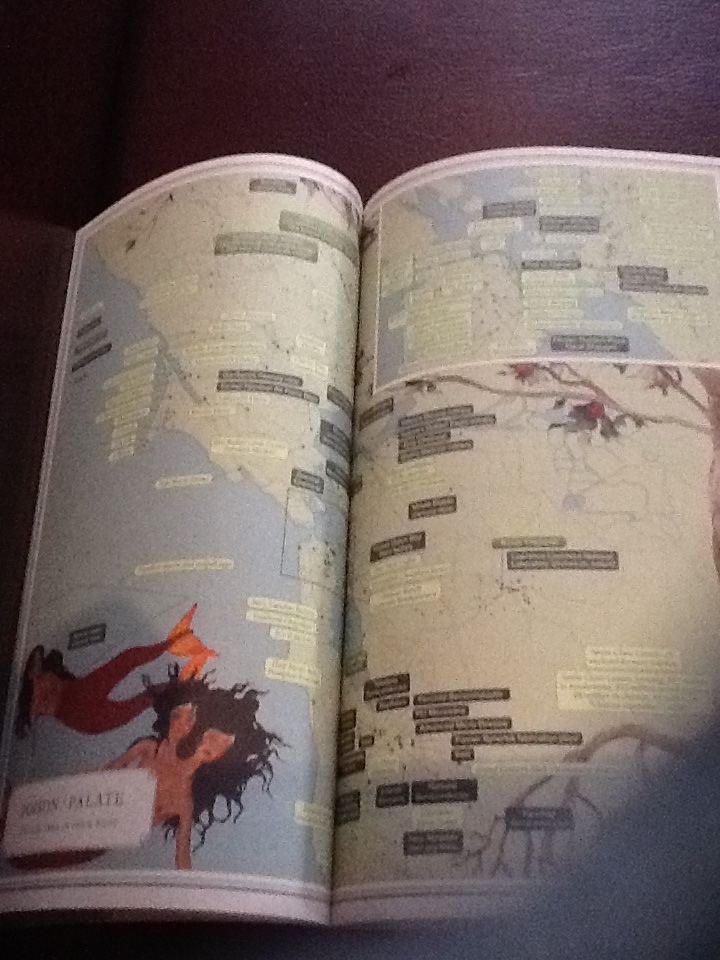
Poson/Palate: The Bay Area in your Body
The population map–the current population not the map of those who have left and those who are arriving–is set up as a “tribal” map. The expected ethnicities are cited–the Chinese, the Irish, the Korean, the Mexican–but they are accompanied by neighborhoods where the “tribes” include skateboarders, people with ties, transgender people, etc. Again, this is accompanied by a moving essay by Solnit about the ever changing population shifts of her city.
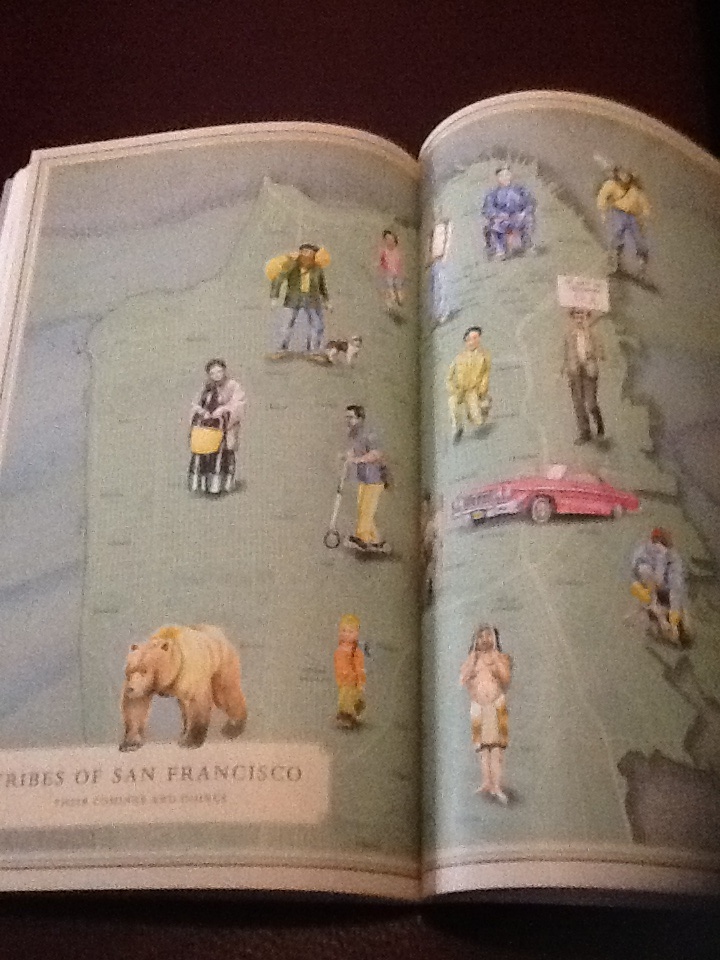
Tribes of San Francisco
But it is the pairings that are the most intriguing. One map, entitled Death and Beauty, tracks the murders in the city during the year 2008 and the locations of Monterey cyprus trees throughout the city; another entitled Dharma Wheels and Fish Ladders lists salmon streams, hatcheries and viewing sites along with the location of Zen monasteries, schools, and core sites; and still another, entitled Monarchs and Queens, reveals the locations of various butterfly locations and queer public spaces.
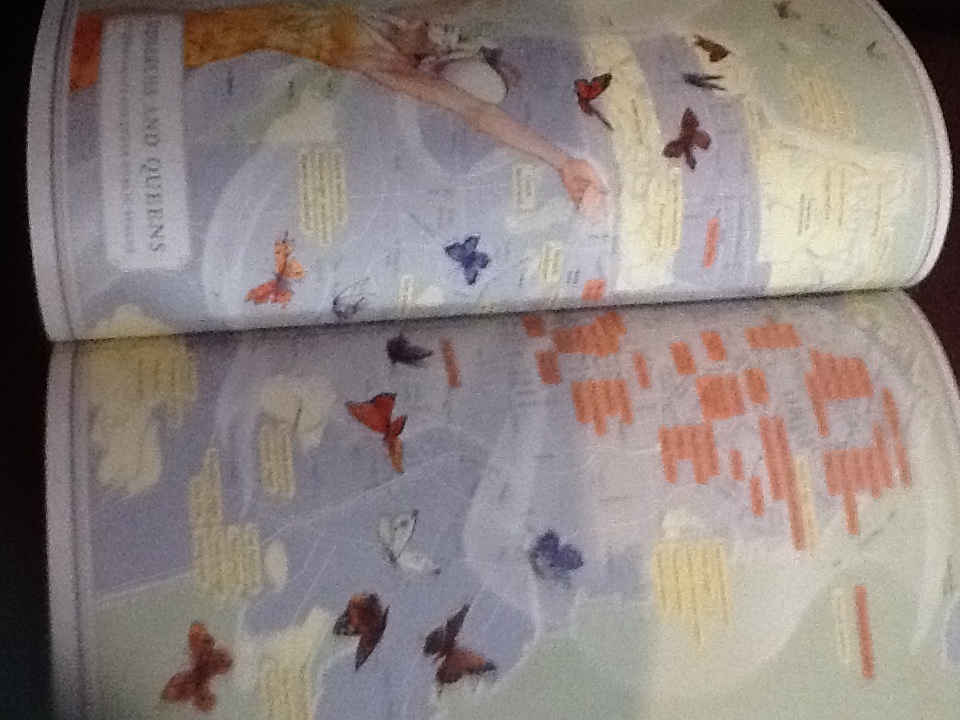
Monarchs and Queens
Each of the twenty-two maps are jewels of color, design, and information. They are beautiful, as are all of the illustrations throughout.
While Solnit did not write all of the essays that accompany the maps, she did write the majority and her fellow essayists are similar in spirit, similar in the way they look at their ever-changing city. In a recent piece for the London Review of Books entitled “Google Invades” (February 2013), Solnit bemoaned the changes that have occurred in her city with the influx of Silicon Valley money. She felt that the variety in the city’s fabric–in its economics, its life styles, its ethnicities, its politics, and its arts– was being leveled and watered-down with the influx of cyber-millionaires. The city–not just a neighborhood– was being gentrified.
Solnit sees her city, San Francisco, in many, various ways, in multiple perspectives that have accrued layer after layer through the years that she has lived there. These views are both nostalgic and forward-looking, while still very much ensconced in the present, no matter how ethereal that might be. And while some of these layers may now have physically vanished, they remain in her memory, in her view of the city.
And they remain in this amazing, attractive, and addictive book.
I rarely drive, so I rarely listen to the radio. That might not make sense for many, but I know that some will understand. The radio is simply not part of my home life.
But anyway,there were reasons for my being behind the wheel this past Thursday and I was listening to RadioTimes on Public Radio (Marty Moss-Coane on WHYY in Philadelphia.) The guest was MK Asante, a hip-hop singer, filmmaker, writer and creative-writing/film teacher at Morgan State University.
I was blown away.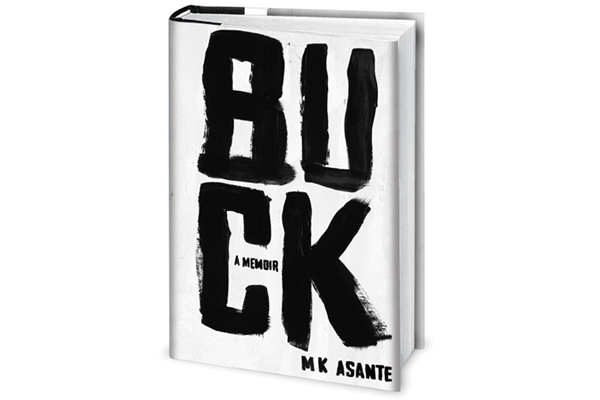
Asante was plugging his new book, Buck: A Memoir about his life in “Killadelphia” during the 1990s. At the same time it is the story of his family’s breaking apart and then coming back together.
Asante was born in Zimbabwe and raised in Philadelphia. His parents’ marriage disintegrated, his idolized brother had a series of run-ins with the law and was imprisoned, his mother suffered from clinical depression, and he grew up in the “hood” full of anger, confusion, and energy.
This coming-of-age story is probably more familiar than it ever should be, but, oh, the language itself is extraordinary. Like nothing you ever heard.
Here is the first paragraph of the book: (Asante reads it in the interview attached below):
The Fall
The fall in Killadelphia. Outside is the color of corn bread and blood. Change hangs in air like sneaks on the live wires behind my crib. Me and my big brother, Uzi, in the kitchen. He’s rolling a blunt on top of the Source, the one with Tyson on the cover rocking a kufi, ice-grilling through the gloss. Uzi can roll a blunt with his eyes closed.
Cracks, splits, bits.
The rawest crews in Philly are all three letters,“ he tells me. I read the cover through the tobacco guts and weed flakes: “The Rebirth of Mike Tyson: ‘I’m Not Good. I’m Not Bad. I’m Just Trying to Survive in this World.’”
Awakening crews in a rude fashion
On they ass like Mike Tyson at a beauty pageant•
I do this–spit lyrics to songs under my breath–all day, every day. The bars just jump out of me no matter where I am or what I’m doing. It’s like hip-hop Tourette’s.
Dumps, spreads, evens.
“JBM–Junior Black Mafia. Of course us, UPK–Uptown Killaz. PHD–Play Hero and Die.”
Tears, licks, wraps.
“HRM–Hit Run Mob. EAM–Erie Ave. Mobsters. ABC–Another Bad Creation.”
Folds, rolls, tucks. Another perfect blunt, jawn looks like a paintbrush.
Jawn can mean anything–person, place, or thing. Sometimes if we’re telling a story and don’t want people to know what we’re talking about, we’ll plug in jawn in for everything. The other day I was at the jawn around the corner with the young jawn from down the street. We get to the jawn, right, and the ngh at the door is all on his jawn, not nowing I had that jawn on me. Man, it was about to be on in that jawn.
“ Wreck Your Ears (Can Do),” The B.U.M.S. (Brothers Under Madness), 1965
This is language at its most alive, its most energetic. (To hear him read it is even more electrifying.)
Asante mentions in the interview that the first book that turned him on was Jack Kerouac’s On the Road. Besides the plot of the novel–drugs, sex, wildness–which he was surprised to learn could be the focus of serious literature, it was the style of the writing that attracted him, the energy, the speed, the exuberance. As he said, from it he learned he didn’t have to worry about commas.
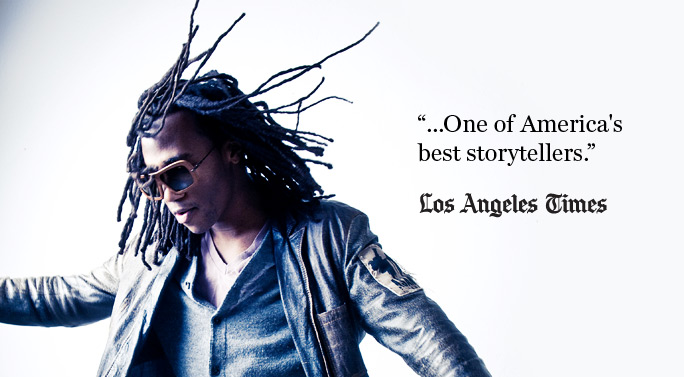
photo of MK Asante from the L.A. Times
MK Asante’s journey from the hood to plugging his books on national radio is one story. But it is a minor story. The true story is the language of this memoir. It is hypnotizing, energetic, alive and present. It puts me to shame.
In two more weeks I begin teaching a class in creative writing. My students are quite a distance from the world that MK Asante grew up in. Nevertheless, I am opening class with readings from the book. It is a lesson in being true to oneself, in being true to one’s voice, in being able to plumb one’s life for the story we all need to tell.
Here is the interview in its entirety: (this is Radio Times web site and will feature the day’s current show. Scroll down to the middle of the page to hear MK Asante on yesterday’s show. As time passes, the 8/22/2013 show will be placed in the easily accessed archives. And check out MK Asante’s web page, above, to see trailers, past works, etc.)
A friend of mine, who had read my post on worrying about too much fiction in my reading diet, met me for coffee the other day with a bag full of books. Some he gave to me. Others he lent. I started the first one yesterday around 5:00 and finished it before finally turning the lights out on the day.
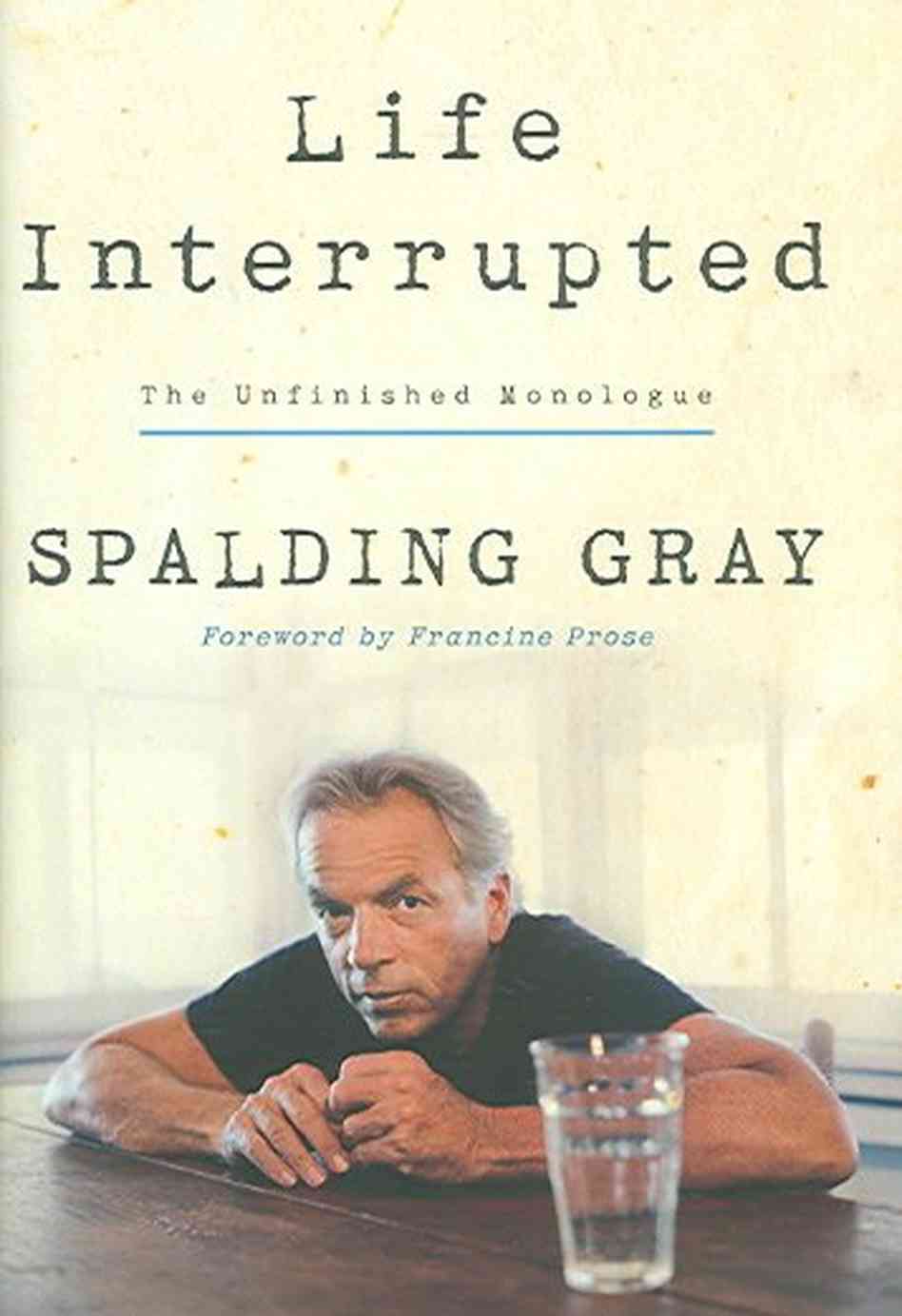
Cover of Life Interrupted/i>
(By the way, my worries were groundless: Out of the last seventeen books I read, 7 were fiction, 6 were non-fiction, 3 were collections of poetry and 1 was a play.)
Anyway, Life Interrupted is a wonderful collection that includes the title monologue plus two small companion pieces by Spalding Gray. These were the last pieces Gray was working on, still writing and ironing out, before ending his life in 2004. Filling out the volume is a series of remembrances given at two separate memorials to Gray, remembrances by fellow actors and writers, agents, producers, friends, and family. These are sincere, warm, and humorous reflections on a man who himself was sincere, warm and humorous.
The centerpiece, “Life Interrupted” recounts the horrible car accident and subsequent hospital stay that Gray experienced in Ireland in the summer of 2001. His account of the events before the accident seem to presage (at least to him) that death was everywhere: they were in the town of Mort in County Offaly, next to a monastery where gravediggers were stopping for a cigarette break, in the home of a host who himself had died two weeks earlier and from which, on his walk that morning through the surrounding countryside, Gray had encountered a dying calf.
He had tempted fate, he felt, because he told people he was content–happily married and enjoying fatherhood. His work had always revolved around anxieties, fears, conflicts, disasters. Now, he told someone that morning, he’d have nothing to write about. He was simply too happy.
Boy was he wrong about having nothing to write about.
His stay in the hospital, his transference to another, and then to another is close to slapstick. His detailed observations of his Irish fellow-patients, of his care-givers (a large transvestite with emerald green fingernails comes through the wards offering tea and toast), of the facilities themselves is wickedly funny, especially if you are not yourself experiencing it.
But the injuries were quite debilitating. A smashed hip caused him transference to one hospital. A large dent in his head sent him to another. There it was discovered he had a shattered orbital bone which was allowing open passage to his brain. A plate needed to be inserted and the bone fragments removed from his brain. He chose to fly back to New York for that procedure.
If all this sounds morbid, it is not. Like Gray’s more famous monologues, Swimming to Cambodia, Gray’s Anatomy, The Terrors of Pleasure, it is trenchant in its observation of life and life’s quirks. And extraordinarily funny.
The other two pieces, “The Anniversary” and ” DearNew York City” are much shorter. The first typical of his rambling, tangential style. The second a sweet paean to New York City in the aftermath of the attacks on the twin towers.
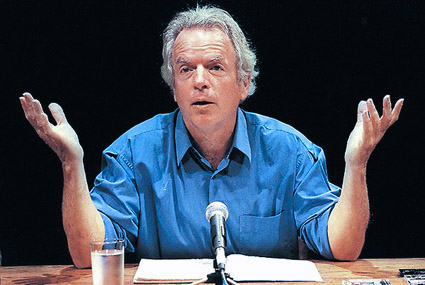
Spalding Gray and his entire stage setting
But by then, Spalding was in intractable pain–psychically and emotionally. He had returned from the accident in Ireland a changed man, and the demons he once tempered through his art were getting the better of him. On January 10, 2004 he was reported missing. In March, his body was found in the East River.
But again, this is never a morbid book. Gray’s pieces are funny and clever, and every reader will find him or herself nodding in agreement at the outrageous details that Gray observes.
And even the memorial speeches that finish the book are more upbeat than not. They recount Gray’s generosity, his curiosity, his love of fatherhood, and his kindness. Each speaker genuinely feels that he or she has been blessed to be considered Spalding Gray’s friend, to have spent time with this gregarious and wonderful man.
In a way, reading the book, one gets to experience the same.
In 2010, six years after Spalding Gray’s death, the director Steven Soderbergh put together a documentary on Gray and his art entitled And Everything is Going Fine. It is a wonderful introduction to the man who was a consummate storyteller, an entertaining man to spend an evening with. Here is the trailer:
“Verisimilitude” is a word I know from movie criticism and from literary criticism. I define it as a strict faithfulness to the truth of reality. And it is a concept that the movie director, Richard Linklater, has striven for in his triology, Before Sunrise, Before Sunset, and Before Midnight. In many ways he has succeeded.
For those who don’t know, in 1995, Linklater cast his stars Julie Delpy and Ethan Hawke in the first movie, Before Sunrise, as young twenty-somethings who meet on a train from Budapest to Vienna, who spend a day and night together and go their separate ways. (That the day is June 16th, the day that James Joyce met his life partner Nora Barnacle and the day that his novel Ulysses takes place is one of the many Joycean allusions in the triology.)
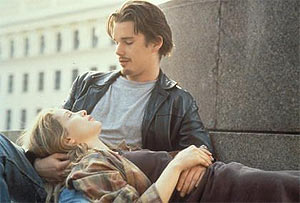
Celine (Julie Delpy) and Jesse (Ethan Hawke)
in Before Sunrise (1995)
To be truthful to his quest for truthfulness, Linklater nine years later, cast the same two actors to play the same characters who happen to meet again nine years later. This time Hawke’s Jesse is on a book tour in Paris when Delpy’s Celine meets him. His book–which fictionalizes the day they had spent together a decade ago–is a success. They spend this second time together walking through Paris before he must fly back to America. (Because the film takes place in mid-afternoon, Linklater only shot at that time to get the light exactly right. This is verisimilitide. )
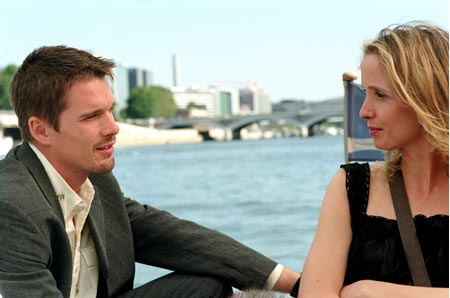
Jesse and Celine (Ethan Hawke and Julie Delpy) in
Before Sunset 2004
Now in the summer of 2013, we catch up once more with Jesse and Celine. As it is with the actors, it is with the characters–nine more years have passed for both. Now, in Before Midnight, Celine and Jesse have been together for nearly a decade. They have twin girls, and Jesse’s son with his ex-wife, now a young boy going into high-school, has spent the summer with his father and his new family in Greece.
In fact, as the film begins, Jesse is dropping his son off at the airport for the return flight home. Jesse is now a very successful novelist, having written two critically and commercially acclaimed novels (both based on the events that we saw in the previous two movies.) However, he is unhappy about his distance from his son and is toying with the idea of moving his European family to Chicago to be closer to the boy.
The film is divided into three basic scenes: the trip to the airport, a dinner at the villa they are sharing, and a night at hotel together without their daughters (a gift from their friends at the villa.) In the first scene, we see Jesse struggling with saying farewell to his son, Celine announcing that she has the opportunity to change jobs, and the two bantering amicably in the car, both daughters asleep in the back seat. However, Celine does not like the idea of a move to America or the prospect of refusing the career opportunity that has just now cropped up.
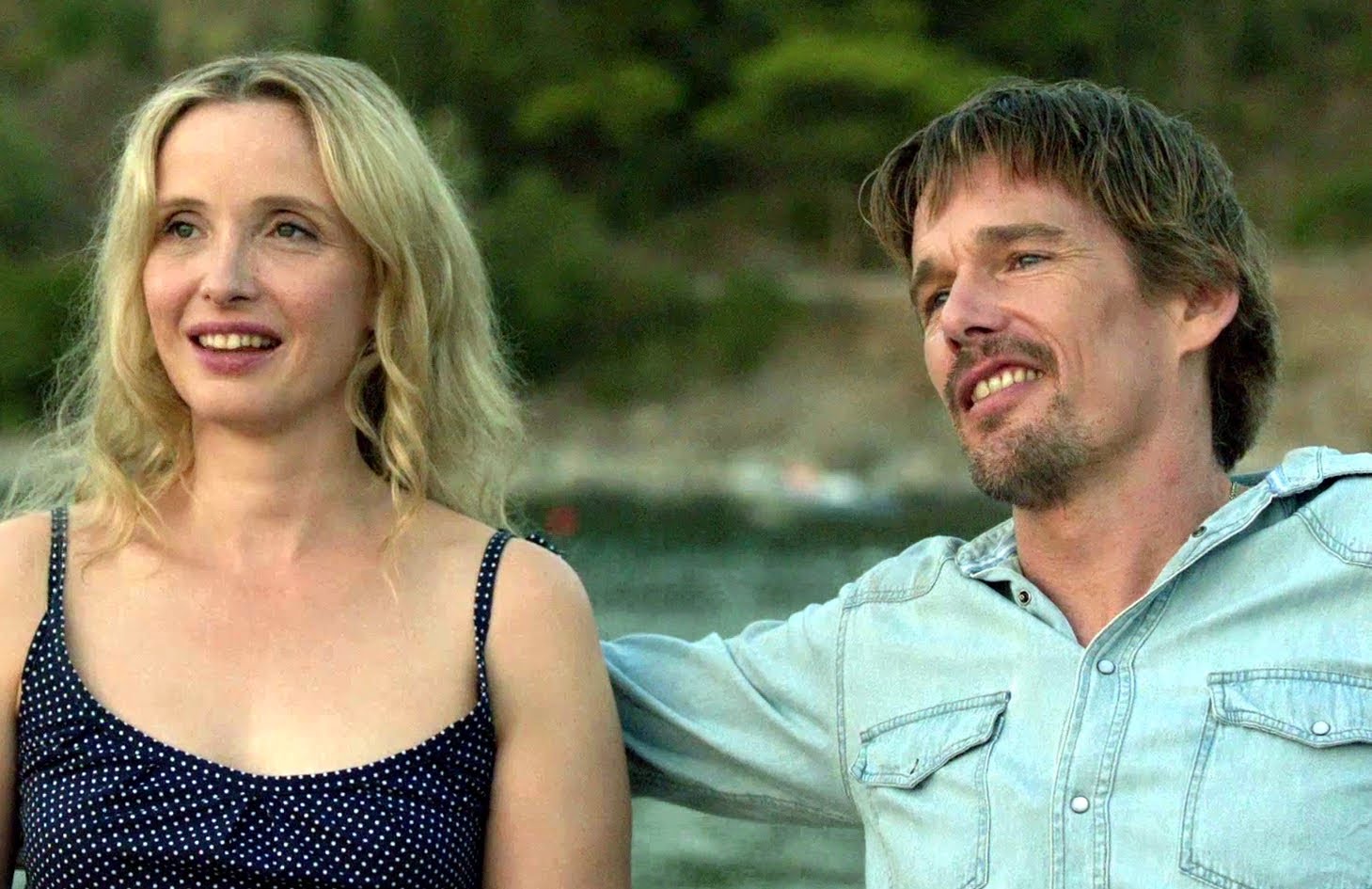
Celine and Jesse (Julie Delpy and Ethan Hawke)
in Before Midnight (2013)
The second scene is at their villa where the males sit outside discussing literature while Celine and the women prepare the dinner. It is light, gregarious, and beautiful–but you feel the emotion lying low within Celine. The dinner itself is wonderful. At turns, amusing, intelligent, and poignant, the conversation is witty and enjoyable. There is a tad of acid in some of Celine’s comments, but for the most part, it is a dinner which I very much would have liked to have joined.
As a gift, their friends have bought them a child-free night in a hotel in the local town. After dinner, the two walk into town, talk, reminisce, and plan for the future. In the lobby, Jesse is recognized and asked to sign a book. Celine is also asked, as the reader assumes (correctly) that she is the woman whom Jesse writes about. She reluctantly agrees.
The night however does not go exactly the way they had planned.
Like its predecessors, Before Midnight is wonderful because it seems real. (There’s that “verisimiltude” again.) People talk, plan, argue, hurt, and enjoy. There are no cataclysmic disasters pushing them into conflict, no terrorists to fight, no snarky humor to overcome. It is simply two people at a patch in their relationship that is proving a little rough. In their forties now (both the actors and the characters), they are looking at life differently and with more cognizance of its quick passing. If I have problem, it is that Celine’s outburst–while we anticipate its coming–still seems to come out of nowhere. But it is wonderfully honest and wonderfully real.
But, maybe that’s the truth of life–and the truth of relationships–we know little of the turmoil going on in a partner’s soul. Maybe that’s the truth of the movie.
And while Hawke and Delpy have comfortably grown into their parts for the past two decades and while the small supporting cast is more than excellent (Walter Lassally as the aging writer with whom they are staying, Xenia Kalogeropoulou as his widowed friend, and Yiannis Papadopoulos and Athina Rachel Tsangari as the couple who present them with the child-free night), it is the setting that struck me most. Filmed on the southern Peloponnesian coast, it is filled with gorgeous coastline, quaint villages, memorable sunsets, and illuminating sunlight. When I got home from the film, I spent the next two days searching real-estate in the area.
I spent two weeks there once. I wouldn’t mind spending more.
Here’s the trailer, if you want:

Kenzburo Oe
My knowledge of Japanese literature is very limited. I know a few poets–mainly ancient masters of the haiku–and I knew two novelists: Yukio Mishma, who many of my generation would know as the author of The Sailor Who Fell From Grace with the Sea, and the contemporary novelist Haruki Murakami, whose critically acclaimed novels such as Kafka on the Shore, Norwegian Wood, and The Wind-up Bird Chronicles have been international best sellers as well.
Well this summer, I was introduced to a new one–Kenzaburo Oe. (It is evidence of my ignorance that Kenzaburo Oe won the 1994 Nobel Prize for Literature, but nevertheless unknown to me.) I was introduced to him by a wonderful writer, reader, traveler and photographer who writes the erroneously named blog “francescannotwrite“ and who spoke about picking up the novel in Geneva last year, having known nothing about it or the author either. Her comments on it stressed the intelligence of Oe and her fascination with the plot. And it sent me searching for it.
She was right on both accounts.
The Changeling tells the story of an aging writer Kogito whose boy-hood friend is now his brother-in-law and a giant in the Japanese film industry. The brother-in-law, Goro, had once sent Kogito a tape-deck with a collections of tapes that he had made. These first tapes were of overheard (and recorded) conversations, eavesdropped moments, unsettling sounds that Goro collected to help Kogito put out of mind the vindictive journalist who has been hounding him. Fifteen years later, Goro sent him a new collection of tapes, tapes that were, in his voice, lectures, rants, philosophical queries, friendly advice and mentoring, and most importantly–the announcement of his suicide.

Book cover for The Changeling
In fact, it is on an early tape that Kogito learns of his friend’s death:
“So anyway, that’s it for today–I’m going to head over to the Other Side now,” Goro said casually. …”But don’t worry,” Goro went on, “I’m not going to stop communicating with you.”
And the rest of the tapes are Goro’s communication–from the Other Side. Each night Kogito listens, pauses the tapes, responds, pushes play again, responds again. In fact, each night after Goro’s death, Kogito has full-out conversations with his dead friend. Conversations that are filled with intelligence, logic, debate and argument and that are seeped in a great deal of memory.
After a while, Kogito’s wife–and Goro’s sister–asks him to stop. His loud conversations are upsetting both her and their disabled son.
Kogito does stop and accepts a guest teaching spot in Berlin. But Goro speaks to him in other ways there as well. There is a mysterious woman who claims to have known him, claims to know the real reason for Goro’s suicide. (The Japanese tabloids have been running with a scandalous story.) But most importantly there are Kogito’s memories, which, alone in Berlin, he can recount, examine and analyze with much greater attention to detail. Memories of Goro’s life, of his own, and of the two’s together.
We learn that Goro had been attacked and badly beaten by the henchman of Japanese organized crime (he had made an unflattering film about them), but then we learn that the left-leaning Kogito had years earlier been attacked several times by right-wing groups. Goro’s attack made international news and he is fighting the thugs in court; Kogito never reported his assaults.
We also learn a disturbing secret of the two men’s shared childhood. A secret that–when faced–shines much light on Kogito’s memories and the inward journey that Goro’s suicide precipitated.
Frances, of “francescannotwrite” mentions the intelligence with which the novel is imbued. And she is right. The conversations between Goro and Kogito, one dead and one alive, are heady and range from art and politics to society and life, from French literature and Japanese gangsterism to the War and their childhoods. In his tapes, Goro seems–from “the Other Side”–to be pushing his friend to a clarity that his life requires.
And it is a wonderful read. Like the art of Hokusai, where there are minimal lines but great power, Oe’s story is rich and dense and intelligent but it never feels that those things are in the foreground. The power is there in the conversations, the allusions, the references, but In the foreground is the fascinating history of Kogito and his dead friend.
It is a memorable story and a memorable novel. So now, I need to find some others.
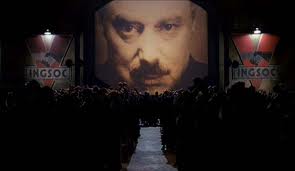
In the two weeks before the opening of school I have the students who will be entering my class read George Orwell’s 1984. It is the perfect prequel to the first two books we read in class, Brave New World and A Handmaid’s Tale. (We start out with a big dose of dystopia.)
Well, one of my more ambitious students has already done all his summer reading and e-mailed me about 1984. Orwell was pretty clever, he wrote, but he doesn’t think that that kind of thing could really ever happen.
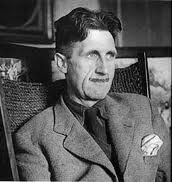
George Orwell
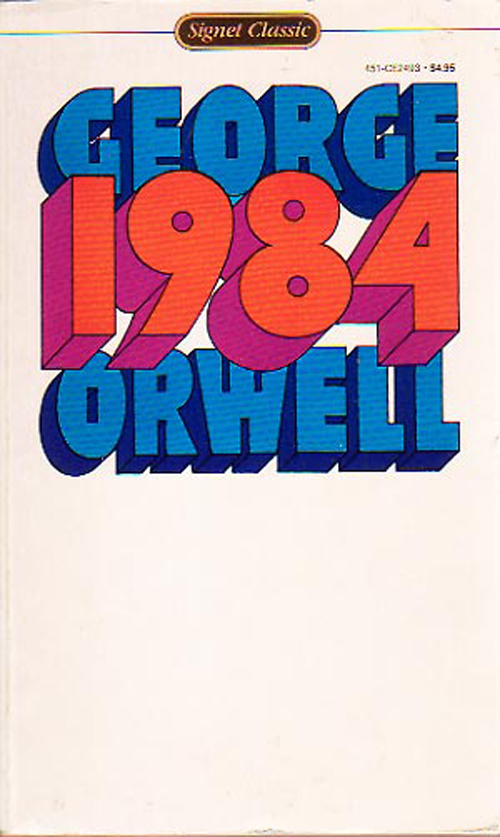
Signet Classic’s cover of 1984
Boy, did he pick the wrong summer to make that statement.
The other day, I saw the trailer for a film, Closed Circuit (see bottom of post). It is a terrorist-mole-investigative reporting-shady government department type of thing. And it looked very good. But, as I was telling a friend, one of the major players in the film is the network of 1.85 million close circuit cameras mounted throughout Britain. (http://www.theguardian.com/uk/2011/mar/02/cctv-cameras-watching-surveillance). That is roughly one camera for every 32 people. Of course, that ratio is a lot smaller in urban areas than in rural.
George Orwell saw it coming.
And then of course, the major news story of the summer was the Snowden leaks. (As Yossarian said in Catch-22, “Where are the Snowdens of yesteryear?”) For many, the actions of Snowden, his search for asylum, the international posturing and subsequent tensions have been the most riveting part of the story. What seems to have trouble staying in the foreground, however, is the fact that the U.S.government has been spying on its citizens, collecting data from their e-mails, their texts, their cell-phones, and their search engines. The citizens have been assured that the NSA is not going to use this data, but is simply archiving it. “For what?” is a sensible question.
George Orwell would have certainly asked it.
And the technology just gets better and better. Even the most naive teenager knows that his computer searches and activity are catalogued and sold to marketers. So it is not surprising that if the day after you search on-line for an umbrella for your father, you see umbrella advertisements popping up on your screen. (And depending who you are, where you are, and how often you searched, the price for the same umbrella will fluctuate.)
Well now this same marketing scheme has been adapted by the brick and mortar stores through face-recognition technology. Higher-end stores are testing facial-recognition technology which will alert store clerks immediately when someone (usually a celebrity) walks into the store and what his or her buying preferences are. At the moment the focus is on celebrities because their photos are already available in their databanks.
But it won’t be long. Walk into your favorite department store, spend some time in the men’s shoe department, and you might find an advert for men’s shoes pop up the next time you click on your device. They already know what you think you want.
Google has the technology for you to snap a photo of someone on the street, upload it, and learn everything you want about them. They have refrained from releasing it so far, mainly due to the legal tangle that Facebook is finding itself in. Facebook’s ‘”tagging” photos capabilities is a subtle way to create an enormous facial-recognition database. And that database is available not only to you and your friends.
As Facebook founder Mark Zuckerberg once famously claimed, privacy is no longer a “social norm.”
George Orwell would find it all familiar.
If things go right, the first few days in school should have a lot of interesting discussions.
I hope so.
Here’s the trailer to Close Circuit. It looks like it could be good.
“Sponsored by the Academy of American Poets, the Walt Whitman
Award is given annually to the winner of an open competition
among American poets who have not yet published a book of poems.”
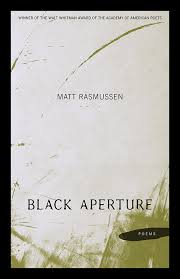
Black Aperture by Matt Rasmussen
Each year the Academy of American Poets sends its members a copy of that year’s winning volume. This year the title was Black Aperture by Matt Rasmussen. And if good poetry is meant to rattle in your head, nestle there a while in the corners of your mind, and then come unbeckoned to the forefront of your consciousness, then Rasmussen’s poems pass the test and the Academy made an excellent choice.
Within the collection, there are poems about deer hunting and bird hunting: “when cleaning a grouse,/puncture the crop/to release the scent/of fresh clover.” (from “O”). There are poems that re-imagine the creation:
The animals gathered
and having cried enough
would never again.
God knew he had
asked too much. He threw himself
into the sun and burnt
into white ash. It fell
from the sky and covered
the mountains. The animal
who named everything
called it snow. (from “And God Said”)
And there are poems about poetry itself: “Through the mirror, it saw a house/of air falling inward. The poem heard/the poet calling and jumped.” (from “I am not a poem”)
But the overriding theme is the suicide of a brother.
There are three separate poems called “After Suicide” and one poem, “Reverse Suicide,” which takes the events in reverse to when both the speaker and his dead brother are once again raking and bagging leaves. In truth, the majority of poems take this momentous act as its subject. And those that don’t address it specifically are tinged with the shadow of it, a shadow that hovers over every poem.
Yet the poetry is not maudlin or morbid. It is, in fact, a source of liberation, as the speaker attempts to clarify through language both the act and his reactions, both his grief and his understanding of it, both his dead brother and his relationship with him.
Midway through the book, Ramussen places a poem called “Chekhov’s Gun.” Chekhov’s theory is that if a loaded gun appears in a play in Act 1, it must be fired by Act 5. Rasmussen begs to differ:
Nothing ever absolutely has to happen. The gun
doesn’t have to be fired. When our hero sits
on the edge of his bed contemplating the pistol
on his nightstand, you have to believe he might
not use it. … (from Chekhov’s Gun”)
It is a clever argument within the Black Aperture, because that gun–not only loaded but already fired–is present from the very beginning of the collection. The possibility of “not firing” that he posits in the Chekhov poem, is no longer a possibility. The speaker circles the once possible act of not-firing, while coming to grips with the already accomplished fact. That he does so with clarity, compassion, understanding and brilliance raises Matt Rasmussen’s Black Aperture from a mere elegy for a dead brother into something much more universal and accessible to us all.
The Official Web Site of LeAnn Skeen
Grumpy younger old man casts jaded eye on whipper snappers
"Here is my secret. It is very simple: It is only with the heart that one can see rightly; what is essential is invisible to the eye.."- Antoine de Saint Exupéry
Of writing and reading
Photography from Northern Ontario
Musings on poetry, language, perception, numbers, food, and anything else that slips through the cracks.
philo poétique de G à L I B E R
Hand-stitched collage from conked-out stuff.
"Be yourself - everyone else is already taken."
Celebrate Silent Film
Indulge- Travel, Adventure, & New Experiences
Haiku, Poems, Book Reviews & Film Reviews
The blog for Year 13 English students at Cromwell College.
John Self's Shelves
writer, editor
In which a teacher and family guy is still learning ... and writing about it
A Community of Writers
visionary author
3d | fine art | design | life inspiration
Craft tips for writers
 j. p. bohannon