Movie Review: Something in the Air: Born Too Late

The actual title of Olivier Assayas’ new film is Après Mai–a reference to the months following the student and worker demonstrations of May 1968 in France.  And that, in many ways, is the focus of the film: young, sincere characters trying to maintain the commitments of 1968, but somewhat too young still to be a real part and unprepared for the crashing ordinariness of the life to come.

The film begins with high-school students’ listening to their teacher’s monotonous reading of Pascal’s Penseés. Within minutes of screen time, these same students are scrambling away from overzealous police dispelling a student demonstration.  The life of the classroom and their political/social/activist lives are much, much different. The teachers give them Pascal and they are reading Gregory Corso, Chairman Mao and listening to Phil Ochs.
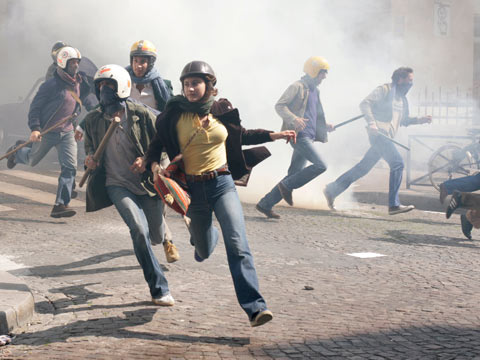
Early riot scene in Something in the Air

Early riot scene in Something in the Air

I had a friend who was a student in Paris at that time in 1968.  When I asked her about it, she sort of shrugged.  “The only difference,” she said,  “was that afterwards we were permitted to call our professors tu rather than vous.

But for Gilles, Alain, Christine, Rachkam la Rouge, they want very much for the  spirit of May 1968 to be carried on, to be carried through.  They believe that May was not the climax but the beginning of the revolution. Stuck in their sleepy village outside of Paris, the students join political parties, pack debating halls, distribute the radical free-press, and organize guerrilla graffiti forays against the local establishment and police.  One of these night raids goes wrong and a guard falls into a coma when hit with a bag of cement mix.  The students decide to scatter.

Gilles (Clémont Métayer) and Christine (Lola Créton) hitch up with a radical collaborative on its way Italy where they become lovers and later part as she continues with the collaborative to make a film on Italian workers.

Christine and Giles on the road to Italy

Christine and Giles on the road to Italy

gilleschristine

Gilles (Clémont Métayer) and Christine (Lola Créton)

Gilles is torn in his radicalism–for his passion is art, and he is not convinced that his art must always serve the “cause.”  Alain (Felix Armand)  and Leslie (India Menduez), an American he meets in Rome,  go East to Afghanistan, he an artist and she a dancer looking for spirituality. Disillusioned over time, they all return to France, and ultimately to Paris.

But there is another story running through Gilles life.  Of course, in a story of a teenage-boy there needs to be friction between him and his father, a successful movie director.  While there is never dramatic conflict between the two, as he grows, Gilles is able to tell his father how superficial and wrong-headed he believes his film adaptations are.  (The father makes adaptations of George Simenon’s Maigret novels.)

But the more important sub-plot is about Gilles and his true love, Laure (Carole Combes).  When she first appears early in the film, there is a jarring film switch from the smokey riots of their village to an Edenic, woodsy scene. She has come to meet Gilles and is in flowing white and the sun illuminates both her and the shimmering foliage around her.  I felt however that I was in a 1970’s shampoo advertisement and that any minute I would hear Donovan singing “Wear Your Love Like Heaven.”

Gilles and Laure

Gilles and Laure

Laure is a bit more worldly than Gilles and his mates, and her wealthy bohemian parents are taking her to London, as the father is the light-man for a fledgling rock band. She is willowy and bright and airy and full of sunshine.  And she leaves a mark that even Christine knows she cannot undo.  Later, when his father informs him that she has returned, he ventures out to her parents’ chateau for a party.  Throughout the party, I was reminded of when the Stones had moved to the south of France in the early ’70s  and had worked on Exile on Main Street.  There was the same louche, blowsy freedom, the same drug use, the same music, the same comings-and-goings.

The party is important, though I am not positive how it ended.  Gilles leaves. Laure jumps from a burning building and that is it.

And then real life steps in.  Gilles is a “go-fer” for his father’s film company (although a left-wing broadsheet has begun using his drawings), Leslie abandons her “spirituality” and returns with her father to New York and Julliard,  Rackham le Rouge leaves the Trotskyites for inconsequential anarchism, and Christine discovers that the earnest leftism of the man she is living with and the collective they are part of does not carry forward to women.

Olivier Assayas–who wrote and directed–gives us a nostalgic film, a film that even looks from an earlier period. The colors, the lighting, the cutting, the soundtrack all capture a particular moment in time.  And the two leads, Créton and Métayer are likeable and familiar–we do care about them and their decisions.

Frequently in the film, we watch characters watching films–and these films within a film are rendered in wavering, sincere, gaudy, and innocent beauty.  (Perhaps part of that innocence is the knowledge in hindsight that much of it is not going to last.) Indeed, film and film-making is such an integral part of the story that now I am not sure if Apres Mai (Something in the Air) isn’t a dissertation on film of that era disguised behind a story of that era.

In the end, Gilles is working on a science fiction film in London that features giant lizards and Nazis (and Dolores Chaplin, the granddaughter of Charlie and Oona!); Christine’s collective is releasing its first commercial documentary on Italian workers (though free to workers’ unions) and Gille’s dad is still turning out the Maigret mysteries.  However, Apres Mai ends with a haunting, new wave, almost psychedelic clip of a willowy woman walking towards the camera.

We recognize her by the end.

♦     ♦     ♦     ♦     ♦     ♦

And for a treat, here’s the Stones live in 1972 doing “Tumbling Dice” from Exile on Main Street.

Sunday Book Review: Hitch-22: A Memoir by Christopher Hitchens

It is a cliché that one should never meet the writer’s that one admires–disappointment is surely to be the outcome.  Well, Christopher Hitchens is the exception to the rule.

I admire him even more having read his memoir.

As one of the most prolific and provocative essayists of the last thirty-odd years, Hitchens seemed to be everywhere–his journalist’s beat the places where injustice, cruelty, and war loomed most horribly.  From Belfast during the heights of the “Troubles,” to Argentina during the period of the “disappeared,” to Poland at the beginnings of the “Solidarity” movement, to Zimbabwe, Mogadishu, Romania, Cyprus, Iraq, and Iran, Hitchens brought his sensible eye and exquisite writing style to reveal to the world the frequent cruelty and inanity of world politics, exposing the greed and stupidity of many of the political leaders who claim to have the “peoples’ interests” at heart.

It is that principled, observant eye and the exquisite sense of writing that defines Hitchens memoir–for his biography is one of two sides: the principled, political advocate and the Oxford educated, man of letters. And the people he encounters come from both of these worlds as well.

On one hand, he is with a young Bill Clinton at Oxford when he infamously “did not inhale.”  (Hitchens says that is probably correct because Clinton was terribly allergic to smoke. However, he adds, he certainly consumed more than his share of the “brownies.”) He meets Margaret Thatcher when she is made head of the Tory party. (He immediately got in a disagreement with her and she smacked his bottom with rolled up program to terminate the discussion.)  He meets the vile General Videla of Argentina; the future first elected president of Iraq,  Jalal Talabani; the Cypriot president, Archbishop Makarios. He debates Western pundits and arranges lectures for some of the world’s most unsung champions of the people.

On the other hand, his closest friends are major lights of the British literary world: the novelists, Martin Amis and Ian McEwan, and the poet James Fenton.  His accounts of their times together rival any of the apocryphal stories of the Algonquin Table.  (My favorite line is the critic’s Clive James’ review of Pumping Iron, the documentary on body-building that introduced Arnold Schwarzneggger to the world.  James said that Schwarzenegger looked like “a brown condom stuffed with walnuts.”)

But what stands out in Hitch-22 is not the list of notables with whom Hitchens associated or fought against. It is the dedication to principle with which he lived his life.  As a young man he was a dedicated member of the International Socialist party and later became a dedicated member of the Labour Party. Both of these he jettisoned when he believed that the party had strayed from its principles–and he continually called them on it.

As he traveled from hot-spot to hot-spot, he began to trust the leaders of all these revolutionary movements less and less. Here’s what he says:

I eventually came to appreciate a feature of the situation that since helped me to understand similar obduracy in Lebanon, Gaza, Cyprus, and several other spots. The local leadership that are generated by the “troubles” in such places do not want there to be a solution. A solution would mean that they were no longer deferred to by visiting UN or American mediators, no longer invited to ritzy high-profile international conferences, no longer treated with deference by the mass media, and no longer able to make a second living by smuggling and protection-racketeering.

A bit cynical to be sure, but this is from a man who has entered the belly of the beast and refuses to swallow the muck he sees there.

Always an iconoclast, Hitchens attacks those he believes deserve it, no matter what their status or reputation. For example, early on, he admits that he felt separated from the rest of the world in November, 1963 for not mourning sufficiently  the assassination of the American president.   The sainted Jack Kennedy he condemns as a “high risk narcissist” for the game of chicken that he played with Russia over the Cuba missile crisis.  (This event  very likely sowed his interest in geopolitics.) He very famously debunked Mother Theresa and was called in by the Vatican to present a case against her when she was up for canonization. (This used to be called “The Devil’s Advocate,”  a position that the Vatican eliminated by the time Hitchens was called in. He jokingly said that he  must then be advocating for the devil, pro bono.)

Like any good thinker, Hitchens is not afraid to change his mind, to reconsider his position, when presented by new facts.

More than anything else, it is this life as a DELIBERATE THINKING HUMAN that impresses me more than anything else in his story. Hitchens considered the world around him with open, unprejudiced eyes, tried to make sense of it, and tried to expose what he saw as nonsense.

Hitchens died 15, December 2011, after a struggle with esophagal cancer.  His writings live on. I have two collections of his essays on hold at our public library.  I can’t wait to tackle them.

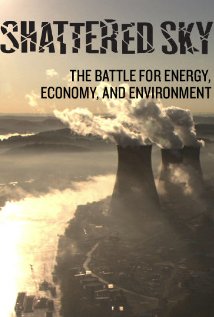
Shattered Sky–An Important and Hopeful Documentary by Steve Dorst and Dan Evans

Tonight I was lucky enough to attend a premier of the film Shattered Sky in Washington D.C. as part of the closing night of the Environmental Film Festival.  (Full disclosure: I was invited because I am friends with one of the filmmakers, Dan Evans.)  Held in the majestic Carnegie Institution for Science at 16th and P streets with a following reception at the Bar at the Hotel Rouge, the film seemed like a good way to spend a Sunday night and catch up with some friends I haven’t seen in a while.

I am so glad I went.

The film–which will be shown on PBS stations in the fall–deals with two distinct environmental situations, separated by four decades. In the 1970s, when the hole in the ozone layer was first detected, the science showed that CFCs were the main culprit, and America and Americans led the way to curtail the use of these photo-carbons around the globe. Fighting against an indifferent world, many of whom had financial interests in the status quo, the EPA–under the Reagan administration–pressed its case hard. The climax of this fight occurs in a marathon session in Montreal when America held sway and the rest of the world finally signed on to greatly limit the use of these ozone-depleting agents. The film  celebrates this moment in American leadership, touting the efforts of Johnson, Nixon, Carter and Reagan admnistrations. It is this battle–and the victory–that is the crux of the film.

Now fast forward, thirty years.  Climate-change is today presenting even more dire predictions. But the topic has become a political tug-of-war.  With the “ozone” problem, there seemed to be immediate repercussions for the public–such as skin cancer and cataracts–and the public made its voice  heard through the marketplace, refusing to buy aerosol products, for instance, and forcing industry’s hand to come up with alternatives. The effects of climate-change, however,  are not so immediate–and the possibilities of market pressures from the public are unlikely given our modern way of life. Plus, while we are enjoying this balmy spring, it is hard to imagine immediate  down-side.  But the down-side is there, and it is drastic. The film deliberately tries to skirt partisan politics; instead, it asks for America to take on the kind of leadership that it showed in the “ozone” battle many years ago.  And it asks, because the situation is urgent.

Unlike many environmental documentaries, however, Shattered Sky does not leave one feeling helpless and doomed, but instead is full of hope. For if America was once able to forget its political differences and  fight together to counter an environmental disaster such as the depletion of the ozone layer, it can certainly rise to the occasion once more.

The science is there.  Those who oppose it, who try to find holes in the facts, do so for other reasons than truth, reasons that often deal with economy, industry, and self-interest. The film is riveting, rational and cautiously hopeful, even as it recognizes the possibility and the consequences of no action at all. Check out the film’s web site for more information.  Check out its Facebook page. And more importantly try to check out the film.

The Shattered Sky web site is here: http://www.shatteredsky.com/

The IMDB review is here: http://www.imdb.com/title/tt1795650/