Book Review: Professor Andersen’s Night by Dag Solstad

Journal Copy - 37

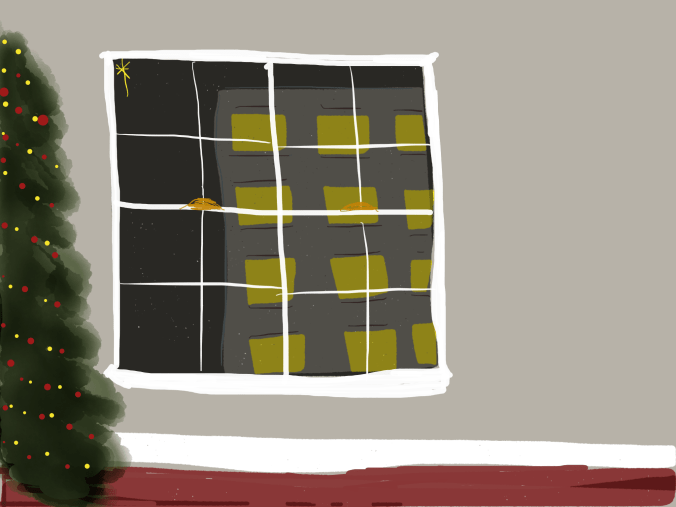
“The Quiet Christmas” illustration 2016 by jpbohannon

In Camus’ iconic novel The Stranger, a man murders another and spends the second half of the novel trying to understand and rationalize both his actions and their consequence. Despite Camus’ distancing himself from the term, The Stranger is the quintessential “existential” novel.

As is the Norwegian writer Dag Solstad’s novel Professor Andersen’s Night.

But unlike Camus’ Meursault who kills an unnamed Arab on a beach in Algiers. Professor Andersen does not kill but witnesses a murder, on Christmas Eve night in the apartment across from his. And his internal struggles are every bit as Sisyphean as Camus’ protagonist.

In Solstad’s novel, a literature professor in Oslo who specializes in Ibsen is a loner who enjoys both his solitude and communal traditions. (Shyness and DignitySolstad’s first novel translated in English–featured a high-school literature teacher who had his moment of crisis while teaching Ibsen.) Thus on Christmas Eve night, Professor Andersen dresses in a suit and tie, cooks a traditional Christmas dinner and opens the two gifts under the fully decorated, full-sized tree while enjoying his after-dinner coffee and cognac. It is the perfect traditional Christmas Eve… except that he is willfully alone.

To compensate, he draws the curtains of his apartment window and stares out at the festivities in the windows across from him. In the various windows, he sees people sitting at meals, standing convivially with drinks in hand, sitting around distributing gifts.

And one man strangle a woman.

Naturally, Professor Andersen is shocked. He reaches for the phone, dials the police, but hangs up before he is connected.

He cannot make the call.

Through the holidays and for the next month after, he is obsessed with the murder and with his decision not to call. He searches the various newspapers for mention of the murder or mention of a missing woman. He goes over to the apartment building and discovers the man’s name. He watches from behind the curtains the man’s comings and goings.
Pocket_fullbok

Book cover of the Norwegian paperback edition.

At a dinner party, he considers telling his friends, all radicals when they were together in college, but now quite comfortable in their professions. He knows that they would not understand his decision, that their advice, concerns, discussion would be far off the mark.

And so he examines his every thought–past and present. Is he committed– as a member of a civilized society–to tell? Or does his championing of the individual commit him not to tell?  He considers his options, his mental growth, his expertise in literature (where, after all, he is consistently analyzing men who are put into crisis and must act). He examines his soul, his basic beliefs, to a degree that most of us do not.

And then he meets the murderer–unintentionally, in a sushi restaurant. Afterwards, he invites the man in to his apartment for a drink.

Even this encounter, does not quell his internal wrestling. He has a quasi-religious experience, believes he has received some sort of divine grace. And yet still he must ponder the consequences of both his acting and not acting.

Professor Andersen’s Night is a short, but dense, novel. The internal dialog that Professor Andersen conducts is wrought by philosophical quibbling, rich in existential anguish, and accessible in its “everyman” applicability.

Like Elias Rukla in Shyness and Dignity, he too comes to doubt all that he has believed and professed, to second-guess his career and all that it purported to do. And he too must fathom, exactly what it is he stands for and where he goes from here.

Professor Andersen’s Night is a thoughtful novel–a novel of ideas and questions. It is a novel that stays with you for the better.

And makes one consider where any of us actually stand.

Movie Review: Maggie’s Plan, directed by Rebecca Miller

maggies-plan-poster

Poster for Maggie’s Plan

A general statement would be that I greatly admire Ethan Hawke’s movies. (His “serious” movies. I’ve never seen his more commercial work.) Just as true is the fact that I rarely like the characters Ethan Hawke plays in these movies. Too often they seem to me to be self-involved posers. To wit, while I truly love the three Richard Linklater films (Before Sunset, Before Sunrise, and Before Midnight), I do not like the Ethan Hawke character, particularly in the last. (As his success as a writer grows in these movies, so does his self-involvement and pomposity.) I believe that Hawke himself to be an interesting, knowledgeable and intellectual artist, honest about his art and serious about his decisions, but playing one on film is another thing. My god, the most annoyingly self-centered intellectual twit of all time is Hamlet, and Ethan Hawke’s version of the character is true to form. Though I love this version of Hamlet, I’m pretty glad when Hawke’s Hamlet gets it in the end (by gun this time rather than sword.)

Having said that, Maggie’s Plan is a sweet, whimsical film, filled with quirky performances and centered around the Ethan Hawke typical role–a wannabe novelist, anguishing over his work, and pretty sure the world revolves around him.

'Maggie's Plan' Film Set

Greta Gerwig as Maggie. Photo Credit: Kristin Callahan/ACE/INFphoto.com Ref: infusny-220

Quickly, the film concerns a young girl in New York, Maggie (Greta Gerwig) who wants to get pregnant. She finds a potential sperm donor–a friend from her undergraduate days in Wisconsin (Travis Fimmel). However, at the same time she meets  John (Ethan Hawke) a  professor at New York’s New School where she also works.

And so, they begin an affair.

John is writing a novel, and is not getting the support he wants from his wife Georgette, a superstar intellectual played by Julianne Moore, who hilariously uses an accent that channels Madeline Kahn from her Young Frankenstein and Blazing Saddles days. John begins having Maggie read his work-in-progress, which is basically how he seduces her.

Hawke and Gerwig

Quickly Maggie and John get married, they have a child, and just as quickly she wants to give him back to his wife. His self-centeredness is simply too much to cope with. So elaborate plans are made to “return him.” (This could be the “Maggie’s plan” of the title, or it could be her strategy to have a child.)The plot to get the original husband and wife together is humorous and flawed and is the gist of the film.

Helping Maggie along are her two friends Tony and Felicia, played by Bill Hader and Maya Rudolf. Both of these actors continue to grow their talents in a variety of interesting projects, and in Maggie’s Plan, they make the most of the minutes they are on the screen.

Maggie herself is quirky and likeable and somewhat innocent. Her wardrobe (which seems to be what can only be called 1950s Wisconsin-chic) places her as an outsider in savvy New York, and her contact with the intimidating Georgette only underscores this.

https://resizing.flixster.com/o0a2VgeWXV4T6CTeZJXpo3nhvAc=/fit-in/1152x864/v1.bjsxMDUwMzI3O2o7MTcwMjI7MTIwMDs0NTc4OzMwNTI

Maggie (Greta Gerwig) reveals her plan to Georgette (Julianne Moore)

Maggie’s Plan is light fare–so much lighter than director Rebecca Miller’s previous work. There is a sweet and satisfying (though hinted at) ending and there are some wonderful performances. (Again, Julianne Moore is hilarious, and seems as if she is enjoying playing so over-the-top.)

It is not the kind of film where one goes for  coffee afterwords to deconstruct and analyze it–and it is not intended to be such. Maggie’s Plan is simply a pleasant way to pass a few hours in the summer.


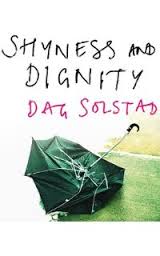
Book Review: Broken Umbrellas and Ennui: Shyness and Dignity by Dag Solstad

FullSizeRender(2)

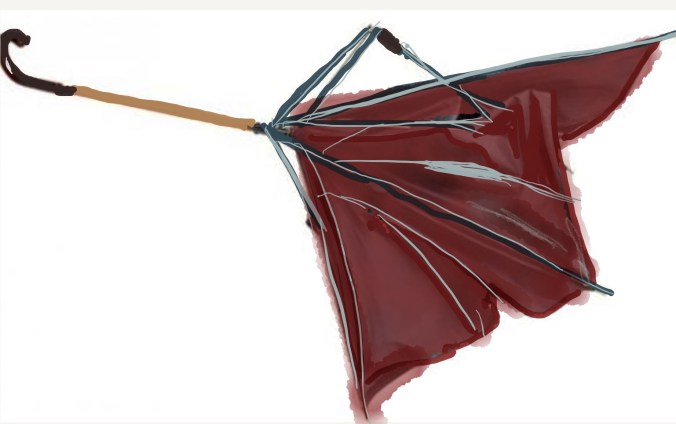
“Broken Umbrella” illustration 2016 by jpbohannon

Dag Solstad, a novelist and playwright, has won numerous prizes for his writing, including the prestigious Nordic Prize for Literature. He is the only author to have recived the Norwegian Literary Critics Award three times. This is the first English translation of his work. Solstad lives in both Oslo and Berlin.
Back Cover copy of Shyness and Dignity by Dag Solstad

And most of us have never heard of him.

In general, we Americans are very ignorant of writers in other languages. It is not our fault (despite our staunch embrace of our mono-lingualism). American publishing houses take very few chances with translated works. Of course, there are exceptions. Publishing houses such as Europa Editions, Graywolf Press, and Vintage have been steadfast in bringing forth translated novels. And every so often they catch on. Elena Ferrante is a phenomenon; Jo Nesbo continues to thrill; and the Girl with the Dragon Tattoo series was a publishing behemoth.  But in general, we are isolationists when it comes to reading.

To wit, Shyness and Dignity, Solstad’s first novel to be translated into English, was published in Norway in 1996 and in the States in 2006. It was his first novel translated into English–thirty-seven years after his first book came out in 1969.

(One would think that his books covering each of the FIFA World Cups from 1982 on would have introduced him to Americans. But then again, we as a nation are just beginning to watch soccer; obsessive reading about it is probably a bit down the road.)

And so we have Shyness and Dignity. (As of now, there are three novels translated: Shyness and Dignity, Professor Andersen’s Night, and Novel 11, Book 18.)Shynessbookcover

Elias Rukla is a middle-aged teacher, teaching Norwegian Literature in a National high-school in Oslo. He is frustrated by his work, has lost belief in the relevance of what he professes, and feels useless in the new  educational arena. One day, after his last class, a class in which he felt he was being particularly trenchant, in which for the first time in a while he believed he had said something original, something worthwhile, and in which at his greatest moment of insight, he was interrupted by the bored groan of one of his students, Elias left the building for the day.

It was raining, he was prepared, but his umbrella would not open. Another moment of frustration. Many attempts at opening it escalated into a battle. He sliced his hands with the umbrella ribs,  threw the umbrella on the ground and began jumping on it.  As students gathered around to watch their teacher wrestle with this inanimate object, he lashed out, calling one tall blond student a “fat snout” and a “damned bitch.”

At that moment, he realized his career was over.

This scene is actually a very small part of the novel. The opening frame, if you will. As he wanders the streets of Oslo, considering the irreparable consequences of his actions, he thinks of how he would tell his wife.

And then he thinks of how he had met her. And then he thinks of the friend who had introduced them. And then he thinks of what he and she and the friend had once been and had now become.

It is a story of hopes unrealized, optimism and activism dampened, and life soullessly borne.

We follow Elias through his graduate school days and his fascination with a young philosophy student who is the darling of both his peers and his professors. Not only is Johan Corneliussen a prodigy in philosophy–particularly Kantian philosophy–but he is a prodigy in life. As Elias explains:

Johan Corneliussen moved without difficulty from ice hockey to Kant, from interest in advertising posters to the Frankfurt school of philosophy, from rock ‘n’ roll to classical music. Operettas and Arne Nordheim …  Music, ice hockey, literature, film, soccer, advertising, politics, skating.

It was this total immersion into life–so different from the shy and insecure Elias Rukla–that was Corneliussen’s attraction. And Rukla became his shadow, inseparable friend, partaking in it all and basking in the reflected adulation that was directed towards his companion.

As we follow the college students through their various interests and politics, their associates and lovers, we also see the crumbling of young certainties. Except that Elias retains his much further into life.

It is struggle with his umbrella that brought about this realization that all has changed, his career, his wife, his beliefs, his interests.

And with this meandering journey homeward, he has reviewed his entire life up to this very moment, this moment when he feared what he would say to his wife. All had changed and he was just realizing it now.

Solstad’s novel is an examination into what makes us act, what compromises we make, and what indignities we are willing to bear. It is an internal examination, not of conscience, but of consciousness. It is a somewhat dreary look at the dampening of hope, the degrading of cultural literacy, the momentum of capitalism. Solstad’s sentences are long and meandering, walking through a paragraph much the way the Elias walks through the streets of Oslo, but each one is perfect.

Each one brings us a few steps closer to the destination that Elias must ultimately reach.

Movie Review Monday: Wiener-Dog, directed and written by Todd Solenz

Adjusted wiener dog

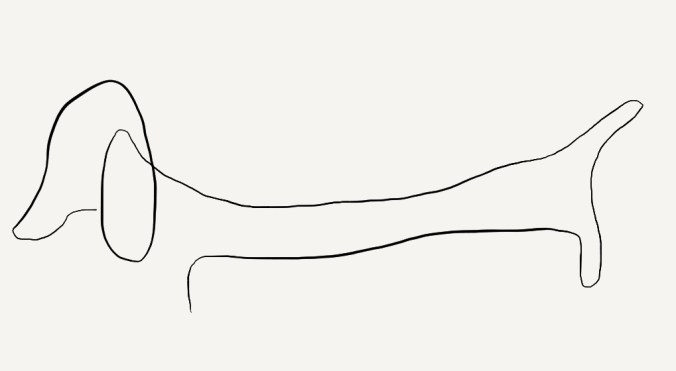
“Wiener-Dog”  illustration 2016 by jpbohannon                                                                                                                                                       (based on one-line Picasso drawing of his dog LUMP)

I have always had a thing against dachshunds. I believe it stems from cartoon watching when I was a child. Back then, if you were a dachshund in a cartoon, you were typecast: you had to wear a monocle, smoke a cigarette in a long cigarette holder and dress like a Nazi officer. (German Shepherds were often the guard dogs, the grunts, but the dachshunds were ALWAYS the officers.) Anyway, the prejudice stuck, and I am still not fond of dachshunds.

So against my better instincts, I went to see Todd Solondz’s Wiener-Dog. A quirky series of vignettes, performed by an interesting cast, and tied together by a dachshund who is passed from one owner to the next. And while the dog itself has little to do with the different stories, it is the tie that binds, so to speak.

MV5BMTc5ODU5MTM0OV5BMl5BanBnXkFtZTgwOTAzNzIwOTE@._V1_SY1000_CR0,0,679,1000_AL_

Movie poster for Todd Solondz’s Wiener-Dog

We begin with a young boy (Keaton Nigel Cooke), a cancer survivor, whose father brings the dachshund home to the boy as a companion. The parents are self-absorbed; the boy is understandably interested in death and life and birth; and the mother, played by Julie Delpy, tries to answer his questions honestly. However, she has difficulty with this. (The story she tells to explain why it is important to have the dog spayed is extraordinary in its outlandishness. At one point in the story, the man in front of me moaned at the political incorrectness in her tale.)

The parents cannot handle the dog in their pristine house–who has gotten violently and graphically sick–and quickly take it to the vet to be put down. Here the vet’s assistant (Gretta Gerwig) steals the dog and brings it home. While shopping for dog-food, she meets an old high-school friend (Kieran Culkin) with a heroin problem. He is driving across country to Ohio to inform his brother of their father’s death. For some reason, she decides to accompany him. The dachshund sits on her lap throughout most of the trip and does nothing. Much like Gerwig herself.

Although the wiener-dog is given to Culkin’s brother and his wife in Ohio (Connor Long and Bridget Brown) at the end of Gerwig’s vignette, it next appears in New York City with a film-school instructor, Dave Schmerz (Danny DeVito). Schmerz is waiting for his big break; his screenplay has been sitting in offices in Hollywood and it is obvious that the agents are not taking him seriously.

He is also greatly disliked by his students who feel he is a dinosaur and has nothing to offer their uber-hip selves. (One hipster film-student explains just how out of touch Schmerz is by claiming he probably has a box-set of Curb Your Enthusiasm, still watches Seinfeld, and thinks Woody Allen is terrific. Wow!)

And while DeVito’s character puts the dog in an adorable yellow dress and walks her through Manhattan on his way to school, his story is sad and does not end well.

And so somehow the wiener-dog  appears next with a curmudgeonly old woman (Ellen Burstyn). She is bitter about her life and her life choices. After her drug-addled granddaughter visits and asks for a very large check to help finance her artist boyfriend, (which she writes), the old-woman is visited by a series of versions of herself–selves she would have been, if she had been different. (This hearkens back to Danny DeVito story, where the teacher is ridiculed for his screenwriting mantra “what if.”)

This story does not end well either.

Wiener-Dog is beautifully shot, particularly the scenes of the little boy and the dog, of the dog and Ellen Burstyn, and the suburban landscapes that Gerwig and Culkin drive through. Full of light and color, they capture an America that always seems to have something hidden right under the surface. And the performances of Keaton Nigel Cooke, Danny DeVito, and Ellen Burstyn are poignant and memorable.

And there is a jokey Intermission sequence where a large Dachshund walks across the American landscape to a cowboy-type theme song, “The Ballad of Wiener-Dog.” It is fun and silly and for a moment takes our mind off some of the more unsettling ideas that lie beneath the tales that we are seeing.

Wiener-Dog is described as a dark comedy. I am discovering that the more I think about it, the darker it becomes.


Movie Review: Genius, directed by Michael Grandage

filmposter

There is a scene towards the end of Michael Grandage’s film Genius where Scott Fitzgerald (played by Guy Pearce) is in Hollywood, drinking Coca-Cola and working hard on The Last Tycoon.  He has failed and given up on screenwriting, he is trying to keep his drinking in check, and he is hopeful for his new work. I mention this because it is the fourth time I have seen (or read about) this moment in the last two months. It is a pivotal point in Fitzgerald’s short life, and Fitzgerald and his world certainly seem to be “trending” these days. (A film version of The Beautiful and Damned is now in production; Z: The Beginning of Everything is airing now on Amazon; and Stewart O’Nan’s West of Sunset hit the shelves in the spring.)

Genius is about Fitzgerald’s world. He is only a minor figure — borrowing money, taking care of Zelda, scolding Thomas Wolfe for ingratitude.  Hemingway (Dominic West) also puts in a brief appearance and when he does, he seems the most pragmatic of the lot.

But Genius is not the story of these two giants of American letters. It is the story of their editor Max Perkins, and his overlarge, prolix client Thomas Wolfe.

firthlaw

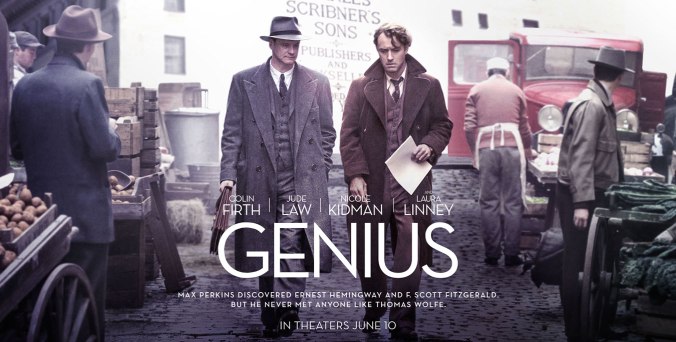
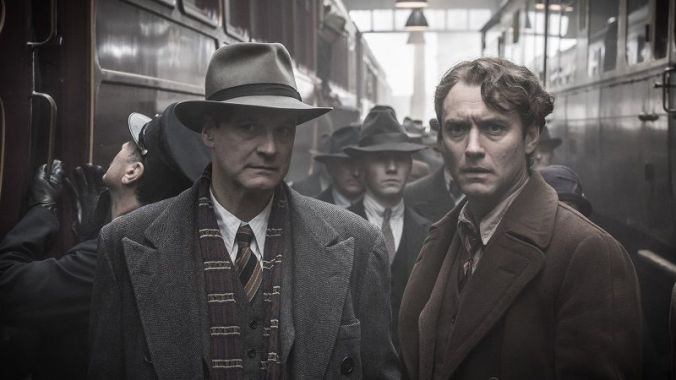
Colin Firth as Max Perkins and Jude Law as Thomas Wolfe in Michael Grandage’s Genius

Genius is based on A. Scott Berg’s book Max Perkins: Editor of Genius and concentrates primarily on his relationship with and molding of Thomas Wolfe. And while the book title implies that Perkins was the editor of men of genius, such as Fitzgerald and Hemingway, the film leaves one wondering whether it was Perkins who was the genius after all.

Wolfe (Jude Law) explodes into Perkins’ office at Scribner’s, expecting to have his manuscript rejected by yet another New York publisher. When Perkins (Colin Firth) informs him that they want to publish him, a very close and productive relationship begins.

Wolfe is overlarge in his personality and writing, and Jude Law plays this for all it’s worth, chewing up every scene he is in, which is the majority of the film. His gregarious, boiling over energy is in stark contrast to Perkins whom Colin Firth plays with reflective gravity and business-like rigidity. The contrast seems as if it would sabotage the relationship, but it does not.

There are other issues buried much deeper.

When Wolfe first comes to Scribner’s, he is being supported and promoted by his lover, Aline Bernstein (Nicole Kidman), who quickly becomes jealous of Perkins’ influence on and success with Wolfe. Perkins’ wife Louise (Laura Linney) also is concerned with the amount of time that her husband is spending with his new client; (He needs to spend time, Wolfe’s second novel is over 5000 pages long when he brings it to Perkins.) She counters his argument that only once in a lifetime comes such a writer as Wolfe with the fact that only once in a lifetime will he have his daughters around him.

His responsibility to Wolfe overrides her logic.

But it is hinted at that there is a deeper foundation to Wolfe and Perkins relationship. For Wolfe, Perkins has become a father-figure, replacing the father that he lost when he was a young man and who he has been writing about ever since through two very large novels. For Perkins, Wolfe was the son he never had.

And like many father-son relationships, there has to come a break, when the son feels he must strike out on his own. When Wolfe makes this break, we know it will not end well.

Genius is a wordy film, as any film about Thomas Wolfe needs to be. It is hampered, perhaps by scenes of writing and editing, scenes that never translate well to the screen, and by the melodrama of Wolfe’s and Bernstein’s affair.

Editing

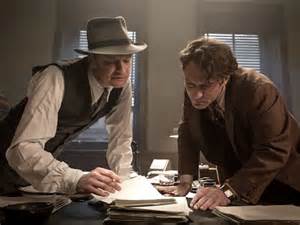
Perkins and Wolfe (Firth and Law) editing Of Time and the River

But it is an honest film, built on the back of Colin Firth’s nuanced, quiet performance. Allowing Law’s Wolfe to rage and celebrate and orate and revel, Firth’s Perkins builds a quiet portrait of a feeling man, conscientiously doing the job he loves and loving the man who is his job.


Filmed in a palate of brown and greys (contrasted brightly when Wolfe visits Fitzgerald in Hollywood), it is a film about words not images. About a man of so many, many words, Genius is a tragic view into the blistering comet that was Thomas Wolfe. More importantly, it is the story of Max Perkins, the man who burnished Wolfe’s blazing talent for the world to know and  remember.


Book Review Monday: The Big Rewind by Libby Cudmore

It is hardly a new reindexvelation that the music of one’s youth is that which is most resonant throughout the rest of our lives. It is the soundtrack of our adolescent development, the rhythm of our initiation into love, into heartbreak, and who we are in the process of becoming.  And it sticks with us no matter how far beyond it we grow.


It is a conversation I frequently have with a colleague and friend. And though our references are often separated by a generation or two, there is enough overlap that we understand each other completely.

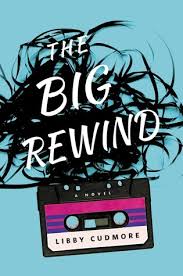
Libby Cudmore’s The Big Rewind is crafted around that very concept. The music throughout the novel –and there is a lot of it– is the underpinnings of both the solution of the murder mystery and the liberation of its protagonist, Jett Bennett.

Bennett, who had come to New York hoping to land a job in music journalism, feels very much a square peg in the ultra-hip(ster) world of Brooklyn. Her downstairs neighbor, KitKat, who is at the vortex of Brooklyn hipdom, has befriended her, but she dies in the first few pages, brutally murdered with a rolling pin.

And Bennett is the one who finds her.

Bennett had been bringing a mixed-tape to KitKat which had come in the mail and had mistakenly been delivered to her. Later, she “inherits” an entire box of KitKat’s mixed-tapes, music selected and arranged in such a way that Bennett believes they point to the identity of the killer.

And as she goes through KitKat’s tapes, she also re-discovers her own tapes and takes a journey through heartbreak and love and hope and despair. It is this music that will ultimately scattered the clouds that have been hanging heavily upon her.

Capturing the hipster world of Brooklyn, the basement night-clubs and the trendy brunch-eries,  the world of vegans and punks and poseurs, among those selling vinyl records and those selling pot-laced cupcakes, Cudmore gives us a fast pace mystery that is fun, nostalgic and wry.  Her eye for detail is unerring –given to us often with tongue firmly in her cheek. Irony is alive and well in Libby Cudmore.

c8809a83a670142d39ea1d5e581d018a

Libby Cudmore

And Bennett is a hero we can love. She is vulnerable, honest, and striving to understand herself. And she believes in her truth, for which she will fight. With her friend Syd, she immerses herself into the world of punk music and strippers, academia and neighborhood community, of fetishes and memory.  And she comes out okay.

There has been much written about The Big Rewind and comparing it to Nick Hornby’s High Fidelity.  And that is somewhat accurate. But whereas, Hornby’s novel is ultimately about his protagonist’s understanding his failures, successes and lost opportunities in love, The Big Rewind seems a little different. For one, it is a murder mystery and a fairly good one. And even after the solution seems evident, there are still enough issues yet to be resolved to keep the reader racing towards the end.

And that’s what I did. I began it somewhere over the Rockies on a red-eye flight to the East Coast and had it finished when I landed. It is that captivating.

I admit that much of the music, I did not know. Though there was still much that was familar. And many of Jett’s obsessions are understandable and familiar as well. At one point she plays Warren Zevon’s “Accidentally Like a Martyr” over and over again. I’ve done the same with the same song. (Both she, her friend Syd and I are serious Warren Zevon fans.) I know people who, like Jett, have had similar obsessions with the Cure and  the Smiths, and some who know even the more obscure bands, like the Clarks. (Very big in Western Pennsylvania.)

Libby Cudmore is a shrewd observer, and the world she creates for her protagonist is honest and real. The Big Rewind is well worth the read.

It’s like finding a vinyl Tom Rush in the sales-bin.


Quote # 62: “The sound of laughter…” Milan Kundera

                                                                                                          The Sistine Chapel                                                                            photo © by Sharon Emmons-Mason

“The sound of laughter is like the vaulted dome of a temple of happiness.”

                                                                                  Milan Kundera

Book Review: The Days of Abandonment by Elena Ferrante

abandon

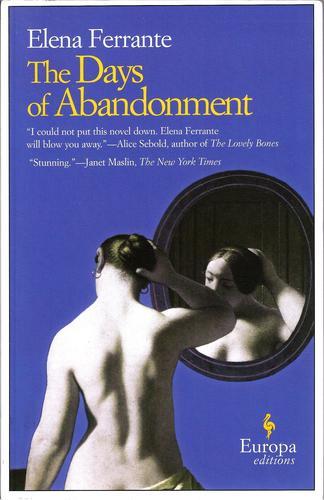
Book cover for the Europa edition of The Days of Abandonment

A very good friend of mine—an Italian woman—has lately been going through a very rough patch in her marriage. These last few years have been filled with much drama and melodrama, with betrayals and reconciliations, with threats and recriminations, and with lots and lots of pain.

I know much of this because she is also a very good and honest writer, and, at times, I have been a sounding board/early reader for her essays as she finalizes them prior to sending them out. With these, I am a bad critic because I cannot separate the raw, emotional writing from the woman I know and care about. The quality of the writing seems secondary to the pain being displayed.  So I can’t focus on the writing as I should.

This was also the case when I first began Elena Ferrante’s Days of Abandonment. Immediately, it too draws you in with the story of an intelligent woman–a writer–blindsided and abandoned by a careless husband. It too draws you in with the raw pain, the self-doubt, the self-incrimination of one who has been abandoned.

And Ferrante’s writing is such that we forget easily that this is all a fiction–we believe we are reading the true story of a real woman who is in pain and confusion and despair.

One April afternoon, right after lunch, my husband announced that he wanted to leave,” reads the very first sentence.

And thus Olga, the narrator, is demolished. Her sense of self-worth is destroyed, her understanding of her past is shakened, her hope for the future vaporized. And through Ferrante’s words we feel that abandonment greatly.

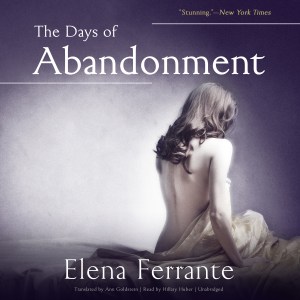
bjp8-square-orig

Book cover for the audio-book edition of The Days of Abandonment

Like one grieving at a death, the narrator experiences all the varying emotions of loss: she is in turn defeated and determined, angry and frustrated, confused and clear-minded.  Besides the trauma of her husband’s leaving, she must also deal with the business of raising two children and running a household.

At times, Olga can also be quite funny in her frustration and anger. Once when she goes to the telephone offices to complain that her service has been cut off, she is told that all complaints must be phoned in. Where do I  go, she asks “if I want to spit in somebody’s face”? And her attacking her ex the first day she sees him in the street with his mistress is very funny–and satisfying.

There is a sex scene–one that ends prematurely and unsatisfyingly for Olga– in which Olga attempts to grasp some sense of self-worth, and while sad and pathetic, it also highlights Ferrante’s skill as a writer for it is well-written and unique and believable–never an easy thing to do when describing sex.

There are sick children and dying dogs and grumpy natives and the usual manipulations that accompany a formal separation between couples. And through it all we see Olga hit bottom, recover and then survive.

At one point, Olga says, “In order to write well, I need to go to the heart of every question, of a smaller, safer place. Eliminate the superfluous. Narrow the field. To write truly is to speak from the depths of the maternal womb.

And this is what Ferrante herself has done with her novel–she has stripped away the “superfluous,” she has asked the essential questions, and she has written from the very depths.

One reviewer wrote that The Days of Abandonment could have been written only by someone who has experienced the pain and despair of sudden separation, and implied that this is Ferrante’s own story.  I don’t know if that is true or not.

I do know that such an assumption is a critical fallacy, and it demeans the artistry that Ferrante possesses. The Days of Abandonment is a novel; it is a piece of fiction. Whether Ferrante has drawn on her own experiences or not does not matter. She has created a work of art that stands on its own.

Olga’s story is ours to read, to think about and to empathize with.  And in the process, she becomes someone we care about and worry about and celebrate with.

It is like having a good friend tell you her story.

The Days of Abandoment by Elena Ferrante
translated by Ann Goldstein
Europa editions, 2005