Movie Review: The Angels’ Share by Ken Loach

I had wanted to like The Angels’ Share. In fact, I wanted to love it. It had all the makings of a great film: a master artist in Ken Loach, a lovable though incompetent gang of petty criminals, Scotland both urban and rural, and a plot involving Scotch whisky.  It had won the Jury Prize at Cannes in 2012 and even featured that catchy old tune by The Proclaimers, “500 Miles.”  And yet something felt flat.

Robbie (Paul Brannigan) is a soon-to-be-father with severe “anger management” problems. He is before the judge on assault and battery charges against three thugs who spend much of the film trying to get revenge. (It’s a tribal feud that can be traced back to their fathers.)  His pregnant girlfriend, Leonie (Siobhan Robinson) is about to deliver, and her father and his brothers want Robbie out.  The father calls Robbie a “waste of space” and offers him £5000 to move to England and away from his daughter.  While prison probably would be safer for him, the judge orders him to 300 hours of “community service.”

“Your record is appalling. For much of your short life you have behaved like a thug,” proclaims the judge to Robbie, and then sends him out into the rough life again, where that same thuggery is waiting its turn to do him in.

It is there, in community service, that he meets his gang of co-workers: Mo (Jasmine Riggins), a kleptomaniac who was arrested walking out of a store with a giant Macaw and called the arresting officer a “grumpy twat”; Rhino (William Ruane), arrested for urinating and defacing the statues of public dignitaries; and Albert (Gary Maitland), a profoundly stupid man, who was arrested for disrupting public transportation (he drunkenly fell onto the rail tracks). For all of them, life  is hopeless; Robbie, alone, sees hope in his newborn son, Luke, albeit a hope tinged with fear that the world he knows will bring down his son as well.

Mo, Rhino, Robbie and Albert after their heist.

The “Master Criminals” of The Angels’ Share

Having to oversee this very  incompetent and hopeless crew is Harry (John Henshaw) who has the patience, humor and compassion to see what a sorry lot he must deal with and how the justice system–and society in general– is doing none of them a favor. After Harry drives Robbie to the hospital where his son is being born and where Robbie is refused entrance by Leonine’s family and brutally pummeled by her uncles, Harry tends to Robbie’s gashes and injuries, brings him home, and in bracing him up offers him a glass of whisky.

Harry and Robbie (John Henshaw and Paul Brannigan)

Harry and Robbie (John Henshaw and Paul Brannigan)

Robbie does not drink–he has enough problems without that–but he becomes intrigued with the whisky: the ratings, the histories, the auctions, the distilling process, and the distinctions. And he becomes very deft at rating and describing whisky.

It cannot be an accident that  “whisky,” a word that comes from the Scottish Gaelic uisge beatha, means “water of life,” for that is exactly what it becomes in The Angels’ Share.  For the plan that Robbie hatches–involving a cask of highly prized whisky–will become, for all of them, the chance for a better life…or a further descent into their downward spiral.

Ken Loach has been described as a social-realist director and his films routinely look at those whom society has written off.  His world is not the violent underbelly as portrayed by Guy Ritchie or the taut, impoverished world of Mike Leigh, but a world in which hope does exist and brightness and compassion. This is not to say that everything in Loach’s vision of Paul Laverty’s screenplay is Pollyannish–by no means, no.  Robbie and his mates live in a violent, bleak world. But Loach always tends to offer a glimmer of hope.

Certainly, The Angles’ Share has its own share of faults and inconsistencies, but it is a likeable film nevertheless.  I simply didn’t love it.

Watch and enjoy the trailer below:
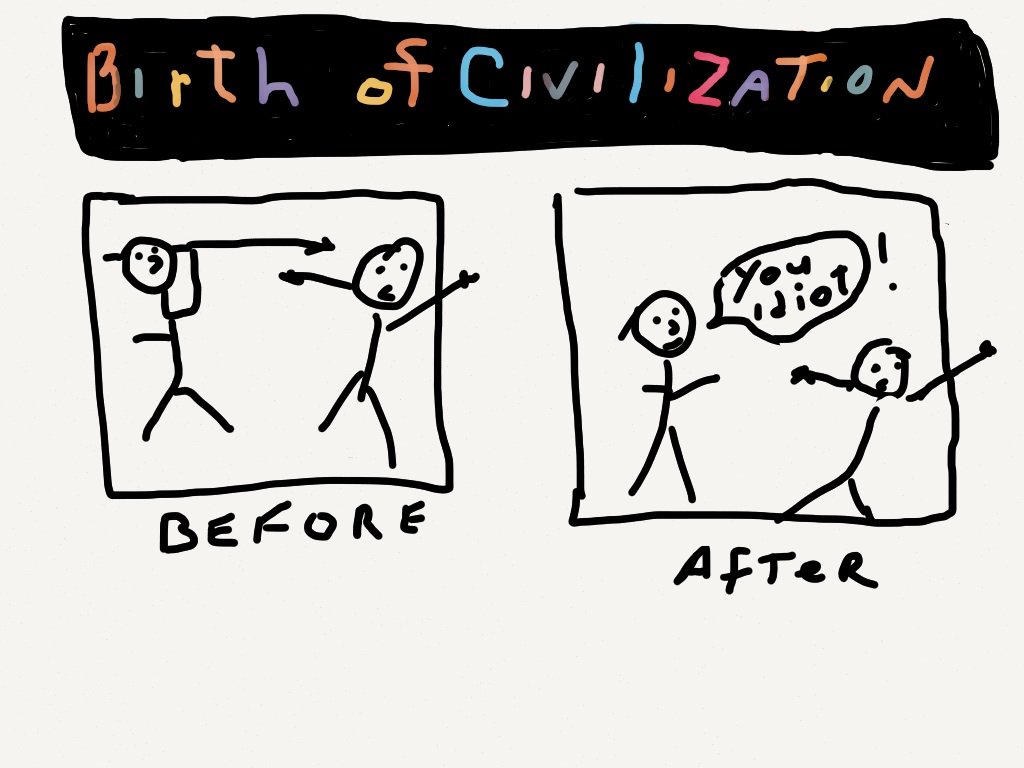
Quote of the week #5: May 26, 2013

“The man who first flung a word of abuse at his enemy instead of a spear was the founder of civilization.”

Sigmund Freud (tweeted by @alaindebotton)

illustration 2013 by jpbohannon

illustration 2013 by jpbohannon

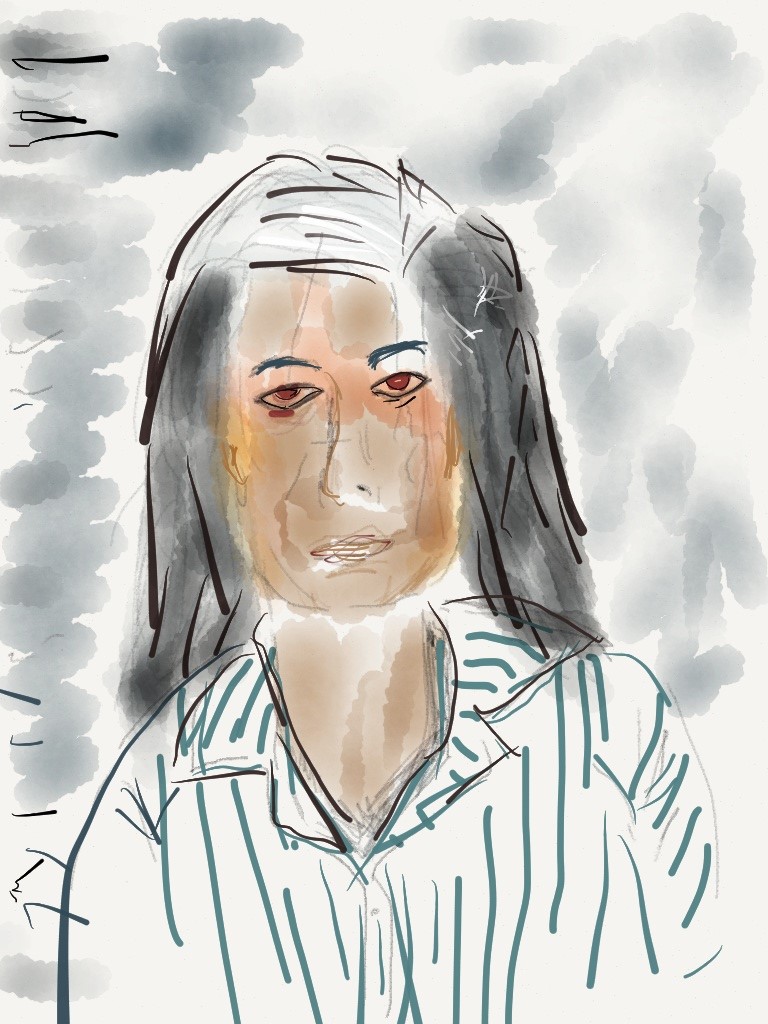
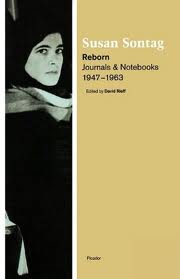
Book Review: Reborn: Journals and Notebooks 1947-1966 Susan Sontag

illustration by jpbohannon 2013

Susan Sontag (1933-2004)
illustration by jpbohannon 2013 (based on painting by Juan Bastos)

There is a danger in reading memoirs, diaries, journals. Certainly, there are times when our angels are shown to have feet of clay. Or other instances, when we weigh the turmoils and angst of a particular life with the end product that impelled you to read the memoir in the first place.

But with Sontag it is quite, quite different.

Next to even her young self, I feel so inadequate, so shallow, so wasteful of time.

Here is a young woman–14 years of age when the journals begin–embarking on a intellectual career that would put most of us to shame. Her reading lists, her “to-do” lists, her debates with herself, her analysis of events, readings, concerts and people she meets, her experiences, all are more fervent, more intelligent, more thoughtful in the years between her 14th birthday and her 30th, than mine have been for most of my life.

Susan Sontag bookcover

I teach a group of extremely bright 18-year old boys. They have great intelligence, and some are quite creative. But every so often they need to be reminded that their superior intelligence is frequently measured within the very small pond of our school.  Here’s what I read them from Sontag’s journal:

…Yet we do exist, + affirm that. We affirm the life of lust. Yet there is more. One flees not from one’s real nature which is animal, id, to a self-torturing externally imposed conscience, super-ego, as Freud would have it–but the reverse, as Kierkegaard says. Our ethical sensitivity is what is natural to man + we flee from it to the beast…

I ask them to describe the person who would write this in his or her personal journal.  And they are always far off…in both gender and age.  Sontag wrote this (a snippet of a much larger journal entry) two weeks after she had turned 17!  Already her depth of reading and understanding and active thoughtfulness is evident.

Immediately in this first volume of the journals, one meets a brilliant, thoughtful intelligence. She attended Berkeley at the age of 16, transfered to University of Chicago, married Phillip Reiff–a sociology professor–at 17, taught at the University of Connecticut when she was 19, and attended graduate school at Harvard, where she got her degree in philosophy and theology. And throughout these years, she recorded her thoughts and criticisms and interpretations, as well as her fears, her doubts and her insecurities.  As her marriage began to falter, she received a fellowship to Oxford and then moved to Paris. When she moved back to New York in 1959 (26 years old), her marriage was dissolved and she had gained custody of her son. Established in New York, she began teaching at various colleges, completed her first novel, The Benefactor, and witnessed her reputation as part of New York’s  intelligentsia begin to grow.

These are the years covered in the volume. Aside from the inquisitiveness, interpretation, and analysis of what she reads, sees and watches (she was a rabid film-goer), there is the struggle of understanding who she was. The marriage was unsatisfying, the lovers often hurtful, and in reading the journals we see a young woman trying to discover herself and come to terms with her own individuality, her own bi-sexuality, her own identity. There are times when one feels she is too hard on herself…when one wants to warn her, NO, this is going to end bad, but then again, one can’t.

Beginning when she was 14 and ending when she was 30, the journals are remarkable for their honesty and the peek into her rigorous mind.  But at the end, one is moved by the ever-going struggle between her sexuality and her intelligence, by the vulnerabilities and insecurities she reveals in her two major love affairs with Harriet Sohmers Zwerling  and Irene Fornés.  For her extraordinary mind struggled continually to understand the extraordinary pull of the flesh.

Her last two entries for 1963 read:

The intellectual ecstasy I have had access to since early
childhood. But ecstasy is ecstasy.

Intellectual “wanting” like sexual wanting.

♦     ♦     ♦     ♦     ♦     ♦

Reborn is the first of a proposed three volumes of journals. The next volume–As Consciousness Is Harnessed to Flesh– covers the years 1963 to 1964, when Sontag develops her reputation, her political activism, and her writing. It is now on my “to-read” list.

Quote of the week: #4 May 19, 2013

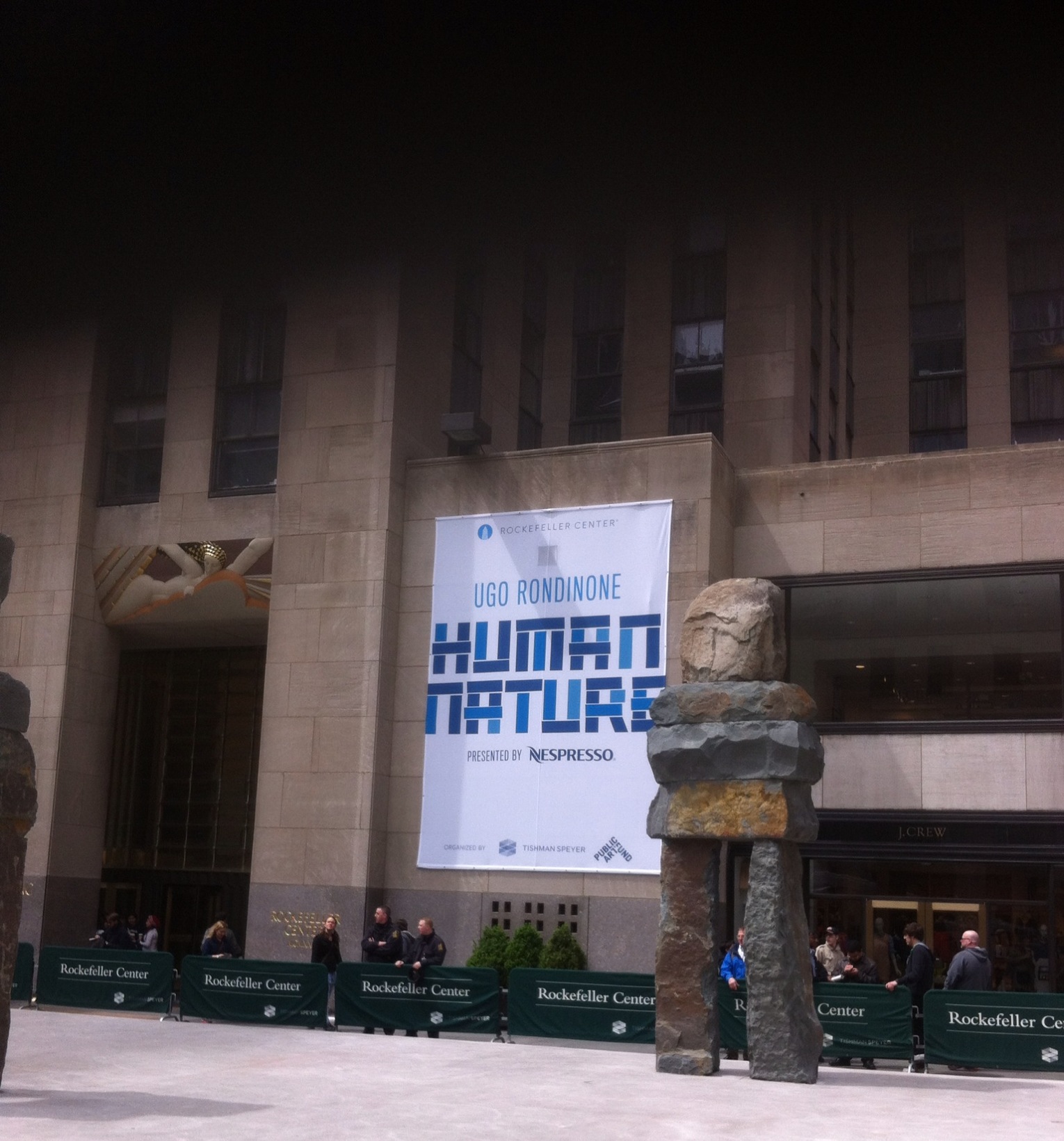
“…even in an era of touchscreens and interactive spectacle, it’s human nature to feel awed and inspired in the presence of a giant rock.”

Robin Cembalest,  Artnews. “The Gentle Giants of Rockefeller Center”

Ugo Rondinone's "Human Nature" Installation, Rockerfeller Center, NYC photo: 2013 jpbohannon

Ugo Rondinone’s “Human Nature” Installation, Rockerfeller Center, NYC
photo: 2013 jpbohannon

Ugo Rondinone's "Human Nature" Installation, Rockerfeller Center, NYC photo: 2013 jpbohannon
Ugo Rondinone’s “Human Nature” Installation, Rockerfeller Center, NYC
photo: 2013 jpbohannon

Movie Review: Something in the Air: Born Too Late

The actual title of Olivier Assayas’ new film is Après Mai–a reference to the months following the student and worker demonstrations of May 1968 in France.  And that, in many ways, is the focus of the film: young, sincere characters trying to maintain the commitments of 1968, but somewhat too young still to be a real part and unprepared for the crashing ordinariness of the life to come.

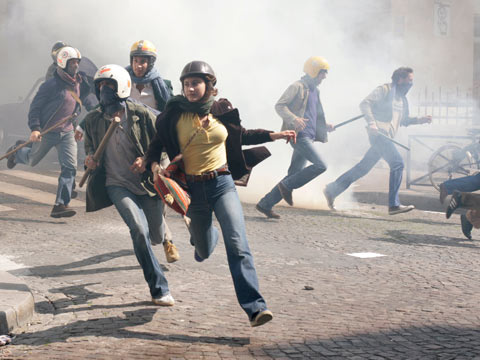
The film begins with high-school students’ listening to their teacher’s monotonous reading of Pascal’s Penseés. Within minutes of screen time, these same students are scrambling away from overzealous police dispelling a student demonstration.  The life of the classroom and their political/social/activist lives are much, much different. The teachers give them Pascal and they are reading Gregory Corso, Chairman Mao and listening to Phil Ochs.

Early riot scene in Something in the Air

Early riot scene in Something in the Air

I had a friend who was a student in Paris at that time in 1968.  When I asked her about it, she sort of shrugged.  “The only difference,” she said,  “was that afterwards we were permitted to call our professors tu rather than vous.

But for Gilles, Alain, Christine, Rachkam la Rouge, they want very much for the  spirit of May 1968 to be carried on, to be carried through.  They believe that May was not the climax but the beginning of the revolution. Stuck in their sleepy village outside of Paris, the students join political parties, pack debating halls, distribute the radical free-press, and organize guerrilla graffiti forays against the local establishment and police.  One of these night raids goes wrong and a guard falls into a coma when hit with a bag of cement mix.  The students decide to scatter.

Gilles (Clémont Métayer) and Christine (Lola Créton) hitch up with a radical collaborative on its way Italy where they become lovers and later part as she continues with the collaborative to make a film on Italian workers.

Christine and Giles on the road to Italy

Christine and Giles on the road to Italy

gilleschristine

Gilles (Clémont Métayer) and Christine (Lola Créton)

Gilles is torn in his radicalism–for his passion is art, and he is not convinced that his art must always serve the “cause.”  Alain (Felix Armand)  and Leslie (India Menduez), an American he meets in Rome,  go East to Afghanistan, he an artist and she a dancer looking for spirituality. Disillusioned over time, they all return to France, and ultimately to Paris.

But there is another story running through Gilles life.  Of course, in a story of a teenage-boy there needs to be friction between him and his father, a successful movie director.  While there is never dramatic conflict between the two, as he grows, Gilles is able to tell his father how superficial and wrong-headed he believes his film adaptations are.  (The father makes adaptations of George Simenon’s Maigret novels.)

But the more important sub-plot is about Gilles and his true love, Laure (Carole Combes).  When she first appears early in the film, there is a jarring film switch from the smokey riots of their village to an Edenic, woodsy scene. She has come to meet Gilles and is in flowing white and the sun illuminates both her and the shimmering foliage around her.  I felt however that I was in a 1970’s shampoo advertisement and that any minute I would hear Donovan singing “Wear Your Love Like Heaven.”

Gilles and Laure

Gilles and Laure

Laure is a bit more worldly than Gilles and his mates, and her wealthy bohemian parents are taking her to London, as the father is the light-man for a fledgling rock band. She is willowy and bright and airy and full of sunshine.  And she leaves a mark that even Christine knows she cannot undo.  Later, when his father informs him that she has returned, he ventures out to her parents’ chateau for a party.  Throughout the party, I was reminded of when the Stones had moved to the south of France in the early ’70s  and had worked on Exile on Main Street.  There was the same louche, blowsy freedom, the same drug use, the same music, the same comings-and-goings.

The party is important, though I am not positive how it ended.  Gilles leaves. Laure jumps from a burning building and that is it.

And then real life steps in.  Gilles is a “go-fer” for his father’s film company (although a left-wing broadsheet has begun using his drawings), Leslie abandons her “spirituality” and returns with her father to New York and Julliard,  Rackham le Rouge leaves the Trotskyites for inconsequential anarchism, and Christine discovers that the earnest leftism of the man she is living with and the collective they are part of does not carry forward to women.

Olivier Assayas–who wrote and directed–gives us a nostalgic film, a film that even looks from an earlier period. The colors, the lighting, the cutting, the soundtrack all capture a particular moment in time.  And the two leads, Créton and Métayer are likeable and familiar–we do care about them and their decisions.

Frequently in the film, we watch characters watching films–and these films within a film are rendered in wavering, sincere, gaudy, and innocent beauty.  (Perhaps part of that innocence is the knowledge in hindsight that much of it is not going to last.) Indeed, film and film-making is such an integral part of the story that now I am not sure if Apres Mai (Something in the Air) isn’t a dissertation on film of that era disguised behind a story of that era.

In the end, Gilles is working on a science fiction film in London that features giant lizards and Nazis (and Dolores Chaplin, the granddaughter of Charlie and Oona!); Christine’s collective is releasing its first commercial documentary on Italian workers (though free to workers’ unions) and Gille’s dad is still turning out the Maigret mysteries.  However, Apres Mai ends with a haunting, new wave, almost psychedelic clip of a willowy woman walking towards the camera.

We recognize her by the end.

♦     ♦     ♦     ♦     ♦     ♦

And for a treat, here’s the Stones live in 1972 doing “Tumbling Dice” from Exile on Main Street.

Adam Phillips: Promises, Promises: Essays on Psychoanalysis and Literature

illustration by jpbohannon

illustration by jpbohannon, 2013

In the office of a colleague a while back I noticed a towering pile of books on the desk, as if he were re-arranging his book shelves or carting out old titles to a different location.  But no,  it was his “to read” pile, and it was impressive and imposing.

Among the authors gathered, there was one whom I had not heard of–Adam Phillips. A psychoanalyst by trade–specifically a children’s clinical psychotherapist–Phillips read literature at Oxford, specializing in the 19th century British romantics.  And as the “science” of psychoanalysis has always been symbiotically tied to literature,  a degree in literature seemed the perfect training ground.
Adam Phillips photo: Andy Hall

Adam Phillips
photo: Andy Hall

And so I decided to dive in.

Of Phillips’ seven or so titles, Promises, Promises: Essays on Psychoanalysis and Literature seemed a reasonable starting point. And, the frantic busyness at the end of the school term made a collection of independent essays more attractive and less of a task.
 

“As poets struggle to find a place in contemporary cultural reality, psychoanalysts, implicitly or explicitly,  are still promoting the poets as ego-ideals.”

Philips, “Poetry and Psychoanalysis”

The crux of Phillips’ essays is the mutual relationship between literature and psychoanalysis…and psychoanalysts’  established reverence for creative writers. Literature, according to Freud, gave birth to psychoanalysis and psychoanalysis often gives resonance to literature.

And so go his essays.

He begins with the essay “Poetry and Psychoanalysis” and brings in the young poet Keats–a former medical student–who famously stated that science ruined poetry when Newton reduced the rainbow to a prism.  Not so, Phillips says, for poetry (and you can read “creative writing” where Phillips says “poetry”) can do what the sciences cannot.  Indeed, much of his argument is that the science of psychoanalysis is bringing understanding to the vision of poetry.  Freud said, Phillips tells us, that the poets had long before discovered the unconscious, and that he only had devised a way to study it.

Phillips graciously gives way to “poetry” saying that the short history of psychoanalysis has been an attempt to study the unconscious that poetry reveals. And since both poetry and psychoanalysis–the “talking cure”–depend on language, and often, coded language, the two are intrinsically welded together.

And so he is off.

There are marvelous literary essays on Hamlet, Hart Crane, Martin Amis,  A.E. Housman and Frederick Seidel, all informed by an accessible shading of psychoanalytic theory, as well as masterful psychoanalytic pieces on Narcissism, Jokes, Anorexia and Clutter, informed by a broad knowledge of literature/poetry.  It is Phillips’ contention–his modus operandi, if you will–that the two disciplines can or should depend on each other for clarity.

Hamlet-and-skull-on-stampThe collection ends with the title piece, “Promises, Promises.”  In it, Phillips examines the “promise” that both literature and psychoanalysis offer. He writes:

“If we talk about promises now, as I think we should when we talk about psychoanalysis and literature, then we are talking about hopes and wishes, about what we are wanting from our relationship with these two objects in the cultural field.”

What does reading literature promise us?  What does analysis promise us?  Phillips contends that both promise us, to a degree, “the experience of a relationship in silence, the unusual experience of a relationship in which no one speaks.”  Of course, ultimately, the analyst must speak.  But it is in that silence that often we become “true to ourselves.”

Reading psychoanalytic theory can often be dry and dusty, but Phillips’ writing never is. Bringing in an encyclopedic knowledge of both creative literature and psychoanalytic literature (and, at times, arguing that there might not be a difference),  Phillips imaginatively and wittily plumbs past and current trends, canonical and esoteric literatures, clinical practice and private correspondence to bring to light his vision of psychoanalysis and literature’s potential and promise.

Quote of the Week: #3 May 12, 2013

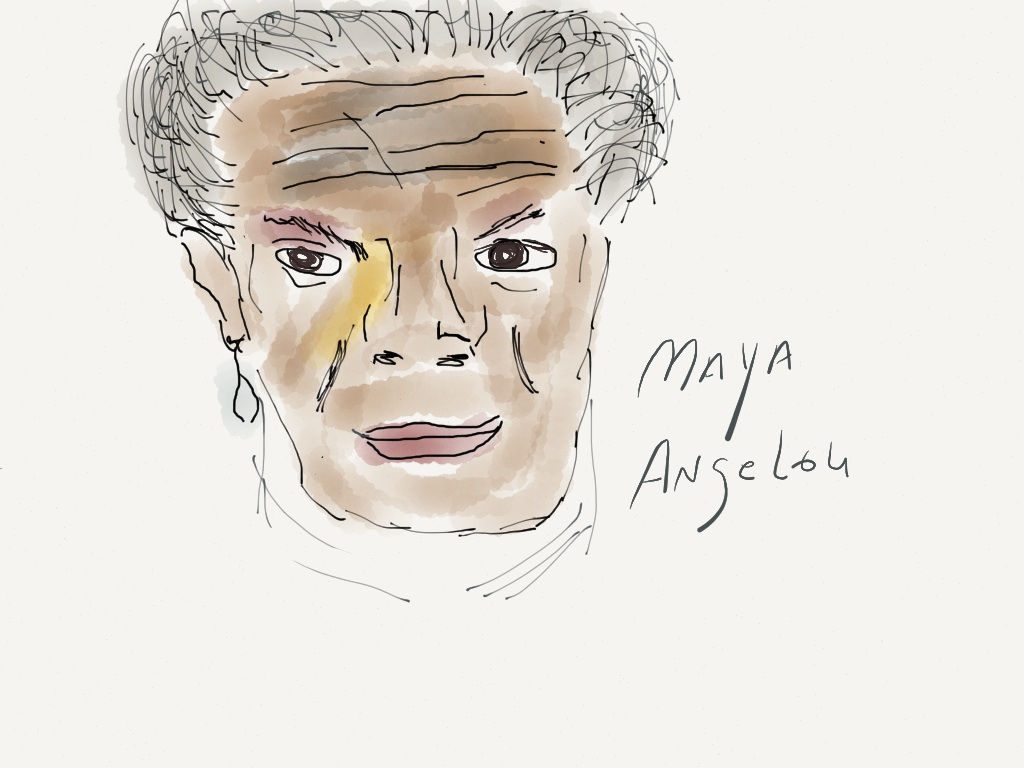
“Be certain that you do not die without having done something wonderful for humanity.”

Maya Angelou, Letter to her daughter

Maya Angelou 2013 jpbohannon

Maya Angelou
illustration by jpbohannon © 2013

Quote of the week: #2, May 6, 2013

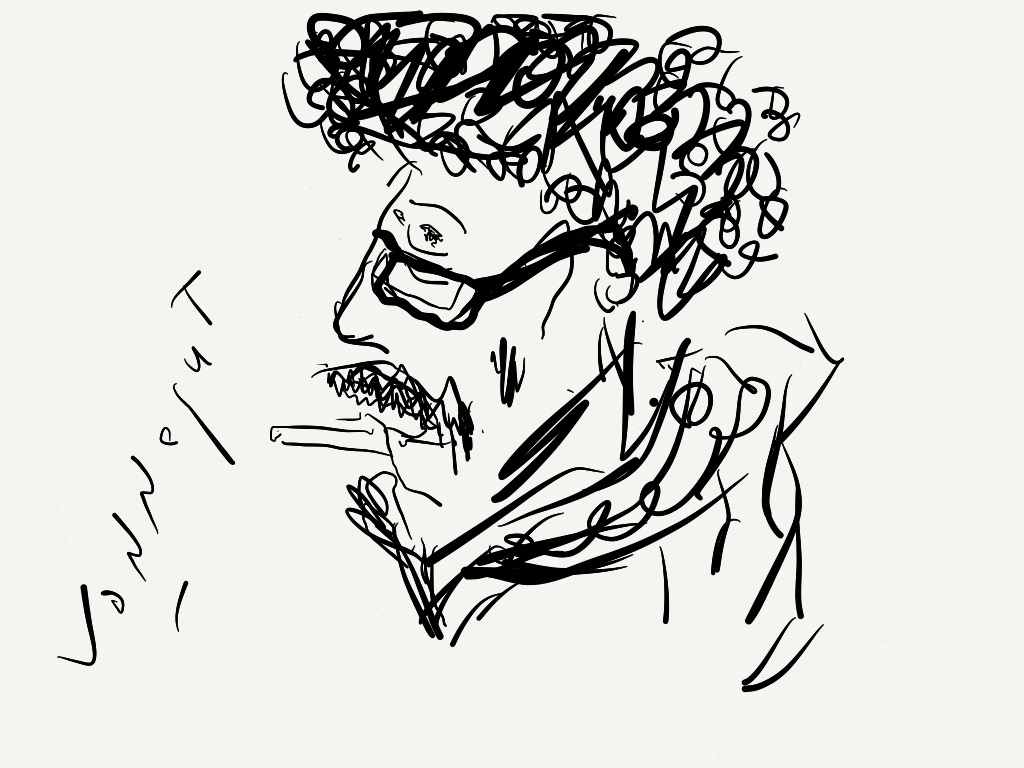
“…The arts are not a way to make a living. They are a very human way of making life more bearable. Practicing an art, no matter how well or badly, is a way to make your soul grow, for heaven’s sake. Sing in the shower. Dance to the radio. Tell stories. Write a poem to a friend, even a lousy poem. Do it as well as you possibly can. You will get an enormous reward. You will have created something.” — Kurt Vonnegut, Jr. A Man Without a Country, 2005

Kurt Vonnegut, 1922-2007. 2013 jpbohannon

Kurt Vonnegut, Jr., 1922-2007
illustration by jpbohannon © 2013

Waiting for Godot: Crying in Beckett

A while back, I had posted about a performance of Samuel Beckett’s Endgame that I ‘d seen at the Arden Theater in Philadelphia. In it, I quoted my favorite lines from the play:

HAMM: (letting go his toque) What’s he doing?

(Clov raises lid of Nagg’s bin, stoops, look into it. Pause.)
CLOV: He’s crying. (He closes lid, straightens up.)
HAMM: Then he’s living.

The character Hamm has made the immediate inference that if his father is crying, then he is alive. And we, by extension, apply it to the human condition. I remembered this line–and the act of crying– this week when teaching Waiting for Godot. (Actually, the crying seemed more appropriate than ever for someone trying to teach Godot to 18-year old boys during their last week of school when the temperatures are in the mid-70s and the sun is bright! Hah!)

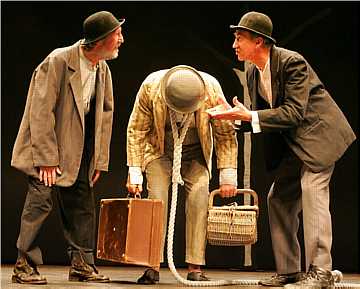
Early in the play, Estragon and Vladimir point out the tree where they are supposed to wait for Godot. (It is the only piece of scenery. The scene description reads simply: A country road. A tree. )

godot tree

Mark Bedard (Vladimir) and Mark Anderson Phillips (Estragon) in Samuel Beckett s ‘Waiting for Godot,’ at Marin Theatre Company. photo 2013 by Kevin Berne

Estragon: [desparingly] Ah! [pause] You’re sure it was here?

Vladimir: What?

Estragon: That we were to wait.

Vladimir: He said by the tree. [They look at the tree.] Do you see any others?

Estragon: What is it?

Vladimir: I don’t know. A willow.

Estragon: Where are the leaves?

Vladimir: It must be dead.

Estragon: No more weeping.

This is the exact inverse of the lines from Endgame. In Endgame, the syllogism is that if you are crying then you are alive. In Waiting for Godot, the syllogism is that if you are dead, then there is no more crying. More or less the same thing.

Later on, as Vladimir and Estragon rebuke Pozzo for his treatment of his slave/servant, Lucky, there is more conversation about crying:

[Lucky weeps]

Estragon: He’s crying!

Pozzo: Old dogs have more dignity! [He proffers his handkerchief to Estragon.] Comfort him, since you pity him. [Estragon hesitates.] Come on. [Estragon takes the handkerchief.] Wipe away his tears, he’ll feel less forsaken.

[Estragon hesitates]

Vladimir: Here give it to me, I’ll do it.
[Estragon refuses to give the handkerchief. Childish gestures.]

Estragon and Vladimir with Lucky

Estragon and Vladimir with Lucky from samuel-beckett.net

Pozzo: Make haste before he stops. [Estragon approaches Lucky and makes to wipe his eyes. Lucky kicks him violently in the shin. Estragon drops the handkerchief, recoils, staggers about the stage, howling with pain.] Hanky!
[Lucky puts down bag and basket, picks up handkerchief and gives it to Pozzo, goes back to his place, picks up bag and basket.]

♦ ♦ ♦ ♦ ♦ ♦

What are we to make of that? What is the significance of Lucky’s crying? Of Estragon and Vladimir’s desire to comfort him? Of Lucky’s lashing out at his comforter? And of his immediate subservience to his persecutor.

There is, of course, much more going on here, but the small emphasis on tears should be noted. Earlier Beckett had equated crying with living. Are we simply to be reminded that Lucky is a living, human being, and leave it at that? (We knew that anyway.)

Or perhaps we are to examine the difficult symbiosis between the comforter and the comforted? The helper and the helped? The cry of pain and those who hear and those who refuse to hear?

What is our responsibility to those who are “crying”? To those who are inconsolable? Good questions, all. And ones that we should take the time to think about every so often.

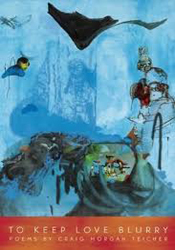
The End of April and National Poetry Month, part 3: To Keep Love Blurry by Craig Morgan Teicher

To-Keep-Love-BlurryI must say that I did not enjoy Craig Morgan Teicher’s third collection of poems.  That is not to say that they are not technically brilliant, that they are not impressively raw and honest, nor that there are not many moments that just knock you open. I admire it greatly; however, I do not like it.  Even Teicher understands the sadness and dysfunction and sourness inherent in his verses.  Here is his dedication:

To Cal and Simone–you should know that it’s a lot more fun than these poems suggest–
and

for Brenda, who knows…

Brenda is Teicher’s wife, who makes many appearances in the collection (actually throughout his work– his first collection was entitled Brenda is in the Room and other poems.)

To Keep Love Blurry is tied together by two major themes. One his mother and father, particularly after his mother’s death. And two, his marriage to Brenda, their (apparently) special-needs son, and Teicher’s sullen acceptance of love.  Indeed, for Teicher love–both familial and marital– is more of an anchor than a source of flight. Here is he about motherhood:

My wife is not my mom. My mom is not
my mom. My father is not my mom. My boss
is not my mom. She is a tooth with rot,
a flower pressed between the pages of a lost
book. My son is not my mom. She is a mare
crushing my skull beneath her hoof. She is forever
starved. I ride to the edge of the earth clutching her hair.
Get it over with. It’s never OK, not ever.
Fuck it, whatever.  If Robert Frost is my mom,
then so is Robert Lowell. She taught me to talk.
She is where I’m headed, a bomb
crater. She forgives me like a hunting hawk.
Maybe she’s my boss’s boss, my wife’s other other lover,
my son’s midnight cough. She loves me like a brother.

(“My Mom, d. 1994”)

The perfection of form–a modern Shakespearean sonnet with A-B-A-B…rhyme scheme, a regular rhythm, an unusual octet, quatrain, couplet construction–is made inconspicuous by the language, the odd identifications of motherhood, with unusually negative words: “tooth with rot,” “a mare crushing my skull,” ” a bomb crater,” “my wife’s other other lover.”  What exactly are his feelings?  “Loves me like a brother” does not cut it for me.  Perhaps the secret lies in the allusion to Robert Frost and Robert Lowell.  Teicher quotes a Lowell poem as an epigraph to his collection:

“Those blessed structures, plot and rhyme–
why are they no help to me now…”

Perhaps Teicher is saying that the “blessed structures” of poetry–with which he is extraordiaryily adept–are no longer to sufficient to buoy one in the sourness of modern life.  Here he is similarly on friendship, marriage and love:

In just the couple years since two by two
we all began to partner off,
already we’ve practically retired, passing though
apartment doors shut tighter than a cough.
There used to be long, wasted hours of talk,
nothing secret between us, not even skin;
at the conclusion of a wandering walk,
the flirtatious dark would set in.
Is marriage lonely by design,
in hopes that obeying an age-old law

of I am only hers, she is only mine
forms a brittle scab over the always-raw
wound of too much intimacy between friends
in favor of a duller aching that never ends.

(“Friendship”)

Again, the “plot and structure” to which Lowell refers are exquisite: a Shakespearean sonnet, intricately wrought and patterned. But for the speaker, the poetry is subsumed by the “duller aching” and “brittle scab.”

Mixed among the villanelles and sonnets, the rhyming couplets and the longer verse, there is a series of prose ruminations on the death of his mother and the subsequent loneliness of his father. These too are notable for their raw honesty, their unflinching introspection.

Well-wrought and linguistically daring, To Keep Love Blurry is evidence of Teicher’s impressive talent. However, I found it sullen and pouty and self-indulgent. Nevertheless, such is Teicher’s poetic cleverness and adroitness that I will surely keep my eye out for his future work.