“Character is at least as important as intellect.”
Angela Duckworth, 2013 MacArthur “genius”
Angela Duckworth, 2013 MacArthur “genius”
A good while back, I saw the film A Dangerous Method. I was enthralled. Depicting the budding relationship and subsequent falling out between Freud and Jung, and hanging it on the larger story of Sabina Spielrein, it introduced me to a history that I did not know.
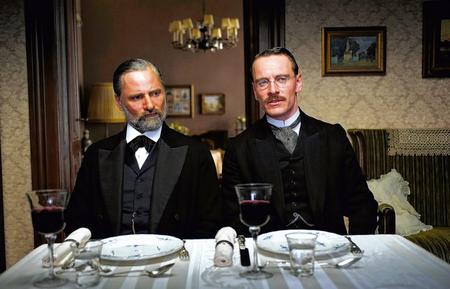
Freud and Jung as played by Viggo Mortensen and Michael Fassbender in the film A Dangerous Method.
Like most people, I knew about Freud and Jung to varying degrees, and probably a little more than the average reader. An avocation of sorts, I had read much more of Freud than of Jung: I had read several volumes of his works, different collections of his letters and several biographies and was more conversant with Freud’s vocabulary than with Jung’s. (Though I once had read a fascinating collection of letters between Jung and Herman Hesse that I remember mostly because upon finishing it, I had a startling–and still remembered–dream featuring the floating head of an exotic woman repeating the Sanskrit term, kamakeli. I would love to find those letters now–or a psychoanalyst to help me through the dream.)
But what I hadn’t known about until the film A Dangerous Method (based on the book of the same name by John Kerr) was the existence–or the importance–of Sabina Spielrein. And so I began reading. First, I read the Kerr book on which the film was based. Then I read Jung–a relative hole in my reading. And this week I read a small book entitled Sex versus Survival: The Story of Sabina Spielrein–Her life, her ideas, her genius by John Launer. Launer is a senior staff member at the Tavistock Clinic–the preeminent institute in the U.K. for psychological training and a senior lecturer at the medical school of the University of London.
The stated purpose of his book is to give due to Spielrein, whom he believes should be ranked among the major figures in the history of psychoanalysis–and who is not because of injustice, malfeasance, and patriarchal insecurities, particularly at the hands of Freud and Jung. He divides his book into three sections: Spielrein’s biography, Spielrein’s work, and Spielrein’s influence on 21st-century evolutionary psychoanalysis.
In 1904, Spielrein was brought to Switzerland–having been turned away from various clinics–to be treated for severe psychic disorders. There she was first treated by Eugen Bleuler, head of the clinic, and later by his protege, Carl Jung. In fact, Spielrein would be the first patient to be psychoanalyzed by Jung. She would also soon become his lover.
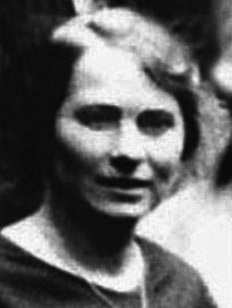
Sabina Spielrein
Within a year, Spielrein’s symptoms had abated so that she had entered medical school in Zurich–while still being treated by Jung and entagled romantically with him. Together, the two debated and discussed the psychoanalytic topics of the day–with Spielrein progressively formulating and stating her own views.
However, before long, Jung saw her as a liability. (He was married and a respected figure in the early days of psychoanalysis. And he had certainly crossed a line with a damaged patient’s understandable “transference.”) He wrote to his mentor–and idol–Freud about the situation, though not naming names. She at the same time wrote to Freud. Freud wrote to Jung and the two discussed her as if she were nothing more than a case study. And so we have the two giants of psychoanalysis trying to quell a female colleague (and former patient and former lover) and cover up what would have certainly have been a professional and personal scandal. This would go on for a long time–a power play mixed with antisemitism (was the Christian Jung attracted to her “otherness”?), patriarchy, chauvinism, and professional insecurity.
When Spielrein read her paper–“Destruction as the Cause of Coming into Being”– to the bearded Vienna Psychoanalytic Society, (she was only the second woman to belong to the Society and a mere 26 years old), she focused on the biological factors at play in the sexual life of humans. Freud adamantly wanted psychoanalysis to have no connection whatsoever with biology (although he started out as a talented neurologist) and dismissed this major–and prescient–part of her paper. And when she brought mythology in to support her argument, Freud saw traces of Jung, with whom by now he was becoming completely disenchanted.
The two wrote about her–crudely at times–and patronizingly discussed her views. And then they buried her: Jung–the editor of the Society’s journal–held her paper for a year before publishing it. Freud, in a snit about Jung, associated her too closely with him and gave her views barely a glance. When he did correspond with her, it was to analyze why she fell for Jung in the first place. As Launer writes, the two dealt with Spielrein by “pathologising the victim, and ignoring her ground-breaking ideas.” (p. 99)
And yet, her views influenced both men significantly. For Jung, she was instrumental in developing his theory of the anima and animus; for Freud, she brought the thanatos to his eros, the “death wish” to his “pleasure principle.”
Spielrein moved on, becoming a leading figure in child psychology. (She was Jean Piaget’s psychoanalysist.) When she returned to her native Russia, she introduced psychology and psychoanalysis to the Russian medical system. But history was moving too fast. First the communists closed down the psychology departments, then forbade psychoanalysis, then came down heavy on all the sciences. Her brothers– a physicist and a biologist– were sent to labor camps and never heard from again.
And then came the Nazis. In the summer of 1942, Nazi soldiers marched into the town of Rostov. They gathered the people and marched them to the Zmeyevsky gully–a mass grave at the edge of town where mass executions took place. Sabina Spielrein was among those killed.
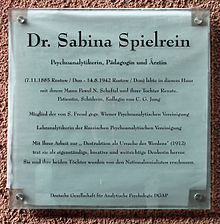
Plaque in front of the Berlin house where Sabina Spielrein once lived.
Launer spends the second half of the book describing the text of her initial paper to the Vienna Psychoanalytic Society. She began by equating the “invasion” of a sperm fertilizing an egg with the sex act itself and stated that in sex–both personal and genetic–something is loss (or killed) in the evolutionary drive to replicate itself. Launer then goes on to say, that despite her mistakes and misdirections, that she was greatly prescient and anticipated some of the major theories of 21st century biology and evolutionary psychology. Three of his final chapters take her three main positions and reword them as a modern evolutionary biologist would put them. Here is how he pairs them:
According to Speilrein’s first principle, ˆReproduction predominates over survival”
Speilrein wrote: “The individual must strongly hunger for this new creation in order to place its own destruction in its service.”
Modern Evolutionary Theory says: “The imperative of all living organisms is the replication of their genes by direct or indirect means in the face of individual extinction.”
According to Speilrein’s second principle, ˆSex is a form of invasion, leading to the destruction of genes from both partners to the reconstitution of new life.”
Speilrein described sex as a process of destruction and reconstruction at every level : “a union in which one forces its way into another.”
Modern Evolutionary Theory says: “As well as co-operation, sexual reproduction involves inherent conflict at every level between male and female genetic interests.“
According to Speilrein’s third principle, “Human feelings correspond with the biological facts of reproduction.”
Speilrein wrote: “It would be highly unlikely if the individual did not at least surmise, through corresponding feelings, these internal deconstructive-reconstructive events.”
Modern Evolutionary Theory says: “Our feelings correspond to the way we balance opportunities for genetic continuation against the risks of extinction.“
In her writings, Spielrein anticipated the “selfish gene” of Richard Dawkins; she anticipated a needed convergence of Darwin and Freud; and she brought biology onto the psychoanalyst’s couch. Perhaps, she was so far ahead of her time that her theories could not be proven, tested, or validated, but she was also stymied by forces more powerful than she.
The story of Sabina Spielrein is fascinating, a story of love and passion, of intelligence and perseverance, of betrayal and destruction. It is Launer’s contention that Spielrein’s name should be as familiar to us as the name of her two more famous male colleagues. The depth of her influence is still be discovered–her papers were not found until the 1970s–and it is certain that her contributions to psychology and evolutionary biology is still yet to be fully appreciated.
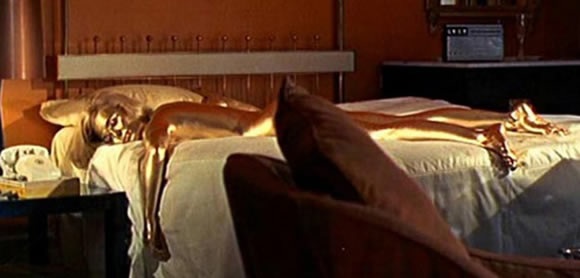
I was a young boy living for one year in a suburb of Chicago–Arlington Heights. I don’t remember much of that year: a monstrous ice-storm that shut everything down and men ice-skating to work; an enormous and popular race-track that burned down after we left; a candy store and a record shop. I don’t remember much else.
I do remember however that my parents did not give me permission to go see Goldfinger. Secret Agents were all the rage–that Christmas my little brother had even received a toy briefcase that fired missiles–and here was the ultimate secret agent of them all: 007… Bond, James Bond.
My buddies were all going, I argued–but still I was not allowed. (At the time, the Catholic Church still had a large influence on the “rating” of films, and Goldfinger surely must have been on some list singled out by the Legion of Decency. A list my parents believed in.)
And so now, several decades later, I saw Goldfinger for the first time. I watched it this weekend.
Boy, have times changed.
Let’s consider the reasons that one would not let their children see a movie (and in America there is only ONE reason, followed by a simpering second.) First there is SEX and then there is Violence (which Americans find preferable to viewing sex.) The violence in Goldfinger is cartoonish. There is a car chase scene where Bond is able to test the extras on his Aston Martin: smoke screen fogger, oil slick sprayer, ejector seat, bullet proof armor and machine guns. There is a later “fight scene” where the American military (which was “pretending” to be knock out by nerve gas) take back Fort Knox. The violence is much less than what appears in a saturday morning cartoon today.
And of course there is the first of the great Bond villains–OddJob.
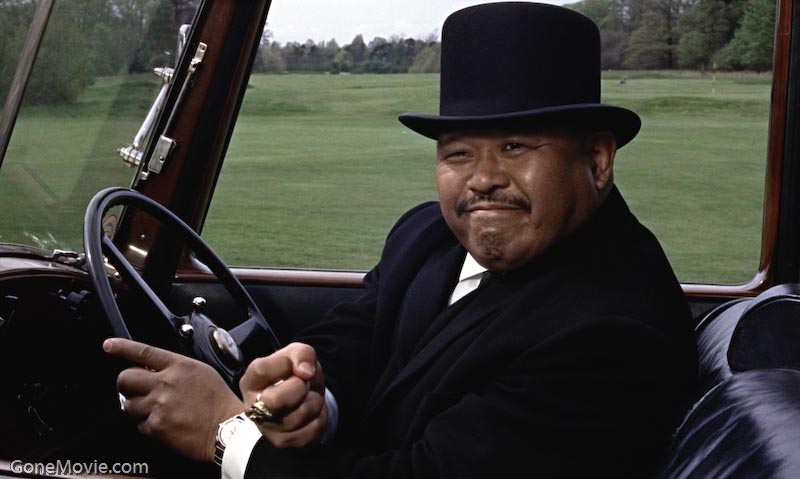
Harold Sakata as Oddjob
As for the sex. Well, there is none. In the beginning of the film, Bond charms and disarms one of Goldfinger’s sexy “henchmen” who is helping him cheat poolside at a game of gin. (Egads, what criminality!) We assume there has been sex, because there is some post-coital conversation–she lying wrapped in sheets and Bond standing in some sort of sleep wear. When he goes to his fridge for another bottle of Dom Perignon, he is attacked and knocked out. When he regains consciousness, his lady friend is naked, painted in gold, and dead from suffocation.
The next “sex scene” is a jiu-jitsu struggle in a barn with Pussy Galore. Bond is thrown a few times, she is thrown a few times and the two end up in the hay (literally), kissing–fully clothed. That is it.
And my parents wouldn’t let me see it.
Excepting for the sophomoric double entendre on Pussy Galore’s name, the film is squeaky clean–at least by current standards.
And still today, the coolest part of the film is the car. Certainly not the girls and hardly the “action.”
And yet, in hindsight, the film is intriguing: we are witnessing the birth of a franchise. There are those who argue that no other Bond can match Sean Connery and they may be right. He is suave and stylish, resourceful and droll. From this vantage point, he seems to understand that he is already a parody of himself. And yet, he is always a gentleman. And like any secret agent worth his salt he is extremely cool under pressure. Truly, he invented the type.
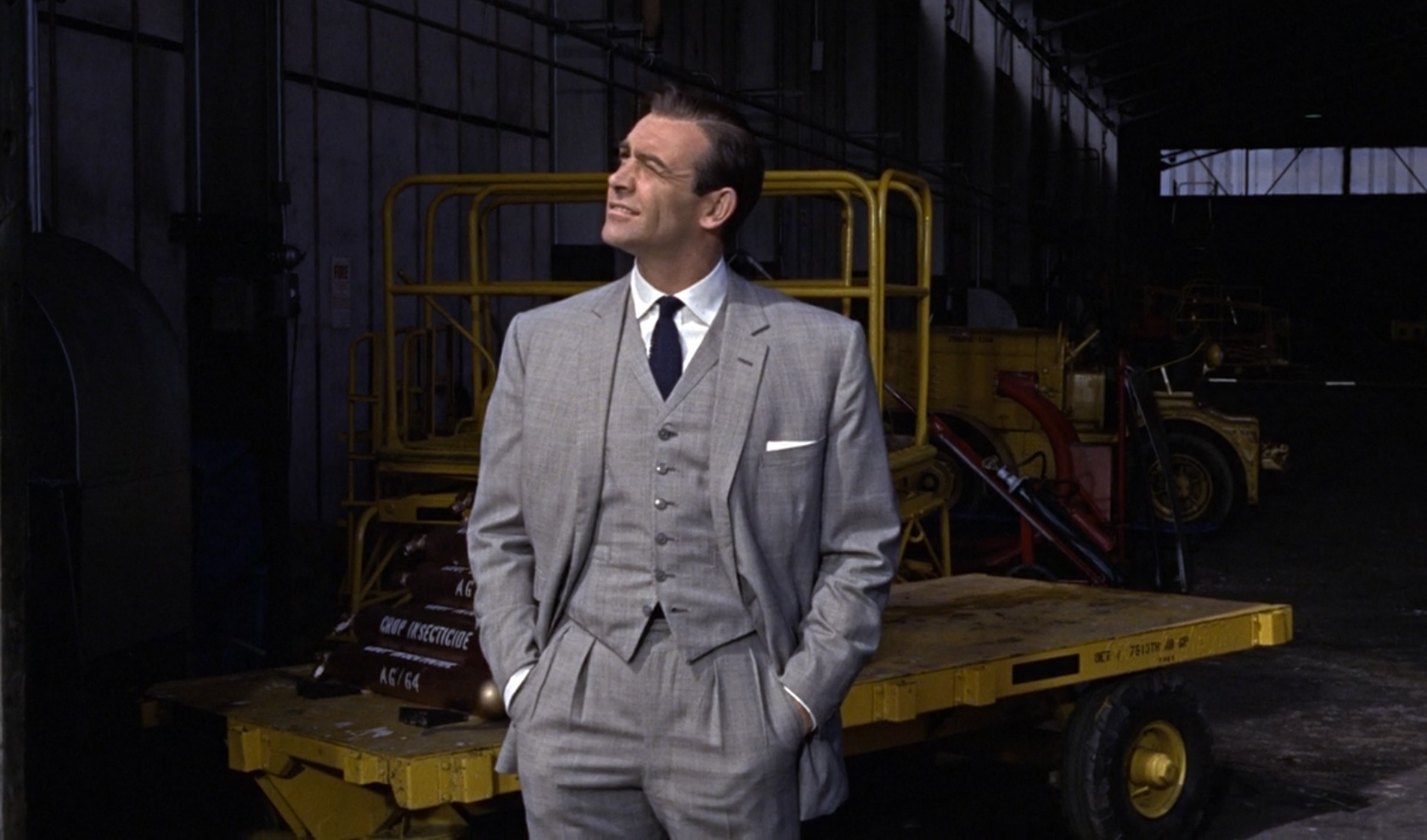
Sean Connery as James Bond
So much so, that the Ian Fleming Publishing Ltd. recently commissioned the British novelist, William Boyd, to write a new Bond novel. Boyd, a critically and commercially successful novelist, took the commission gladly–he loved the Bond novels and figured his plots would be better than Fleming’s. (And when you examine the plot of Goldfinger, you’re pretty likely to agree.) Boyd’s novel Solo will be released on September 26 in Britain and on October 8th in the States. It is not like Bond ever went away…except now he is newer and fresher.
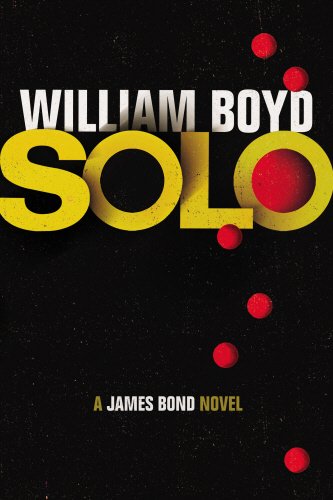
William Boyd’s novel Solo
I wonder if my parents would let me read it.

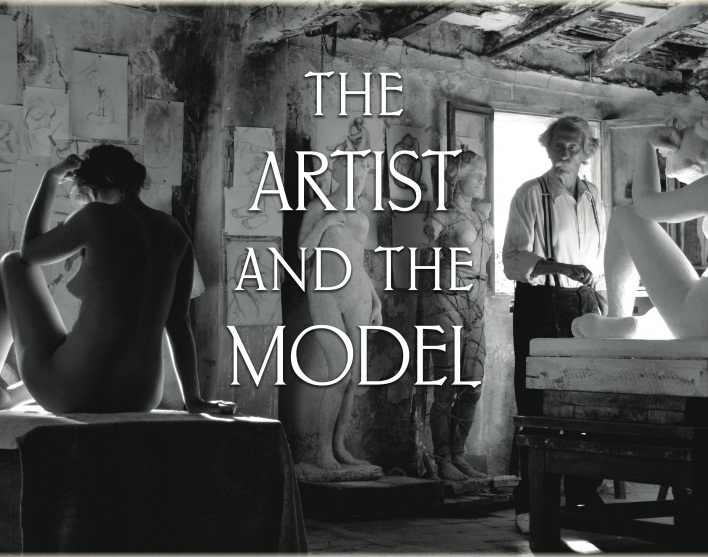
poster for Trueba’s The Artist and the Model
Trueba’s The Artist and the Model is the art of film raised to the highest level. Its story is poignant, its intelligence is palpable, its cinematography is mesmerizing, its acting is subtle and powerful and its beauty is breathtaking. And in a film that addresses life and art and beauty and work, it is the very face of the artist Marc Cros (Jean Rochefort) that comes to represent them all, a face that Trueba closes in on with love and craftsmanship, a face that seems to contain the very themes of the film itself.
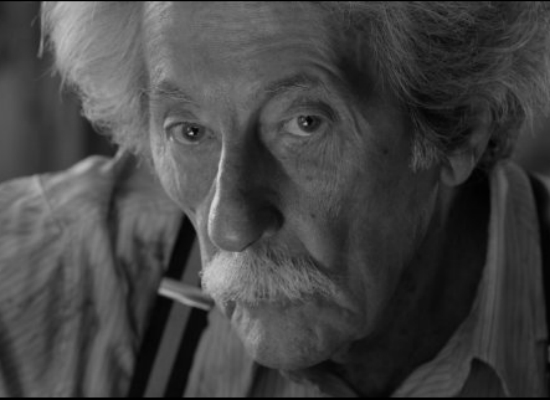
Jean Rochefort as the sculptor Marc Cros in The Artist and the Model.
An elderly sculptor (Rochefort) has isolated himself in a small village apart from the business of war in Occupied France during World War II. One day, his wife (Claudia Cardinale) discovers a Spanish refugee (Aida Folch) sleeping rough and washing herself in the village’s fountain, She brings the girl home to her husband to be his next (and last) model, to be the muse for him that she had once first been.
In exchange, the young woman, Mercè, receives room and board and a salary. Awkward at first, their relationship–the artist and the model– grows into a symbiotic one: she inspires the sculptor and he transforms her into his masterpiece. In their life together, she is joyous and he is crotchety. She is young and he is wise. She is involved in the war and he is trying to keep it at bay.

Aida Folch as Mercè in The Artist and the Model
The film is shot in black and white. But to merely say “black and white” does not capture the luminous beauty of the photography. Each scene has a shimmering silver light that imbues the film with both beauty and gravitas. Each scene seems as if a Richard Avedon portrait had come to life. I do not exaggerate when I say that this may be the most beautiful film I have ever seen.
The slow rhythm of the film may be off-putting to some, but it should not. We are watching something very special here. The creative process has always been a difficult one to portray, and a slew of films have done it badly. But not this. This comes as close as is probably possible in capturing the artistic process: idea, incubation, trial, and execution.
And aside from our watching the process, there is the sculptor’s instruction for his model. At one point, he tells her his version of creation. God, he says, having created the beauty of the universe, wanted someone to share it with and so he created woman. (He believes the female body and olive oil are God’s greatest creations.) Together, God and the woman, had a son Adam.
At another time, he takes a scribbled pen-and-ink drawing of Rembrandt’s and explains to Mercè what the artist was doing. In a simple three minutes of film, he gives a master class in art–and one that any art student should attend to.
We learn more about the artist when a Nazi officer drives up to his mountain studio. Mercè–who at that point is hiding a wounded Resistance fighter–is naturally on alert. But the Nazi is there to discuss the biography he is writing on the artist. (He already has some 400 pages.) After the two discuss the book, the Nazi departs, telling Cros that he has been transferred to the Russian Front. We get the idea that he’ll never live long enough to finish his book.
The stories surrounding the making of The Artist and the Model are a lesson in creativity as well. Based loosely on the sculptor Aridste Maillol and his final model, Trueba began working on the script in 1990, intending to collaborate with his brother the sculptor Maximo. But Maximo’s young and sudden death, put Trueba off the project. It was not until, Rochefort, whom Trueba had already considered to play his sculptor, told him he was retiring that Trueba decided to go ahead with it.
It is undoubtedly, the high point of Trueba’s career so far, as it probably is also for Jean Rochefort. Indeed, like the sculptor that he plays, Rochefort’s finest performance–in a long and celebrated career–is here in this his final performance.
Certainly, there is much good art around. There is very little great art. The Artist and the Model falls into the second category.
Here is the trailer:

Evening at the Barnes.
photo © 2013 jpbohannon
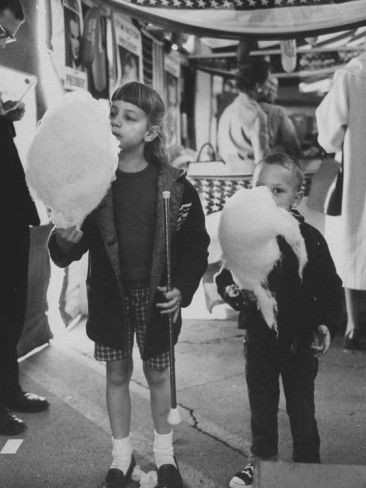
photo Ralph Crane
We probably all can imagine that little boy or girl at a fair, a carnival, or an amusement park, who seeing an enormous pompadour of pink or blue cotton candy (spun sugar to some of you) insists on getting the largest size. We can see further the sticky stains upon their faces, the crazed shock of sugar in their eyes. And we can empathize with them and their queasy stomachs that a night filled with cotton candy is certain to produce.
That’s how I feel about Renoir and his nudes.
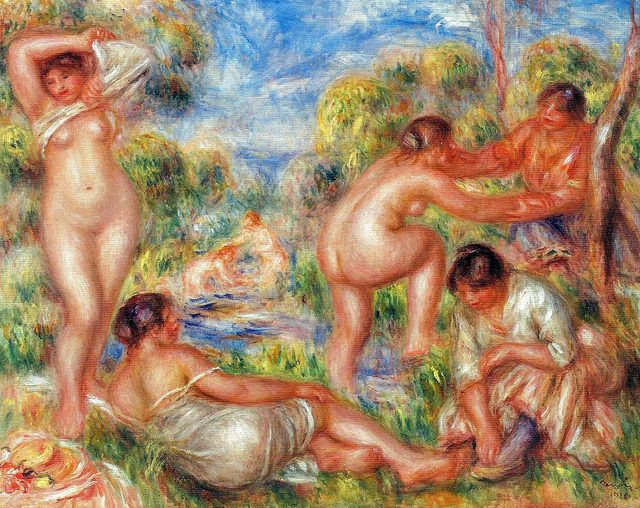
Pierre Renoir
“The Bathing Group (1916)”
Barnes Foundation
I spent more than three hours at the Barnes Foundation last Friday night. And as always, it is a mind-boggling collection of early modern art, African sculpture, and American furniture, decorative and industrial arts. I could spend a lifetime looking at the Modglianis and Mattisses. I am fascinated by Chaim Soutaine and George Seurat. And Henri Rousseau I find thoroughly relaxing and amusing.
But it is the Renoirs that I find cloying.
Barnes owns 181 Renoirs that encompass the span of the artist’s career. Now, there is much that I like about Renoir: his early works, the group portraits and the early nudes. But the more famous nudes, those cotton candy swirls of creams, oranges, pinks and yellows, I find difficult to look at.
By contrast, one of my favorite paintings in the collection is also a nude: Amadeo Modgliani’s Reclining Nude from Back. Is it lifelike? No. But it is sensuous and intriguing and narrative and appealing and pleasing. And what more could a person want from a work of art?
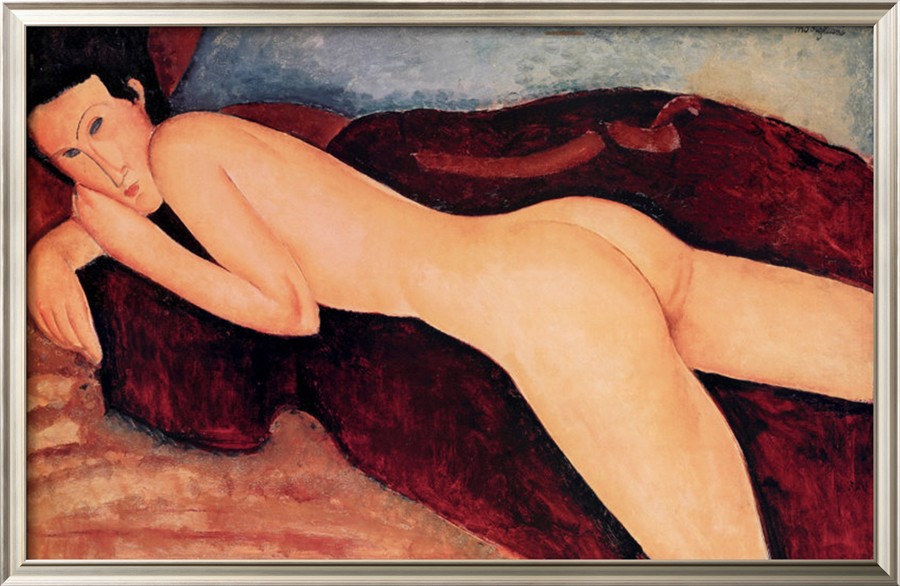
Reclining Nude from the Back by Amadeo Modgliani
Modgliani’s attenuated figures with their mask-like visages, I find fascinating. I find a story in each of their stony faces. Likewise, I delight in the classical innocence of Picasso’s Girl with a Goat or the bold outlines and patterns of Mattisse’s Reclining Nude with Blue Eyes. Each is so distinct in itself, so original in its view of the human body.
Renoir’s nudes, on the other hand, I find distracting in their busyness. I find them tiring and I tend to pass over them quickly.
To me, they look like how Barbie would decorate a bordello if she ever became a Madam.
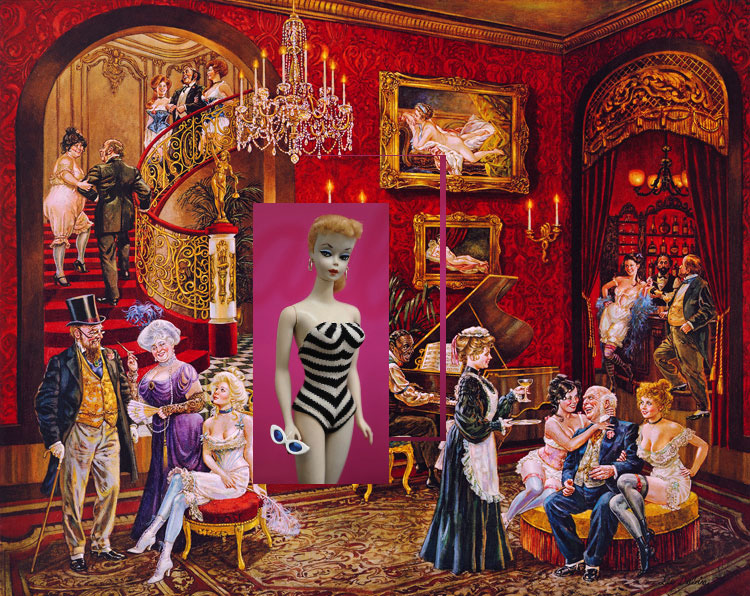
Barbie and the Bordello
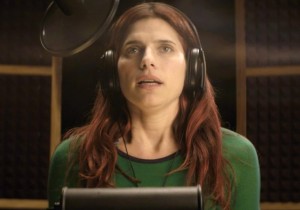
Lake Bell as Carol Solomon in In a World…
Last week a friend and colleague of mine e-mailed me with an odd request. He was making a film on an Institute he had attended this summer and wanted me to do the voice-over. I was honored and a little nervous. After I agreed, he sent over the script–a mere twenty lines–and I began practicing.
We wrapped it up the next day.
I’m not sure I want to see/hear the finished project.
Anyway, in this world of coincidences I went to the movies and saw In a World…, Lake Bell’s delightful film about a young woman in the voice-over business.
 Lake Bell–who also wrote and directed the film–plays Carol Solomon, the thirty-something daughter of the “King of Voice-Overs,” Sam Sota, played by Fred Melamed, Sam is a bit full of himself; He has published his own kiss-and-tell autobiography and quickly in the movie kicks Carol out of their apartment because his 30-year old girlfriend is moving in. (That the 30-year old girlfriend ultimately acts as his moral conscience shows the shallowness of the man.)
Carol is trying to crack into the male-dominated world of voice-overs. (Easily a microcosm for the difficulty of women finding jobs in the entire film business). And rather than help his daughter in the business, Sam places every roadblock in her way. He truly believes that women have no place in the voice-over business–even if it is his daughter–and so he mentors the rising new “voice-over” superstar, a man perhaps sleazier than Sota himself.
Suddenly without a home, Carol crashes at her sister and brother-in-laws’s house where there is an undercurrent of marital tension and ekes out a living as a voice coach. That is until a few breaks come her way and she makes the most of them.
The arc of the plot is familiar, but the film is no less enjoyable because of that. Bell is a delight to watch. She is quirky without being annoying, serious without being sober, and she is intelligent–in front of and behind the camera. Her relationship with her sister is satisfying, and the romance she has with the sound man, Louis–played by the always enjoyable Demitri Martin–is one that you find yourself rooting for.
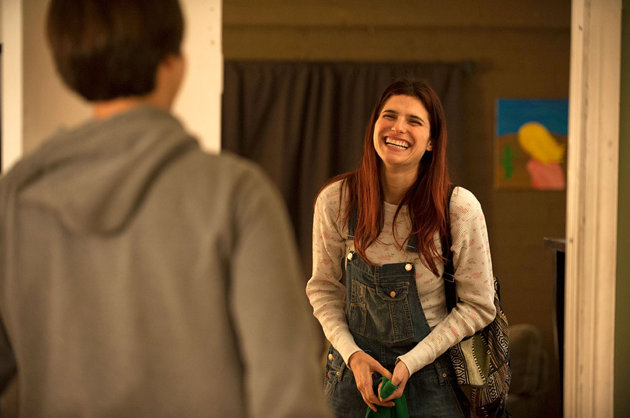
Louis and Carol (Dimitri Martin and Lake Bell)
I came out of the film smiling. Not because of any silliness or humor, but because In a World… is a small film that gives off a good feeling. In a quiet way, good appears to win in a pretty cutt-hroat town, and that is always an unexpected pleasure.
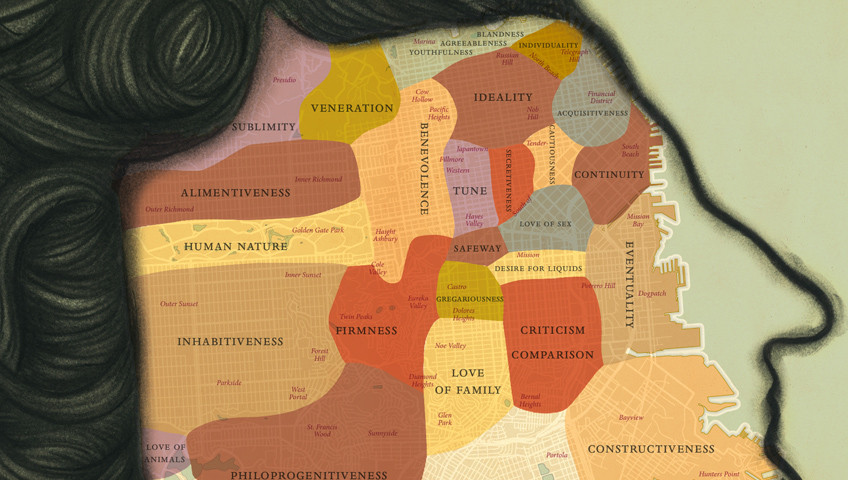
Phrenological San Francisco (page 128-129)
Rebecca Solnit begins her book with this quotation from Thoreau:
“I have traveled widely in Concord.”
Concord really isn’t that big a place to “travel widely” in, but that is the argument of Solnit’s Infinite City: every place contains an infinite number of “maps” with which we travel, and within her book Solnit creates a unique, intriguing, and entertaining series of maps of her city, San Francisco.
Now, you know you are in heady territory when in the first three paragraphs Solnit makes multiple references to Borges and Calvino, both fantastic cartographers and creators of worlds that have never existed. Yet, Solnit is every bit as imaginative and perceptive. She reveals a given place (San Francisco) in ways that had never been categorized before and introduces new perspectives on the city that have never before been imagined.
In her introduction, Solnit explains her method thus:
Every place is if not infinite then practically inexhaustible, and no quantity of maps will allow the distance to be completely traversed. Any single map can depict only an arbitrary selection of the facts on its two-dimensional surface… . For Infinite City, this selection has been a pleasure, an invitation to map death and beauty, butterflies and queer histories, together, with the intention not of comprehensively describing the city but rather of suggesting through these pairings the countless further ways it could be described. (I also chose pairs in order to use the space more effectively to play up this arbitrariness, and because this city is, as all good cities are, a compilation of coexisting differences, of the Baptist church next to the Dim Sum dispensary, the homeless outside the Opera House.)
And this is how the book works. The “arbitrary selection of facts” are surprising and unconventional. There are maps of industries and bee migrations and “tribal neighborhoods” and gang-lands and right-wing bastions and bygone areas of entertainment and carousal. And the pairings are both startling and sensible. For instance, the map entitled “Poison/Palate: The Bay Area in your Body” is accompanied by Solnit’s essay “What Doesn’t Kill You Makes You Gourmet.” In both, the reader is given a map of the major dumpers of toxins into the environment (often food and wine growers) and the sites of delicious, food providers. (Often the two overlap.) The key to the map gives symbols for EPA SUPERFUNDS, Poison Sites, Palate Sites, Poison/Palate Sites and Wineries.
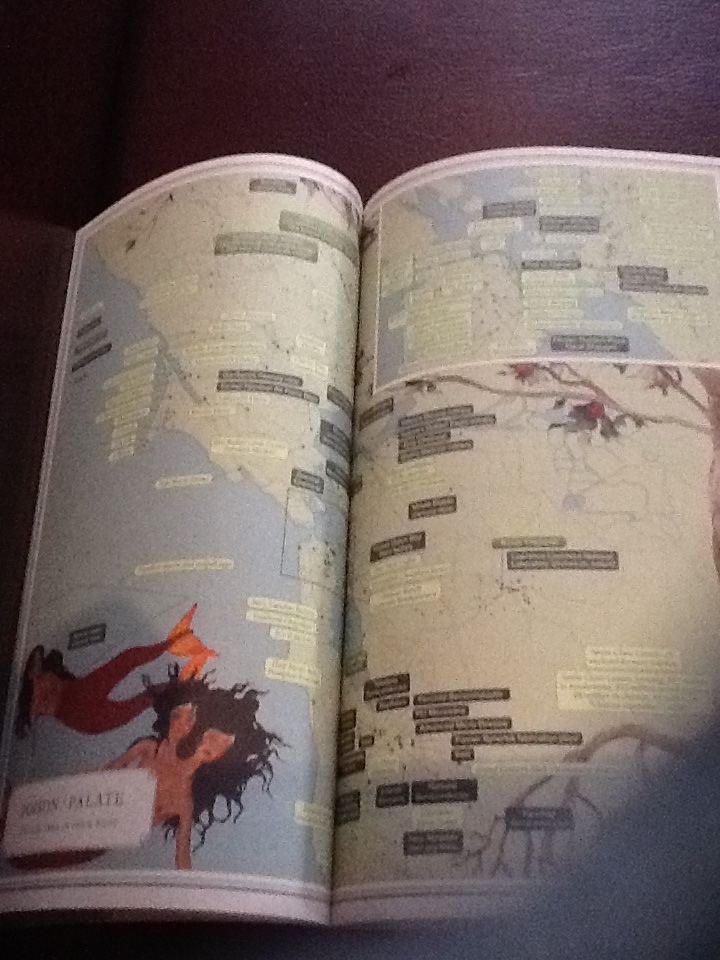
Poson/Palate: The Bay Area in your Body
The population map–the current population not the map of those who have left and those who are arriving–is set up as a “tribal” map. The expected ethnicities are cited–the Chinese, the Irish, the Korean, the Mexican–but they are accompanied by neighborhoods where the “tribes” include skateboarders, people with ties, transgender people, etc. Again, this is accompanied by a moving essay by Solnit about the ever changing population shifts of her city.
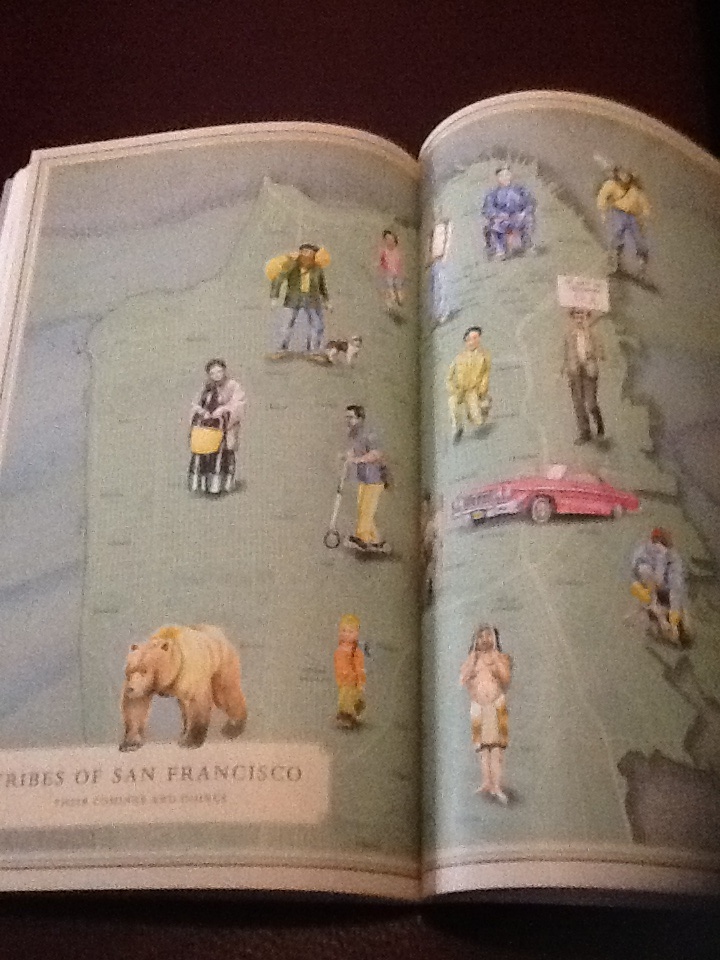
Tribes of San Francisco
But it is the pairings that are the most intriguing. One map, entitled Death and Beauty, tracks the murders in the city during the year 2008 and the locations of Monterey cyprus trees throughout the city; another entitled Dharma Wheels and Fish Ladders lists salmon streams, hatcheries and viewing sites along with the location of Zen monasteries, schools, and core sites; and still another, entitled Monarchs and Queens, reveals the locations of various butterfly locations and queer public spaces.
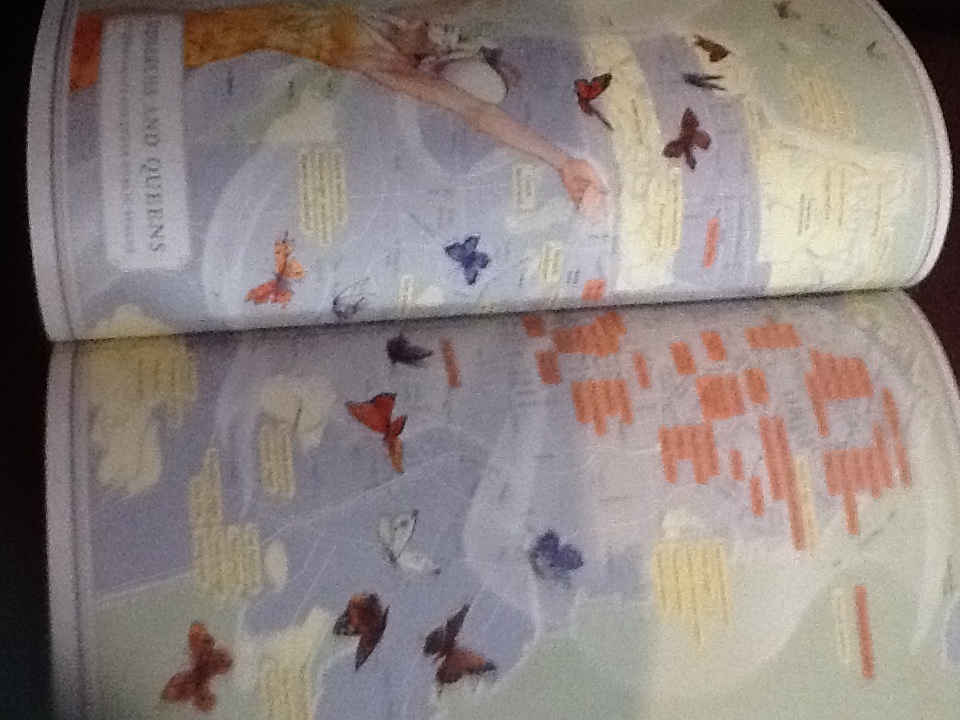
Monarchs and Queens
Each of the twenty-two maps are jewels of color, design, and information. They are beautiful, as are all of the illustrations throughout.
While Solnit did not write all of the essays that accompany the maps, she did write the majority and her fellow essayists are similar in spirit, similar in the way they look at their ever-changing city. In a recent piece for the London Review of Books entitled “Google Invades” (February 2013), Solnit bemoaned the changes that have occurred in her city with the influx of Silicon Valley money. She felt that the variety in the city’s fabric–in its economics, its life styles, its ethnicities, its politics, and its arts– was being leveled and watered-down with the influx of cyber-millionaires. The city–not just a neighborhood– was being gentrified.
Solnit sees her city, San Francisco, in many, various ways, in multiple perspectives that have accrued layer after layer through the years that she has lived there. These views are both nostalgic and forward-looking, while still very much ensconced in the present, no matter how ethereal that might be. And while some of these layers may now have physically vanished, they remain in her memory, in her view of the city.
And they remain in this amazing, attractive, and addictive book.
Illustration 2013 by jpbohannon
The Official Web Site of LeAnn Skeen
Grumpy younger old man casts jaded eye on whipper snappers
"Here is my secret. It is very simple: It is only with the heart that one can see rightly; what is essential is invisible to the eye.."- Antoine de Saint Exupéry
Of writing and reading
Photography from Northern Ontario
Musings on poetry, language, perception, numbers, food, and anything else that slips through the cracks.
philo poétique de G à L I B E R
Hand-stitched collage from conked-out stuff.
"Be yourself - everyone else is already taken."
Celebrate Silent Film
Indulge- Travel, Adventure, & New Experiences
Haiku, Poems, Book Reviews & Film Reviews
The blog for Year 13 English students at Cromwell College.
John Self's Shelves
writer, editor
In which a teacher and family guy is still learning ... and writing about it
A Community of Writers
visionary author
3d | fine art | design | life inspiration
Craft tips for writers
 j. p. bohannon