Quote #29: Adrienne Rich on “love”

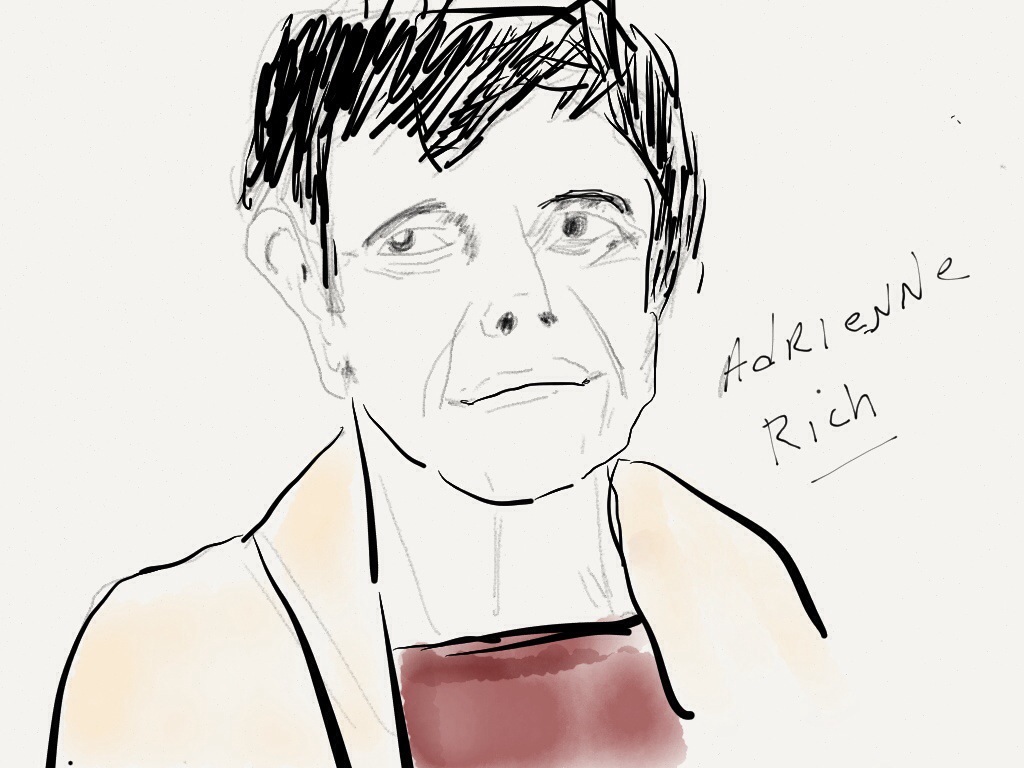
Adrienne Rich illustration 2013 jpbohannon

Adrienne Rich
illustration 2013 jpbohannon

An honorable human relationship — that is, one in which two people have the right to use the word “love” — is a process, delicate, violent, often terrifying to both persons involved, a process of refining the truths they can tell each other.

Adrienne Rich (quoted from brainpickings)

Quote #28: The Door of Opportunity…or of Truth

Illustration 2013 jpbohannon

Illustration 2013 jpbohannon

“The truth knocks on the door and you say, ‘Go away, I’m looking for the truth,’ and so it goes away. Puzzling.”

Robert M. Pirsig, Zen and the Art of Motorcycle Maintenance

Thanksgiving, mothers, food and unspoken love

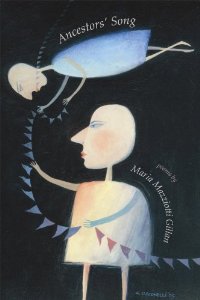
Ancestors' Song by Maria Mazziotti Gillan

Ancestors’ Song by Maria Mazziotti Gillan

A friend of mine went to a conference in New York City a few weeks back, where she saw the poet, Maria Mazziotti Gillan.  When she returned, she had thoughtfully brought me back a copy of Gillan’s latest collection, Ancestors’ Song, with a lovely note on the title page (which I didn’t discover until I had read most of it two or three times.)

The poems are powerful. They are heart-wrenching and thought provoking and memory inducing.

Anyway, I thought I would share one with you. (I hope that Ms. Gillan does not mind.)

Even if you claim not to like poetry, read this one anyway. It is not a thanksgiving day poem, but a poem about mothers and food and abundance and unspoken love, things that are often intertwined during this holiday which so heavily focuses on the kitchen and table.

Enjoy it:

Conjuring Up My Mother

Why this morning, twenty years after my mother died,
do I conjure her up in her basement kitchen, clear
as if I had seen her yesterday? Watch her lift the roasting
pan out of the oven, the chicken browned and sizzling,
the oven-roasted potatoes, sliced and quartered, brown
and gold. Watch her pull out the stuffed artichokes, dark
green leaves holding homemade breadcrumbs that have formed
a crust while the artichokes cooked. She places the food carefully
as an artist on serving platters in the basement dining room
where 16 of us sit around three tables placed end to end
to form a long row. The chicken and artichokes are the third
course she has served this Sunday, as she does each Sunday, her
children and grandchildren laughing and talking, take for granted
the aroma of tomato sauce and homemade ravioli, meatballs, bowls
of olives and walnuts, huge salads from her garden, the entire meal
ending with her special lemon cake and bowls of fruit and cookies
and espresso. Such bounty presented to us each week as though it
would go on forever, my mother happy to be cooking for hours before
we arrived from our morning coffee and NYTimes and sleeping in, happy
to see us all together at her table, the way we came to believe we deserved
to be served, came to believe she would always be there. Even now, I imagine
I can see the crispy skin of that chicken, long since eaten, the crusty potatoes,
the artichoke leaves, the bread stuffing, that I could drive to her house
and she’d be waiting for me, and not as I do now, each day, all the voices
that surrounded me vanished, only this memory to comfort me in my empty
house where too often, I eat alone.

“Conjuring Up My Mother,” by Maria Mazziotti Gillan.  In Ancestors’ Song, Bordighera Press, 2013.

Quote #27: Allen Ginsberg, “Follow your inner moonlight…”

"Follow your inner moonlight; don't hide your thoughts." Allen Ginsbergillustration 2013 jpbohannon

“Follow your inner moonlight; don’t hide your madness.” Allen Ginsberg
illustration 2013 jpbohannon

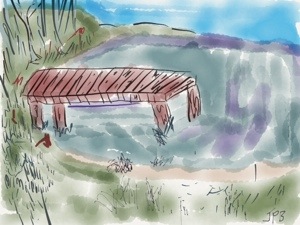
Quote #26: Ted Hughes’ “To Paint a Water Lily”

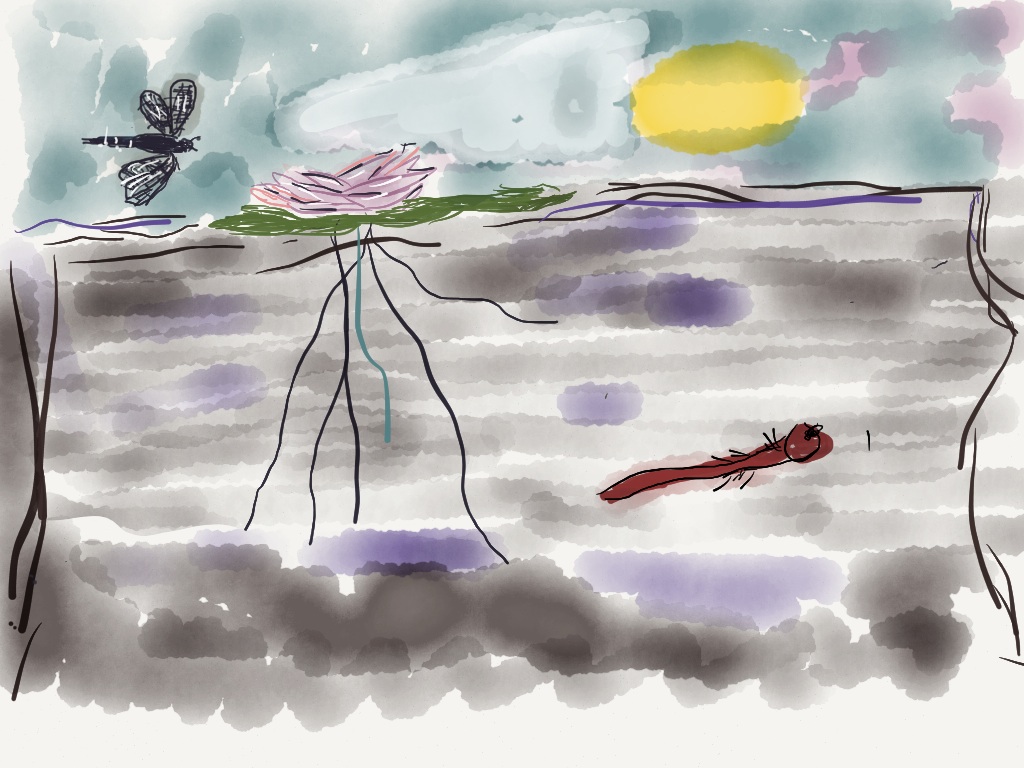
illustration 2013 jpbohannon

illustration 2013 jpbohannon

… Now paint the long-necked lily-flower

Which, deep in both worlds, can be still
As a painting, trembling hardly at all

Though the dragonfly alight,
Whatever horror nudge her root.

from “To Paint a Water Lily,”   Ted Hughes

Quote of the week #25: Thoreau’s Thanksgiving

20131019-131701.jpg

“I am grateful for what I am and have. My thanksgiving is perpetual. It is surprising how one can be with nothing definite–only a sense of existence.”

Henry David Thoreau (letter to Harrison Blake, 1856)

Quote of the Week #24: October 13, 2013

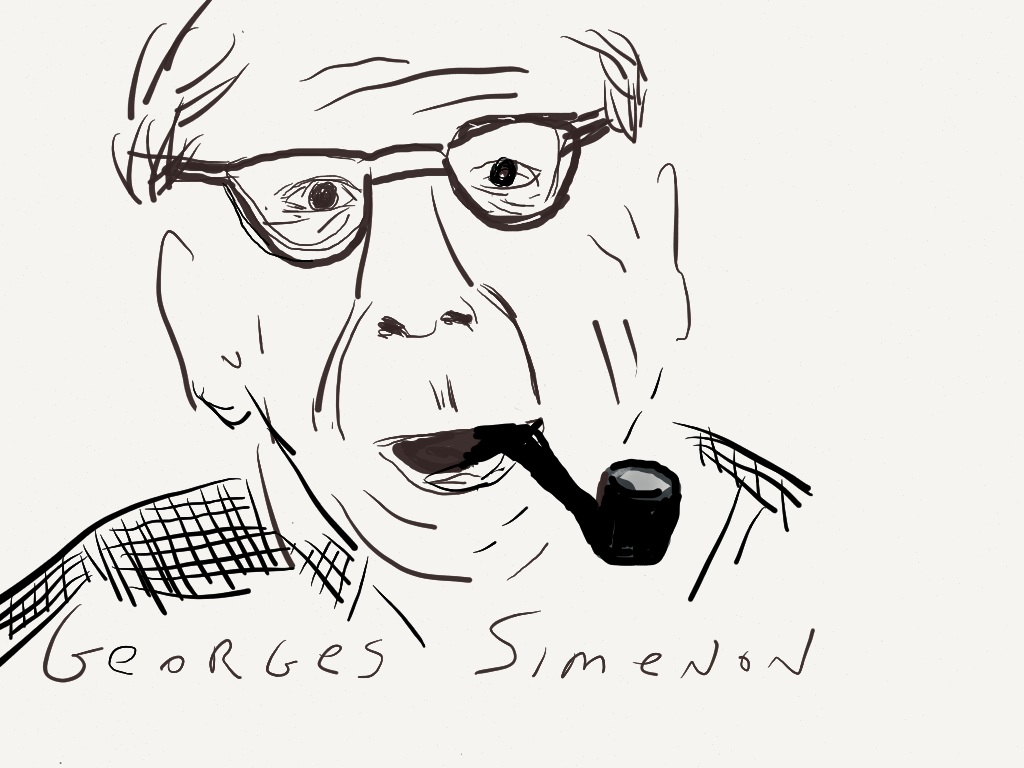
Georges Simenon illustration 2013 by jpbohannon

Georges Simenon
illustration 2013 by jpbohannon

“If your vision of the world is of a certain kind you will put poetry in everything, necessarily.”

Georges Simenon

Baseball Poetry: “The Pitcher” by Robert Francis

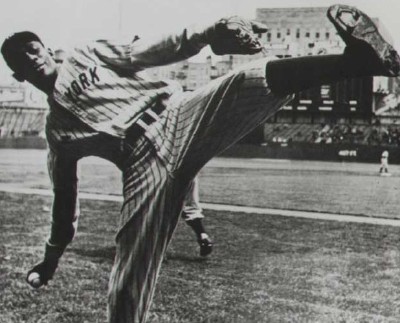
Satchel Paige--a true poet

Satchel Paige–a true poet

I gave my students a poem today and asked them to wriggle around inside it and tell me everything they found in there.  The poem I gave them was “The Pitcher” by Robert Francis.  I was hoping there were some baseball players in the class, but none of them had played much past little league. But many of them were fans.  And I believe they achieved a pretty good literal reading–how a pitcher in baseball depends greatly on being misunderstood, at aiming at something he didn’t seem to be aiming at, at avoiding the obvious and varying the avoidance.  We went through it line by line, describing what aspect of a pitcher’s performance was being described. One student thought that maybe it might even be, in his words, “about a pitcher and maybe about a non-conformist.” That was interesting. He knew what he meant but was having trouble working himself through it. And then one student, somewhat self-doubting, said that he too saw the poem dealing with a baseball player and something else. But for him, that something else was “a poet.” He went on to say that a poet’s deception was that instead of saying something was brown, he would say something was like the “leaves of autumn.” Much like a pitcher’s throw looks like its coming one way but then intentionally breaks another. A part of him believed that he was really off-the-mark but, to his credit, he forged on. And he was pretty good. In fact, in the past, after a class has seen this poem, I ask them–as they are leaving–to think again about “The Pitcher” when they get home, but this time to think in terms of a poet and the poet’s craft, to think about the similarities between what some pitchers and some poets attempt to do. And the next days’ discussions are often quite good. But today’s student was the first ever to go there without my prompting.  And that’s a pretty cool thing.

The Pitcher by Robert Francis

His art is eccentricity, his aim

How not to hit the mark he seems to aim at,

His passion how to avoid the obvious,

His technique how to vary the avoidance.

The others throw to be comprehended. He

Throws to be a moment misunderstood.

Yet not too much. Not errant, arrant, wild,

But every seeming aberration willed.

Not to, yet still, still to communicate

Making the batter understand too late.

Quote of the Week #23: October 6, 2013

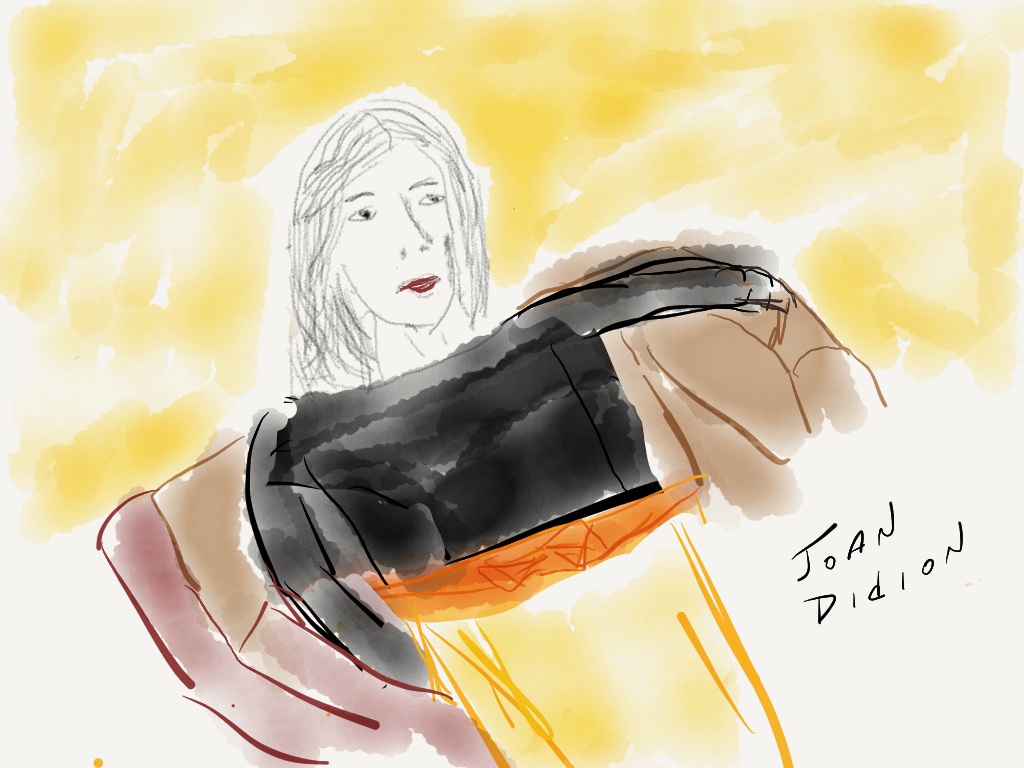
Joan Didion.  illustration 2013 jpbohannon  based on portrait by Lisa Congdon for Reconstructionists project

Joan Didion.
illustration 2013 jpbohannon
based on portrait by Lisa Congdon for Reconstructionists project

“I’m not telling you to make the world better, because I don’t think that progress is necessarily part of the package. I’m just telling you to live in it. Not just to endure it, not just to suffer it, not just to pass through it, but to live in it. To look at it. To try to get the picture. To live recklessly. To take chances. To make your own work and take pride in it. To seize the moment. And if you ask me why you should bother to do that, I could tell you that the grave’s a fine and private place, but none I think do there embrace. Nor do they sing there, or write, or argue, or see the tidal bore on the Amazon, or touch their children. And that’s what there is to do and get it while you can and good luck at it.”

Joan Didion

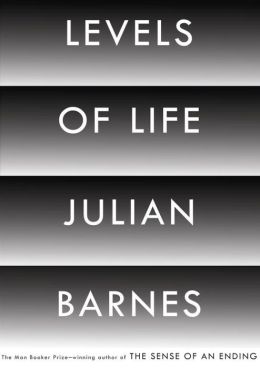
Book Review: Levels of Life by Julian Barnes… a grief both honest and beautiful.

levels of life  Julian Barnes latest work is a slim, tripartite volume that encompasses a 19th century history of ballooning and the beginnings of portrait photography, a semi-fictional account of the love affair between an English “balloonatic” and the divine Sarah Bernhardt, and a searingly honest examination of the author’s own grief upon the loss of his wife, Pat Kavanagh, in 2008.

As always, Barnes writing is careful, thoughtful, and precise. His insight into the heights of ballooning and its accompanying crashes, the flights of romance and the desperation of rejection, and the comfort of love and the devastation of its loss are intelligent, beautiful, and memorable. It is the type of book that one reads with a pencil nearby so to copy the phrases that so often hit their marks squarely.

In the first section, “The Sin of Height,” Barnes describes the flights of three different balloonists over the course of nineteen years–all of the passengers whose paths cross at times throughout the years. The first is Nadar the French photographer, whose balloon basket carried a developing lab and who was one of the first to ever give us aerial photographs, albeit very vague and poor ones. (moving from Nadar’s early aerial photographs to the Earthrise photos that were taken on the first trip to the moon a century later, Barnes writes beautifully about our tiny planet, swirling with gasses and storms and blue beauty.)

Nadar did however go on to be a great portrait photographer, and his photographs of the actress Sarah Bernhardt are the first we have of her. She too is one of the balloonists that Barnes features. The third balloonist, Fred Burnaby is a English military man–a member of the Royal Horse Guard–an adventurer, and a noted bohemian.  It is a history that captures the excitement and controversy of the modern age–encapsulated by the birth of photography, electricity, and aviation.  Victor Hugo believed that flight would bring about democracy while Balzac believed that photography steals a layer of the sitter’s persona.

It is Burnaby’s romance with Sarah Bernhardt that makes up the second section, “On the Level.” Reading like part of a novel, this section depicts Burnaby–very much a man of the world–now very much in love and very articulate about how he feels. He is aware of the dizzying heights to which Bernhardt has taken him, and, as a ballonist, he is always aware of the heights from which he will fall when she releases him. His dispassionate accounting of his heartbreak, his pain, his desolation is telling, but despite the level-headedness of his account we never doubt the intensity of the love that he experienced.

But it is the third and longest section–“The Loss of Depth”–that is the most moving, that often feels like a punch in the heart.  For in it, Barnes examines his own grief upon losing his wife.  “Thirty-seven days from diagnosis to death” is the quickness with which this blow was dealt, and Barnes delineates his pain, his grief, his loneliness with extraordinary honesty and bravery and clarity. It is a exceptional feat, this incise, self-examination of utter loss, put down in words.

While the section surprises us, coming as it does after the previous two sections, in a way he was preparing us for it as well. Burnaby’s meditation on the loss of love, the discussion of crashing being part of the risk of rising, the uxorious care that Nadar took of his stroke-stricken wife, all these point to the marriage of Barnes and Pat Kavanagh.
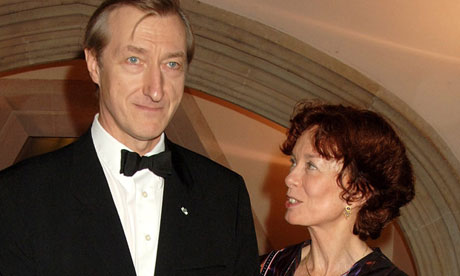
Julian Barnes with his wife, Pat Kavanagh in 2005. Photograph: Dave M. Benett/Getty Images

Julian Barnes with his wife, Pat Kavanagh in 2005.
Photograph: Dave M. Benett/Getty Images

He discusses the reactions of those he knows, the kind but often inept remarks that friends attempt, the plans they suggest to help him “through it.”  He discusses his daily patterns, emptied now of half the players. He considers suicide, but checks that because if his wife lives in his memory, killing himself would be killing her a second time. He examines the Orpheus legend and takes refuge in meaningless soccer games and overly-emotional opera. And through this all he continues to miss his wife terribly and daily, and the pain of her absence seems never to go away.

But at no times is this meditation maudlin. Indeed, I found myself thinking what a wonderful thing this would have been if he could have shown it to his wife when she was alive. But then, he wouldn’t have had the wrenching grief that allowed him to write it.

Levels of Life is more than a beautiful book. It is powerful and loving. Intelligent and thoughtful. Honest and real. Perhaps after reading it, we should then ask our partners to read it as well, to let them know now what they mean to each of us and how their absence would affect us.