“We yield too much to the ridiculous fear that we are at bottom quite impossible beings, that if everyone were to appear as he really is, a frightful social catastrophe would ensue.”
Carl Jung, The Archetype and the Collective Unconscious
The other night I went to see the poet Billy Collins deliver a lecture. It was a pretty fancy event–I’d been given the tickets– held in the beautiful Verizon Hall at the Kimmel Center in Philadelphia. As Billy Collins remarked, it is like standing inside an enormous cello.

Anyway, I don’t know a lot of Collins’ poetry, except maybe two or three poems, but I always use his poem “Introduction to Poetry” at the beginning of any course I teach in poetry. In it, Collins claims:
I ask them to take a poem
and hold it up to the light
like a color slide
or press an ear against its hive.
I say drop a mouse into a poem
and watch him probe his way out,
or walk inside the poem’s room
and feel the walls for a light switch.
I want them to waterski
across the surface of a poem
waving at the author’s name on the shore.
But all they want to do
is tie the poem to a chair with rope
and torture a confession out of it.
They begin beating it with a hose
to find out what it really means.
It is those last five lines that are important. They describe why poetry is met with such an “ugh” from people whose only experience with it has been in classes where the well-intentioned teacher urged them to “find the meaning.”
I tell my students that human beings are innately wired to respond positively to poetry (think infant lullabies, toddlers’ picture books, nonsense riddles, jump-roping songs). It is the English teachers who teach students to dislike it. To think of it as something to fear and dread.
And that is a shame.
For last night, Collins (who repeated what I said about poetry being innate) was as entertaining as could be. He told the audience a bit of his life and his term as Poet Laureate of the U.S. He spoke of his influences and literary influences in general. He spoke of the death of humor in poetry–he blames the Romantics who he said “replaced sex and humor with landscape.” And he spoke of the difficulty for some people used to hearing formalist poetry to hear the acoustics of what is commonly called free verse. (He doesn’t like the term.)
He also read several of his poems, although half of what he read came from others. Here is a wonderful two line poem by Howard Nemerov called “Bacon and Eggs”:
The chicken contributes,
But the pig gives his all.
See it’s good to laugh. And have fun in poetry.
And so he spoke of the importance of humor and used a poem by Ruth L. Schwartz to demonstrate how humor can be used as a transition point, moving from light to darkness (or vise versa). He got a laugh on the line “look at that DUCK,” which is how he wanted it to be:
The Swan at Edgewater Park
Isn’t one of your prissy richpeoples’ swans
Wouldn’t be at home on some pristine pond
Chooses the whole stinking shoreline, candy wrappers, condoms
in its tidal fringe
Prefers to curve its muscular, slightly grubby neck
into the body of a Great Lake,
Swilling whatever it is swans swill,
Chardonnay of algae with bouquet of crud,
While Clevelanders walk by saying Look
at that big duck!
Beauty isn’t the point here; of course
the swan is beautiful,
But not like Lorie at 16, when
Everything was possible—no
More like Lorie at 27
Smoking away her days off in her dirty kitchen,
Her kid with asthma watching TV,
The boyfriend who doesn’t know yet she’s gonna
Leave him, washing his car out back—and
He’s a runty little guy, and drinks too much, and
It’s not his kid anyway, but he loves her, he
Really does, he loves them both—
That’s the kind of swan this is.
But the most effecting poem that he read was the one that he read last. It is his beautiful poem about the love between a mother and son–told with sweet humor:
The Lanyard
by Billy Collins
The other day I was ricocheting slowly
off the blue walls of this room,
moving as if underwater from typewriter to piano,
from bookshelf to an envelope lying on the floor,
when I found myself in the L section of the dictionary
where my eyes fell upon the word lanyard.
No cookie nibbled by a French novelist
could send one into the past more suddenly—
a past where I sat at a workbench at a camp
by a deep Adirondack lake
learning how to braid long thin plastic strips
into a lanyard, a gift for my mother.
I had never seen anyone use a lanyard
or wear one, if that’s what you did with them,
but that did not keep me from crossing
strand over strand again and again
until I had made a boxy
red and white lanyard for my mother.
She gave me life and milk from her breasts,
and I gave her a lanyard.
She nursed me in many a sick room,
lifted spoons of medicine to my lips,
laid cold face-cloths on my forehead,
and then led me out into the airy light
and taught me to walk and swim,
and I, in turn, presented her with a lanyard.
Here are thousands of meals, she said,
and here is clothing and a good education.
And here is your lanyard, I replied,
which I made with a little help from a counselor.
Here is a breathing body and a beating heart,
strong legs, bones and teeth,
and two clear eyes to read the world, she whispered,
and here, I said, is the lanyard I made at camp.
And here, I wish to say to her now,
is a smaller gift—not the worn truth
that you can never repay your mother,
but the rueful admission that when she took
the two-tone lanyard from my hand,
I was as sure as a boy could be
that this useless, worthless thing I wove
out of boredom would be enough to make us even.

In the mid-nineties, the Guinness company ran a contest that entailed writing an advertisement within a certain number of words. First prize for the winning ad was a pub in Ireland, and you could see the pubs themselves on-line. (Winning this prize is the impetus of the plot of the novel The Night Swimmer)
Anyway, I remember my entry and remember loving its major image…150 orphans playing handball against the wide girth of Finn McCool’s arse.
Obviously I didn’t win. (I arrogantly told myself that I didn’t win the contest because it was run by American advertisers who didn’t pick up on the allusion!)
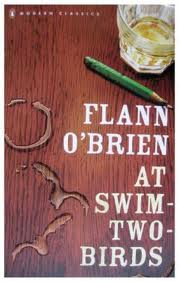
And I remembered that ad because the image came from Flann O’Brien’s novel, At Swim-Two-Birds. And last week I began a post with a poem “The Workman’s Friend” that came from the same novel. That post got me nostalgic for O’Brien’s work. A man of many pseudonyms, O’Brien is best known for the comic novel At Swim-Two-Birds, although my funnest memories are of The Third Policeman and The Poor Mouth, the latter which O’Nolan wrote in Irish as An Beal Bocht under the pen name Myles na Gopaleen. (And both of which I first read in Connemarra and Sandymount respectively.)
At Swim Two-Birds is a rich novel of basically three stories, a meta-fiction in which a character created by the protagonist writes a novel from which his characters gang together with other characters in the novel to avenge their creator. It starts with a university student, who spends more time in his bed and in the pubs than in the classroom. Besides drinking, the student is also writing a novel about a man named Dermot Trellis, a middling writer of Westerns. It is his characters who intermingle with each other, who plot against him, and who attempt to live their lives apart from their author’s intentions, after they drug him.
All of this is mixed with a great deal of Irish mythology and ancient poetry (wryly translated by O’Brien himself). From McCool to Mad King Sweeney, from pookas to fairies, an entire ancient world enters this most modern of novels and interacts with O’Brien’s and Trellis’s fictional creations.
To say there is a circularity to the plot is perhaps inaccurate, and certainly understated. It is more like a mobius strip in another dimension. One thing turns on another to make way for other things that reflect on something else. This jibes very much with the Greek epigraph which translated means “For all things change, making way for each other.” For yes, indeed, one character after another makes way for one other character after yet another.
But most memorably, it is laugh-out-loud funny.
So I began re-reading At Swim-Two-Birds again this week and I started thinking of comic novels in general.
I feel they are best enjoyed by the young.
Think The Gingerman and Catch-22. Think Tom Jones and Confederacy of Dunces. Think Lucky Jim and Reuben, Reuben. Each presents a hero who is outrageously set up against the straight-laced establishment, whether it be the military bureaucracy, the world of academia, or society in general. And each hero takes part in the most outrageous antics–antics that only a young soul could aspire to and believe in. It was once said that an uncle of mine in the army tried to received a medal buck naked, much like–and before–Yossarian in Catch-22. (Unlike Yossarian, he was thrown in the brig.) For my 21st birthday, a good friend of mine wanted to rent a kangaroo suit for me to go bar hopping in, as Sebastian Dangerfield did in The Gingerman. I still chuckle at the peccadilloes that the Scottish poet Gowan McGland gets himself into in the uptight Connecticut suburbs in Reuben, Reuben. (Apparently, the plot was based on Dylan Thomas’s drunken stay in the town in the 1950s.)
But these antics and nose-thumbings are the actions (and dreams) of younger men. And, also, the world has changed. I remember once reading The Gingerman on a bus and being accosted by a woman who yelled that Sebastian Dangerfield was the most misogynistic character in all of literature. I had to admit she was right. In fact, I’d go one further: he is one of the most despicable anti-heroes of all time. Yet, he is still extraordinarily funny.
But, young or old, the truth of all comedy is a certain sadness mixed with the high-jinx. Perhaps the perception of each changes with age–but they both are undoubtedly there. They both need each other.
And so, once more I am churning through At Swim-Two-Birds, and I am still laughing out loud. I just hope that there is no one on my bus protecting the interests of characters who are thought up by characters who are thought up by characters. Cheers.
A few years back, after a particularly mind-numbing conference, a number of colleagues and I repaired to a little hole in the wall on 3rd Street called St. Jacks. The place, hung with erotic black and white photos and glazed with a patina of dust and grime, look as if it were waking up after a rough night. There were no other patrons and, if I remember right, the “kitchen” had been closed for a very long time.
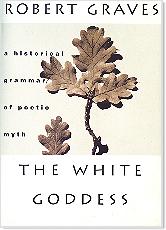
The place was named after a character in the eponymous novel by Paul Theroux. (It was later made into a film by Peter Bogdanovich which has a weird history in itself.) At the time, I was reading Robert Graves The White Goddess, his archeological/anthropological/mythological treatise on pre-Grecian religion, primarily the matriarchies of early civilizations that spread throughout Northern Europe and the British Islands from the south.
Several of my colleagues filled the booths, and four or five of us sat at the bar. The bartender’s name was Cinammon. And she was good. In fact, she is perhaps the best bartender I’ve ever encountered. I put the book I was carrying on the bar, and preceded to talk to my colleagues and to Cinnamon.
Yes, her mother had named her after Neil Young’s “Cinnamon Girl.” And yes, she asked me about the book, but no, she had never read Robert Graves, nor had ever heard of him. After a while, the others wandered out, but my friend Jim and I stayed for a few hours more. The two of us–and Cinnamon–talked about the things we always do when sitting at a bar: music, film, and books. It was a good day.
But now comes the amazing part. We attended a similar conference, one year and a day from that original conference. And like the first one, we all went to St. Jack’s after the conference. And Cinnamon was still tending bar. I hadn’t been in the place since that first time, a year ago. But when I sat at the bar and ordered my pint she asked me if I had finished The White Goddess.
Now, a good bartender should remember the drinks of his regular customers. A very good bartender will remember the drink of the occasional customer. But it is an extraordinary bartender who remembers not only the drink of a customer whom she had served only once a year ago, but remembers the book he was reading at the time.
Jim and I stopped a few more times after that, but Cinnamon left a short while after, left to become a legal secretary. It is a great loss to the bar-tending profession. And St. Jack’s itself is now gone (It had once got in trouble with the Thai government for using an image of the King of Thailand on an advertisement that ran in one of the free city papers. How they came across it is a wonder? Much of the novel/film St. Jack takes place in Singapore and what was then Siam.) And I have never warmed to the new place.
And for various reasons–I had just purchased James George Fraser’s The Golden Bough which reminded me of The White Goddess, and I have been lately banging out “Cinnamon Girl” on the guitar whenever I get a moment to myself–I have been thinking about St. Jack’s, about The White Goddess, and about Cinnamon.
So here, in memory of the greatest bartender I ever met is Neil Young singing “Cinnamon Girl.” And as a treat, it is not his familiar fuzz-driven guitar version of the song, but a different version of Neil by himself on the piano from his upcoming album “Live at the Cellar Door.” Enjoy:
About Time is largely advertised as being from the makers of Notting Hill, Love Actually, and Four Weddings and a Funeral. And the film nods politely to all three of its ancestors. Notting Hill and Four Weddings and a Funeral were carried by Hugh Grant’s bumbling and boyish charm, and Love Actually by Bill Nighy’s performance as an over-the-hill rock-singer, as well as a packet of sweet and moving love stories.
About Time capitalizes on both. Like Hugh Grant, Domhnall Gleeson is all boyishness and sweetness and bumbling good will. Without the classic handsomeness of Grant, Gleeson’s is a more affecting, more real character. The same can be said of his love interest played by Rachel McAdams. Her simple beauty is open and fresh and void of Hollywood sheen. And together they make a couple we might know, whom we like and root for.
But it is Bill Nighy who anchors the piece. Has Nighy become the go-to-guy when someone needs a somewhat eccentric, aging British male, who is always ready to give the finger to the establishment and to all that it expects of him? If so, he does it wonderfully. (See his character in Love Actually, Pirate Radio, even the Last Marigold Hotel).
At first, the plot sounds a bit of a stretch–on New Year’s day of his 21st year, a young man Tim (Gleeson) is told by his father (Nighy) that the men in their family have the ability to travel in time. This is not H.G. Wells science-fiction stuff, however, simply the ability to return to a moment and correct any faux pas that one might have made. You know those moments that only after they have passed do you realize what you should have said, should have done? (The French have a phrase for those moments–l’esprit de l’escalier.) Well, what Tim’s father is giving him is the chance to always go back and say or do that right thing, make that suave gesture, deliver that saving grace.
Dubious of his father’s newly shared secret, Tim tests his new power immediately by returning to the previous night’s New Year’s Eve party where he had slighted a young woman at midnight (a slight that had him tossing in his sleep all night long.) He is able to correct what happened and is rewarded by a smile on the young woman’s face where there had once been pain.
The remainder of the film follows Tim as he courts Mary (McAdams), prevents disasters for his roommate, and tries to save his sister’s descent into a damaging and abusive relationship. His attempts are charming and amusing–his first night with Mary is filled with many “do-overs” until he has it down perfectly–and the goodness and sincerity of his wishes are heartwarming.
But it is the eminent death of his father that is the most poignant.
Moving seamlessly from a cute romantic-comedy to a poignant examination of fatherhood and family, About Time surprises us with an emotional wallop that we weren’t really prepared for. But it works perfectly. The father’s last request of sharing a time-travel with his son is beautifully filmed and presented.
Richard Curtis’s films are regularly sweet confections, mixed with a comforting dollop of poignancy. (Who could forget the recitation of Auden’s “Funeral Blues” during the one funeral in Four Weddings and a Funeral?) With About Time, Curtis has perfected his style. It is a funny, romantic and sweet film…but what separates it from the rest of the pack is a certain emotional sophistication.
I think it is a beautiful film.
Here’s the trailer.
The Official Web Site of LeAnn Skeen
Grumpy younger old man casts jaded eye on whipper snappers
"Here is my secret. It is very simple: It is only with the heart that one can see rightly; what is essential is invisible to the eye.."- Antoine de Saint Exupéry
Of writing and reading
Photography from Northern Ontario
Musings on poetry, language, perception, numbers, food, and anything else that slips through the cracks.
philo poétique de G à L I B E R
Hand-stitched collage from conked-out stuff.
"Be yourself - everyone else is already taken."
Celebrate Silent Film
Indulge- Travel, Adventure, & New Experiences
Haiku, Poems, Book Reviews & Film Reviews
The blog for Year 13 English students at Cromwell College.
John Self's Shelves
writer, editor
In which a teacher and family guy is still learning ... and writing about it
A Community of Writers
visionary author
3d | fine art | design | life inspiration
Craft tips for writers