
法界一相
“Ultimate reality has a unified form.”
Buddha
法界一相
“Ultimate reality has a unified form.”
Buddha

The Grand Budapest Hotel
Towards the end of Wes Anderson’s latest film, The Grand Budapest Hotel, the elderly Moustafa (played by F. Murray Abrahams) says this about his mentor, the concierge M. Gustav H.:
“His world had vanished long before he entered it. But he sustained the illusion with a marvelous grace.”
And this reminded me of Cary Grant.
I saw three movies this week. And oddly–and not purposefully– they dovetailed into a similar theme. I was sick as a dog in the beginning of the week and so, lazing around, I watched two films on television.
The first was To Catch a Thief. How gloriously campy it now seems. Cary Grant’s ascots alone are only outdone by the sweet innuendos that he and Grace Kelly ad-libbed with Hitchcock’s permission.
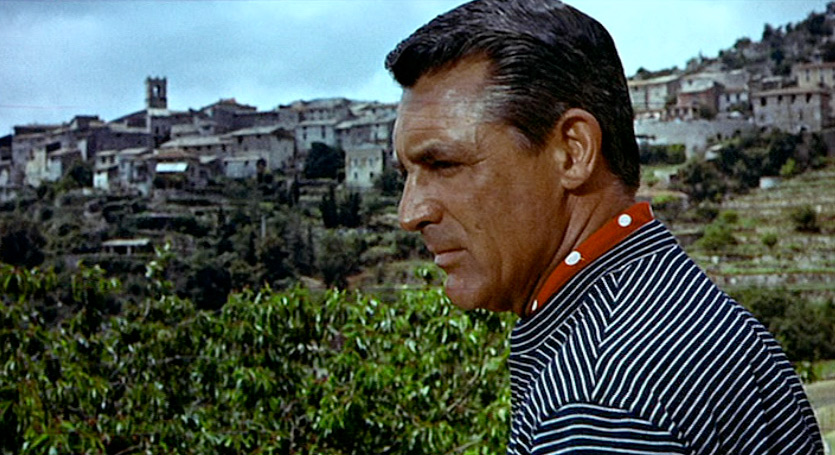
Cary Grant in To Catch a Thief
It is all pure fantasy. Pure illusion.
One time, when Cary Grant was told by an interviewer that countless men would love to be “like Cary Grant,” he replied that so would he. For he knew it was all illusion: the sophisticated banter, the artless seductions, the calm equanimity. It was his job, being Cary Grant. In the end, Grant ultimately left the movie business when the illusion gave way to reality. His type of character–as unreal as it was–was no longer in fashion in the gritty, realism of modern cinema.
A few days later I watched Woody Allen’s Midnight in Paris. The entire movie is built on illusion, one that we all suffer from. The plot deals with the idea that we all believe that an earlier time was more exciting, more inspiring, more fulfilling. The fallacy of the belief is wonderfully depicted, as Owen Wilson’s character–Gil Pender–returns to the 1920s and falls in love with a beautiful woman whose dream is to live in the 1890s. Even in the presence of his literary and artistic idols, Wilson’s character comes to realize that the past is painted with gold dust and that our image of that past is greatly unreal.
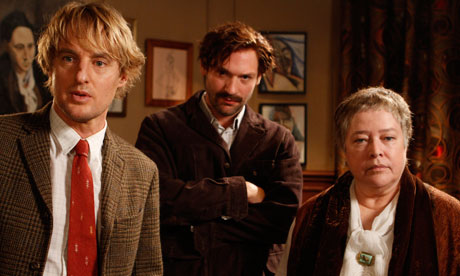
Owen Wilson with Corey Stoll as Ernest Hemingway and Kathy Bates as Gertrude Stein.
And in the end, it is all illusion. Many of us believe that another time was better than the one we live in. And some believe that, if only, they had been born at a different time their lives would be so much different–and better. (At this point read, E. A. Robinson’s poem “Miniver Cheevy” which is referenced in the film as well.)
And so, I finally go out and go to the movies and I see Wes Anderson’s The Budapest Grand Hotel. It is a beautiful movie to look at and the performances of Ralph Fiennes and his young protege, Tony Revolori, are extraordinary. But it too is all illusion. The world it describes is long gone, if it ever existed at all. And the heroism of the film–if it can be called such–is that Fiennes’ character maintains the illusion that that world still exists, still matters. And we are even more removed from it than he.
And after all that is what movie making is about. Sixty years ago, Cary Grant left movie making because he believed the magic had left, that hard-nosed grittiness had blown the magic away.
But that is not the case. Most of the time, we still go to the movies for the magic. Whether it is the unreal pleasures of the moneyed classes in Monte Carlo or the time-tripping adventures of a sincere romantic in Paris, the movies still provide a good dollop of magic. And in The Grand Budapest Hotel all that magic comes full circle. For not only is the set and the landscape and the costumes and the cartoonish villainy not part of our real world, but even the characters themselves are clinging to an illusion, to a world that has longed passed, but which in our “Golden Age” memories is a thing of refinement, class and excitement…more civilized world than the one we know.
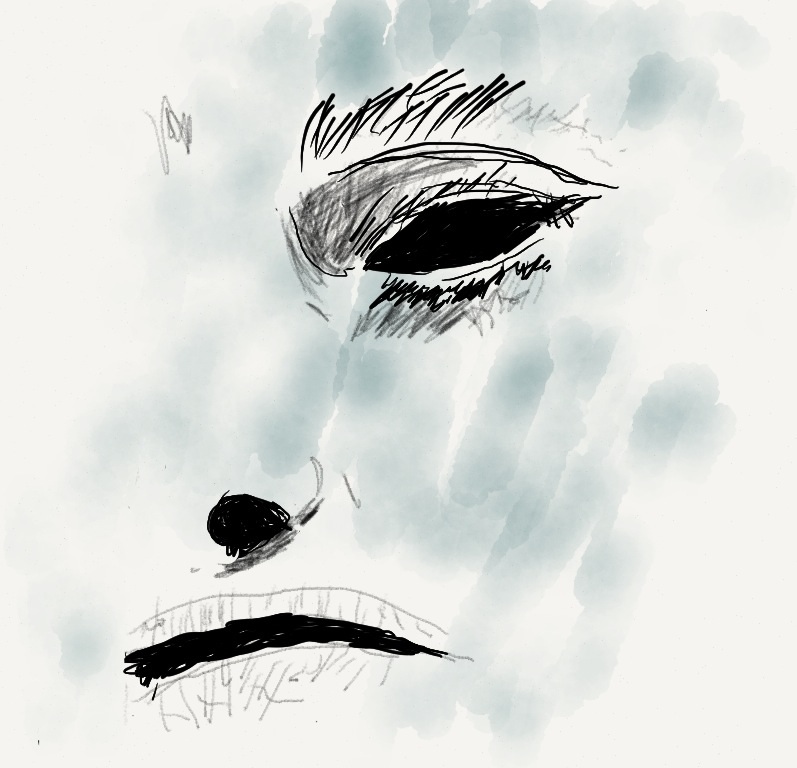
illustration 2014 by jpbohannon
A few weeks back I saw a photograph of Jonathan Letham’s favorite books. Among the titles on the row of spines, I noticed a book by Leonard Cohen called Beautiful Losers.
Now, I am a big Cohen fan. I listen to and play his music frequently–both new and old– and I am well aware of his poetry, so I assumed Beautiful Losers was one such poetry collection.
I was wrong. It was a novel, first published in 1964–several years before the release of his first album, The Songs of Leonard Cohen.
And so I thought, what the hell.
Beautiful Losers is very much a work of its times. Frenetic and speeding. Erotic and rambling. Big-hearted and narcissistic.
It is the story of an unnamed narrator whose other two partners in a odd love-triangle –his wife and an elusive shaman-like man named F.–are dead. (His wife committed suicide in the unconventional way of sitting at the bottom of an elevator shaft and having the elevator crush her. F. is a member of the Canadian Parliament.) The other object of his love/lust is also dead but she’s been dead for 300 years and is up for canonization by the Catholic Church, Catherine Tekakwitha, the virgin of the Iroquois.
There are betrayals and reversals and climaxes and re-unions. There is sex and loneliness and more sex. There is 17th-century genocide and 20th-century nationalism and separatism. (This is early 1960s Montreal, after all.) There are Joycean lists and Henry Miller-like rhapsodies, but all and all the whole thing seemed to me to be very much a part of the 60’s gestalt. (One of my favorite scenes is when the naked narrator watches his wife and her/his lover shoot up, only to discover later that they are injecting an odd mix of heroin and Lourdes water. He found the advertisement/receipts for the Lourdes water in his wife’s dresser drawer)
The whole thing reminded me more of late Ken Kesey or even Gilbert Sorrentino than it reminded me of Joyce or Miller (which connection the book jacket blurbs go on and on about). The attempt seemed old and tired…but maybe because the energy of those times seems so old these days as well. True, it is a pastiche of Joyce–but then again how many young artists were trying the same at the time.
But more than anything else, Beautiful Losers is the announcement of a unique and individual voice. That that voice ultimately decided to be heard through poetry and song rather than through fiction was a decision that the artist himself made.
And I for one believe it was a right decision.
In a very early poem, Cohen wrote:
So you’re the kind of vegetarian
Who only eats roses
Is that what you meant
with your beautiful losers?”
I’m not sure if this is where Cohen got the title for his novel or precisely what these lines might mean, but it reflects the word usage and mindset of the novel.

“Oh, No!”
2014 by jpbohannon
“Most people miss their whole lives, you know. Listen, life isn’t when you are standing on top of a mountain looking at a sunset. Life isn’t waiting at the altar or the moment your child is born or that time you were swimming in a deep water and a dolphin came up alongside you. These are fragments. Ten or twelve grains of sand spread throughout your entire existence. These are not life. Life is brushing your teeth or making a sandwich or watching the news or waiting for the bus. Or walking. Every day, thousands of tiny events happen and if you’re not watching, if you’re not careful, if you don’t capture them and make them count, your could miss it.
You could miss your whole life.”
Toni Jordan, Addition
(as quoted in Literary Jukebox)

At the American Educational Research Association’s annual meeting in Philadelphia this past weekend, Mark Gleason made the following remark about the Philadelphia public schools:
“As you close the lowest performers, you’re slowly raising the bar. So that’s what portfolio is, as Paul [Socolar] described it–you keep dumping the losers and overtime you create a higher bar for what we expect from our schools.”
Now, Gleason has justifiably gotten a lot of flak for describing the poorer performing schools as “losers,” but it is something else that is bothering me.
Gleason was describing school evaluation in terms of stock portfolios. His use of the term “losers” was referring to those “stocks” that were not performing. He was using business/financial parameters to measure school success.
I am getting tired of it. Schools are about students not bulls and bears.
Somewhere along the line, it seems the model for education has been hijacked by the business/financial sector. In the past few years, I have heard students referred to as consumers, I have listened to speakers hold up CEO leadership qualities as models we should emulate, I have read articles about the business of education and been given books that prepare me for successful management skills. I bristle when I hear “entrepreneur” as the new academic buzzword.
I attended one workshop on “coaching” fellow teachers. The consultant hadn’t bothered to adapt her PowerPoint presentation so that most of her examples dealt with a “sales rep” that needed the proper advice or coaching. I went to another workshop where the presenter began by playing a video where a woman spoke about conflict resolution to about twelve middle-managers. To add to the insult, the presenter told us teachers that “We might not know it, but research has shown that taking notes during a presentation aids in memory retention.”
And then–in case we didn’t get the point– he gave us a worksheet of the video script with important words left blank. We were to fill them in.
Perhaps it is me.
I was raised to distrust big-business. “Plastics,” after all, was the laugh-line when newly graduated Benjamin Braddock was adrift in 1968. For the generations before me, the man in the grey-flannel suit was the emblem of mindless conformity; for my generation, big-business was connected with the lies behind Viet-Nam, turned on the fire-hoses against the vanguard of social change, and deliberately hid its own research about what it was spewing into the environment and into people’s bodies. In my circle, they were the bogey-men.
And they were very successful. The following decades saw “Greed is Good” become big business’ mantra …and within twenty-years the country went reeling because of it. And it is still digging out. The rich got rich…the poor got further away.
I went into education to counterbalance the influence of big business.
And I know, I am being illogical.
I know that there are plenty of good, wise and compassionate men in business. There are plenty of great ideas and practices that can be adopted and adapted. Dear friends, respected acquaintances, close family members are businessmen and businesswomen–and some are extraordinarily successful. And I do go to them, at times, for advice on everything, even education.
But I don’t translate their world into mine. Our worlds are too different.
Or so it seems to me.
I am feeling very much a dinosaur these days. Not because I cannot keep up with the latest trends in education–the project-based learning, the collaboration, the student-centered focus. Those I can handle.
No, I feel so out of step, because I can’t kowtow to business metrics. I can’t measure my students’ progress–the quality of their learning — on a spreadsheet. I can’t draw up their successes and failures in a pie-chart based on 401K investments. I don’t hold up the world’s CEO’s as models.
Instead I hold up a liberal education for them to follow–believing that if they do, when THEY become the CEO’s of their world, the world should become a better place.
In 2006, with the release of Christine Falls, the Booker-Prize-winning novelist John Banville began publishing “crime fiction” under the pen name Benjamin Black. Like his “literary novels,” these crime novels are psychologically astute, intensely plotted, and keenly aware of language.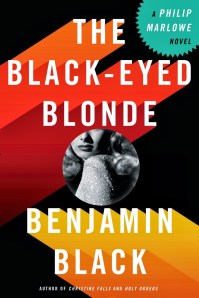
With The Black-Eyed Blonde, however, Banville decided to try something new: to write a novel using Raymond Chandler’s most famous private detective, Philip Marlowe.
While Chandler’s fiction is read and esteemed, and his influence on detective fiction in particular and American literature in general widely acknowledged, his detective’s presence is mostly ingrained in the American consciousness through film and television. There have been several television series featuring the L.A. detective and many movies. Dick Powell and Robert Mitchum both played Marlowe, and successfully, but undoubtedly, the most iconic incarnation of Phillip Marlowe is that played by Humphrey Bogart. So pervasive are the film renditions of Chandler’s L.A., that I found myself casting the characters while reading The Black-Eyed Blonde. Sure enough there was a role for all the usual suspects: there is a creepy, effeminate Peter Lorre type, an enormous, gang-lord Sydney Greenstreet, a fetching Lauren Bacall character, and, of course, there is Bogart as Marlowe.
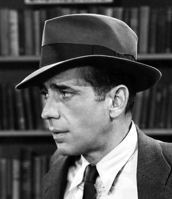
Humphrey Bogart as Phillip Marlowe in The Big Sleep
Banville himself is certainly aware of the hold that film has on the literary characters and early in the book he gives a winking nod to Bogart. Marlowe is sitting in the offices of a fancy country-club. There are cigars and brandy, chintz armchairs and fine china. Marlowe says:
“At that point, I wouldn’t have been surprised if some fruity type in white shorts and a blazer had come bounding through the door, inquiring with a lisp if anyone was for tennis.”
This is Banville’s joke, and nod to Bogart. Before he played tough guys in film, Bogart played in drawing-room comedies on Broadway. A long-lived story is that Bogart’s first professional line as an actor was as a young dandy, bouncing onto stage with his tennis whites and tennis racquet and inquiring “Tennis, anyone?” That Bogart also had a slight lisp, makes Banville’s nod even more on target.
But The Black-Eyed Blonde is not a film, it is a novel, and a highly readable one at that. The title is one of several possibilities that Raymond Chandler had filed away and which Banville received permission to use from The Raymond Chandler Estate. From there, somehow, Banville began channeling Chandler, because what he has created is an exceptional mirroring of Chandler’s style: the rapid-fire dialogue, the lyrical similes, and the sprawling, frenetic plot and subplots.
The plot is typical: the eponymous blonde, Clare Cavendish, enters Marlowe’s office and hires him to find a “friend” who has gone missing. When Marlowe discovers that the friend was killed and cremated two months earlier but that Cavendish had seen him just a few days ago, things get complicated. There are betrayals, murders, cover-ups, flirtations, and deceptions. And throughout it Marlowe maintains a strict code of honor–the characteristic that always set Marlowe apart from the rest. He protects his clients’ confidences, he takes no joy in the violence that is visited upon the deserving, he cannot be bought no matter what the price, and, while he can empathize with those on both sides of the law, he believes in justice. It is this chivalric honor that became the hallmark of the American noir hero.
But always, when reading Chandler–and now Banville posing as Chandler–the story seems secondary. It is the evocation of 1930s-40s Los Angeles, the elaborate metaphors (“He smelled like an over large man who had lain in the bath too long.”), the snappy dialogue that conjures up an entire world–a fictional world, perhaps, but one that we are very familiar with through both reading and film. And with The Black-Eyed Blonde, Banville re-captures that world perfectly, note for note.
The Black-Eyed Blonde is a fun, a quick, and a memorable read.

illustration 2014 jpbohannon
… it’s
spring
The Official Web Site of LeAnn Skeen
Grumpy younger old man casts jaded eye on whipper snappers
"Here is my secret. It is very simple: It is only with the heart that one can see rightly; what is essential is invisible to the eye.."- Antoine de Saint Exupéry
Of writing and reading
Photography from Northern Ontario
Musings on poetry, language, perception, numbers, food, and anything else that slips through the cracks.
philo poétique de G à L I B E R
Hand-stitched collage from conked-out stuff.
"Be yourself - everyone else is already taken."
Celebrate Silent Film
Indulge- Travel, Adventure, & New Experiences
Haiku, Poems, Book Reviews & Film Reviews
The blog for Year 13 English students at Cromwell College.
John Self's Shelves
writer, editor
In which a teacher and family guy is still learning ... and writing about it
A Community of Writers
visionary author
3d | fine art | design | life inspiration
Craft tips for writers
 j. p. bohannon